
FLORAL DESIGN HISTORY HISTORICAL PERIODS EGYPTIAN 2800 28



- Slides: 88
FLORAL DESIGN HISTORY
HISTORICAL PERIODS:
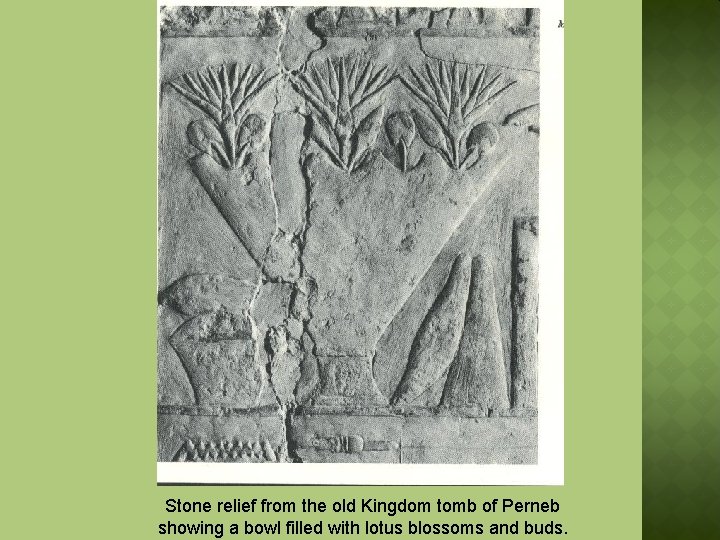
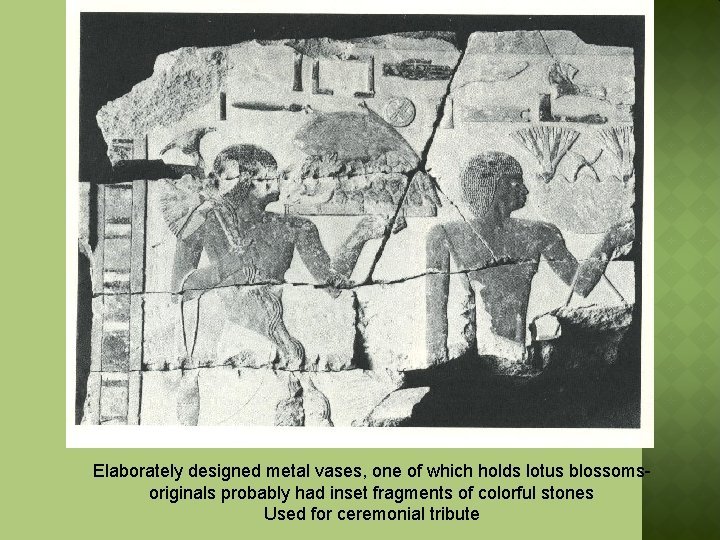
EGYPTIAN 2800 -28 BC: � Repetition and alteration � Lotus flower—Egyptian goddess Isis � traced back as far as 2500 b. c. � Separate primary colors � Egyptian flower vases made to hold up flowers with weaker stems like lotus � Festivals and feasts � Faience—type of finely ground silicate � Mostly used wide-mouth bowls � During time of pharaohs lotus, papyrus and palm tree most commonly portrayed members of the plant kingdom
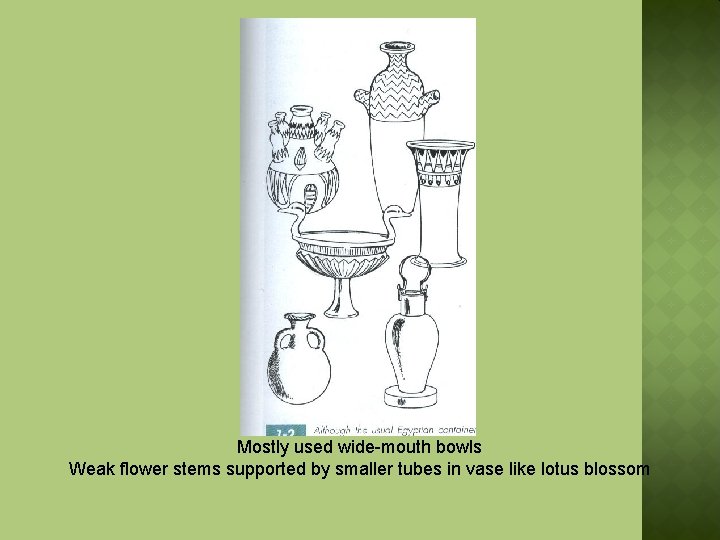
Mostly used wide-mouth bowls Weak flower stems supported by smaller tubes in vase like lotus blossom
Stone relief from the old Kingdom tomb of Perneb showing a bowl filled with lotus blossoms and buds.
Elaborately designed metal vases, one of which holds lotus blossomsoriginals probably had inset fragments of colorful stones Used for ceremonial tribute
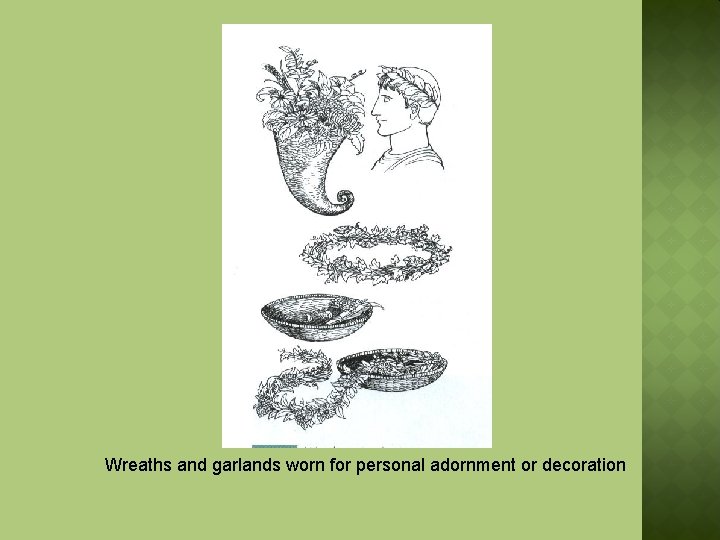
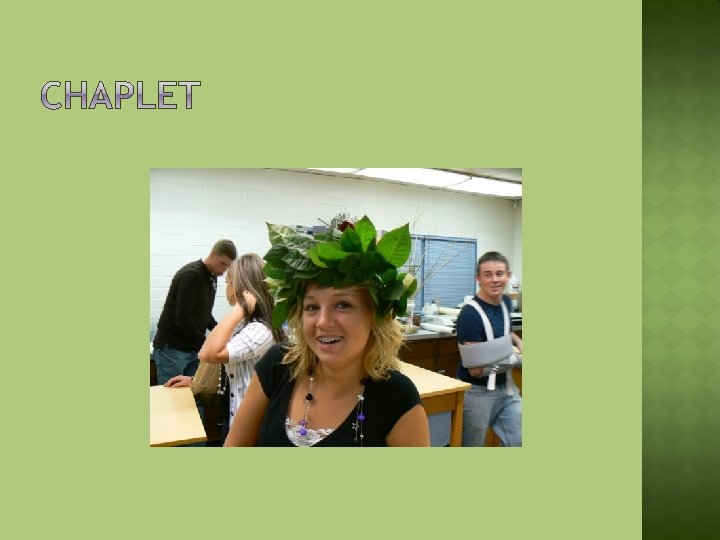
GREEK (CLASSICAL) 600 -146 BC: � Garlands-exchanged by lovers, worn at weddings and hung on door to denote the birth of a son � Wreaths-a symbol of allegiance and dedication � rewarded to athletes, poets, civic leaders and victorious soldiers and sailors � Cornucopia --symbol of abundance � Scattered petals � Mythology � Chaplet-head piece � Professional flower makers and sellers
Wreaths and garlands worn for personal adornment or decoration
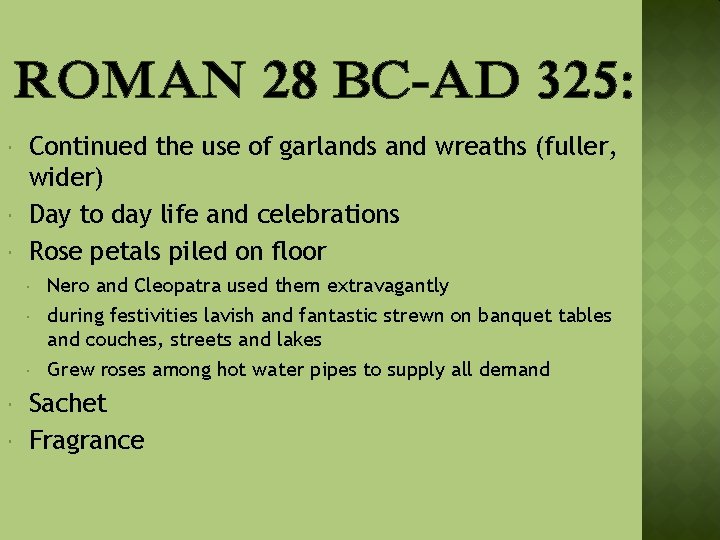
ROMAN 28 BC-AD 325: Continued the use of garlands and wreaths (fuller, wider) Day to day life and celebrations Rose petals piled on floor Nero and Cleopatra used them extravagantly during festivities lavish and fantastic strewn on banquet tables and couches, streets and lakes Grew roses among hot water pipes to supply all demand Sachet Fragrance
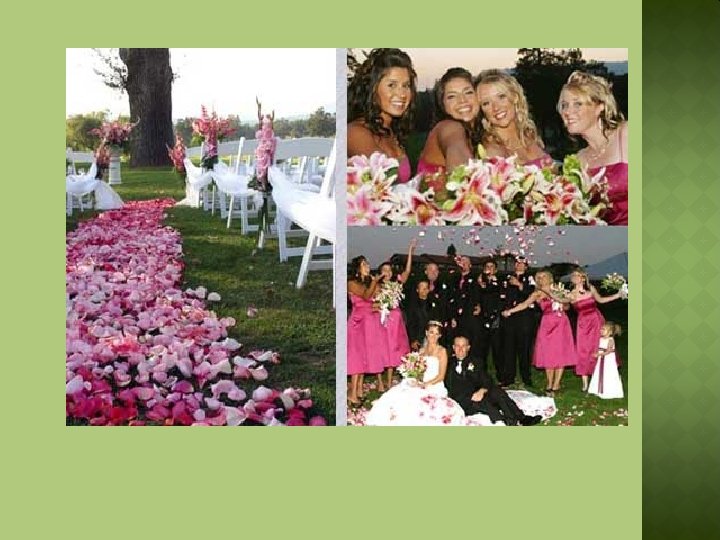
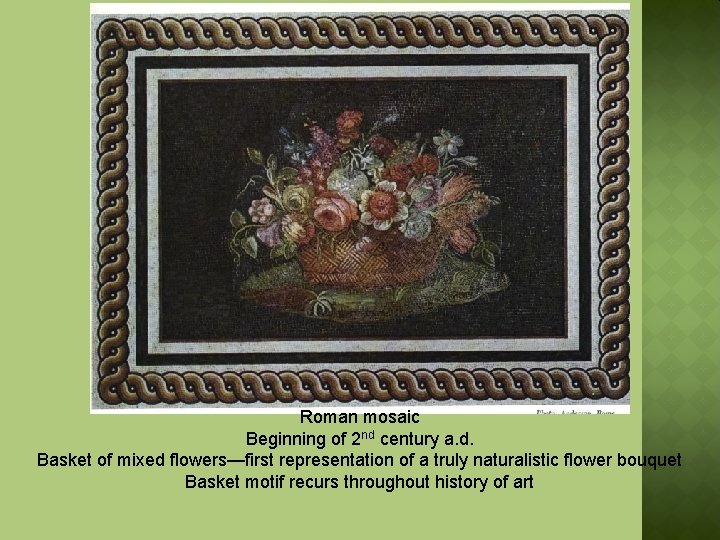
Roman mosaic Beginning of 2 nd century a. d. Basket of mixed flowers—first representation of a truly naturalistic flower bouquet Basket motif recurs throughout history of art
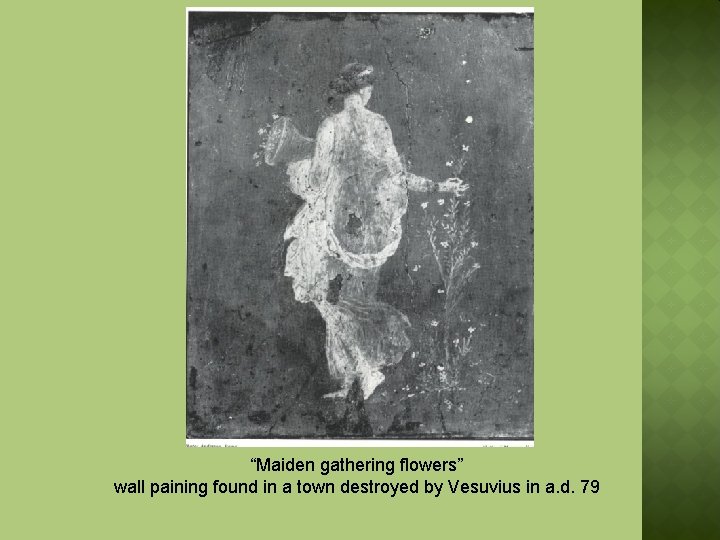
“Maiden gathering flowers” wall paining found in a town destroyed by Vesuvius in a. d. 79
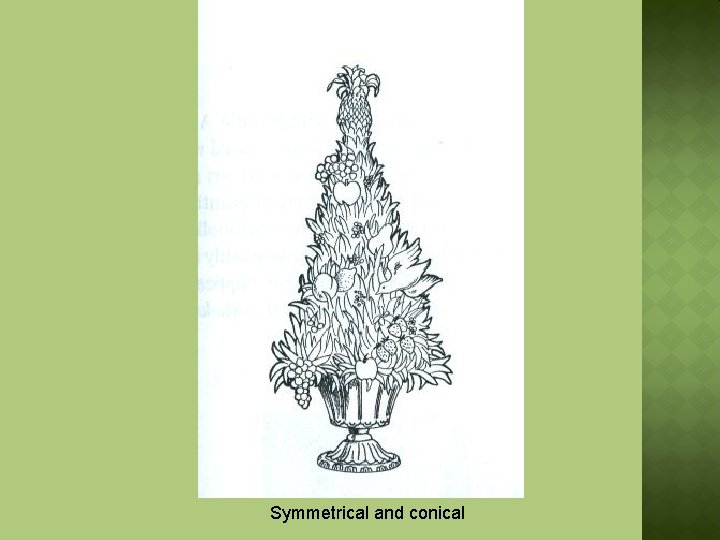
BYZANTINE 320 -600 AD: Garlands of fruit Symmetrical conical designs with concentric rings of fruit, stones, jewels, metals. Tree compositions
Symmetrical and conical
MIDDLE AGES 476 -1400 AD: � Warring feudal lords state of unrest � Monks grew herbs � were well acquainted with many of the beautiful everyday flowers � illuminated in manuscripts � � Everyday life—wild and cultivated used in food, drink, medicine � Fragrant flowers strewn on ground and freshen air � Art belonged to the church—stained glass windows, mosaics, tapestries, sculpture, paintings and illuminated religious books
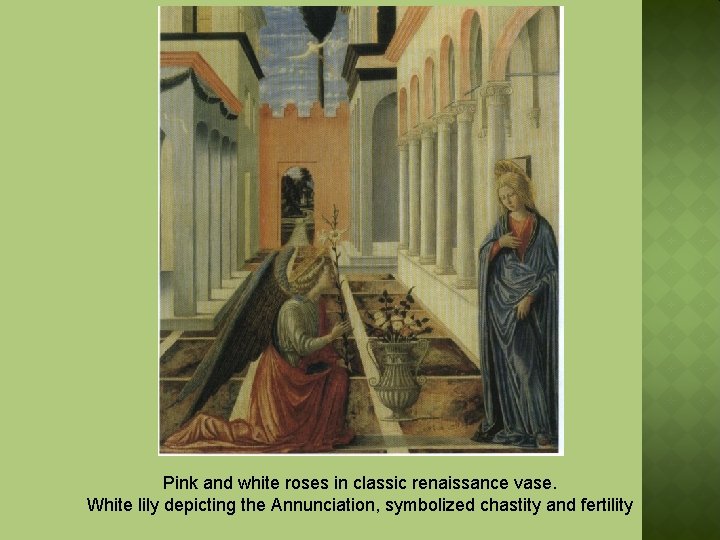
RENAISSANCE 1400 -1600 AD: � Resurgence and flourishing of the arts � Religious symbolism � 7 � flowers representing the 7 stations of the cross Seven fully-opened columbine flowers represent the seven gifts of the holy spirit—wisdom, understanding, counsel, strength, knowledge, true godliness and holy fear � purity represented by certain flowers—usually the white lily (Virgin Mary) because it appeared in so many Annunciation paintings, it soon became known as the Madonna Lily � Annunciation where angel appears to Mary � rose represented sacred or profane love
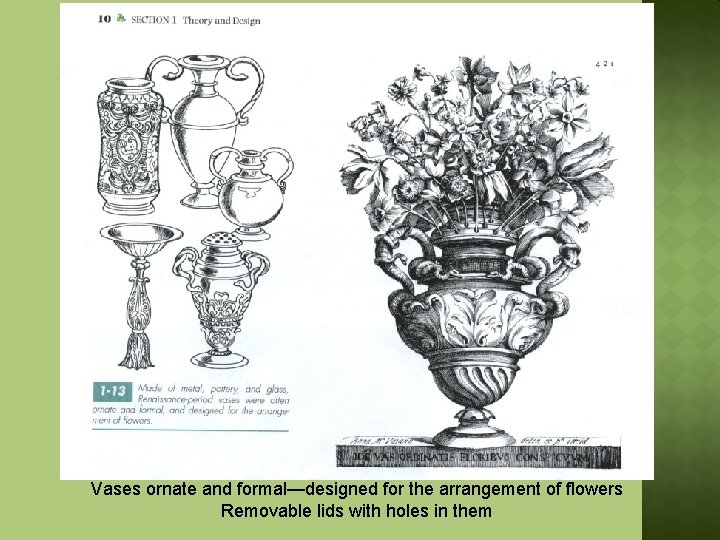
RENAISSANCE 1400 -1600 AD: Old garden book for growing, freshening and arranging flowers—Flora overo Cultura di Fiori Bouquets usually pyramidal and full Containers made for arranging flowers removable lid so flower arrangement can be lifted and flowers recut every 3 rd day tearred affect so short stemmed flowers could be placed on top
Pink and white roses in classic renaissance vase. White lily depicting the Annunciation, symbolized chastity and fertility
Vases ornate and formal—designed for the arrangement of flowers Removable lids with holes in them
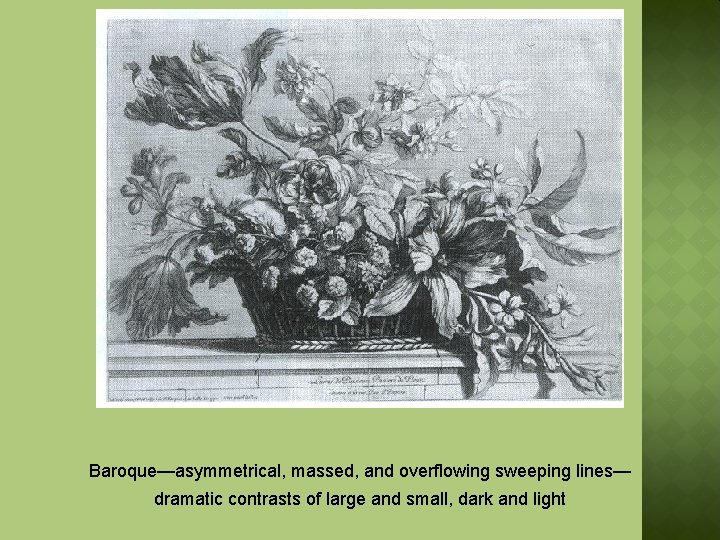
BAROQUE 1600 -1775 AD: Influence of artists The “S” curve or Hogarth curve Lavish designs--bright colors Large, overly proportioned designs in big, heavy containers Not for church or nobility any longer—middle class could have flowers—due to trading and redistribution of wealth with new world
Baroque—asymmetrical, massed, and overflowing sweeping lines— dramatic contrasts of large and small, dark and light
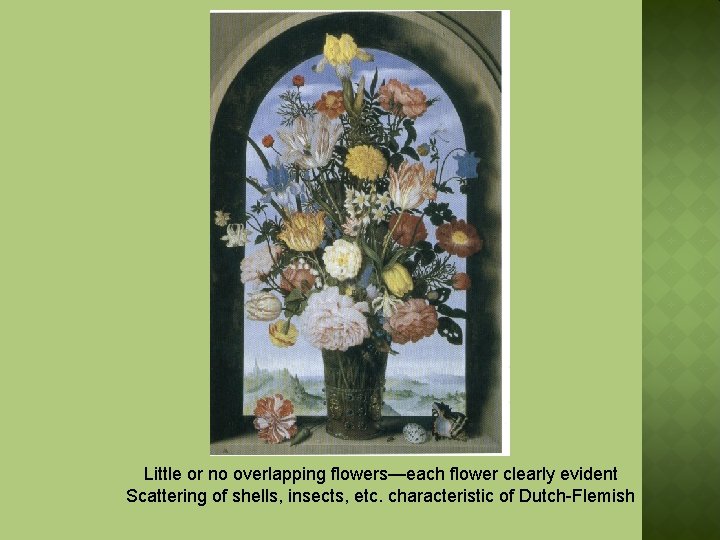
DUTCH-FLEMISH 1550 -1760 AD: Holland Belgium Tulip imported from Turkey New flowers-- particularly “out of season” greenhouse grown flowers Paintings included composite groups of flowers—painted during different seasons Terra-cotta Age of great scientific, botanical and horticultural discoveries Delftware-copied Chinese porcelain vases in blue and white but less expensive—named after Netherland city where it was invented
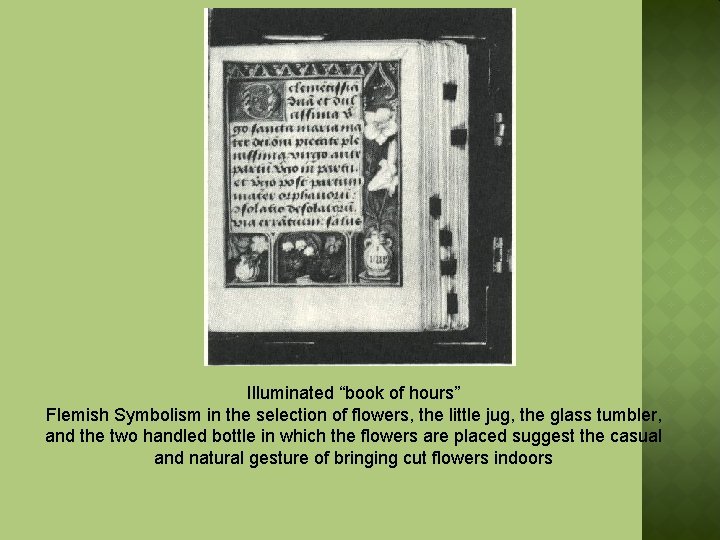
Illuminated “book of hours” Flemish Symbolism in the selection of flowers, the little jug, the glass tumbler, and the two handled bottle in which the flowers are placed suggest the casual and natural gesture of bringing cut flowers indoors
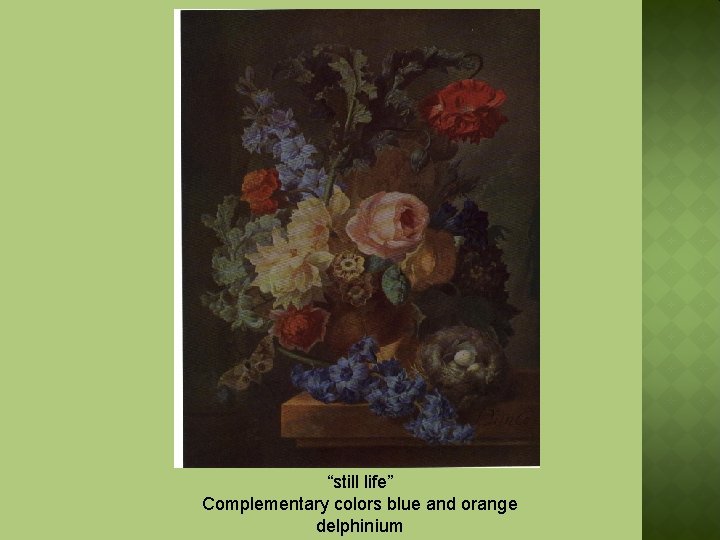
Little or no overlapping flowers—each flower clearly evident Scattering of shells, insects, etc. characteristic of Dutch-Flemish
“still life” Complementary colors blue and orange delphinium
FRENCH PERIODS:
FRENCH BAROQUE 1600’S: � Louis XIV--effeminate extravagance � Art evolved around the aristocracy � Topiary balls or trees � Chateau of Versailles �large rooms decorated with elaborate wood and stone carvings �marble fireplaces and floors �decorative flower arrangements large in scale �Enormous conservatory � stored 3000 orange trees during the winter using hothouses to supply indoor plants for massive decoration
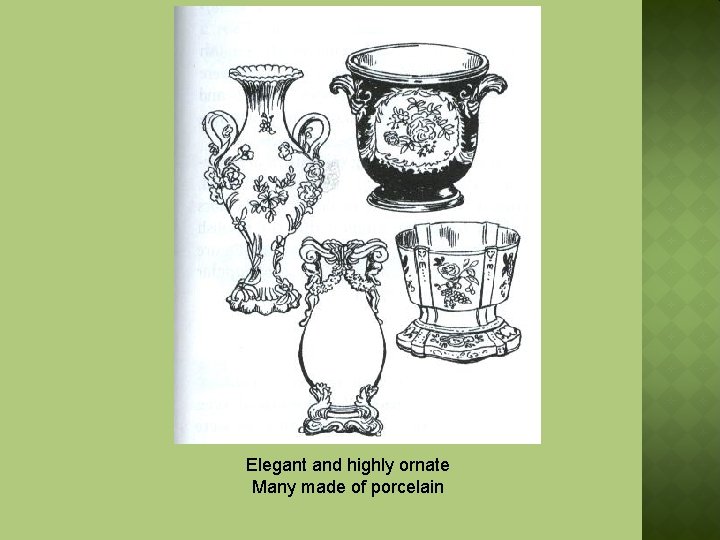
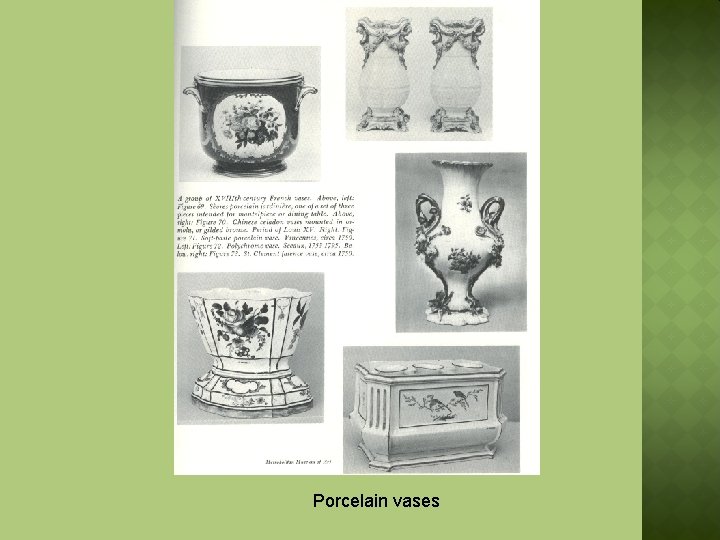
Elegant and highly ornate Many made of porcelain
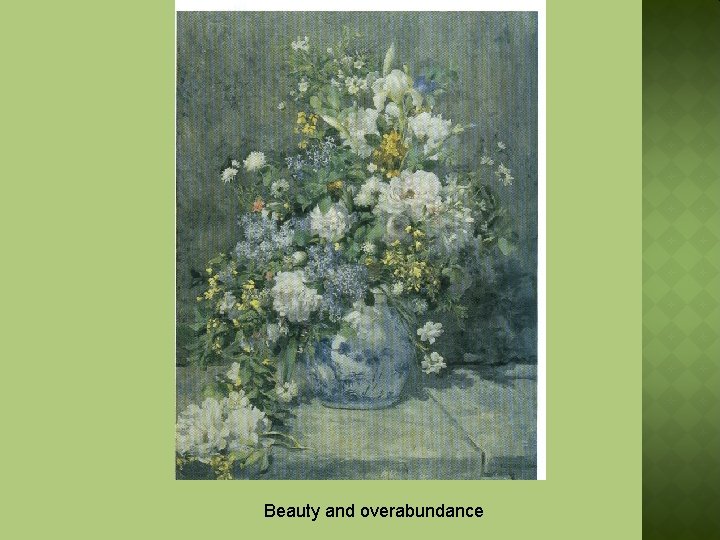
FRENCH ROCOCO 1700’S: Louis XIV mistress-Antoinette Poisson, the Marquis do Pompadour had great influence. Asymmetrical, curvilinear, formal crescent (C curve) “Rock and shell” curving lines Predominant subtle colors: apricot, peach, cream, rose, gray, sage green, yellow, beige, turquoise, and powder blue Delicate accessories
Porcelain vases
Beauty and overabundance
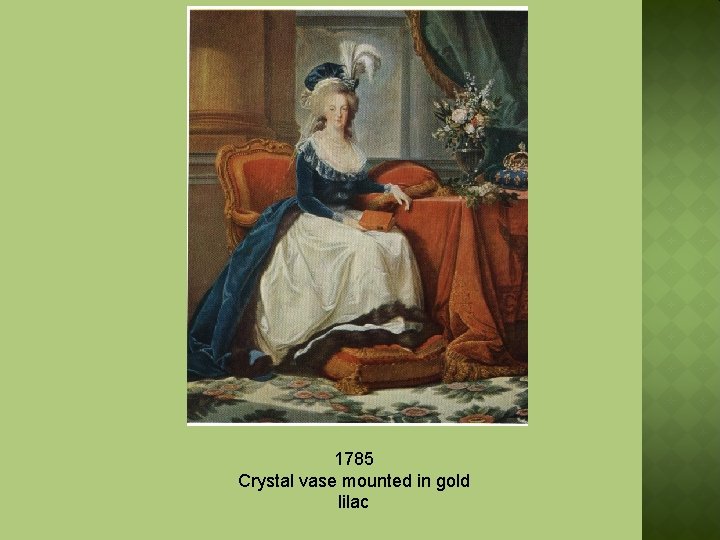
LOUIS XVI LATE 1700’S: Strong feminine influence of Marie Antoinette— delicate, cool colors, highlighted with gold, more simple containers than previous
1785 Crystal vase mounted in gold lilac
EMPIRE 1804 -1814: Strong use of neoclassical design ideas Napoleon Bonaparte Masculine designs, dramatic, militaristic, dictatororiented symbols predominate Heavy massive designs and containers with large boldly colored flowers
ENGLISH PERIODS:
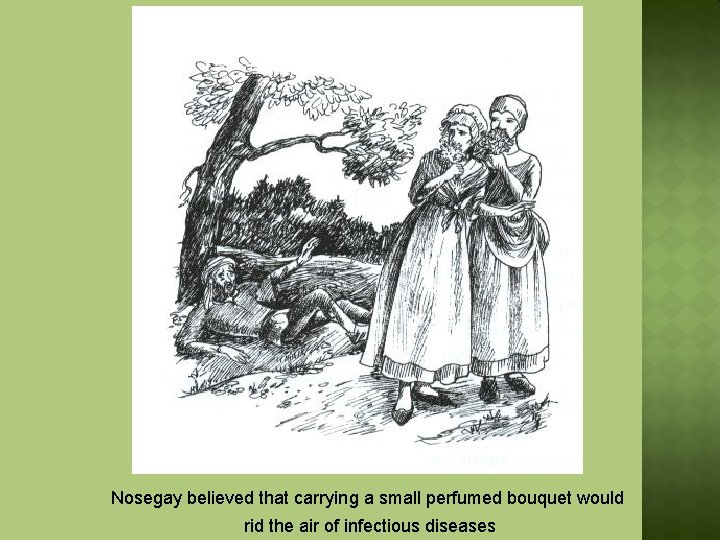
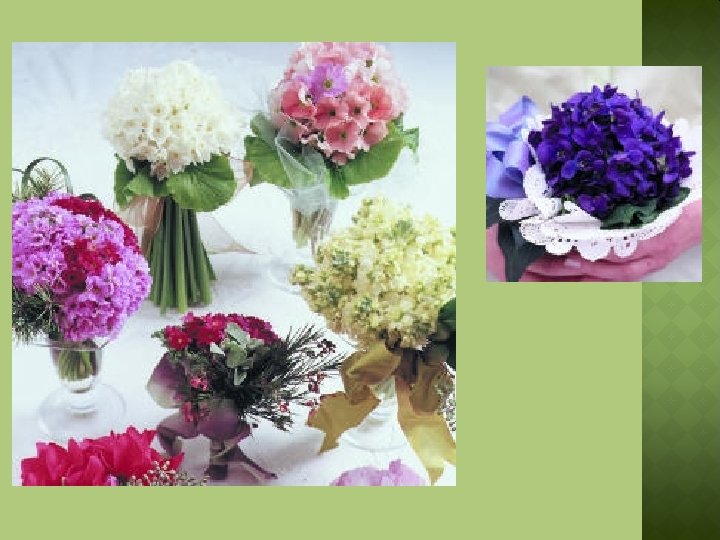
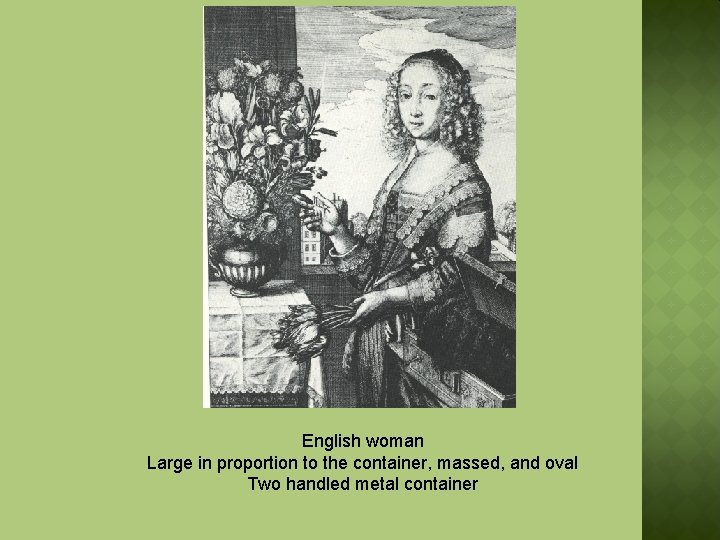
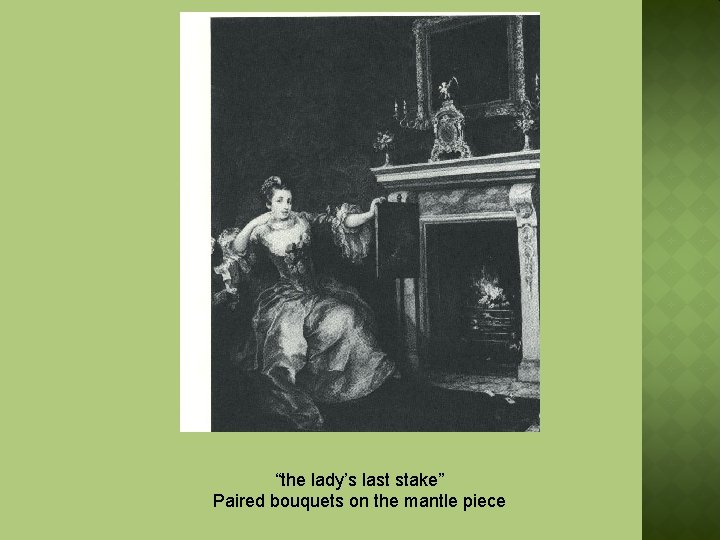
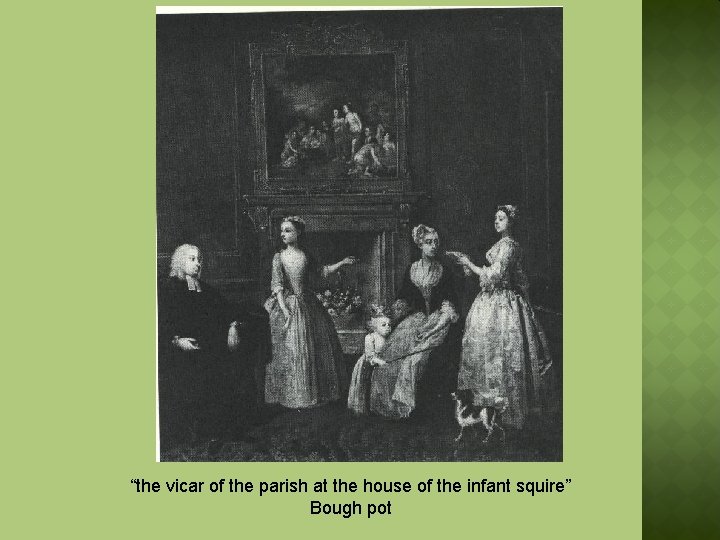
ENGLISH-GEORGIAN PERIOD 1714 -1760: Named after English Kings George I, III Full, strongly stylized symmetrical bouquets, oval to triangular shapes Formal and symmetrical—tightly arranged “tuzzy-muzzy” or nosegay “tuzzy” refers to old English word for knot of flowers Nosegay to carry the sweet scents—relief from unsanitary surroundings Fragrance to rid air of contagious and infectious diseases Decolletage—flowers around neckline of a dress Bough pot—flower filled container set in the fireplace in non heated seasons Wedgwood--English potter Josiah Wedgwood—fine ceramic ware used during this season—special holes to hold flowers in stiff and formal shape
Nosegay believed that carrying a small perfumed bouquet would rid the air of infectious diseases
English woman Large in proportion to the container, massed, and oval Two handled metal container
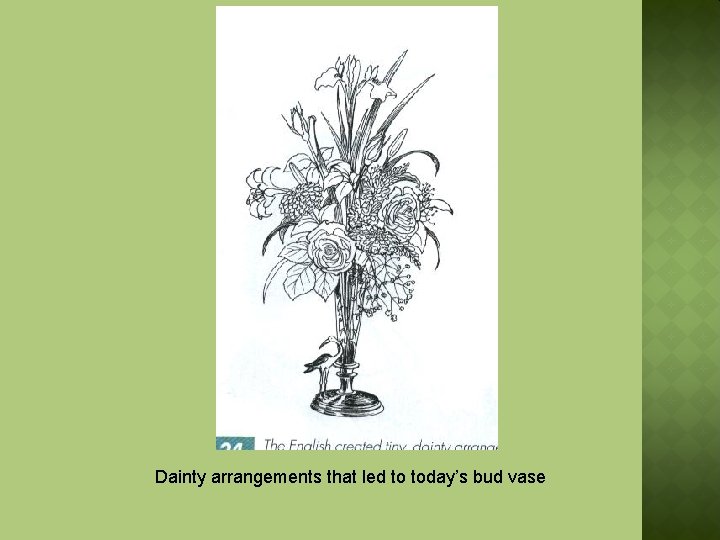
Dainty arrangements that led to today’s bud vase
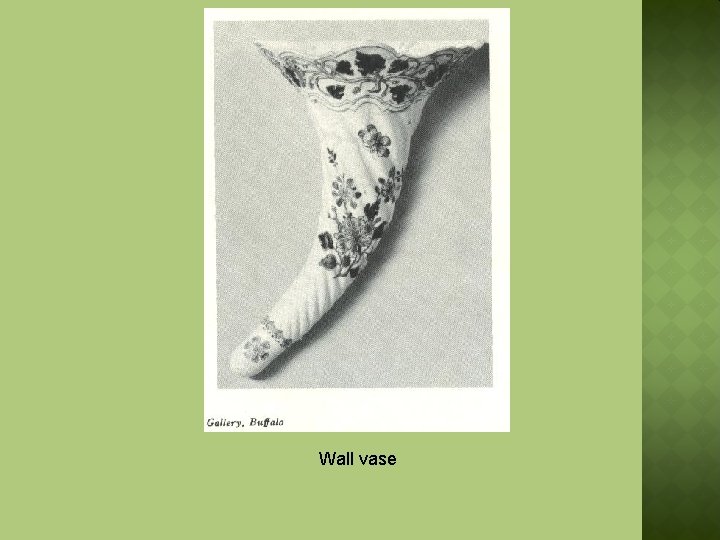
Wall vase
“the lady’s last stake” Paired bouquets on the mantle piece
“the vicar of the parish at the house of the infant squire” Bough pot
VICTORIAN PERIOD 1820 -1901: “Of all modes of enlivening the aspect of an apartment, there is perhaps none more pleasing than the sight of plants and flowers suitably arranged and distributed. They are ornaments of Nature’s own producing, which inspire an interest apart from their beauty, by the care and attention required for their culture. They employ the hand, delight the eye, and inform and edify the mind, and, unlike many artificial objects, the enjoyment and instruction they afford are within the reach of all, the poor may partake as well as the rich. ” --Article written in Jan 1855
VICTORIAN PERIOD 1820 -1901: Named after Queen Victoria who reined in England from 1837 to 1901 Floral design recognized as an art Establishing rules of design led to the development of today’s floral industry Girls taught to arrange flowers and make tussiemussies as well as grow, preserve, press, draw and paint flowers Make artificial flowers using shells, wax, feathers, hair, textiles, and beads Bouquets poorly designed. “Airless, ”overstuffed and flat, symmetrical, with no particular focal point. Short-stemmed flowers
VICTORIAN PERIOD 1820 -1901: Nosegays more popular—conveyed sentiments silent messages depending on what went into them Posey holders—small container to hold nosegay made of metals, steel, and alloy, ivory, glass, painted porcelain, amber, tortoiseshell, and mother of pearl, inlaid with jewels, pearls, and small mirrors Included two small chains—one with ring for finger, other pin attached to secure flowers
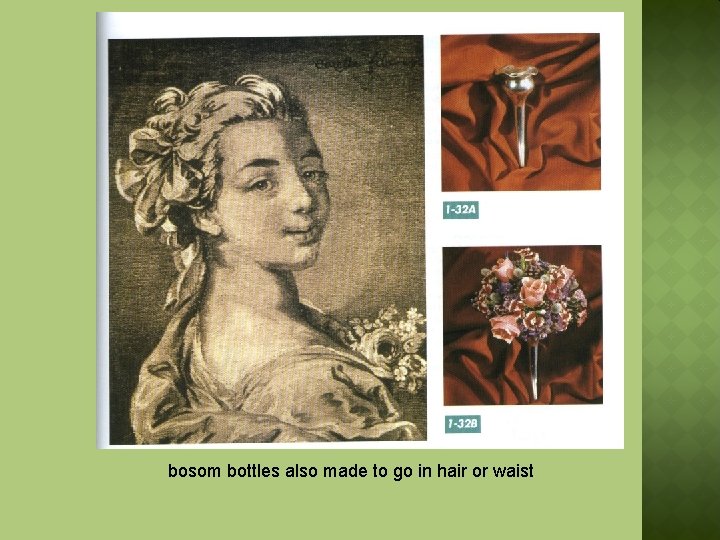
VICTORIAN PERIOD 1820 -1901: Bosom bottles—small container to hold flowers used as an accent for clothing worn at decolletage Complementary color schemes—blue next to orange and so on Sand used to place flowers into
bosom bottles also made to go in hair or waist
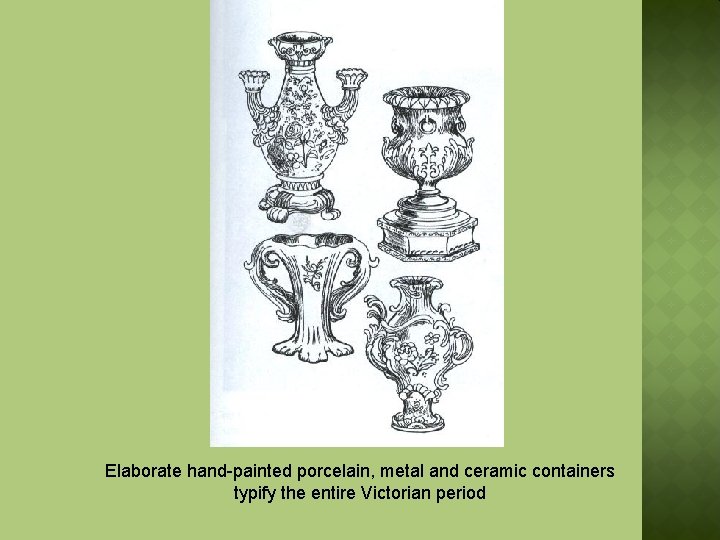
Elaborate hand-painted porcelain, metal and ceramic containers typify the entire Victorian period
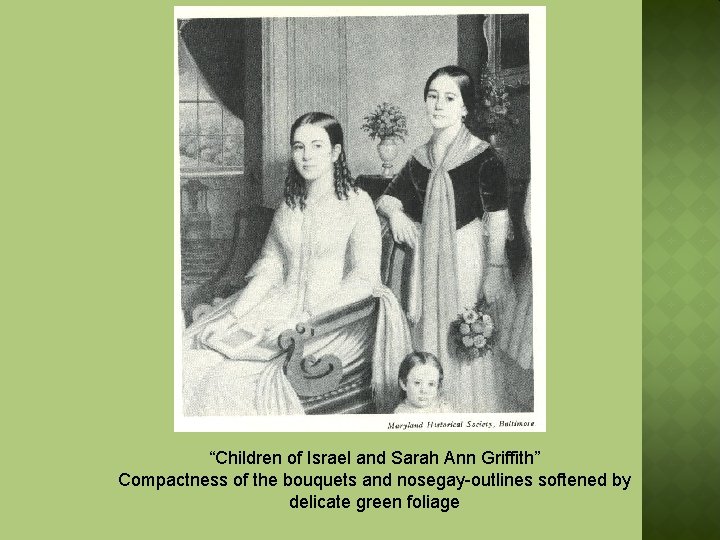
“Children of Israel and Sarah Ann Griffith” Compactness of the bouquets and nosegay-outlines softened by delicate green foliage
EARLY AMERICAN PERIODS: (Closely correlated with the simultaneous periods in Europe)
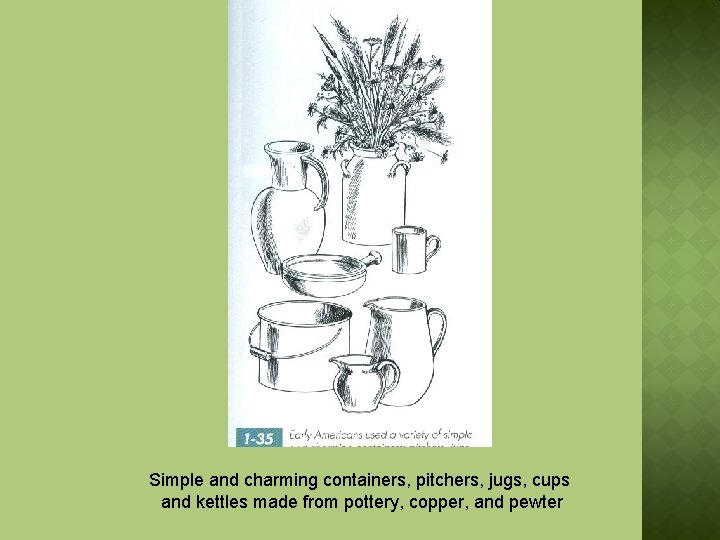
EARLY AMERICAN PERIOD 1620 -1720: Simplified versions of the European designs Colonists were avid gardeners Common people who lived a “puritan” existence Common household containers Bouquets made of wildflowers, often including dried materials.
Simple and charming containers, pitchers, jugs, cups and kettles made from pottery, copper, and pewter
COLONIAL WILLIAMSBURG PERIOD 1714 -1780: Life more sophisticated Trade provided a richer choice of containers and materials Designs copied from floral prints and tapestries Designs were fan-shaped or mounded Fruit and flowers placed for centerpiece
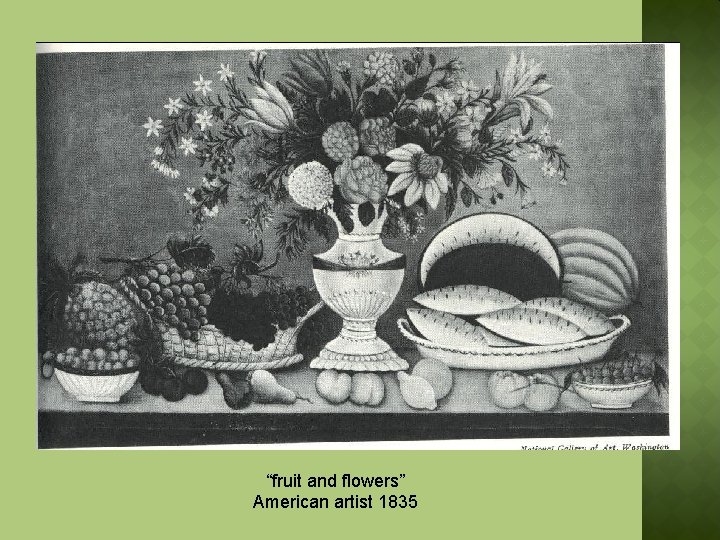
“fruit and flowers” American artist 1835
AMERICAN FEDERAL PERIOD 1780 -1820: The neoclassical, Empire New freedom and independence Designs were influenced by the delicate French, the masculine French, and an emphasis on the individual merits of each flower.
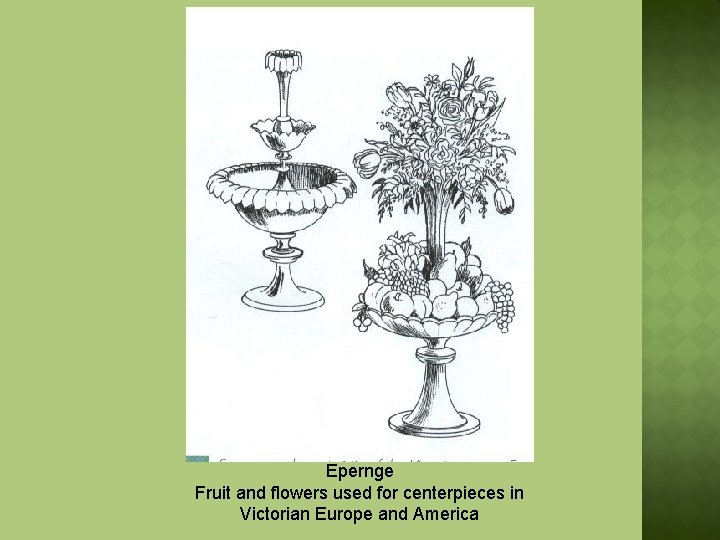
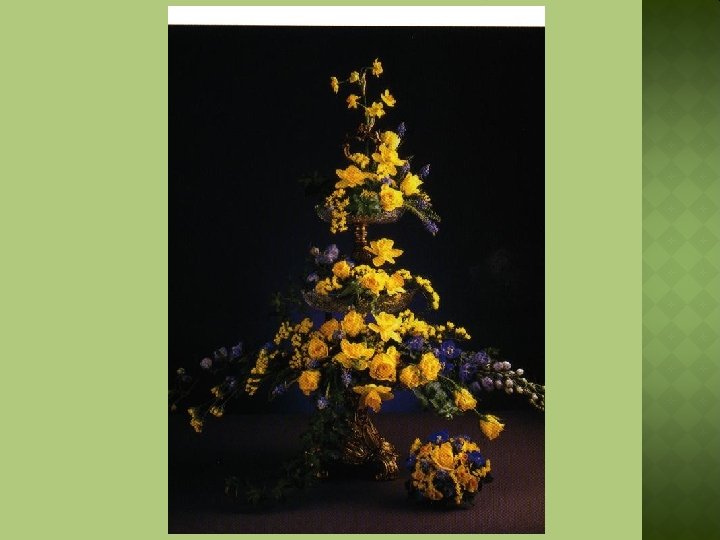
AMERICAN VICTORIAN 1845 -1900: Romantic era Copied European Victorian Epergne
Epernge Fruit and flowers used for centerpieces in Victorian Europe and America
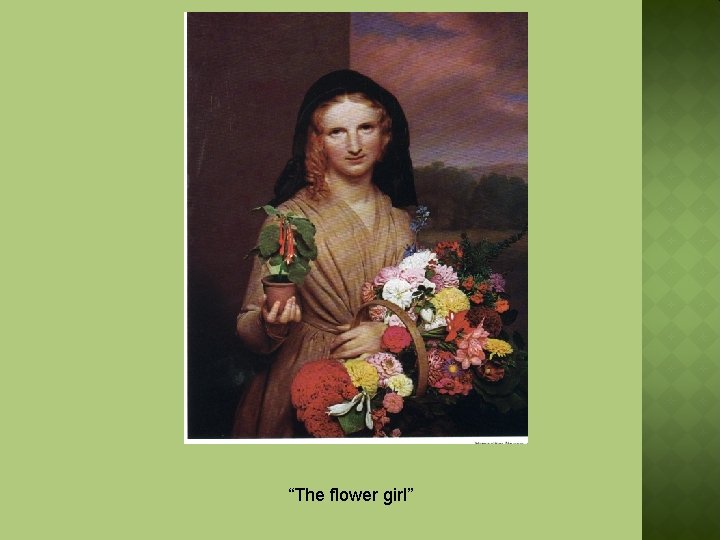
“The flower girl”
ORIENTAL INFLUENCE: place emphasis on individual form, texture, and color of plant material Great attention to negative space and line
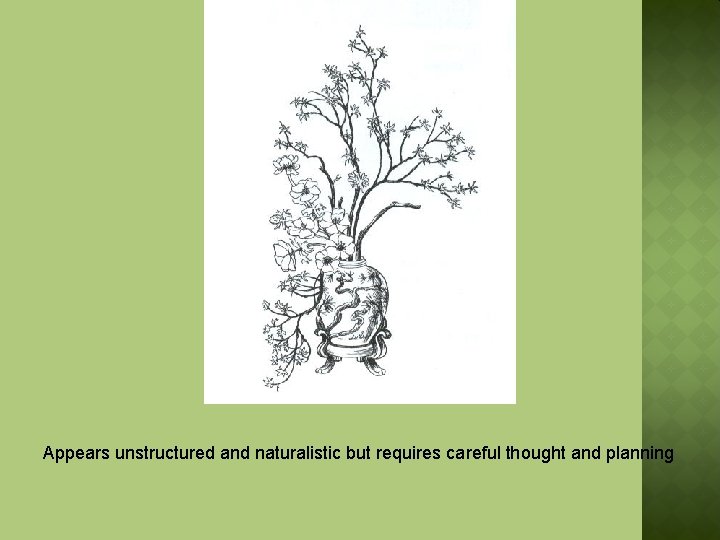
CHINESE STYLE: � China known as “The Flowery Kingdom. ” � Unstructured and naturalistic, but require careful thought and planning. � 1. art of contemplation—Confucius �Confucius—real enjoyment consists in simplicity � there is a distraction that comes from viewing too much beauty � serenity to be gained from savoring one thing at a time � shadow of a tree on a pond—structure, seasons, strength � a few flowers in a vase can conjure up the whole life-history of a plant, as well as display the beauty of perfect blooms
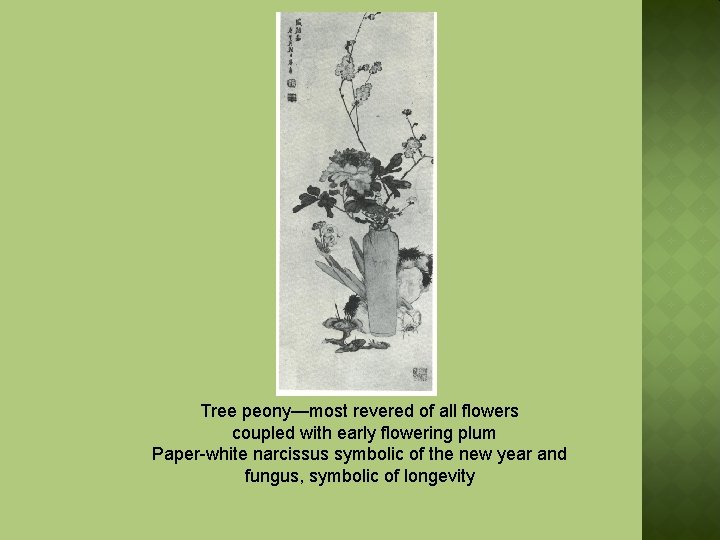
CHINESE STYLE: � 2. preservation of life-Buddhism � prohibits taking of life—cut flowers sparingly � Not conquering nature, following it. � Gardens have strategic flowering plants instead of masses—areas for contemplation � 3. floral symbolism-folklore � all flowers are feminine because of fragile beauty and are given women’s names � tree peony most revered of all flowers � liked to depict the seasons
Appears unstructured and naturalistic but requires careful thought and planning
Tree peony—most revered of all flowers coupled with early flowering plum Paper-white narcissus symbolic of the new year and fungus, symbolic of longevity
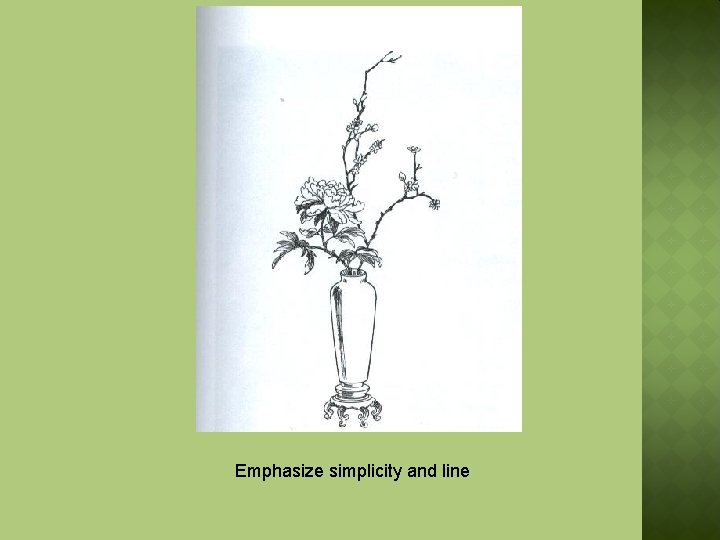
JAPANESE STYLE A. K. A. IKEBANA Highly formalized and follows strict rules of construction--Ikenobo Adapted from ancient Chinese art and steeped in tradition and symbolism. Materials placed in a manner reflecting how they are found in nature. Arrangements emphasize simplicity and line
JAPANESE STYLE A. K. A. IKEBANA � Ono-no-Imoko—founded Ikenobo—flower arranging school � Items found in nature would complement the flowers, rocks, pine, bamboo, cypress, cedar water � Exclusively by men at first—priest then nobility and warrior class to find tranquility of mind and relief from life’s tension in the handling and observation of flowers � In the doing not it the decorating � Contests and books of instruction � Flowers never used out of season—water, branches � Elements of a design face each other
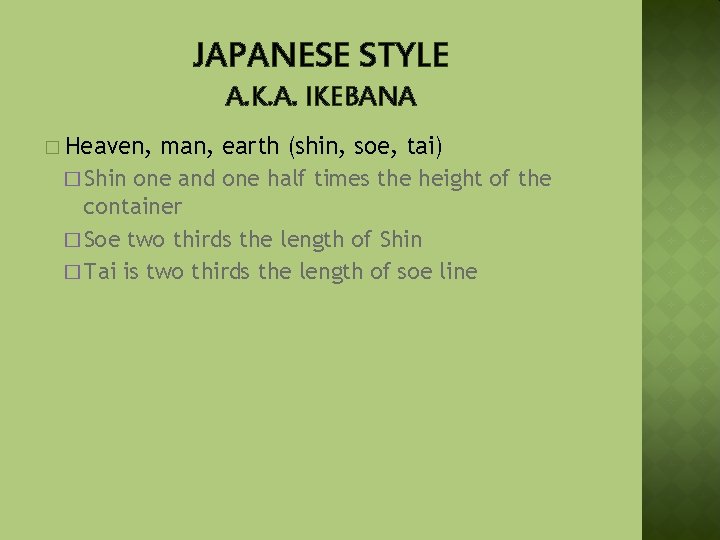
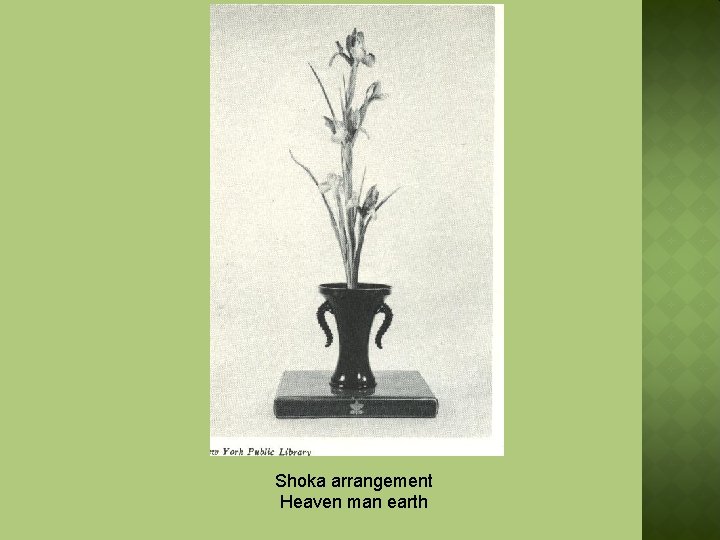
JAPANESE STYLE A. K. A. IKEBANA � Heaven, man, earth (shin, soe, tai) � Shin one and one half times the height of the container � Soe two thirds the length of Shin � Tai is two thirds the length of soe line
Emphasize simplicity and line
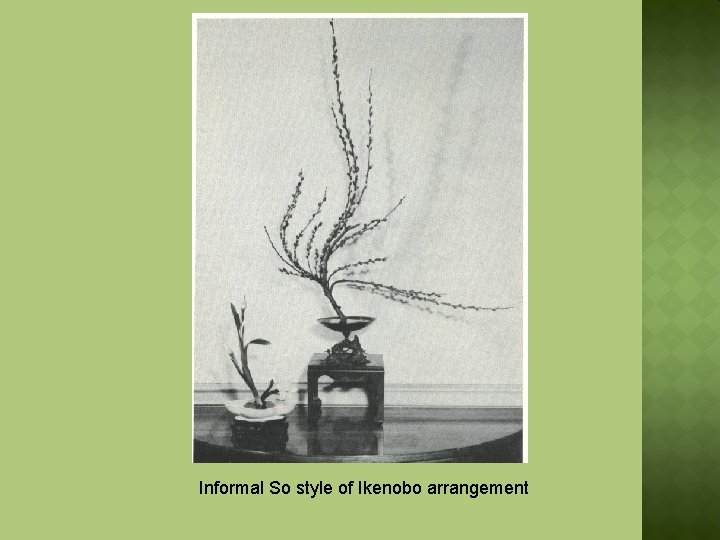
Informal So style of Ikenobo arrangement
Shoka arrangement Heaven man earth
MODERN FLORAL ARRANGING:
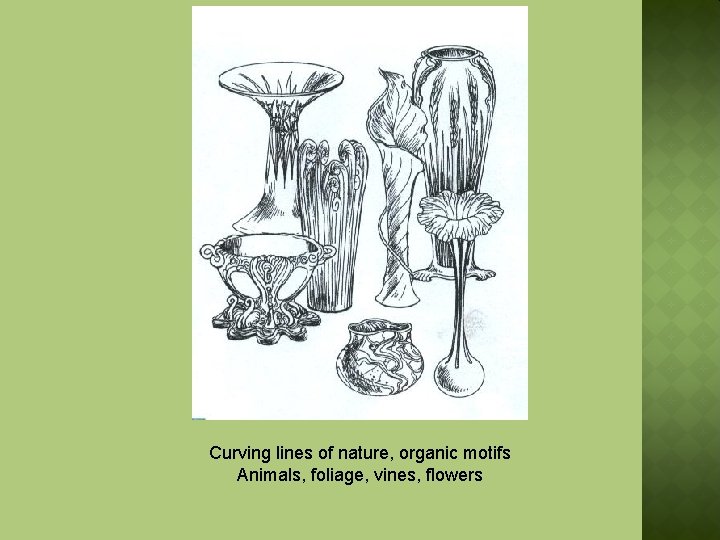
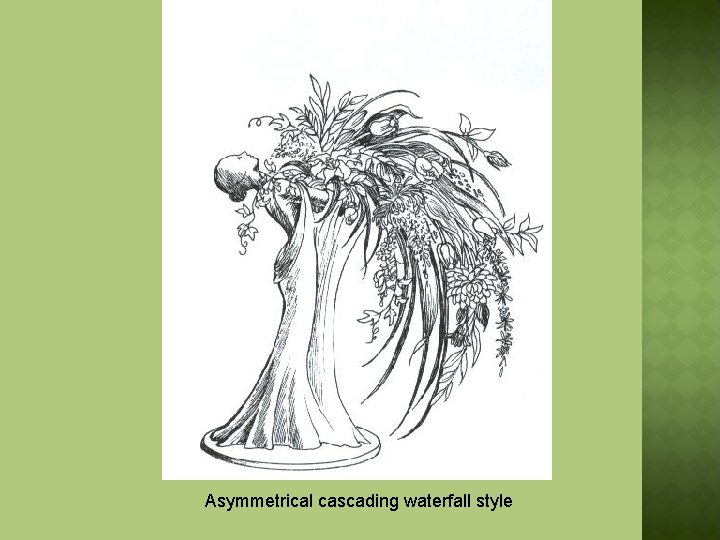
ART NOUVEAU 1890 -1910: Curvilinear lines Patterned after nature Shape of plants or flowers as well as the human form Asymmetrical flower arrangement
Curving lines of nature, organic motifs Animals, foliage, vines, flowers
Asymmetrical cascading waterfall style
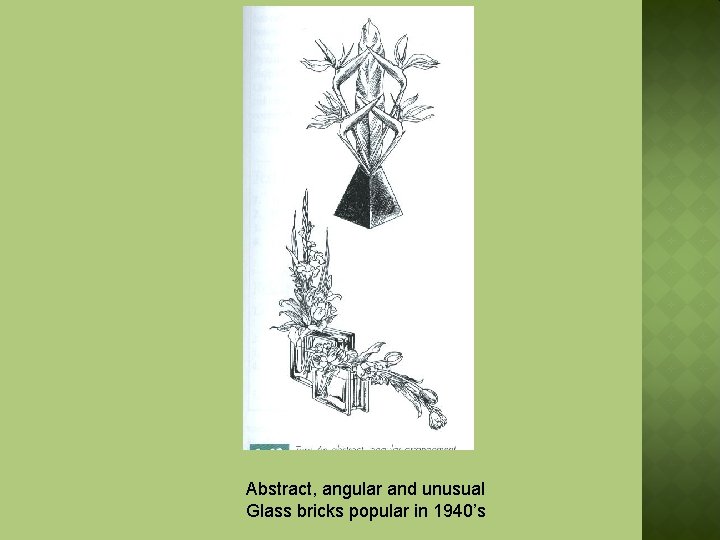
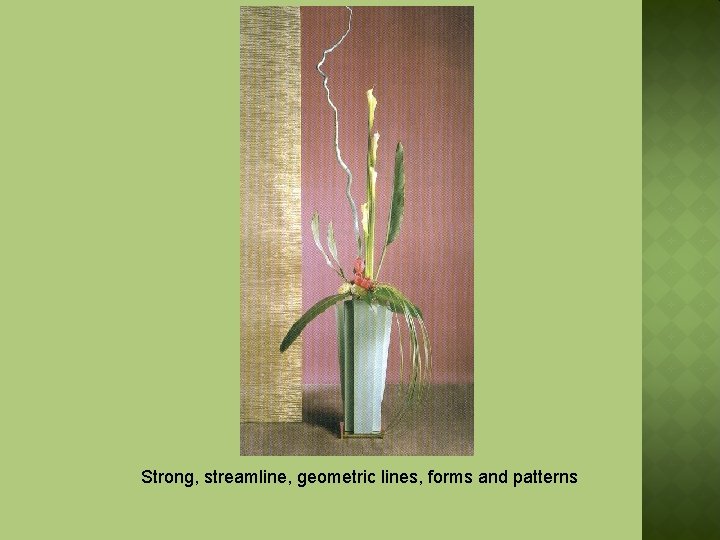
ART DECO 1925 -1930 Derived from 1925 Paris world’s Fair exhibition. Characterized as strong, streamlined, geometric lines, forms and patterns, including zigzags, pyramids, and sunburst motifs Known as le style 25
Abstract, angular and unusual Glass bricks popular in 1940’s
Strong, streamline, geometric lines, forms and patterns
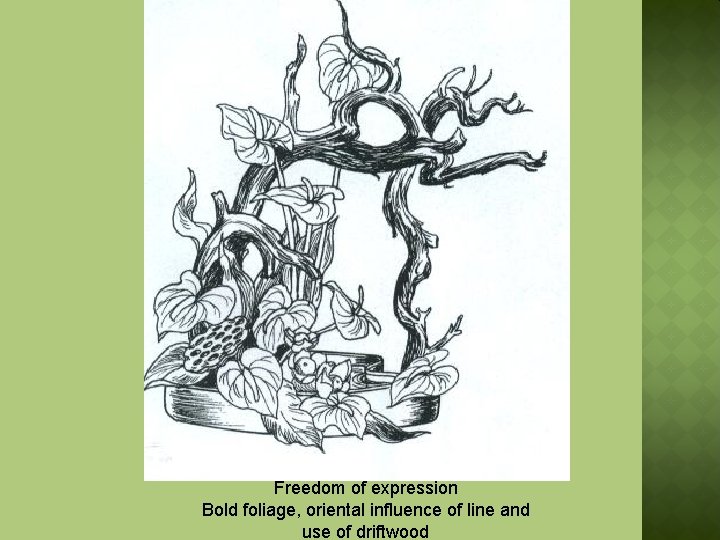
FREE-FORM EXPRESSION 1950’S: A modern, natural appearance. Expressive with both a feeling of movement and of freedom Use of driftwood and other figurines in designs
Freedom of expression Bold foliage, oriental influence of line and use of driftwood
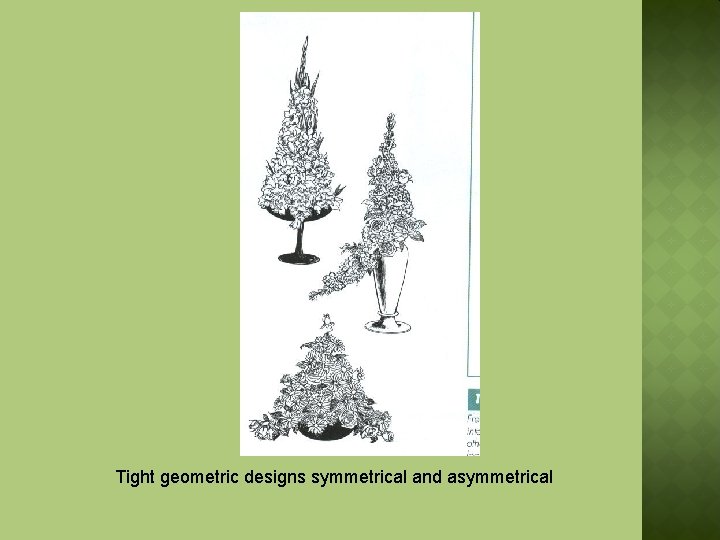
GEOMETRIC MASS DESIGN 1960 -1970’S: Tight geometric bouquets. Include mass and line.
Tight geometric designs symmetrical and asymmetrical
CONTEMPORARY Contemporary refers to the time of the present or of recent times Called modern because they generally are different than whatever style was previously popular
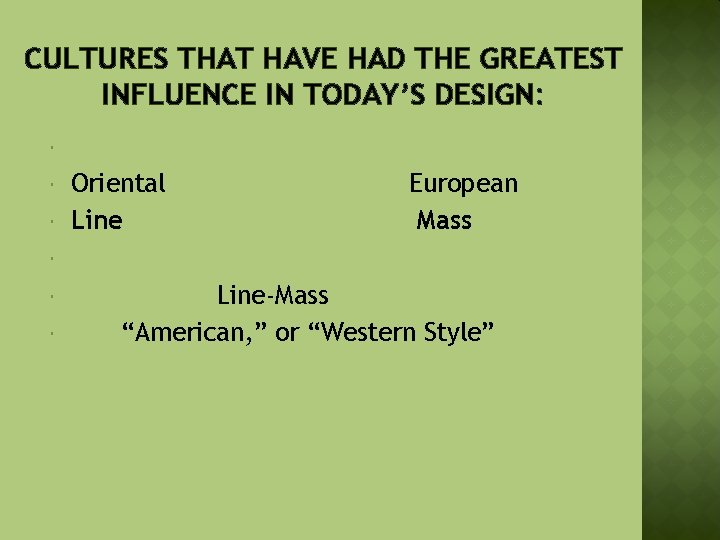
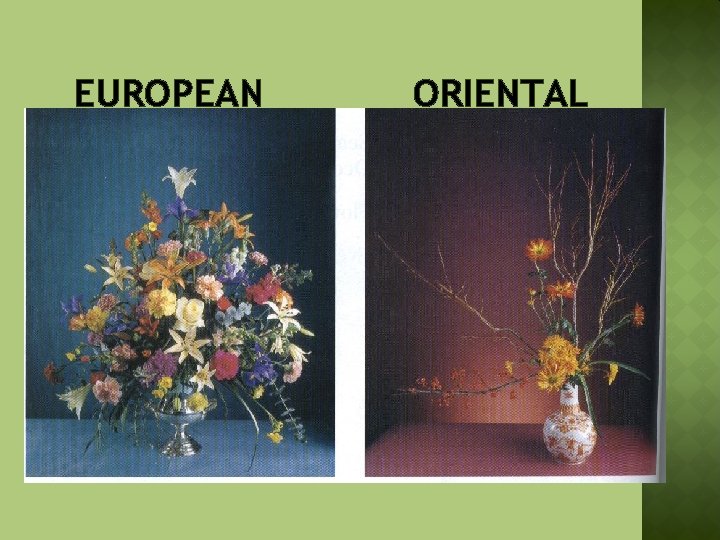
CULTURES THAT HAVE HAD THE GREATEST INFLUENCE IN TODAY’S DESIGN: Oriental Line European Mass Line-Mass “American, ” or “Western Style”
EUROPEAN ORIENTAL