
Floodplain Mapping using HEC RAS and Arc View


- Slides: 32
Floodplain Mapping using HEC -RAS and Arc. View GIS http: //www. ce. utexas. edu/stu/tateec Eric Tate Francisco Olivera David Maidment
Outline l Motivation and Objectives l HEC-RAS Hydraulic Model l Stream Cross-Section Mapping l GIS Data Models l 3 -D Terrain Modeling l Floodplain Mapping
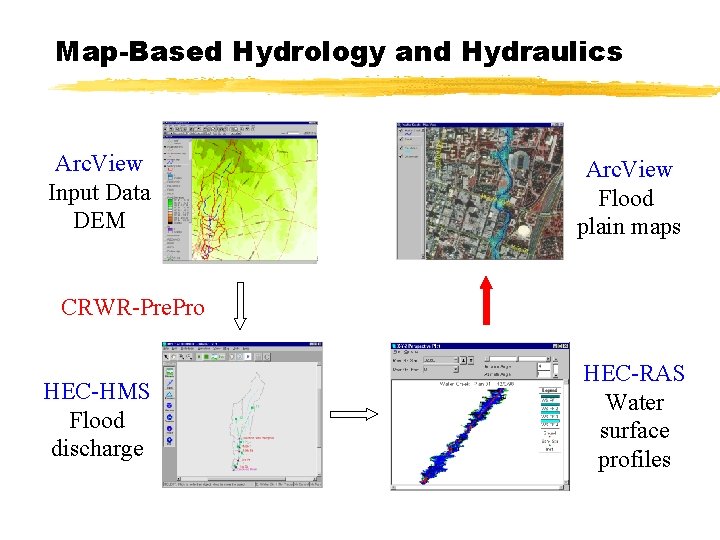
Map-Based Hydrology and Hydraulics Arc. View Input Data DEM Arc. View Flood plain maps CRWR-Pre. Pro HEC-HMS Flood discharge HEC-RAS Water surface profiles
Motivation: Why map floodplains in GIS? l Computer automation results in time and resource savings versus manual floodplain plotting l Flood insurance rate determination l Economic impact analysis and flood early warning systems l Design of drainage control structures, including storm drains, culverts, and bridges
Objectives l Develop procedure to process computed water surface profiles generated from HEC-RAS hydraulic modeling and draw floodplain maps in Arc. View GIS l Synthesize a TIN terrain model from HEC-RAS cross-sectional data and a digital elevation model (DEM)
Outline l Motivation l HEC-RAS Hydraulic Model l Stream Cross-Section Mapping l GIS Data Models l 3 -D Terrain Modeling l Floodplain Mapping
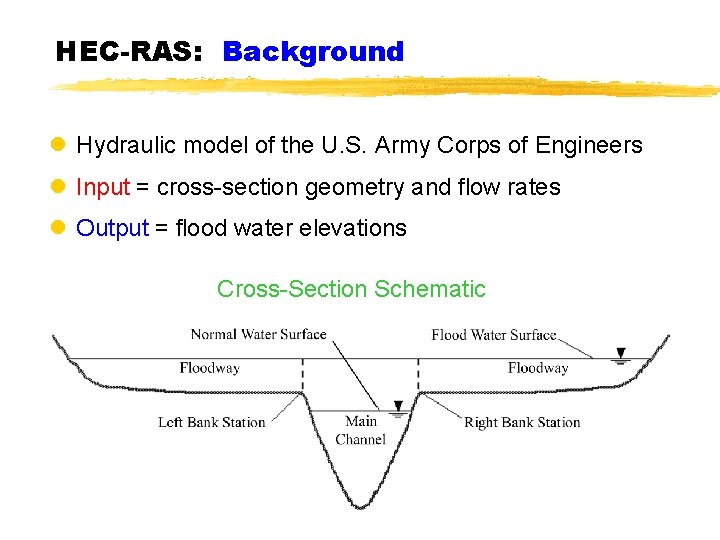
HEC-RAS: Background l Hydraulic model of the U. S. Army Corps of Engineers l Input = cross-section geometry and flow rates l Output = flood water elevations Cross-Section Schematic
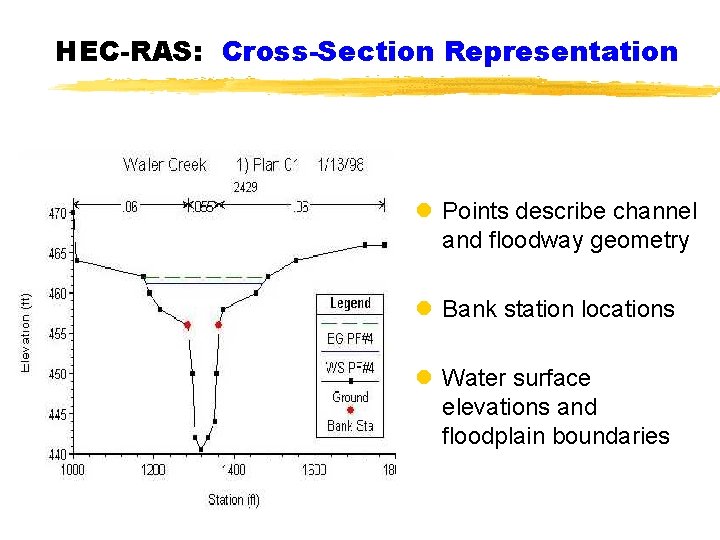
HEC-RAS: Cross-Section Representation l Points describe channel and floodway geometry l Bank station locations l Water surface elevations and floodplain boundaries
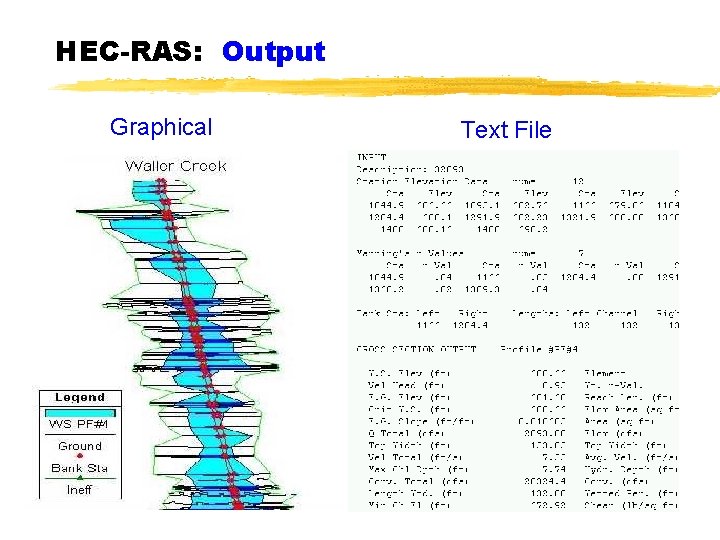
HEC-RAS: Output Graphical Text File
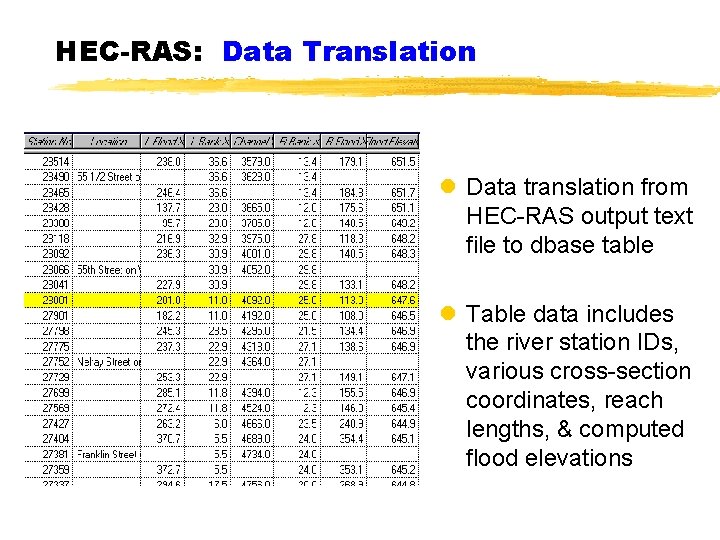
HEC-RAS: Data Translation l Data translation from HEC-RAS output text file to dbase table l Table data includes the river station IDs, various cross-section coordinates, reach lengths, & computed flood elevations
Outline l Motivation l HEC-RAS Hydraulic Model l Stream Cross-Section Mapping l GIS Data Models l 3 -D Terrain Modeling l Floodplain Mapping
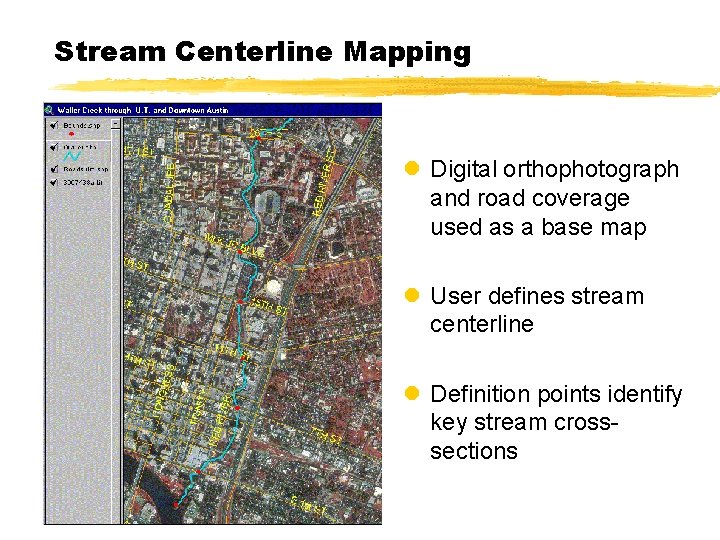
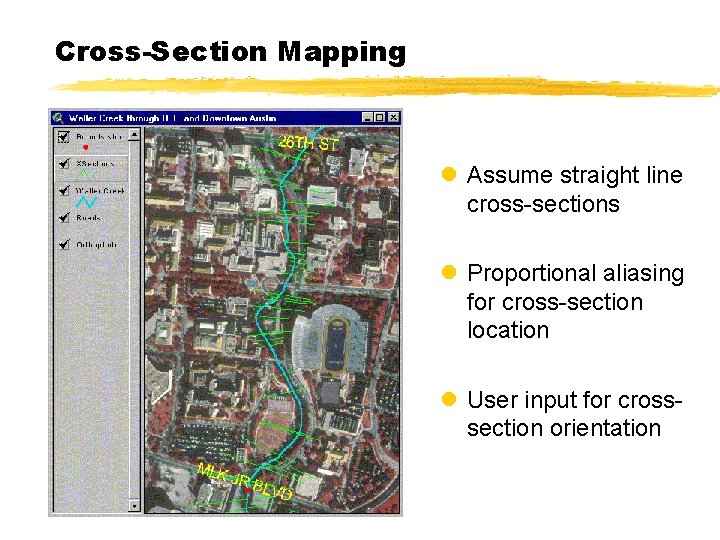
Stream Centerline Mapping l Digital orthophotograph and road coverage used as a base map l User defines stream centerline l Definition points identify key stream crosssections
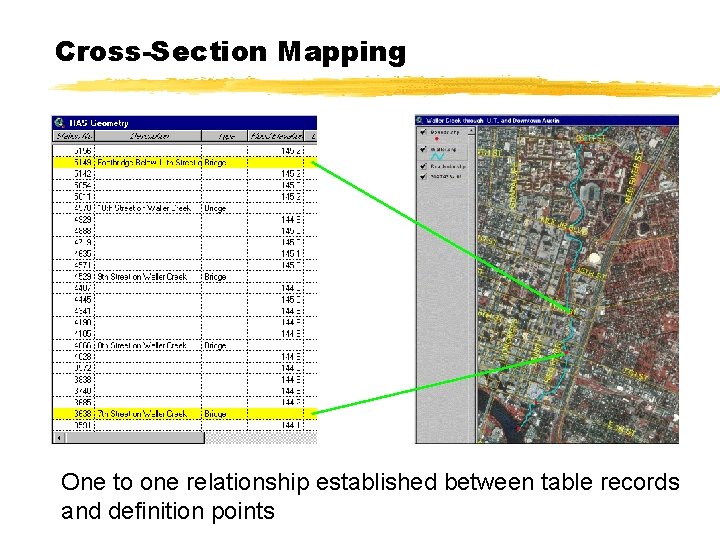
Cross-Section Mapping One to one relationship established between table records and definition points
Cross-Section Mapping l Assume straight line cross-sections l Proportional aliasing for cross-section location l User input for crosssection orientation
Outline l Motivation l HEC-RAS Hydraulic Model l Stream Cross-Section Mapping l GIS Data Models l 3 -D Terrain Modeling l Floodplain Mapping
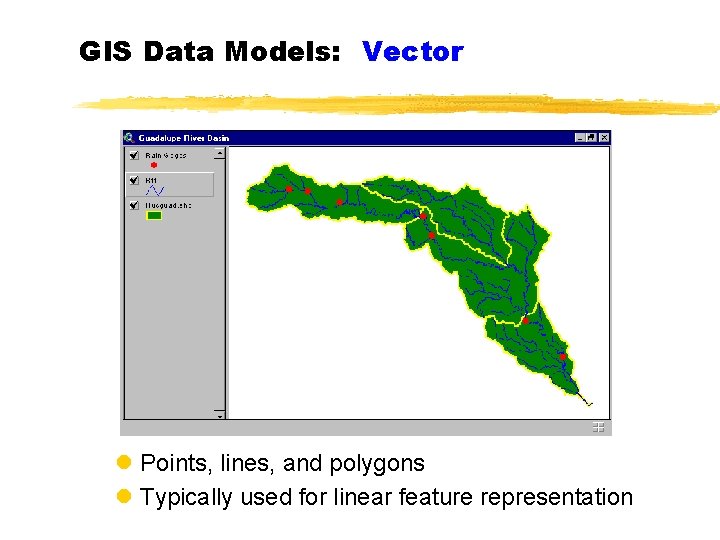
GIS Data Models: Vector l Points, lines, and polygons l Typically used for linear feature representation
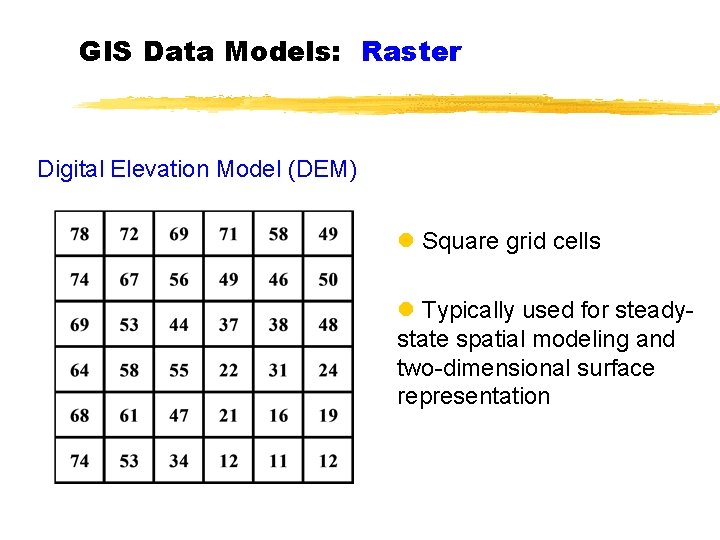
GIS Data Models: Raster Digital Elevation Model (DEM) l Square grid cells l Typically used for steadystate spatial modeling and two-dimensional surface representation
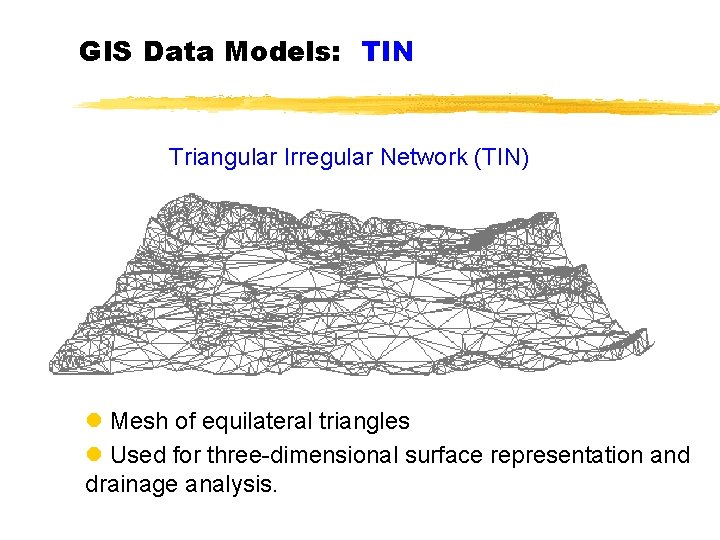
GIS Data Models: TIN Triangular Irregular Network (TIN) l Mesh of equilateral triangles l Used for three-dimensional surface representation and drainage analysis.
Outline l Motivation l HEC-RAS Hydraulic Model l Stream Cross-Section Mapping l GIS Data Models l 3 -D Terrain Modeling l Floodplain Mapping
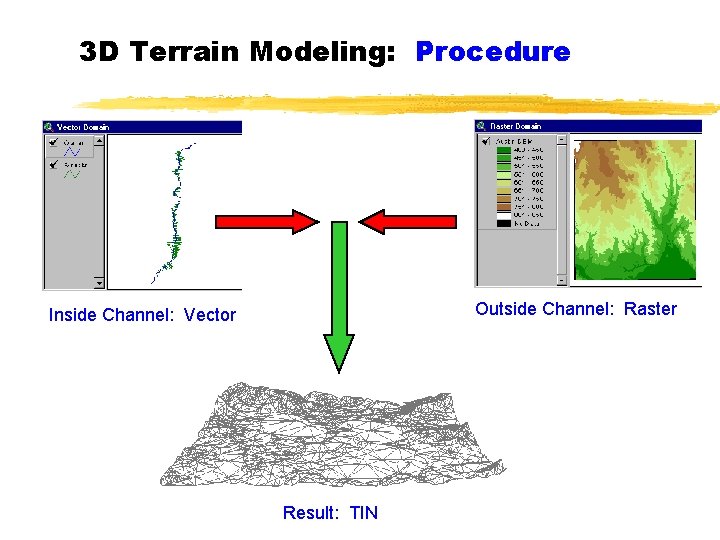
3 D Terrain Modeling: Procedure Outside Channel: Raster Inside Channel: Vector Result: TIN
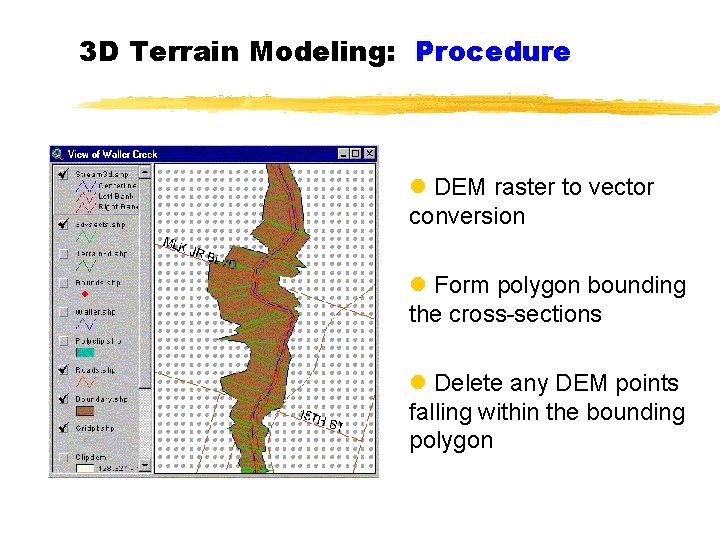
3 D Terrain Modeling: Procedure l DEM raster to vector conversion l Form polygon bounding the cross-sections l Delete any DEM points falling within the bounding polygon
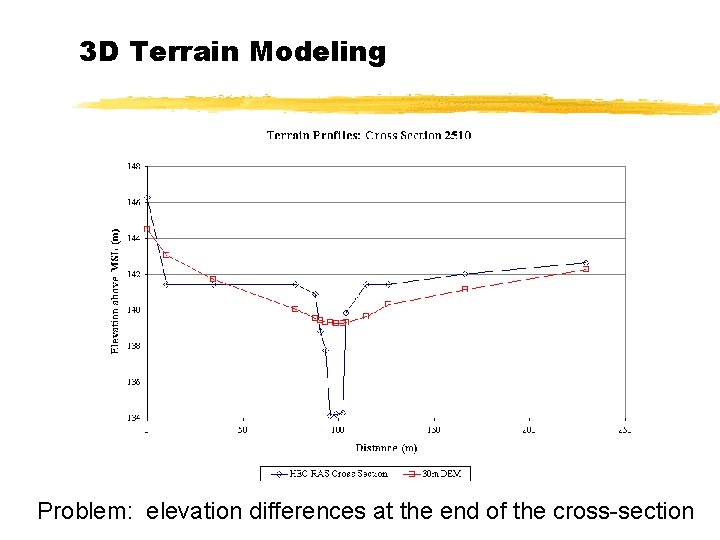
3 D Terrain Modeling Problem: elevation differences at the end of the cross-section
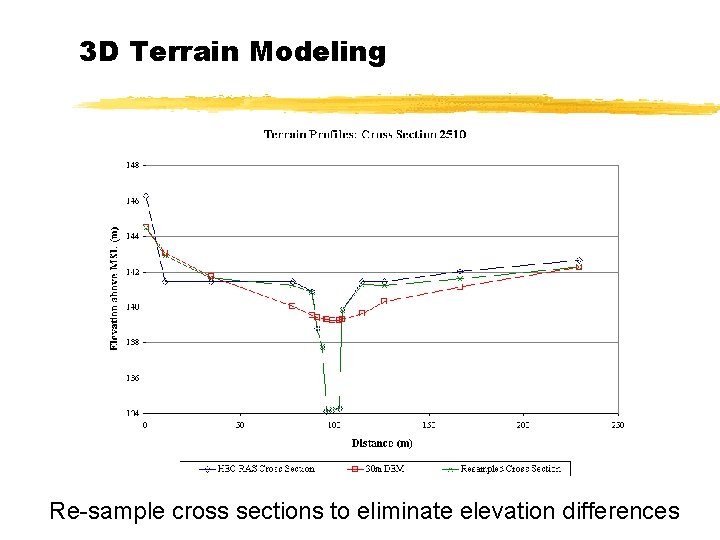
3 D Terrain Modeling Re-sample cross sections to eliminate elevation differences
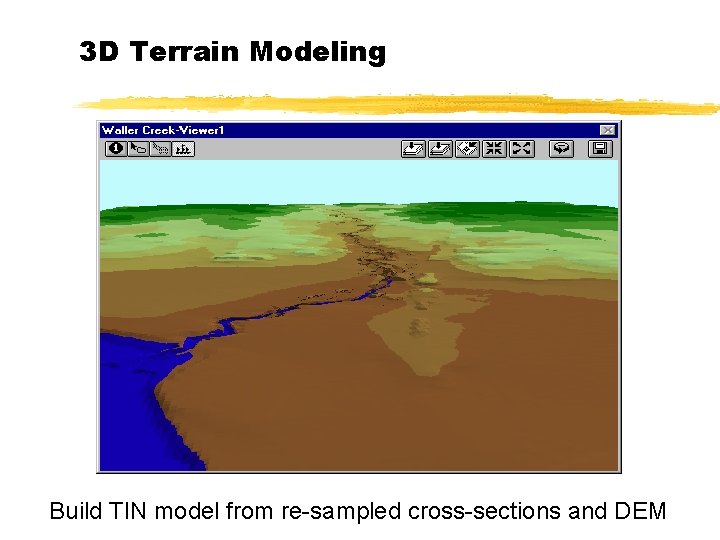
3 D Terrain Modeling Build TIN model from re-sampled cross-sections and DEM
Outline l Motivation l HEC-RAS Hydraulic Model l Stream Cross-Section Mapping l GIS Data Models l 3 -D Terrain Modeling l Floodplain Mapping
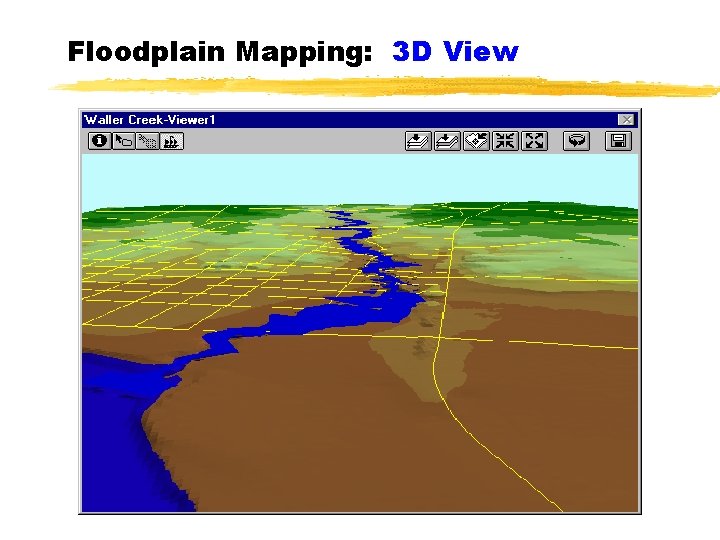
Floodplain Mapping: 3 D View
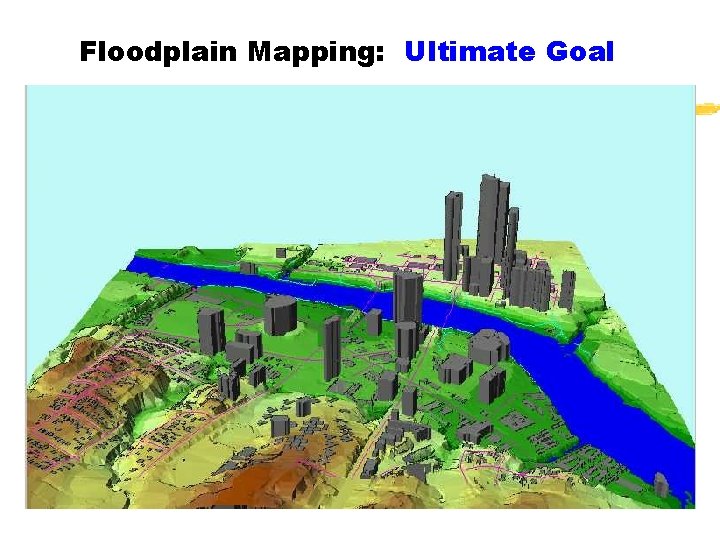
Floodplain Mapping: Ultimate Goal
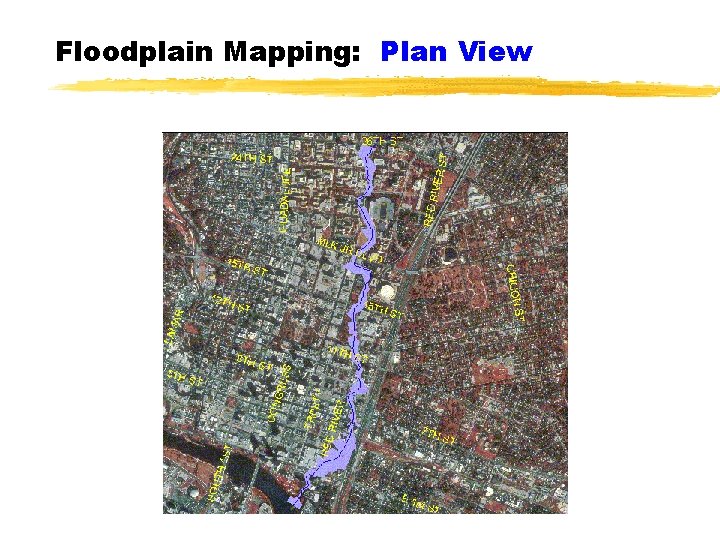
Floodplain Mapping: Plan View
HEC-RAS: Output Graphical Text File
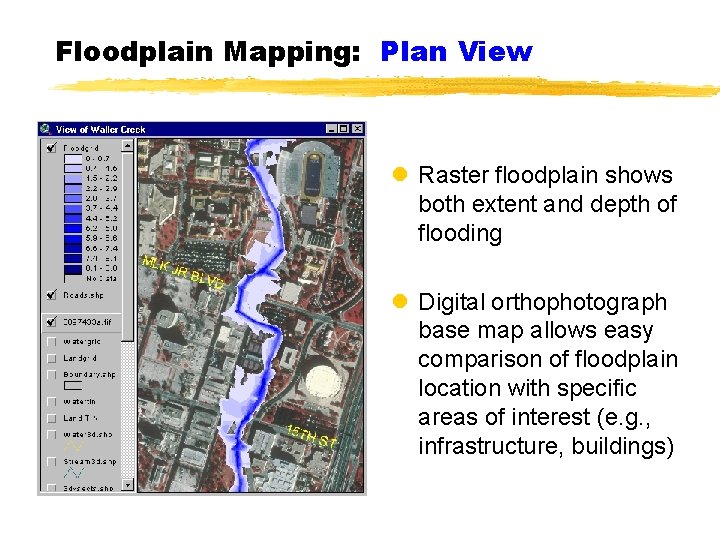
Floodplain Mapping: Plan View l Raster floodplain shows both extent and depth of flooding l Digital orthophotograph base map allows easy comparison of floodplain location with specific areas of interest (e. g. , infrastructure, buildings)
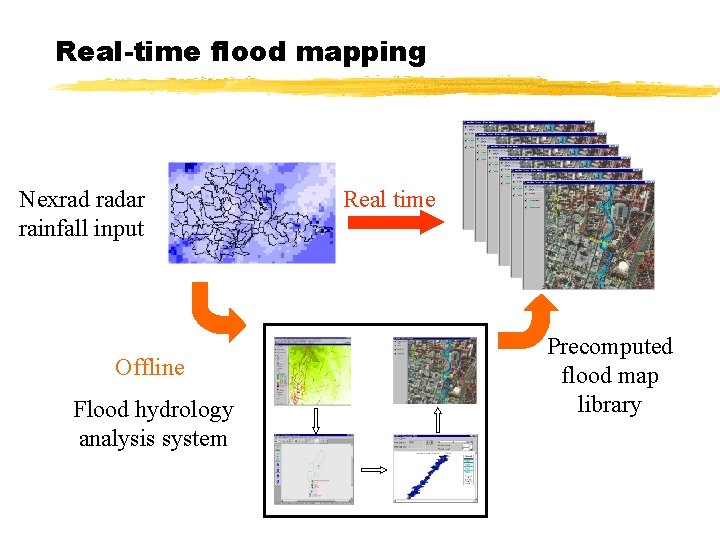
Real-time flood mapping Nexrad radar rainfall input Offline Flood hydrology analysis system Real time Precomputed flood map library
Questions? Comments? Also thanks to Seann Reed and Brian Adams