
FLOOD PANEL FLOODPROOFING TRAINING PROGRAM PART 2 SYSTEM

- Slides: 38
FLOOD PANEL™ FLOODPROOFING TRAINING PROGRAM PART 2: SYSTEM DESIGN COURSE# 14003 © Flood Panel 2014 April 28, 2014
ABOUT THE PROGRAM: • Due to the ever growing threat of flooding across America and the Federal government removing subsidies for the National Flood Insurance Program, there are incentives for commercial building owners to install dry flood proofing mechanisms that mitigate the impacts from flooding. • Flood Panel, LLC designs, sources, installs and maintains high-quality flood protection products on commercial construction projects. The aluminum Flood Panel are flood barriers that will last for the life of the buildings if properly installed and maintained. • An elite team of expert architects, engineers and contractors have been identified, by Flood Panel, LLC, to train industry professionals on the installation and deployment of their vast array of flood protection products. The training is relevant to structural engineers, architects, shell contractors, construction professionals and commercial building owners. • The nation’s vulnerability to flooding is increasing. Because new insurance policies and the modernization of FEMA’s flood maps affecting property insurance and insurability, there is a great demand for Flood Panel products to be installed at commercial properties. 2
FLOODPROOFING COMMERCIAL BUILDINGS William L. Coulbourne, P. E. bill@coulbourneconsulting. com Adam Reeder, P. E. adam. reeder@atkinsglobal. com 3
FOCUS: COMMERCIAL BUILDINGS IN THE 100 YEAR FLOOD ZONE Today’s Program Outline • Is flood risk a problem for your clients? • Estimate the risks’ frequency and magnitude • Alternatives Solutions to address the problem – System Designs – Implementation – Operation and maintenance • Factors in System Selection • Design Process • Load Calculations 1 Flood Zones, Codes, Insurance 2 Assessing Risk 3 Alternatives 4 Functional specifications 5 Dry Floodproofing Systems 6 System Design 4
PART 6: FLOOD LOADS FOR DRY FLOODPROOFING COMMERCIAL BUILDINGS IN THE A ZONE
LEARNING OBJECTIVES: • Learn how to calculate hydrostatic, hydrodynamic and buoyancy flood loads, and debris impact forces • Be able to describe steps for designing flood shields and building supports • Calculate load forces and moments for typical dry floodproofing situations of commercial buildings 6
DESIGN LOADS AND SITE CONSIDERATIONS: Floodproofing measures must ensure that buildings will be designed and constructed to resist flotation, collapse, and lateral movement associated with flooding. Soil and geotechnical: Flood-related loads: Hydrostatic Hydrodynamic Buoyancy Flood-borne debris and ice • Internal and site drainage considerations • • 7 • • Soil pressure Soil permeability Bearing capacity Land subsidence Erosion Scour Shrink-swell potential
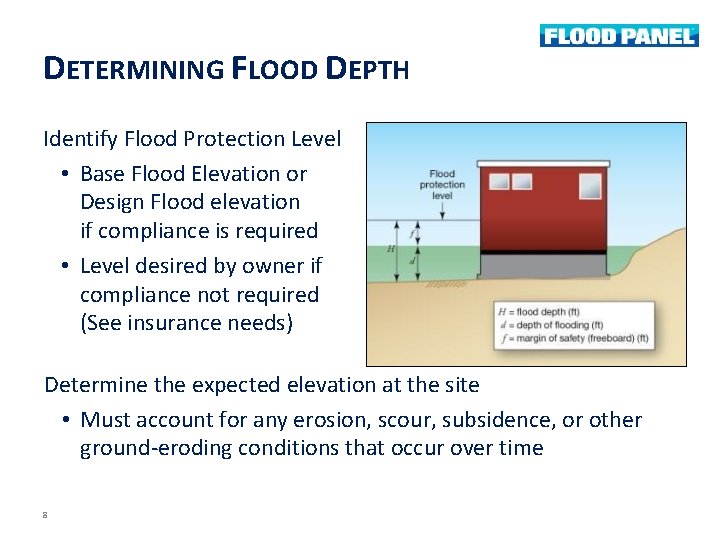
DETERMINING FLOOD DEPTH Identify Flood Protection Level • Base Flood Elevation or Design Flood elevation if compliance is required • Level desired by owner if compliance not required (See insurance needs) Determine the expected elevation at the site • Must account for any erosion, scour, subsidence, or other ground-eroding conditions that occur over time 8
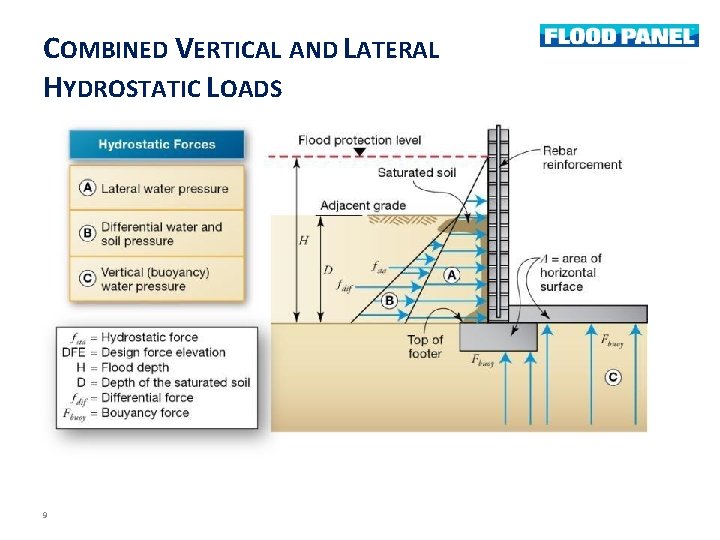
COMBINED VERTICAL AND LATERAL HYDROSTATIC LOADS 9
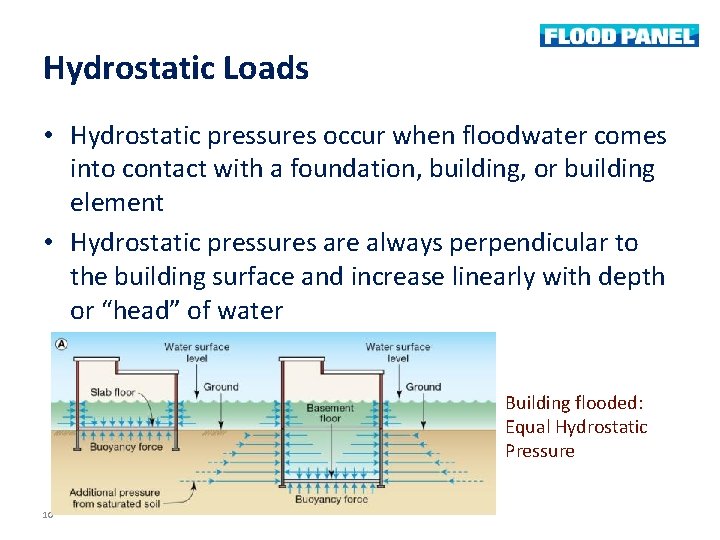
Hydrostatic Loads • Hydrostatic pressures occur when floodwater comes into contact with a foundation, building, or building element • Hydrostatic pressures are always perpendicular to the building surface and increase linearly with depth or “head” of water Building flooded: Equal Hydrostatic Pressure 10
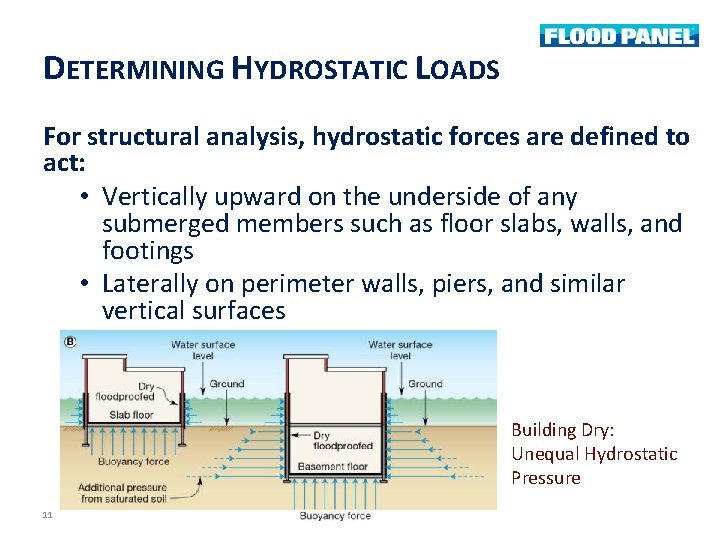
DETERMINING HYDROSTATIC LOADS For structural analysis, hydrostatic forces are defined to act: • Vertically upward on the underside of any submerged members such as floor slabs, walls, and footings • Laterally on perimeter walls, piers, and similar vertical surfaces Building Dry: Unequal Hydrostatic Pressure 11
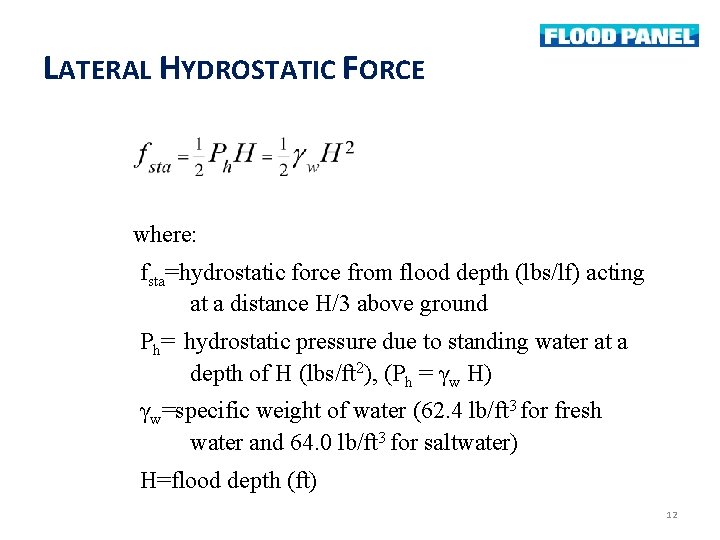
LATERAL HYDROSTATIC FORCE where: fsta=hydrostatic force from flood depth (lbs/lf) acting at a distance H/3 above ground Ph= hydrostatic pressure due to standing water at a depth of H (lbs/ft 2), (Ph = γw H) γw=specific weight of water (62. 4 lb/ft 3 for fresh water and 64. 0 lb/ft 3 for saltwater) H=flood depth (ft) 12
SUBMERGED SOIL AND WATER FORCES Saturated soil pressures: • • 13 Occur when any portion of building is below grade Must be included in design load calculations Include pressure from both soil and water Apply from the lowest adjacent grade to the bottom of the submerged surface
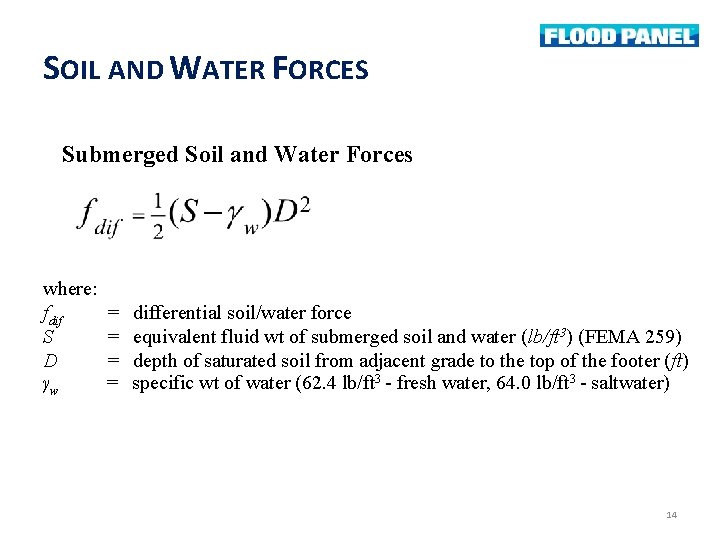
SOIL AND WATER FORCES Submerged Soil and Water Forces where: fdif = S = D = γw = differential soil/water force equivalent fluid wt of submerged soil and water (lb/ft 3) (FEMA 259) depth of saturated soil from adjacent grade to the top of the footer (ft) specific wt of water (62. 4 lb/ft 3 - fresh water, 64. 0 lb/ft 3 - saltwater) 14
VERTICAL HYDROSTATIC FORCES: BUOYANCY Buoyancy forces: • Act on bases of foundation walls and concrete floor slabs • Must be resisted by the weight of the building itself • For larger buildings, the structure itself may not become buoyant; however, elements like the floor slab may Ways to reduce buoyancy: • Install ground or soil anchors • Add weight • Backfill below-grade foundation or crawlspace 15
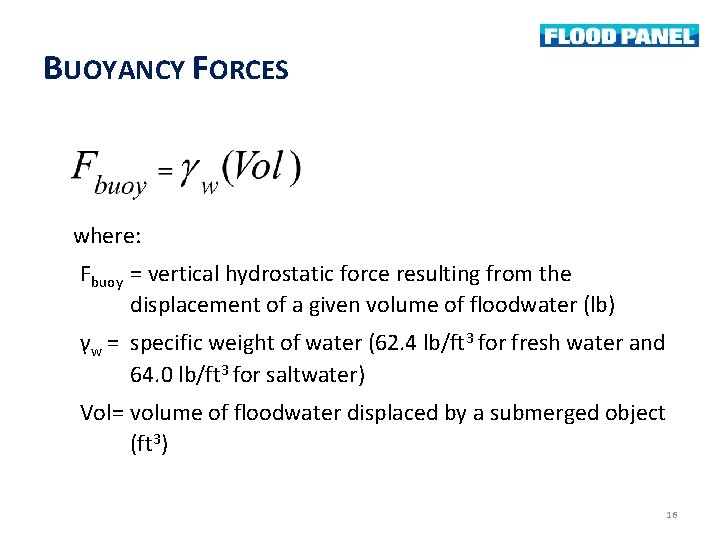
BUOYANCY FORCES where: Fbuoy = vertical hydrostatic force resulting from the displacement of a given volume of floodwater (lb) γw = specific weight of water (62. 4 lb/ft 3 for fresh water and 64. 0 lb/ft 3 for saltwater) Vol= volume of floodwater displaced by a submerged object (ft 3) 16
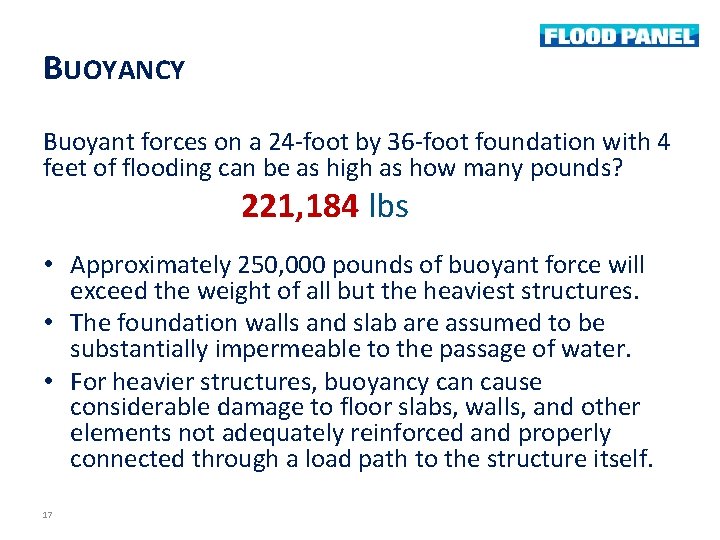
BUOYANCY Buoyant forces on a 24 -foot by 36 -foot foundation with 4 feet of flooding can be as high as how many pounds? 221, 184 lbs • Approximately 250, 000 pounds of buoyant force will exceed the weight of all but the heaviest structures. • The foundation walls and slab are assumed to be substantially impermeable to the passage of water. • For heavier structures, buoyancy can cause considerable damage to floor slabs, walls, and other elements not adequately reinforced and properly connected through a load path to the structure itself. 17
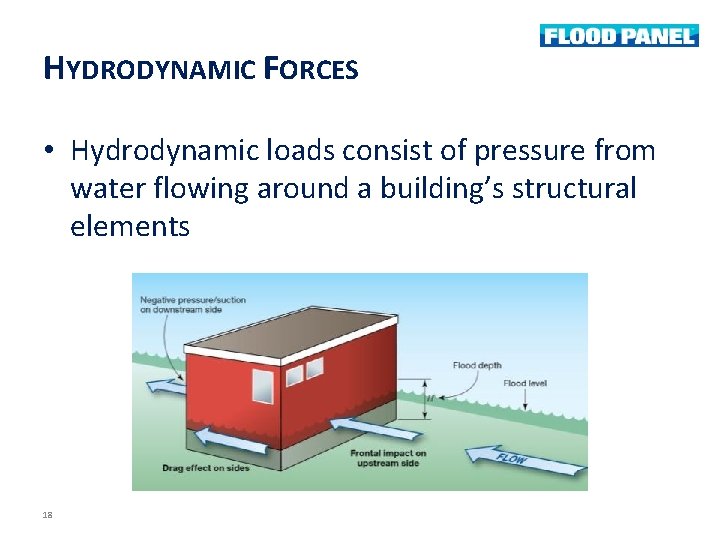
HYDRODYNAMIC FORCES • Hydrodynamic loads consist of pressure from water flowing around a building’s structural elements 18
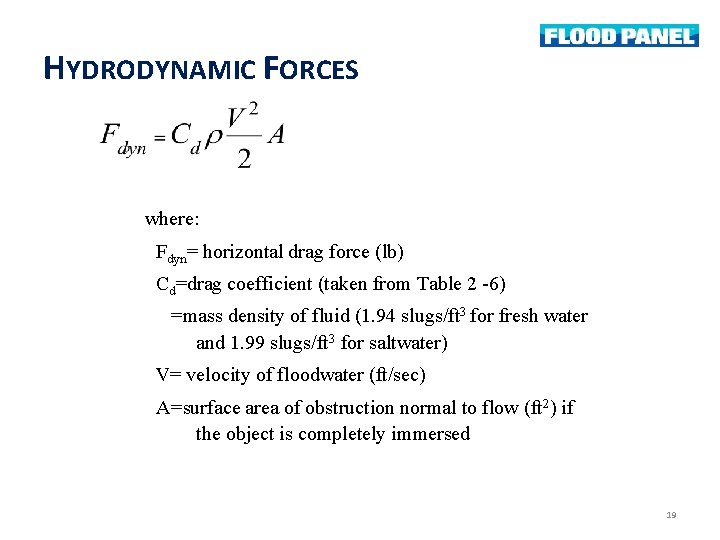
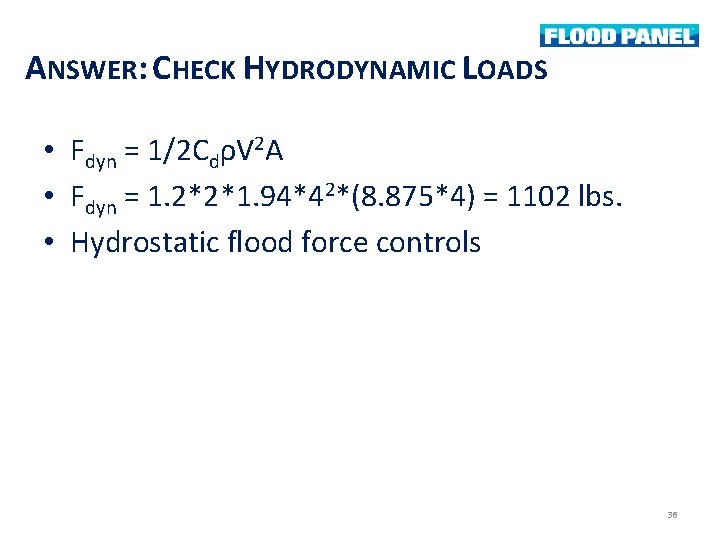
HYDRODYNAMIC FORCES where: Fdyn= horizontal drag force (lb) Cd=drag coefficient (taken from Table 2 -6) =mass density of fluid (1. 94 slugs/ft 3 for fresh water and 1. 99 slugs/ft 3 for saltwater) V= velocity of floodwater (ft/sec) A=surface area of obstruction normal to flow (ft 2) if the object is completely immersed 19
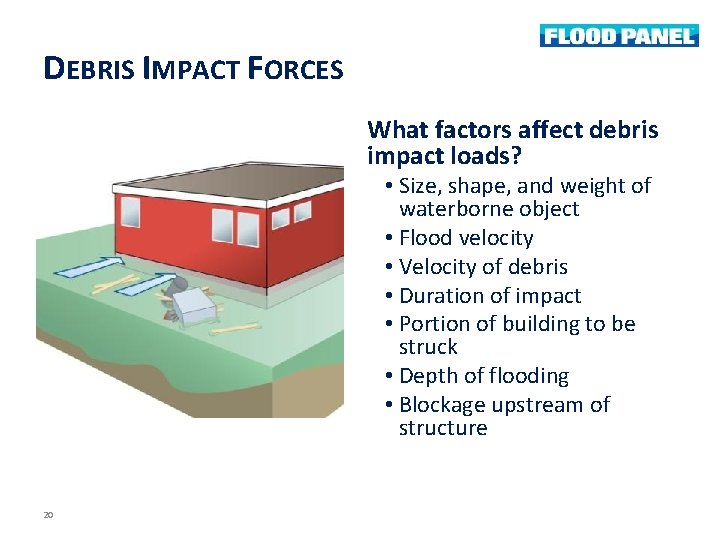
DEBRIS IMPACT FORCES What factors affect debris impact loads? • Size, shape, and weight of waterborne object • Flood velocity • Velocity of debris • Duration of impact • Portion of building to be struck • Depth of flooding • Blockage upstream of structure 20
DURATION OF FLOODING • Duration: How long water remains above normal levels. – Function of watershed size and the slope of the valley (slope influences how fast water drains). • Prolonged contact with floodwater may make some mitigation measures, including dry floodproofing, inappropriate because of the increased chance of seepage and potential structural failure. Prolonged contact: • Is more likely to cause damage to structural members and finishes than short periods of flooding • Has a higher probability of floodwater accumulation • Affects pump design for interior drainage 21
INTERIOR DRAIN SYSTEMS • What are interior drain systems? Systems that keep water from accumulating in interior below-grade areas (e. g. , storm sewers, backflow valves, sump pumps). • Why do we need interior drain systems? Floodwater that surrounds a building or saturates surrounding soils has a high probability of seeping into the building through the exterior walls, foundations, and slabs. • Where are sump pumps used? Sump pumps are most commonly used to dewater below-grade areas. Water in below-grade areas migrates along the lines of least resistance, which should be toward and into the sump. 22
FLASH FLOODS AND DRY FLOODPROOFING • Steep topography and locations with small drainage areas may experience flash flooding, where floodwater can rise very quickly with little or no warning • If a building is susceptible to flash floods, insufficient warning time may make the timely installation of shields and the activation of pump systems and backup energy sources impossible • Temporarily relocating movable contents to a higher level may also be impractical • Dry floodproofing requiring human intervention is not appropriate for sites in flash flood areas because of the potentially short warning time 23
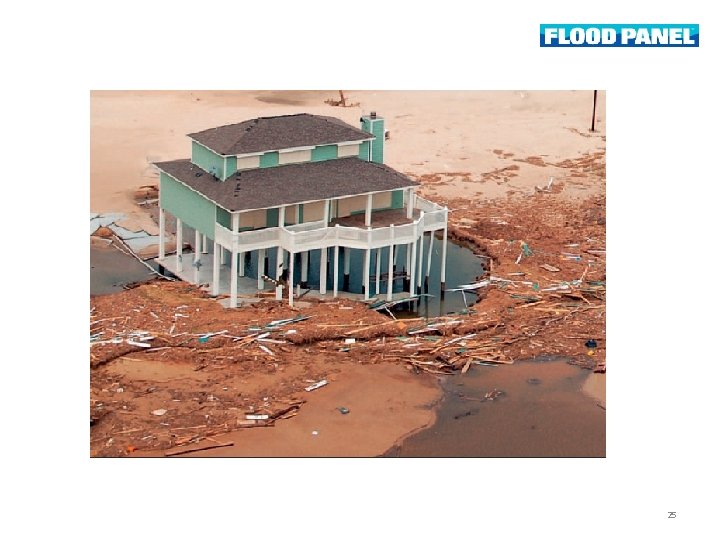
SITE FACTORS: SCOUR AND EROSION Deep scour around foundation piles, Hurricane Ike (Bolivar Peninsula, TX, 2008) • Are difficult to predict • Can threaten existing structures by lowering ground elevations, causing instability and failure in embankments, and transporting sediments landward or downstream • Can increase flood forces by increasing water depths • Are caused by natural events such as flood-inducing storms • Can be exacerbated by human actions such as construction of flood-protection structures • Are particularly troublesome in arid regions especially on alluvial fans 24
25
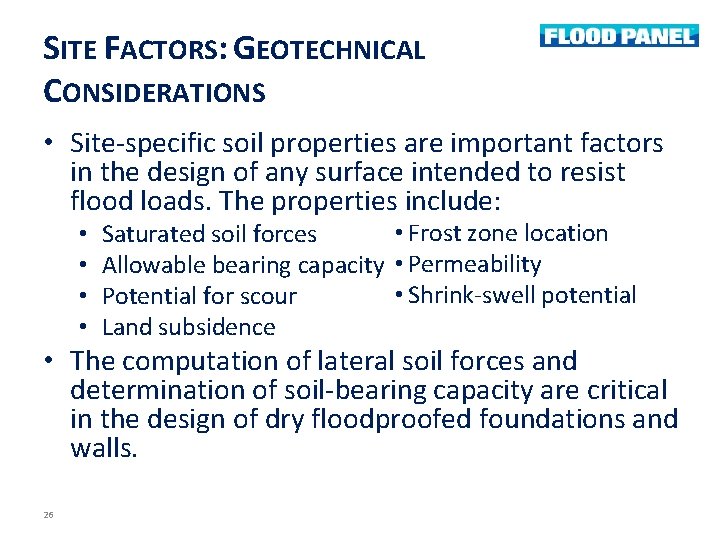
SITE FACTORS: GEOTECHNICAL CONSIDERATIONS • Site-specific soil properties are important factors in the design of any surface intended to resist flood loads. The properties include: • • • Frost zone location Saturated soil forces Allowable bearing capacity • Permeability • Shrink-swell potential Potential for scour Land subsidence • The computation of lateral soil forces and determination of soil-bearing capacity are critical in the design of dry floodproofed foundations and walls. 26
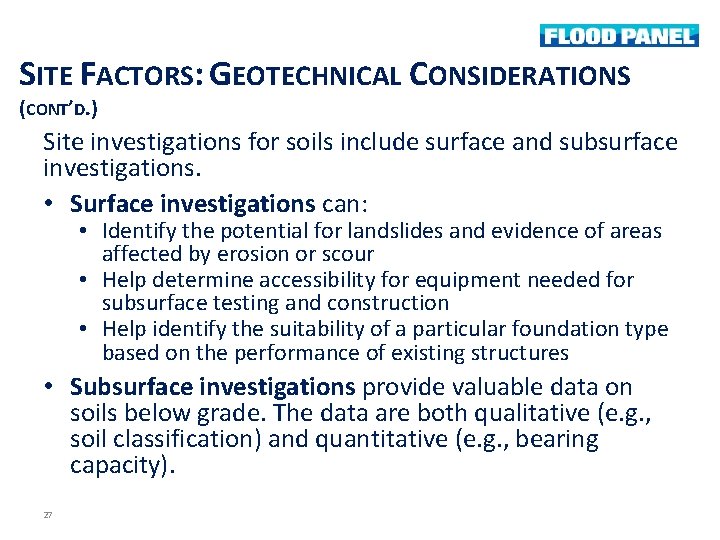
SITE FACTORS: GEOTECHNICAL CONSIDERATIONS (CONT’D. ) Site investigations for soils include surface and subsurface investigations. • Surface investigations can: • Identify the potential for landslides and evidence of areas affected by erosion or scour • Help determine accessibility for equipment needed for subsurface testing and construction • Help identify the suitability of a particular foundation type based on the performance of existing structures • Subsurface investigations provide valuable data on soils below grade. The data are both qualitative (e. g. , soil classification) and quantitative (e. g. , bearing capacity). 27
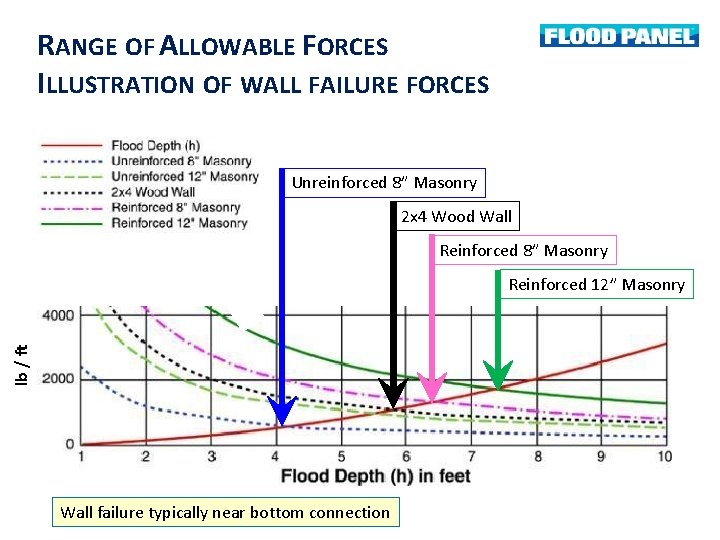
ALLOWABLE FORCES ON WALLS • Graph (next slide) of allowable lateral forces for various wall types • All loads create bending forces on walls • Masonry is reinforced with #4 bars @ 12” o. c. • Wood wall is 2 x 4 s @ 16” o. c. with 1/2” plywood sheathing • Water force is from hydrostatic forces only 28
RANGE OF ALLOWABLE FORCES ILLUSTRATION OF WALL FAILURE FORCES Unreinforced 8” Masonry 2 x 4 Wood Wall Reinforced 8” Masonry lb / ft Reinforced 12” Masonry Wall failure typically near bottom connection
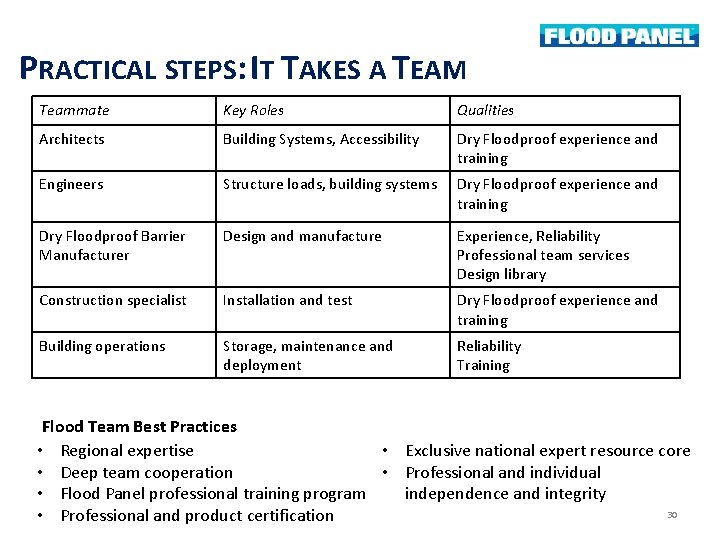
PRACTICAL STEPS: IT TAKES A TEAM Teammate Key Roles Qualities Architects Building Systems, Accessibility Dry Floodproof experience and training Engineers Structure loads, building systems Dry Floodproof experience and training Dry Floodproof Barrier Manufacturer Design and manufacture Experience, Reliability Professional team services Design library Construction specialist Installation and test Dry Floodproof experience and training Building operations Storage, maintenance and deployment Reliability Training Flood Team Best Practices • Regional expertise • Exclusive national expert resource core • Deep team cooperation • Professional and individual • Flood Panel professional training program independence and integrity 30 • Professional and product certification
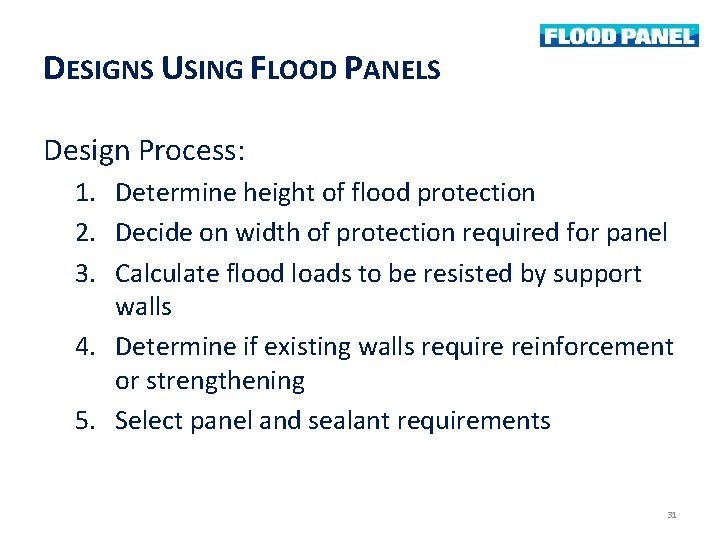
DESIGNS USING FLOOD PANELS Design Process: 1. Determine height of flood protection 2. Decide on width of protection required for panel 3. Calculate flood loads to be resisted by support walls 4. Determine if existing walls require reinforcement or strengthening 5. Select panel and sealant requirements 31
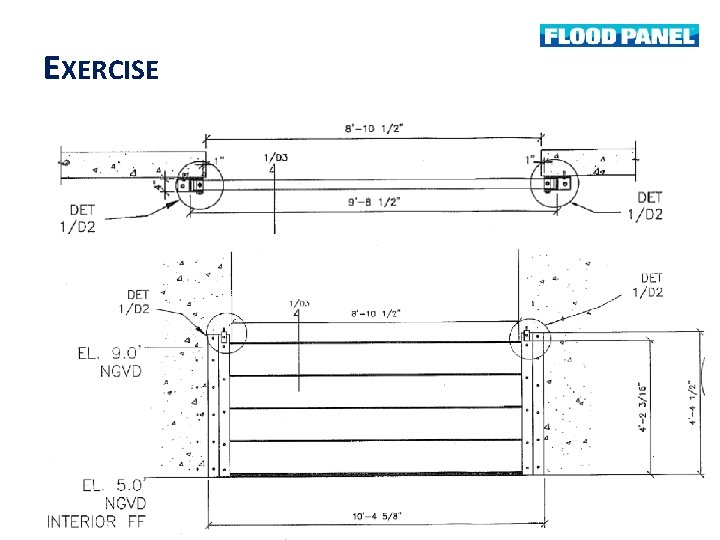
EXERCISE 32
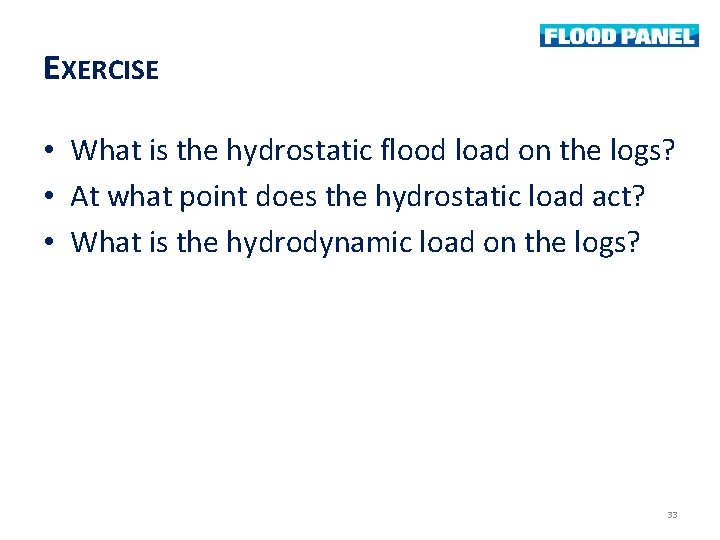
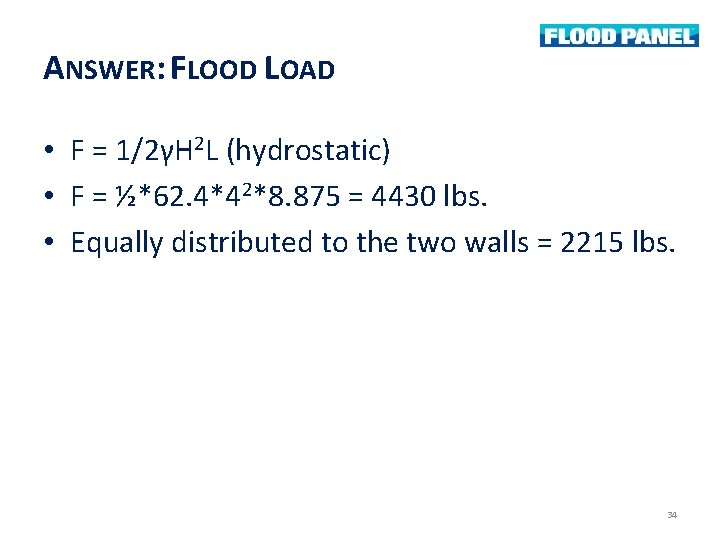
EXERCISE • What is the hydrostatic flood load on the logs? • At what point does the hydrostatic load act? • What is the hydrodynamic load on the logs? 33
ANSWER: FLOOD LOAD • F = 1/2γH 2 L (hydrostatic) • F = ½*62. 4*42*8. 875 = 4430 lbs. • Equally distributed to the two walls = 2215 lbs. 34
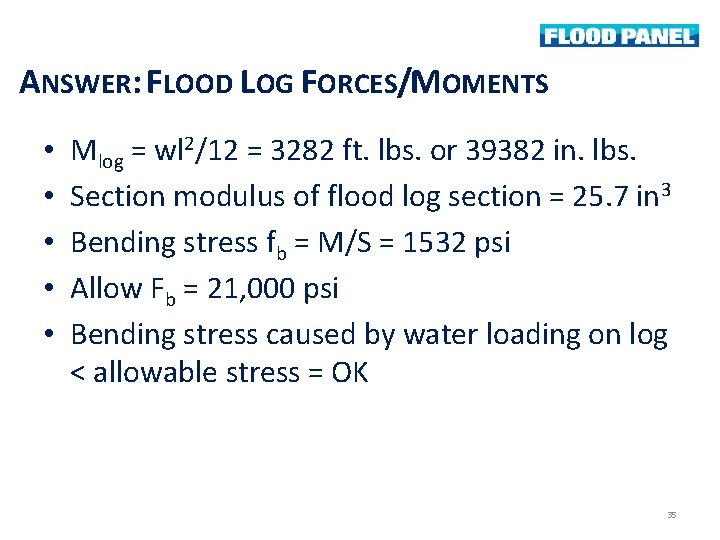
ANSWER: FLOOD LOG FORCES/MOMENTS • • • Mlog = wl 2/12 = 3282 ft. lbs. or 39382 in. lbs. Section modulus of flood log section = 25. 7 in 3 Bending stress fb = M/S = 1532 psi Allow Fb = 21, 000 psi Bending stress caused by water loading on log < allowable stress = OK 35
ANSWER: CHECK HYDRODYNAMIC LOADS • Fdyn = 1/2 CdρV 2 A • Fdyn = 1. 2*2*1. 94*42*(8. 875*4) = 1102 lbs. • Hydrostatic flood force controls 36
CONTACT & QUESTIONS: Address: Flood Panel 5500 Military Trail #22 -220 Jupiter, FL 33458 Tom Osborne President / Engineering Office: 561 -744 -2727 tom@floodpanel. com Telephone: 1 -888 -744 -2607 (Toll Free) 1 -561 -744 -2727 (Phone) 1 -561 -744 -2755 (Fax) 37
QUESTIONS