
FLOOD PANEL FLOODPROOFING TRAINING PROGRAM PART 1 FLOOD




- Slides: 52
FLOOD PANEL™ FLOODPROOFING TRAINING PROGRAM PART 1: FLOOD ZONES, CODES, INSURANCE COURSE# 14001 © Flood Panel 2014 April 28, 2014
FLOODPROOFING COMMERCIAL BUILDINGS William L. Coulbourne, P. E. bill@coulbourneconsulting. com Adam Reeder, P. E. adam. reeder@atkinsglobal. com 2
ABOUT THE PROGRAM: • Due to the ever growing threat of flooding across America and the Federal government removing subsidies for the National Flood Insurance Program, there are incentives for commercial building owners to install dry flood proofing mechanisms that mitigate the impacts from flooding. • Flood Panel, LLC designs, sources, installs and maintains high-quality flood protection products on commercial construction projects. The aluminum Flood Panel are flood barriers that will last for the life of the buildings if properly installed and maintained. • An elite team of expert architects, engineers and contractors have been identified, by Flood Panel LLC, to train industry professionals on the installation and deployment of their vast array of flood protection products. The training is relevant to structural engineers, architects, shell contractors, construction professionals and commercial building owners. • The nation’s vulnerability to flooding is increasing. Because new insurance policies and the modernization of FEMA’s flood maps affecting property insurance and insurability, there is a great demand for Flood Panel products to be installed at commercial properties. 3
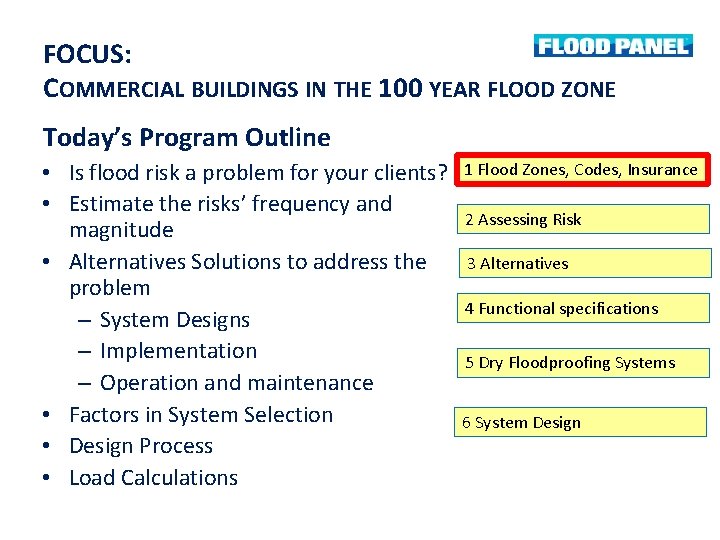
FOCUS: COMMERCIAL BUILDINGS IN THE 100 YEAR FLOOD ZONE Today’s Program Outline • Is flood risk a problem for your clients? • Estimate the risks’ frequency and magnitude • Alternatives Solutions to address the problem – System Designs – Implementation – Operation and maintenance • Factors in System Selection • Design Process • Load Calculations 1 Flood Zones, Codes, Insurance 2 Assessing Risk 3 Alternatives 4 Functional specifications 5 Dry Floodproofing Systems 6 System Design
Program Outline Session 1: Flood Zones, codes and insurance Session 2: Dry floodproofing • What is it? • How is it done? Session 3: Flood loads and protection products Session 4: Conducting on-site assessments 5
PROGRAM OUTLINE: Session 1: Flood Zones, codes and insurance Session 2: Dry floodproofing • What is it? • How is it done? Session 3: Flood loads and protection products Session 4: Conducting on-site assessments 6
SESSION 1: FLOOD ZONES, CODES AND INSURANCE Basic assessment and management of flooding risks for commercial buildings Owners and Architects 7
COMMERCIAL BUILDINGS IN THE 100 YEAR FLOOD ZONE Goals: • Is flood risk a problem for your clients? • Estimate the risks’ frequency and magnitude • Alternatives to address the problem – System Designs – Implementation – Operation and maintenance • Practical steps: It Takes a Team – – – Architect Engineer System Installation Deployment 8
INTRODUCTIONS: • • Name Position/Organization Relevant Experience Course Expectations 9
LEARNING OBJECTIVES: • Understand recent basic national flood protection requirements for commercial buildings and local building codes; • Use professional reference materials to identify and quantify flood risks to specific buildings; • Understand use flood maps to assess risk to structures • Access key references and information resources • Understand safety margins applied to flooding conditions • Understand practical steps to flood safety system installation 10
SESSION 1 AGENDA: • • • NFIP Flood Maps Floodplain Construction Requirements Codes and Standards Risk 11
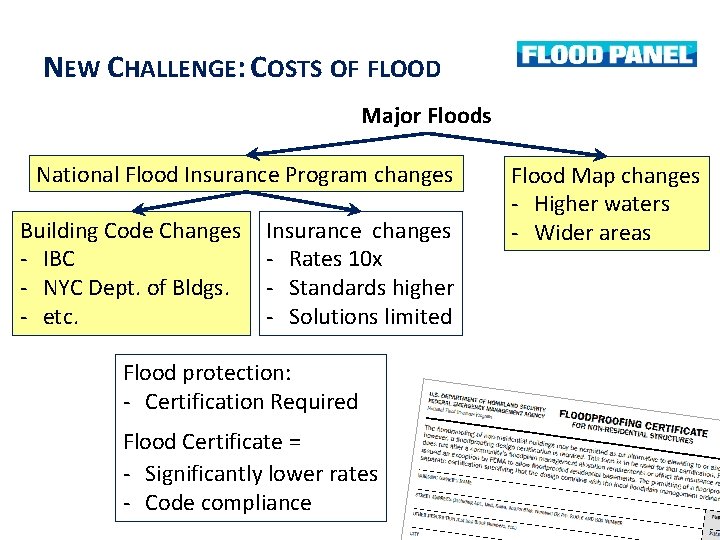
NEW CHALLENGE: COSTS OF FLOOD Major Floods National Flood Insurance Program changes Building Code Changes - IBC - NYC Dept. of Bldgs. - etc. Insurance changes - Rates 10 x - Standards higher - Solutions limited Flood Map changes - Higher waters - Wider areas Flood protection: - Certification Required Flood Certificate = - Significantly lower rates - Code compliance 12
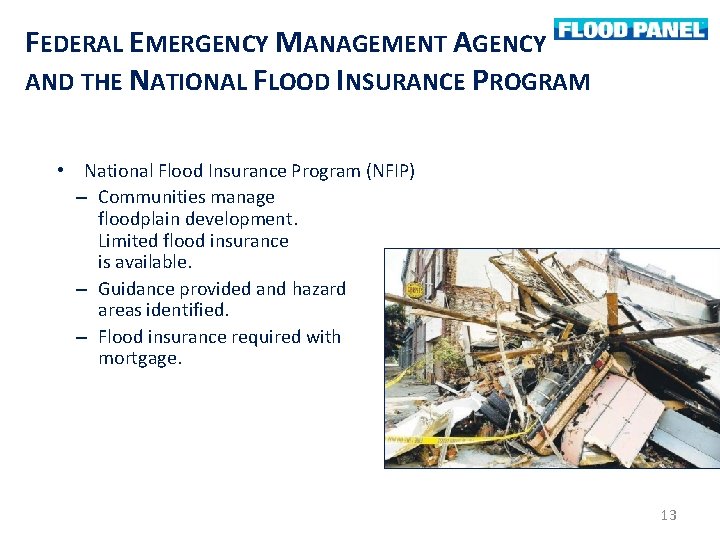
FEDERAL EMERGENCY MANAGEMENT AGENCY AND THE NATIONAL FLOOD INSURANCE PROGRAM • National Flood Insurance Program (NFIP) – Communities manage floodplain development. Limited flood insurance is available. – Guidance provided and hazard areas identified. – Flood insurance required with mortgage. 13
NFIP PARTNERSHIP • Community adopts/enforces flood plain management (FPM) ordinance or law to: – Define regulatory floodplains – Control floodplain development • Must at least meet minimum NFIP regulations • NFIP makes affordable federally backed flood insurance available to residents 14
BASIC INTENT OF NFIP: ALL BUILDINGS, ALL FLOOD ZONES • Site reasonably safe from flooding • Designed to prevent flotation, collapse, and lateral movement during flooding • Flood-resistant materials • Constructed to minimize flood damage • HVAC/plumbing equipment designed or located to prevent water entry 15
BIGGERT-WATERS ACT 12 Goal: Reduce “flood insurance deficit” All insurance subsidies for commercial buildings are being eliminated. 16
INFORMATION RESOURCES: FLOOD ZONES • Flood Insurance Rate Maps (FIRM) • Shows flood boundaries for FEMA flood zones • Shows boundaries of Base Flood (100 year flood) Elevation • Maps the results of a recent Flood Insurance Studies (FIS) • Floodway Boundary Maps • Flood Insurance Studies • Shows mean water levels (Standing Water (SWEL) + waves) • Shows wave elevations along transects drawn perpendicular to the shoreline • FEMA Technical Bulletins 17
INFORMATION RESOURCES: NATIONAL FLOOD INSURANCE PROGRAM Minimum Requirements: Apply To: • Walled and roofed structures • New construction (some additions) • Substantially improved/damaged structures • Subdivisions and other new development • New and replacement water supply systems and sanitary sewage systems Affect Primarily: • Type of foundation • Height of lowest floor • Use of area below lowest floor 18
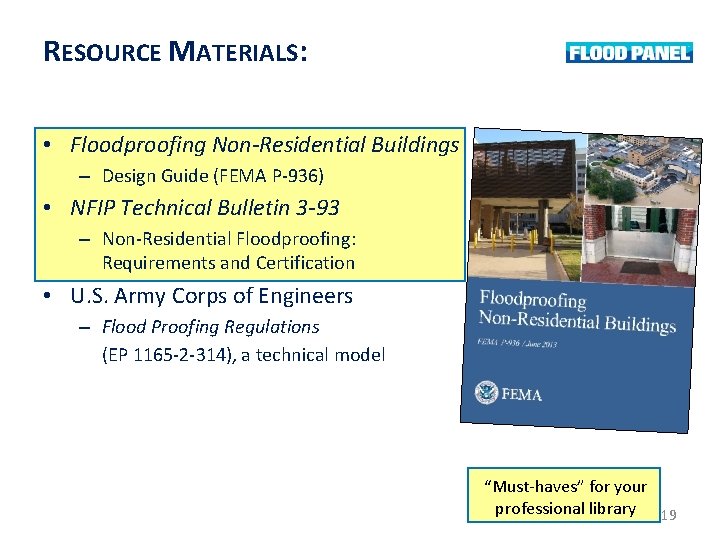
RESOURCE MATERIALS: • Floodproofing Non-Residential Buildings – Design Guide (FEMA P-936) • NFIP Technical Bulletin 3 -93 – Non-Residential Floodproofing: Requirements and Certification • U. S. Army Corps of Engineers – Flood Proofing Regulations (EP 1165 -2 -314), a technical model “Must-haves” for your professional library 19
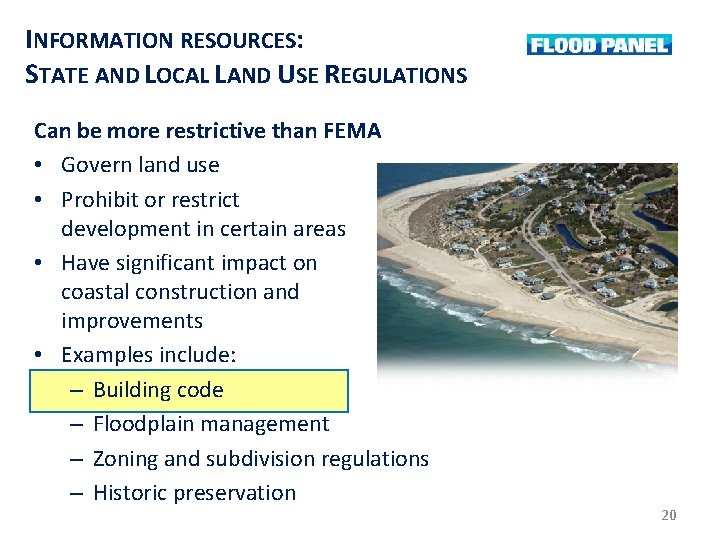
INFORMATION RESOURCES: STATE AND LOCAL LAND USE REGULATIONS Can be more restrictive than FEMA • Govern land use • Prohibit or restrict development in certain areas • Have significant impact on coastal construction and improvements • Examples include: ‒ Building code ‒ Floodplain management ‒ Zoning and subdivision regulations ‒ Historic preservation 20
INFORMATION RESOURCES : COMMUNITY FLOOD REGULATIONS • Locally adopted flood map (FIRM) and flood insurance study (FIS) • Local flood ordinance • Local ordinance defines: – Amount of freeboard, if any • Varies with building type and orientation – More restrictive regulations related to foundations, elevation, construction methods – Allowable location for certain types of construction 21
COMMUNITY FLOOD REGULATIONS REQUIREMENTS: NFIP PARTICIPATION • Communities participating in the National Flood Insurance Program (NFIP) are required to adopt and enforce local floodplain regulations for development in flood hazard areas • Communities are encouraged to adopt requirements that exceed the NFIP minimum requirements 22
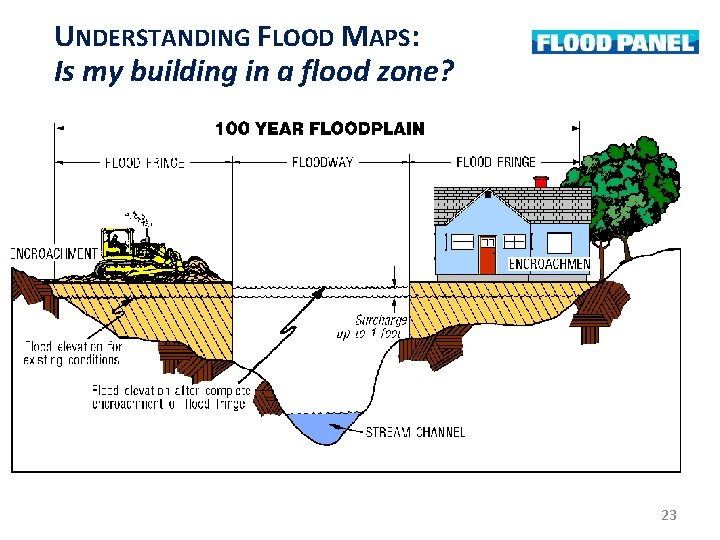
UNDERSTANDING FLOOD MAPS: Is my building in a flood zone? 23
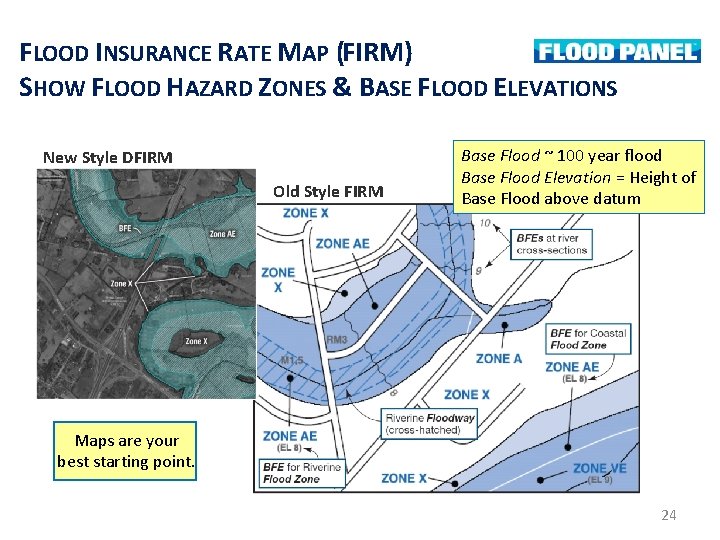
FLOOD INSURANCE RATE MAP (FIRM) SHOW FLOOD HAZARD ZONES & BASE FLOOD ELEVATIONS New Style DFIRM Old Style FIRM Base Flood ~ 100 year flood Base Flood Elevation = Height of Base Flood above datum Maps are your best starting point. 24
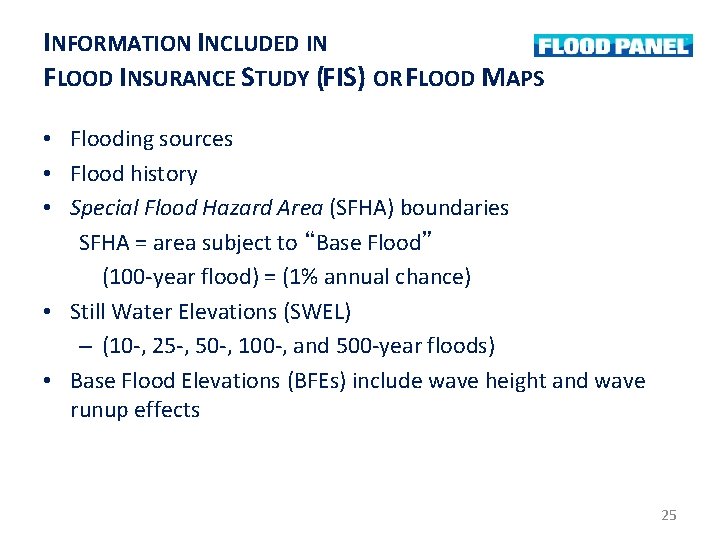
INFORMATION INCLUDED IN FLOOD INSURANCE STUDY (FIS) OR FLOOD MAPS • Flooding sources • Flood history • Special Flood Hazard Area (SFHA) boundaries SFHA = area subject to “Base Flood” (100 -year flood) = (1% annual chance) • Still Water Elevations (SWEL) – (10 -, 25 -, 50 -, 100 -, and 500 -year floods) • Base Flood Elevations (BFEs) include wave height and wave runup effects 25
BASIS OF FLOOD ZONES: • + + + Flood conditions during base flood event Topographic and bathymetric information Physical characteristics of the floodplain Potential for storm-induced dune erosion • (FIRMs don’t account for long-term dune erosion) + FEMA-approved models and procedures to calculate flood hazard zones and BFEs 26
FLOOD HAZARD DETERMINATIONS: Quality and usefulness of FIRM Maps depend on: • Base map used (roads, landmarks) • Topography used (contour interval, map accuracy -- vertical and horizontal) • Number of transects analyzed in FIS • Age of FIRM (changing conditions, changing methods) Conclusion: Maps aren’t perfect 27
FINDING MAPS (FIRMS) AND STUDIES (FISS) FEMA Map Service Center Site allows you to view and purchase, FIS, FIRM, other data. www. region 2 coastal. com/ 28
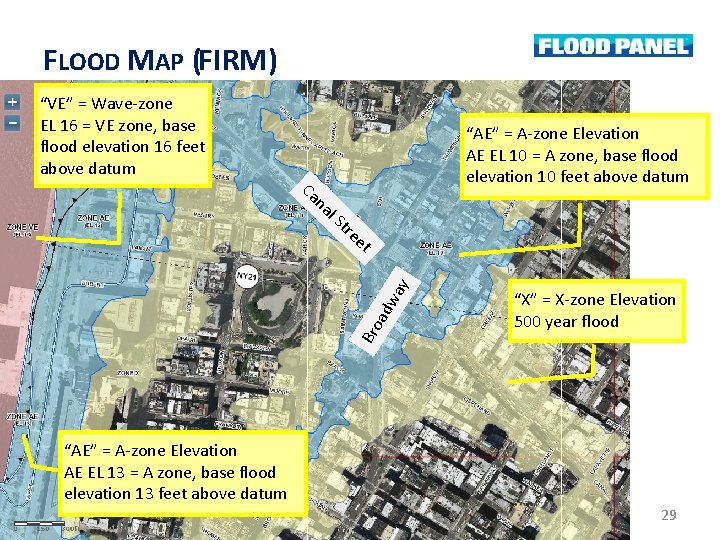
FLOOD MAP (FIRM) “VE” = Wave-zone EL 16 = VE zone, base flood elevation 16 feet above datum Ca na “AE” = A-zone Elevation AE EL 10 = A zone, base flood elevation 10 feet above datum l S tre Bro ad wa y et “X” = X-zone Elevation 500 year flood “AE” = A-zone Elevation AE EL 13 = A zone, base flood elevation 13 feet above datum 29
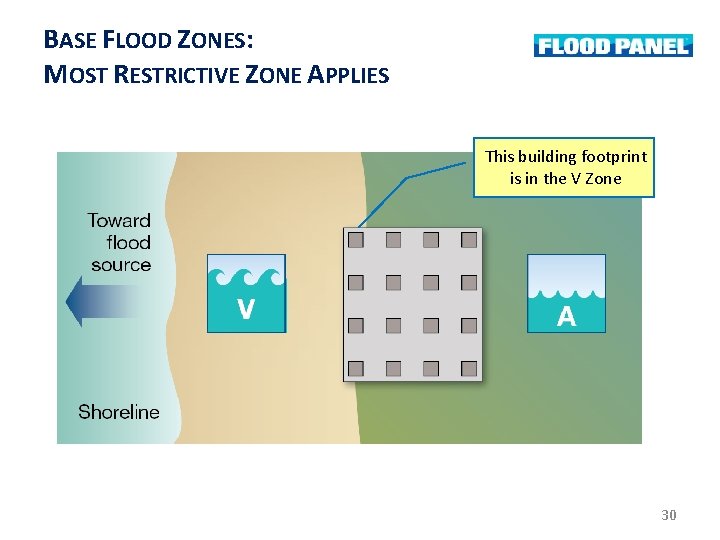
BASE FLOOD ZONES: MOST RESTRICTIVE ZONE APPLIES This building footprint is in the V Zone 30
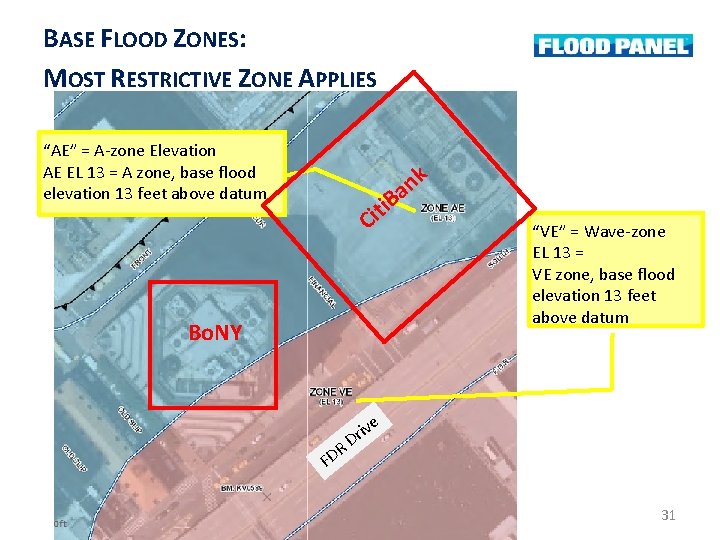
BASE FLOOD ZONES: MOST RESTRICTIVE ZONE APPLIES “AE” = A-zone Elevation AE EL 13 = A zone, base flood elevation 13 feet above datum k n a B ti Ci Bo. NY e iv Dr R FD “VE” = Wave-zone EL 13 = VE zone, base flood elevation 13 feet above datum 31
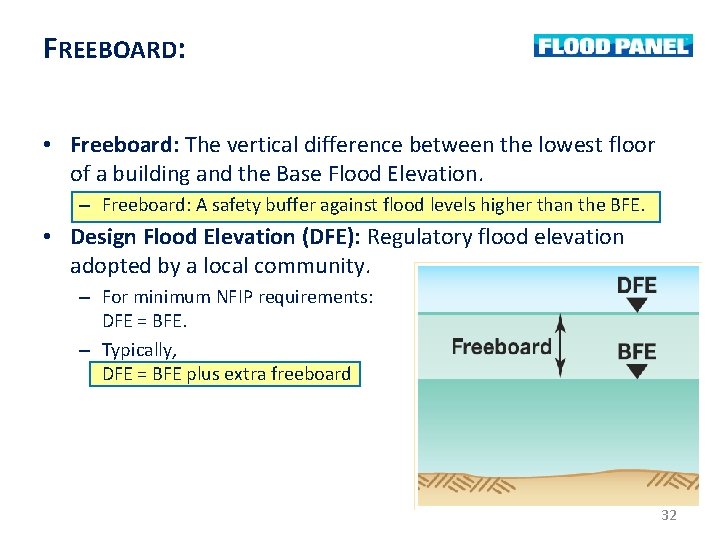
FREEBOARD: • Freeboard: The vertical difference between the lowest floor of a building and the Base Flood Elevation. – Freeboard: A safety buffer against flood levels higher than the BFE. • Design Flood Elevation (DFE): Regulatory flood elevation adopted by a local community. – For minimum NFIP requirements: DFE = BFE. – Typically, DFE = BFE plus extra freeboard 32
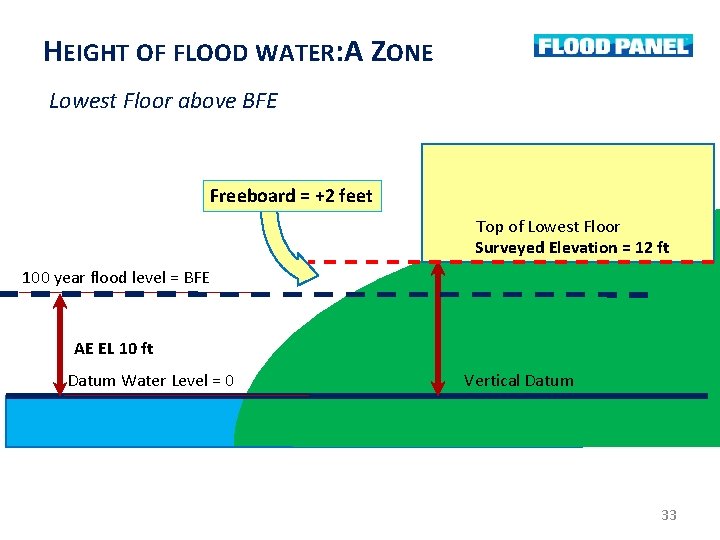
HEIGHT OF FLOOD WATER: A ZONE Lowest Floor above BFE Freeboard = +2 feet Top of Lowest Floor Surveyed Elevation = 12 ft 100 year flood level = BFE AE EL 10 ft Datum Water Level = 0 Vertical Datum 33
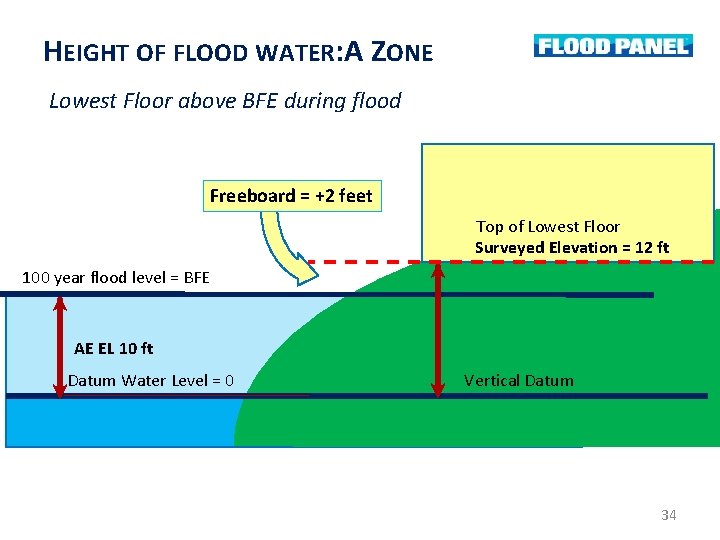
HEIGHT OF FLOOD WATER: A ZONE Lowest Floor above BFE during flood Freeboard = +2 feet Top of Lowest Floor Surveyed Elevation = 12 ft 100 year flood level = BFE AE EL 10 ft Datum Water Level = 0 Vertical Datum 34
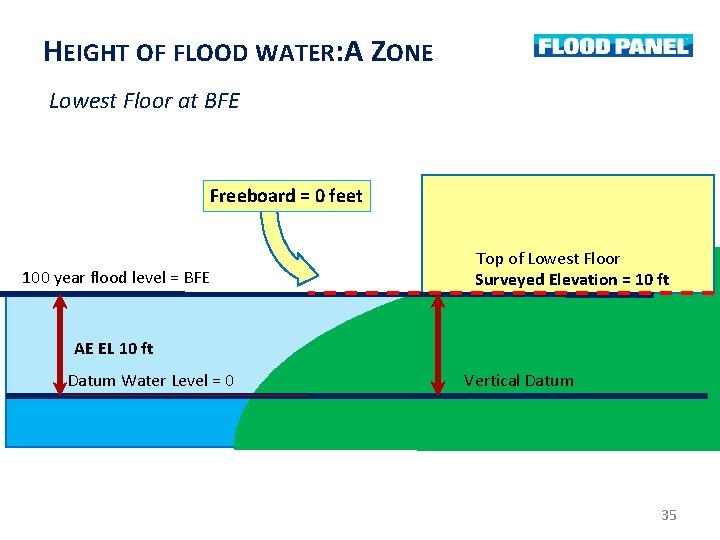
HEIGHT OF FLOOD WATER: A ZONE Lowest Floor at BFE Freeboard = 0 feet 100 year flood level = BFE Top of Lowest Floor Surveyed Elevation = 10 ft AE EL 10 ft Datum Water Level = 0 Vertical Datum 35
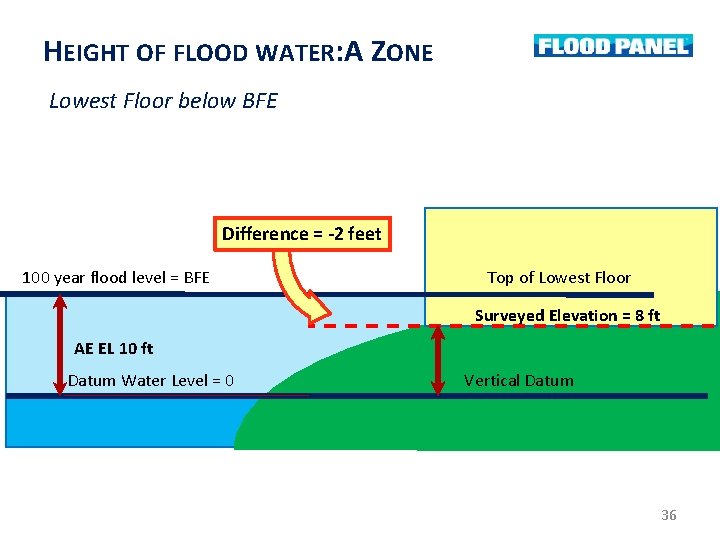
HEIGHT OF FLOOD WATER: A ZONE Lowest Floor below BFE Difference = -2 feet 100 year flood level = BFE Top of Lowest Floor Surveyed Elevation = 8 ft AE EL 10 ft Datum Water Level = 0 Vertical Datum 36
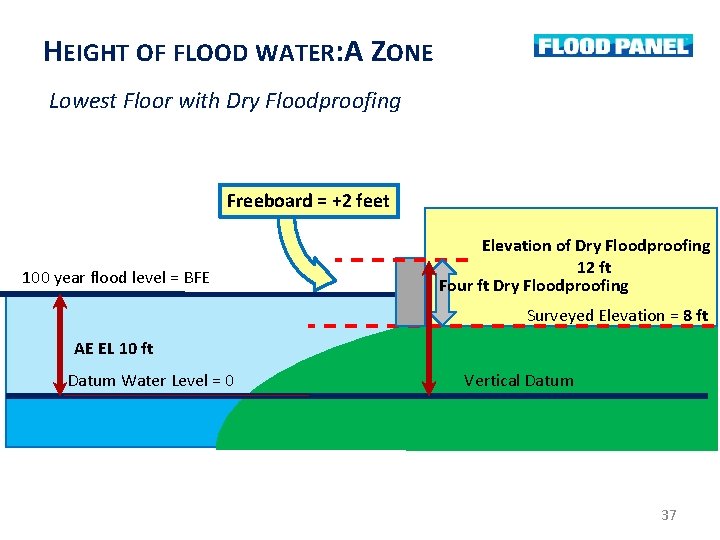
HEIGHT OF FLOOD WATER: A ZONE Lowest Floor with Dry Floodproofing Freeboard = +2 feet 100 year flood level = BFE Elevation of Dry Floodproofing 12 ft Four ft Dry Floodproofing Surveyed Elevation = 8 ft AE EL 10 ft Datum Water Level = 0 Vertical Datum 37
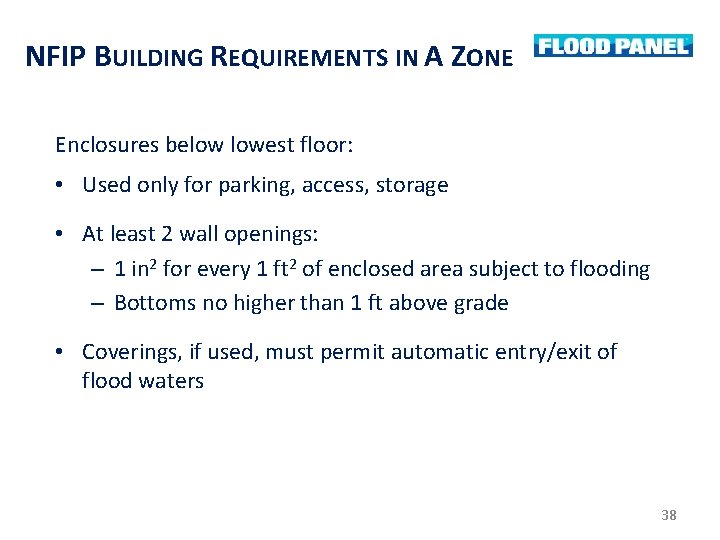
NFIP BUILDING REQUIREMENTS IN A ZONE Enclosures below lowest floor: • Used only for parking, access, storage • At least 2 wall openings: – 1 in 2 for every 1 ft 2 of enclosed area subject to flooding – Bottoms no higher than 1 ft above grade • Coverings, if used, must permit automatic entry/exit of flood waters 38
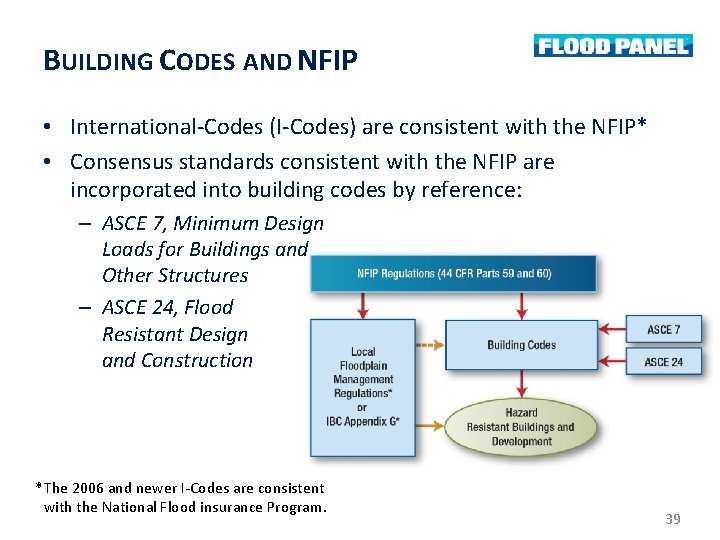
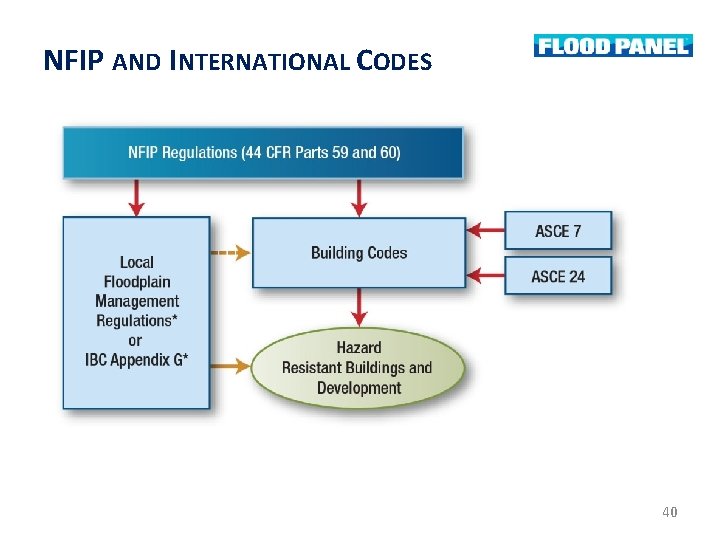
BUILDING CODES AND NFIP • International-Codes (I-Codes) are consistent with the NFIP* • Consensus standards consistent with the NFIP are incorporated into building codes by reference: – ASCE 7, Minimum Design Loads for Buildings and Other Structures – ASCE 24, Flood Resistant Design and Construction *The 2006 and newer I-Codes are consistent with the National Flood insurance Program. 39
NFIP AND INTERNATIONAL CODES 40
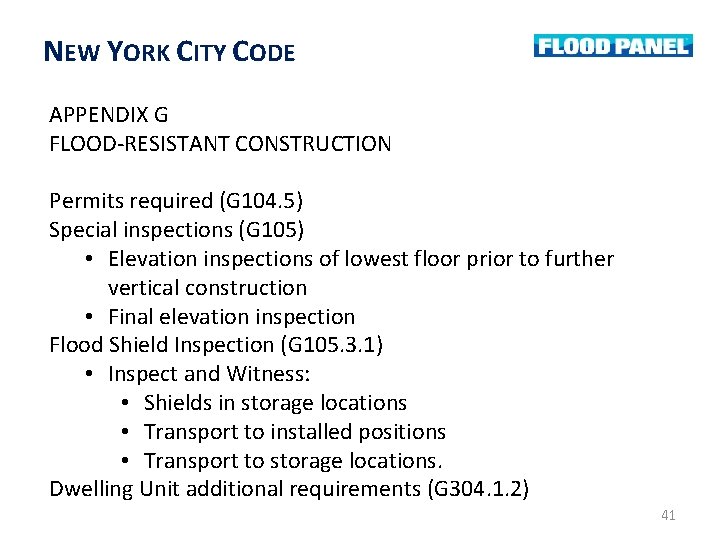
NEW YORK CITY CODE APPENDIX G FLOOD-RESISTANT CONSTRUCTION Permits required (G 104. 5) Special inspections (G 105) • Elevation inspections of lowest floor prior to further vertical construction • Final elevation inspection Flood Shield Inspection (G 105. 3. 1) • Inspect and Witness: • Shields in storage locations • Transport to installed positions • Transport to storage locations. Dwelling Unit additional requirements (G 304. 1. 2) 41
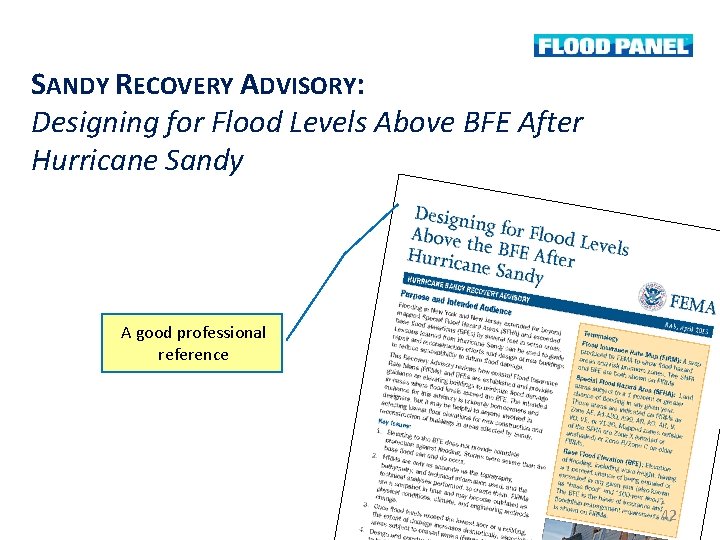
SANDY RECOVERY ADVISORY: Designing for Flood Levels Above BFE After Hurricane Sandy A good professional reference 42
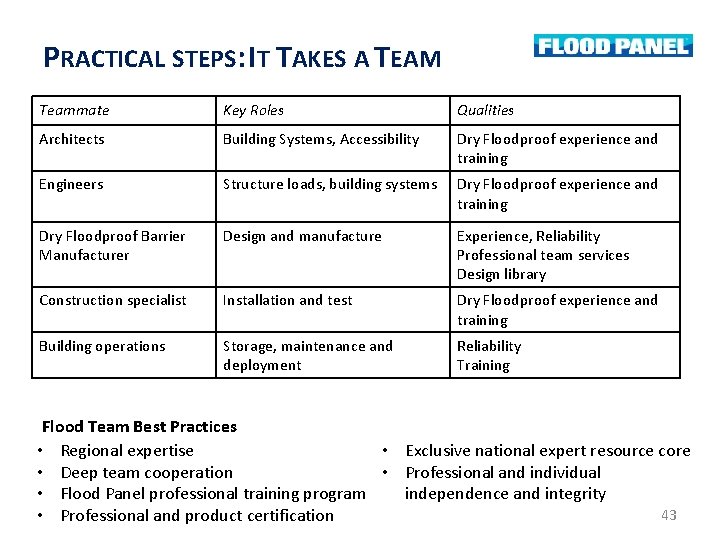
PRACTICAL STEPS: IT TAKES A TEAM Teammate Key Roles Qualities Architects Building Systems, Accessibility Dry Floodproof experience and training Engineers Structure loads, building systems Dry Floodproof experience and training Dry Floodproof Barrier Manufacturer Design and manufacture Experience, Reliability Professional team services Design library Construction specialist Installation and test Dry Floodproof experience and training Building operations Storage, maintenance and deployment Reliability Training Flood Team Best Practices • Regional expertise • Exclusive national expert resource core • Deep team cooperation • Professional and individual • Flood Panel professional training program independence and integrity 43 • Professional and product certification
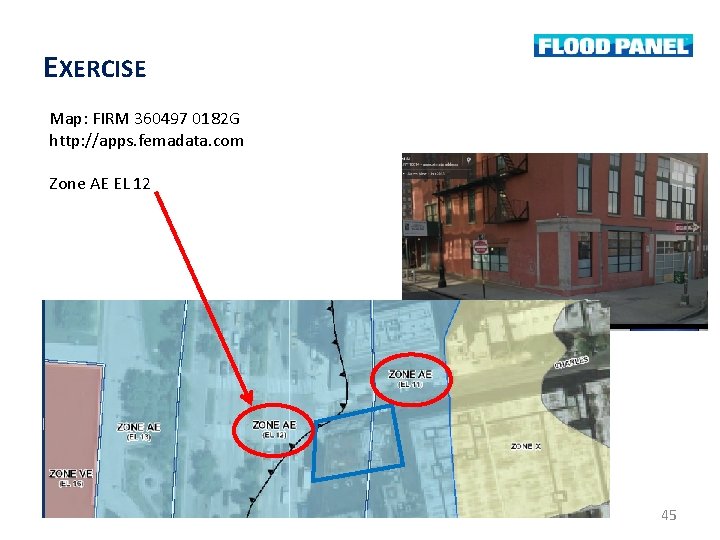
EXERCISE Your client: Charles and West St, NY Lowest floor elevation survey: 9 feet above NAVD 88 West St Find: Height above/below Base Flood Elevation s St Charle 44
EXERCISE Map: FIRM 360497 0182 G http: //apps. femadata. com Zone AE EL 12 45
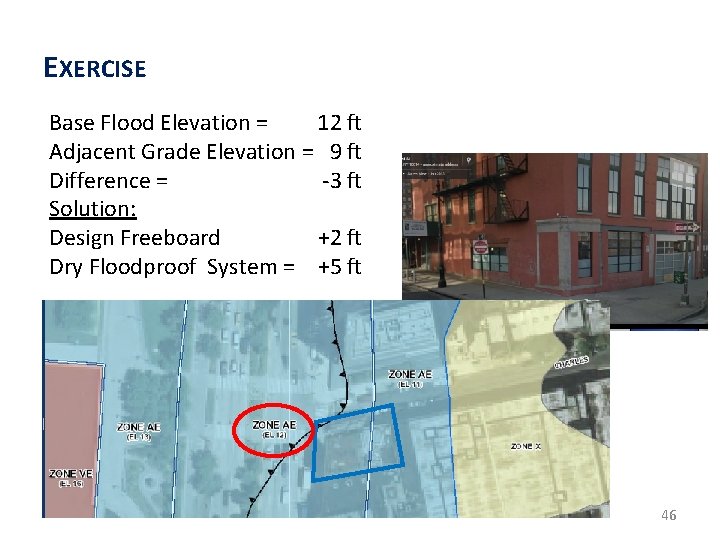
EXERCISE Base Flood Elevation = 12 ft Adjacent Grade Elevation = 9 ft Difference = -3 ft Solution: Design Freeboard +2 ft Dry Floodproof System = +5 ft 46
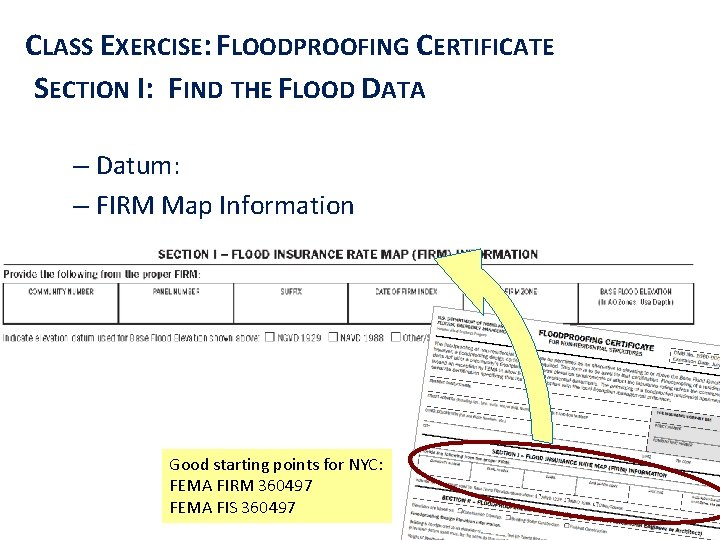
CLASS EXERCISE: FLOODPROOFING CERTIFICATE SECTION I: FIND THE FLOOD DATA – Datum: – FIRM Map Information Good starting points for NYC: FEMA FIRM 360497 FEMA FIS 360497 47
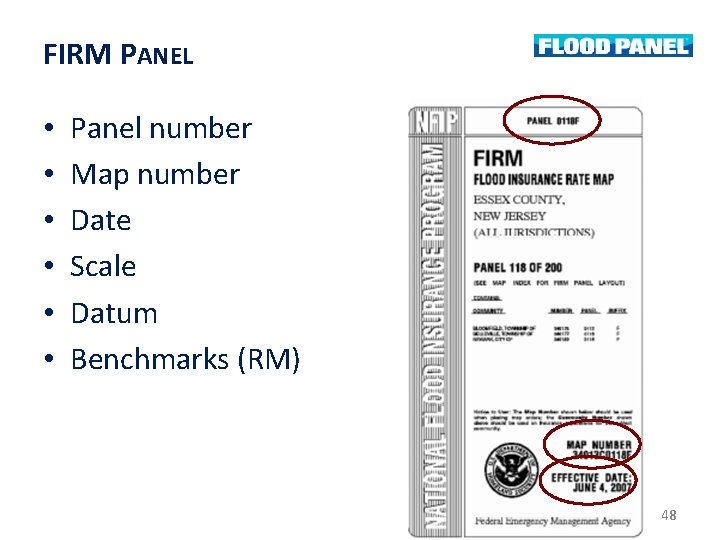
FIRM PANEL • • • Panel number Map number Date Scale Datum Benchmarks (RM) 48
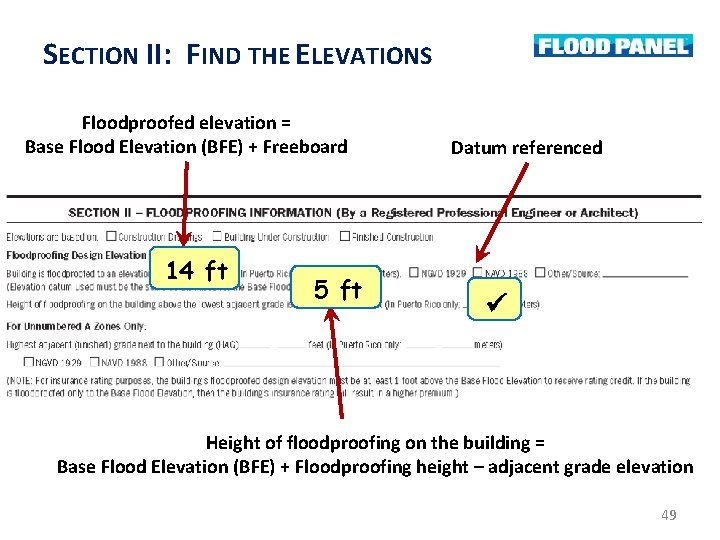
SECTION II: FIND THE ELEVATIONS Floodproofed elevation = Base Flood Elevation (BFE) + Freeboard 14 ft 5 ft Datum referenced Height of floodproofing on the building = Base Flood Elevation (BFE) + Floodproofing height – adjacent grade elevation 49
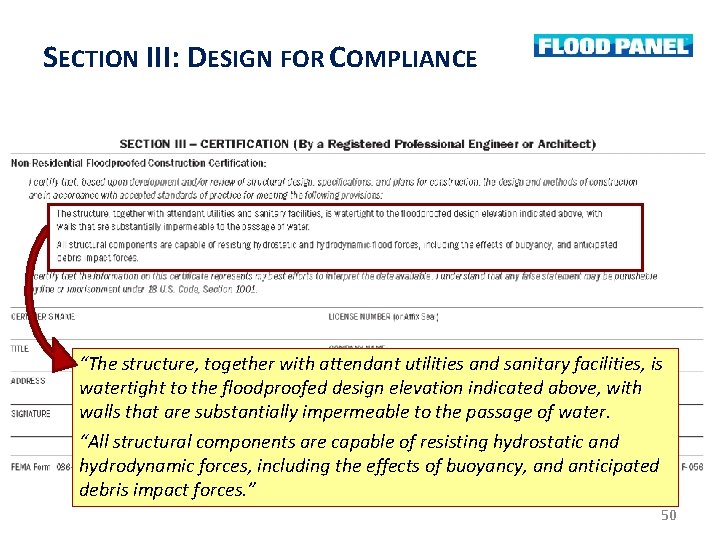
SECTION III: DESIGN FOR COMPLIANCE “The structure, together with attendant utilities and sanitary facilities, is watertight to the floodproofed design elevation indicated above, with walls that are substantially impermeable to the passage of water. “All structural components are capable of resisting hydrostatic and hydrodynamic forces, including the effects of buoyancy, and anticipated debris impact forces. ” 50
Contacts Address: Flood Panel 5500 Military Trail #22 -220 Jupiter, FL 33458 Tom Osborne, PE President / Engineering Office: 561 -744 -2727 tom@floodpanel. com Telephone: 1 -888 -744 -2607 (Toll Free) 1 -561 -744 -2727 (Phone) 1 -561 -744 -2755 (Fax) 51
Questions 52