
Floating Habitat Island for Salt MarshNesting Birds Bri
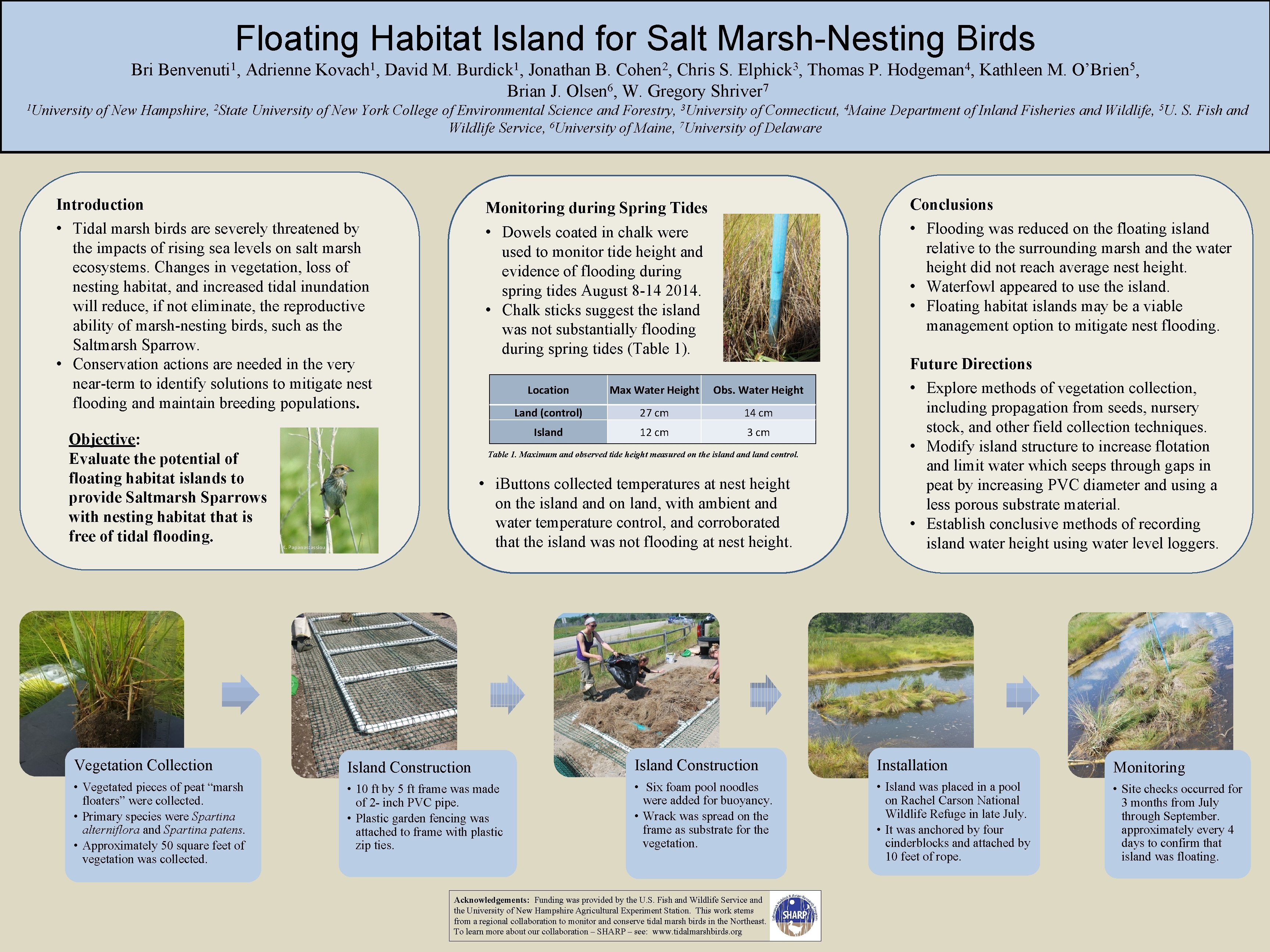
Floating Habitat Island for Salt Marsh-Nesting Birds Bri 1 University 1 Benvenuti , Adrienne 1 Kovach , David M. 1 Burdick , 2 Cohen , 3 Elphick , Jonathan B. Chris S. Brian J. Olsen 6, W. Gregory Shriver 7 Thomas P. 4 Hodgeman , Kathleen M. 5 O’Brien , of New Hampshire, 2 State University of New York College of Environmental Science and Forestry, 3 University of Connecticut, 4 Maine Department of Inland Fisheries and Wildlife, 5 U. S. Fish and Wildlife Service, 6 University of Maine, 7 University of Delaware Introduction • Tidal marsh birds are severely threatened by the impacts of rising sea levels on salt marsh ecosystems. Changes in vegetation, loss of nesting habitat, and increased tidal inundation will reduce, if not eliminate, the reproductive ability of marsh-nesting birds, such as the Saltmarsh Sparrow. • Conservation actions are needed in the very near-term to identify solutions to mitigate nest flooding and maintain breeding populations. Objective: Evaluate the potential of floating habitat islands to provide Saltmarsh Sparrows with nesting habitat that is free of tidal flooding. Conclusions • Flooding was reduced on the floating island relative to the surrounding marsh and the water height did not reach average nest height. • Waterfowl appeared to use the island. • Floating habitat islands may be a viable management option to mitigate nest flooding. Monitoring during Spring Tides • Dowels coated in chalk were used to monitor tide height and evidence of flooding during spring tides August 8 -14 2014. • Chalk sticks suggest the island was not substantially flooding during spring tides (Table 1). Location Max Water Height Obs. Water Height Land (control) 27 cm 14 cm Island 12 cm 3 cm Table 1. Maximum and observed tide height measured on the island control. • i. Buttons collected temperatures at nest height on the island on land, with ambient and water temperature control, and corroborated that the island was not flooding at nest height. K. Papanastassiou Future Directions • Explore methods of vegetation collection, including propagation from seeds, nursery stock, and other field collection techniques. • Modify island structure to increase flotation and limit water which seeps through gaps in peat by increasing PVC diameter and using a less porous substrate material. • Establish conclusive methods of recording island water height using water level loggers. Vegetation Collection Island Construction Installation Monitoring • Vegetated pieces of peat “marsh floaters” were collected. • Primary species were Spartina alterniflora and Spartina patens. • Approximately 50 square feet of vegetation was collected. • 10 ft by 5 ft frame was made of 2 - inch PVC pipe. • Plastic garden fencing was attached to frame with plastic zip ties. • Six foam pool noodles were added for buoyancy. • Wrack was spread on the frame as substrate for the vegetation. • Island was placed in a pool on Rachel Carson National Wildlife Refuge in late July. • It was anchored by four cinderblocks and attached by 10 feet of rope. • Site checks occurred for 3 months from July through September. approximately every 4 days to confirm that island was floating. Acknowledgements: Funding was provided by the U. S. Fish and Wildlife Service and the University of New Hampshire Agricultural Experiment Station. This work stems from a regional collaboration to monitor and conserve tidal marsh birds in the Northeast. To learn more about our collaboration – SHARP – see: www. tidalmarshbirds. org
- Slides: 1