
Floating Car Data Mining Identifying Vehicle Types in


- Slides: 40
Floating Car Data Mining: Identifying Vehicle Types in relation to Usage Patterns Danyang SUN Supervised by Fabien LEURENT Chaire Île-de-France Mobilités La conférence anniversaire Feb 11 th, 2019 Xiaoyan XIE 1
1 Introduction Background Mobility entities are more connected FCD → detailed traces of the vehicle movement By mining→ understand vehicle mobility 2
1 Introduction Objectives To recover information from FCD to explore mobility patterns Identify vehicle types in terms of activity context Assess the type association to the use of different classes of roadways 3
Introduction Data Reconstitution Descriptive Analysis Contents Type Identification Roadway Usage Assessment Conclusion and Discussions 4
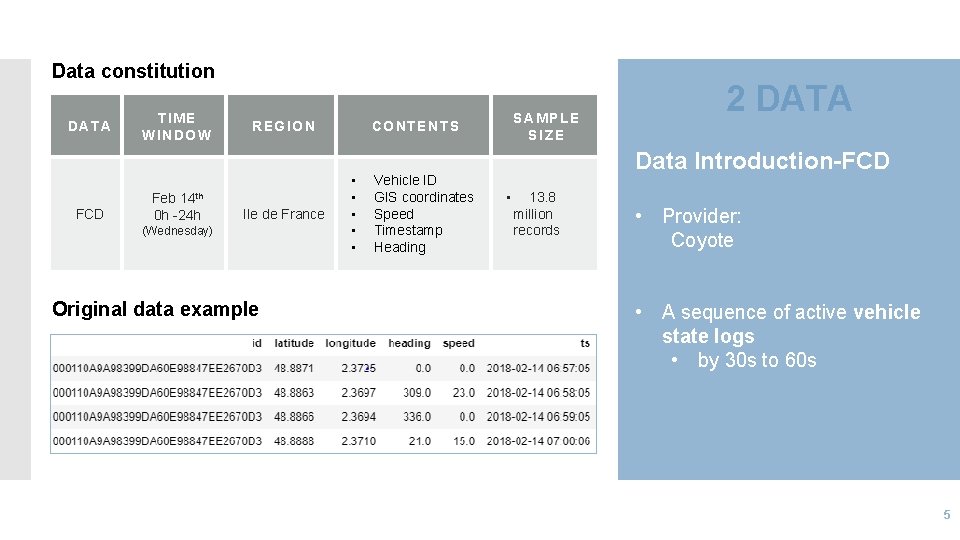
Data constitution DATA FCD TIME WINDOW Feb 14 th 0 h -24 h REGION Ile de France (Wednesday) Original data example SAMPLE SIZE CONTENTS • • • Vehicle ID GIS coordinates Speed Timestamp Heading 2 DATA Data Introduction-FCD • 13. 8 million records • Provider: Coyote • A sequence of active vehicle state logs • by 30 s to 60 s 5
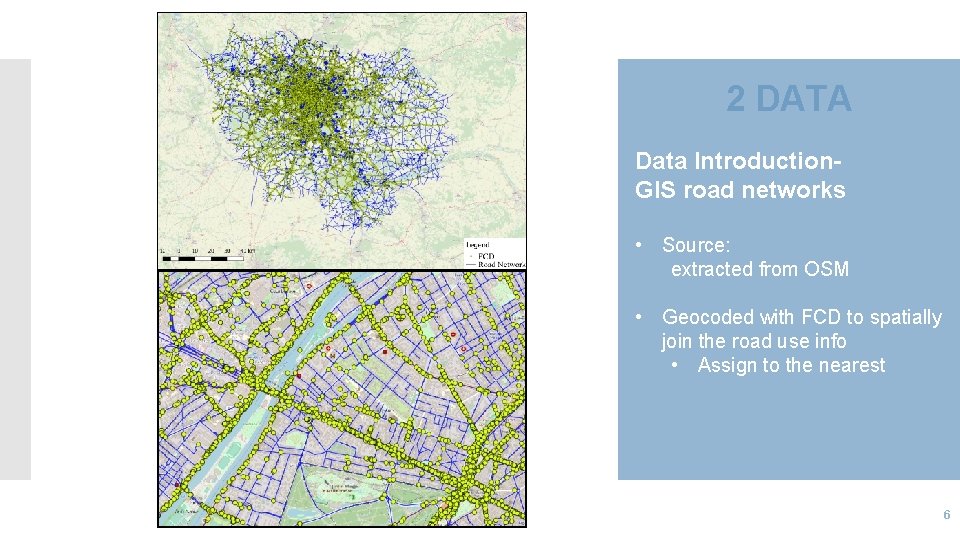
2 DATA Data Introduction. GIS road networks • Source: extracted from OSM • Geocoded with FCD to spatially join the road use info • Assign to the nearest 6
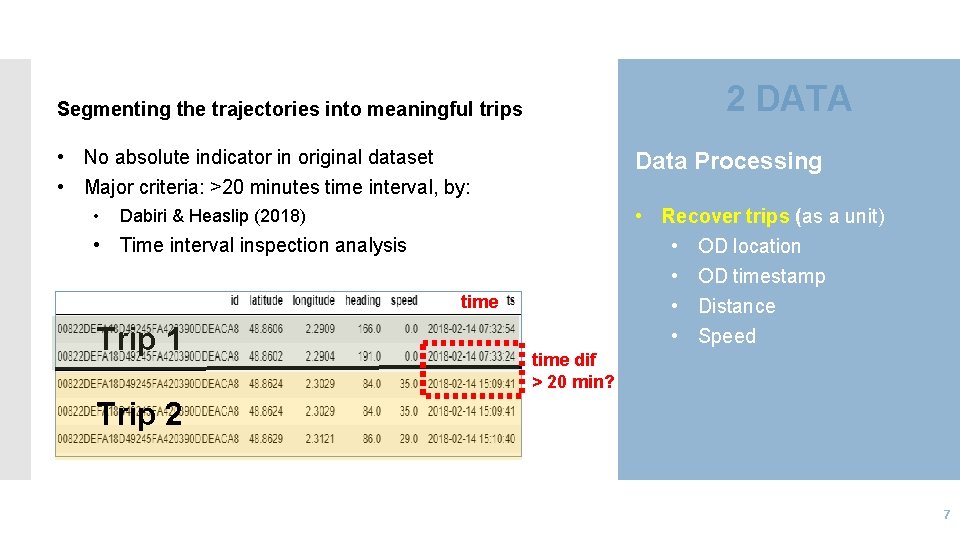
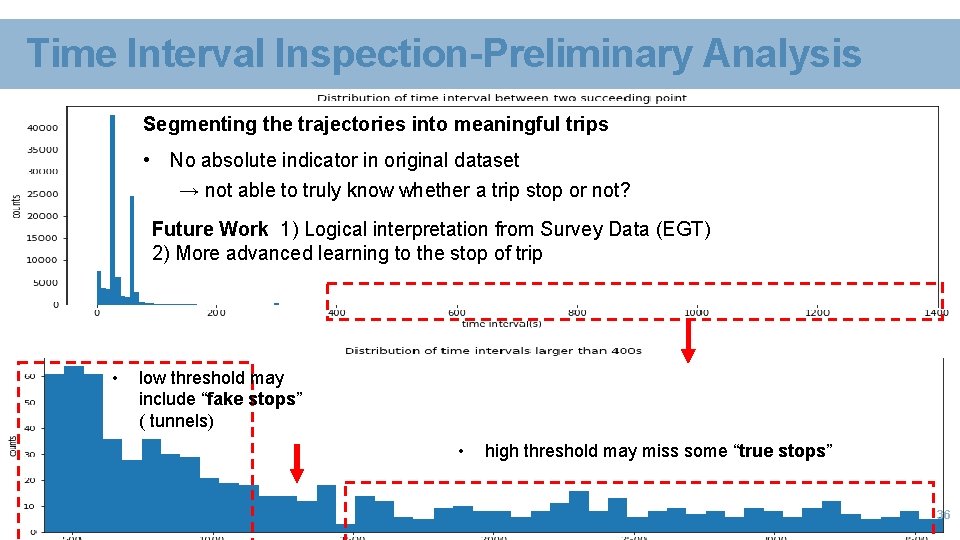
2 DATA Segmenting the trajectories into meaningful trips • No absolute indicator in original dataset • Major criteria: >20 minutes time interval, by: • Data Processing • Recover trips (as a unit) • OD location • OD timestamp • Distance • Speed Dabiri & Heaslip (2018) • Time interval inspection analysis time Trip 1 time dif > 20 min? Trip 2 7
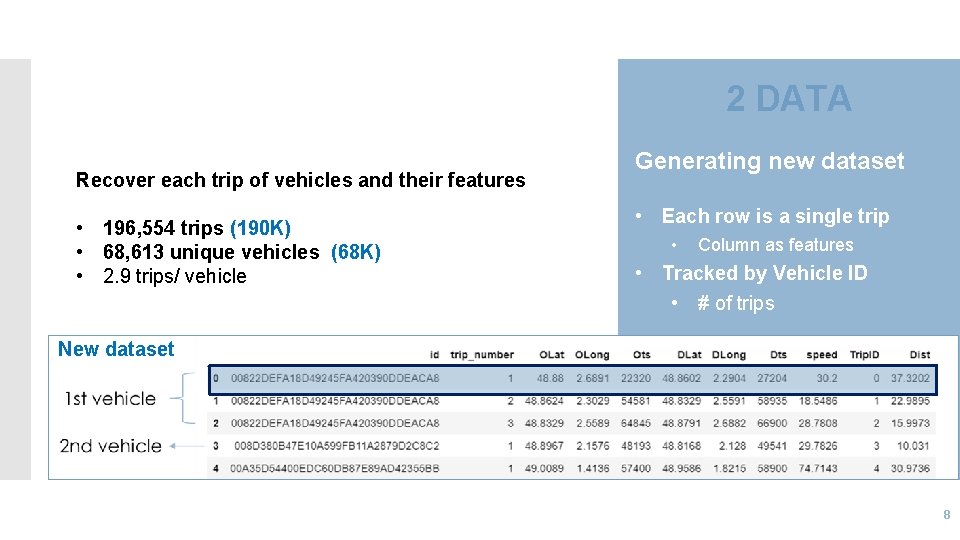
2 DATA Recover each trip of vehicles and their features • 196, 554 trips (190 K) • 68, 613 unique vehicles (68 K) • 2. 9 trips/ vehicle Generating new dataset • Each row is a single trip • Column as features • Tracked by Vehicle ID • # of trips New dataset 8
Introduction Data Reconstitution Descriptive Analysis Contents Type Identification Roadway Usage Assessment Conclusion and Discussions 9
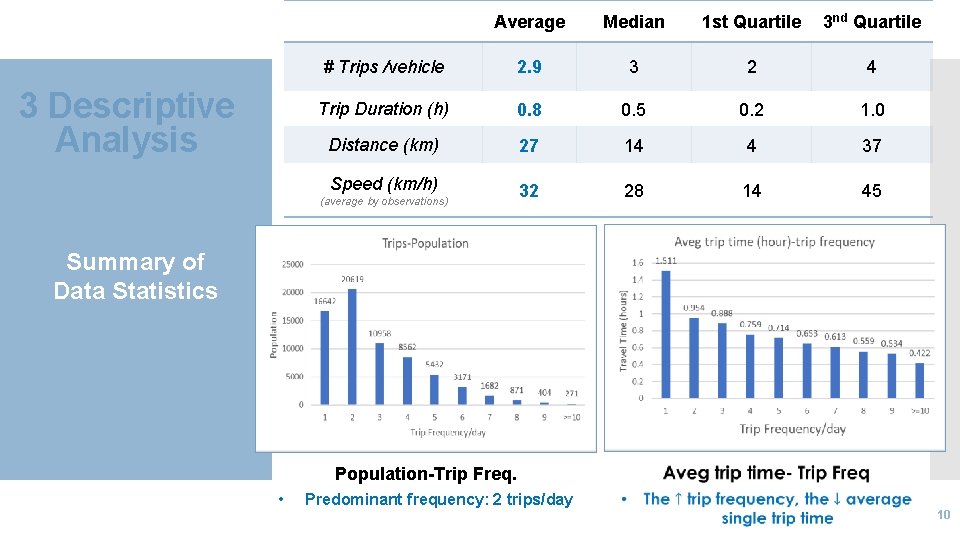
3 Descriptive Analysis Average Median 1 st Quartile 3 nd Quartile # Trips /vehicle 2. 9 3 2 4 Trip Duration (h) 0. 8 0. 5 0. 2 1. 0 Distance (km) 27 14 4 37 Speed (km/h) 32 28 14 45 (average by observations) Summary of Data Statistics Population-Trip Freq. • Predominant frequency: 2 trips/day 10
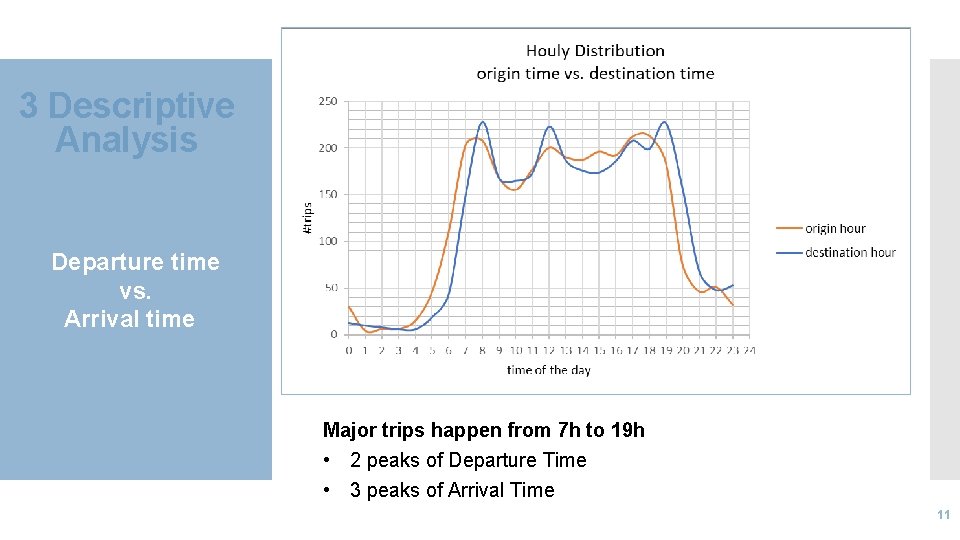
3 Descriptive Analysis Departure time vs. Arrival time Major trips happen from 7 h to 19 h • 2 peaks of Departure Time • 3 peaks of Arrival Time 11
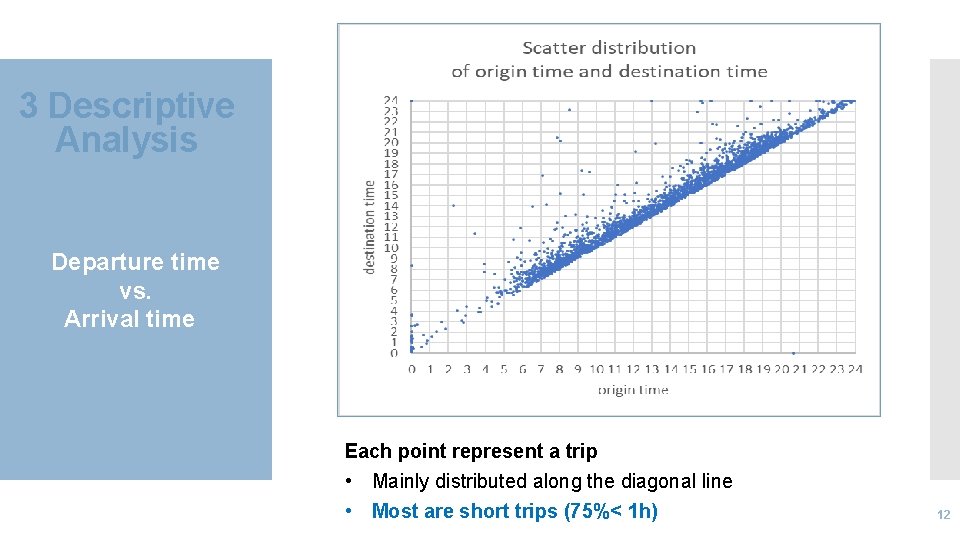
3 Descriptive Analysis Departure time vs. Arrival time Each point represent a trip • Mainly distributed along the diagonal line • Most are short trips (75%< 1 h) 12
Introduction Data Reconstitution Descriptive Analysis Contents Type Identification Roadway Usage Assessment Conclusion and Discussions 13
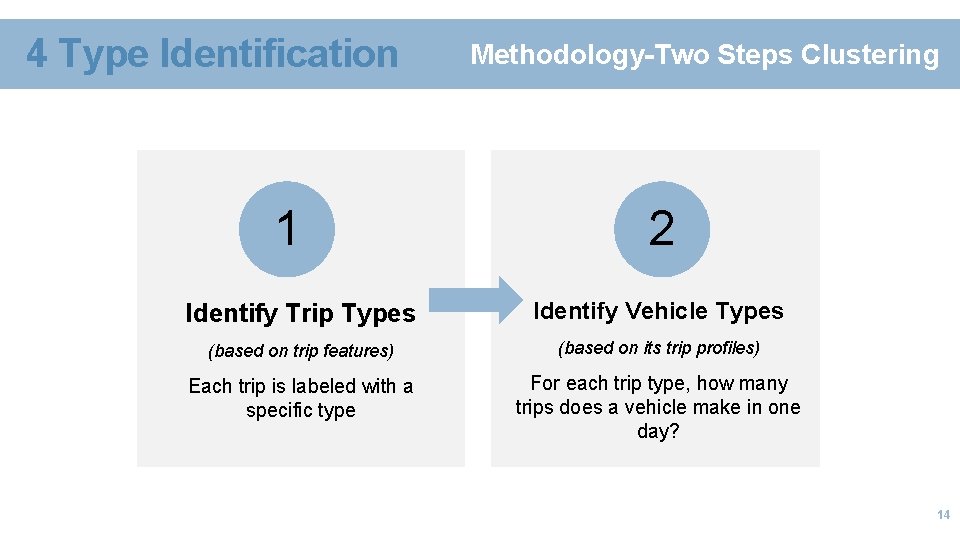
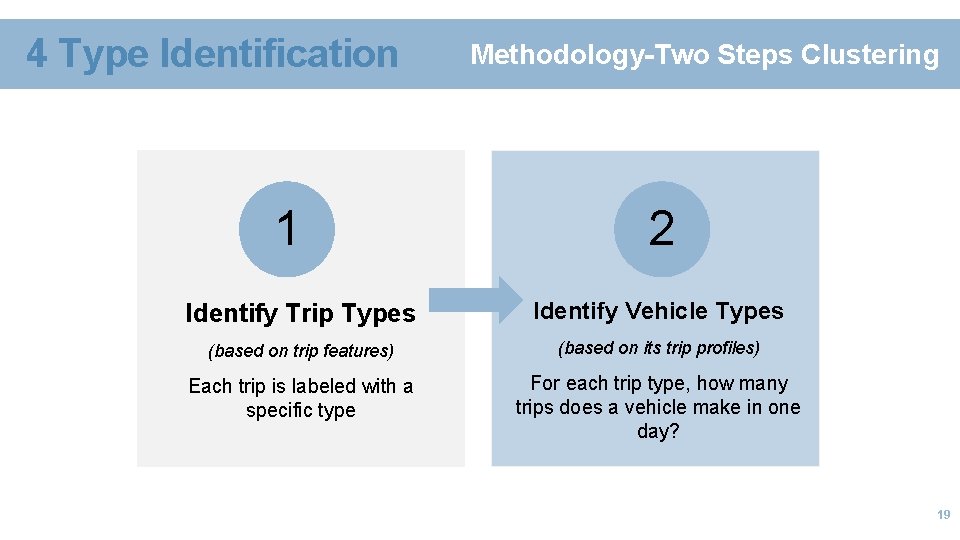
4 Type Identification 1 Methodology-Two Steps Clustering 2 Identify Trip Types Identify Vehicle Types (based on trip features) (based on its trip profiles) Each trip is labeled with a specific type For each trip type, how many trips does a vehicle make in one day? 14
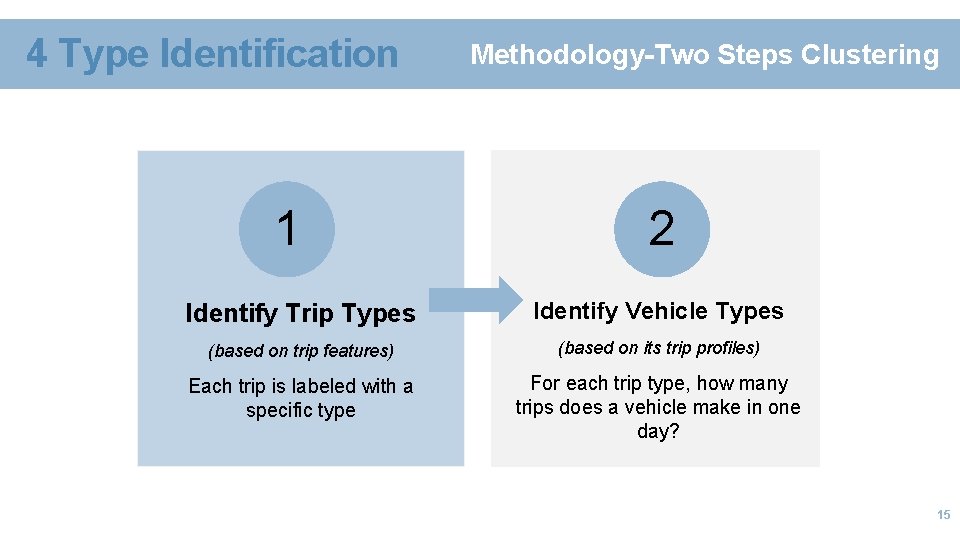
4 Type Identification 1 Methodology-Two Steps Clustering 2 Identify Trip Types Identify Vehicle Types (based on trip features) (based on its trip profiles) Each trip is labeled with a specific type For each trip type, how many trips does a vehicle make in one day? 15
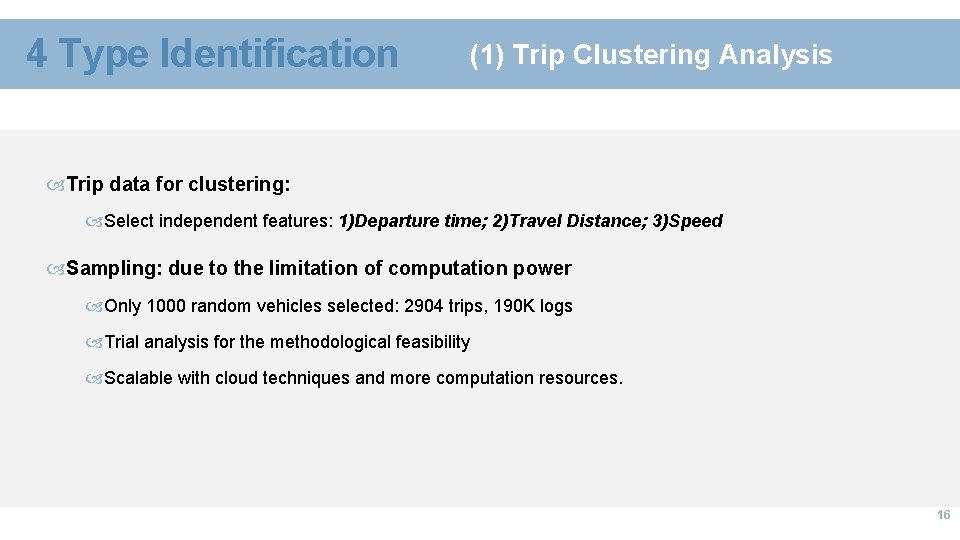
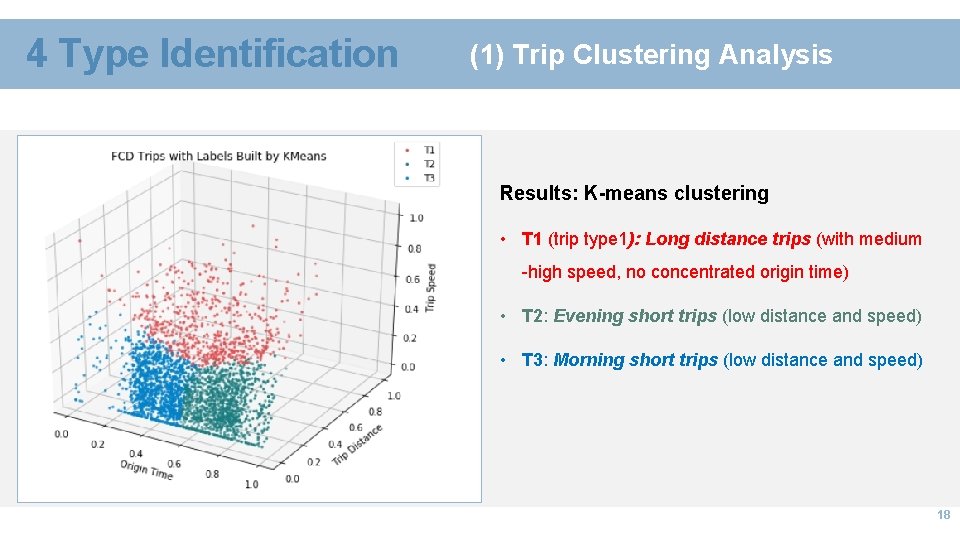
4 Type Identification (1) Trip Clustering Analysis Trip data for clustering: Select independent features: 1)Departure time; 2)Travel Distance; 3)Speed Sampling: due to the limitation of computation power Only 1000 random vehicles selected: 2904 trips, 190 K logs Trial analysis for the methodological feasibility Scalable with cloud techniques and more computation resources. 16
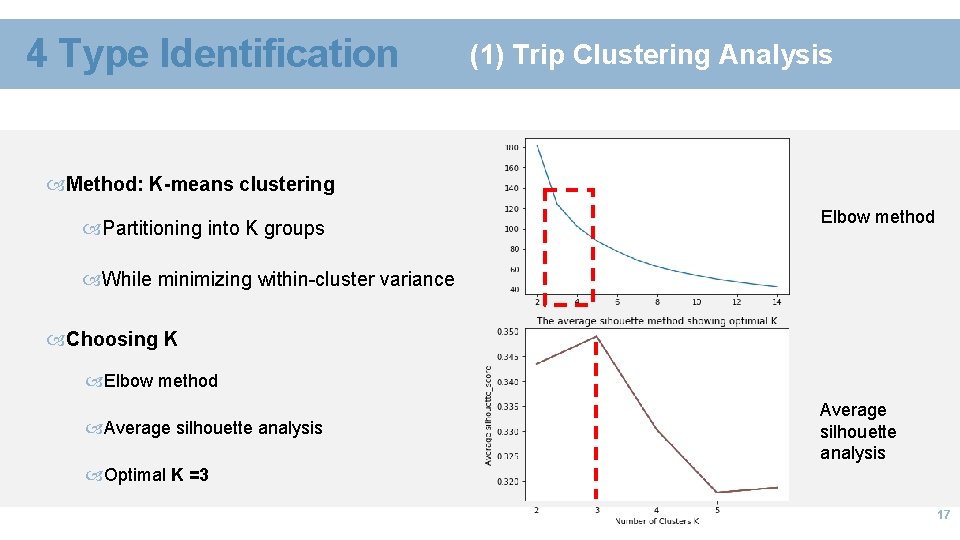
4 Type Identification (1) Trip Clustering Analysis Method: K-means clustering Partitioning into K groups Elbow method While minimizing within-cluster variance Choosing K Elbow method Average silhouette analysis Optimal K =3 17
4 Type Identification (1) Trip Clustering Analysis Results: K-means clustering • T 1 (trip type 1): Long distance trips (with medium -high speed, no concentrated origin time) • T 2: Evening short trips (low distance and speed) • T 3: Morning short trips (low distance and speed) 18
4 Type Identification 1 Methodology-Two Steps Clustering 2 Identify Trip Types Identify Vehicle Types (based on trip features) (based on its trip profiles) Each trip is labeled with a specific type For each trip type, how many trips does a vehicle make in one day? 19
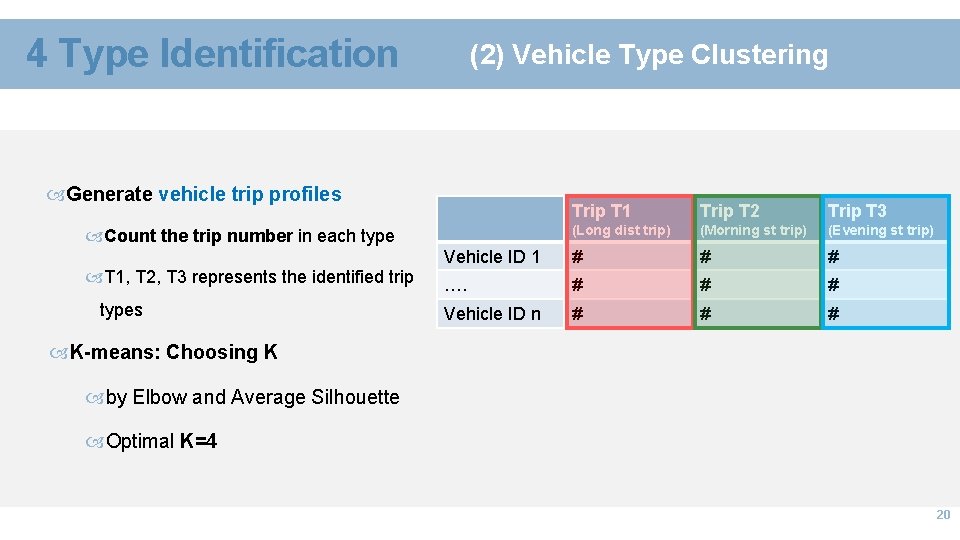
4 Type Identification (2) Vehicle Type Clustering Generate vehicle trip profiles Trip T 1 Trip T 2 Trip T 3 (Long dist trip) (Morning st trip) (Evening st trip) Vehicle ID 1 # # # …. # # # Vehicle ID n # # # Count the trip number in each type T 1, T 2, T 3 represents the identified trip types K-means: Choosing K by Elbow and Average Silhouette Optimal K=4 20
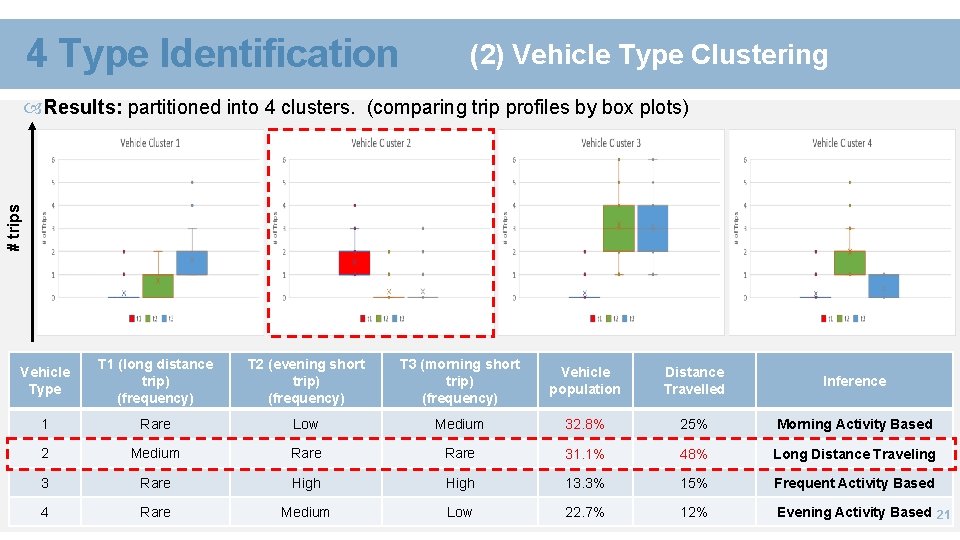
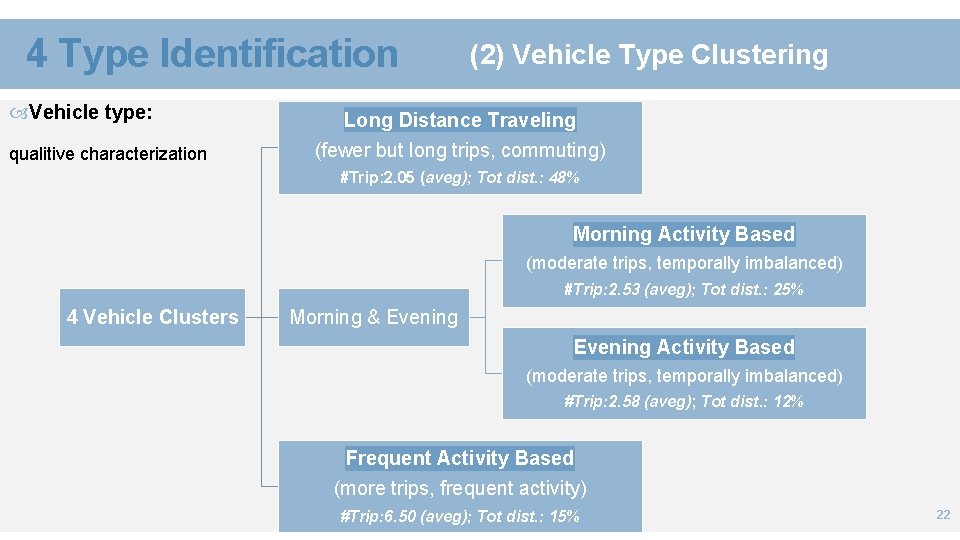
4 Type Identification (2) Vehicle Type Clustering # trips Results: partitioned into 4 clusters. (comparing trip profiles by box plots) Vehicle Type T 1 (long distance trip) (frequency) T 2 (evening short trip) (frequency) T 3 (morning short trip) (frequency) Vehicle population Distance Travelled Inference 1 Rare Low Medium 32. 8% 25% Morning Activity Based 2 Medium Rare 31. 1% 48% Long Distance Traveling 3 Rare High 13. 3% 15% Frequent Activity Based 4 Rare Medium Low 22. 7% 12% Evening Activity Based 21
4 Type Identification Vehicle type: qualitive characterization (2) Vehicle Type Clustering Long Distance Traveling (fewer but long trips, commuting) #Trip: 2. 05 (aveg); Tot dist. : 48% Morning Activity Based (moderate trips, temporally imbalanced) #Trip: 2. 53 (aveg); Tot dist. : 25% 4 Vehicle Clusters Morning & Evening Activity Based (moderate trips, temporally imbalanced) #Trip: 2. 58 (aveg); Tot dist. : 12% Frequent Activity Based (more trips, frequent activity) #Trip: 6. 50 (aveg); Tot dist. : 15% 22
Introduction Data Reconstitution Descriptive Analysis Contents Type Identification Roadway Usage Assessment Conclusion and Discussions 23
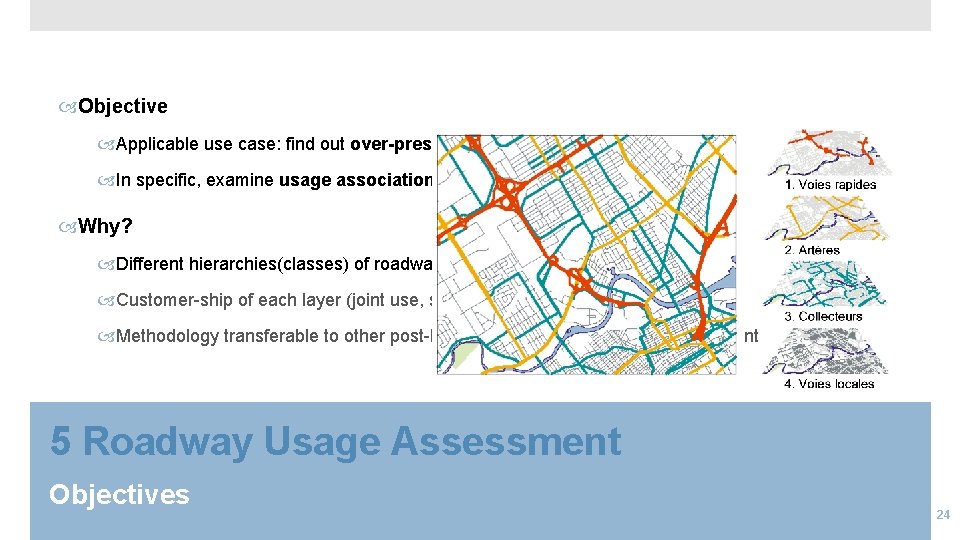
Objective Applicable use case: find out over-presented outcomes of certain types In specific, examine usage association to different classes of roadways Why? Different hierarchies(classes) of roadways Customer-ship of each layer (joint use, splits of vehicles) Methodology transferable to other post-behavior performance (violation, accidents) 5 Roadway Usage Assessment Objectives 24
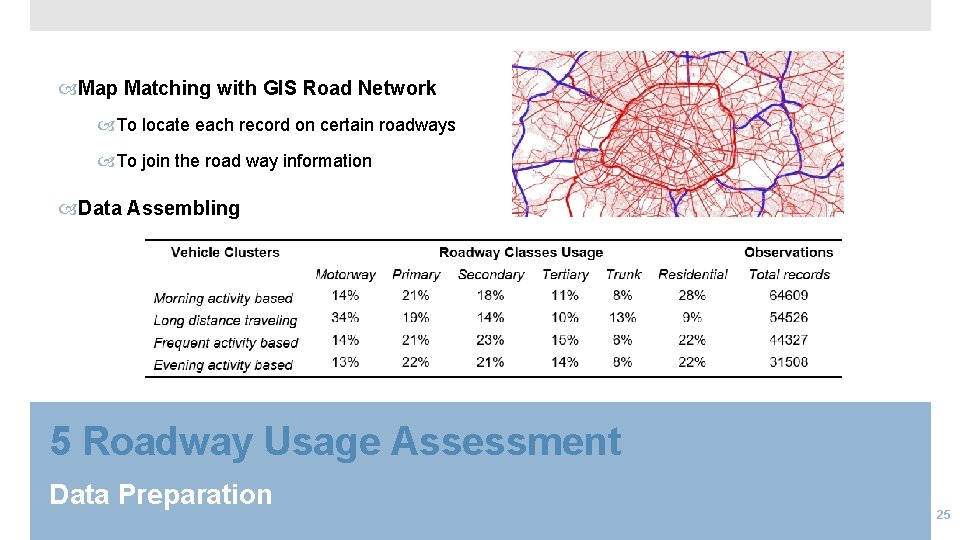
Map Matching with GIS Road Network To locate each record on certain roadways To join the road way information Data Assembling 5 Roadway Usage Assessment Data Preparation 25
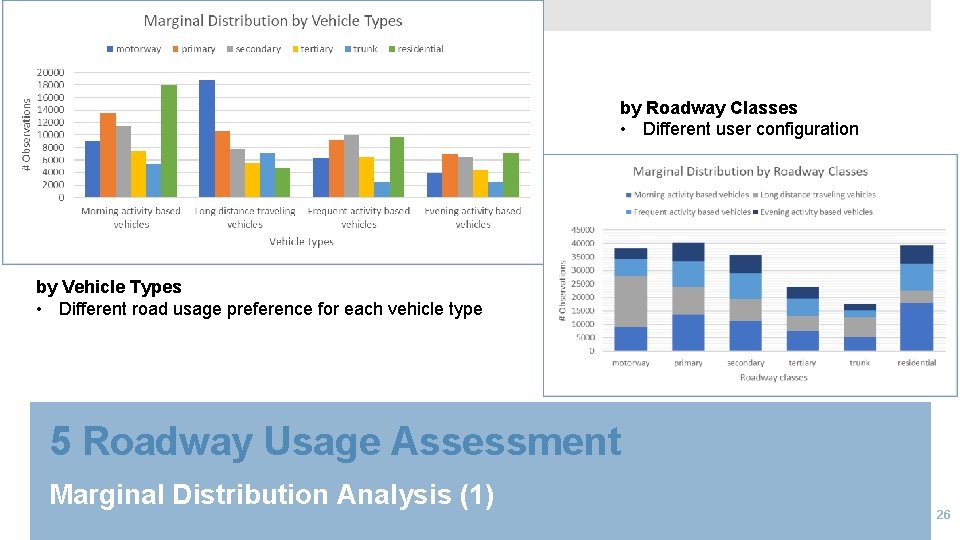
by Roadway Classes • Different user configuration by Vehicle Types • Different road usage preference for each vehicle type 5 Roadway Usage Assessment Marginal Distribution Analysis (1) 26
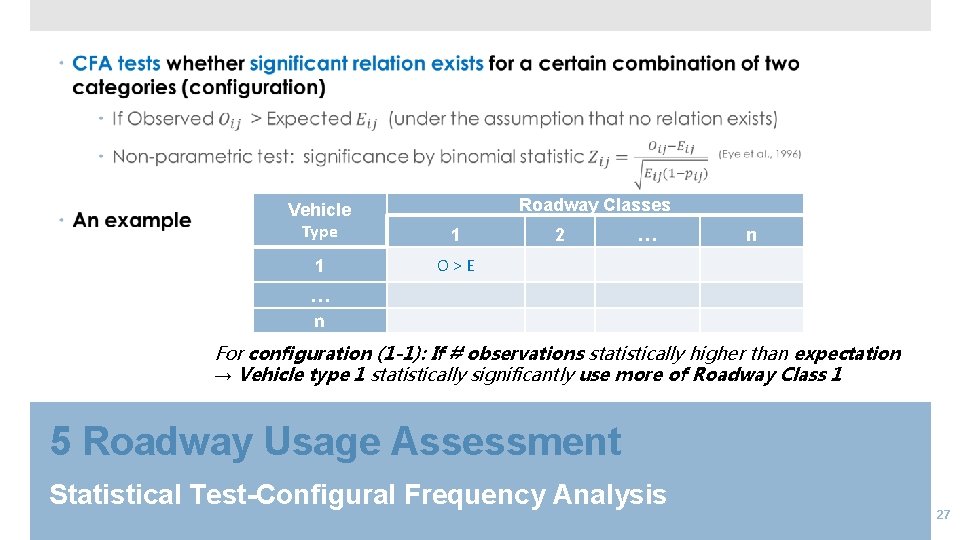
Roadway Classes Vehicle Type 1 1 O>E 2 … n For configuration (1 -1): If # observations statistically higher than expectation → Vehicle type 1 statistically significantly use more of Roadway Class 1 5 Roadway Usage Assessment Statistical Test-Configural Frequency Analysis 27
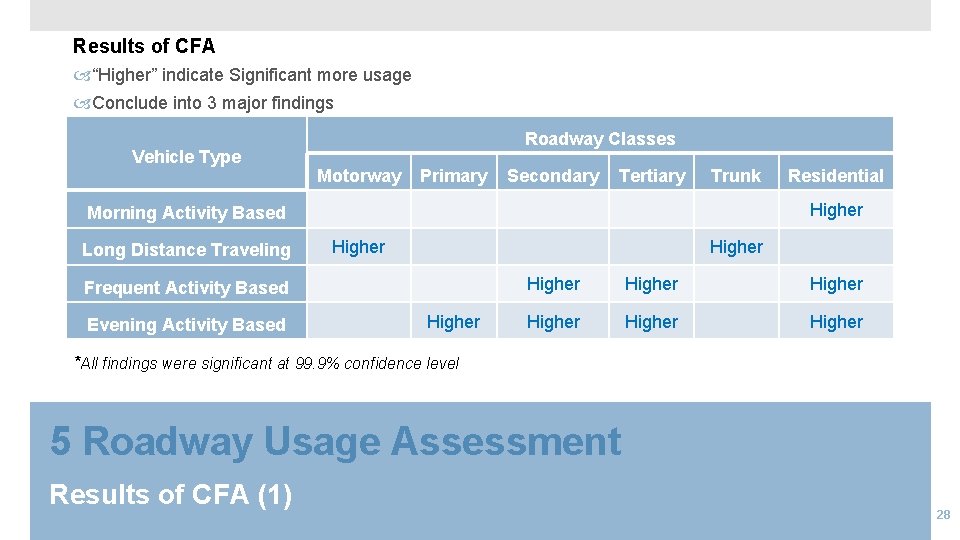
Results of CFA “Higher” indicate Significant more usage Conclude into 3 major findings Vehicle Type Roadway Classes Motorway Primary Secondary Tertiary Trunk Higher Morning Activity Based Long Distance Traveling Higher Frequent Activity Based Evening Activity Based Residential Higher Higher *All findings were significant at 99. 9% confidence level 5 Roadway Usage Assessment Results of CFA (1) 28
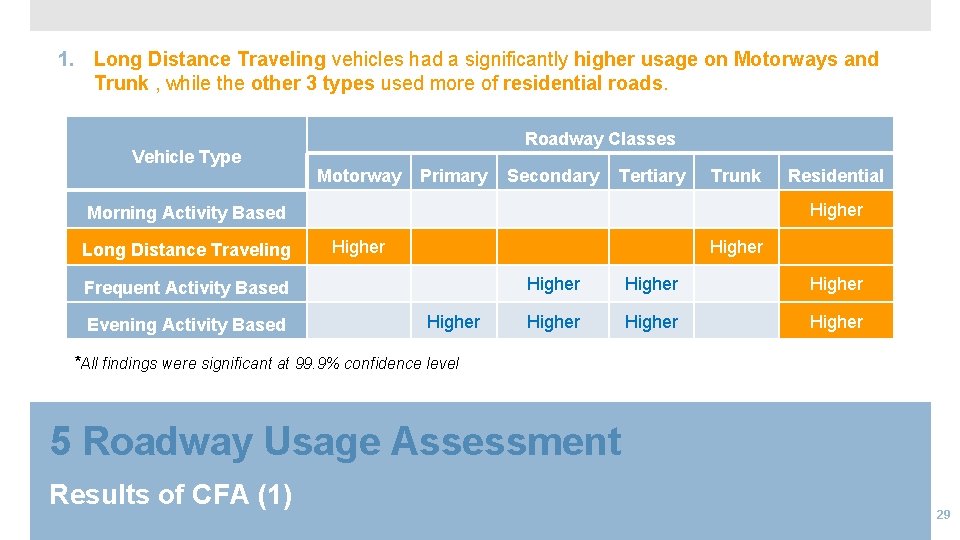
1. Long Distance Traveling vehicles had a significantly higher usage on Motorways and Trunk , while the other 3 types used more of residential roads. Vehicle Type Roadway Classes Motorway Primary Secondary Tertiary Trunk Higher Morning Activity Based Long Distance Traveling Higher Frequent Activity Based Evening Activity Based Residential Higher Higher *All findings were significant at 99. 9% confidence level 5 Roadway Usage Assessment Results of CFA (1) 29
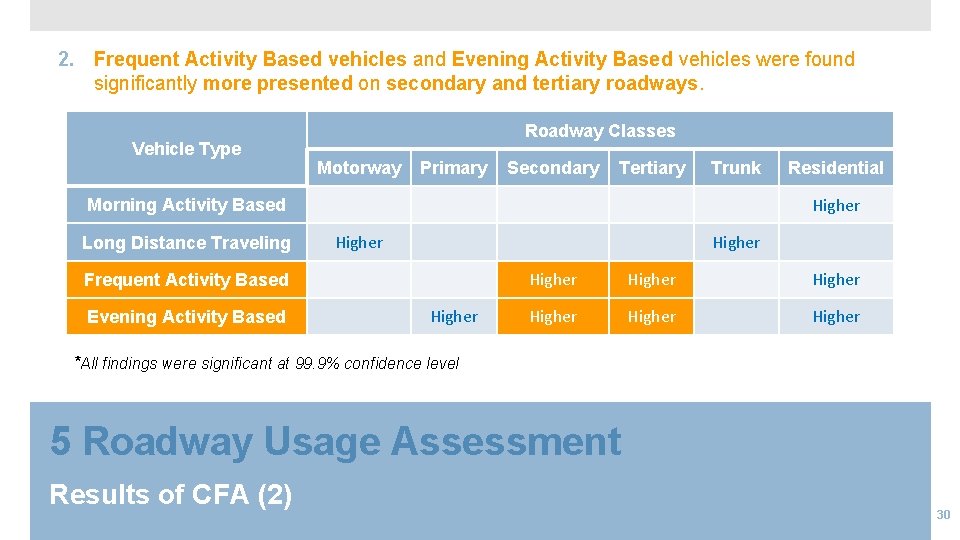
2. Frequent Activity Based vehicles and Evening Activity Based vehicles were found significantly more presented on secondary and tertiary roadways. Vehicle Type Roadway Classes Motorway Primary Secondary Tertiary Trunk Higher Morning Activity Based Long Distance Traveling Higher Frequent Activity Based Evening Activity Based Residential Higher Higher *All findings were significant at 99. 9% confidence level 5 Roadway Usage Assessment Results of CFA (2) 30
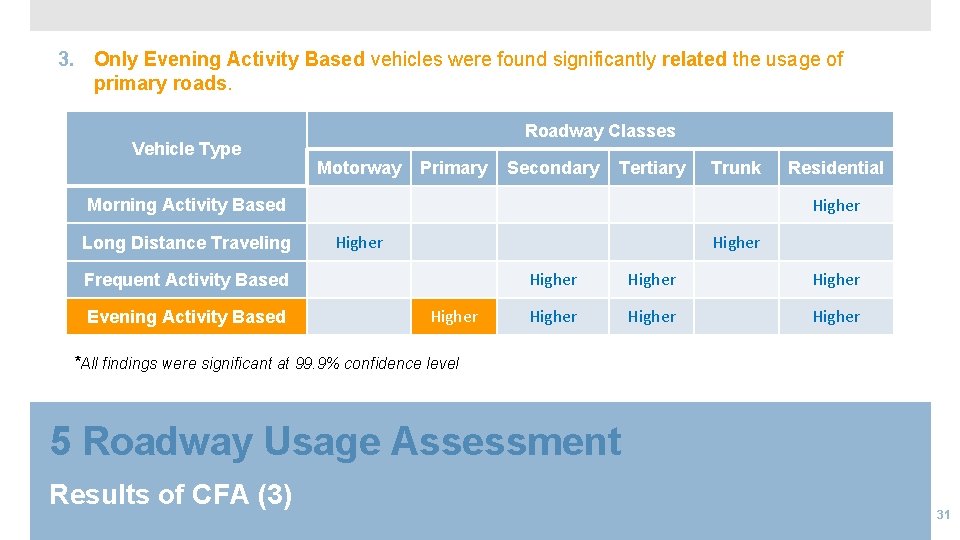
3. Only Evening Activity Based vehicles were found significantly related the usage of primary roads. Vehicle Type Roadway Classes Motorway Primary Secondary Tertiary Trunk Higher Morning Activity Based Long Distance Traveling Higher Frequent Activity Based Evening Activity Based Residential Higher Higher *All findings were significant at 99. 9% confidence level 5 Roadway Usage Assessment Results of CFA (3) 31
Introduction Data Reconstitution Descriptive Analysis Contents Type Identification Roadway Usage Assessment Conclusion and Discussions 32
Conclusion: Findings of social facts 4 major vehicle types can be identified based on mobility patterns using FCD over the Ile de France region, The 2 leading types are Morning Activity Based vehicles (32. 8% population) and Long Distance Traveling vehicles (31. 1% population) Different types had significantly different usage along different classes of roadways 33
Limitations and Future Work Extending analysis scope spatially and temporally Day to day analysis Inter-city mobility patterns Integrate with other data source/ analysis to better recover the mobility context Land use; City structure; Household Survey, etc. More comprehensive data mining methods and big data techniques Better accuracy & Higher efficiency 34
Thank you for your attention! 35
Time Interval Inspection-Preliminary Analysis Segmenting the trajectories into meaningful trips • No absolute indicator in original dataset → not able to truly know whether a trip stop or not? Future Work 1) Logical interpretation from Survey Data (EGT) 2) More advanced learning to the stop of trip • low threshold may include “fake stops” ( tunnels) • high threshold may miss some “true stops” 36
1 Introduction Background Digital revolutions → profound changes with massive data Mobility entities connected → geo-locations all day long Fundamental knowledge → understand mobility in space and time 37
1 Introduction Floating Car Data: a “new” solution to data availability “concern” Essence: vehicle traces via onboard GPS (Tomtom, Coyote) Info: localization+Instantaneous state by every minitute “New” : growing diffusion → massively available nowadays Cost-effective & Rich information High spatial-temporal coverage Detailed routes and up-to-date mobility demand 38
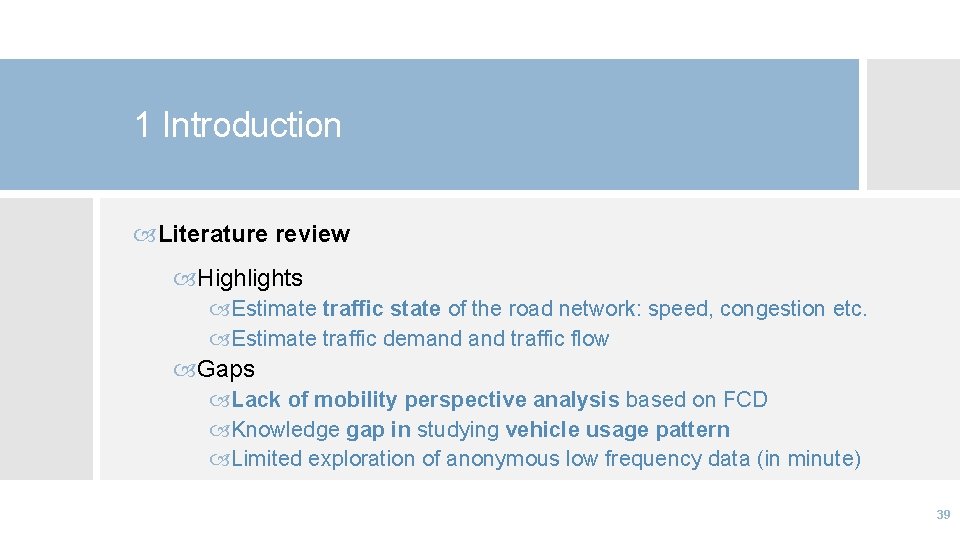
1 Introduction Literature review Highlights Estimate traffic state of the road network: speed, congestion etc. Estimate traffic demand traffic flow Gaps Lack of mobility perspective analysis based on FCD Knowledge gap in studying vehicle usage pattern Limited exploration of anonymous low frequency data (in minute) 39
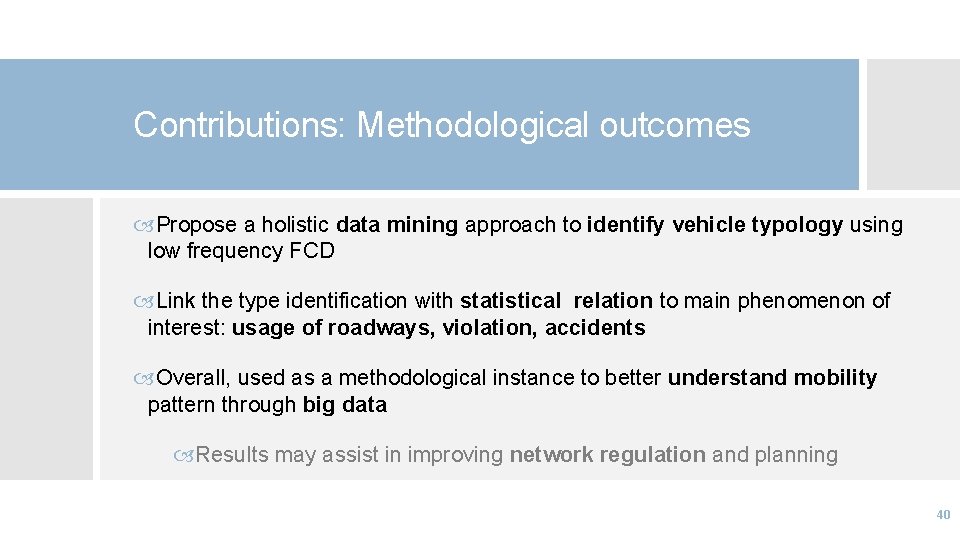
Contributions: Methodological outcomes Propose a holistic data mining approach to identify vehicle typology using low frequency FCD Link the type identification with statistical relation to main phenomenon of interest: usage of roadways, violation, accidents Overall, used as a methodological instance to better understand mobility pattern through big data Results may assist in improving network regulation and planning 40