
Flipping Bits in Memory Without Accessing Them An
Flipping Bits in Memory Without Accessing Them: An Experimental Study of DRAM Disturbance Errors Yoongu Kim 1 Ross Daly* Jeremie Kim 1 Chris Fallin* Ji Hye Lee 1 Donghyuk Lee 1 Chris Wilkerson 2 Konrad Lai Onur Mutlu 1 1 Carnegie Mellon University 2 Intel Labs *work done while at Carnegie Mellon University Lukas Gygi | 10/10/2019 | 1
ROW HAM MER Lukas Gygi | 10/10/2019 | 2
Background, Problems & Goals Novelty Key Approach & Ideas Test Mechanics Takeaway Summary Strengths & Weaknesses Further Work, Thoughts, Ideas Discussion Lukas Gygi | 10/10/2019 | 3
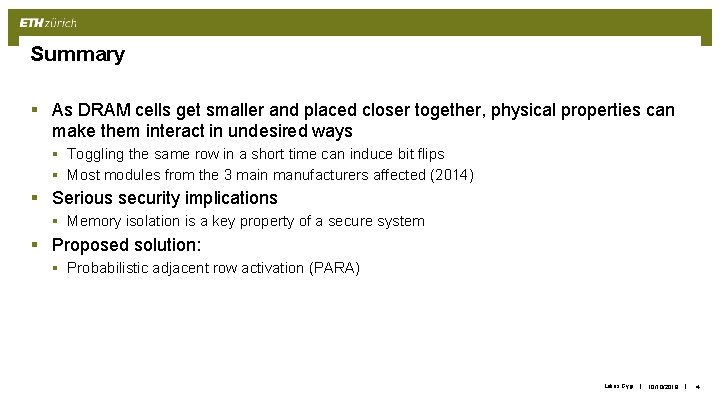
Summary § As DRAM cells get smaller and placed closer together, physical properties can make them interact in undesired ways § Toggling the same row in a short time can induce bit flips § Most modules from the 3 main manufacturers affected (2014) § Serious security implications § Memory isolation is a key property of a secure system § Proposed solution: § Probabilistic adjacent row activation (PARA) Lukas Gygi | 10/10/2019 | 4
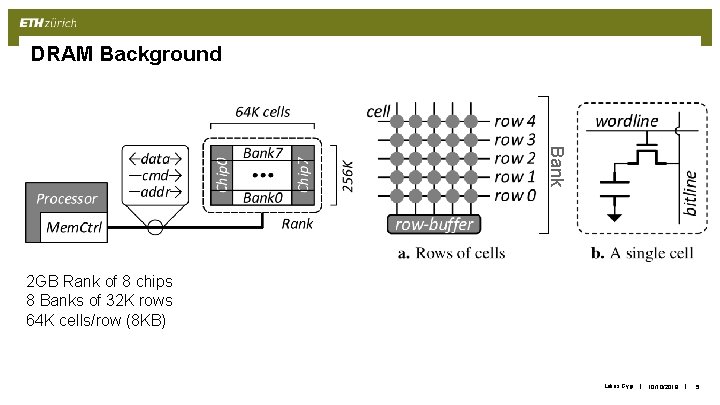
DRAM Background Bank 2 GB Rank of 8 chips 8 Banks of 32 K rows 64 K cells/row (8 KB) Lukas Gygi | 10/10/2019 | 5
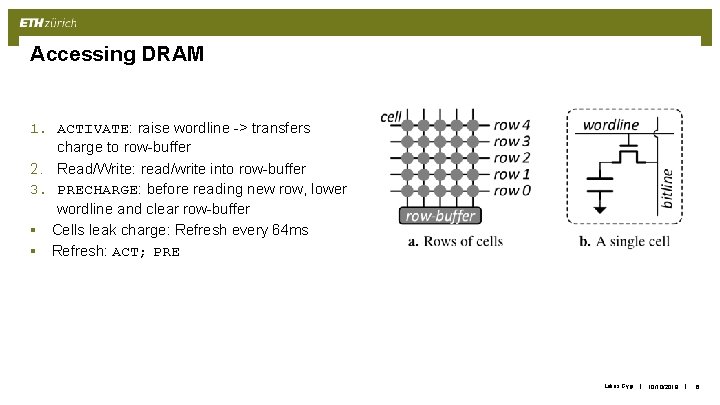
Accessing DRAM 1. ACTIVATE: raise wordline -> transfers charge to row-buffer 2. Read/Write: read/write into row-buffer 3. PRECHARGE: before reading new row, lower wordline and clear row-buffer § Cells leak charge: Refresh every 64 ms § Refresh: ACT; PRE Lukas Gygi | 10/10/2019 | 6
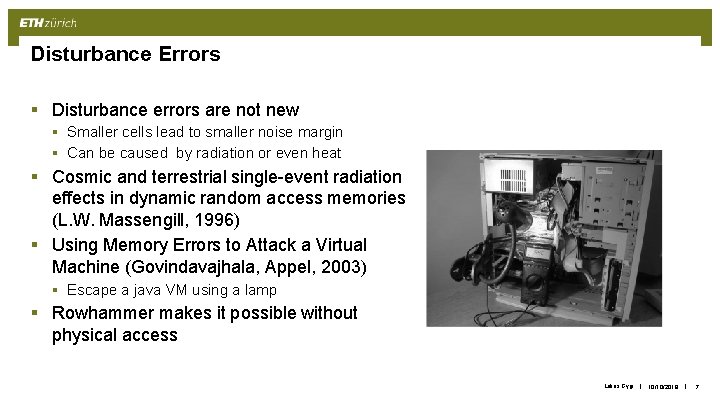
Disturbance Errors § Disturbance errors are not new § Smaller cells lead to smaller noise margin § Can be caused by radiation or even heat § Cosmic and terrestrial single-event radiation effects in dynamic random access memories (L. W. Massengill, 1996) § Using Memory Errors to Attack a Virtual Machine (Govindavajhala, Appel, 2003) § Escape a java VM using a lamp § Rowhammer makes it possible without physical access Lukas Gygi | 10/10/2019 | 7
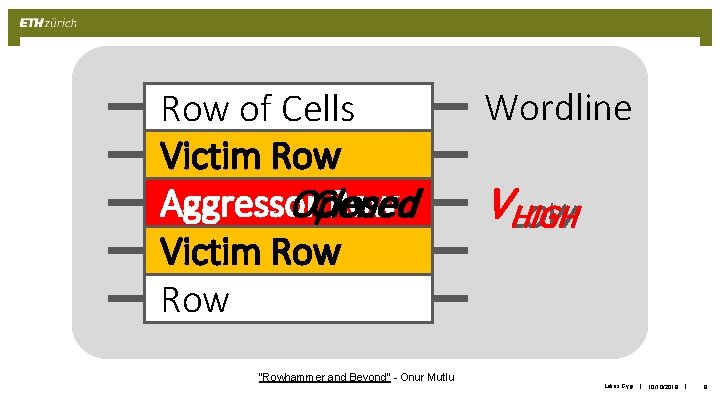
Row of Cells Row Victim Row Opened Aggressor Row Closed Row Victim Row "Rowhammer and Beyond“ - Onur Mutlu Wordline VHIGH LOW Lukas Gygi | 10/10/2019 | 8
Background, Problems & Goals Novelty Key Approach & Ideas Test Mechanics Results Summary Strengths & Weaknesses Further Work, Thoughts, Ideas Takeaway Discussion Lukas Gygi | 10/10/2019 | 9
Novelty § § § Demonstration on real, off-the shelf hardware Shows how widespread the problem of row-hammer is Called a lot of attention to this problem First example of a widespread hardware security issue Novel solution with probabilistic activation Lukas Gygi | 10/10/2019 | 10
Background, Problems & Goals Novelty Key Approach & Ideas Test Mechanics Results Takeaway Strengths & Weaknesses Further Work, Thoughts, Ideas Discussion Lukas Gygi | 10/10/2019 | 11
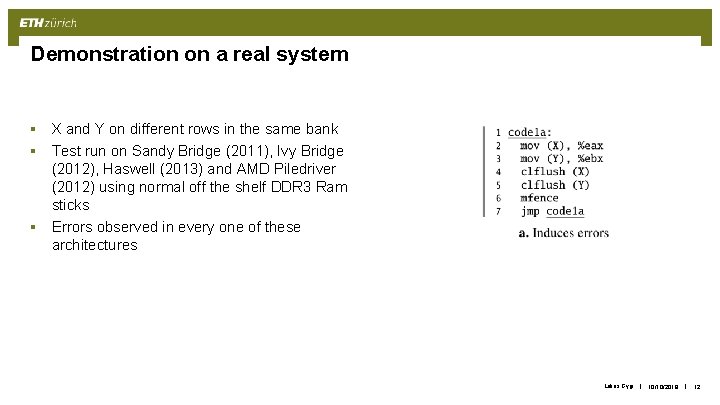
Demonstration on a real system § X and Y on different rows in the same bank § Test run on Sandy Bridge (2011), Ivy Bridge (2012), Haswell (2013) and AMD Piledriver (2012) using normal off the shelf DDR 3 Ram sticks § Errors observed in every one of these architectures Lukas Gygi | 10/10/2019 | 12
Experimental Setup § Test DRAM modules from the 3 main manufacturers § Use an FPGA based test platform to evaluate the modules § Identify under which condition errors occur § § § Manufactured date and process Access patterns Refresh timing Data patterns Temperature § Find a correlation of aggressor and victim rows Lukas Gygi | 10/10/2019 | 13
Background, Problems & Goals Novelty Key Approach & Ideas Test Mechanics Results Takeaway Strengths & Weaknesses Further Work, Thoughts, Ideas Discussion Lukas Gygi | 10/10/2019 | 14
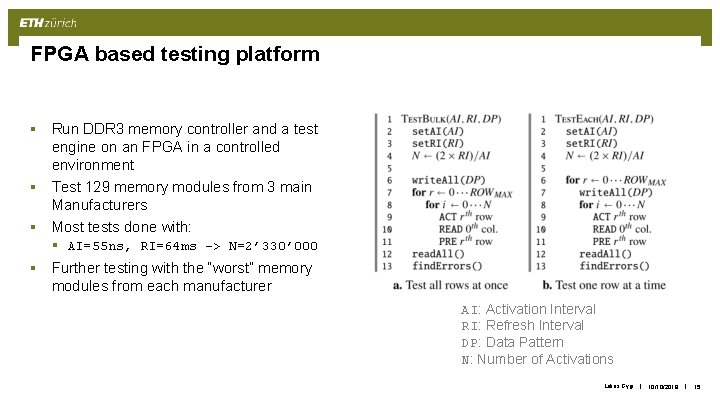
FPGA based testing platform § Run DDR 3 memory controller and a test engine on an FPGA in a controlled environment § Test 129 memory modules from 3 main Manufacturers § Most tests done with: § AI=55 ns, RI=64 ms -> N=2’ 330’ 000 § Further testing with the “worst” memory modules from each manufacturer AI: Activation Interval RI: Refresh Interval DP: Data Pattern N: Number of Activations Lukas Gygi | 10/10/2019 | 15
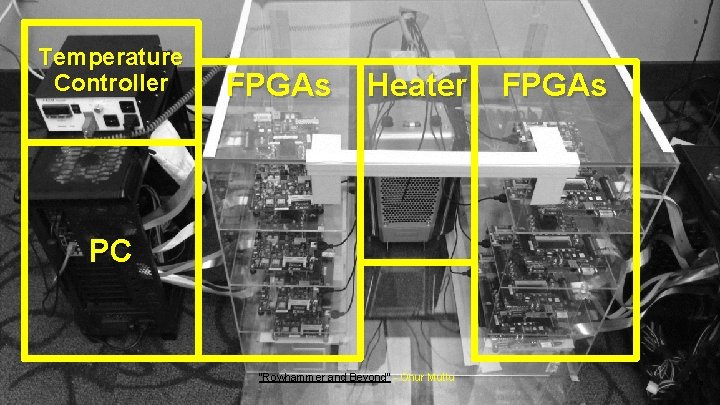
Temperature Controller FPGAs Heater FPGAs PC "Rowhammer and Beyond“ - Onur Mutlu | | 16
Background, Problems & Goals Novelty Key Approach & Ideas Test Mechanics Key Results Takeaway Strengths & Weaknesses Further Work, Thoughts, Ideas Discussion Lukas Gygi | 10/10/2019 | 17
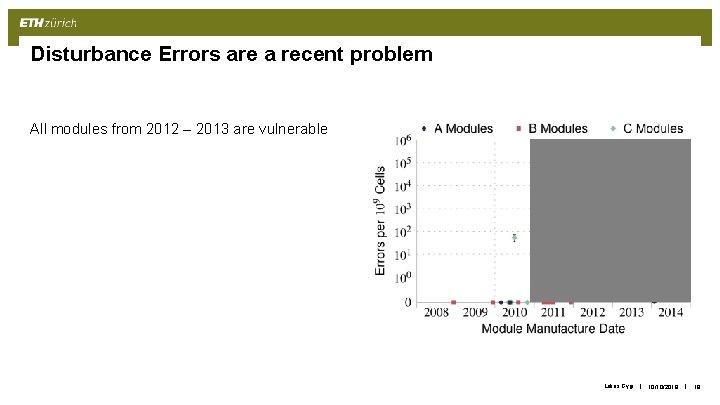
Disturbance Errors are a recent problem All modules from 2012 – 2013 are vulnerable Lukas Gygi | 10/10/2019 | 18
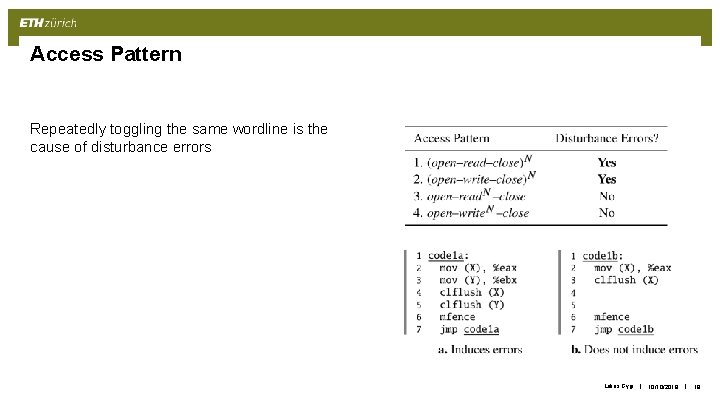
Access Pattern Repeatedly toggling the same wordline is the cause of disturbance errors Lukas Gygi | 10/10/2019 | 19
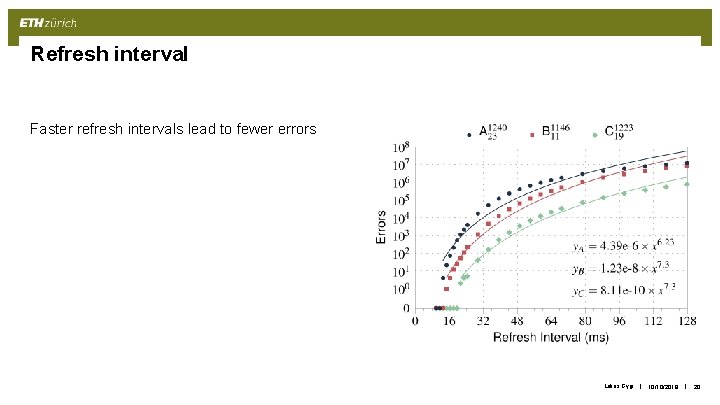
Refresh interval Faster refresh intervals lead to fewer errors Lukas Gygi | 10/10/2019 | 20
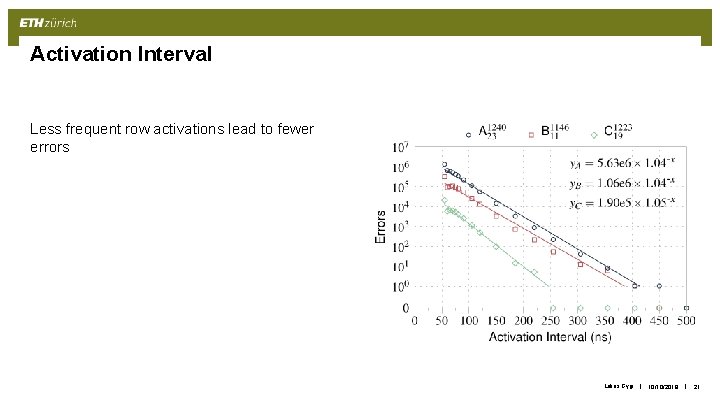
Activation Interval Less frequent row activations lead to fewer errors Lukas Gygi | 10/10/2019 | 21
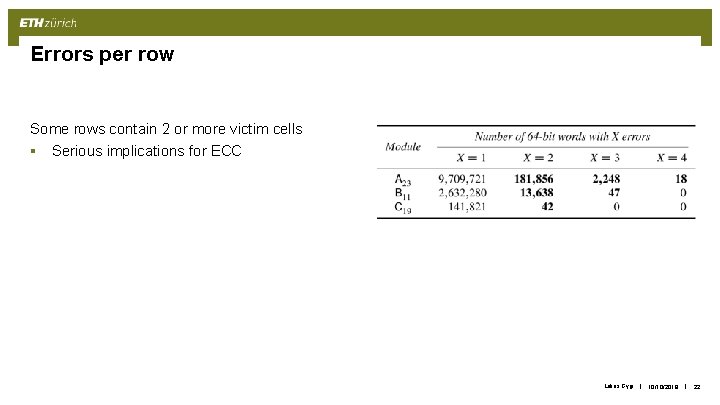
Errors per row Some rows contain 2 or more victim cells § Serious implications for ECC Lukas Gygi | 10/10/2019 | 22
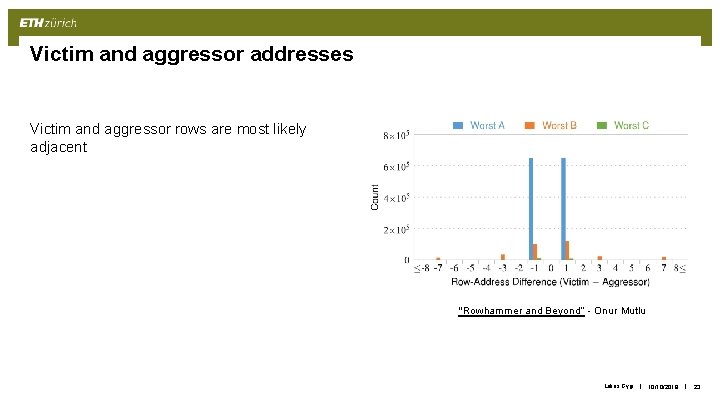
Victim and aggressor addresses Victim and aggressor rows are most likely adjacent "Rowhammer and Beyond“ - Onur Mutlu Lukas Gygi | 10/10/2019 | 23
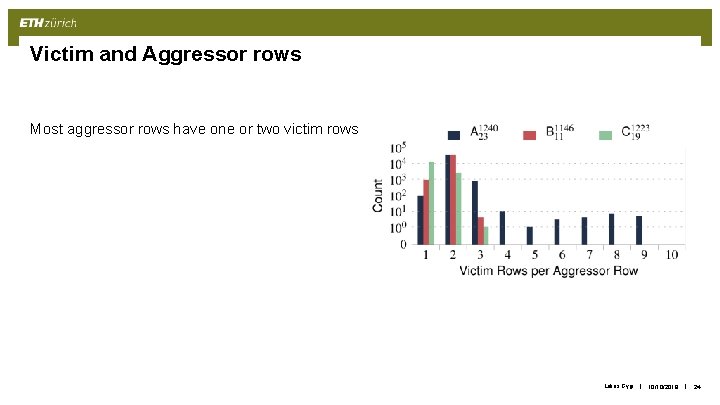
Victim and Aggressor rows Most aggressor rows have one or two victim rows Lukas Gygi | 10/10/2019 | 24
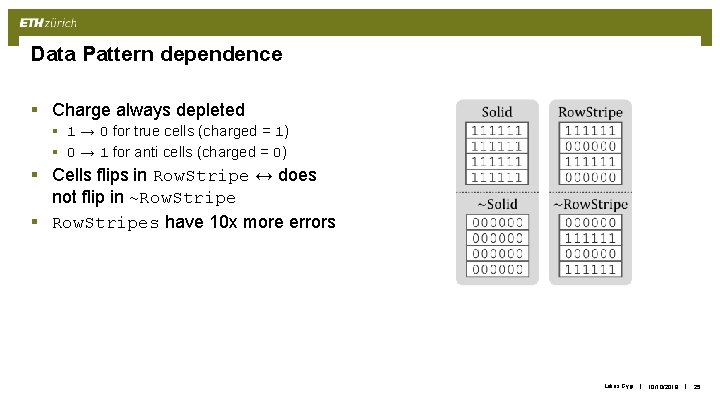
Data Pattern dependence § Charge always depleted § 1 → 0 for true cells (charged = 1) § 0 → 1 for anti cells (charged = 0) § Cells flips in Row. Stripe ↔ does not flip in ~Row. Stripe § Row. Stripes have 10 x more errors Lukas Gygi | 10/10/2019 | 25
Other results § Errors not temperature dependent § Victim cells are not the same as “leaky” cells § Errors are repeatable (>70% of cells had errors in every test iteration) Lukas Gygi | 10/10/2019 | 26
Potential solutions 1. 2. 3. 4. 5. 6. 7. Make better Chips Correct Errors Refresh all rows frequently Retire cells (manufacturer) Retire cells (user) Identify “hot” rows and refresh neighbours probabilistic adjacent row activation (PARA) Lukas Gygi | 10/10/2019 | 27
Probabilistic adjacent row activation (PARA) § § § On row close, refresh adjacent rows with a low probability (p<<1) Extremely low error probability Stateless No expensive hardware structures Low performance overhead in simulation (p=0. 005, 0. 192% avg. overhead) Memory controller has to know the physical layout Lukas Gygi | 10/10/2019 | 28
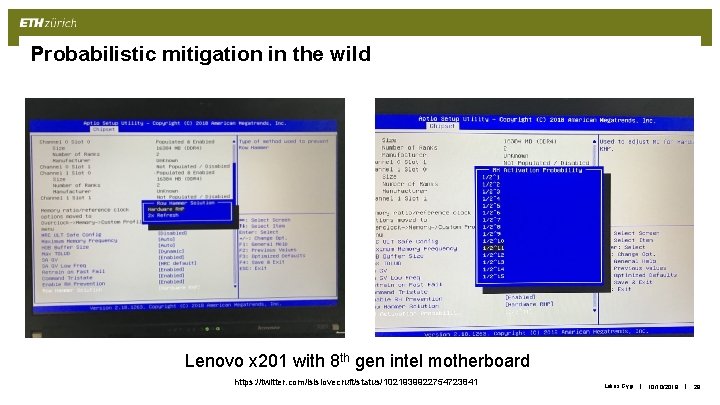
Probabilistic mitigation in the wild Lenovo x 201 with 8 th gen intel motherboard https: //twitter. com/isislovecruft/status/1021939922754723841 Lukas Gygi | 10/10/2019 | 29
Background, Problems & Goals Novelty Key Approach & Ideas Test Mechanics Results Takeaway Strengths & Weaknesses Further Work, Thoughts, Ideas Discussion Lukas Gygi | 10/10/2019 | 30
Takeaway § Software security can be broken by hardware § Intrinsic physical property of the hardware design § To totally mitigate this, a hardware redesign is probably necessary Lukas Gygi | 10/10/2019 | 31
Background, Problems & Goals Novelty Key Approach & Ideas Test Mechanics Results Takeaway Strengths & Weaknesses Further Work, Thoughts, Ideas Discussion Lukas Gygi | 10/10/2019 | 32
Strengths § First paper to show widespread Rowhammer is § Thorough tests on a very wide range of commodity DRAM chips § A practical long-term solution is proposed § Low overhead and hardware cost § Sparked a lot of further research in the topic § Well written paper Lukas Gygi | 10/10/2019 | 33
Weaknesses § Para: § The controller needs to know the physical row layout of the chips, which is not the case at the moment § Needs hardware redesign § Probabilistic solution does not guarantee protection § The only immediate solution presented is refreshing the rows 8 times more often, which has considerable performance overhead § No software solutions mentioned § Does not show any specific exploitation Lukas Gygi | 10/10/2019 | 34
Background, Problems & Goals Novelty Key Approach & Ideas Test Mechanics Results Takeaway Strengths & Weaknesses Further Work, Thoughts, Ideas Discussion Lukas Gygi | 10/10/2019 | 35
Exploiting the DRAM Rowhammer bug to gain kernel privileges (2015, Seaborn et al. , Google Project Zero) § First real life exploitation of Rowhammer § Double-sided hammering § Modify page table entry to gain kernel privileges Lukas Gygi | 10/10/2019 | 36
ECCploit: Exploiting Correcting Codes: On the Effectiveness of ECC Memory Against Rowhammer Attacks (Cojocar et. al 2019) § ECC DDR 3 Memory exploit § Flip multiple bits in order to circumvent ECC § ECC is not a Solution to Rowhammer Lukas Gygi | 10/10/2019 | 37
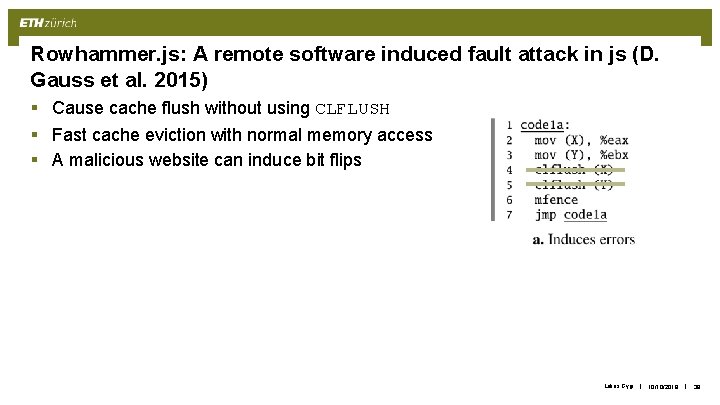
Rowhammer. js: A remote software induced fault attack in js (D. Gauss et al. 2015) § Cause cache flush without using CLFLUSH § Fast cache eviction with normal memory access § A malicious website can induce bit flips Lukas Gygi | 10/10/2019 | 38
RAMbleed: Reading Bits in Memory Without Accessing Them (Kwong et al. , 2020) § Read Memory by data dependence of bit flips § Demonstration: Extracted an RSA-2048 Private Key from Open. SSH Lukas Gygi | 10/10/2019 | 39
Other security exploits § One Bit Flips, One Cloud Flops: Cross-VM Row Hammer Attacks and Privilege Escalation (Y. Xiaou et al. , USENIX Sec. 2016) § Flip Feng Shui: Hammering a Needle in the Software Stack (K. Razavi et al. 2016) § Drammer: Deterministic Rowhammer attacks on mobile platforms (V. van der Veen et al. , CCS, 2016) § Another Flip in the Wall of Rowhammer Defense (D. Gruss et al. , 2018) § Throwhammer: Rowhammer Attacks over the Network and Defenses (A. Tatar et al. , USENIX Sec. , 2018) Lukas Gygi | 10/10/2019 | 40
Protection against Rowhammer § Short term solution: double the refresh rate of DRAM (Apple, HP, Cisco, Lenovo, IBM) § Higher power draw, performance overhead § TRR (targeted row refresh) in DDR 4 § Refresh specific victim rows Lukas Gygi | 10/10/2019 | 41
ANVIL: Software-Based Protection Against Next-Generation Rowhammer Attacks (Z. B. Aweke et al. , 2016) § Track DRAM access using existing hardware performance counters § Detects aggressors and refreshes nearby rows CAn’t Touch This: Software-only Mitigation against Rowhammer Attacks targeting Kernel Memory (F. Brasser et al. , 2017) § Physically isolate memory of kernel- and userspace Lukas Gygi | 10/10/2019 | 42
Guard. ION: Practical Mitigation of DMA-Based Rowhammer Attacks on ARM (V. van der Veen et al. , 2018) § Mitigate attacks using guard rows on DMA allocated Memory TWi. Ce: Time Window Counter Based Row Refresh to Prevent Row-Hammering (E. Lee et al. , 2017) § Low hardware overhead row counters § Needs new DRAM chips Lukas Gygi | 10/10/2019 | 43
Background, Problems & Goals Novelty Key Approach & Ideas Test Mechanics Results Summary Strengths & Weaknesses Further Work, Thoughts, Ideas Discussion Lukas Gygi | 10/10/2019 | 44
Discussion § § § What do you think of the proposed solutions New Solutions? New Attacks? Have you read another interesting paper on rowhammer? Do you think this can be exploited further? (other than dram) Lukas Gygi | 10/10/2019 | 45
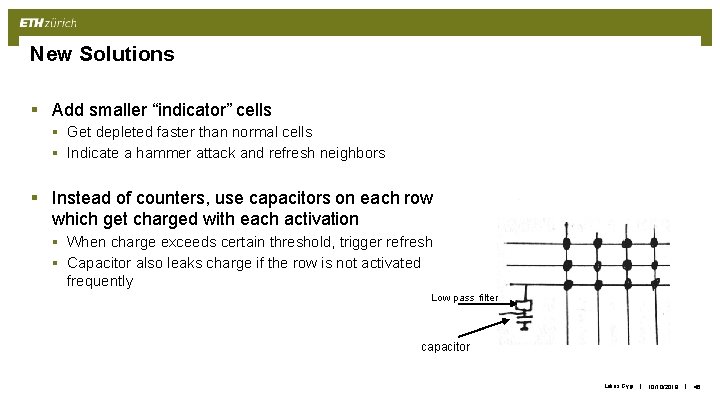
New Solutions § Add smaller “indicator” cells § Get depleted faster than normal cells § Indicate a hammer attack and refresh neighbors § Instead of counters, use capacitors on each row which get charged with each activation § When charge exceeds certain threshold, trigger refresh § Capacitor also leaks charge if the row is not activated frequently Low pass filter capacitor Lukas Gygi | 10/10/2019 | 46
- Slides: 46