
FLIPPED CLASSROOM ACTIVITY FOR CLIENTSERVER ARCHITECTURE RC 1247002
- Slides: 19
FLIPPED CLASSROOM ACTIVITY FOR CLIENT-SERVER ARCHITECTURE RC 1247_002 DR RAJIV PANDEY DR NIDHI SRIVASTAVA MR U. K. FAROOQUI IDP in Educational Technology – IIT Bombay
2 ABOUT YOU Dr. Rajiv Pandey Mr. Umar Khalid Farooqui Dr. Nidhi Srivastava Amity University Lucknow IDP in Educational Technology, IIT Bombay
Client Server Architecture 3 Client Server Architecture an Introduction Network Fundamentals Computer Science BCA Amity University Lucknow IDP in Educational Technology, IIT Bombay
About Out-of-Class Segment 4 Out-of-Class Segment Of Client Server Architecture IDP in Educational Technology, IIT Bombay
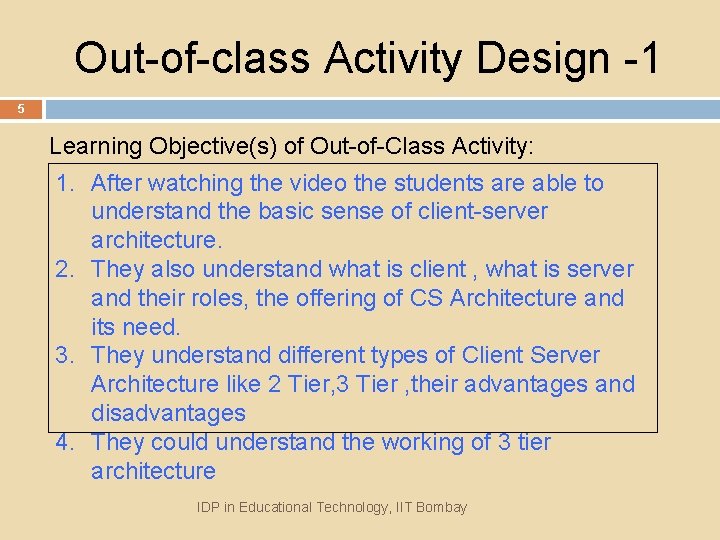
Out-of-class Activity Design -1 5 Learning Objective(s) of Out-of-Class Activity: 1. After watching the video the students are able to understand the basic sense of client-server architecture. 2. They also understand what is client , what is server and their roles, the offering of CS Architecture and its need. 3. They understand different types of Client Server Architecture like 2 Tier, 3 Tier , their advantages and disadvantages 4. They could understand the working of 3 tier architecture IDP in Educational Technology, IIT Bombay
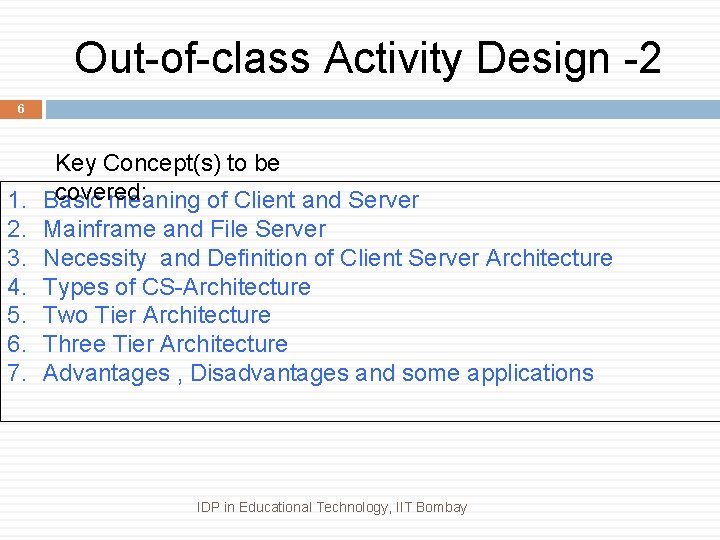
Out-of-class Activity Design -2 6 Key Concept(s) to be covered: 1. Basic meaning of Client and Server 2. Mainframe and File Server 3. Necessity and Definition of Client Server Architecture 4. Types of CS-Architecture 5. Two Tier Architecture 6. Three Tier Architecture 7. Advantages , Disadvantages and some applications IDP in Educational Technology, IIT Bombay
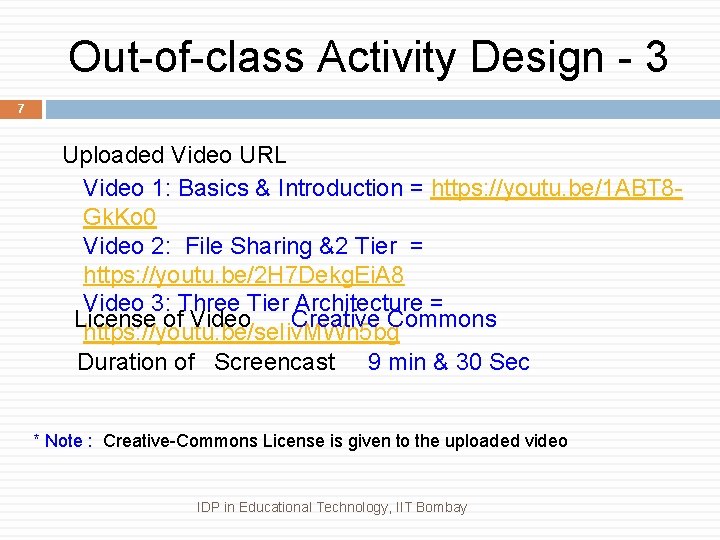
Out-of-class Activity Design - 3 7 Uploaded Video URL Video 1: Basics & Introduction = https: //youtu. be/1 ABT 8 Gk. Ko 0 Video 2: File Sharing &2 Tier = https: //youtu. be/2 H 7 Dekg. Ei. A 8 Video 3: Three Tier Architecture = License of Video Creative Commons https: //youtu. be/se. Iiv. MWn 5 bg Duration of Screencast 9 min & 30 Sec * Note : Creative-Commons License is given to the uploaded video IDP in Educational Technology, IIT Bombay
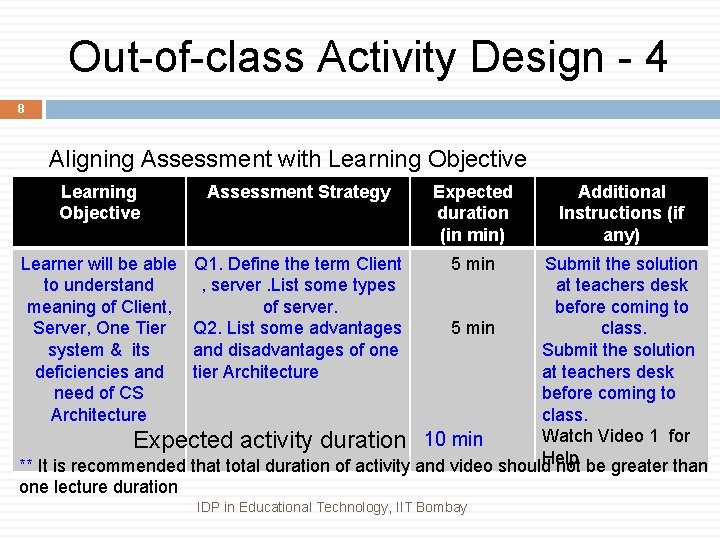
Out-of-class Activity Design - 4 8 Aligning Assessment with Learning Objective Assessment Strategy Expected duration (in min) Learner will be able to understand meaning of Client, Server, One Tier system & its deficiencies and need of CS Architecture Q 1. Define the term Client , server. List some types of server. Q 2. List some advantages and disadvantages of one tier Architecture 5 min Additional Instructions (if any) Submit the solution at teachers desk before coming to 5 min class. Submit the solution at teachers desk before coming to class. Watch Video 1 for Expected activity duration 10 min Help ** It is recommended that total duration of activity and video should not be greater than one lecture duration IDP in Educational Technology, IIT Bombay
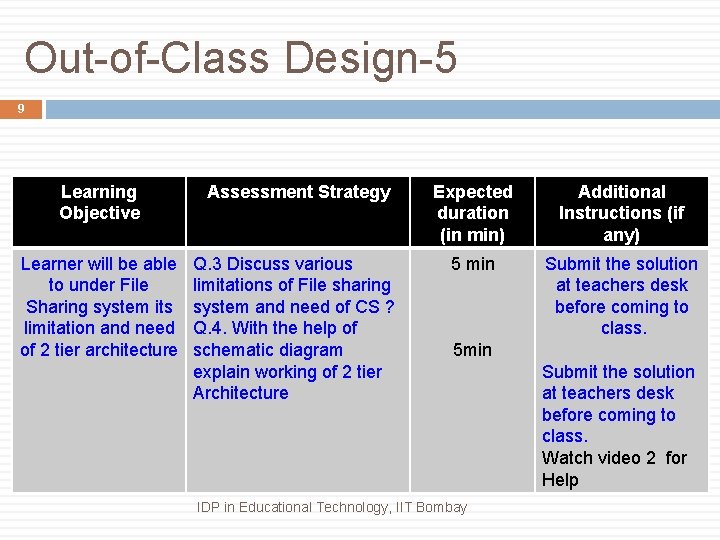
Out-of-Class Design-5 9 Learning Objective Assessment Strategy Expected duration (in min) Additional Instructions (if any) Learner will be able to under File Sharing system its limitation and need of 2 tier architecture Q. 3 Discuss various limitations of File sharing system and need of CS ? Q. 4. With the help of schematic diagram explain working of 2 tier Architecture 5 min Submit the solution at teachers desk before coming to class. 5 min Expected activity duration 10 min IDP in Educational Technology, IIT Bombay Submit the solution at teachers desk before coming to class. Watch video 2 for Help
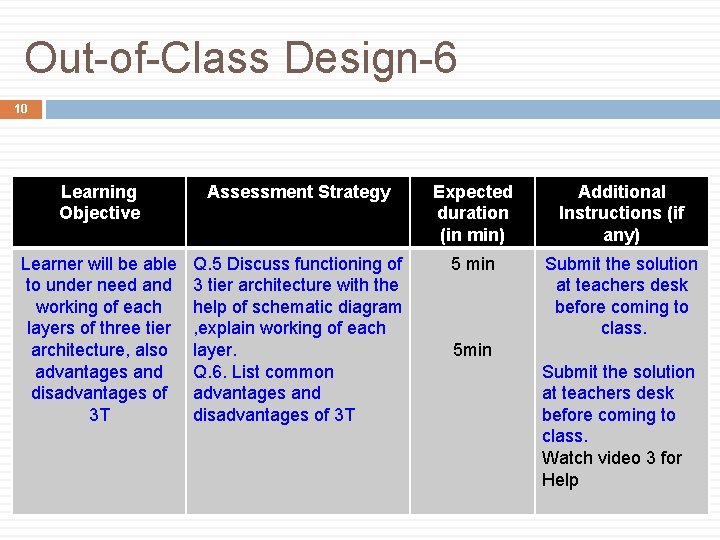
Out-of-Class Design-6 10 Learning Objective Assessment Strategy Expected duration (in min) Additional Instructions (if any) Learner will be able to under need and working of each layers of three tier architecture, also advantages and disadvantages of 3 T Q. 5 Discuss functioning of 3 tier architecture with the help of schematic diagram , explain working of each layer. Q. 6. List common advantages and disadvantages of 3 T 5 min Submit the solution at teachers desk before coming to class. 5 min Expected activity duration 10 min IDP in Educational Technology, IIT Bombay Submit the solution at teachers desk before coming to class. Watch video 3 for Help
11 In-Class Activity Design In-Class Segment Of Client Server Architecture IDP in Educational Technology, IIT Bombay
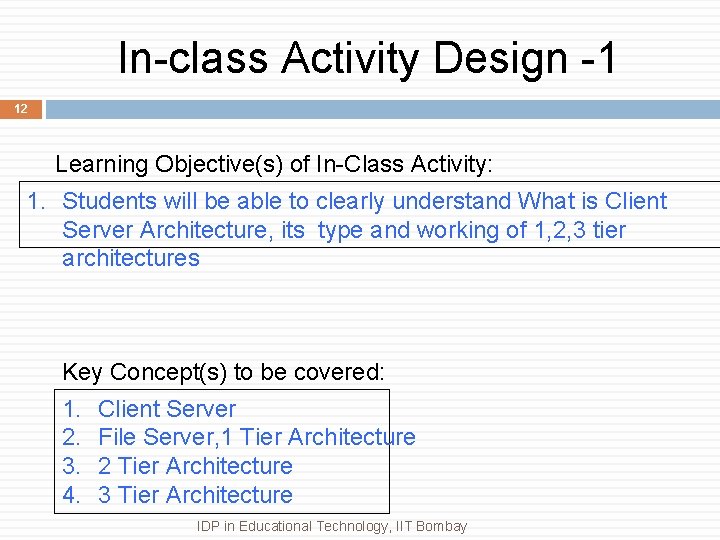
In-class Activity Design -1 12 Learning Objective(s) of In-Class Activity: 1. Students will be able to clearly understand What is Client Server Architecture, its type and working of 1, 2, 3 tier architectures Key Concept(s) to be covered: 1. 2. 3. 4. Client Server File Server, 1 Tier Architecture 2 Tier Architecture 3 Tier Architecture IDP in Educational Technology, IIT Bombay
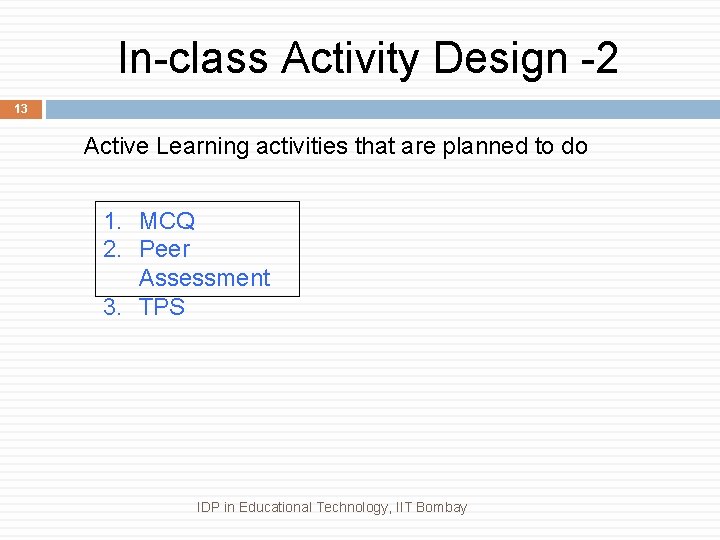
In-class Activity Design -2 13 Active Learning activities that are planned to do 1. MCQ 2. Peer Assessment 3. TPS IDP in Educational Technology, IIT Bombay
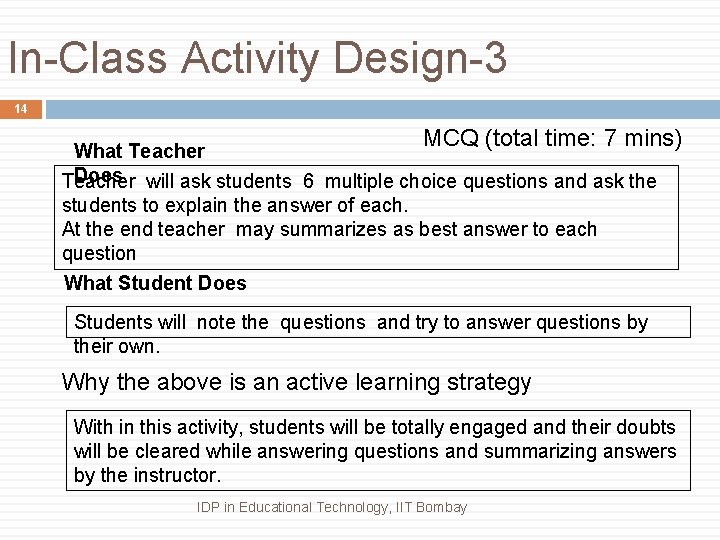
In-Class Activity Design-3 14 MCQ (total time: 7 mins) What Teacher Does will ask students 6 multiple choice questions and ask the Teacher students to explain the answer of each. At the end teacher may summarizes as best answer to each question What Student Does Students will note the questions and try to answer questions by their own. Why the above is an active learning strategy With in this activity, students will be totally engaged and their doubts will be cleared while answering questions and summarizing answers by the instructor. IDP in Educational Technology, IIT Bombay
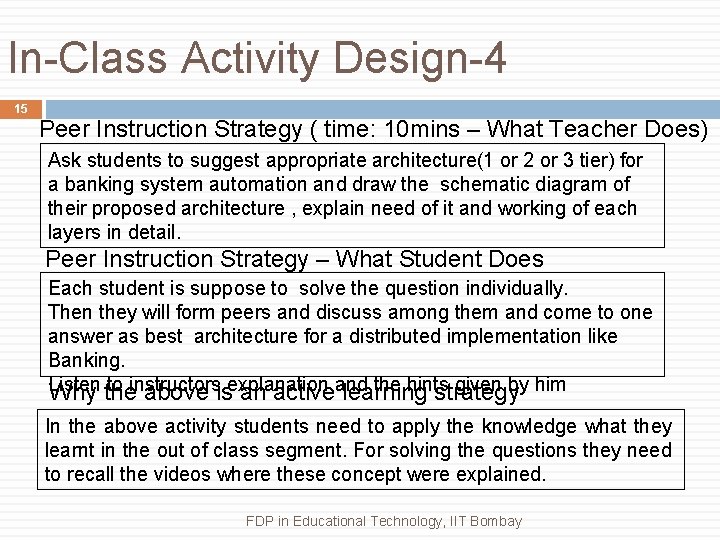
In-Class Activity Design-4 15 Peer Instruction Strategy ( time: 10 mins – What Teacher Does) Ask students to suggest appropriate architecture(1 or 2 or 3 tier) for a banking system automation and draw the schematic diagram of their proposed architecture , explain need of it and working of each layers in detail. Peer Instruction Strategy – What Student Does Each student is suppose to solve the question individually. Then they will form peers and discuss among them and come to one answer as best architecture for a distributed implementation like Banking. Listen to instructors the hints given by him Why the above isexplanation an activeand learning strategy In the above activity students need to apply the knowledge what they learnt in the out of class segment. For solving the questions they need to recall the videos where these concept were explained. FDP in Educational Technology, IIT Bombay
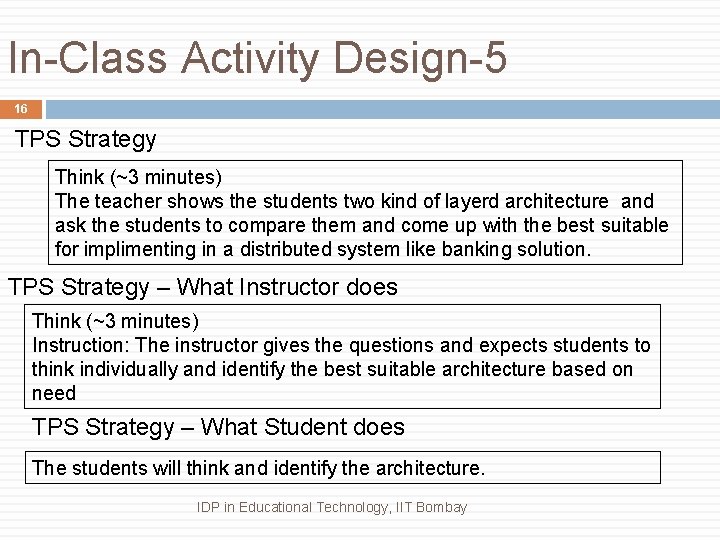
In-Class Activity Design-5 16 TPS Strategy Think (~3 minutes) The teacher shows the students two kind of layerd architecture and ask the students to compare them and come up with the best suitable for implimenting in a distributed system like banking solution. TPS Strategy – What Instructor does Think (~3 minutes) Instruction: The instructor gives the questions and expects students to think individually and identify the best suitable architecture based on need TPS Strategy – What Student does The students will think and identify the architecture. IDP in Educational Technology, IIT Bombay
In-Class Activity Design-6 17 TPS Strategy – What Instructor does Pair (~5 minutes) Instruction: Compare your answer with the neighboring student, discuss and then decide again. Sees that the students are involved in the discussion and in case of any query, gives hints to the students to solve the problem. TPS Strategy – What Student does Student with his pair classmate compares their solutions and reaches to a solution. IDP in Educational Technology, IIT Bombay
In-Class Activity Design-7 18 TPS Strategy – What Instructor does Share (~9 minutes) Instruction: Students to show their solution to each other and find what logic others have applied. Instructor facilitate in the sharing and also points out the different possible ways in which students have solved the problem. TPS Strategy – What Student does Students share their solutions with the other classmates. IDP in Educational Technology, IIT Bombay
THE END 19 IDP in Educational Technology, IIT Bombay