
FLIPPED CLASSROOM ACTIVITY CONSTRUCTOR USING EXISTING CONTENT Table

FLIPPED CLASSROOM ACTIVITY CONSTRUCTOR – USING EXISTING CONTENT

Table of Contents SECTION SLIDE # ABOUT YOU 4 OUT-OF-CLASS SEGMENT 7 IN-CLASS SEGMENT 13 2
About you Provide basic information about yourself and the topic in which you want to design a flipped classroom. 3
Sivaraman P Routh-Hurwitz Criterion Control Systems 10. Electrical and Allied II yr EEE Students, Peers and Researchers Bannari Amman Institute of Technology Sathyamangalam, Erode, Tamil. Nadu 4

Out-of-class Segment This section helps you design the Out-of-Class segment of Flipped Classroom Strategy. 5

About Out-of-Class Segment § § Meant mainly for Information-Transmission to student. Mostly help achieve lower-order cognitive levels (Recall-Understand-Apply) Teacher takes time to search and locate videos. Out-of-Class activity should not be too lengthy, (ideally think of 1 lecture being transferred outside) 6
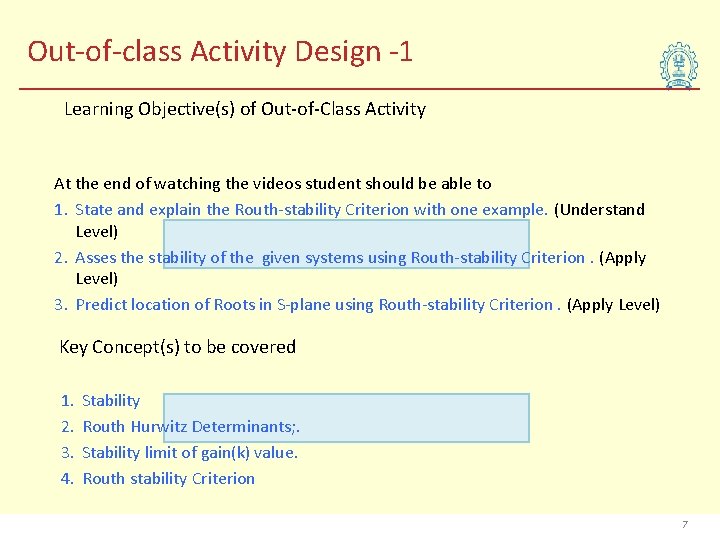
Out-of-class Activity Design -1 Learning Objective(s) of Out-of-Class Activity At the end of watching the videos student should be able to 1. State and explain the Routh-stability Criterion with one example. (Understand Level) 2. Asses the stability of the given systems using Routh-stability Criterion. (Apply Level) 3. Predict location of Roots in S-plane using Routh-stability Criterion. (Apply Level) Key Concept(s) to be covered 1. 2. 3. 4. Stability Routh Hurwitz Determinants; . Stability limit of gain(k) value. Routh stability Criterion 7
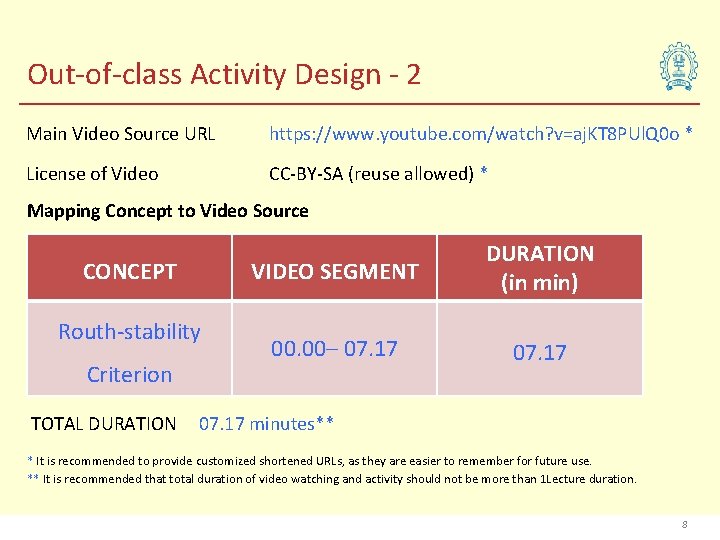
Out-of-class Activity Design - 2 Main Video Source URL https: //www. youtube. com/watch? v=aj. KT 8 PUl. Q 0 o * License of Video CC-BY-SA (reuse allowed) * Mapping Concept to Video Source CONCEPT Routh-stability Criterion TOTAL DURATION VIDEO SEGMENT DURATION (in min) 00. 00– 07. 17 minutes** * It is recommended to provide customized shortened URLs, as they are easier to remember for future use. ** It is recommended that total duration of video watching and activity should not be more than 1 Lecture duration. 8
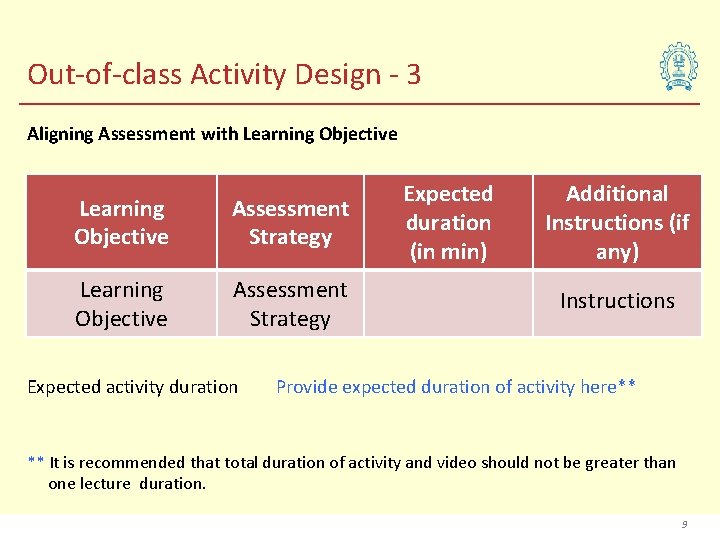
Out-of-class Activity Design - 3 Aligning Assessment with Learning Objective Assessment Strategy Expected activity duration Expected duration (in min) Additional Instructions (if any) Instructions Provide expected duration of activity here** ** It is recommended that total duration of activity and video should not be greater than one lecture duration. 9

Out-of-class Activity Design - 3 Aligning Assessment with Learning Objective State and explain the. Routh-stability Criterion with one example. Assessment Strategy Q 1. Recall the Routh stability criterion. Q 2. Describe the Routh array Construction procedure for the polynomial. Expected Duration (in min) Additional Instructions (if any) 10 minutes 1. Watch V 1 up to 1. 25 minute then pause and then answer Q 1 2. Then Continue to watch the video up to 5. 20 minute and then answer Q 2 10
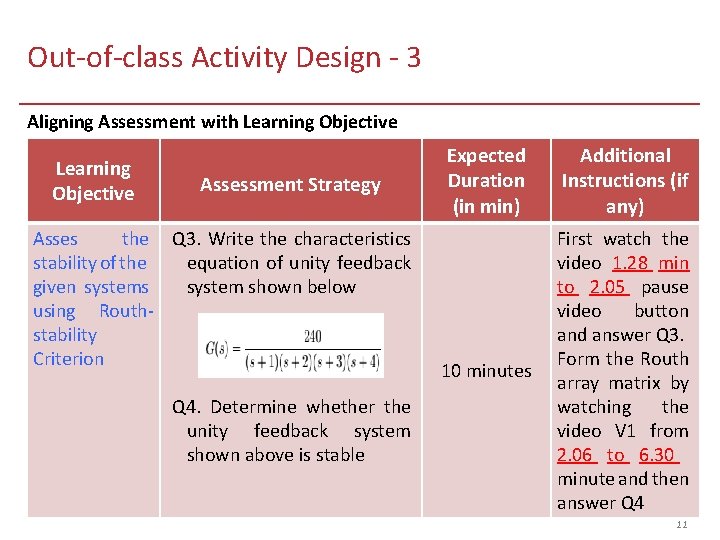
Out-of-class Activity Design - 3 Aligning Assessment with Learning Objective Assessment Strategy Asses the Q 3. Write the characteristics stability of the equation of unity feedback given systems system shown below using Routhstability Criterion Q 4. Determine whether the unity feedback system shown above is stable Expected Duration (in min) Additional Instructions (if any) 10 minutes First watch the video 1. 28 min to 2. 05 pause video button and answer Q 3. Form the Routh array matrix by watching the video V 1 from 2. 06 to 6. 30 minute and then answer Q 4 11
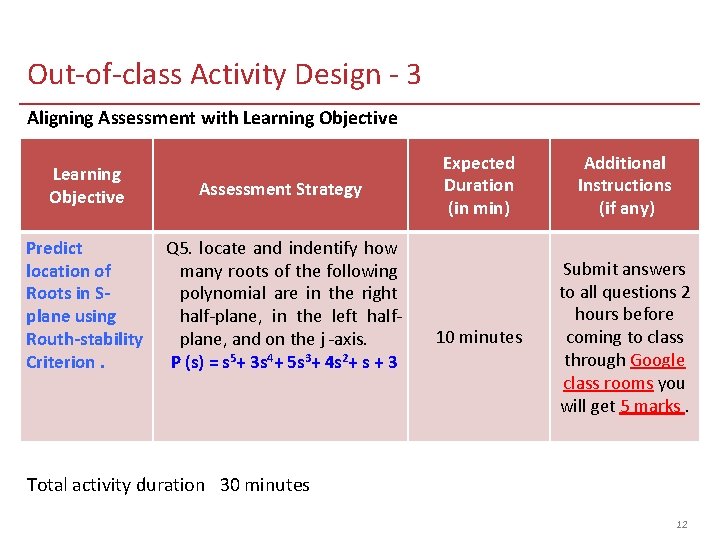
Out-of-class Activity Design - 3 Aligning Assessment with Learning Objective Assessment Strategy Predict location of Roots in Splane using Routh-stability Criterion. Q 5. locate and indentify how many roots of the following polynomial are in the right half-plane, in the left halfplane, and on the j -axis. P (s) = s 5+ 3 s 4+ 5 s 3+ 4 s 2+ s + 3 Expected Duration (in min) Additional Instructions (if any) 10 minutes Submit answers to all questions 2 hours before coming to class through Google class rooms you will get 5 marks. Total activity duration 30 minutes 12
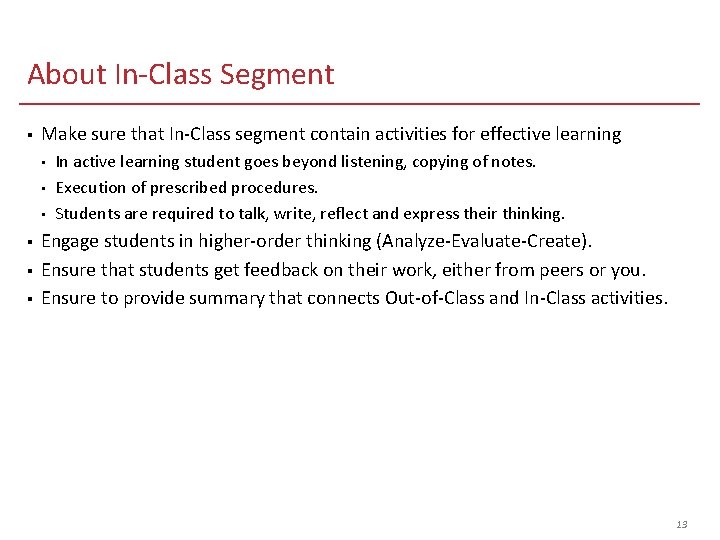
About In-Class Segment § Make sure that In-Class segment contain activities for effective learning • • • § § § In active learning student goes beyond listening, copying of notes. Execution of prescribed procedures. Students are required to talk, write, reflect and express their thinking. Engage students in higher-order thinking (Analyze-Evaluate-Create). Ensure that students get feedback on their work, either from peers or you. Ensure to provide summary that connects Out-of-Class and In-Class activities. 13
In-class Activity Design -1 Learning Objective(s) of In - Class Activity § § Solve real-life scenario problems Routh criterion (ANALYZE Level) Predict stability of filed controlled DC machines using Routh criterion Key Concept(s) to be covered 1. Use of Expression Simplification in Real World Problem Solving 14
In-class Activity Design -2 Active Learning activity(ies) that you plan to do § Peer Instruction Explain the strategy by giving details of 1. Q 1: What will happen if the dc machines runs at overspeed? 2. Peer Instruction Strategy – What Student Does § § § For each question they will first vote individually. Then they will discuss with peers and come to consensus. Listen to instructors explanation. Justify why the above is an active learning strategy 1. Enter Justification Here 15
In-class Activity Design -2 Active Learning activity(ies) that you plan to do Real world problem solving using. § Think-Pair-Share Concept clarification using. § Peer Instruction 16
- Slides: 16