
Flight Goes Mainstream Chapter 3 Lesson 2 Overview
- Slides: 30
Flight Goes Mainstream Chapter 3, Lesson 2
Overview Ø Charles Lindbergh’s famous contribution to aviation Ø The significance of the first transatlantic flight Ø Other significant contributions that helped flight become mainstream Chapter 3, Lesson 2
Quick Write Give some examples of the equipment aboard modern transatlantic aircraft that Charles Lindbergh did not have when he made his famous New York-to-Paris flight. Chapter 3, Lesson 2
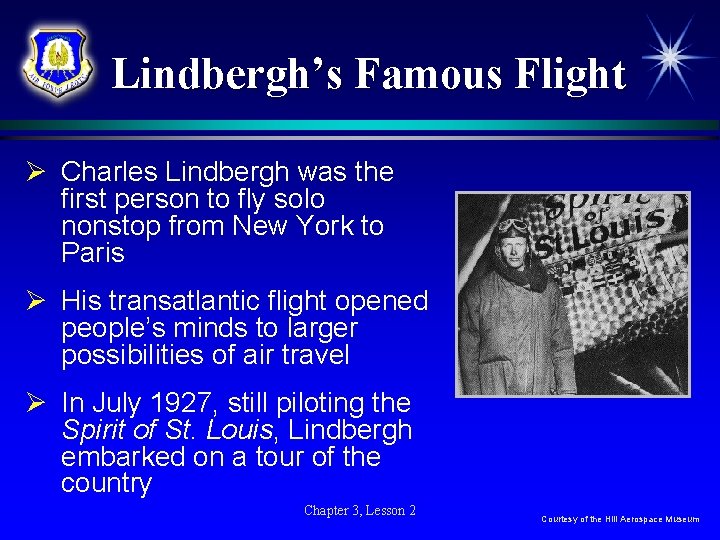
Lindbergh’s Famous Flight Ø Charles Lindbergh was the first person to fly solo nonstop from New York to Paris Ø His transatlantic flight opened people’s minds to larger possibilities of air travel Ø In July 1927, still piloting the Spirit of St. Louis, Lindbergh embarked on a tour of the country Chapter 3, Lesson 2 Courtesy of the Hill Aerospace Museum
Goodwill Ambassador Ø Lindbergh made speeches in 72 cities Ø He encouraged people to get pilot training Ø His efforts to promote civil aviation led to the construction of hundreds of airports Ø He was a true goodwill ambassador for aviation Chapter 3, Lesson 2
More Touring Ø In December 1927 Lindbergh capped off a historic year with a 3, 200 -mile all. American tour Ø He then continued southward to a dozen other Latin American countries Ø Over the next several years, Lindbergh and his wife, Anne Morrow Lindbergh, worked in civil aviation Chapter 3, Lesson 2
Significance of the First Transatlantic Flight Ø Milestone: Milestone an important event, such as a breakthrough in the advancement of knowledge in a field Ø The Wright brothers’ flight on 17 December 1903 was a milestone flight Ø So was Lindbergh’s transatlantic solo flight Ø In the early 20 th century, such milestone flights came one after another Chapter 3, Lesson 2
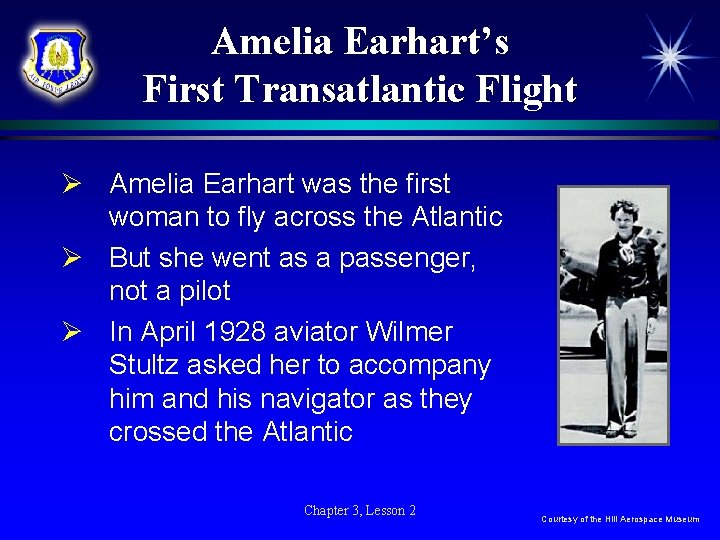
Amelia Earhart’s First Transatlantic Flight Ø Amelia Earhart was the first woman to fly across the Atlantic Ø But she went as a passenger, not a pilot Ø In April 1928 aviator Wilmer Stultz asked her to accompany him and his navigator as they crossed the Atlantic Chapter 3, Lesson 2 Courtesy of the Hill Aerospace Museum
Amelia Earhart’s First Transatlantic Flight Ø They were seeking a prize offered by Pittsburgh heiress Amy Phipps Guest Ø She wanted to get a woman across the ocean in the air—even if only as a passenger Ø The plane Stultz, Gordon, and Earhart flew was the Friendship—a Fokker C-2 trimotor Ø It was a long, cold, dangerous trip Chapter 3, Lesson 2
Earhart the Apprentice Ø The flight was a great opportunity for Earhart to be an apprentice—a apprentice person who works with a skilled master to learn by practical experience Ø Stultz was one of the best pilots of that day Ø And Earhart didn’t miss a thing Chapter 3, Lesson 2
Transcontinental Flight Ø Ø Ø But not everyone accepted Earhart as a hero They said she’d depended on the luck and the skill of her male pilot But finally she proved her courage: she made more milestone flights She set the altitude record for an autogiro, autogiro an early, helicopter-like aircraft, reaching 18, 415 feet Then she became the first woman, and second person, to make a transcontinental—coast-totranscontinental coast—flight in an autogiro Chapter 3, Lesson 2
Earhart’s Solo Crossing of the Atlantic Ø But for Earhart, the milestone that mattered most was a solo crossing of the Atlantic Ø She wanted to be the first woman to do it Ø On 20 May 1932 she took off in her Lockheed Vega from Harbour Grace, Newfoundland Ø Fifteen hours later, she touched down at a farm outside Londonderry in Northern Ireland Chapter 3, Lesson 2
More Milestones Ø Earhart reached another milestone in 1935 as the first pilot to fly from Honolulu to Oakland, California Ø At that point, Earhart felt the only goal left was a “true” round-the-world flight Ø Earhart’s goal was to circle the globe as close as possible to the equator—the equator imaginary circle that divides Earth into northern and southern halves Chapter 3, Lesson 2
Earhart’s Disappearance Ø Earhart took off 2 June 1937, with copilot Frederick Noonan Ø All went well for 40 days while they racked up 22, 000 miles Ø But on the longest leg of the trip, from Lae, New Guinea, to Howland Island in the Pacific, the plane disappeared Chapter 3, Lesson 2
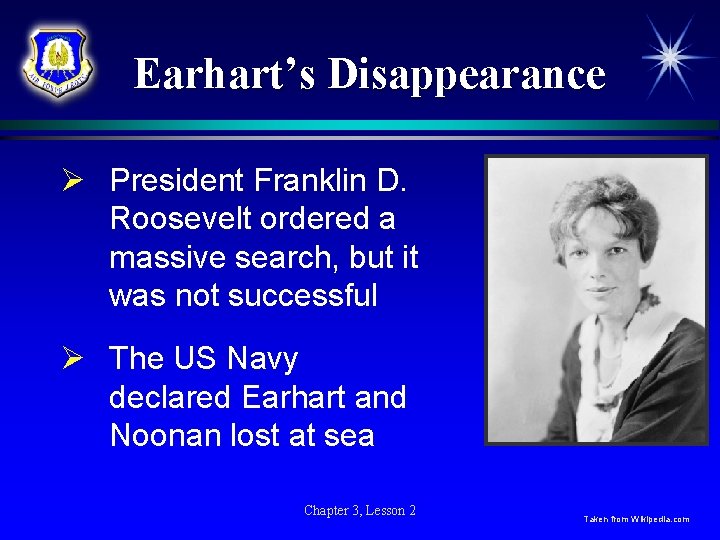
Earhart’s Disappearance Ø President Franklin D. Roosevelt ordered a massive search, but it was not successful Ø The US Navy declared Earhart and Noonan lost at sea Chapter 3, Lesson 2 Taken from Wikipedia. com
st 1 Lt James Doolittle Ø 1 st Lt James Harold Doolittle made a milestone flight on 24 September 1929 Ø His milestone was the first successful blind flight—the act of taking off and landing flight relying solely on instruments inside the cockpit for guidance Ø Because of his work, manufacturers started equipping planes with instruments and twoway radios Chapter 3, Lesson 2
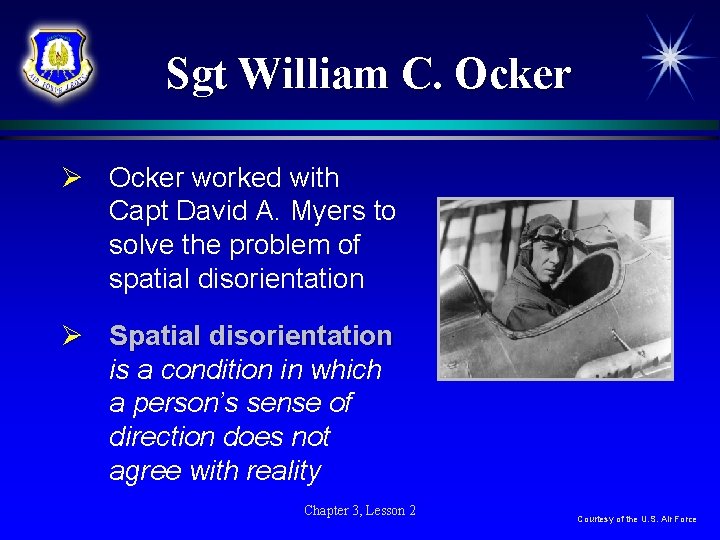
Sgt William C. Ocker Ø Ocker worked with Capt David A. Myers to solve the problem of spatial disorientation Ø Spatial disorientation is a condition in which a person’s sense of direction does not agree with reality Chapter 3, Lesson 2 Courtesy of the U. S. Air Force
Spatial Disorientation Ø A pilot who is spatially disoriented literally doesn’t know which end is up Ø In the early days, even experienced pilots could get confused when visibility was poor Ø They sometimes thought they were banking left when they were banking right Ø This happened because they’d lost sight of the horizon, which they used to orient themselves Chapter 3, Lesson 2
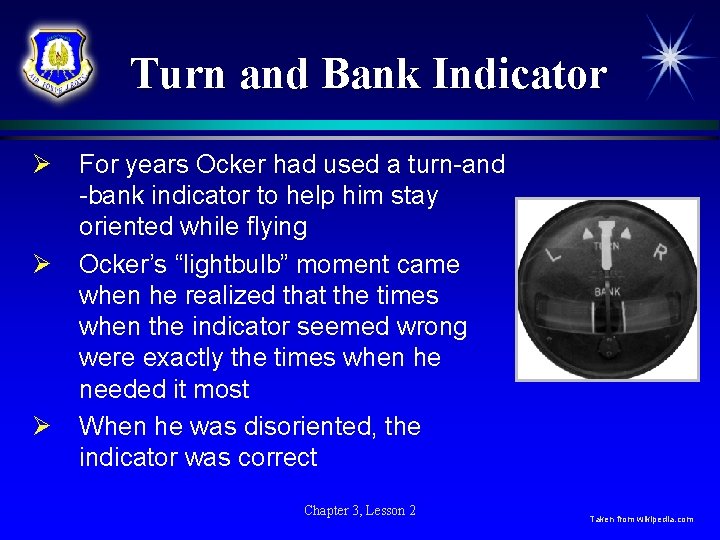
Turn and Bank Indicator Ø Ø Ø For years Ocker had used a turn-and -bank indicator to help him stay oriented while flying Ocker’s “lightbulb” moment came when he realized that the times when the indicator seemed wrong were exactly the times when he needed it most When he was disoriented, the indicator was correct Chapter 3, Lesson 2 Taken from wikipedia. com
Ocker’s Work Ø Ocker and Myers realized that pilots of the future would have to rely more heavily on instruments Ø Their work led to Doolittle’s successful blind flight Ø Ocker developed a number of devices that became critical to pilot training and aviation in general Ø These inventions are forerunners of today’s flight simulators Chapter 3, Lesson 2
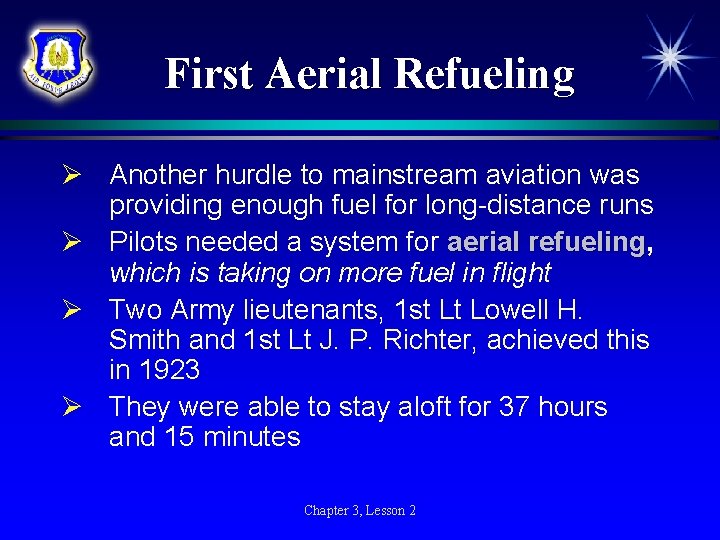
First Aerial Refueling Ø Another hurdle to mainstream aviation was providing enough fuel for long-distance runs Ø Pilots needed a system for aerial refueling, refueling which is taking on more fuel in flight Ø Two Army lieutenants, 1 st Lt Lowell H. Smith and 1 st Lt J. P. Richter, achieved this in 1923 Ø They were able to stay aloft for 37 hours and 15 minutes Chapter 3, Lesson 2
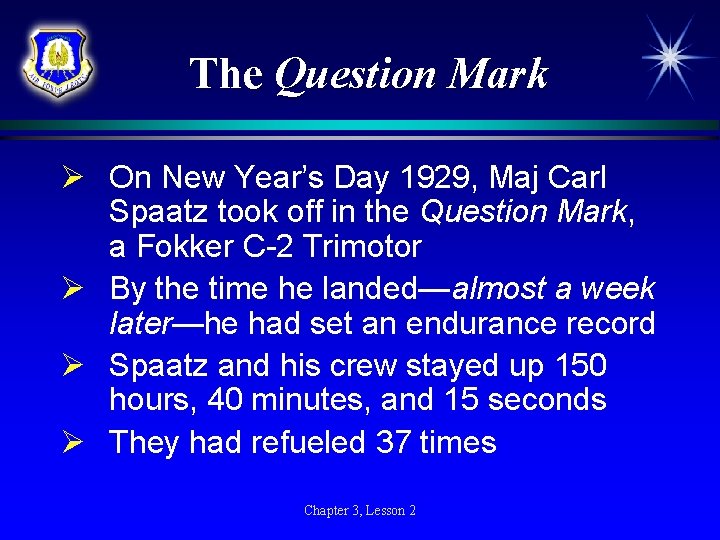
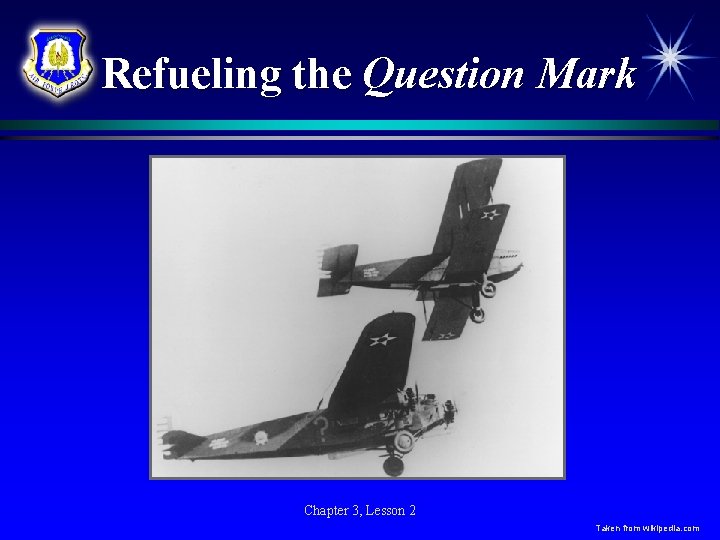
The Question Mark Ø On New Year’s Day 1929, Maj Carl Spaatz took off in the Question Mark, a Fokker C-2 Trimotor Ø By the time he landed—almost a week later—he had set an endurance record Ø Spaatz and his crew stayed up 150 hours, 40 minutes, and 15 seconds Ø They had refueled 37 times Chapter 3, Lesson 2
Refueling the Question Mark Chapter 3, Lesson 2 Taken from wikipedia. com
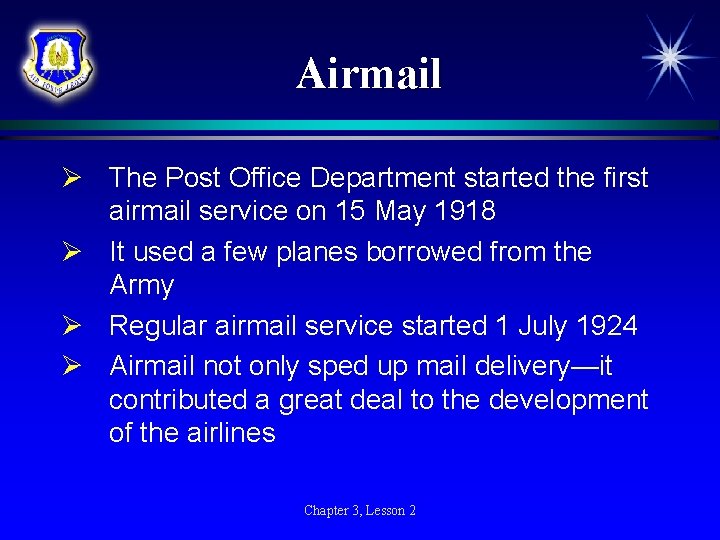
Airmail Ø The Post Office Department started the first airmail service on 15 May 1918 Ø It used a few planes borrowed from the Army Ø Regular airmail service started 1 July 1924 Ø Airmail not only sped up mail delivery—it contributed a great deal to the development of the airlines Chapter 3, Lesson 2
Airlines Ø The passage of the Air Commerce Act on 20 May 1926 provided for the first federal safety regulation of aviation for pilots and aircraft Ø It also sparked the growth of commercial airlines Ø In 1934 Congress passed another airmail act—it separated the air-transport companies from the aircraft manufacturers Chapter 3, Lesson 2
Review Ø Lindbergh’s transatlantic flight opened people’s minds to larger possibilities of air travel Ø In the early 20 th century, the golden age of aviation, milestone flights came one after another Ø Amelia Earhart was the first woman to fly across the Atlantic; first as a passenger, then flying solo Chapter 3, Lesson 2
Review Ø 1 st Lt James Harold Doolittle made another milestone flight on 24 September 1929—the first successful blind flight Ø Sgt William C. Ocker worked with Capt David A. Myers to solve the problem of spatial disorientation Ø Ocker developed a number of devices that became critical to pilot training and aviation in general Chapter 3, Lesson 2
Review Ø On New Year’s Day 1929, Maj Carl Spaatz took off in the Question Mark Ø By the time he landed—almost a week later— he had set an endurance record Ø The Post Office Department started the first airmail service on 15 May 1918 Ø The passage of the Air Commerce Act on 20 May 1926 provided for the first federal safety regulation of aviation for pilots and aircraft Chapter 3, Lesson 2
Summary Ø Charles Lindbergh’s famous contribution to aviation Ø The significance of the first transatlantic flight Ø Other significant contributions that helped flight become mainstream Chapter 3, Lesson 2
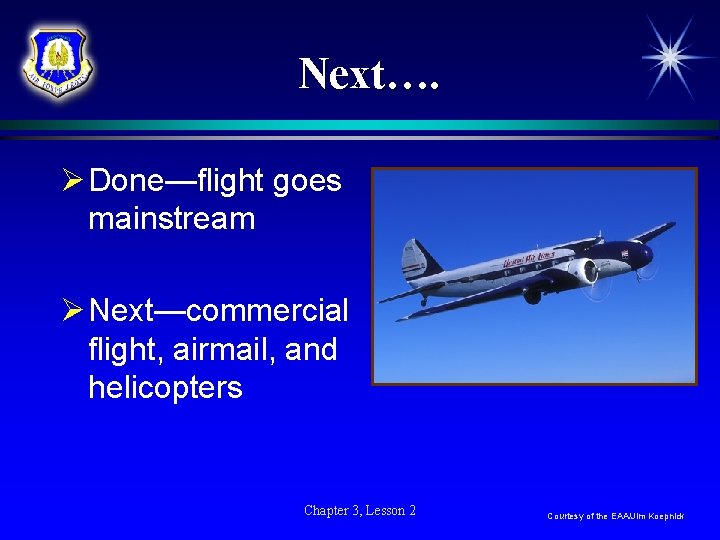
Next…. Ø Done—flight goes mainstream Ø Next—commercial flight, airmail, and helicopters Chapter 3, Lesson 2 Courtesy of the EAA/Jim Koepnick