
Flight flight No Integer available Seats Integer flights
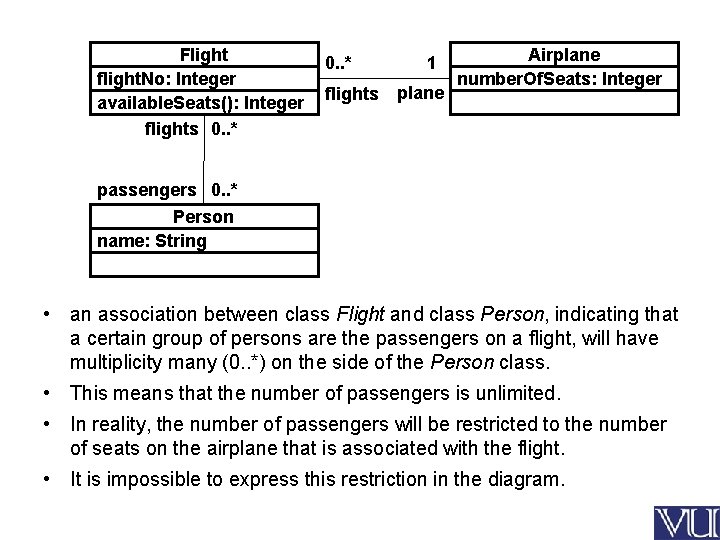
Flight flight. No: Integer available. Seats(): Integer flights 0. . * flights 1 plane Airplane number. Of. Seats: Integer passengers 0. . * Person name: String • an association between class Flight and class Person, indicating that a certain group of persons are the passengers on a flight, will have multiplicity many (0. . *) on the side of the Person class. • This means that the number of passengers is unlimited. • In reality, the number of passengers will be restricted to the number of seats on the airplane that is associated with the flight. • It is impossible to express this restriction in the diagram.
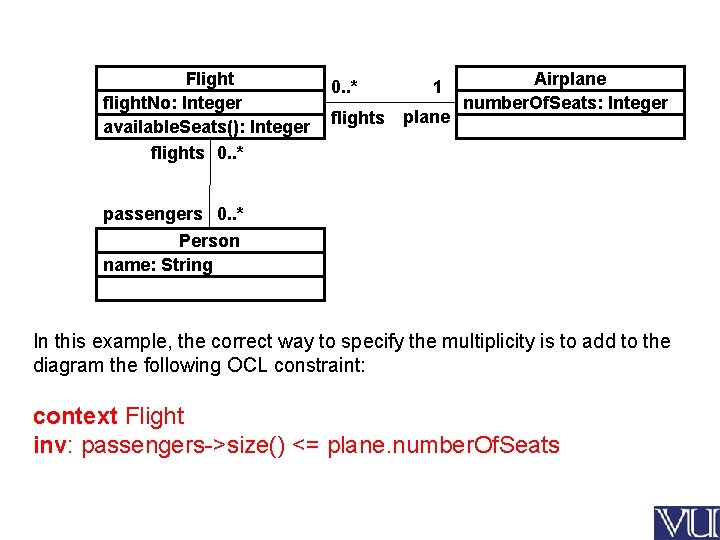
Flight flight. No: Integer available. Seats(): Integer flights 0. . * flights 1 plane Airplane number. Of. Seats: Integer passengers 0. . * Person name: String In this example, the correct way to specify the multiplicity is to add to the diagram the following OCL constraint: context Flight inv: passengers->size() <= plane. number. Of. Seats
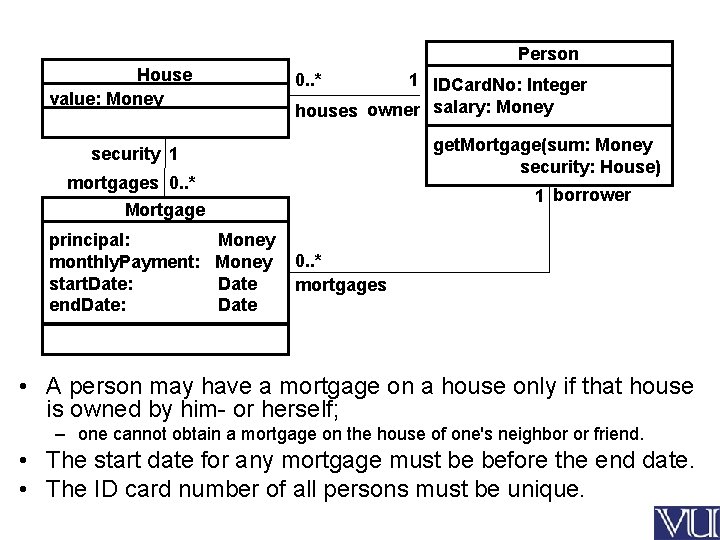
Person House value: Money 0. . * 1 IDCard. No: Integer houses owner salary: Money get. Mortgage(sum: Money security: House) security 1 mortgages 0. . * Mortgage principal: monthly. Payment: start. Date: end. Date: 1 borrower Money Date 0. . * mortgages • A person may have a mortgage on a house only if that house is owned by him- or herself; – one cannot obtain a mortgage on the house of one's neighbor or friend. • The start date for any mortgage must be before the end date. • The ID card number of all persons must be unique.
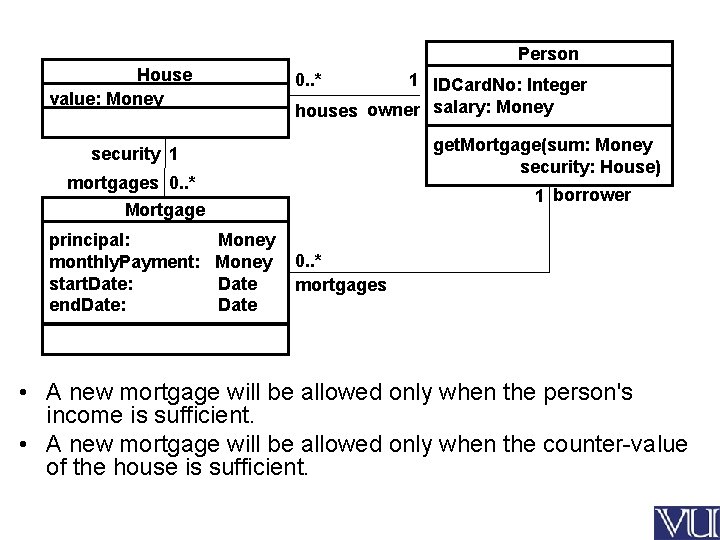
Person House value: Money 0. . * 1 IDCard. No: Integer houses owner salary: Money get. Mortgage(sum: Money security: House) security 1 mortgages 0. . * Mortgage principal: monthly. Payment: start. Date: end. Date: 1 borrower Money Date 0. . * mortgages • A new mortgage will be allowed only when the person's income is sufficient. • A new mortgage will be allowed only when the counter-value of the house is sufficient.
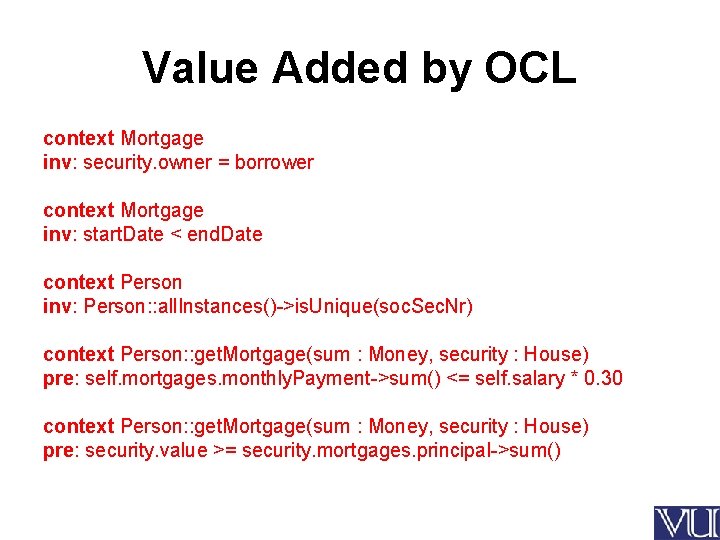
Value Added by OCL context Mortgage inv: security. owner = borrower context Mortgage inv: start. Date < end. Date context Person inv: Person: : all. Instances()->is. Unique(soc. Sec. Nr) context Person: : get. Mortgage(sum : Money, security : House) pre: self. mortgages. monthly. Payment->sum() <= self. salary * 0. 30 context Person: : get. Mortgage(sum : Money, security : House) pre: security. value >= security. mortgages. principal->sum()
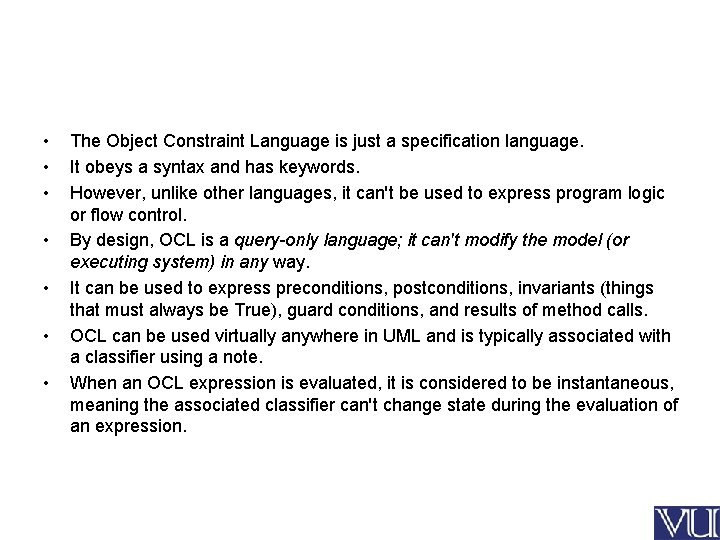
• • The Object Constraint Language is just a specification language. It obeys a syntax and has keywords. However, unlike other languages, it can't be used to express program logic or flow control. By design, OCL is a query-only language; it can't modify the model (or executing system) in any way. It can be used to express preconditions, postconditions, invariants (things that must always be True), guard conditions, and results of method calls. OCL can be used virtually anywhere in UML and is typically associated with a classifier using a note. When an OCL expression is evaluated, it is considered to be instantaneous, meaning the associated classifier can't change state during the evaluation of an expression.
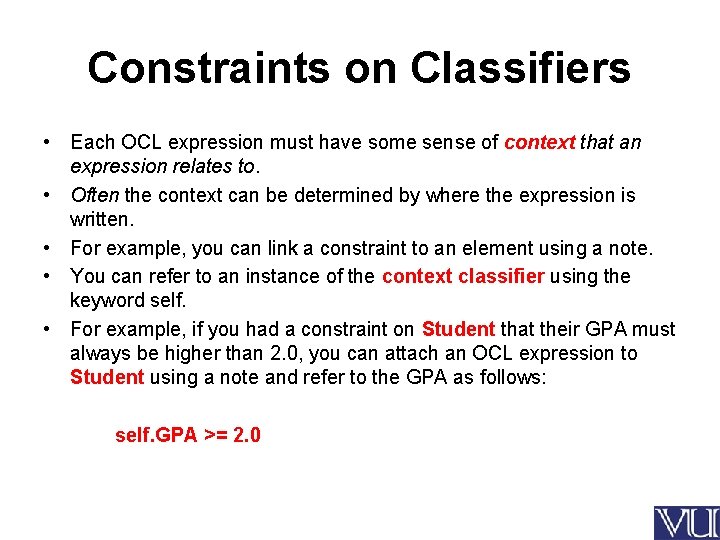
Constraints on Classifiers • Each OCL expression must have some sense of context that an expression relates to. • Often the context can be determined by where the expression is written. • For example, you can link a constraint to an element using a note. • You can refer to an instance of the context classifier using the keyword self. • For example, if you had a constraint on Student that their GPA must always be higher than 2. 0, you can attach an OCL expression to Student using a note and refer to the GPA as follows: self. GPA >= 2. 0
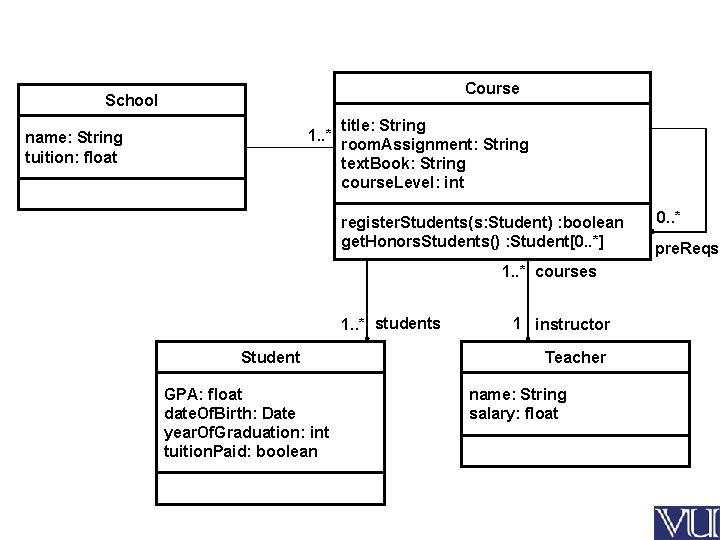
Course School 1. . * name: String tuition: float title: String room. Assignment: String text. Book: String course. Level: int register. Students(s: Student) : boolean get. Honors. Students() : Student[0. . *] 1. . * courses 1. . * students Student GPA: float date. Of. Birth: Date year. Of. Graduation: int tuition. Paid: boolean 1 instructor Teacher name: String salary: float 0. . * pre. Reqs
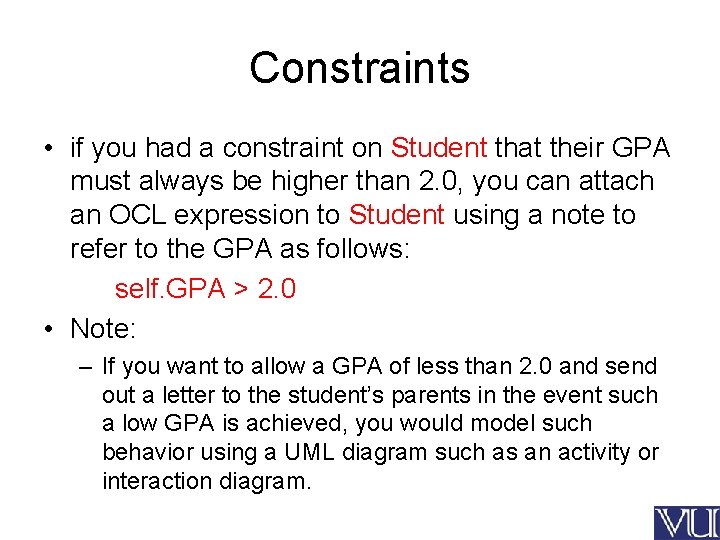
Constraints • if you had a constraint on Student that their GPA must always be higher than 2. 0, you can attach an OCL expression to Student using a note to refer to the GPA as follows: self. GPA > 2. 0 • Note: – If you want to allow a GPA of less than 2. 0 and send out a letter to the student’s parents in the event such a low GPA is achieved, you would model such behavior using a UML diagram such as an activity or interaction diagram.
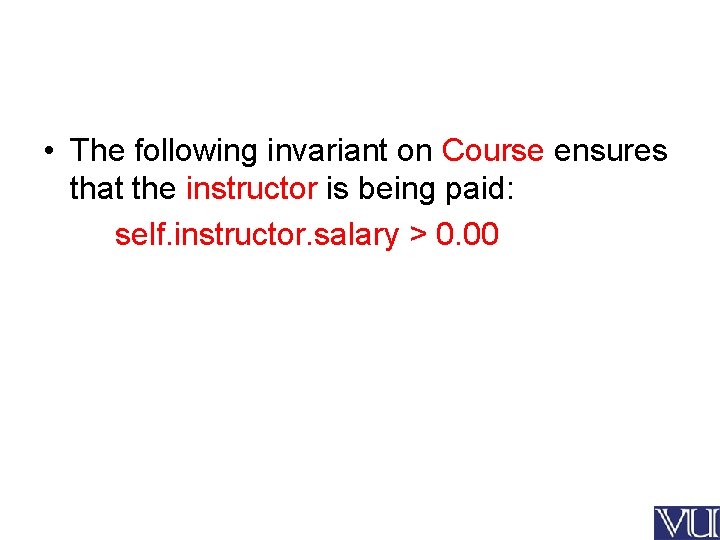
• The following invariant on Course ensures that the instructor is being paid: self. instructor. salary > 0. 00
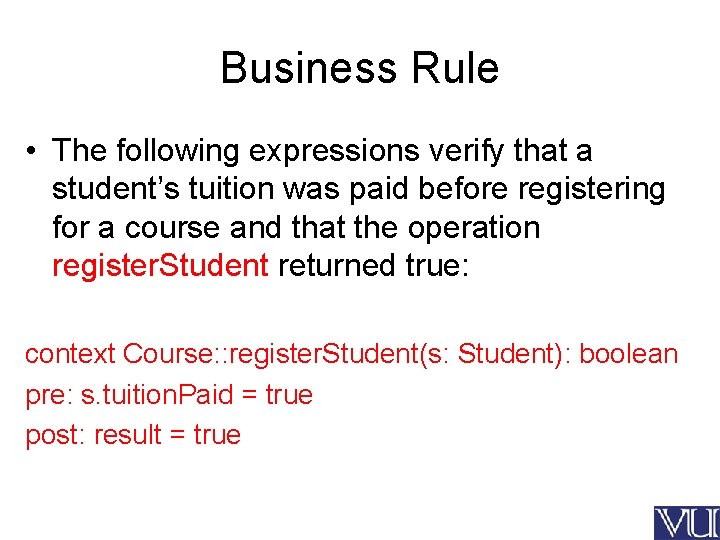
Business Rule • The following expressions verify that a student’s tuition was paid before registering for a course and that the operation register. Student returned true: context Course: : register. Student(s: Student): boolean pre: s. tuition. Paid = true post: result = true
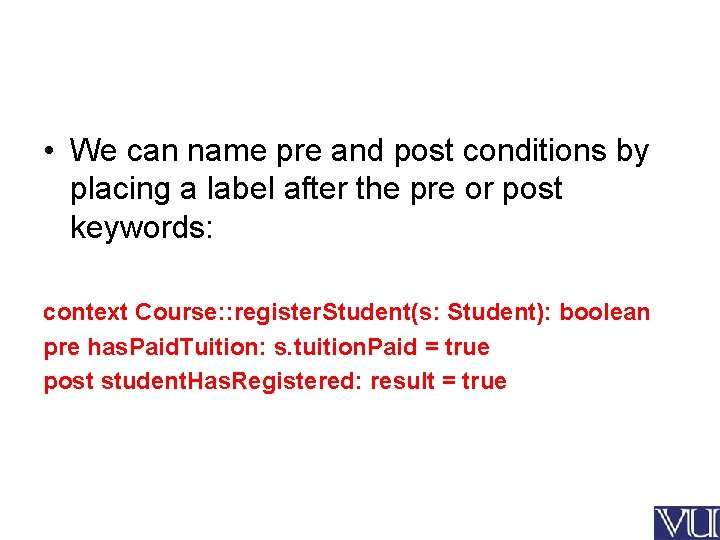
• We can name pre and post conditions by placing a label after the pre or post keywords: context Course: : register. Student(s: Student): boolean pre has. Paid. Tuition: s. tuition. Paid = true post student. Has. Registered: result = true
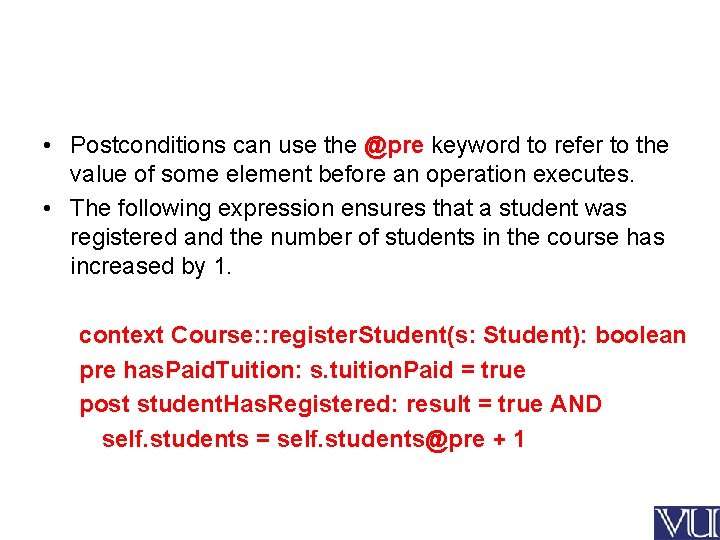
• Postconditions can use the @pre keyword to refer to the value of some element before an operation executes. • The following expression ensures that a student was registered and the number of students in the course has increased by 1. context Course: : register. Student(s: Student): boolean pre has. Paid. Tuition: s. tuition. Paid = true post student. Has. Registered: result = true AND self. students = self. students@pre + 1
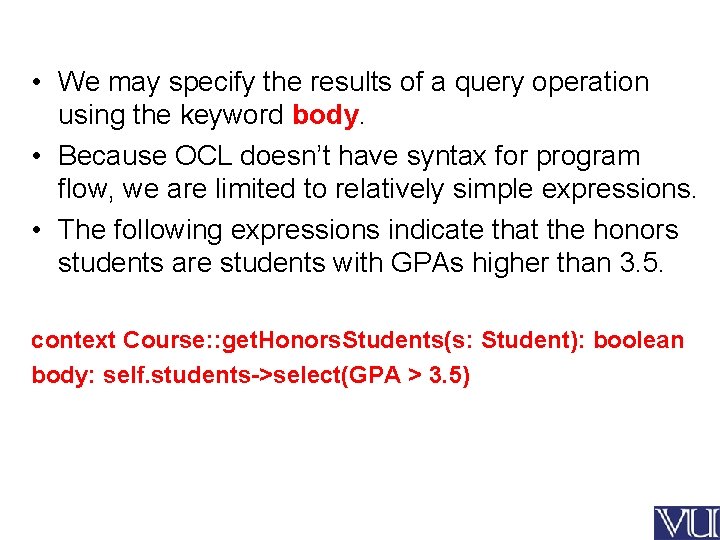
• We may specify the results of a query operation using the keyword body. • Because OCL doesn’t have syntax for program flow, we are limited to relatively simple expressions. • The following expressions indicate that the honors students are students with GPAs higher than 3. 5. context Course: : get. Honors. Students(s: Student): boolean body: self. students->select(GPA > 3. 5)
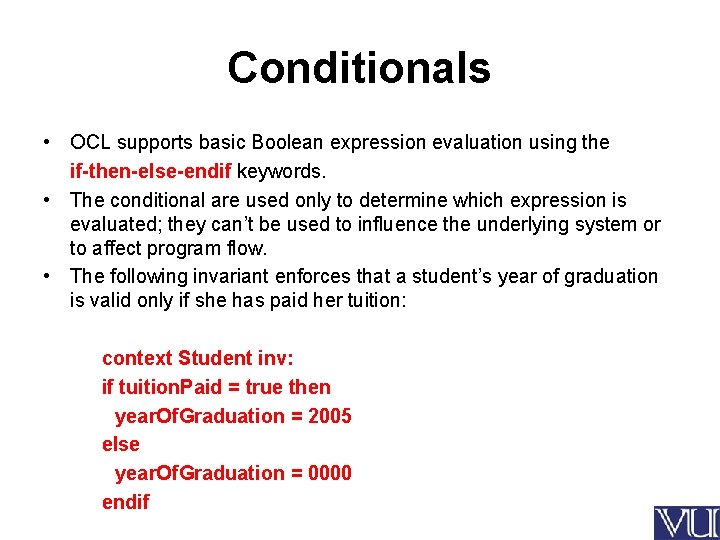
Conditionals • OCL supports basic Boolean expression evaluation using the if-then-else-endif keywords. • The conditional are used only to determine which expression is evaluated; they can’t be used to influence the underlying system or to affect program flow. • The following invariant enforces that a student’s year of graduation is valid only if she has paid her tuition: context Student inv: if tuition. Paid = true then year. Of. Graduation = 2005 else year. Of. Graduation = 0000 endif
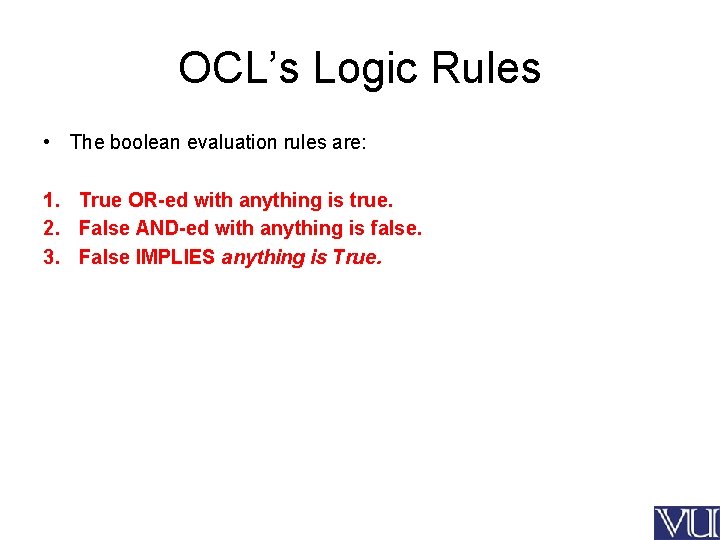
OCL’s Logic Rules • The boolean evaluation rules are: 1. True OR-ed with anything is true. 2. False AND-ed with anything is false. 3. False IMPLIES anything is True.
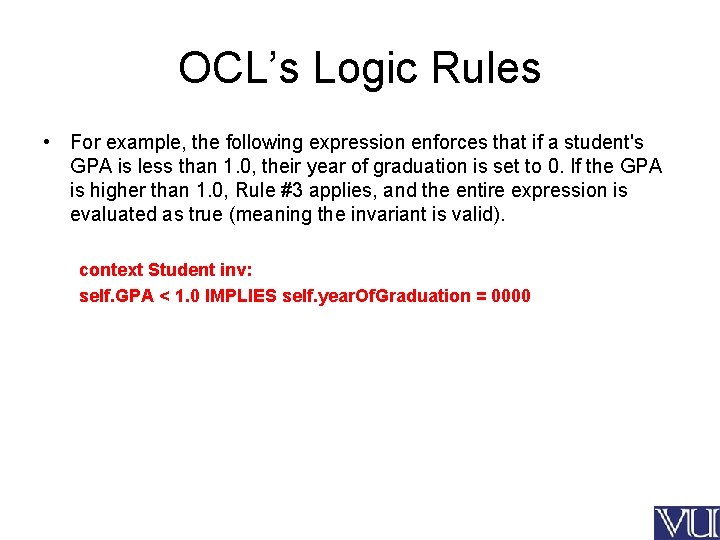
OCL’s Logic Rules • For example, the following expression enforces that if a student's GPA is less than 1. 0, their year of graduation is set to 0. If the GPA is higher than 1. 0, Rule #3 applies, and the entire expression is evaluated as true (meaning the invariant is valid). context Student inv: self. GPA < 1. 0 IMPLIES self. year. Of. Graduation = 0000
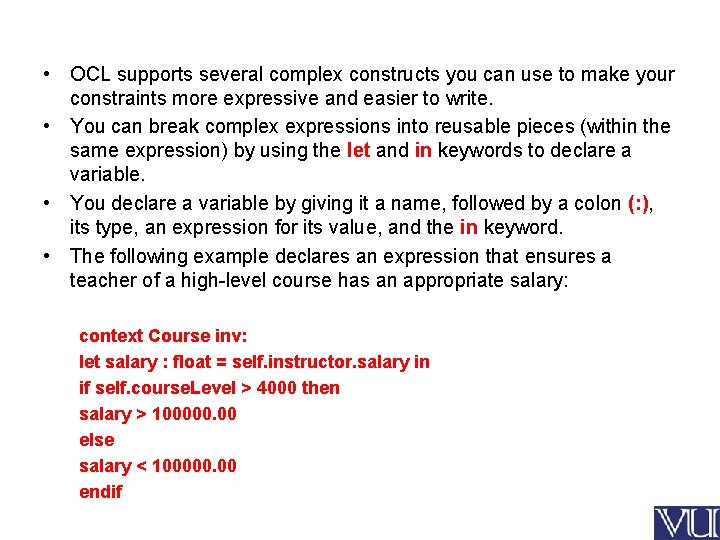
• OCL supports several complex constructs you can use to make your constraints more expressive and easier to write. • You can break complex expressions into reusable pieces (within the same expression) by using the let and in keywords to declare a variable. • You declare a variable by giving it a name, followed by a colon (: ), its type, an expression for its value, and the in keyword. • The following example declares an expression that ensures a teacher of a high-level course has an appropriate salary: context Course inv: let salary : float = self. instructor. salary in if self. course. Level > 4000 then salary > 100000. 00 else salary < 100000. 00 endif
- Slides: 18