
Flexible Use of Airspace Civil Military Collaboration i
Flexible Use of Airspace Civil – Military Collaboration i. FLEX Workshop III - Paris
Military Airspace • Special Use Airspace (SUA) • Allocated for military purposes • Defined Times • Permanent • SFC – UNL • Variable Utilization • Military tend to not consider civilian needs • SUAs occasionally subdivided internally Ø Opportunity to share ‘cold’ areas • How do we open the door to sharing?
Flight Efficiencies • Long haul flights are especially affected by winds • Daily and seasonal Jetstream variations • The ability to select (daily) optimal flight routes affect fuel loading. • Fuel upload affects passenger and cargo flight capacity • Long haul flights subject to adverse winds may have to limit cargo and passenger loads to reach destination

Military Airspace Requirements / Usage Army Weapons ranges Air Force Close Air Support (CAS) Small volume Ballistic templates usually BLO 17000’ AGL Medium volume Hi-Lo-Hi profile FL 200 (or less) and BLO Air Combat Maneuvering (ACM) Air Refueling Large volume Orbits or tracks Variable altitudes, FLs Low to mid 20 s depending on tanker often high (ABV FL 400)
Objective • Obtain the use of inactive military airspace to allow its use by civilian long range flights.
Modes • Time • SUAs are released to ATC for a period of time. • By “Range” • In some cases SUAs consist of smaller “range” components that can be inactive • Altitude Band • Civilian flights are allowed to use one or more altitudes to transit SUA • Point Out • Tactical permission for a particular flight

Coordination • Plans • Manages Military • Informs ATC AO • Coordinates w/ Military • Informs AOs (NOTAM? ) • Plans • Coordinates w/ ATC
Returns on Investment • GHGs World AOs • Cost ATM • Reduced complexity? MIL • Goodwill
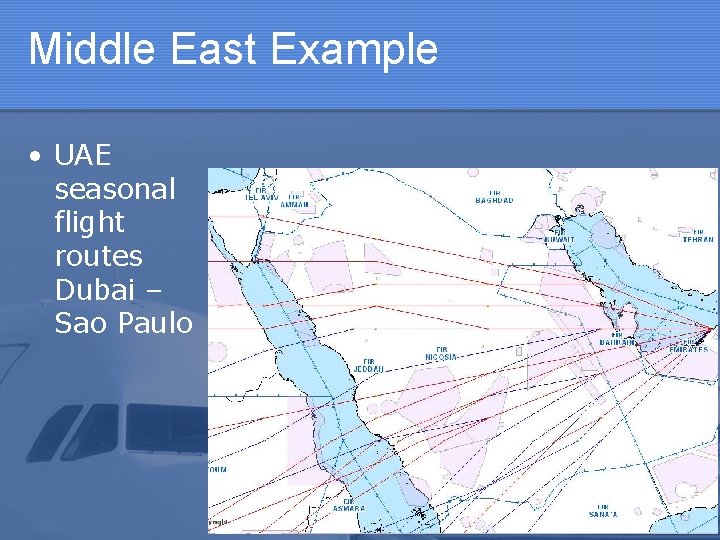
Middle East Example • UAE seasonal flight routes Dubai – Sao Paulo
How?
- Slides: 11