
Flexible Thermal Protection System Design and Margin Policy
Flexible Thermal Protection System Design and Margin Policy Anthony M. Calomino 1, John A. Dec 1, and Joseph A. Del Corso 1 Roy M. Sullivan 2, Eric H. Baker 2 and Peter J. Bonacuse 2 (1)NASA Langley Research Center, MS 431 Hampton VA 23681, USA Anthony. M. Calomino@nasa. gov, John. A. Dec@nasa. gov, Joseph. A. Delcorso@nasa. gov (2)NASA Glenn Research Center, MS 49 -3, Cleveland OH 44135, USA Roy. M. Sullivan@nasa. gov, Eric. H. Baker@nasa. gov, Peter. J. Bonacuse@nasa. gov 9 th International Planetary Probe Workshop Toulouse, France June 2012
Introduction • Design of Thermal Protection System (TPS) is critical to successful planetary atmospheric entry. • Design of a TPS depends on several analysis stages having inherent and unavoidable uncertainty – Prediction of aerothermal environment – Prediction of material thermal properties – Prediction of material response to environment. • Uncertainty conventionally handled with stacked, conservative margins that are often overly conservative. • Conservative margin policies lead to increased TPS mass. • Improved modeling and increased understanding with rational uncertainty treatment can result in TPS mass fraction reduction. 2
Thermal Margin Policy Objectives • Investigate and reliably model thermal management mechanisms for f-TPS using physics based formulations. • Establish a margins policy for f-TPS that treats model and response uncertainty using a Monte Carlo methods. • Couple f-TPS sizing to trajectory dispersion analysis. • Predict temperature profile distributions that can be used to establish reliability intervals. 3
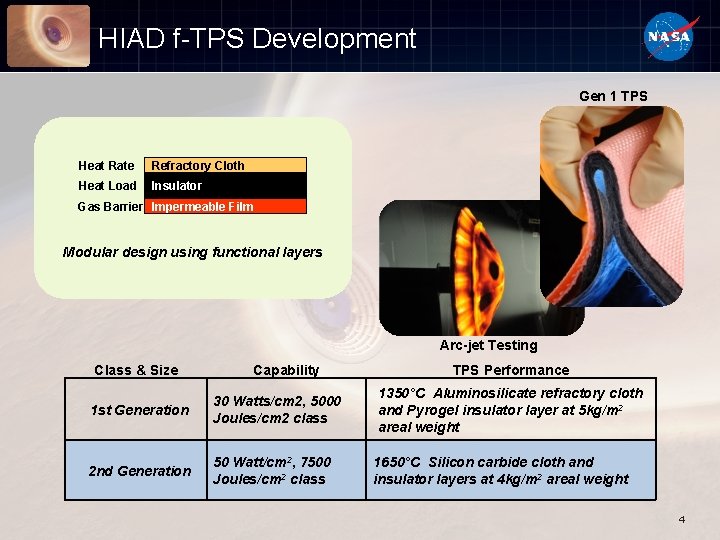
HIAD f-TPS Development Gen 1 TPS Heat Rate Refractory Cloth Heat Load Insulator Gas Barrier Impermeable Film Modular design using functional layers Arc-jet Testing Class & Size Capability 1 st Generation 30 Watts/cm 2, 5000 Joules/cm 2 class 2 nd Generation 50 Watt/cm 2, 7500 Joules/cm 2 class TPS Performance 1350°C Aluminosilicate refractory cloth and Pyrogel insulator layer at 5 kg/m 2 areal weight 1650°C Silicon carbide cloth and insulator layers at 4 kg/m 2 areal weight 4
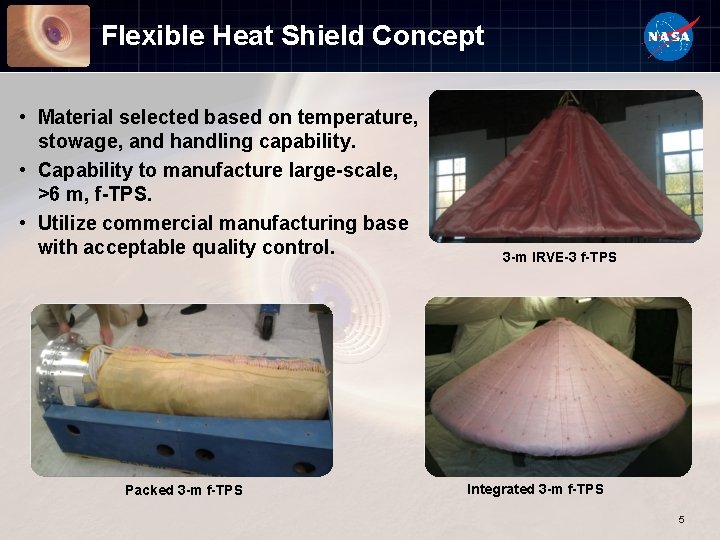
Flexible Heat Shield Concept • Material selected based on temperature, stowage, and handling capability. • Capability to manufacture large-scale, >6 m, f-TPS. • Utilize commercial manufacturing base with acceptable quality control. Packed 3 -m f-TPS 3 -m IRVE-3 f-TPS Integrated 3 -m f-TPS 5
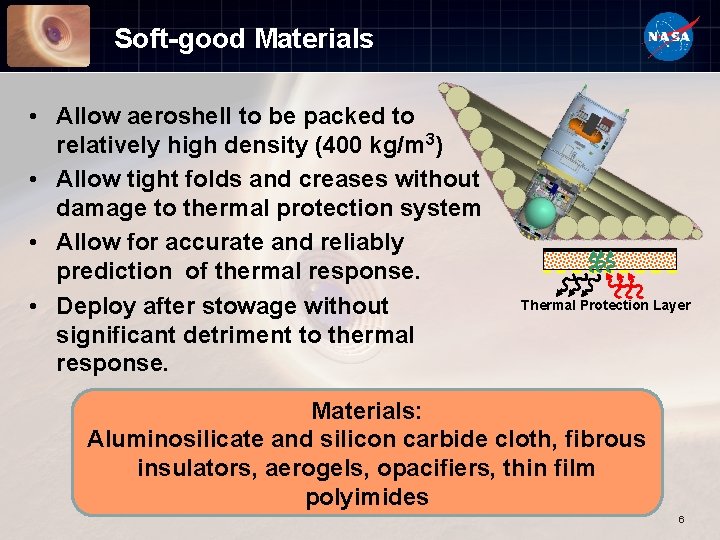
Soft-good Materials • Allow aeroshell to be packed to relatively high density (400 kg/m 3) • Allow tight folds and creases without damage to thermal protection system • Allow for accurate and reliably prediction of thermal response. • Deploy after stowage without significant detriment to thermal response. Thermal Protection Layer Materials: Aluminosilicate and silicon carbide cloth, fibrous insulators, aerogels, opacifiers, thin film polyimides 6

f-TPS Margins Policy Approach f-TPS sizing pipelined within trajectory and aerothermal dispersion analysis Trajectory output Aero-thermal output HEART Trajectory (Aaron Olds) Thermal Sizing model input Monte Carlo Predict fixed-time temperature distributions Predict fixed-temperature time distributions +3σ Normal Gamma Lognormal f-TPS Key Property Distribution 7
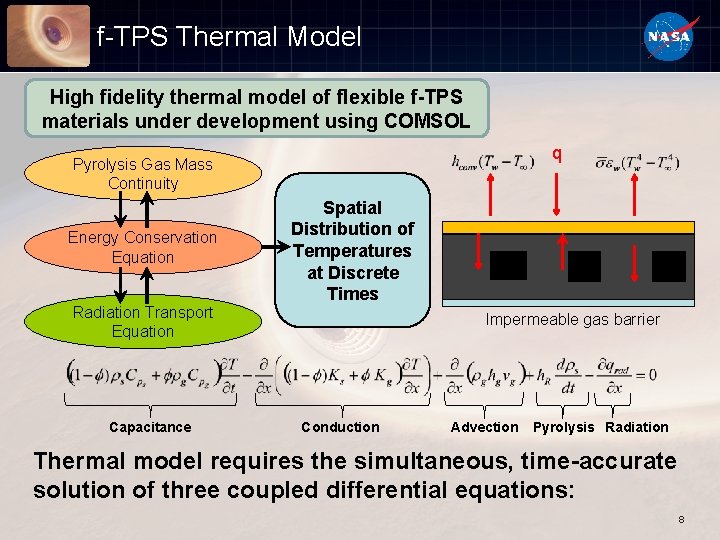
f-TPS Thermal Model High fidelity thermal model of flexible f-TPS materials under development using COMSOL q Pyrolysis Gas Mass Continuity Energy Conservation Equation Radiation Transport Equation Capacitance Spatial Distribution of Temperatures at Discrete Times Impermeable gas barrier Conduction Advection Pyrolysis Radiation Thermal model requires the simultaneous, time-accurate solution of three coupled differential equations: 8
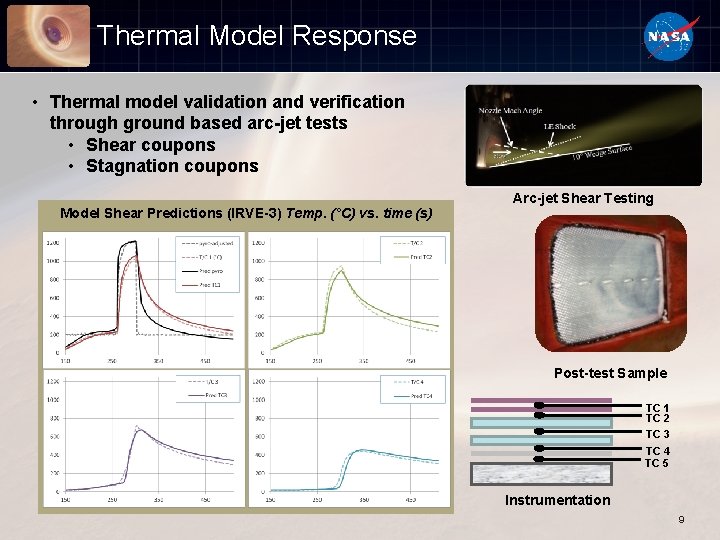
Thermal Model Response • Thermal model validation and verification through ground based arc-jet tests • Shear coupons • Stagnation coupons Model Shear Predictions (IRVE-3) Temp. (°C) vs. time (s) Arc-jet Shear Testing Post-test Sample TC 1 TC 2 TC 3 TC 4 TC 5 Instrumentation 9
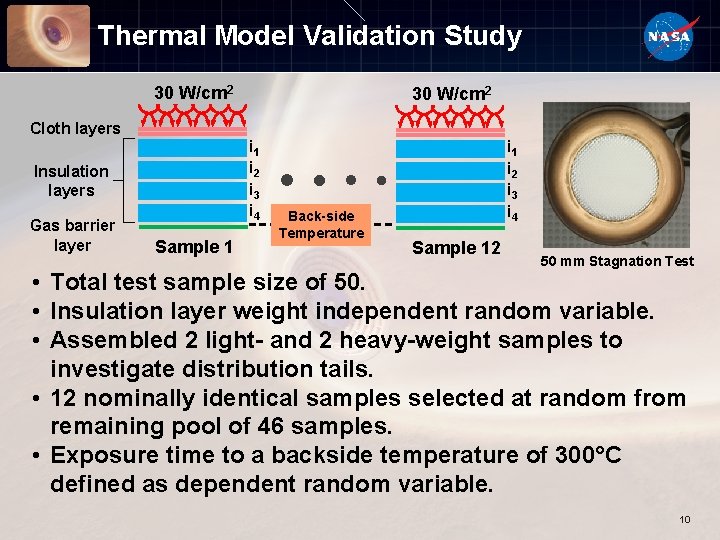
Thermal Model Validation Study 30 W/cm 2 Cloth layers i 1 i 2 i 3 i 4 Insulation layers Gas barrier layer 30 W/cm 2 Sample 1 • • • Back-side Temperature i 1 i 2 i 3 i 4 • Sample 12 50 mm Stagnation Test • Total test sample size of 50. • Insulation layer weight independent random variable. • Assembled 2 light- and 2 heavy-weight samples to investigate distribution tails. • 12 nominally identical samples selected at random from remaining pool of 46 samples. • Exposure time to a backside temperature of 300°C defined as dependent random variable. 10
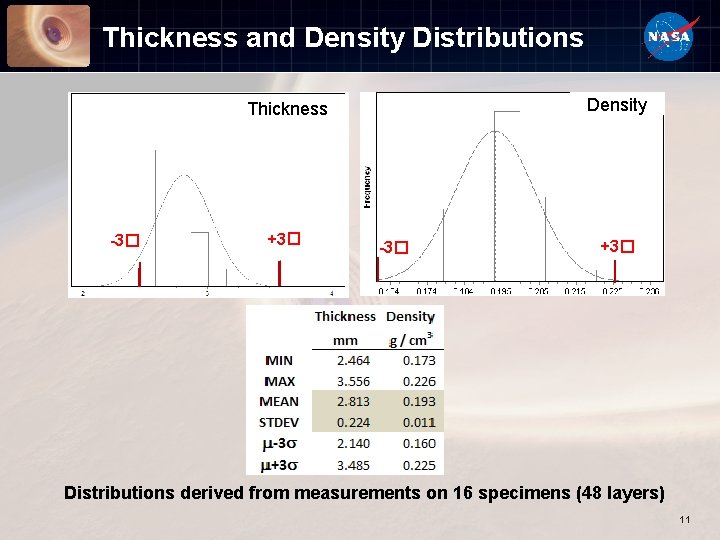
Thickness and Density Distributions Density Thickness -3� +3� Distributions derived from measurements on 16 specimens (48 layers) 11
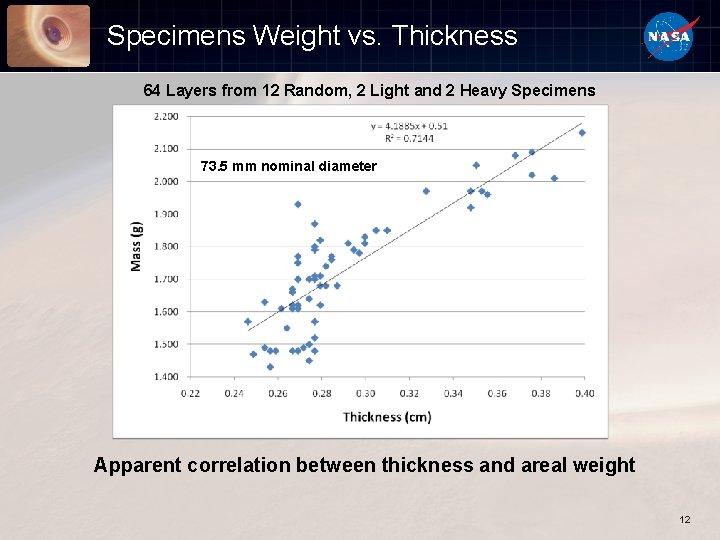
Specimens Weight vs. Thickness 64 Layers from 12 Random, 2 Light and 2 Heavy Specimens 73. 5 mm nominal diameter Apparent correlation between thickness and areal weight 12
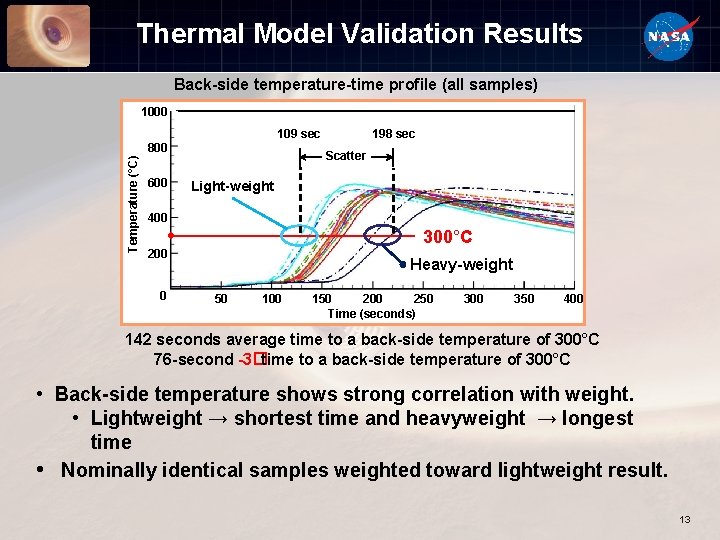
Thermal Model Validation Results Back-side temperature-time profile (all samples) 1000 109 sec Temperature (°C) 800 600 198 sec Scatter Light-weight 400 300°C 200 0 Heavy-weight 50 100 150 200 250 Time (seconds) 300 350 400 142 seconds average time to a back-side temperature of 300°C 76 -second -3�time to a back-side temperature of 300°C • Back-side temperature shows strong correlation with weight. • Lightweight → shortest time and heavyweight → longest time • Nominally identical samples weighted toward lightweight result. 13
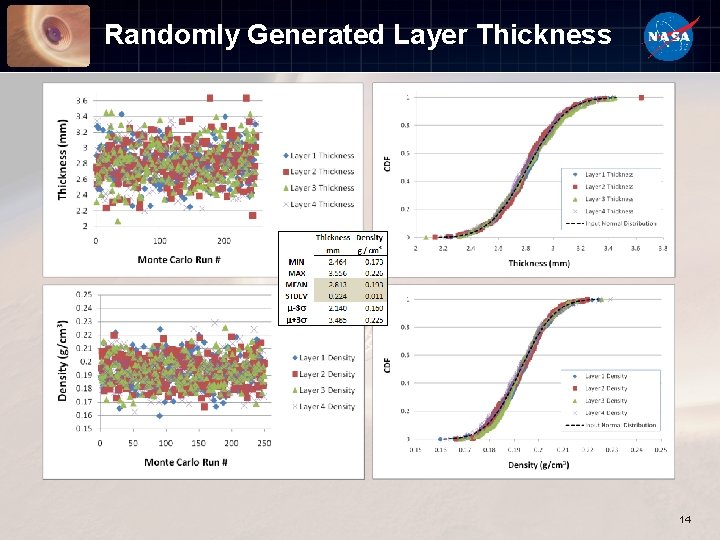
Randomly Generated Layer Thickness 14
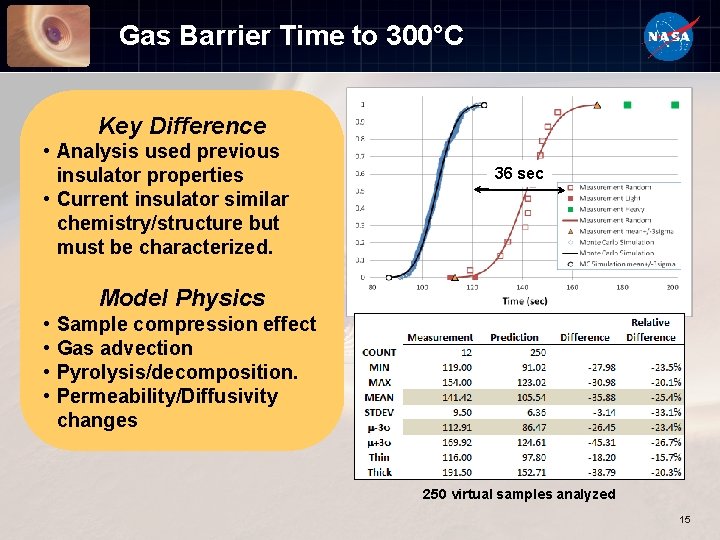
Gas Barrier Time to 300°C Key Difference • Analysis used previous insulator properties • Current insulator similar chemistry/structure but must be characterized. 36 sec Model Physics • • Sample compression effect Gas advection Pyrolysis/decomposition. Permeability/Diffusivity changes 250 virtual samples analyzed 15
Conclusions • A margin policy assembled for f-TPS that addresses response uncertainty using Monte Carlo techniques. • f-TPS thermal response model has been coded within COMSOL using a physics-based formulations. • Thermal model shows good correlation with Gen-1 f-TPS response under shear aerothermal loading. • Gen-1 f-TPS validation data set will be examined to improve understanding and modeling capability. • Additional material measurements are required to improve the fidelity: • Acquire properties for new insulator • Permeability/diffusivity • Pyrolysis/decomposition 16
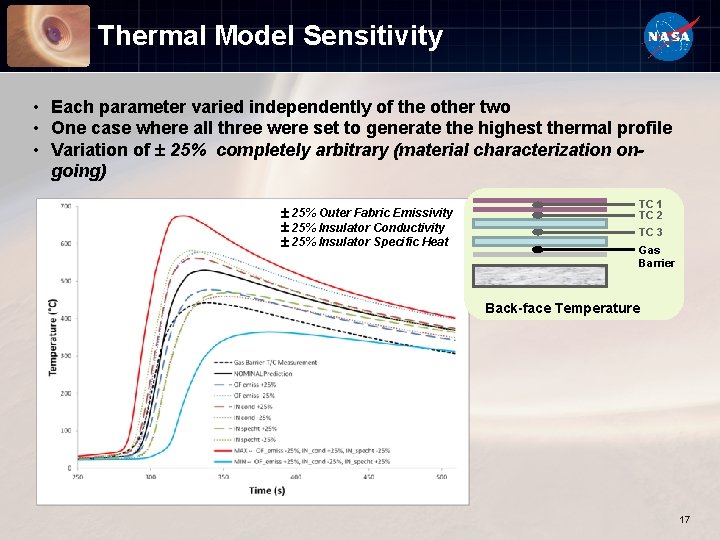
Thermal Model Sensitivity • Each parameter varied independently of the other two • One case where all three were set to generate the highest thermal profile • Variation of 25% completely arbitrary (material characterization ongoing) TC 1 TC 2 25% Outer Fabric Emissivity 25% Insulator Conductivity 25% Insulator Specific Heat TC 3 Gas Barrier Back-face Temperature 17
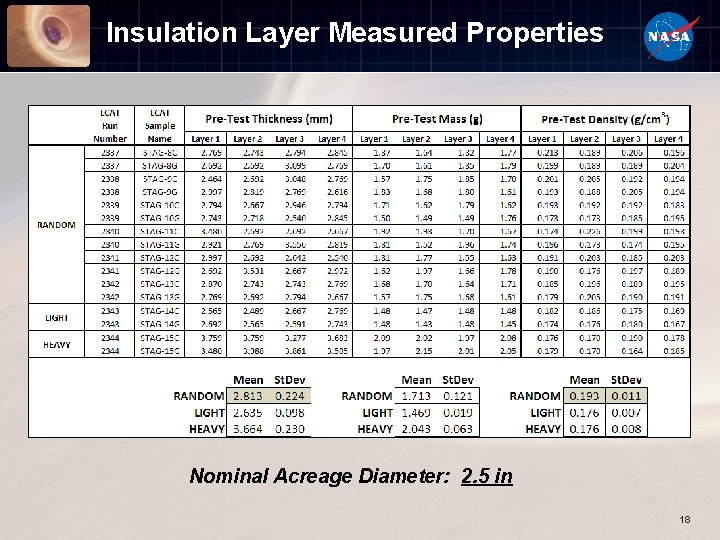
Insulation Layer Measured Properties Nominal Acreage Diameter: 2. 5 in 18
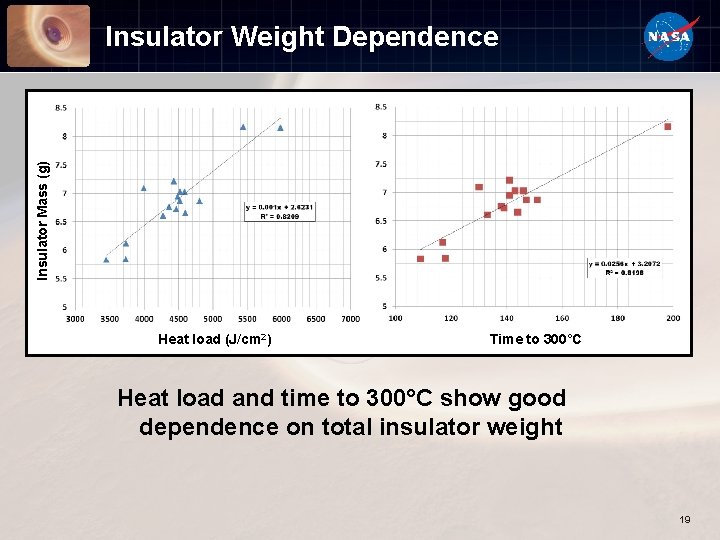
Insulator Mass (g) Insulator Weight Dependence Heat load (J/cm 2) Time to 300°C Heat load and time to 300°C show good dependence on total insulator weight 19
- Slides: 19