
Flexible Micro Electrode Arrays For Neuronal Stimulation and

Flexible Micro Electrode Arrays For Neuronal Stimulation and Recording IWORID 2004 Christopher Adams K. Mathieson, D. Gunning, J. D. Morrison, W. Cunningham, M. Pryddrech, M. French, M. Rahman University Of Glasgow, CCLRC
Contents • • Introduction Eye Bio - Synthetic model for artificial vision Active Pixel Sensor (APS) Neural Network. Array Development Cellular Stimulation Summary
Retinal Prosthesis • Is it possible to develop microelectronics for a retinal prosthesis? – Restore partial sight to blind patients • Several groups working on possible solutions around the world – USA – Retinal Implant Projects • MIT and Harvard (Rizzo) • USC (Humayan) – Implanted arrays in patients – Germany • EPI-RET and SUB-RET – Optobionics, Second Sight • developing commercial products – Exist around 40 groups looking at developing retinal prosthetics
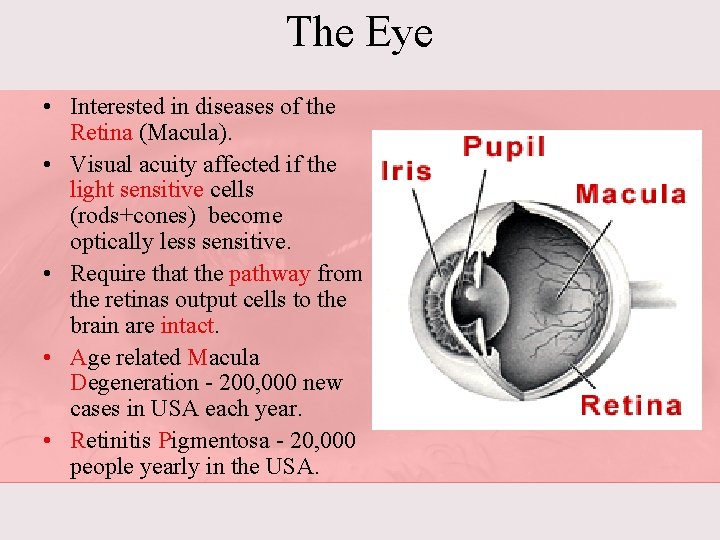
The Eye • Interested in diseases of the Retina (Macula). • Visual acuity affected if the light sensitive cells (rods+cones) become optically less sensitive. • Require that the pathway from the retinas output cells to the brain are intact. • Age related Macula Degeneration - 200, 000 new cases in USA each year. • Retinitis Pigmentosa - 20, 000 people yearly in the USA.
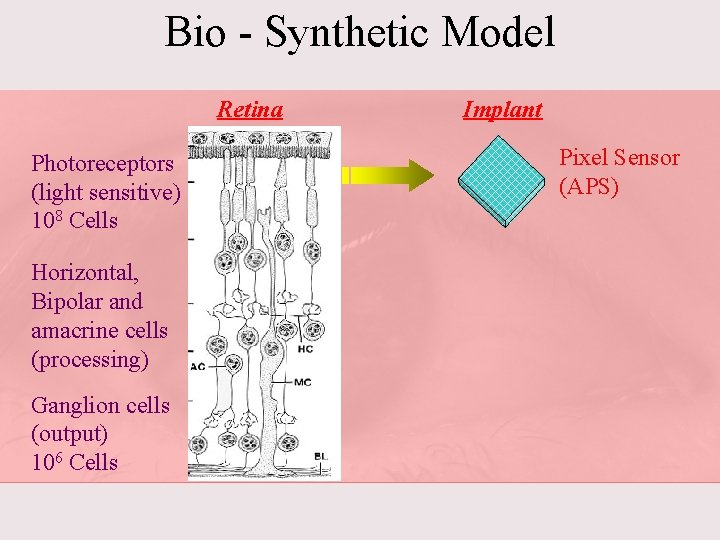
Bio - Synthetic Model Retina Photoreceptors (light sensitive) 108 Cells Horizontal, Bipolar and amacrine cells (processing) Ganglion cells (output) 106 Cells Implant Pixel Sensor (APS)

Active Pixel Sensor (APS) • • 10 x 10 pixel matrix pixel pitch 100 m 0. 35 m technology Each pixel contains a voltage controlled oscillator (VCO), which creates signals capable of stimulating the ganglion cell. Frequency of VCO responds logarithmically to incident light. • Bi-phasic output ~50 n. C/phase Frequency range : 10 Hz-1 k. Hz
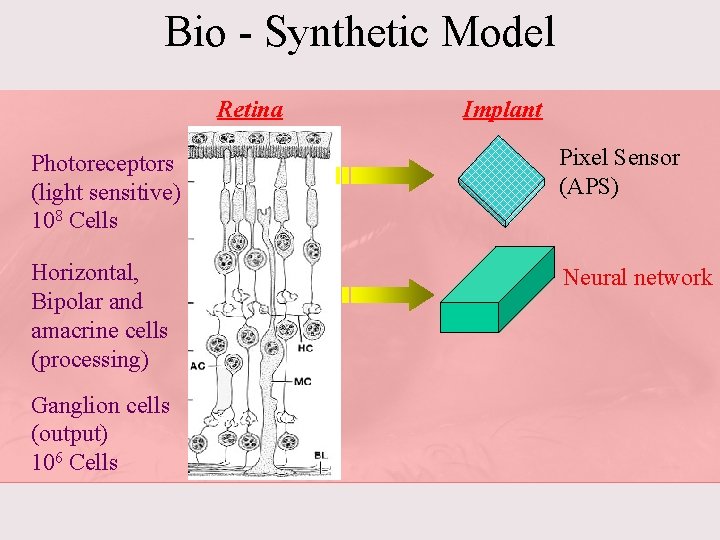
Bio - Synthetic Model Retina Implant Photoreceptors (light sensitive) 108 Cells Pixel Sensor (APS) Horizontal, Bipolar and amacrine cells (processing) Neural network Ganglion cells (output) 106 Cells
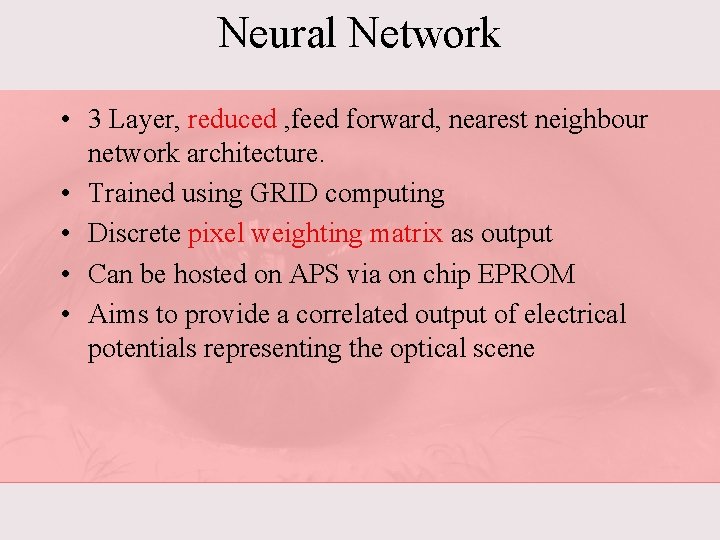
Neural Network • 3 Layer, reduced , feed forward, nearest neighbour network architecture. • Trained using GRID computing • Discrete pixel weighting matrix as output • Can be hosted on APS via on chip EPROM • Aims to provide a correlated output of electrical potentials representing the optical scene
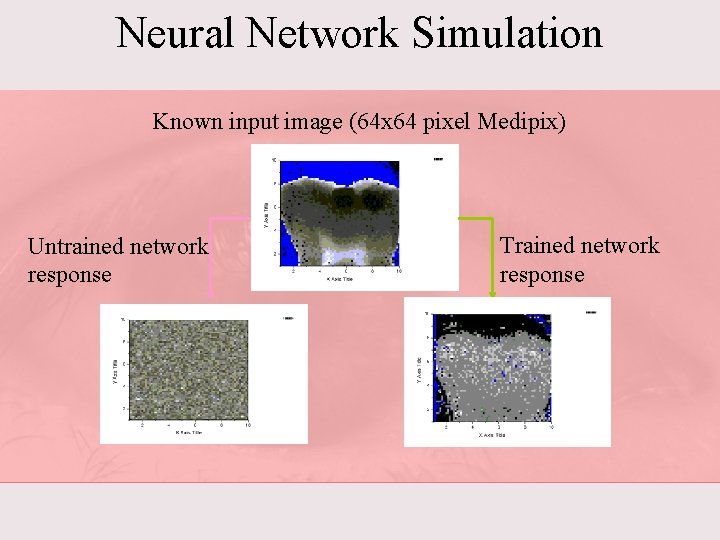
Neural Network Simulation Known input image (64 x 64 pixel Medipix) Untrained network response Trained network response

Bio - Synthetic Model Retina Implant Photoreceptors (light sensitive) 108 Cells Pixel Sensor (APS) Horizontal, Bipolar and amacrine cells (processing) Neural network Ganglion cells (output) 106 Cells Microelectrode array
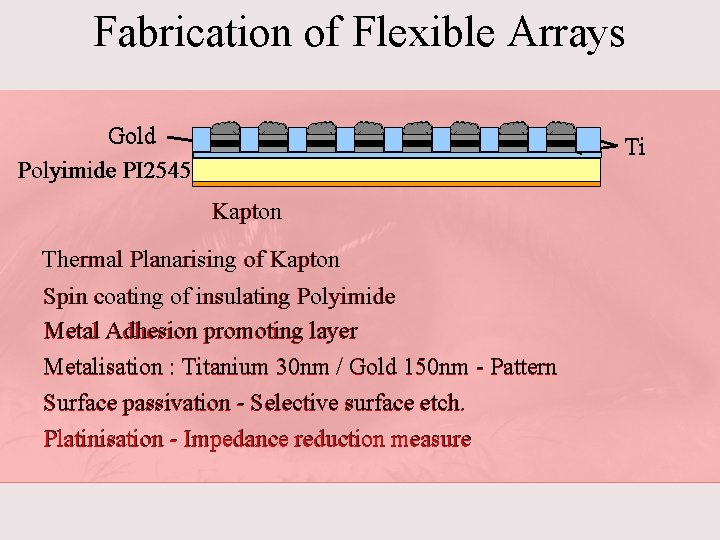
Fabrication of Flexible Arrays Gold Polyimide PI 2545 Ti Kapton Thermal Planarising of Kapton Spin coating of insulating Polyimide Metal Adhesion promoting layer Metalisation : Titanium 30 nm / Gold 150 nm - Pattern Surface passivation - Selective surface etch. Platinisation - Impedance reduction measure
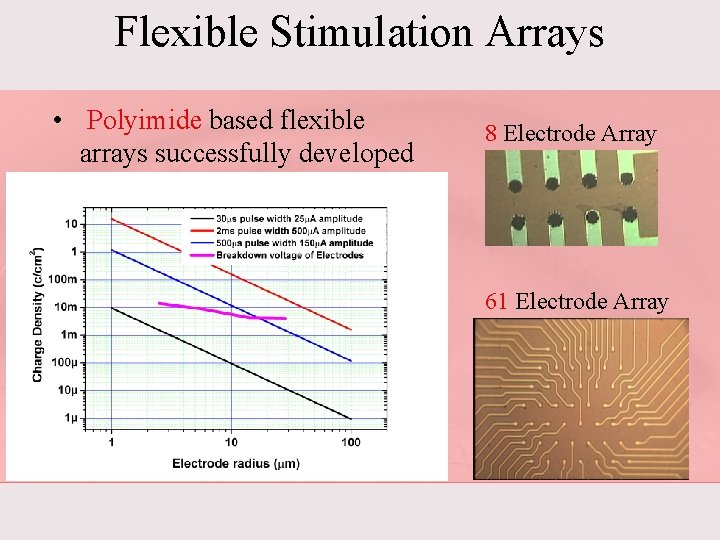
Flexible Stimulation Arrays • Polyimide based flexible arrays successfully developed 8 Electrode Array 61 Electrode Array
Stimulation of cells • Given the recorded ganglion cell AP waveform in response to light incident on the retina. • Principally if we reconstruct the spike trains we are reconstructing the visual scene. • Electronically recreate the AP’s and pass to an electrode coupled to a ganglion cell, connected to brain through the optic nerve. • Main constraints include : Current densities, balanced biphasic pulses, frequency of AP’s, heating, electrode charge injection limits and reproducing the retinal coding through spike trains.
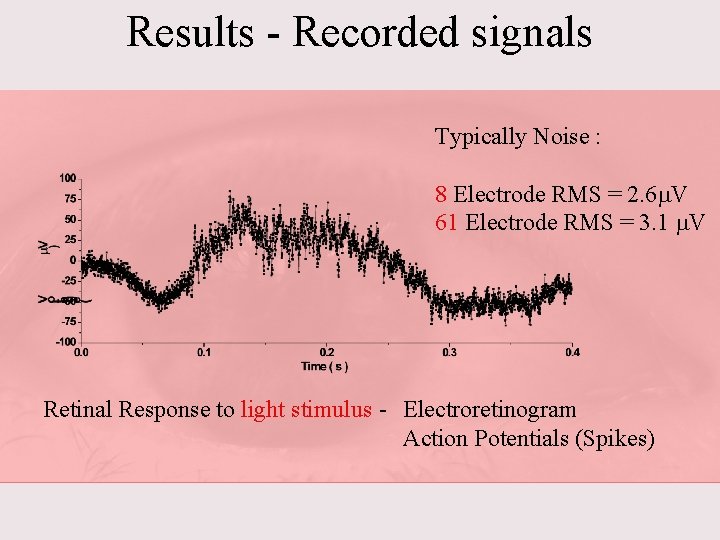
Results - Recorded signals Typically Noise : 8 Electrode RMS = 2. 6 V 61 Electrode RMS = 3. 1 V Retinal Response to light stimulus - Electroretinogram Action Potentials (Spikes)
Conclusions • Fabrication of flexible arrays successful on polyimide based substrates. • Design for APS detector complete, foundry run in progress - Arrive mid August. • 1 st optimisation of neural network complete. • Investigations of cell stimulation underway. • New flexible materials in development stage. Thanks for listening

The Eye • Highly evolved detector • Central retina has few micron detector pitch – =>High spatial contrast • Refresh rate 40 ms (25 Hz) • Large light intensity range
• Electroretinograms and spike trains (Action Potentials) recorded. • Stimulus intensity variance discernible on recorded action potentials
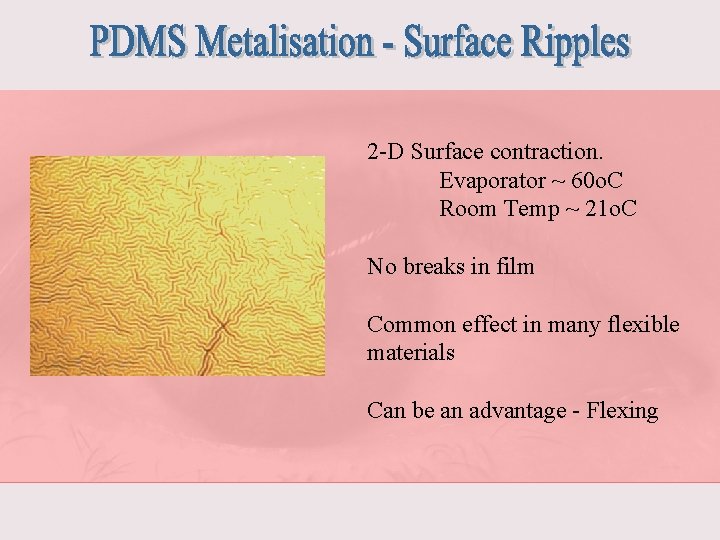
2 -D Surface contraction. Evaporator ~ 60 o. C Room Temp ~ 21 o. C No breaks in film Common effect in many flexible materials Can be an advantage - Flexing
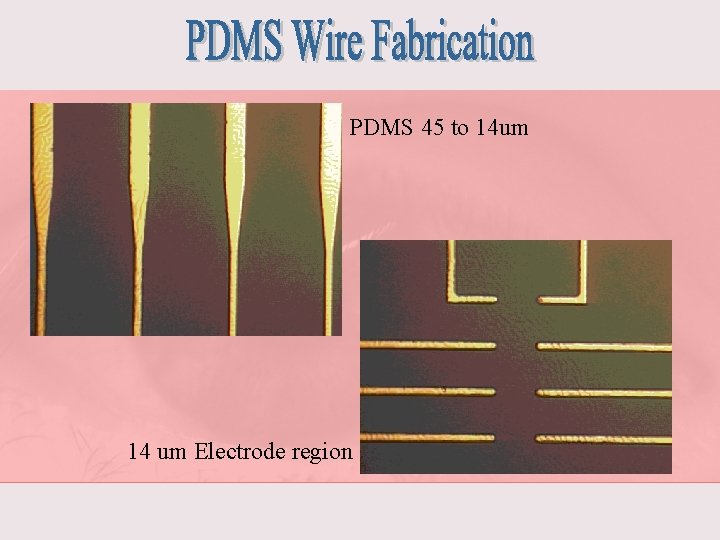
PDMS 45 to 14 um 14 um Electrode region
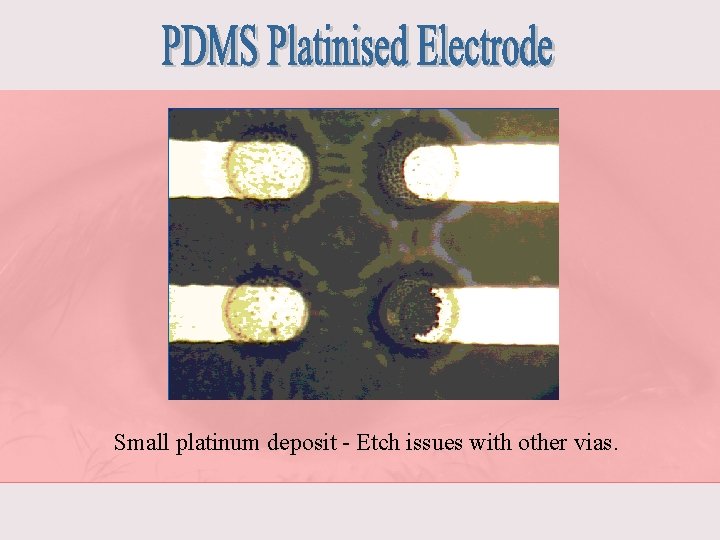
Small platinum deposit - Etch issues with other vias.
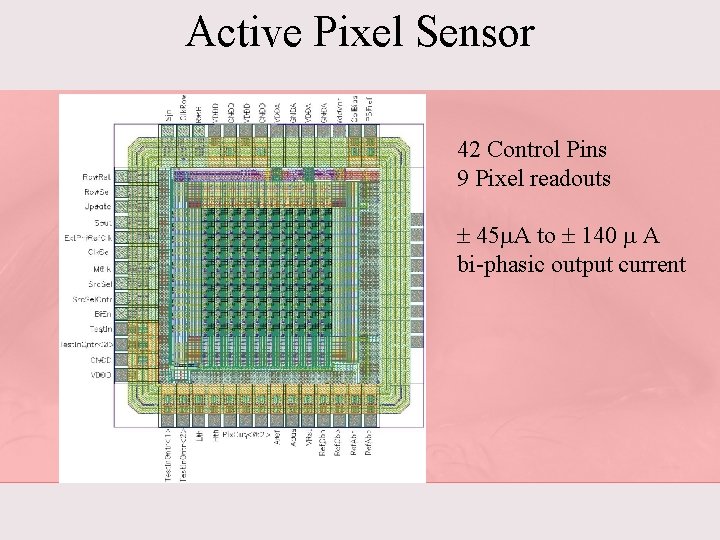
Active Pixel Sensor 42 Control Pins 9 Pixel readouts 45 A to 140 A bi-phasic output current
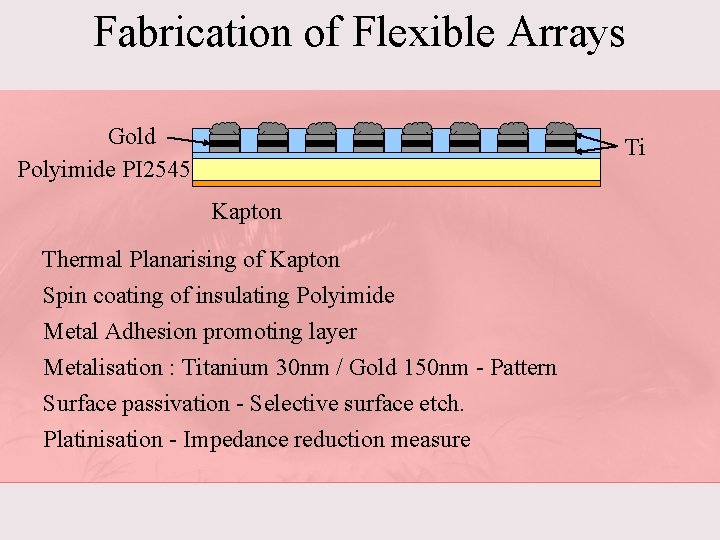
Fabrication of Flexible Arrays Gold Polyimide PI 2545 Ti Kapton Thermal Planarising of Kapton Spin coating of insulating Polyimide Metal Adhesion promoting layer Metalisation : Titanium 30 nm / Gold 150 nm - Pattern Surface passivation - Selective surface etch. Platinisation - Impedance reduction measure
Fabrication of Flexible Arrays(2) • Require a scalable process • Utilising biocompatible materials • Need to comply with microfabrication techniques. - Etching, metalisation etc.
- Slides: 24