
Flexible Couplings Content The function of flexible coupling
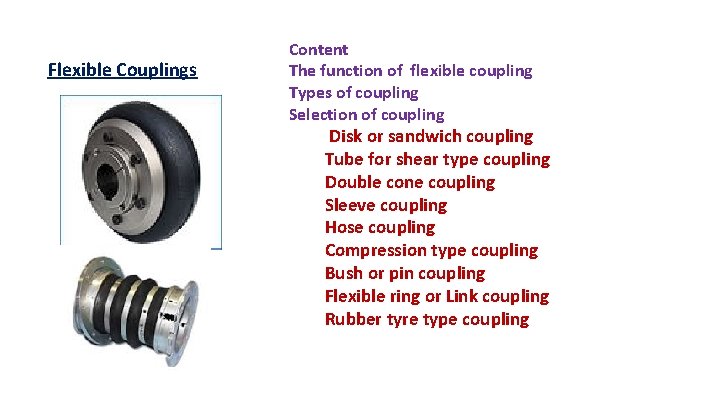
Flexible Couplings Content The function of flexible coupling Types of coupling Selection of coupling Disk or sandwich coupling Tube for shear type coupling Double cone coupling Sleeve coupling Hose coupling Compression type coupling Bush or pin coupling Flexible ring or Link coupling Rubber tyre type coupling
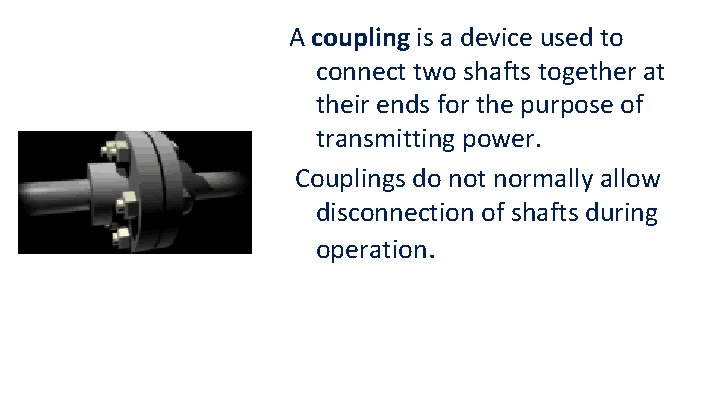
A coupling is a device used to connect two shafts together at their ends for the purpose of transmitting power. Couplings do not normally allow disconnection of shafts during operation.
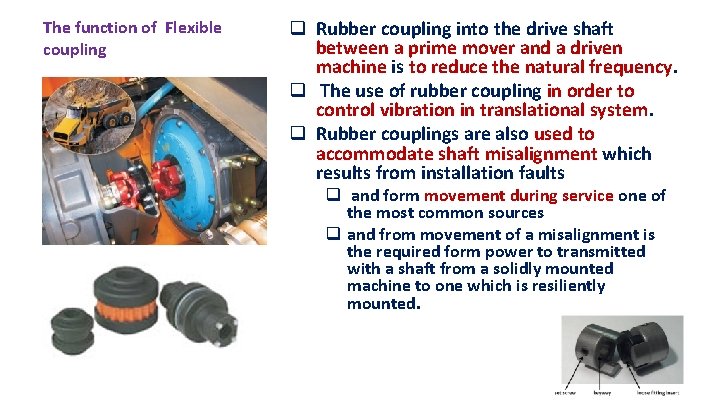
The function of Flexible coupling q Rubber coupling into the drive shaft between a prime mover and a driven machine is to reduce the natural frequency. q The use of rubber coupling in order to control vibration in translational system. q Rubber couplings are also used to accommodate shaft misalignment which results from installation faults q and form movement during service one of the most common sources q and from movement of a misalignment is the required form power to transmitted with a shaft from a solidly mounted machine to one which is resiliently mounted.

TYPES OF COUPLING 1) Disk or sandwich coupling 2) Tube for shear type coupling 3) Double cone coupling 4) Sleeve coupling 5) Hose coupling 6) Compression type coupling 7) Bush or pin coupling 8) Flexible ring or Link coupling 9) Rubber tyre type coupling The capability of coupling to cope with misalignment, it is important to note that any misalignment should be absorbed by coupling component themselves. In large rubber disk coupling angular or axial misalignment may in some design result additional bending distortion making it less effective.

SELECTION OF COUPLING The characteristic required of a coupling depends on the type of coupling, but the minimum information required for design purpose is as follows; • • • Maximum safe distortional displacement in degrees Maximum safe parallel displacement Maximum safe conical displacement Maximum safe axial displacement Safety factor in working; torque load Safety factor in maximum axial load Minimum and maximum revolutions per minutes Type of prime mover and type of driven machine Maximum permitted length and diameter of couplings

• SELECTION OF COUPLING • • • Position of shaft to be connected (horizontal, vertical or machined and position of bearings in relation to couplings halves, together with shaft size and required means of attachment. Space available for dismantling and desirability of including a quick dismantling feature Operating conditions (temperature and presence of dust, oil, corrosive atmosphere etc. ) Whether the driven machine is to be directly coupled of gear driven and whether the drive is to be reversible or non reversible Type of load (whether uniform, pulsating, intermittent, impact etc. ) Estimated cyclic irregularity of the drive. Permissible backlash
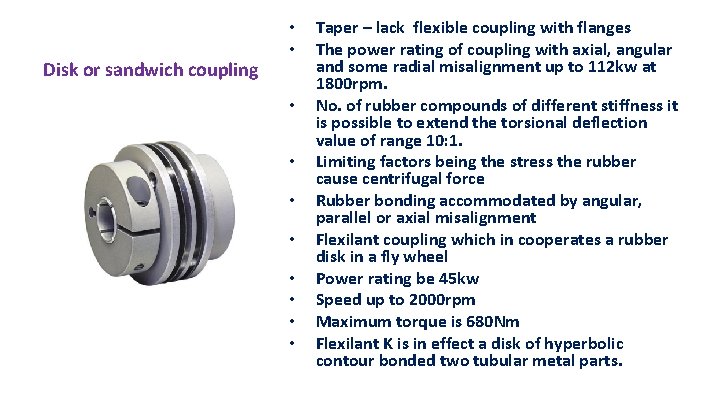
Disk or sandwich coupling • • • Taper – lack flexible coupling with flanges The power rating of coupling with axial, angular and some radial misalignment up to 112 kw at 1800 rpm. No. of rubber compounds of different stiffness it is possible to extend the torsional deflection value of range 10: 1. Limiting factors being the stress the rubber cause centrifugal force Rubber bonding accommodated by angular, parallel or axial misalignment Flexilant coupling which in cooperates a rubber disk in a fly wheel Power rating be 45 kw Speed up to 2000 rpm Maximum torque is 680 Nm Flexilant K is in effect a disk of hyperbolic contour bonded two tubular metal parts.
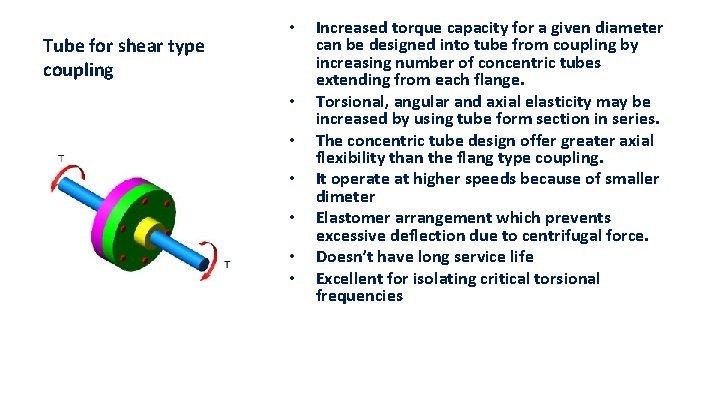
Tube for shear type coupling • • Increased torque capacity for a given diameter can be designed into tube from coupling by increasing number of concentric tubes extending from each flange. Torsional, angular and axial elasticity may be increased by using tube form section in series. The concentric tube design offer greater axial flexibility than the flang type coupling. It operate at higher speeds because of smaller dimeter Elastomer arrangement which prevents excessive deflection due to centrifugal force. Doesn’t have long service life Excellent for isolating critical torsional frequencies
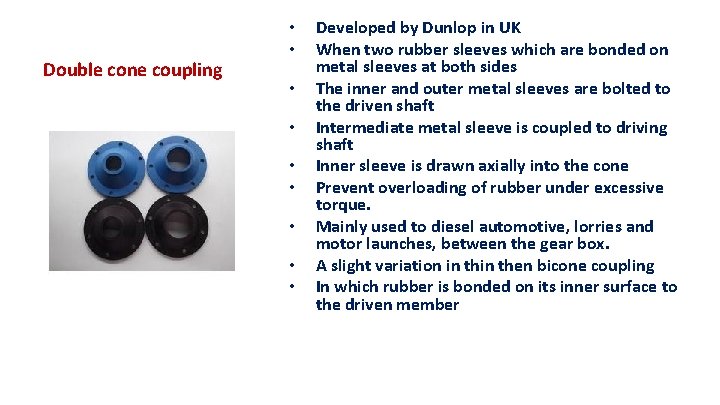
Double cone coupling • • • Developed by Dunlop in UK When two rubber sleeves which are bonded on metal sleeves at both sides The inner and outer metal sleeves are bolted to the driven shaft Intermediate metal sleeve is coupled to driving shaft Inner sleeve is drawn axially into the cone Prevent overloading of rubber under excessive torque. Mainly used to diesel automotive, lorries and motor launches, between the gear box. A slight variation in then bicone coupling In which rubber is bonded on its inner surface to the driven member

• Sleeve coupling • • Coupling with a rubber sleeve bonded to a flange end to give a design which provides high torsional flexibility and shock loads, vibration and angular misalignment. Power rating is about 13 kw per 100 rpm. These couplings have an elastomeric elements shape to give uniform stress distribution. The ability of the coupling to slip at outer member with short duration shock overload protects. This coupling is successful for diesel-driven application Clay flex coupling consists of two inner members, suitably bored and outer shell into two halves. The rubber is chemically bonded to inner members and to split outer members and disposed gap between the halves of the outer shell The outer clamping ring forced over outer shell and prestress on the rubber which separates inner member by axial deformation
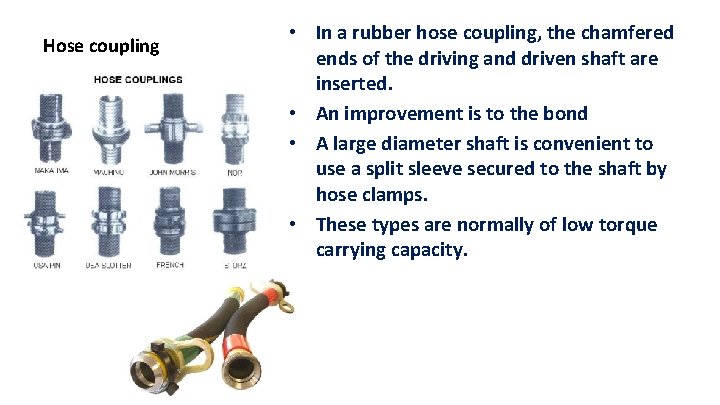
Hose coupling • In a rubber hose coupling, the chamfered ends of the driving and driven shaft are inserted. • An improvement is to the bond • A large diameter shaft is convenient to use a split sleeve secured to the shaft by hose clamps. • These types are normally of low torque carrying capacity.
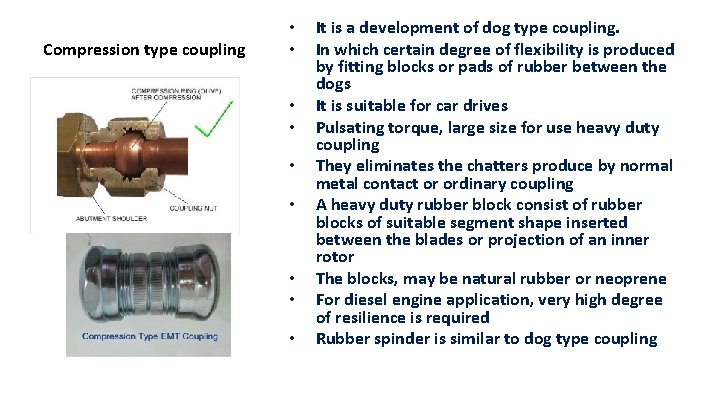
Compression type coupling • • • It is a development of dog type coupling. In which certain degree of flexibility is produced by fitting blocks or pads of rubber between the dogs It is suitable for car drives Pulsating torque, large size for use heavy duty coupling They eliminates the chatters produce by normal metal contact or ordinary coupling A heavy duty rubber block consist of rubber blocks of suitable segment shape inserted between the blades or projection of an inner rotor The blocks, may be natural rubber or neoprene For diesel engine application, very high degree of resilience is required Rubber spinder is similar to dog type coupling
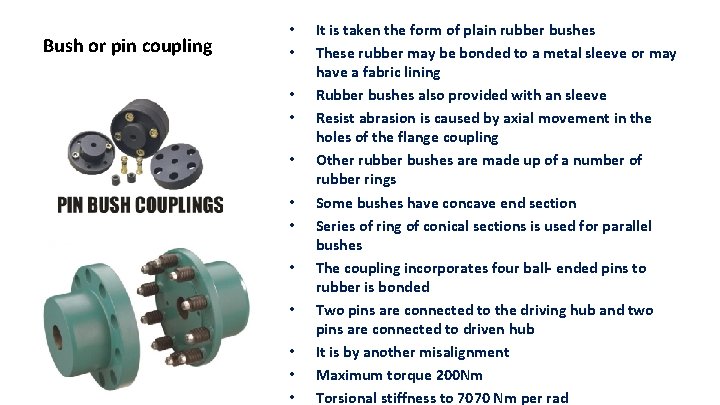
Bush or pin coupling • • • It is taken the form of plain rubber bushes These rubber may be bonded to a metal sleeve or may have a fabric lining Rubber bushes also provided with an sleeve Resist abrasion is caused by axial movement in the holes of the flange coupling Other rubber bushes are made up of a number of rubber rings Some bushes have concave end section Series of ring of conical sections is used for parallel bushes The coupling incorporates four ball- ended pins to rubber is bonded Two pins are connected to the driving hub and two pins are connected to driven hub It is by another misalignment Maximum torque 200 Nm Torsional stiffness to 7070 Nm per rad
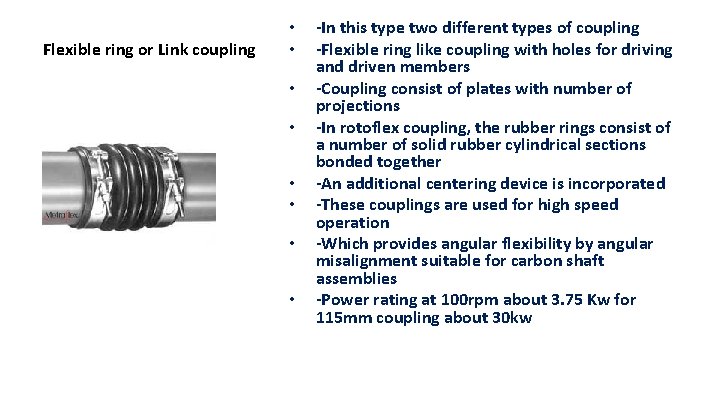
Flexible ring or Link coupling • • -In this type two different types of coupling -Flexible ring like coupling with holes for driving and driven members -Coupling consist of plates with number of projections -In rotoflex coupling, the rubber rings consist of a number of solid rubber cylindrical sections bonded together -An additional centering device is incorporated -These couplings are used for high speed operation -Which provides angular flexibility by angular misalignment suitable for carbon shaft assemblies -Power rating at 100 rpm about 3. 75 Kw for 115 mm coupling about 30 kw
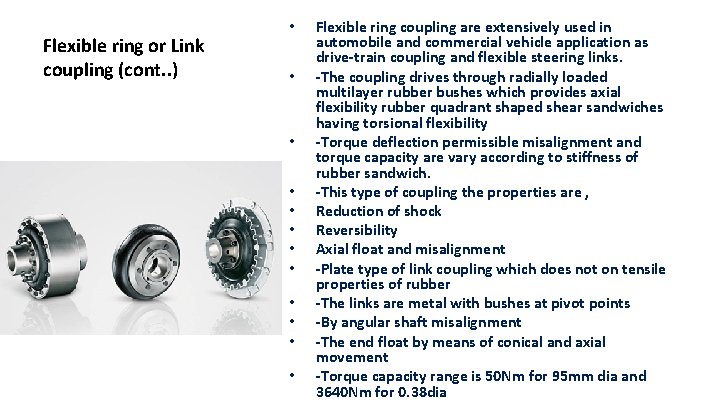
Flexible ring or Link coupling (cont. . ) • • • Flexible ring coupling are extensively used in automobile and commercial vehicle application as drive-train coupling and flexible steering links. -The coupling drives through radially loaded multilayer rubber bushes which provides axial flexibility rubber quadrant shaped shear sandwiches having torsional flexibility -Torque deflection permissible misalignment and torque capacity are vary according to stiffness of rubber sandwich. -This type of coupling the properties are , Reduction of shock Reversibility Axial float and misalignment -Plate type of link coupling which does not on tensile properties of rubber -The links are metal with bushes at pivot points -By angular shaft misalignment -The end float by means of conical and axial movement -Torque capacity range is 50 Nm for 95 mm dia and 3640 Nm for 0. 38 dia
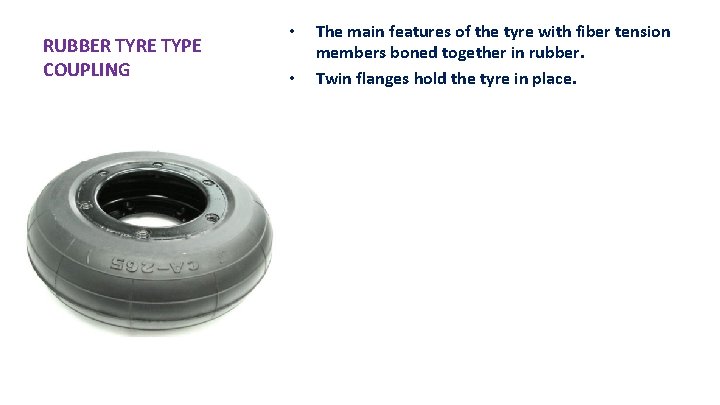
RUBBER TYRE TYPE COUPLING • • The main features of the tyre with fiber tension members boned together in rubber. Twin flanges hold the tyre in place.
Part A ( 2 Mark ) Flexible Couplings - QUESTIONS 1. Define the function of Flexible coupling *2. What are the Types of coupling **3. How will you make the Selection of coupling Part –B (8 mark) **1. Explain the following flexible couplings in details (or) (Answer for any four types of couplings) Disk or sandwich coupling Tube for shear type coupling Double cone coupling Sleeve coupling Hose coupling Compression type coupling Bush or pin coupling Flexible ring or Link coupling Rubber tyre type coupling
- Slides: 17