
Flexible Bronchoscopy Basic Techniques Part 1 A Introduction
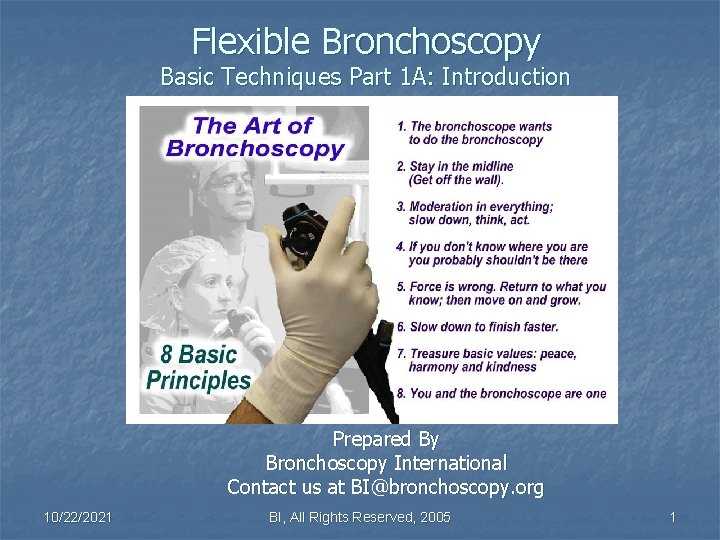
Flexible Bronchoscopy Basic Techniques Part 1 A: Introduction Prepared By Bronchoscopy International Contact us at BI@bronchoscopy. org 10/22/2021 BI, All Rights Reserved, 2005 1
Bronchoscopy Haiku Before starting bronchoscopy I know where I am going. The scope and I are One Together, we explore, knowingly. Inspired from Thich Nhat Hanh; The Path of Mindfulness in Everyday Life, pg 31, Bantam Books, NY, 1991. 10/22/2021 BI, All Rights Reserved, 2005 2
Normal Inspection Click here to view video presentation Video and audio will load (may take 10 seconds), then play automatically Click to Continue 10/22/2021 BI, All Rights Reserved, 2005 3
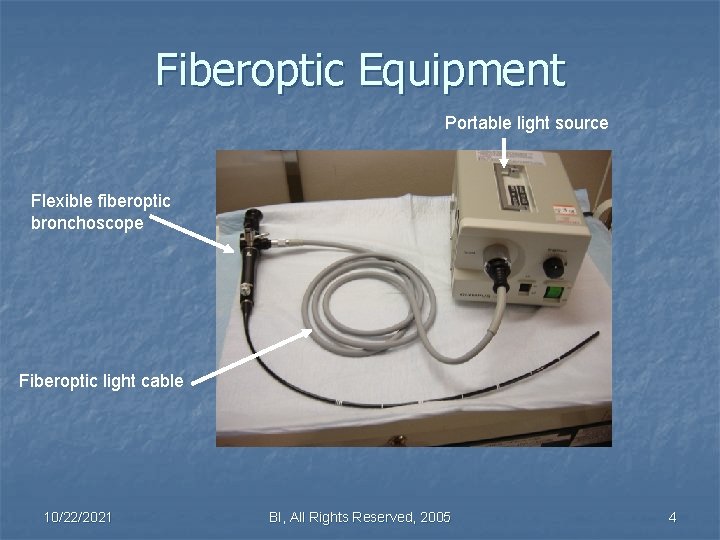
Fiberoptic Equipment Portable light source Flexible fiberoptic bronchoscope Fiberoptic light cable 10/22/2021 BI, All Rights Reserved, 2005 4
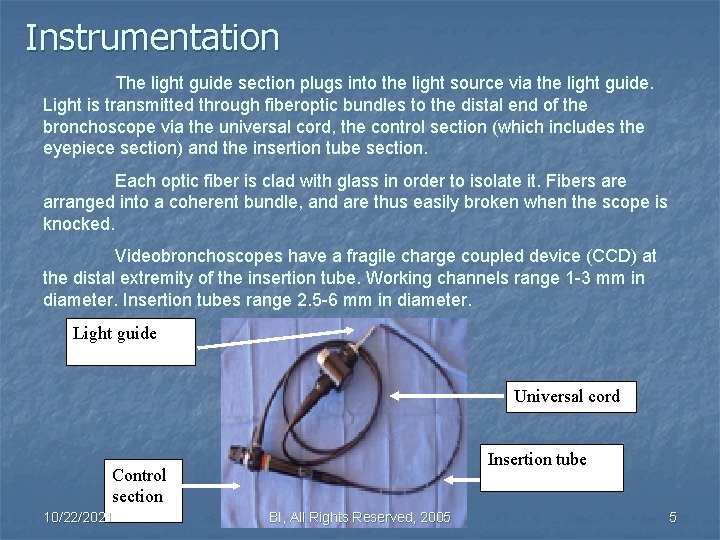
Instrumentation The light guide section plugs into the light source via the light guide. Light is transmitted through fiberoptic bundles to the distal end of the bronchoscope via the universal cord, the control section (which includes the eyepiece section) and the insertion tube section. Each optic fiber is clad with glass in order to isolate it. Fibers are arranged into a coherent bundle, and are thus easily broken when the scope is knocked. Videobronchoscopes have a fragile charge coupled device (CCD) at the distal extremity of the insertion tube. Working channels range 1 -3 mm in diameter. Insertion tubes range 2. 5 -6 mm in diameter. Light guide Universal cord Insertion tube Control section 10/22/2021 BI, All Rights Reserved, 2005 5
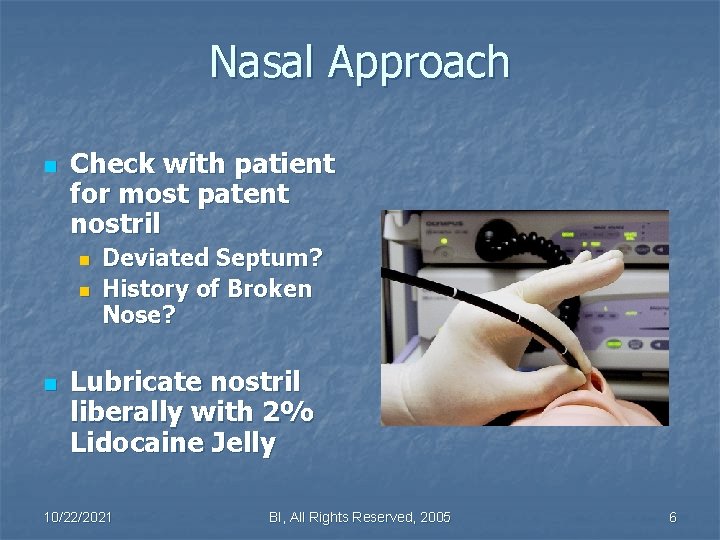
Nasal Approach n Check with patient for most patent nostril n n n Deviated Septum? History of Broken Nose? Lubricate nostril liberally with 2% Lidocaine Jelly 10/22/2021 BI, All Rights Reserved, 2005 6
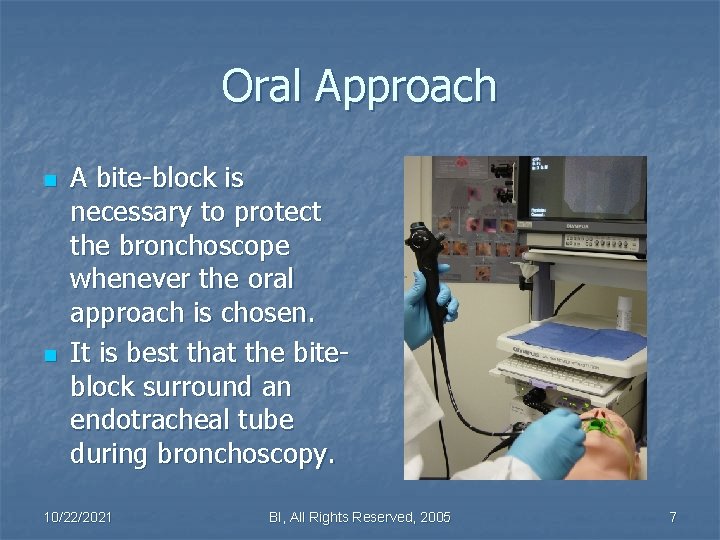
Oral Approach n n A bite-block is necessary to protect the bronchoscope whenever the oral approach is chosen. It is best that the biteblock surround an endotracheal tube during bronchoscopy. 10/22/2021 BI, All Rights Reserved, 2005 7
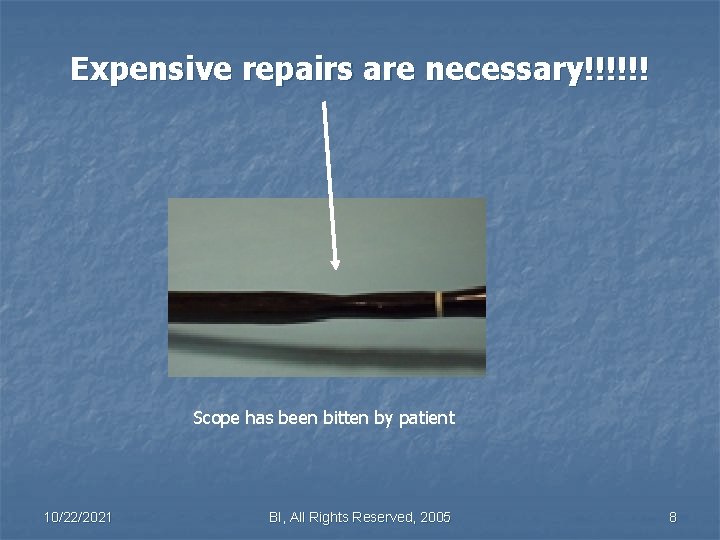
Expensive repairs are necessary!!!!!! Scope has been bitten by patient 10/22/2021 BI, All Rights Reserved, 2005 8
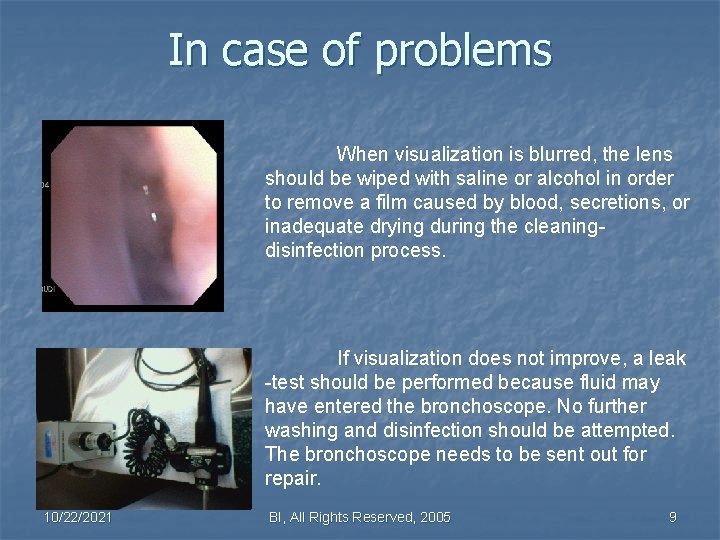
In case of problems When visualization is blurred, the lens should be wiped with saline or alcohol in order to remove a film caused by blood, secretions, or inadequate drying during the cleaningdisinfection process. If visualization does not improve, a leak -test should be performed because fluid may have entered the bronchoscope. No further washing and disinfection should be attempted. The bronchoscope needs to be sent out for repair. 10/22/2021 BI, All Rights Reserved, 2005 9
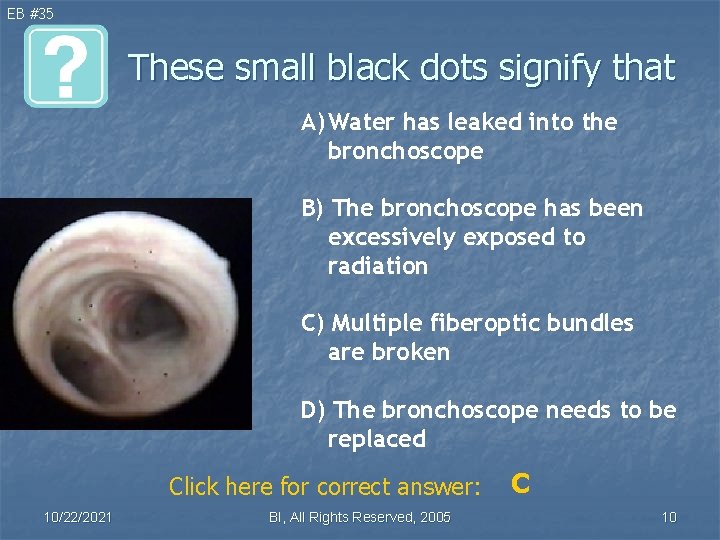
EB #35 These small black dots signify that A) Water has leaked into the bronchoscope B) The bronchoscope has been excessively exposed to radiation C) Multiple fiberoptic bundles are broken D) The bronchoscope needs to be replaced Click here for correct answer: 10/22/2021 BI, All Rights Reserved, 2005 C 10
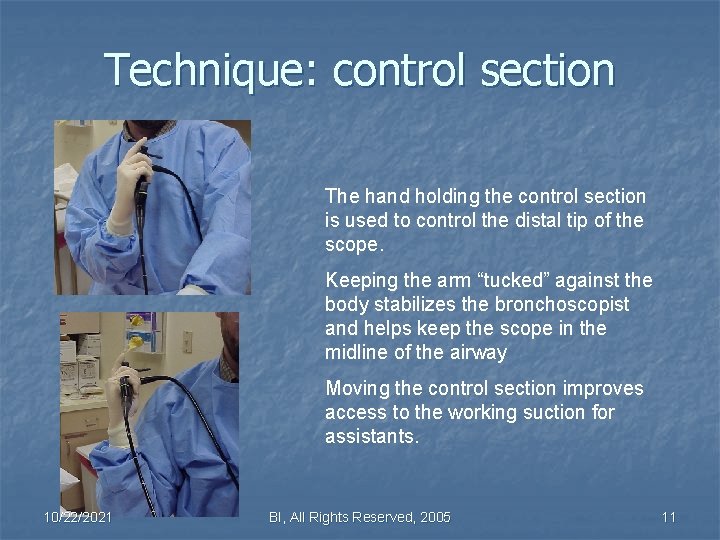
Technique: control section The hand holding the control section is used to control the distal tip of the scope. Keeping the arm “tucked” against the body stabilizes the bronchoscopist and helps keep the scope in the midline of the airway Moving the control section improves access to the working suction for assistants. 10/22/2021 BI, All Rights Reserved, 2005 11
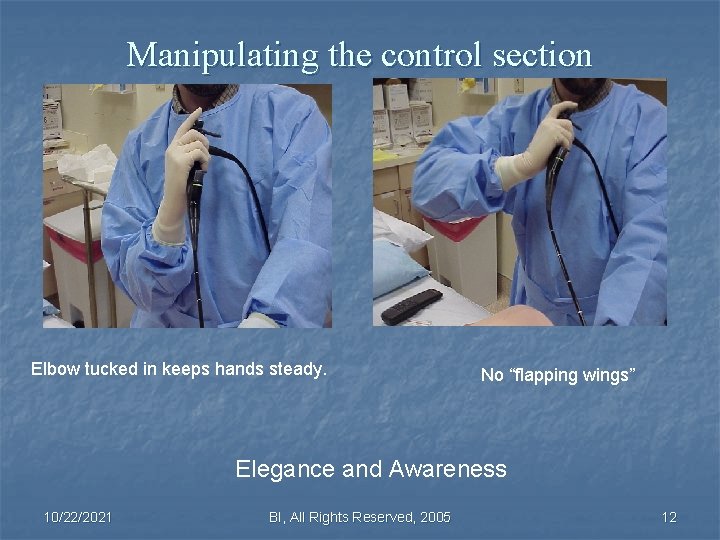
Manipulating the control section Elbow tucked in keeps hands steady. No “flapping wings” Elegance and Awareness 10/22/2021 BI, All Rights Reserved, 2005 12

Flexion-extension Extend UP 10/22/2021 Flex DOWN BI, All Rights Reserved, 2005 13
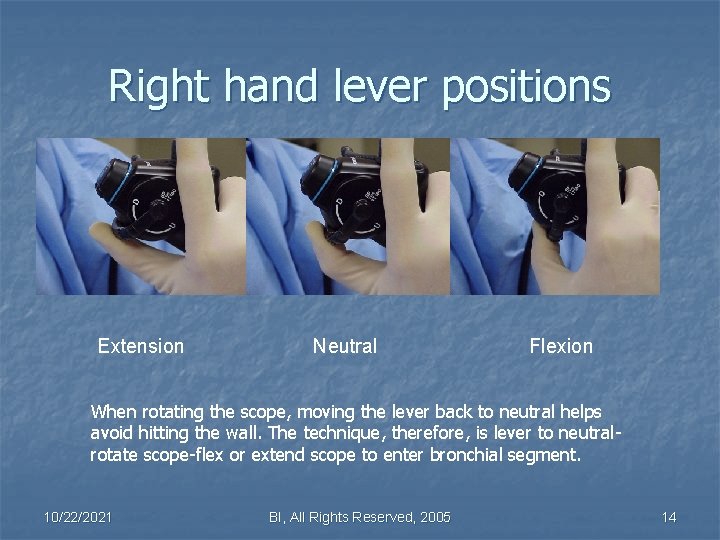
Right hand lever positions Extension Neutral Flexion When rotating the scope, moving the lever back to neutral helps avoid hitting the wall. The technique, therefore, is lever to neutralrotate scope-flex or extend scope to enter bronchial segment. 10/22/2021 BI, All Rights Reserved, 2005 14
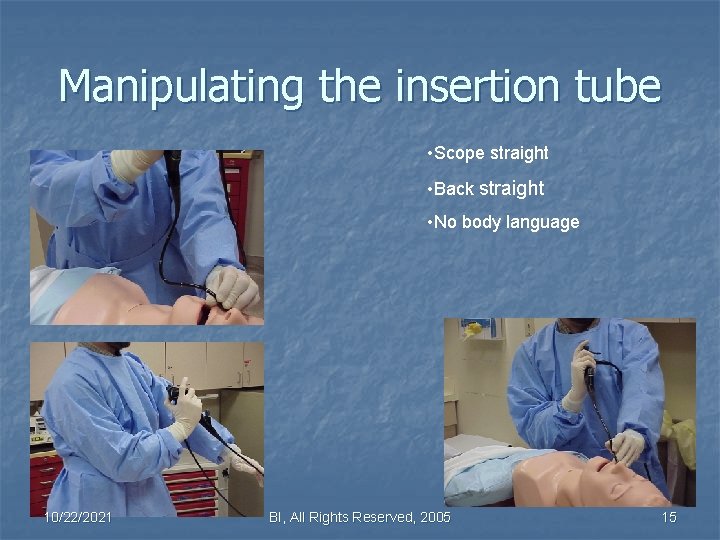
Manipulating the insertion tube • Scope straight • Back straight • No body language 10/22/2021 BI, All Rights Reserved, 2005 15
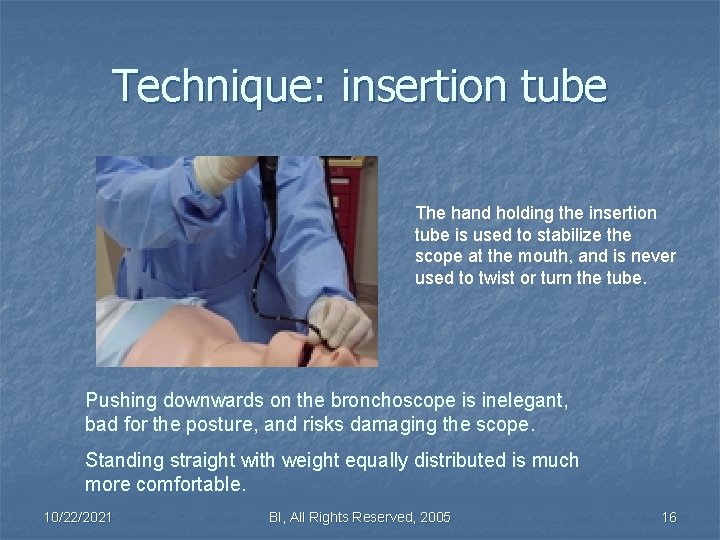
Technique: insertion tube The hand holding the insertion tube is used to stabilize the scope at the mouth, and is never used to twist or turn the tube. Pushing downwards on the bronchoscope is inelegant, bad for the posture, and risks damaging the scope. Standing straight with weight equally distributed is much more comfortable. 10/22/2021 BI, All Rights Reserved, 2005 16
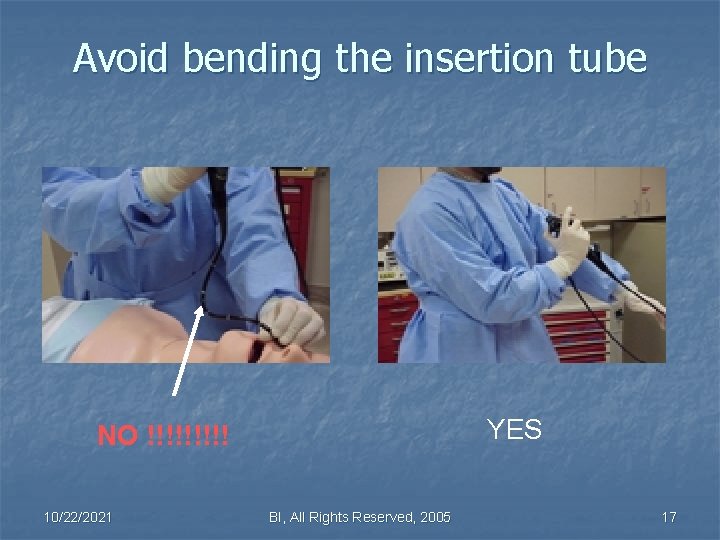
Avoid bending the insertion tube YES NO !!!!! 10/22/2021 BI, All Rights Reserved, 2005 17
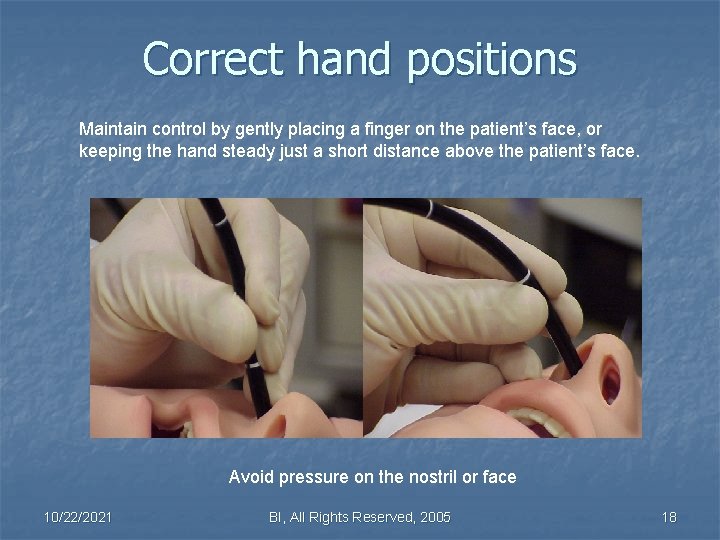
Correct hand positions Maintain control by gently placing a finger on the patient’s face, or keeping the hand steady just a short distance above the patient’s face. Avoid pressure on the nostril or face 10/22/2021 BI, All Rights Reserved, 2005 18
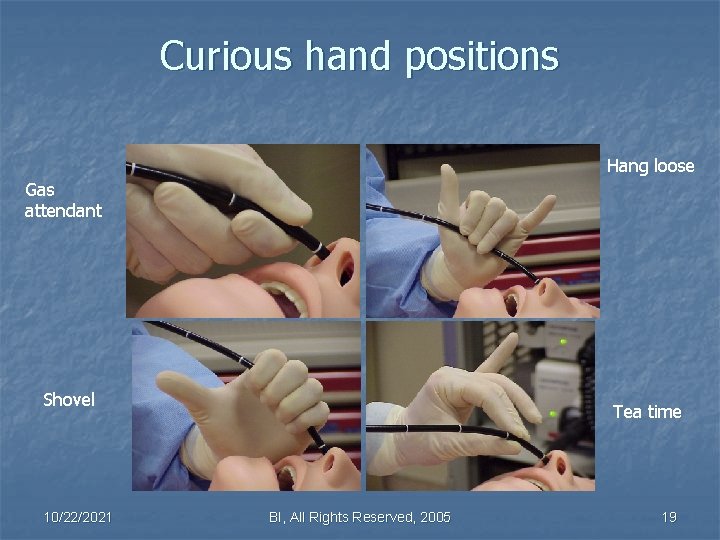
Curious hand positions Hang loose Gas attendant Shovel 10/22/2021 Tea time BI, All Rights Reserved, 2005 19
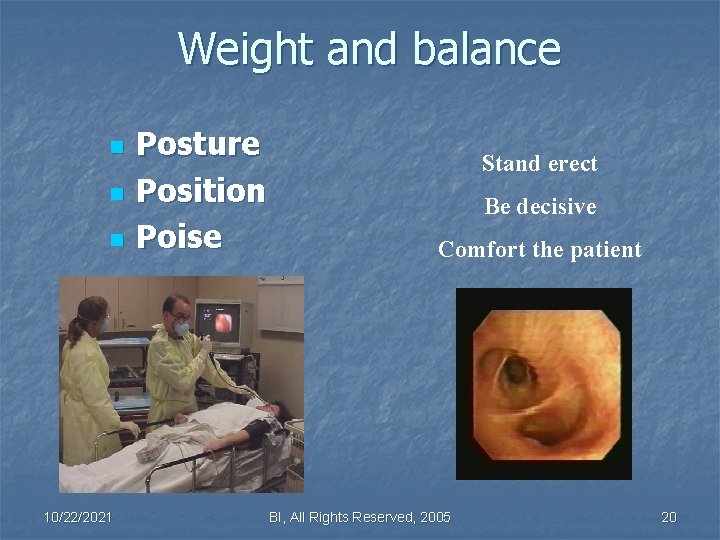
Weight and balance n n n 10/22/2021 Posture Position Poise Stand erect Be decisive Comfort the patient BI, All Rights Reserved, 2005 20
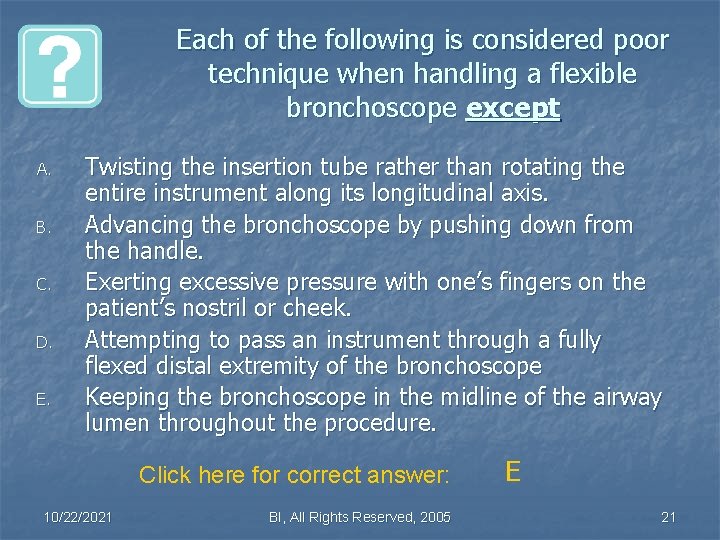
Each of the following is considered poor technique when handling a flexible bronchoscope except A. B. C. D. E. Twisting the insertion tube rather than rotating the entire instrument along its longitudinal axis. Advancing the bronchoscope by pushing down from the handle. Exerting excessive pressure with one’s fingers on the patient’s nostril or cheek. Attempting to pass an instrument through a fully flexed distal extremity of the bronchoscope Keeping the bronchoscope in the midline of the airway lumen throughout the procedure. Click here for correct answer: 10/22/2021 BI, All Rights Reserved, 2005 E 21
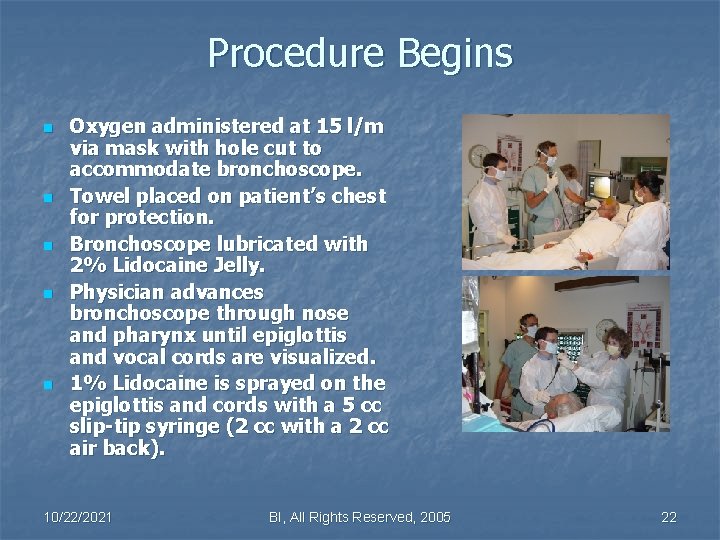
Procedure Begins n n n Oxygen administered at 15 l/m via mask with hole cut to accommodate bronchoscope. Towel placed on patient’s chest for protection. Bronchoscope lubricated with 2% Lidocaine Jelly. Physician advances bronchoscope through nose and pharynx until epiglottis and vocal cords are visualized. 1% Lidocaine is sprayed on the epiglottis and cords with a 5 cc slip-tip syringe (2 cc with a 2 cc air back). 10/22/2021 BI, All Rights Reserved, 2005 22
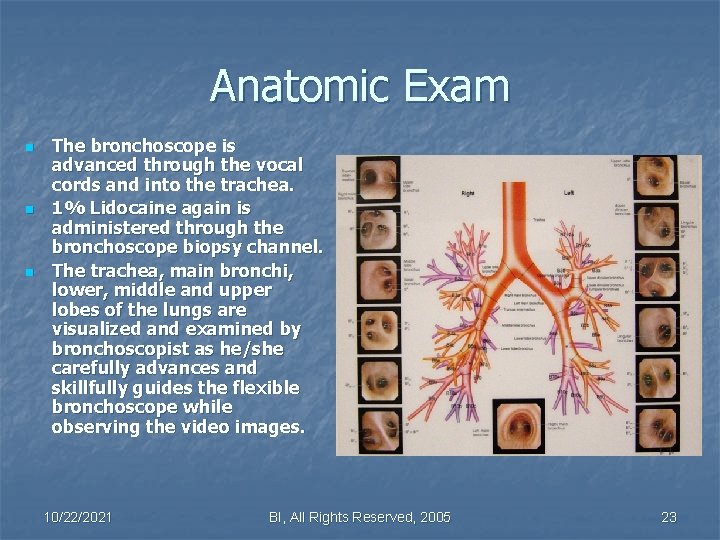
Anatomic Exam n n n The bronchoscope is advanced through the vocal cords and into the trachea. 1% Lidocaine again is administered through the bronchoscope biopsy channel. The trachea, main bronchi, lower, middle and upper lobes of the lungs are visualized and examined by bronchoscopist as he/she carefully advances and skillfully guides the flexible bronchoscope while observing the video images. 10/22/2021 BI, All Rights Reserved, 2005 23
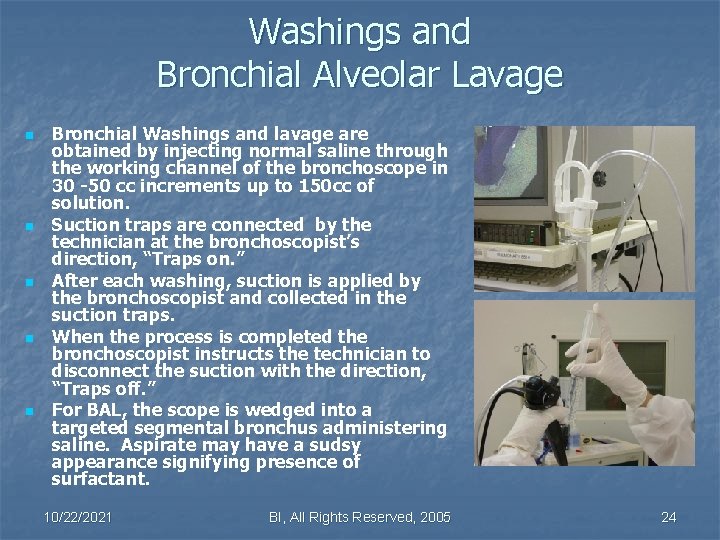
Washings and Bronchial Alveolar Lavage n n n Bronchial Washings and lavage are obtained by injecting normal saline through the working channel of the bronchoscope in 30 -50 cc increments up to 150 cc of solution. Suction traps are connected by the technician at the bronchoscopist’s direction, “Traps on. ” After each washing, suction is applied by the bronchoscopist and collected in the suction traps. When the process is completed the bronchoscopist instructs the technician to disconnect the suction with the direction, “Traps off. ” For BAL, the scope is wedged into a targeted segmental bronchus administering saline. Aspirate may have a sudsy appearance signifying presence of surfactant. 10/22/2021 BI, All Rights Reserved, 2005 24
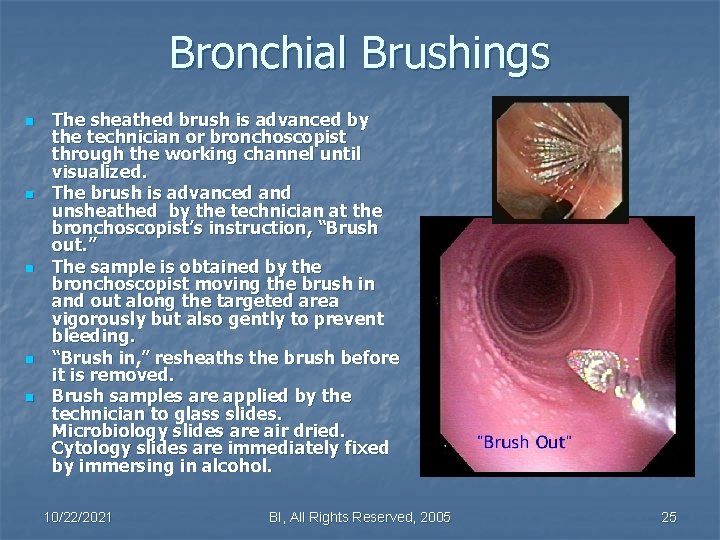
Bronchial Brushings n n n The sheathed brush is advanced by the technician or bronchoscopist through the working channel until visualized. The brush is advanced and unsheathed by the technician at the bronchoscopist’s instruction, “Brush out. ” The sample is obtained by the bronchoscopist moving the brush in and out along the targeted area vigorously but also gently to prevent bleeding. “Brush in, ” resheaths the brush before it is removed. Brush samples are applied by the technician to glass slides. Microbiology slides are air dried. Cytology slides are immediately fixed by immersing in alcohol. 10/22/2021 BI, All Rights Reserved, 2005 25
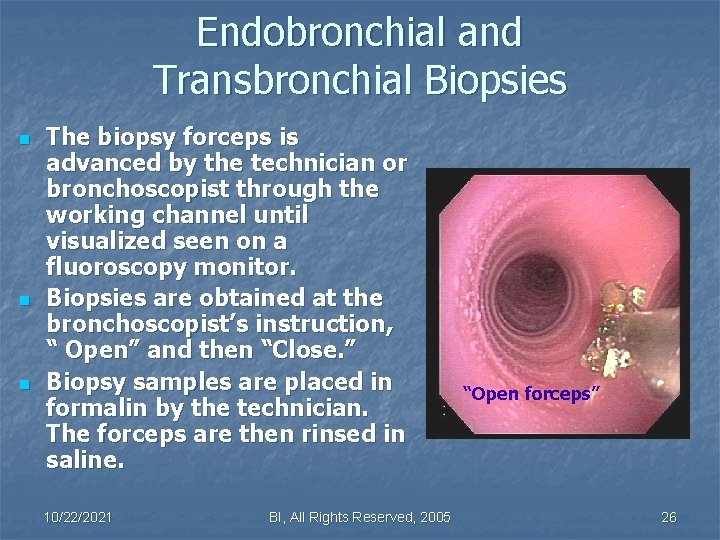
Endobronchial and Transbronchial Biopsies n n n The biopsy forceps is advanced by the technician or bronchoscopist through the working channel until visualized seen on a fluoroscopy monitor. Biopsies are obtained at the bronchoscopist’s instruction, “ Open” and then “Close. ” Biopsy samples are placed in formalin by the technician. The forceps are then rinsed in saline. 10/22/2021 BI, All Rights Reserved, 2005 “Open forceps” 26
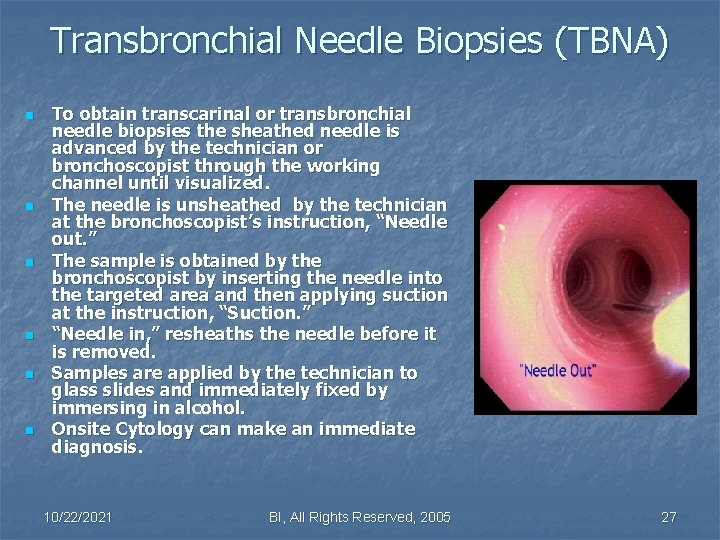
Transbronchial Needle Biopsies (TBNA) n n n To obtain transcarinal or transbronchial needle biopsies the sheathed needle is advanced by the technician or bronchoscopist through the working channel until visualized. The needle is unsheathed by the technician at the bronchoscopist’s instruction, “Needle out. ” The sample is obtained by the bronchoscopist by inserting the needle into the targeted area and then applying suction at the instruction, “Suction. ” “Needle in, ” resheaths the needle before it is removed. Samples are applied by the technician to glass slides and immediately fixed by immersing in alcohol. Onsite Cytology can make an immediate diagnosis. 10/22/2021 BI, All Rights Reserved, 2005 27
This presentation is part of a comprehensive curriculum for Flexible Bronchoscopy. Our goals are to help health care workers become better at what they do, and to decrease the burden of procedurerelated training on patients. 10/22/2021 BI, All Rights Reserved, 2005 28
Step by Step© A new curriculum Assured competency and proficiency 1. 2. 3. 4. 5. Web-based Self-learning study guide. Computer-based simulations, didactic lectures, and image encyclopedia. Bronchoscopy step-by-step©: Practical exercises, skills and tasks, competency testing. Guided apprenticeship. Learning the art of Bronchoscopy. BRONCHATLAS© DEMOCRATIZATION AND GLOBALIZATION OF KNOWLEDGE 10/22/2021 BI, All Rights Reserved, 2005 29
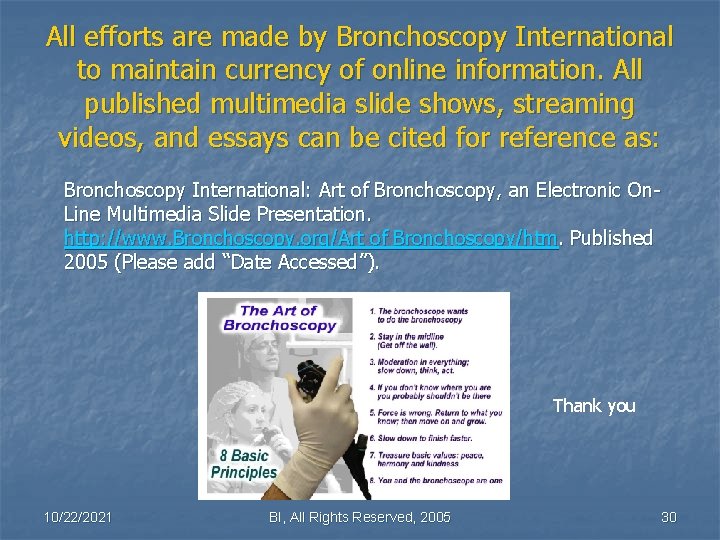
All efforts are made by Bronchoscopy International to maintain currency of online information. All published multimedia slide shows, streaming videos, and essays can be cited for reference as: Bronchoscopy International: Art of Bronchoscopy, an Electronic On. Line Multimedia Slide Presentation. http: //www. Bronchoscopy. org/Art of Bronchoscopy/htm. Published 2005 (Please add “Date Accessed”). Thank you 10/22/2021 BI, All Rights Reserved, 2005 30
- Slides: 30