
Flavour Physics and Dark Matter Introduction Selected Experimental
- Slides: 20
Flavour Physics and Dark Matter Introduction Selected Experimental Results Impact on Dark Matter Searches Conclusion Matthew Herndon University of Wisconsin Dark Side of the Universe 2007, Minneapolis Minnesota
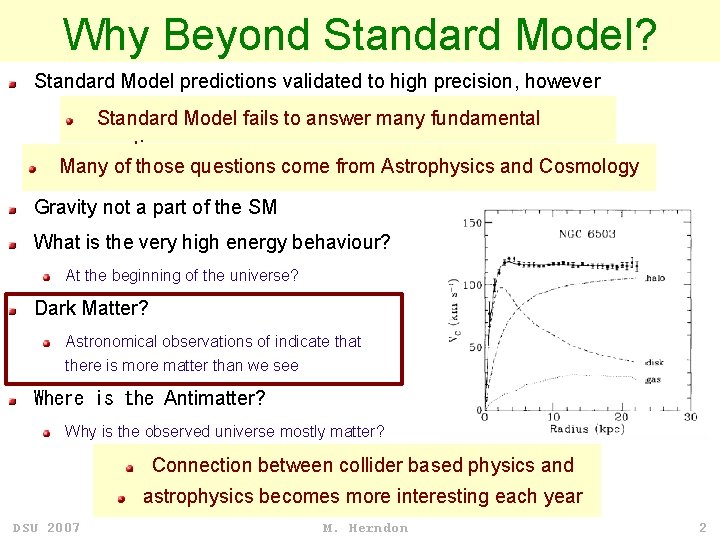
Why Beyond Standard Model? Standard Model predictions validated to high precision, however Standard Model fails to answer many fundamental questions Many of those questions come from Astrophysics and Cosmology Gravity not a part of the SM What is the very high energy behaviour? At the beginning of the universe? Dark Matter? Astronomical observations of indicate that there is more matter than we see Where is the Antimatter? Why is the observed universe mostly matter? Connection between collider based physics and astrophysics becomes more interesting each year DSU 2007 M. Herndon 2
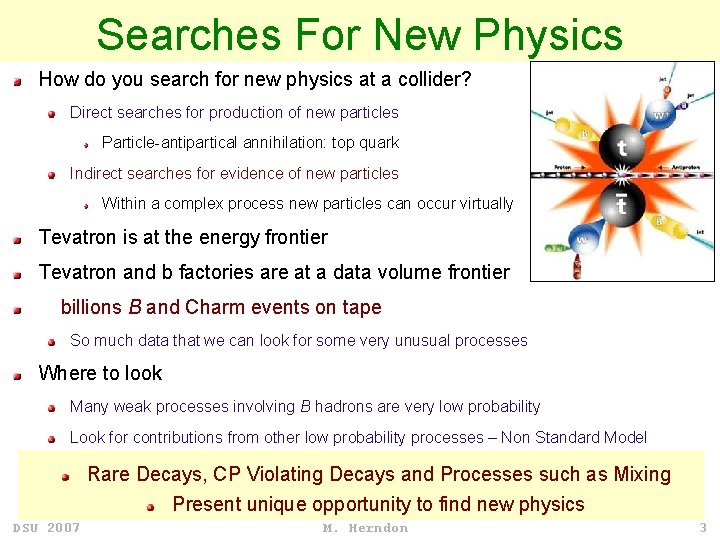
Searches For New Physics How do you search for new physics at a collider? Direct searches for production of new particles Particle-antipartical annihilation: top quark Indirect searches for evidence of new particles Within a complex process new particles can occur virtually Tevatron is at the energy frontier Tevatron and b factories are at a data volume frontier billions B and Charm events on tape So much data that we can look for some very unusual processes Where to look Many weak processes involving B hadrons are very low probability Look for contributions from other low probability processes – Non Standard Model Rare Decays, CP Violating Decays and Processes such as Mixing Present unique opportunity to find new physics DSU 2007 M. Herndon 3
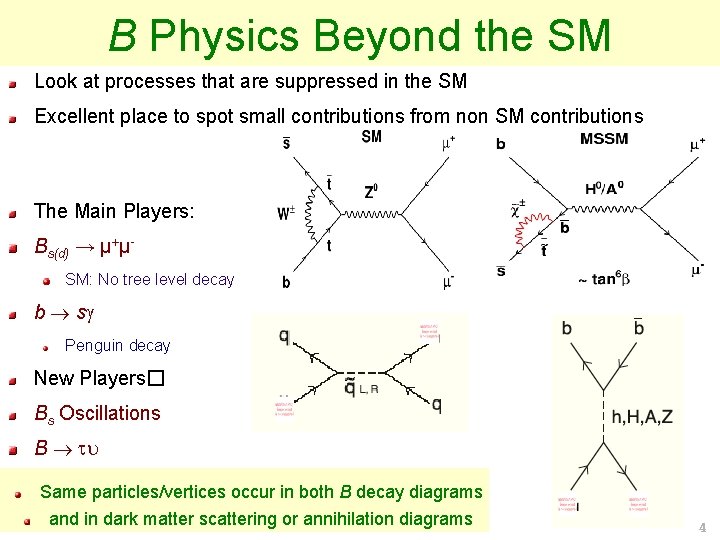
B Physics Beyond the SM Look at processes that are suppressed in the SM Excellent place to spot small contributions from non SM contributions The Main Players: Bs(d) → μ+μSM: No tree level decay b s Penguin decay New Players� Bs Oscillations B Same particles/vertices occur in both B decay diagrams and in dark matter scattering or annihilation diagrams M. Herndon 4
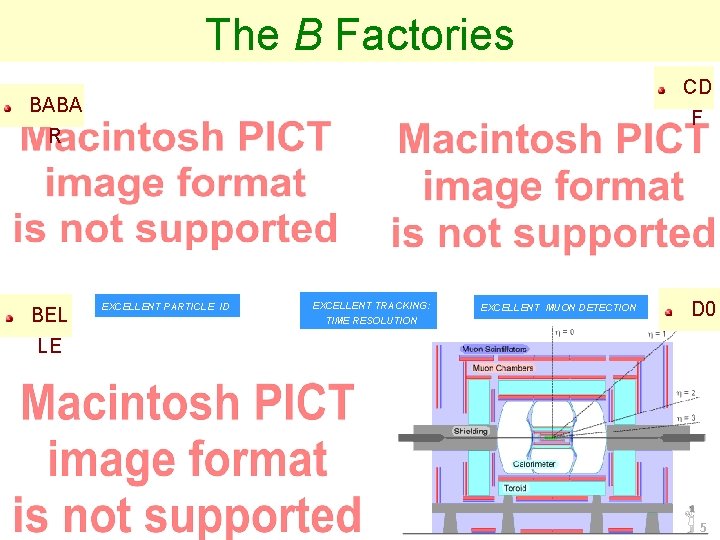
The B Factories CD BABA F R BEL EXCELLENT PARTICLE ID EXCELLENT TRACKING: TIME RESOLUTION EXCELLENT MUON DETECTION D 0 LE 5
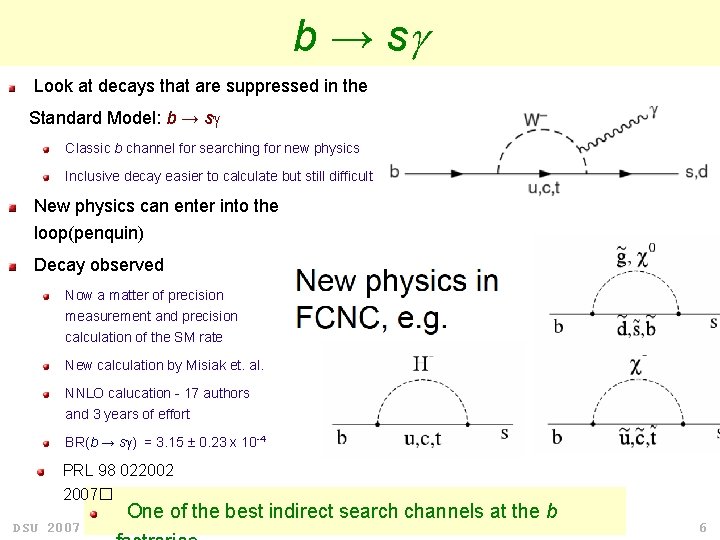
b → s Look at decays that are suppressed in the Standard Model: b → s Classic b channel for searching for new physics Inclusive decay easier to calculate but still difficult New physics can enter into the loop(penquin) Decay observed Now a matter of precision measurement and precision calculation of the SM rate New calculation by Misiak et. al. NNLO calucation - 17 authors and 3 years of effort BR(b → s ) = 3. 15 0. 23 x 10 -4 PRL 98 022002 2007� DSU 2007 One of the best indirect search channels at the b M. Herndon 6
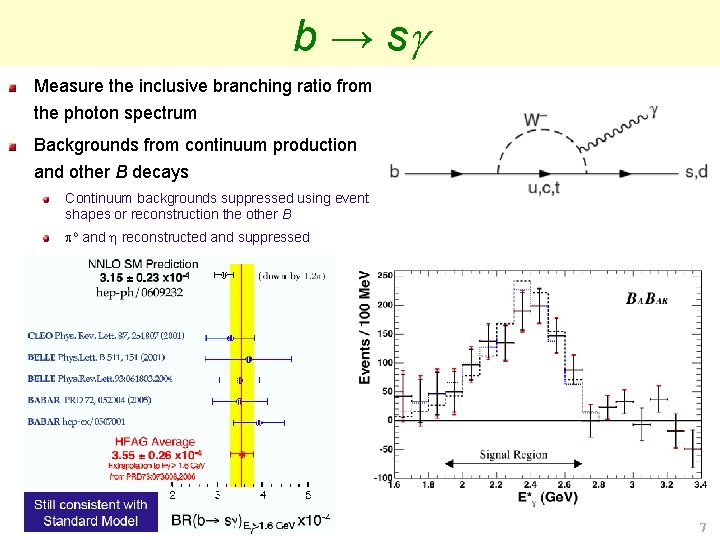
b → s Measure the inclusive branching ratio from the photon spectrum Backgrounds from continuum production and other B decays Continuum backgrounds suppressed using event shapes or reconstruction the other B o and reconstructed and suppressed 7
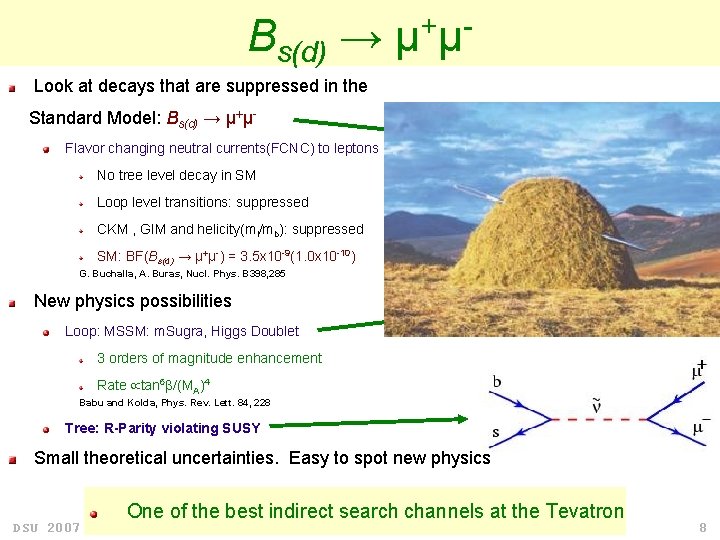
Bs(d) → μ+μLook at decays that are suppressed in the Standard Model: Bs(d) → μ+μFlavor changing neutral currents(FCNC) to leptons No tree level decay in SM Loop level transitions: suppressed CKM , GIM and helicity(ml/mb): suppressed SM: BF(Bs(d) → μ+μ-) = 3. 5 x 10 -9(1. 0 x 10 -10) G. Buchalla, A. Buras, Nucl. Phys. B 398, 285 New physics possibilities Loop: MSSM: m. Sugra, Higgs Doublet 3 orders of magnitude enhancement Rate tan 6β/(MA)4 Babu and Kolda, Phys. Rev. Lett. 84, 228 Tree: R-Parity violating SUSY Small theoretical uncertainties. Easy to spot new physics DSU 2007 One of the best indirect search channels at the Tevatron M. Herndon 8
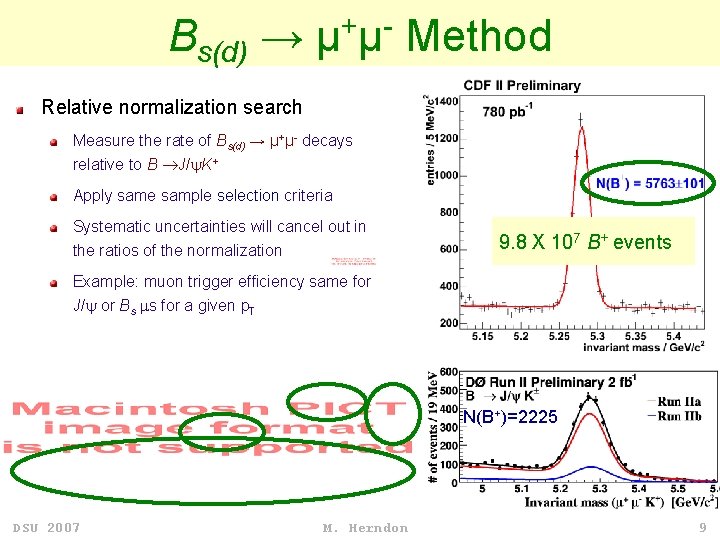
Bs(d) → μ+μ- Method Relative normalization search Measure the rate of Bs(d) → μ+μ- decays relative to B J/ K+ Apply same sample selection criteria Systematic uncertainties will cancel out in the ratios of the normalization 9. 8 X 10⁷ B+ events Example: muon trigger efficiency same for J/ or Bs s for a given p. T 400 pb-1 N(B+)=2225 DSU 2007 M. Herndon 9
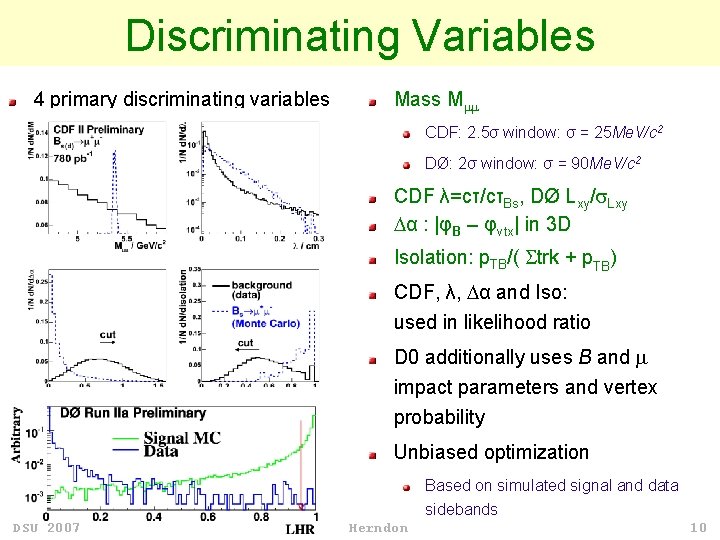
Discriminating Variables 4 primary discriminating variables Mass M CDF: 2. 5σ window: σ = 25 Me. V/c 2 DØ: 2σ window: σ = 90 Me. V/c 2 CDF λ=cτ/cτBs, DØ Lxy/ Lxy α : |φB – φvtx| in 3 D Isolation: p. TB/( trk + p. TB) CDF, λ, α and Iso: used in likelihood ratio D 0 additionally uses B and impact parameters and vertex probability Unbiased optimization Based on simulated signal and data sidebands DSU 2007 M. Herndon 10
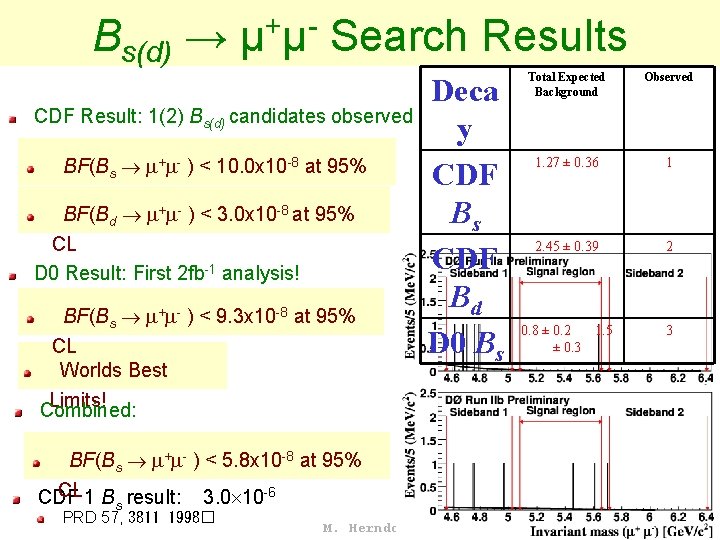
Bs(d) → μ+μ- Search Results CDF Result: 1(2) Bs(d) candidates observed consistent with+ background expectation BF(Bs - ) < 10. 0 x 10 -8 at 95% CL BF(Bd + - ) < 3. 0 x 10 -8 at 95% CL D 0 Result: First 2 fb-1 analysis! BF(Bs + - ) < 9. 3 x 10 -8 at 95% CL Worlds Best Deca y CDF Bs CDF Bd D 0 Bs Total Expected Background Observed 1. 27 ± 0. 36 1 2. 45 ± 0. 39 2 0. 8 ± 0. 2 ± 0. 3 1. 5 3 Limits! Combined: BF(Bs + - ) < 5. 8 x 10 -8 at 95% CL 1 B result: CDF s 3. 0 10 -6 PRD 57, 3811 1998� M. Herndon 11
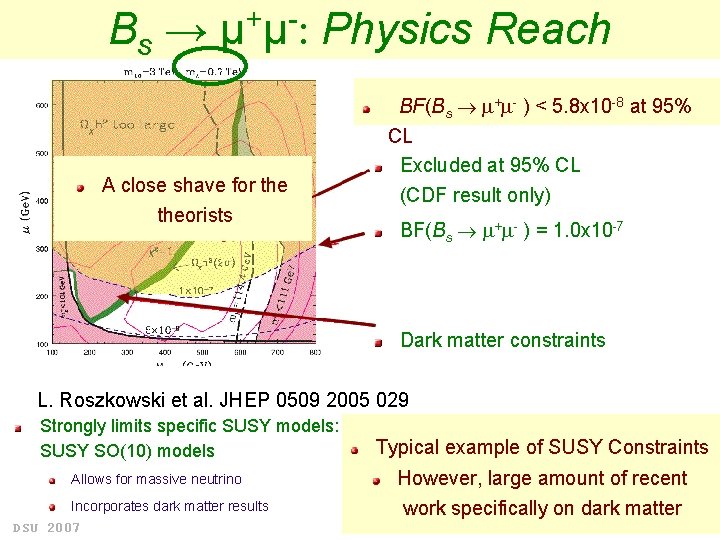
Bs → μ+μ-: Physics Reach BF(Bs + - ) < 5. 8 x 10 -8 at 95% A close shave for theorists CL Excluded at 95% CL (CDF result only) BF(Bs + - ) = 1. 0 x 10 -7 Dark matter constraints L. Roszkowski et al. JHEP 0509 2005 029 Strongly limits specific SUSY models: SUSY SO(10) models Allows for massive neutrino Incorporates dark matter results DSU 2007 Typical example of SUSY Constraints However, large amount of recent work specifically on dark matter 12
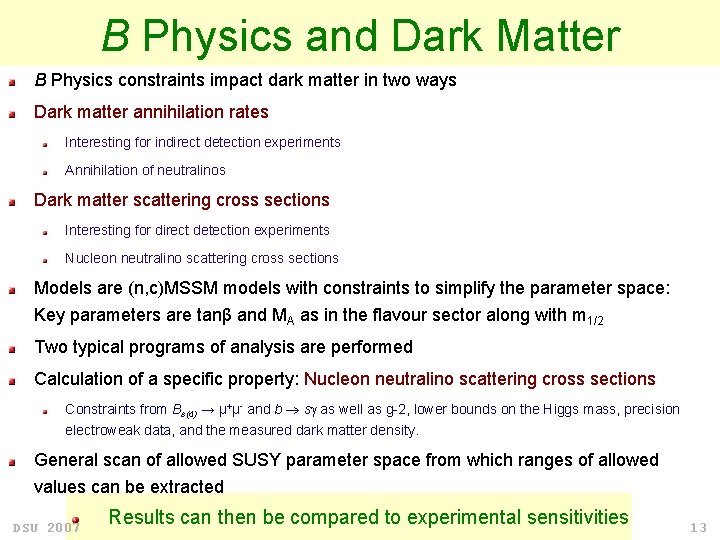
B Physics and Dark Matter B Physics constraints impact dark matter in two ways Dark matter annihilation rates Interesting for indirect detection experiments Annihilation of neutralinos Dark matter scattering cross sections Interesting for direct detection experiments Nucleon neutralino scattering cross sections Models are (n, c)MSSM models with constraints to simplify the parameter space: Key parameters are tanβ and MA as in the flavour sector along with m 1/2 Two typical programs of analysis are performed Calculation of a specific property: Nucleon neutralino scattering cross sections Constraints from Bs(d) → μ+μ- and b s as well as g-2, lower bounds on the Higgs mass, precision electroweak data, and the measured dark matter density. General scan of allowed SUSY parameter space from which ranges of allowed values can be extracted DSU 2007 Results can then be compared to experimental sensitivities M. Herndon 13
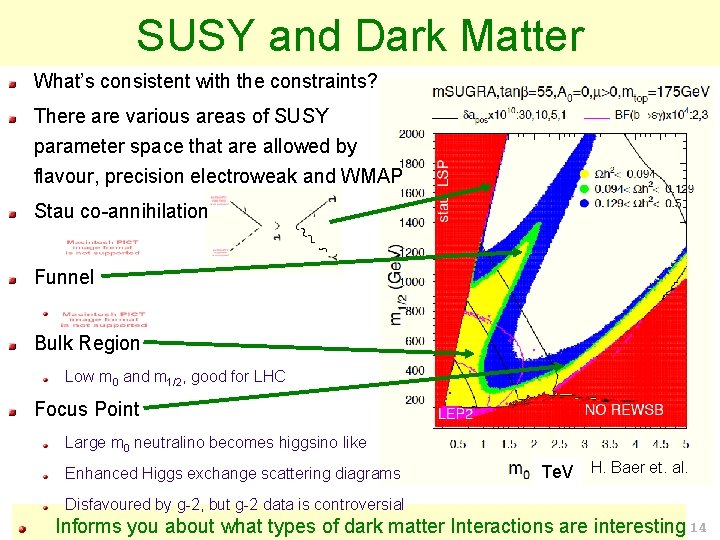
SUSY and Dark Matter What’s consistent with the constraints? There are various areas of SUSY parameter space that are allowed by flavour, precision electroweak and WMAP Stau co-annihilation Funnel Bulk Region Low m 0 and m 1/2, good for LHC Focus Point Large m 0 neutralino becomes higgsino like Enhanced Higgs exchange scattering diagrams Te. V H. Baer et. al. Disfavoured by g-2, but g-2 data is controversial M. dark Herndon Informs you about what types of matter Interactions are interesting 14
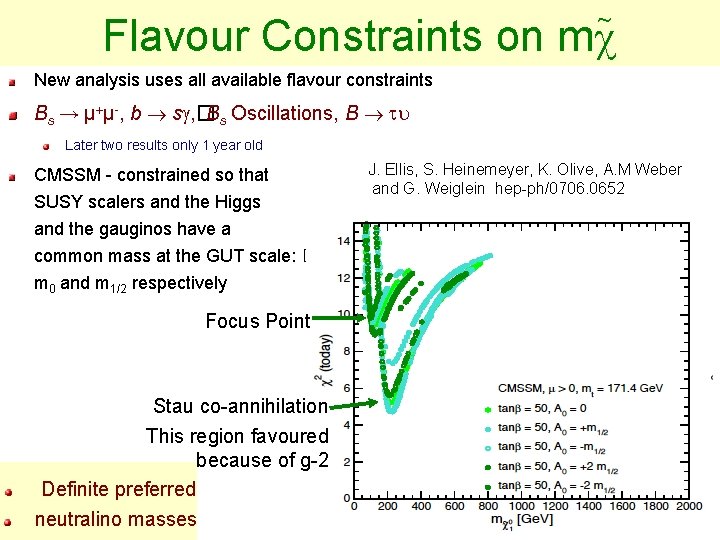
~ Flavour Constraints on m New analysis uses all available flavour constraints Bs → μ+μ-, b s , �Bs Oscillations, B Later two results only 1 year old J. Ellis, S. Heinemeyer, K. Olive, A. M Weber and G. Weiglein hep-ph/0706. 0652 CMSSM - constrained so that SUSY scalers and the Higgs and the gauginos have a common mass at the GUT scale: � m 0 and m 1/2 respectively Focus Point Stau co-annihilation This region favoured because of g-2 Definite preferred neutralino masses M. Herndon 15
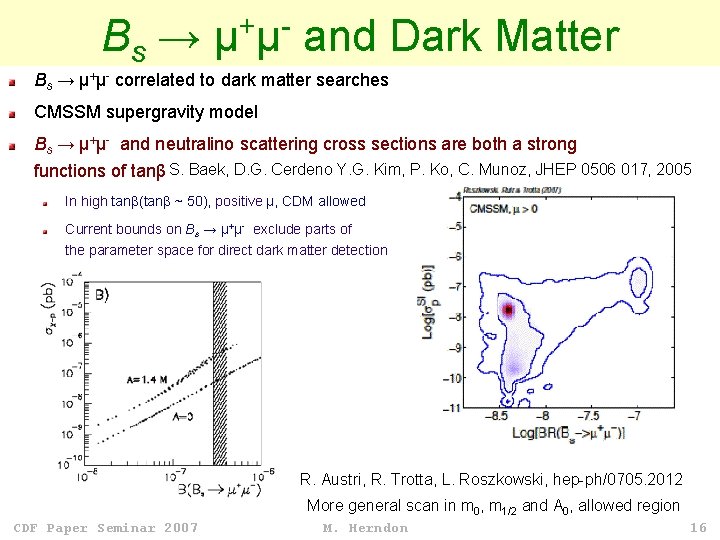
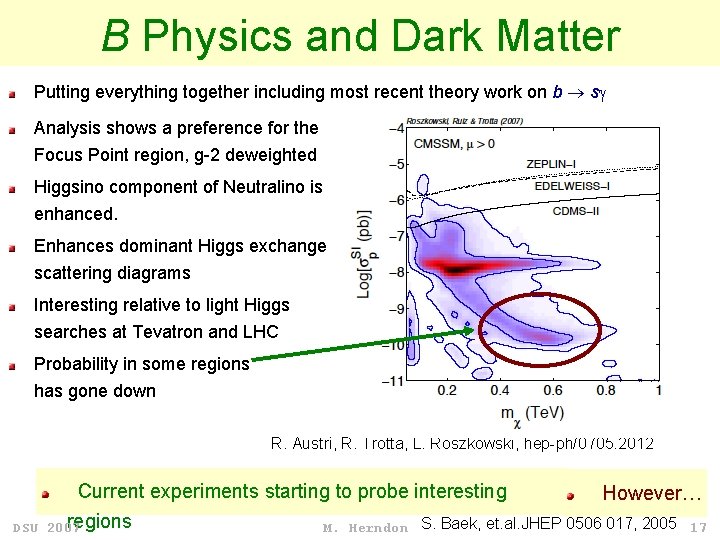
Bs → μ+μ- and Dark Matter Bs → μ+μ- correlated to dark matter searches CMSSM supergravity model Bs → μ+μ- and neutralino scattering cross sections are both a strong functions of tanβ S. Baek, D. G. Cerdeno Y. G. Kim, P. Ko, C. Munoz, JHEP 0506 017, 2005 In high tanβ(tanβ ~ 50), positive μ, CDM allowed Current bounds on Bs → μ+μ- exclude parts of the parameter space for direct dark matter detection R. Austri, R. Trotta, L. Roszkowski, hep-ph/0705. 2012 More general scan in m 0, m 1/2 and A 0, allowed region CDF Paper Seminar 2007 M. Herndon 16
B Physics and Dark Matter Putting everything together including most recent theory work on b s Analysis shows a preference for the Focus Point region, g-2 deweighted Higgsino component of Neutralino is enhanced. Enhances dominant Higgs exchange scattering diagrams Interesting relative to light Higgs searches at Tevatron and LHC Probability in some regions has gone down R. Austri, R. Trotta, L. Roszkowski, hep-ph/0705. 2012 Current experiments starting to probe interesting regions DSU 2007 However… M. Herndon S. Baek, et. al. JHEP 0506 017, 2005 17
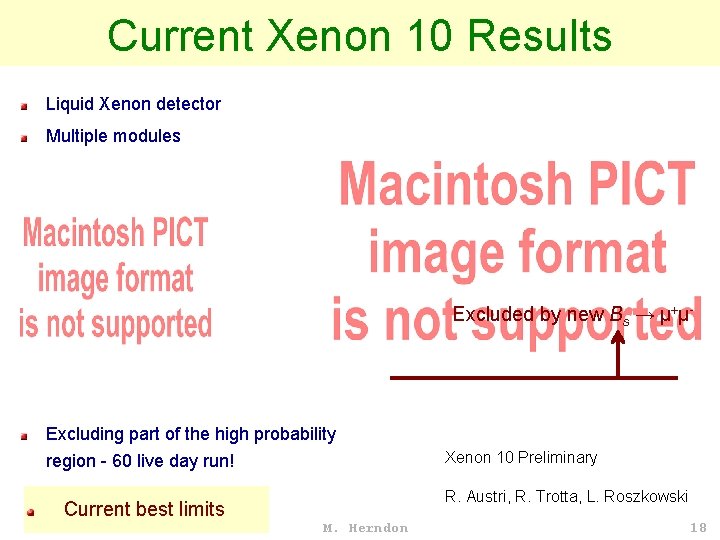
Current Xenon 10 Results Liquid Xenon detector Multiple modules Excluded by new Bs → μ+μ- Excluding part of the high probability Xenon 10 Preliminary region - 60 live day run! Current best limits R. Austri, R. Trotta, L. Roszkowski M. Herndon 18
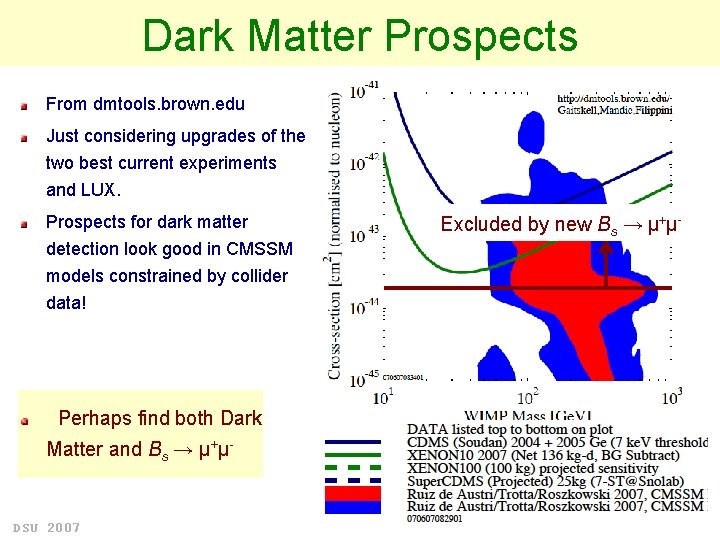
Dark Matter Prospects From dmtools. brown. edu Just considering upgrades of the two best current experiments and LUX. Excluded by new Bs → μ+μ- Prospects for dark matter detection look good in CMSSM models constrained by collider data! Perhaps find both Dark Matter and Bs → μ+μ- DSU 2007 M. Herndon 19
Conclusions Collider experiments are providing a wealth of data on Flavour physics as well as direct searches and precision electroweak data These data can be used to constrain the masses and scattering cross sections of dark matter candidates Constrained MSSM models indicate that dark matter observation may be within reach for current or next generation experiments! If Bs → μ+μis there as well. A simulations observation of direct(or indirect) evidence for new physics at a collider and Cold Dark Matter would reveal much about the form of the new physics DSU 2007 M. Herndon 20