
FLAVOR ANALYSIS OBJECTIVES 1 Analysis of aroma substances
FLAVOR ANALYSIS OBJECTIVES 1. Analysis of aroma substances; 2. Dificulties.
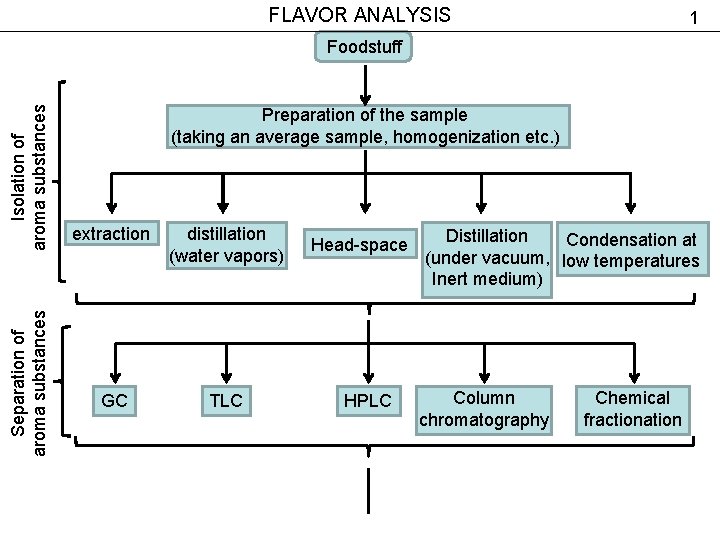
FLAVOR ANALYSIS 1 Separation of aroma substances Isolation of aroma substances Foodstuff Preparation of the sample (taking an average sample, homogenization etc. ) extraction distillation (water vapors) GC TLC Head-space HPLC Distillation Condensation at (under vacuum, low temperatures Inert medium) Column chromatography Chemical fractionation
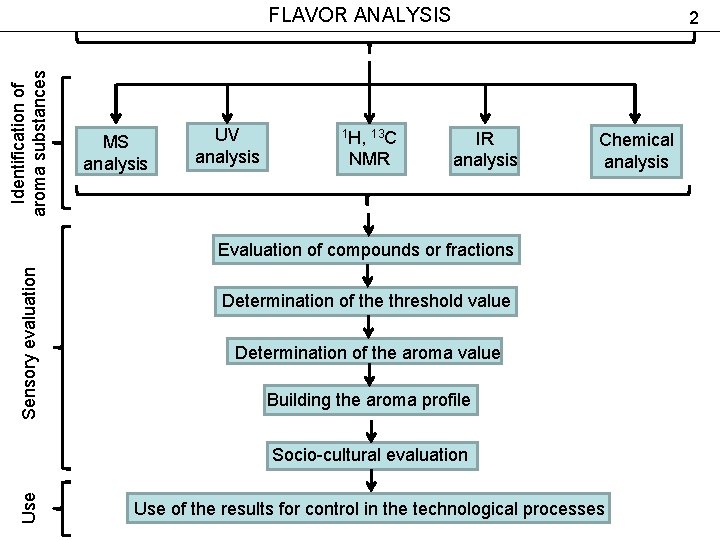
Identification of aroma substances FLAVOR ANALYSIS MS analysis UV analysis 1 H, 13 C NMR 2 IR analysis Chemical analysis Sensory evaluation Evaluation of compounds or fractions Determination of the threshold value Determination of the aroma value Building the aroma profile Use Socio-cultural evaluation Use of the results for control in the technological processes
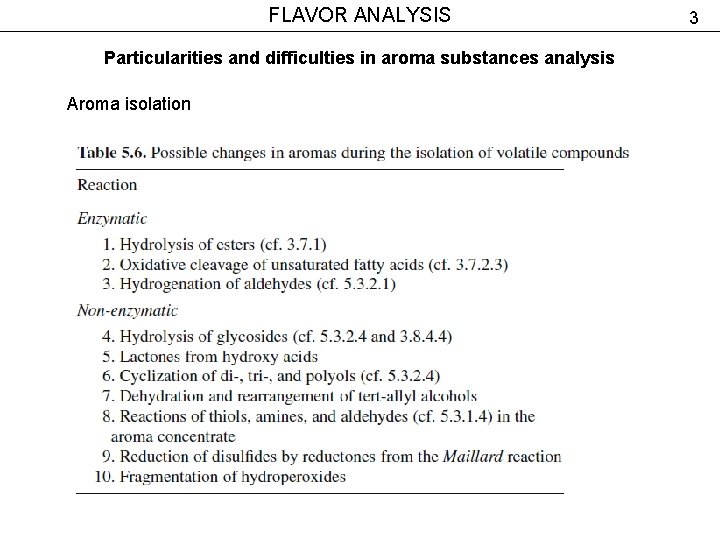
FLAVOR ANALYSIS Particularities and difficulties in aroma substances analysis Aroma isolation 3
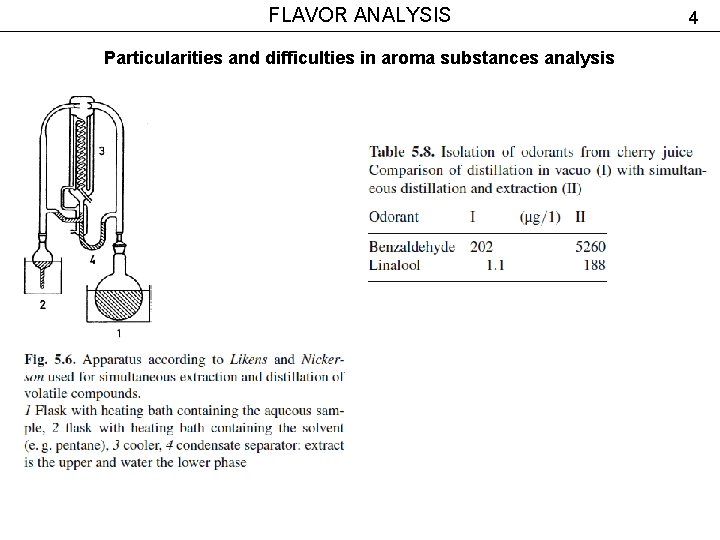
FLAVOR ANALYSIS Particularities and difficulties in aroma substances analysis 4
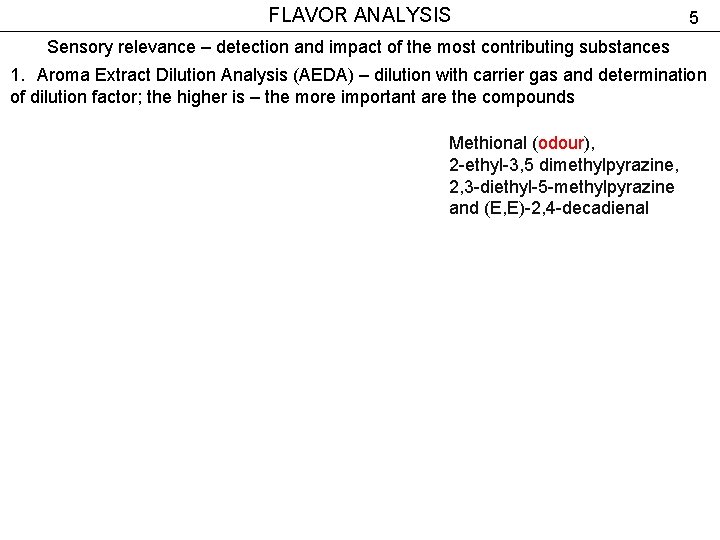
FLAVOR ANALYSIS 5 Sensory relevance – detection and impact of the most contributing substances 1. Aroma Extract Dilution Analysis (AEDA) – dilution with carrier gas and determination of dilution factor; the higher is – the more important are the compounds Methional (odour), 2 -ethyl-3, 5 dimethylpyrazine, 2, 3 -diethyl-5 -methylpyrazine and (E, E)-2, 4 -decadienal

FLAVOR ANALYSIS Sensory relevance – detection and impact of the most contributing substances 2. Headspace GC olfactometry – in AEDA some of the key odorant are masked by the career gas (methanethiol, acetaldehyde, etc. ); additional concentration step (cold trap) is performed and sniffing of the leaving substances with simultaneous GC detection. 3. Enrichment – fractionation (acidic, basic and neutral fractions). Further analysis by HPLC, multi-dimensional GC (several columns attached), NMR, MS (used for chemical structure elucidation, followed by reverse chemical synthesis – proof of the structure). More info – H. D. Belitz, W. Grosch, P. Schieberle, FOOD CHEMISTRY, 4 th Ed. 2009, Springer-Verlag, Berlin Heidelberg; pages – 340 -400. 6

FLAVOR ANALYSIS 7 Particularities and difficulties in aroma substances analysis Headspace GC olfactometry Static and dynamic (by solid phase microextraction) head space
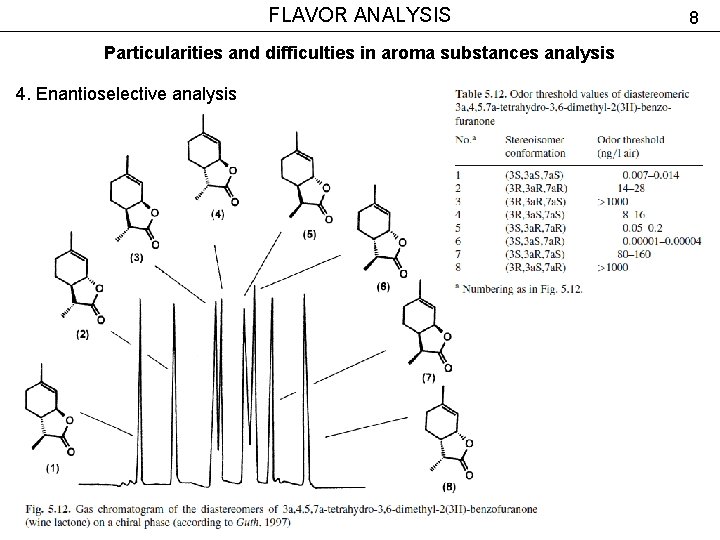
FLAVOR ANALYSIS Particularities and difficulties in aroma substances analysis 4. Enantioselective analysis 8
FLAVOR ANALYSIS Particularities and difficulties in aroma substances analysis 4. Isotopic dilution analysis (addition of the same compound in the mixture but with replaced H or 12 C) – GC-MS 5. Aroma value calculation, Aroma models and Omission experiments (French fries) Omission experiments – taking into account the influence of the matrix and other Odorants. 9
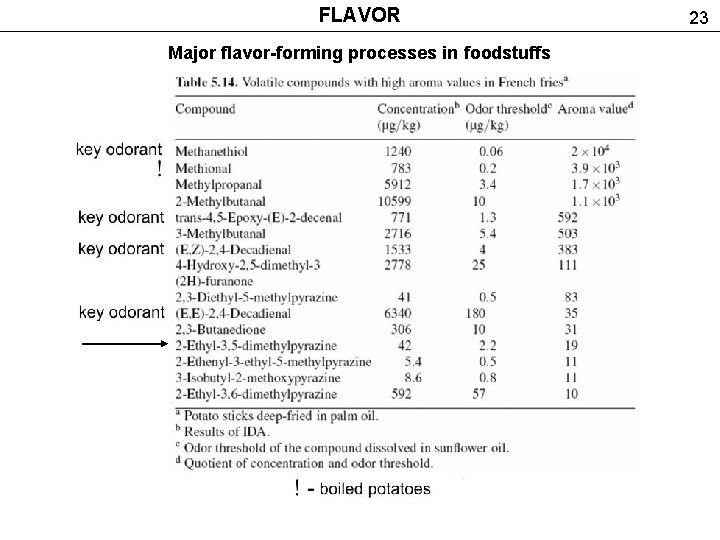
FLAVOR Major flavor-forming processes in foodstuffs 23
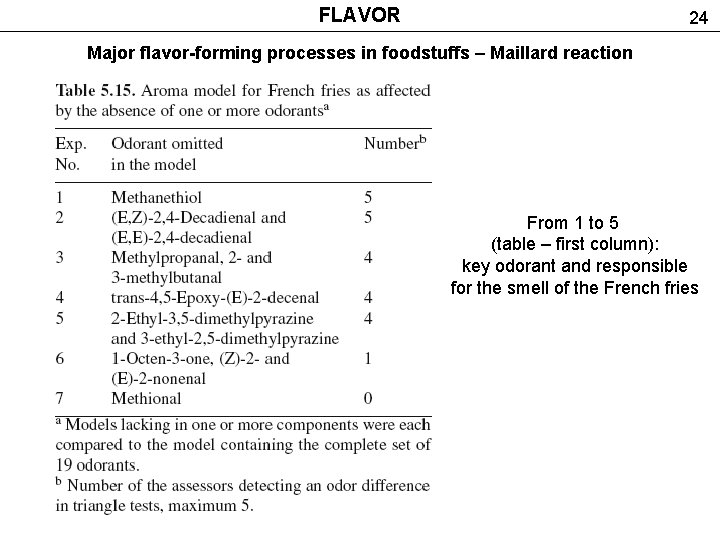
FLAVOR 24 Major flavor-forming processes in foodstuffs – Maillard reaction From 1 to 5 (table – first column): key odorant and responsible for the smell of the French fries
- Slides: 12