
Flash Normalize Programming by Examples for Text Normalization

Flash. Normalize: Programming by Examples for Text Normalization Dileep Kini Sumit Gulwani International Joint Conference on Artificial Intelligence, Buenos Aires 7/29/2015 Flash. Normalize 1
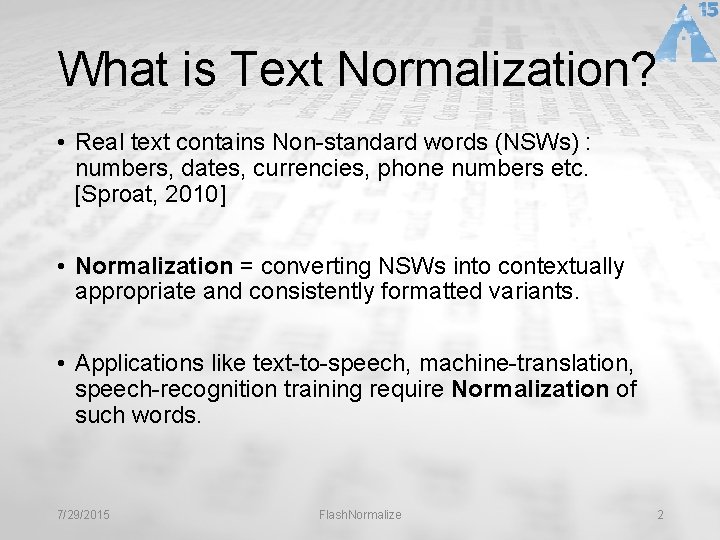
What is Text Normalization? • Real text contains Non-standard words (NSWs) : numbers, dates, currencies, phone numbers etc. [Sproat, 2010] • Normalization = converting NSWs into contextually appropriate and consistently formatted variants. • Applications like text-to-speech, machine-translation, speech-recognition training require Normalization of such words. 7/29/2015 Flash. Normalize 2
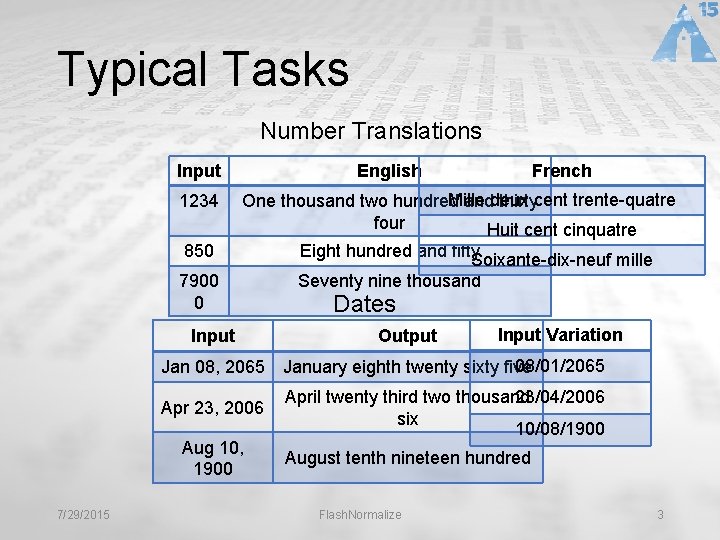
Typical Tasks Number Translations Input 1234 English Mille One thousand two hundred anddeux thirtycent trente-quatre four Huit cent cinquatre 850 Eight hundred and fifty. Soixante-dix-neuf mille 7900 0 Seventy nine thousand Input Dates Output Input Variation Jan 08, 2065 08/01/2065 January eighth twenty sixty five Apr 23, 2006 April twenty third two thousand 23/04/2006 six 10/08/1900 Aug 10, 1900 7/29/2015 French August tenth nineteen hundred Flash. Normalize 3
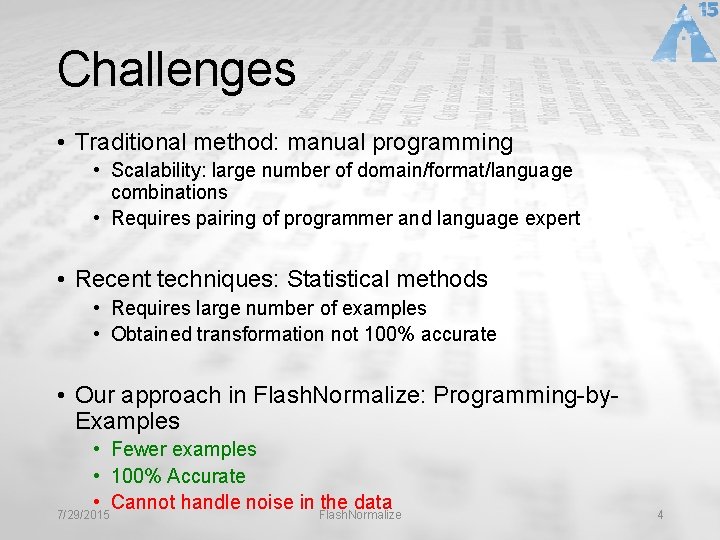
Challenges • Traditional method: manual programming • Scalability: large number of domain/format/language combinations • Requires pairing of programmer and language expert • Recent techniques: Statistical methods • Requires large number of examples • Obtained transformation not 100% accurate • Our approach in Flash. Normalize: Programming-by. Examples • Fewer examples • 100% Accurate • Cannot handle noise in Flash. Normalize the data 7/29/2015 4
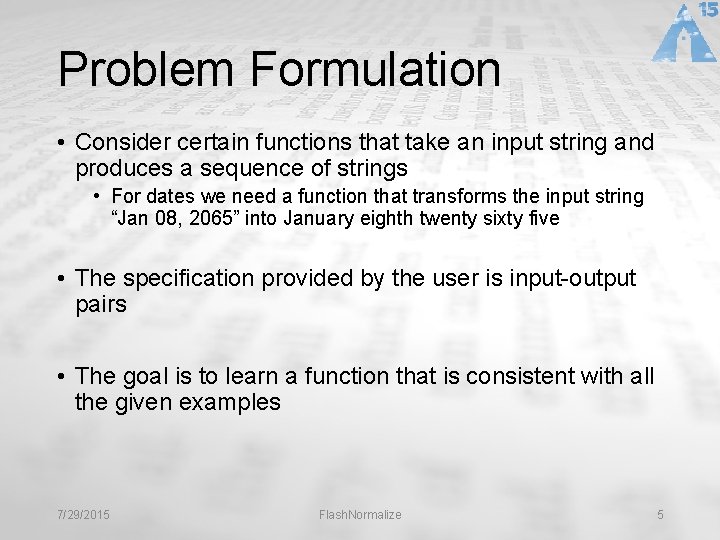
Problem Formulation • Consider certain functions that take an input string and produces a sequence of strings • For dates we need a function that transforms the input string “Jan 08, 2065” into January eighth twenty sixty five • The specification provided by the user is input-output pairs • The goal is to learn a function that is consistent with all the given examples 7/29/2015 Flash. Normalize 5
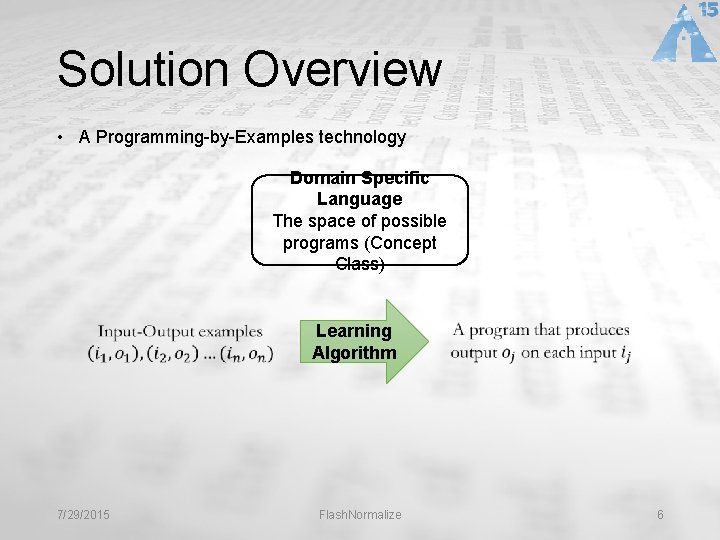
Solution Overview • A Programming-by-Examples technology Domain Specific Language The space of possible programs (Concept Class) Learning Algorithm 7/29/2015 Flash. Normalize 6
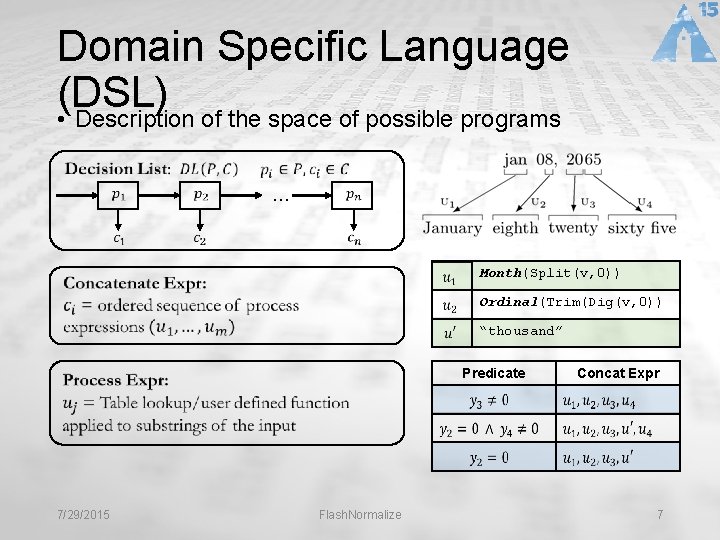
Domain Specific Language (DSL) • Description of the space of possible programs … Month(Split(v, 0)) Ordinal(Trim(Dig(v, 0)) “thousand” Predicate 7/29/2015 Flash. Normalize Concat Expr 7

Synthesis Algorithm • Given a set of input-output example pairs, derive a program from the DSL that is consistent with all the examples. • Our algorithm has 2 logically distinct phases • A bottom-up learning of process expressions for individual examples • A top-down search for decision lists and concats for all examples 7/29/2015 Flash. Normalize 8
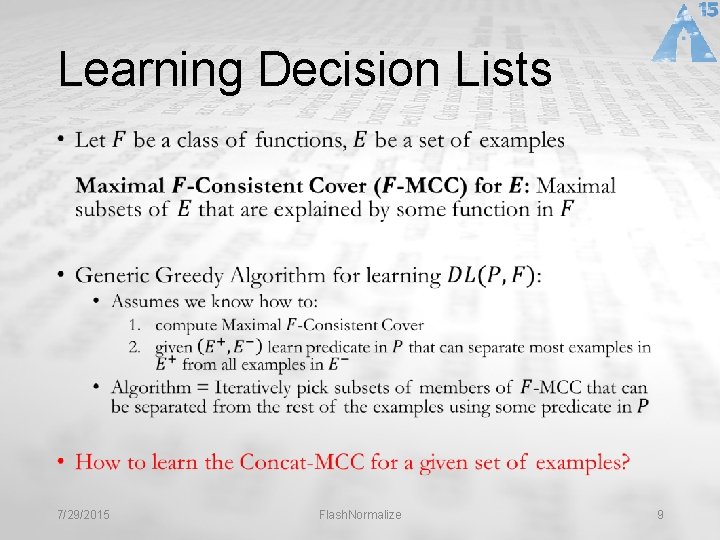
Learning Decision Lists • 7/29/2015 Flash. Normalize 9
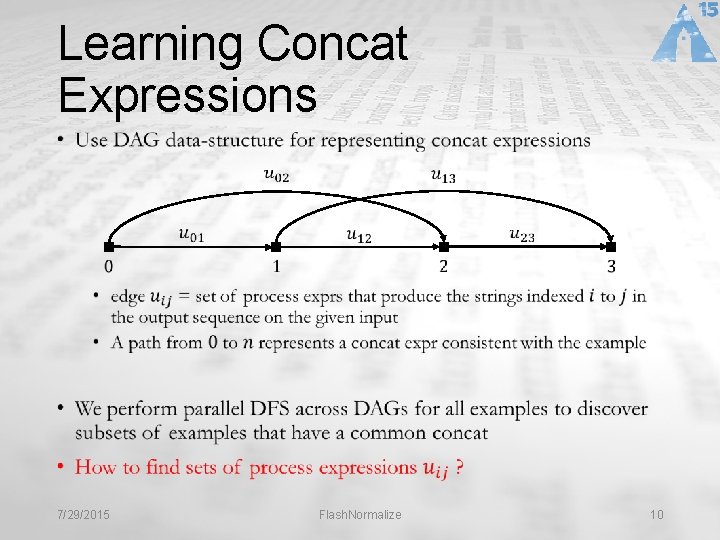
Learning Concat Expressions • 7/29/2015 Flash. Normalize 10
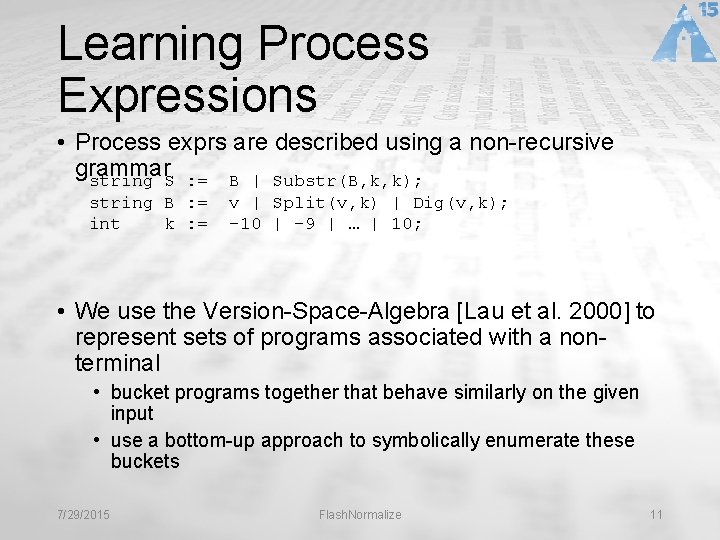
Learning Process Expressions • Process exprs are described using a non-recursive grammar string S : = B | Substr(B, k, k); string B : = int k : = v | Split(v, k) | Dig(v, k); -10 | -9 | … | 10; • We use the Version-Space-Algebra [Lau et al. 2000] to represent sets of programs associated with a nonterminal • bucket programs together that behave similarly on the given input • use a bottom-up approach to symbolically enumerate these buckets 7/29/2015 Flash. Normalize 11
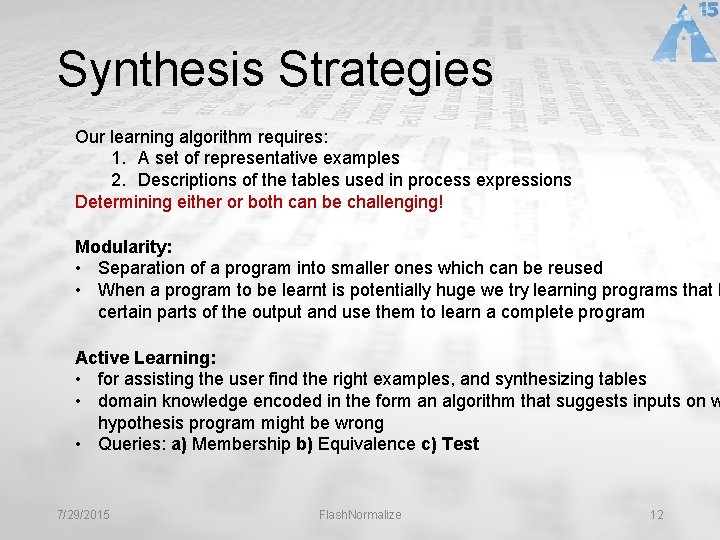
Synthesis Strategies Our learning algorithm requires: 1. A set of representative examples 2. Descriptions of the tables used in process expressions Determining either or both can be challenging! Modularity: • Separation of a program into smaller ones which can be reused • When a program to be learnt is potentially huge we try learning programs that h certain parts of the output and use them to learn a complete program Active Learning: • for assisting the user find the right examples, and synthesizing tables • domain knowledge encoded in the form an algorithm that suggests inputs on w hypothesis program might be wrong • Queries: a) Membership b) Equivalence c) Test 7/29/2015 Flash. Normalize 12
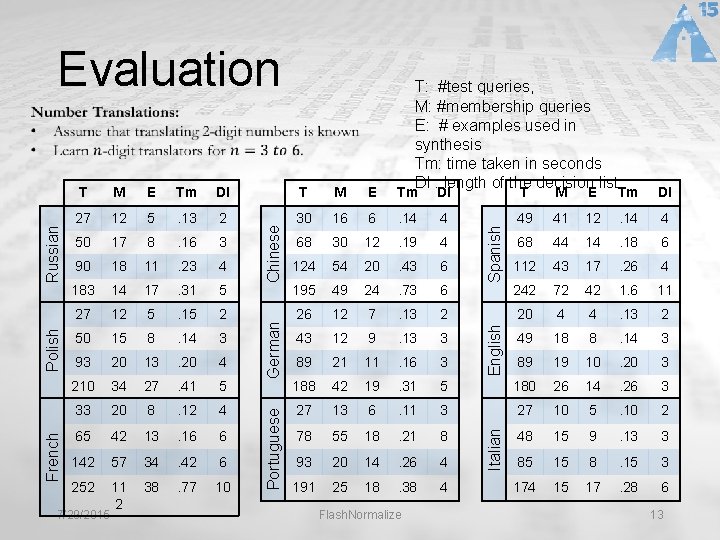
T: #test queries, M: #membership queries E: # examples used in synthesis Tm: time taken in seconds Dl : length of the decision list E Tm Dl T M E Tm Dl 27 12 5 . 13 2 30 16 6 . 14 4 49 41 12 . 14 4 50 17 8 . 16 3 68 30 12 . 19 4 68 44 14 . 18 6 90 18 11 . 23 4 124 54 20 . 43 6 112 43 17 . 26 4 183 14 17 . 31 5 195 49 24 . 73 6 242 72 42 1. 6 11 27 12 5 . 15 2 26 12 7 . 13 2 20 4 4 . 13 2 50 15 8 . 14 3 43 12 9 . 13 3 49 18 8 . 14 3 93 20 13 . 20 4 89 21 11 . 16 3 89 19 10 . 20 3 210 34 27 . 41 5 188 42 19 . 31 5 180 26 14 . 26 3 33 20 8 . 12 4 27 13 6 . 11 3 27 10 5 . 10 2 65 42 13 . 16 6 78 55 18 . 21 8 48 15 9 . 13 3 142 57 34 . 42 6 93 20 14 . 26 4 85 15 8 . 15 3 252 11 2 38 . 77 10 191 25 18 . 38 4 174 15 17 . 28 6 7/29/2015 Flash. Normalize English Italian German Spanish M Chinese T Portuguese French Polish Russian Evaluation 13
Thank You! 7/29/2015 Flash. Normalize 14
- Slides: 14