
Flash CorrectandRefresh RetentionAware Error Management for Increased Flash
![NAND Flash Error Types n Four types of errors [Cai+, DATE 2012] n Caused](https://slidetodoc.com/presentation_image_h/06585d8cec4f836ffdbd3b6d638a36f6/image-9.jpg "NAND Flash Error Types n Four types of errors [Cai+, DATE 2012] n Caused")




- Slides: 56
Flash Correct-and-Refresh Retention-Aware Error Management for Increased Flash Memory Lifetime Yu Cai 1 Gulay Yalcin 2 Onur Mutlu 1 Erich F. Haratsch 3 Adrian Cristal 2 Osman S. Unsal 2 Ken Mai 1 Carnegie Mellon University 2 Barcelona Supercomputing Center 3 LSI Corporation 1
Executive Summary n n n NAND flash memory has low endurance: a flash cell dies after 3 k P/E cycles vs. 50 k desired Major scaling challenge for flash memory Flash error rate increases exponentially over flash lifetime Problem: Stronger error correction codes (ECC) are ineffective and undesirable for improving flash lifetime due to q q n n Our Goal: Develop techniques to tolerate high error rates w/o strong ECC Observation: Retention errors are the dominant errors in MLC NAND flash q n flash cell loses charge over time; retention errors increase as cell gets worn out Solution: Flash Correct-and-Refresh (FCR) q q n diminishing returns on lifetime with increased correction strength prohibitively high power, area, latency overheads Periodically read, correct, and reprogram (in place) or remap each flash page before it accumulates more errors than can be corrected by simple ECC Adapt “refresh” rate to the severity of retention errors (i. e. , # of P/E cycles) Results: FCR improves flash memory lifetime by 46 X with no hardware changes and low energy overhead; outperforms strong ECCs 2
Outline n n n Executive Summary The Problem: Limited Flash Memory Endurance/Lifetime Error and ECC Analysis for Flash Memory Flash Correct and Refresh Techniques (FCR) Evaluation Conclusions 3
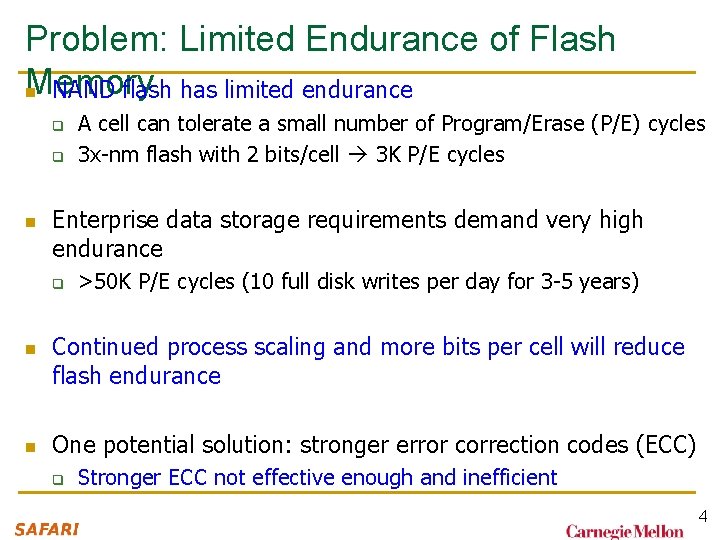
Problem: Limited Endurance of Flash Memory n NAND flash has limited endurance q q n Enterprise data storage requirements demand very high endurance q n n A cell can tolerate a small number of Program/Erase (P/E) cycles 3 x-nm flash with 2 bits/cell 3 K P/E cycles >50 K P/E cycles (10 full disk writes per day for 3 -5 years) Continued process scaling and more bits per cell will reduce flash endurance One potential solution: stronger error correction codes (ECC) q Stronger ECC not effective enough and inefficient 4
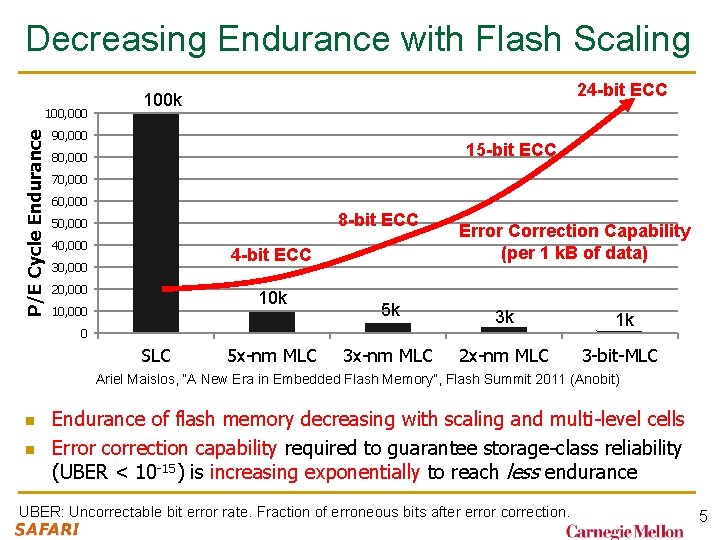
Decreasing Endurance with Flash Scaling P/E Cycle Endurance 100, 000 24 -bit ECC 100 k 90, 000 15 -bit ECC 80, 000 70, 000 60, 000 8 -bit ECC 50, 000 4 -bit ECC 30, 000 20, 000 10 k 10, 000 5 k 3 k 1 k 3 x-nm MLC 2 x-nm MLC 3 -bit-MLC 0 SLC 5 x-nm MLC Error Correction Capability (per 1 k. B of data) Ariel Maislos, “A New Era in Embedded Flash Memory”, Flash Summit 2011 (Anobit) n n Endurance of flash memory decreasing with scaling and multi-level cells Error correction capability required to guarantee storage-class reliability (UBER < 10 -15) is increasing exponentially to reach less endurance UBER: Uncorrectable bit error rate. Fraction of erroneous bits after error correction. 5
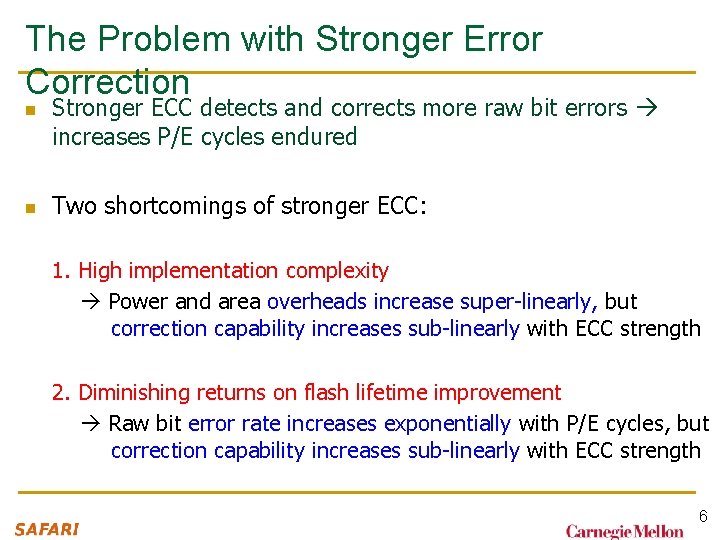
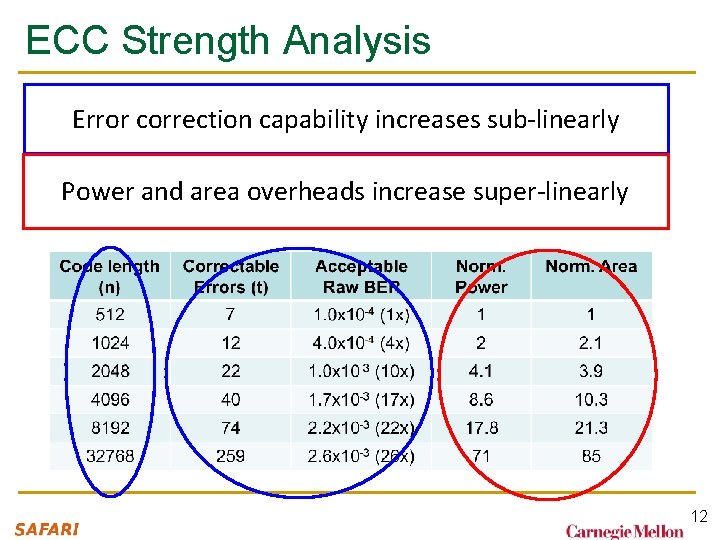
The Problem with Stronger Error Correction n n Stronger ECC detects and corrects more raw bit errors increases P/E cycles endured Two shortcomings of stronger ECC: 1. High implementation complexity Power and area overheads increase super-linearly, but correction capability increases sub-linearly with ECC strength 2. Diminishing returns on flash lifetime improvement Raw bit error rate increases exponentially with P/E cycles, but correction capability increases sub-linearly with ECC strength 6
Outline n n n Executive Summary The Problem: Limited Flash Memory Endurance/Lifetime Error and ECC Analysis for Flash Memory Flash Correct and Refresh Techniques (FCR) Evaluation Conclusions 7
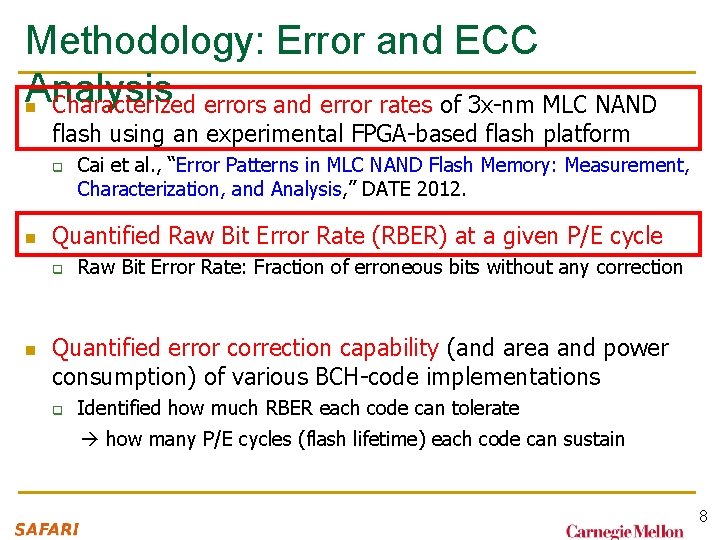
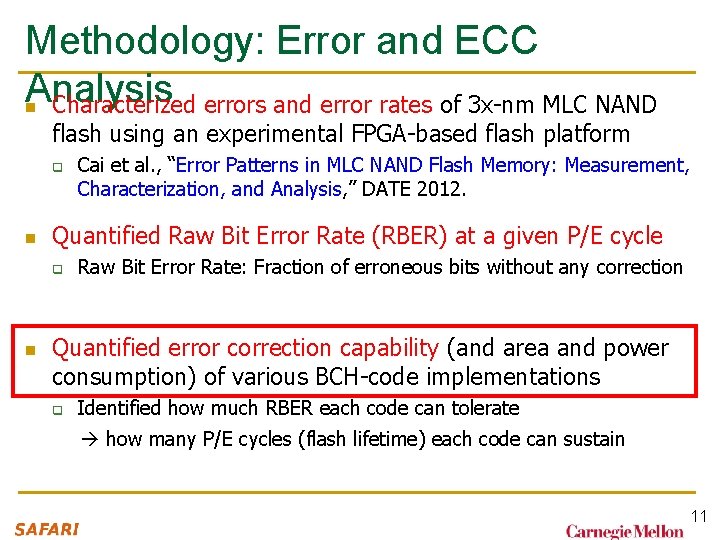
Methodology: Error and ECC Analysis n Characterized errors and error rates of 3 x-nm MLC NAND flash using an experimental FPGA-based flash platform q n Quantified Raw Bit Error Rate (RBER) at a given P/E cycle q n Cai et al. , “Error Patterns in MLC NAND Flash Memory: Measurement, Characterization, and Analysis, ” DATE 2012. Raw Bit Error Rate: Fraction of erroneous bits without any correction Quantified error correction capability (and area and power consumption) of various BCH-code implementations q Identified how much RBER each code can tolerate how many P/E cycles (flash lifetime) each code can sustain 8
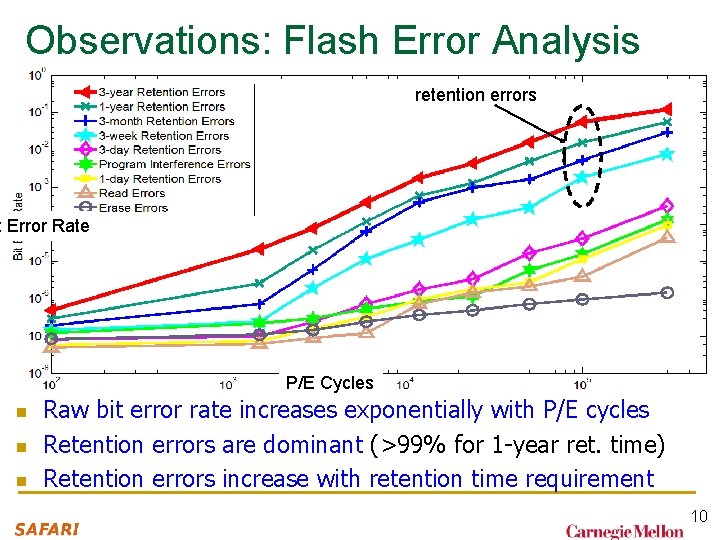
NAND Flash Error Types n Four types of errors [Cai+, DATE 2012] n Caused by common flash operations q q q n Read errors Erase errors Program (interference) errors Caused by flash cell losing charge over time q Retention errors n n Whether an error happens depends on required retention time Especially problematic in MLC flash because voltage threshold window to determine stored value is smaller 9
Observations: Flash Error Analysis retention errors t Error Rate P/E Cycles n n n Raw bit error rate increases exponentially with P/E cycles Retention errors are dominant (>99% for 1 -year ret. time) Retention errors increase with retention time requirement 10
Methodology: Error and ECC Analysis n Characterized errors and error rates of 3 x-nm MLC NAND flash using an experimental FPGA-based flash platform q n Quantified Raw Bit Error Rate (RBER) at a given P/E cycle q n Cai et al. , “Error Patterns in MLC NAND Flash Memory: Measurement, Characterization, and Analysis, ” DATE 2012. Raw Bit Error Rate: Fraction of erroneous bits without any correction Quantified error correction capability (and area and power consumption) of various BCH-code implementations q Identified how much RBER each code can tolerate how many P/E cycles (flash lifetime) each code can sustain 11
ECC Strength Analysis n Examined characteristics of various-strength BCH codes Error capability increases sub-linearly with thecorrection following criteria Storage efficiency: >89% coding rate (user data/total storage) q Reliability: <10 -15 uncorrectable bit error rate Power and area overheads increase super-linearly q Code length: segment of one flash page (e. g. , 4 k. B) q 12
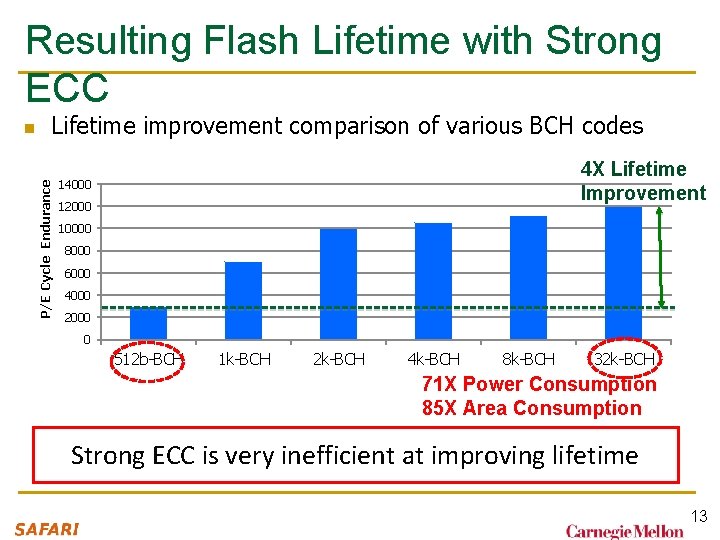
Resulting Flash Lifetime with Strong ECC Lifetime improvement comparison of various BCH codes P/E Cycle Endurance n 4 X Lifetime Improvement 14000 12000 10000 8000 6000 4000 2000 0 512 b-BCH 1 k-BCH 2 k-BCH 4 k-BCH 8 k-BCH 32 k-BCH 71 X Power Consumption 85 X Area Consumption Strong ECC is very inefficient at improving lifetime 13
Our Goal Develop new techniques to improve flash lifetime without relying on stronger ECC 14
Outline n n n Executive Summary The Problem: Limited Flash Memory Endurance/Lifetime Error and ECC Analysis for Flash Memory Flash Correct and Refresh Techniques (FCR) Evaluation Conclusions 15
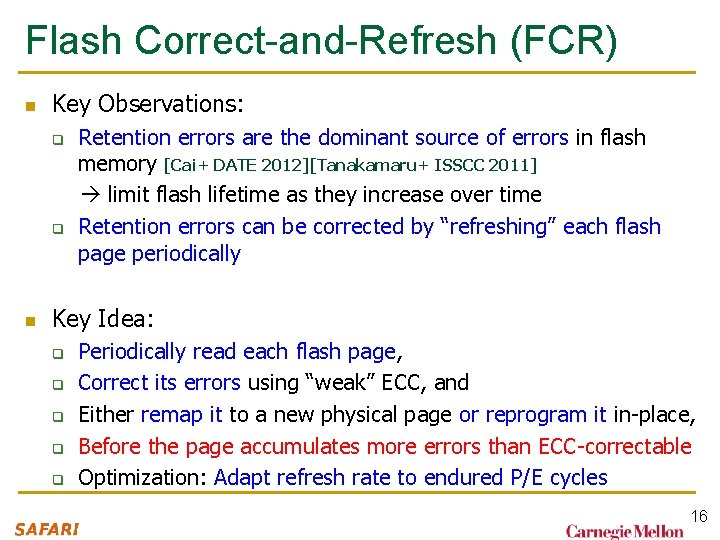
Flash Correct-and-Refresh (FCR) n Key Observations: q q n Retention errors are the dominant source of errors in flash memory [Cai+ DATE 2012][Tanakamaru+ ISSCC 2011] limit flash lifetime as they increase over time Retention errors can be corrected by “refreshing” each flash page periodically Key Idea: q q q Periodically read each flash page, Correct its errors using “weak” ECC, and Either remap it to a new physical page or reprogram it in-place, Before the page accumulates more errors than ECC-correctable Optimization: Adapt refresh rate to endured P/E cycles 16
FCR Intuition Errors with Periodic refresh Errors with No refresh Program Page × × After time T × × × After time 2 T × × After time 3 T ×× × × × × Retention Error × Program Error 17
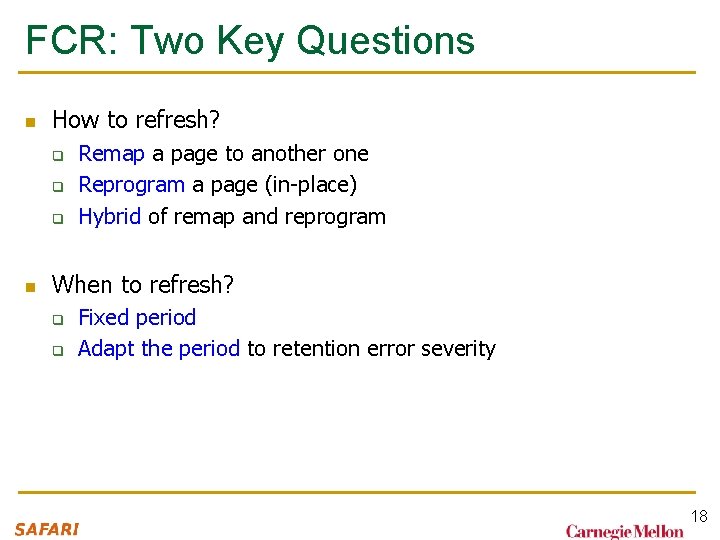
FCR: Two Key Questions n How to refresh? q q q n Remap a page to another one Reprogram a page (in-place) Hybrid of remap and reprogram When to refresh? q q Fixed period Adapt the period to retention error severity 18
Outline n n Executive Summary The Problem: Limited Flash Memory Endurance/Lifetime Error and ECC Analysis for Flash Memory Flash Correct and Refresh Techniques (FCR) 1. Remapping based FCR 2. Hybrid Reprogramming and Remapping based FCR 3. Adaptive-Rate FCR n n Evaluation Conclusions 19
Outline n n Executive Summary The Problem: Limited Flash Memory Endurance/Lifetime Error and ECC Analysis for Flash Memory Flash Correct and Refresh Techniques (FCR) 1. Remapping based FCR 2. Hybrid Reprogramming and Remapping based FCR 3. Adaptive-Rate FCR n n Evaluation Conclusions 20
Remapping Based FCR n Idea: Periodically remap each page to a different physical page (after correcting errors) q q q n Also [Pan et al. , HPCA 2012] FTL already has support for changing logical physical flash block/page mappings Deallocated block is erased by garbage collector Problem: Causes additional erase operations more wearout q q Bad for read-intensive workloads (few erases really needed) Lifetime degrades for such workloads (see paper) 21
Outline n n Executive Summary The Problem: Limited Flash Memory Endurance/Lifetime Error and ECC Analysis for Flash Memory Flash Correct and Refresh Techniques (FCR) 1. Remapping based FCR 2. Hybrid Reprogramming and Remapping based FCR 3. Adaptive-Rate FCR n n Evaluation Conclusions 22
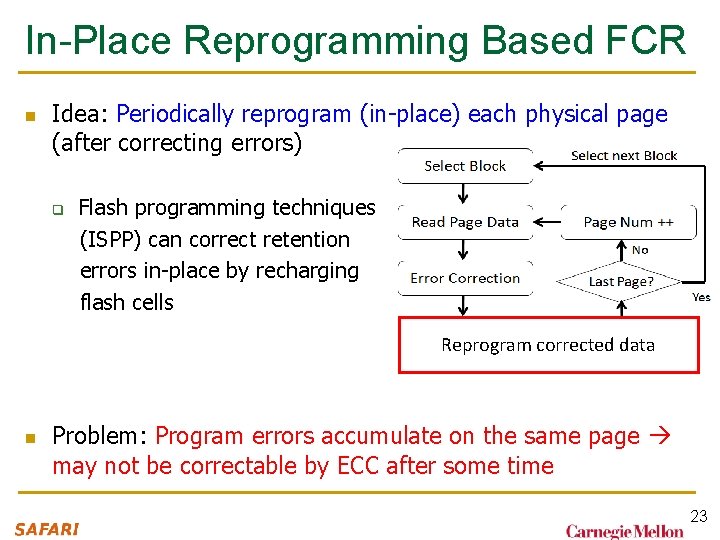
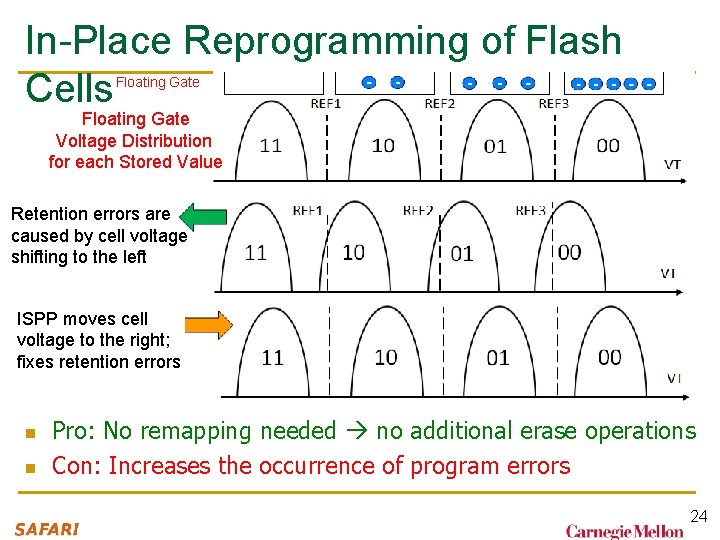
In-Place Reprogramming Based FCR n Idea: Periodically reprogram (in-place) each physical page (after correcting errors) q Flash programming techniques (ISPP) can correct retention errors in-place by recharging flash cells Reprogram corrected data n Problem: Program errors accumulate on the same page may not be correctable by ECC after some time 23
In-Place Reprogramming of Flash Cells Floating Gate Voltage Distribution for each Stored Value Retention errors are caused by cell voltage shifting to the left ISPP moves cell voltage to the right; fixes retention errors n n Pro: No remapping needed no additional erase operations Con: Increases the occurrence of program errors 24
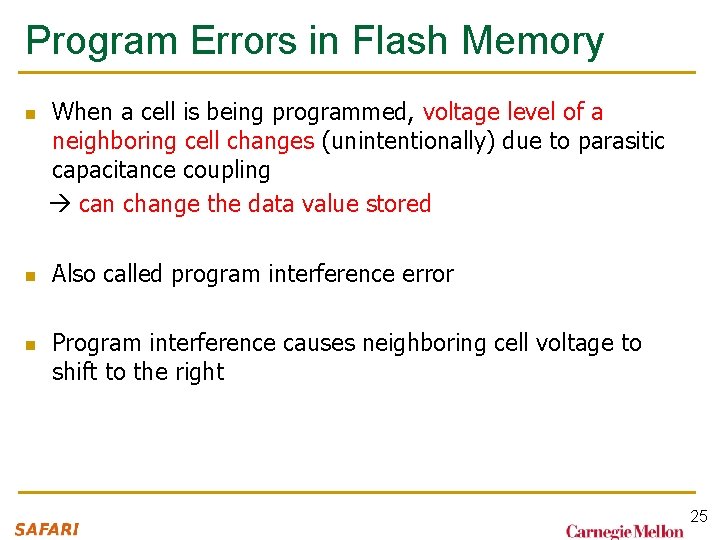
Program Errors in Flash Memory n n n When a cell is being programmed, voltage level of a neighboring cell changes (unintentionally) due to parasitic capacitance coupling can change the data value stored Also called program interference error Program interference causes neighboring cell voltage to shift to the right 25
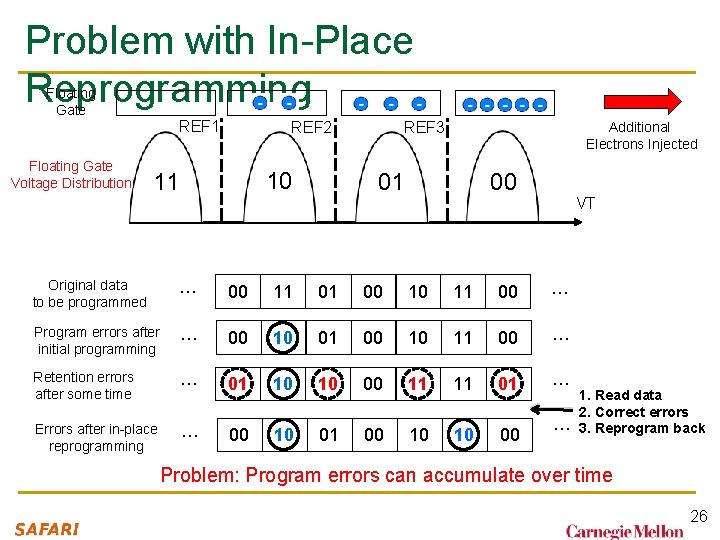
Problem with In-Place Reprogramming Floating Gate Voltage Distribution REF 1 REF 2 10 11 REF 3 Additional Electrons Injected 01 00 VT Original data to be programmed … 00 11 01 00 10 11 00 … Program errors after initial programming … 00 10 01 00 10 11 00 … Retention errors after some time … 01 10 10 00 11 11 01 … Errors after in-place reprogramming … 00 10 01 00 10 10 00 … 1. Read data 2. Correct errors 3. Reprogram back Problem: Program errors can accumulate over time 26
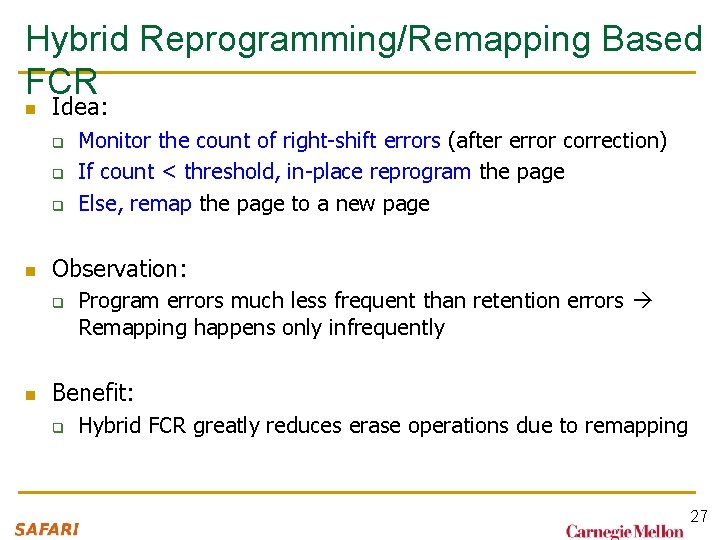
Hybrid Reprogramming/Remapping Based FCR n Idea: q q q n Observation: q n Monitor the count of right-shift errors (after error correction) If count < threshold, in-place reprogram the page Else, remap the page to a new page Program errors much less frequent than retention errors Remapping happens only infrequently Benefit: q Hybrid FCR greatly reduces erase operations due to remapping 27
Outline n n Executive Summary The Problem: Limited Flash Memory Endurance/Lifetime Error and ECC Analysis for Flash Memory Flash Correct and Refresh Techniques (FCR) 1. Remapping based FCR 2. Hybrid Reprogramming and Remapping based FCR 3. Adaptive-Rate FCR n n Evaluation Conclusions 28
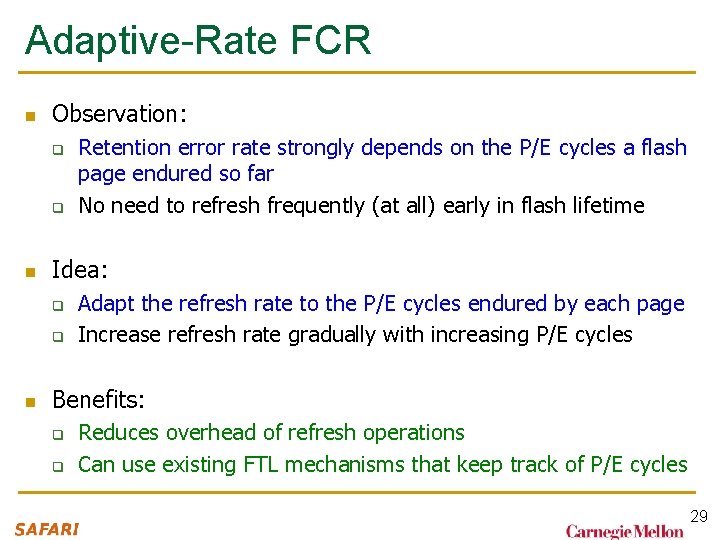
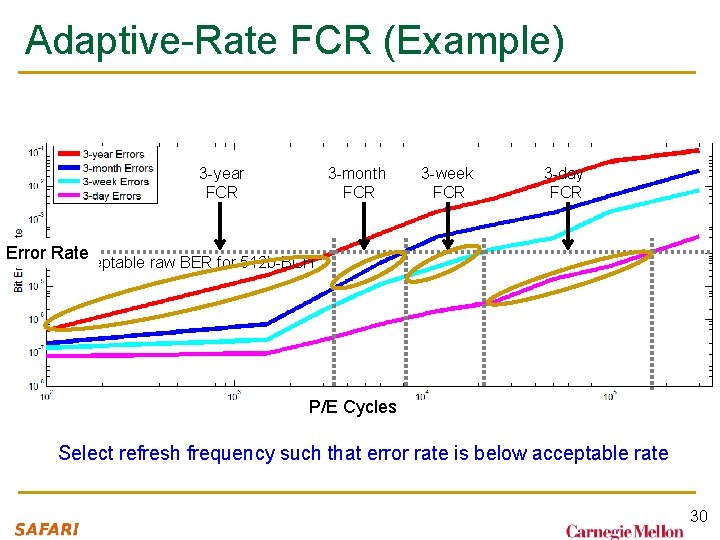
Adaptive-Rate FCR n Observation: q q n Idea: q q n Retention error rate strongly depends on the P/E cycles a flash page endured so far No need to refresh frequently (at all) early in flash lifetime Adapt the refresh rate to the P/E cycles endured by each page Increase refresh rate gradually with increasing P/E cycles Benefits: q q Reduces overhead of refresh operations Can use existing FTL mechanisms that keep track of P/E cycles 29
Adaptive-Rate FCR (Example) 3 -year FCR 3 -month FCR 3 -week FCR 3 -day FCR t Error Rate Acceptable raw BER for 512 b-BCH P/E Cycles Select refresh frequency such that error rate is below acceptable rate 30
Outline n n Executive Summary The Problem: Limited Flash Memory Endurance/Lifetime Error and ECC Analysis for Flash Memory Flash Correct and Refresh Techniques (FCR) 1. Remapping based FCR 2. Hybrid Reprogramming and Remapping based FCR 3. Adaptive-Rate FCR n n Evaluation Conclusions 31
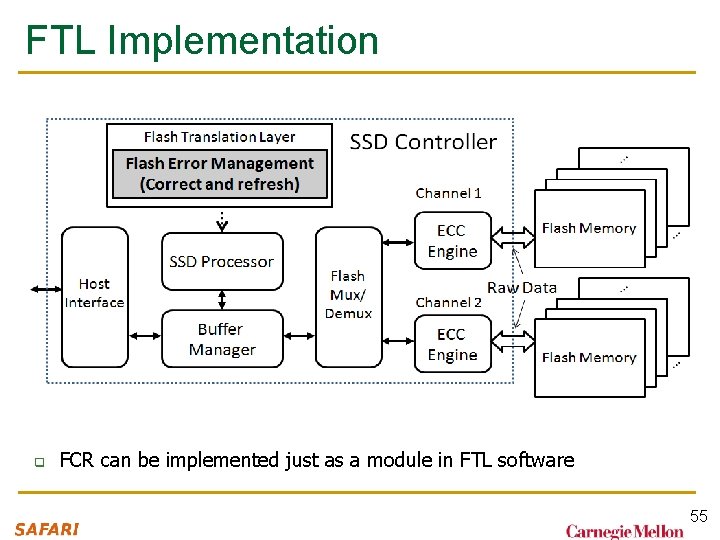
FCR: Other Considerations n Implementation cost q q n Response time impact q n FCR not as frequent as DRAM refresh; low impact Adaptation to variations in retention error rate q n No hardware changes FTL software/firmware needs modification Adapt refresh rate based on, e. g. , temperature [Liu+ ISCA 2012] FCR requires power q Enterprise storage systems typically powered on 32
Outline n n n Executive Summary The Problem: Limited Flash Memory Endurance/Lifetime Error and ECC Analysis for Flash Memory Flash Correct and Refresh Techniques (FCR) Evaluation Conclusions 33
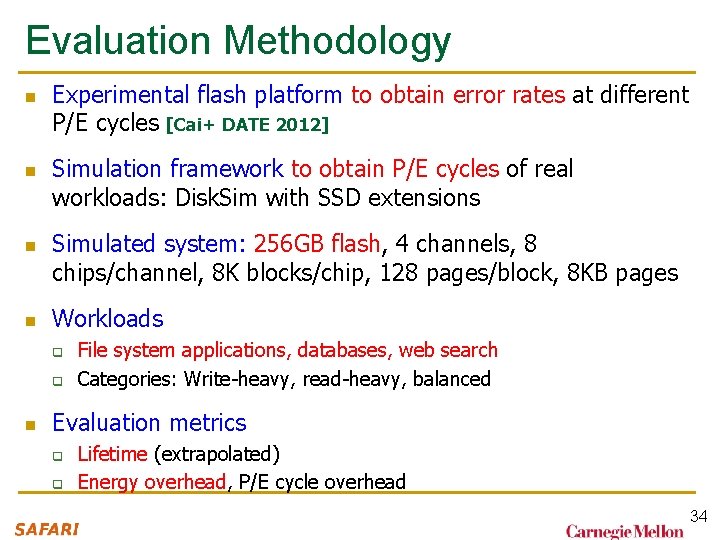
Evaluation Methodology n n Experimental flash platform to obtain error rates at different P/E cycles [Cai+ DATE 2012] Simulation framework to obtain P/E cycles of real workloads: Disk. Sim with SSD extensions Simulated system: 256 GB flash, 4 channels, 8 chips/channel, 8 K blocks/chip, 128 pages/block, 8 KB pages Workloads q q n File system applications, databases, web search Categories: Write-heavy, read-heavy, balanced Evaluation metrics q q Lifetime (extrapolated) Energy overhead, P/E cycle overhead 34
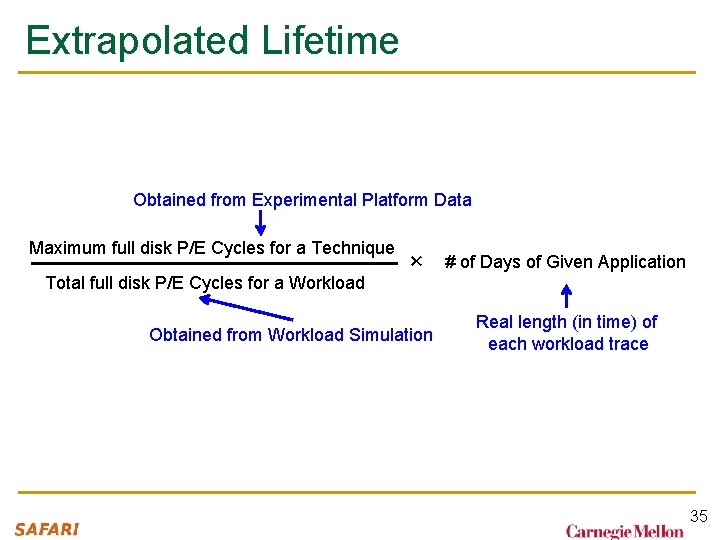
Extrapolated Lifetime Obtained from Experimental Platform Data Maximum full disk P/E Cycles for a Technique Total full disk P/E Cycles for a Workload × Obtained from Workload Simulation # of Days of Given Application Real length (in time) of each workload trace 35
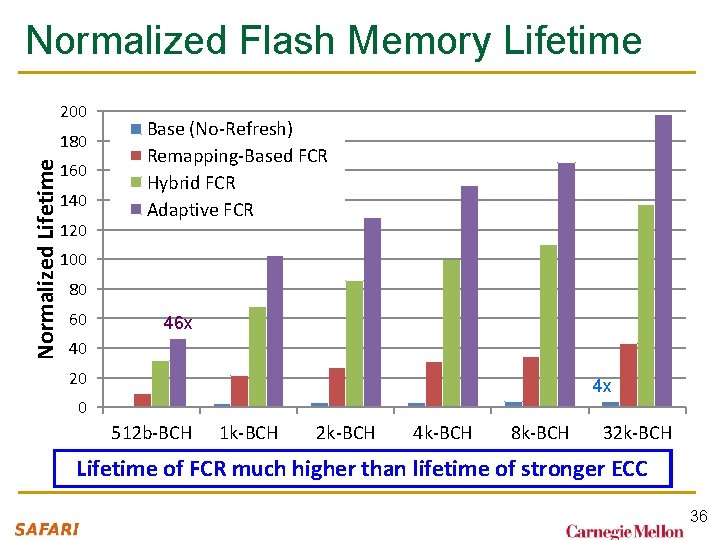
Normalized Flash Memory Lifetime 200 Normalized Lifetime 180 160 140 120 Base (No-Refresh) Remapping-Based FCR Hybrid FCR Adaptive FCR 100 80 60 46 x 40 20 4 x 0 512 b-BCH 1 k-BCH 2 k-BCH 4 k-BCH 8 k-BCH 32 k-BCH Lifetime Adaptive-rate of FCR much FCR higher provides thanthe lifetime highest of stronger lifetime ECC 36
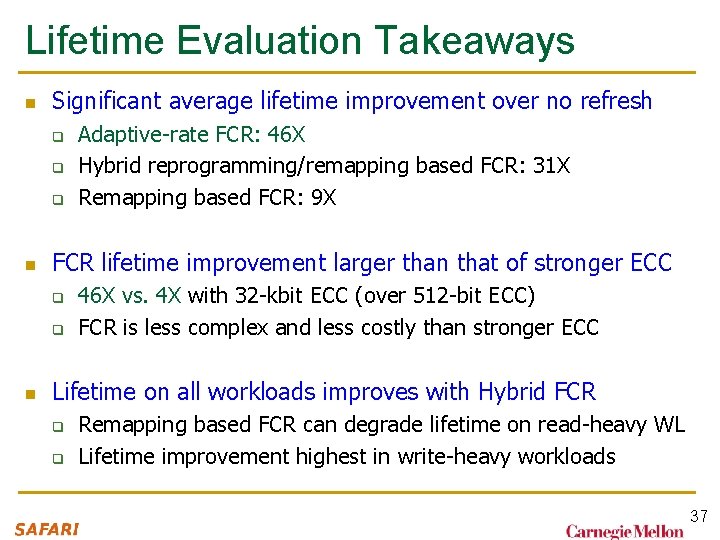
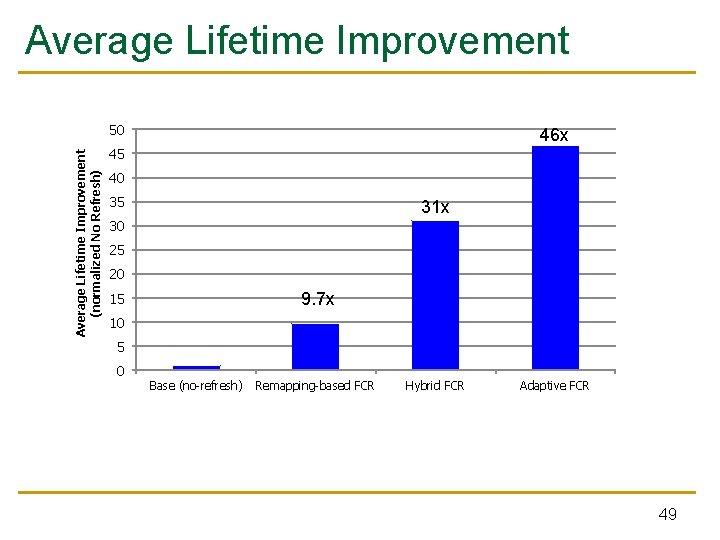
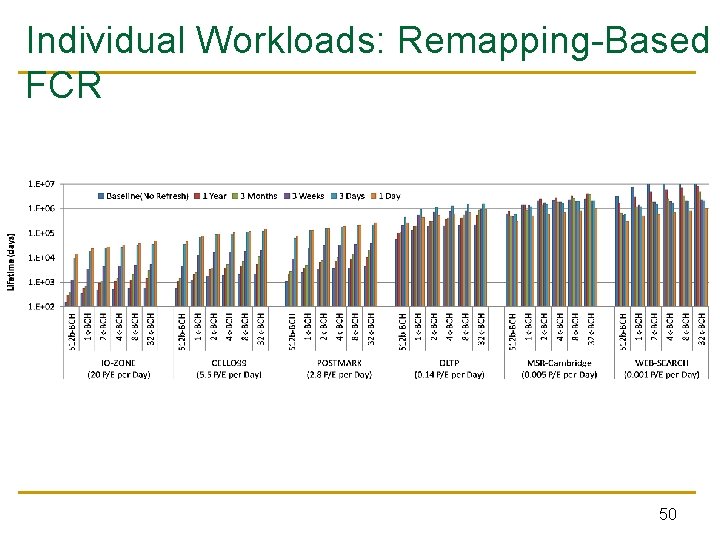
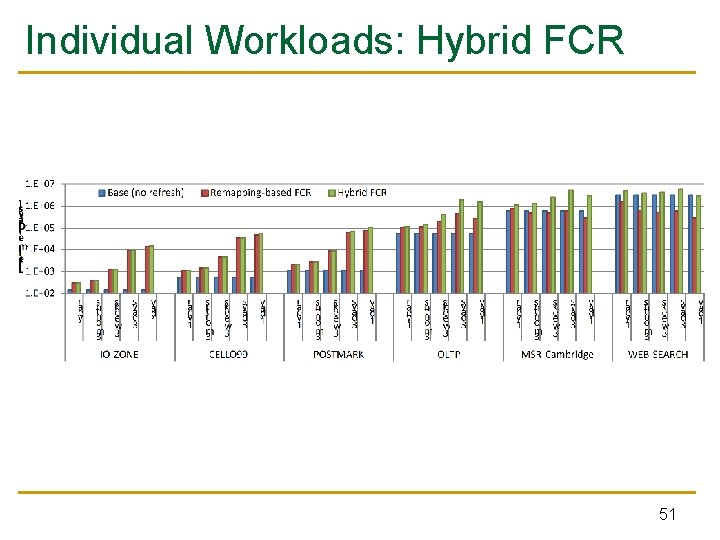
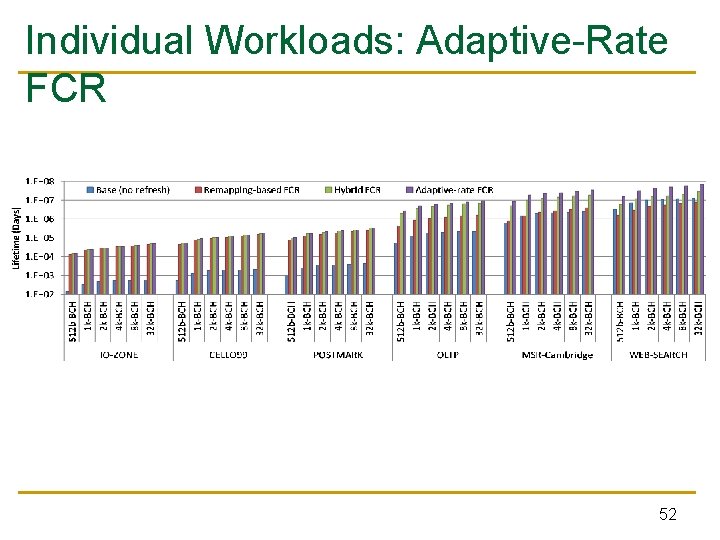
Lifetime Evaluation Takeaways n Significant average lifetime improvement over no refresh q q q n FCR lifetime improvement larger than that of stronger ECC q q n Adaptive-rate FCR: 46 X Hybrid reprogramming/remapping based FCR: 31 X Remapping based FCR: 9 X 46 X vs. 4 X with 32 -kbit ECC (over 512 -bit ECC) FCR is less complex and less costly than stronger ECC Lifetime on all workloads improves with Hybrid FCR q q Remapping based FCR can degrade lifetime on read-heavy WL Lifetime improvement highest in write-heavy workloads 37
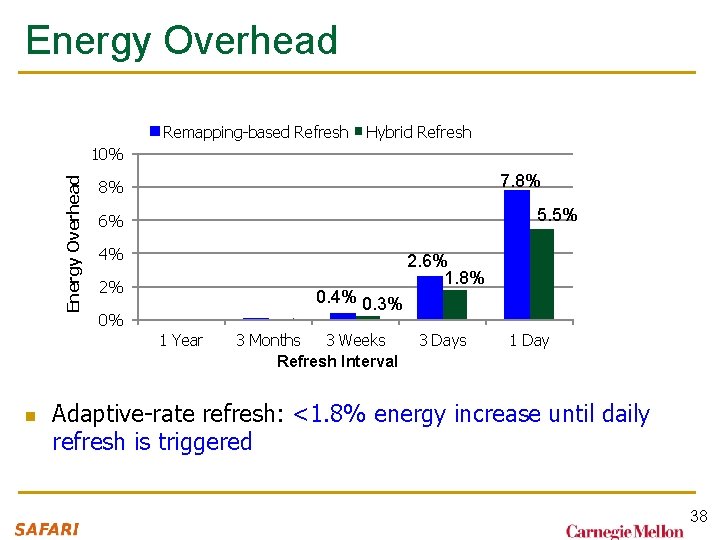
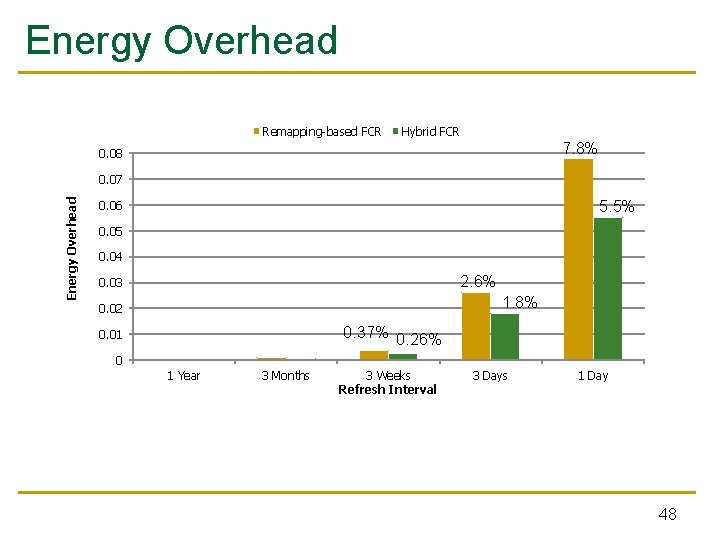
Energy Overhead Remapping-based Refresh Hybrid Refresh Energy Overhead 10% 7. 8% 8% 5. 5% 6% 4% 2% 0. 4% 0. 3% 0% 1 Year n 3 Months 3 Weeks Refresh Interval 2. 6% 1. 8% 3 Days 1 Day Adaptive-rate refresh: <1. 8% energy increase until daily refresh is triggered 38
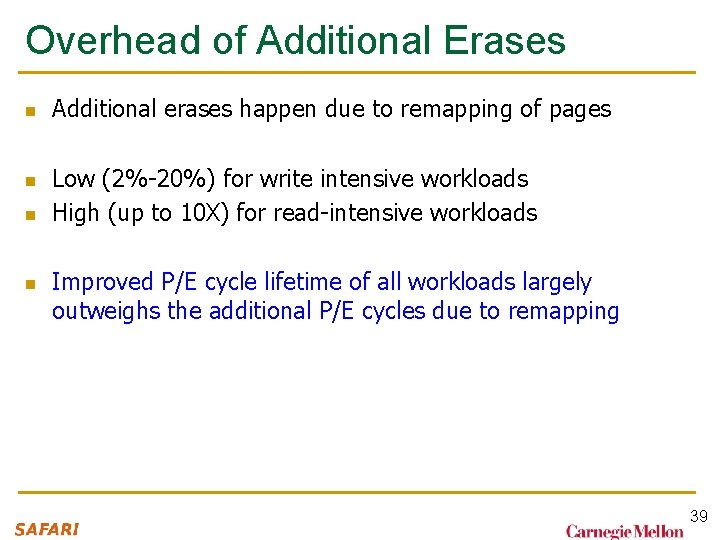
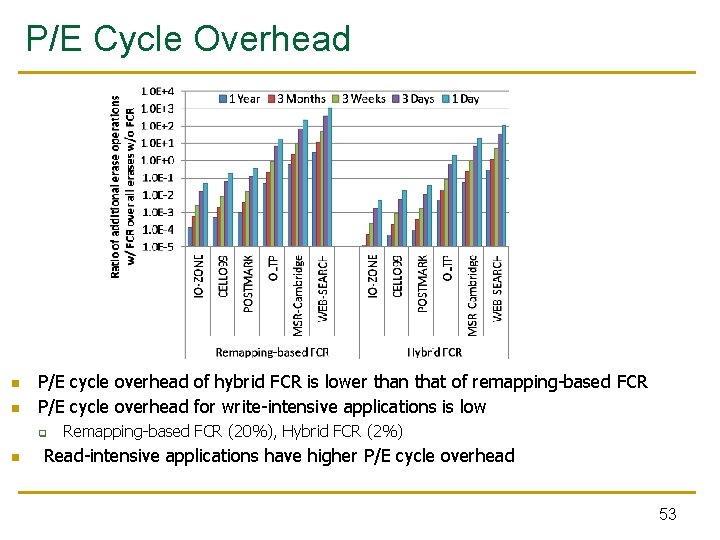
Overhead of Additional Erases n n Additional erases happen due to remapping of pages Low (2%-20%) for write intensive workloads High (up to 10 X) for read-intensive workloads Improved P/E cycle lifetime of all workloads largely outweighs the additional P/E cycles due to remapping 39
More Results in the Paper n Detailed workload analysis n Effect of refresh rate 40
Outline n n n Executive Summary The Problem: Limited Flash Memory Endurance/Lifetime Error and ECC Analysis for Flash Memory Flash Correct and Refresh Techniques (FCR) Evaluation Conclusions 41
Conclusion n NAND flash memory lifetime is limited due to uncorrectable errors, which increase over lifetime (P/E cycles) Observation: Dominant source of errors in flash memory is retention errors retention error rate limits lifetime Flash Correct-and-Refresh (FCR) techniques reduce retention error rate to improve flash lifetime q q n Periodically read, correct, and remap or reprogram each page before it accumulates more errors than can be corrected Adapt refresh period to the severity of errors FCR improves flash lifetime by 46 X at no hardware cost q q More effective and efficient than stronger ECC Can enable better flash memory scaling 42
Thank You.
Flash Correct-and-Refresh Retention-Aware Error Management for Increased Flash Memory Lifetime Yu Cai 1 Gulay Yalcin 2 Onur Mutlu 1 Erich F. Haratsch 3 Adrian Cristal 2 Osman S. Unsal 2 Ken Mai 1 Carnegie Mellon University 2 Barcelona Supercomputing Center 3 LSI Corporation 1
Backup Slides
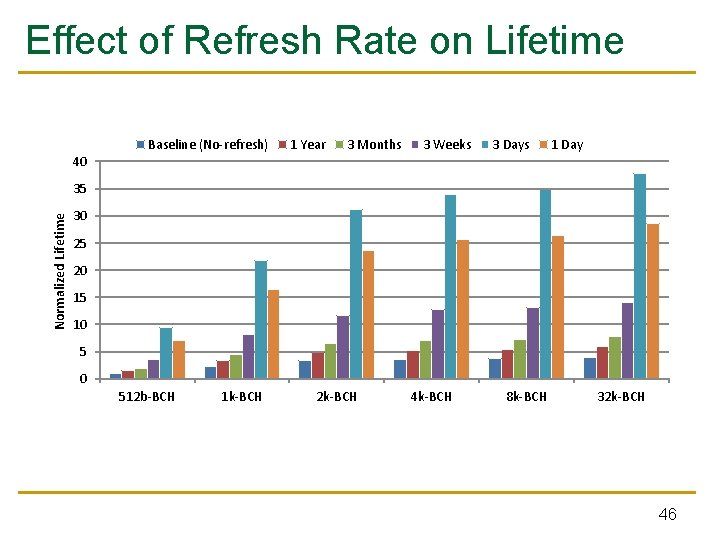
Effect of Refresh Rate on Lifetime 40 Baseline (No-refresh) 1 Year 3 Months 3 Weeks 3 Days 1 Day Normalized Lifetime 35 30 25 20 15 10 5 0 512 b-BCH 1 k-BCH 2 k-BCH 4 k-BCH 8 k-BCH 32 k-BCH 46
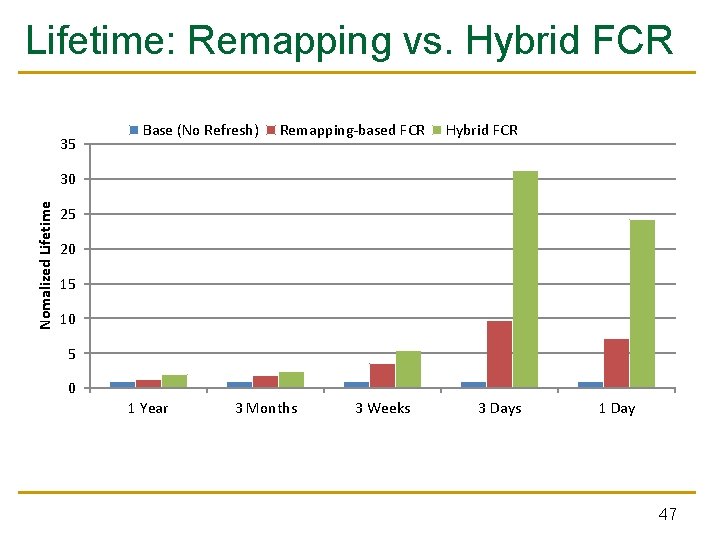
Lifetime: Remapping vs. Hybrid FCR 35 Base (No Refresh) Remapping-based FCR Hybrid FCR Nomalized Lifetime 30 25 20 15 10 5 0 1 Year 3 Months 3 Weeks 3 Days 1 Day 47
Energy Overhead Remapping-based FCR Hybrid FCR 7. 8% 0. 08 Energy Overhead 0. 07 0. 06 5. 5% 0. 05 0. 04 2. 6% 0. 03 1. 8% 0. 02 0. 37% 0. 26% 0. 01 0 1 Year 3 Months 3 Weeks Refresh Interval 3 Days 1 Day 48
Average Lifetime Improvement (normalized No Refresh) 50 46 x 45 40 35 31 x 30 25 20 9. 7 x 15 10 5 0 Base (no-refresh) Remapping-based FCR Hybrid FCR Adaptive FCR 49
Individual Workloads: Remapping-Based FCR 50
Individual Workloads: Hybrid FCR 51
Individual Workloads: Adaptive-Rate FCR 52
P/E Cycle Overhead n n P/E cycle overhead of hybrid FCR is lower than that of remapping-based FCR P/E cycle overhead for write-intensive applications is low q n Remapping-based FCR (20%), Hybrid FCR (2%) Read-intensive applications have higher P/E cycle overhead 53
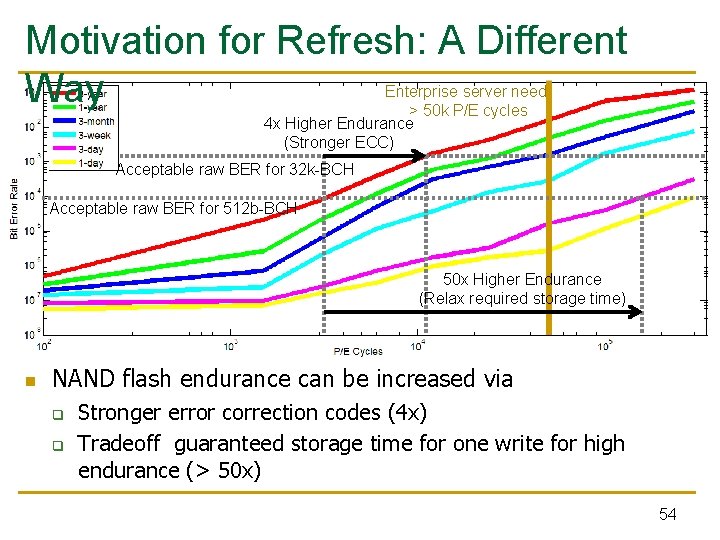
Motivation for Refresh: A Different Way Enterprise server need > 50 k P/E cycles 4 x Higher Endurance (Stronger ECC) Acceptable raw BER for 32 k-BCH Acceptable raw BER for 512 b-BCH 50 x Higher Endurance (Relax required storage time) n NAND flash endurance can be increased via q q Stronger error correction codes (4 x) Tradeoff guaranteed storage time for one write for high endurance (> 50 x) 54
FTL Implementation q FCR can be implemented just as a module in FTL software 55
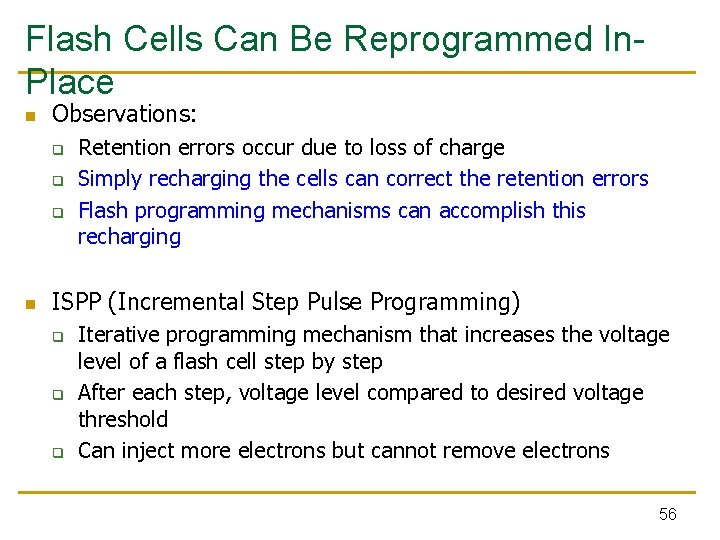
Flash Cells Can Be Reprogrammed In. Place n Observations: q q q n Retention errors occur due to loss of charge Simply recharging the cells can correct the retention errors Flash programming mechanisms can accomplish this recharging ISPP (Incremental Step Pulse Programming) q q q Iterative programming mechanism that increases the voltage level of a flash cell step by step After each step, voltage level compared to desired voltage threshold Can inject more electrons but cannot remove electrons 56