
Flammable Combustible Liquids Bureau of Workers Compensation PA
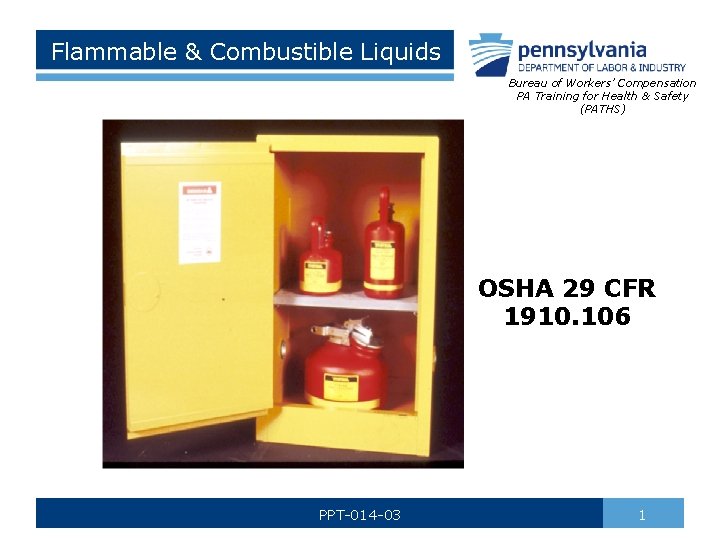
Flammable & Combustible Liquids Bureau of Workers’ Compensation PA Training for Health & Safety (PATHS) OSHA 29 CFR 1910. 106 PPT-014 -03 1
Topics § Important Definitions § Class of Flammable & Combustible Liquids § Components of a Good Plan for Safe Use § Sources of Ignition § Static Electricity, Grounding, and Bonding § Safe Storage, Use, and Handling PPT-014 -03 2
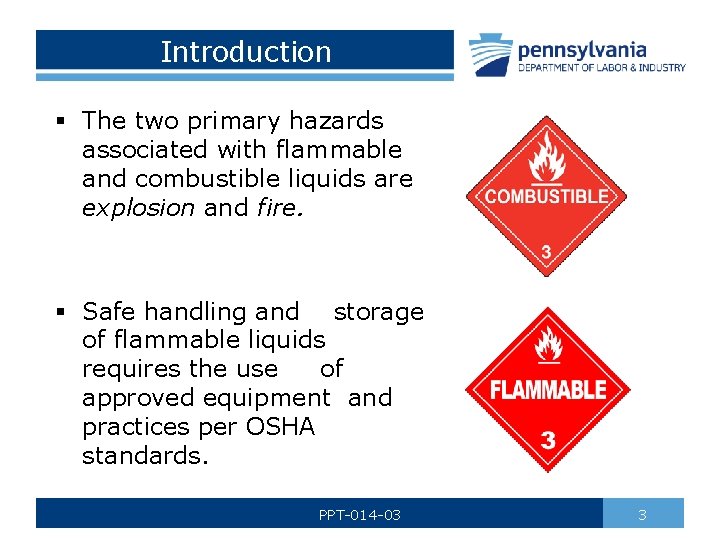
Introduction § The two primary hazards associated with flammable and combustible liquids are explosion and fire. § Safe handling and storage of flammable liquids requires the use of approved equipment and practices per OSHA standards. PPT-014 -03 3
Flash Point & Flammable Liquids § Flash point – the minimum temperature at which a liquid gives off enough vapor to form an ignitable mixture. § In general, the lower the flash point, the greater the hazard. § Flammable liquids have flash points below 100 o. F, and are more dangerous than combustible liquids, since they may be ignited at room temperature PPT-014 -03 4
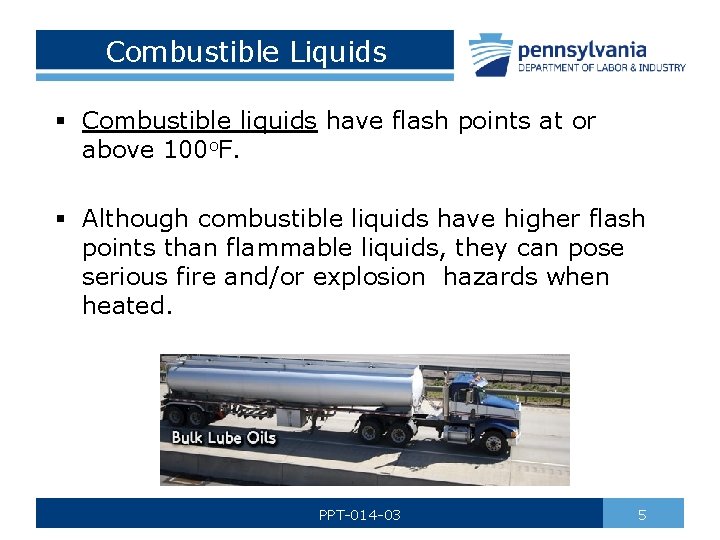
Combustible Liquids § Combustible liquids have flash points at or above 100 o. F. § Although combustible liquids have higher flash points than flammable liquids, they can pose serious fire and/or explosion hazards when heated. PPT-014 -03 5
Definitions § Volatility = tendency or ability of a liquid to vaporize. § Vapor pressure = measure of a liquid’s volatility. A high vapor pressure usually is an indication of a volatile liquid, or one that readily vaporizes. § Boiling point = temperature at which the vapor pressure equals atmospheric pressure, such that the pressure of the atmosphere can no longer hold the liquid in a liquid state and bubbles begin to form. Generally, low boiling point indicates high vapor pressure (possibly, increased fire hazard). § Flashpoint = the least temperature at which vapors are ignited by an ignition source and go out; no sustained combustion. PPT-014 -03 6
Definitions § Flammable range = proportion of vapor to air mixture that is ignitable (expressed in terms of percentage of vapor in air by volume). § Ignition Temperature = A temperature unique to various materials where they will combust due to an open flame source. § Auto ignition temperature = minimum temperature at which a vapor-air mixture will spontaneously ignite, without the necessity of a spark or flame. § Vapor density = measure of a vapor’s weight when compared to air (air assigned value of 1). Denser vapors tend to sink to floor level, less dense vapors tend to rise to ceiling level. PPT-014 -03 7
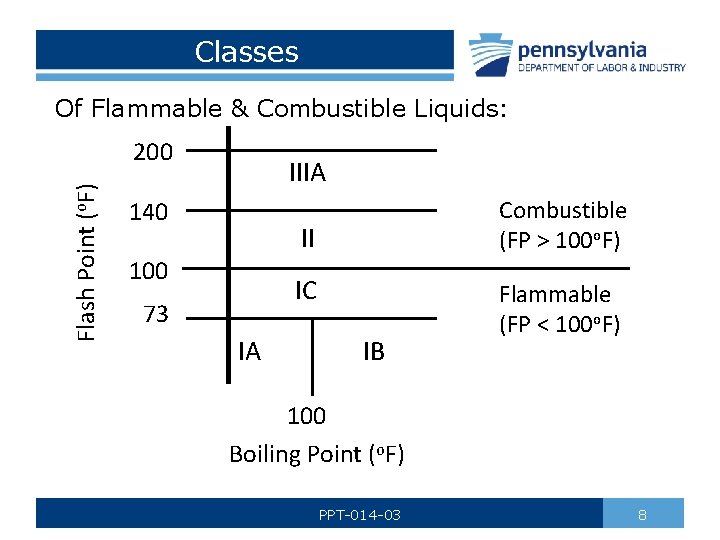
Classes Of Flammable & Combustible Liquids: Flash Point (o. F) 200 IIIA 140 Combustible (FP > 100 o. F) II 100 IC 73 IA IB Flammable (FP < 100 o. F) 100 Boiling Point (o. F) PPT-014 -03 8
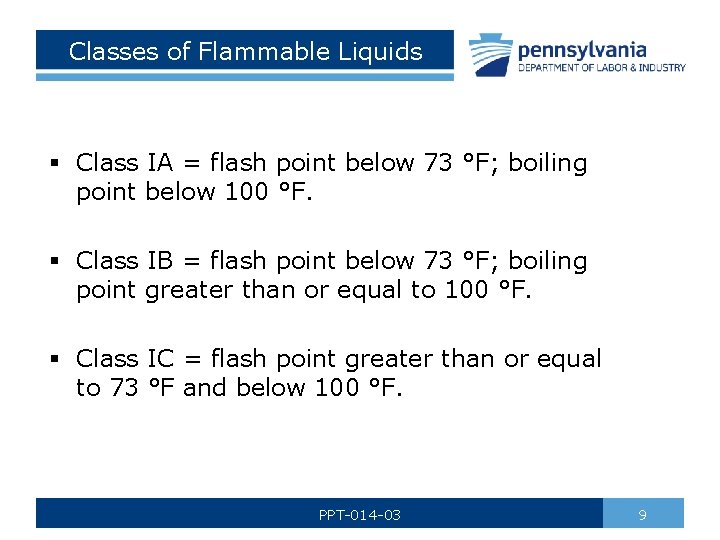
Classes of Flammable Liquids § Class IA = flash point below 73 °F; boiling point below 100 °F. § Class IB = flash point below 73 °F; boiling point greater than or equal to 100 °F. § Class IC = flash point greater than or equal to 73 °F and below 100 °F. PPT-014 -03 9
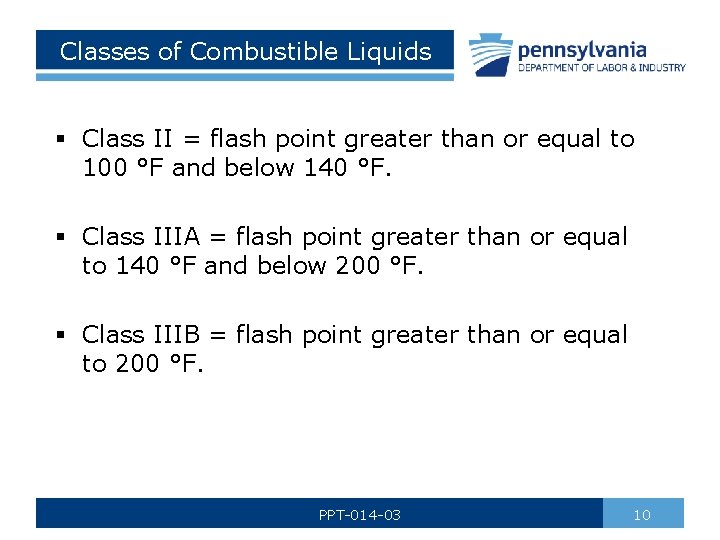
Classes of Combustible Liquids § Class II = flash point greater than or equal to 100 °F and below 140 °F. § Class IIIA = flash point greater than or equal to 140 °F and below 200 °F. § Class IIIB = flash point greater than or equal to 200 °F. PPT-014 -03 10
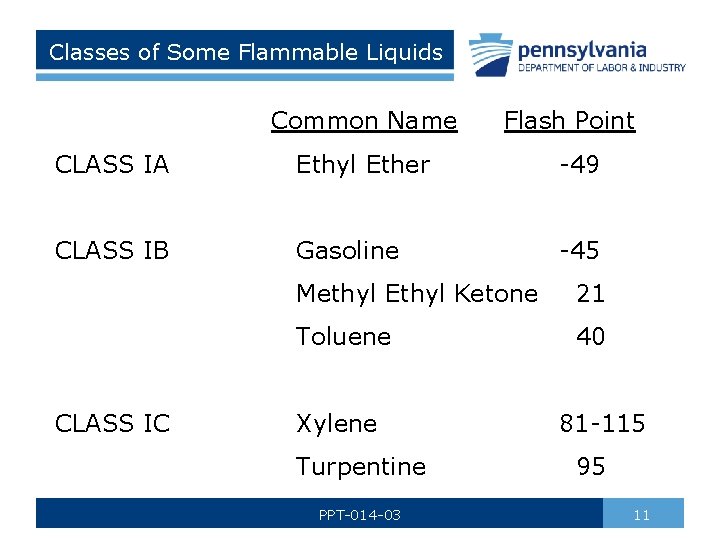
Classes of Some Flammable Liquids Common Name Flash Point CLASS IA Ethyl Ether -49 CLASS IB Gasoline -45 CLASS IC Methyl Ethyl Ketone 21 Toluene 40 Xylene Turpentine PPT-014 -03 81 -115 95 11
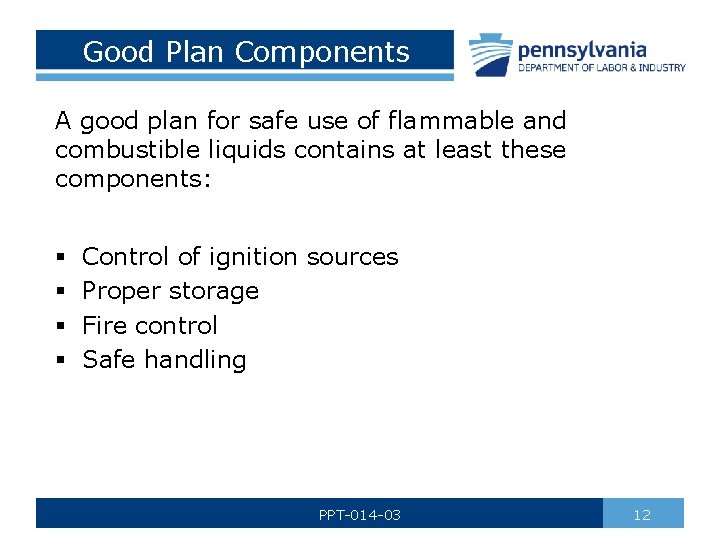
Good Plan Components A good plan for safe use of flammable and combustible liquids contains at least these components: § § Control of ignition sources Proper storage Fire control Safe handling PPT-014 -03 12
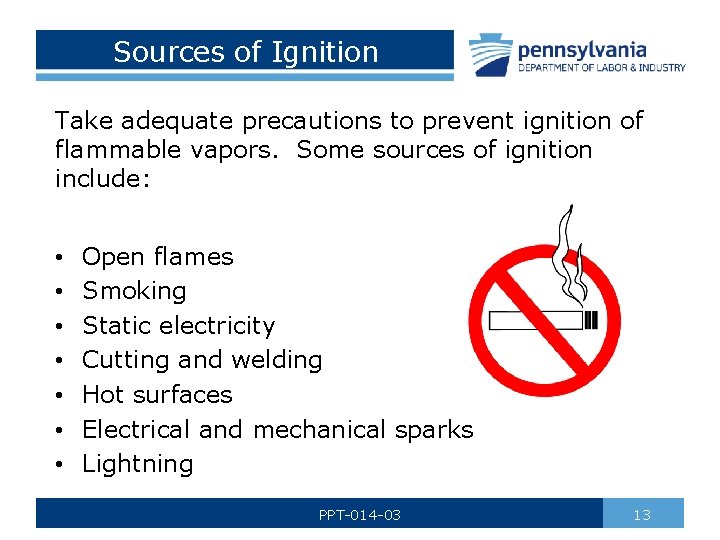
Sources of Ignition Take adequate precautions to prevent ignition of flammable vapors. Some sources of ignition include: • • Open flames Smoking Static electricity Cutting and welding Hot surfaces Electrical and mechanical sparks Lightning PPT-014 -03 13
Static Electricity • Generated when a fluid flows through a pipe or from an opening into a tank. • Main hazards are fire and explosion from sparks containing enough energy to ignite flammable vapors. • Bonding or grounding of flammable liquid containers is necessary to prevent static electricity from causing a spark. PPT-014 -03 14
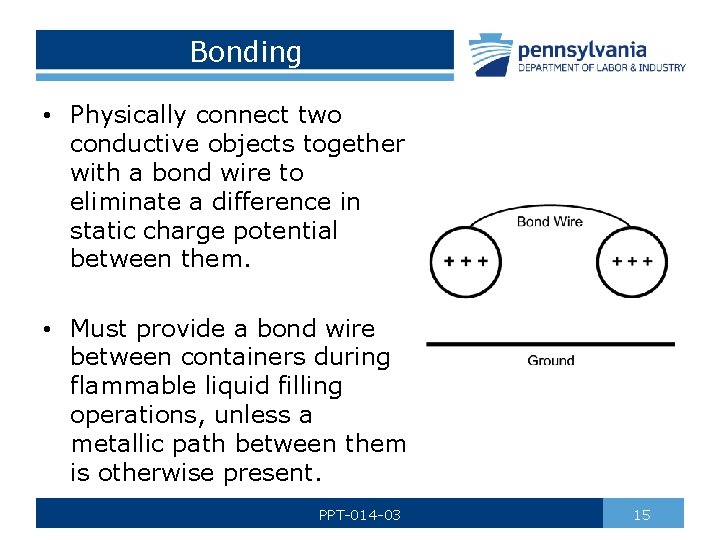
Bonding • Physically connect two conductive objects together with a bond wire to eliminate a difference in static charge potential between them. • Must provide a bond wire between containers during flammable liquid filling operations, unless a metallic path between them is otherwise present. PPT-014 -03 15
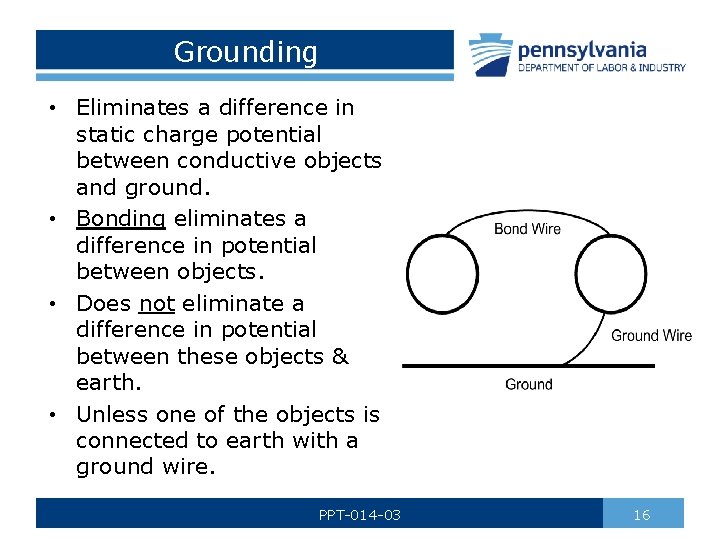
Grounding • Eliminates a difference in static charge potential between conductive objects and ground. • Bonding eliminates a difference in potential between objects. • Does not eliminate a difference in potential between these objects & earth. • Unless one of the objects is connected to earth with a ground wire. PPT-014 -03 16
Ventilation Always provide adequate ventilation to reduce the potential for ignition of flammable vapors. PPT-014 -03 17
Storage Fundamentals • Identify incompatible chemicals – check the Safety Data Sheet (SDS). • Isolate and separate incompatible materials: o Isolate by storing in another area or room. o Degree of isolation depends on quantities, chemical properties and packaging. o Separate by storing in same area or room, but apart from each other. PPT-014 -03 18
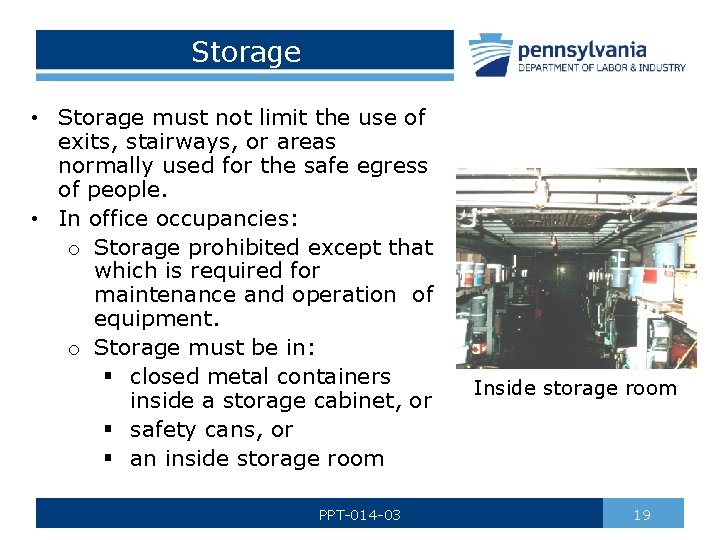
Storage • Storage must not limit the use of exits, stairways, or areas normally used for the safe egress of people. • In office occupancies: o Storage prohibited except that which is required for maintenance and operation of equipment. o Storage must be in: § closed metal containers inside a storage cabinet, or § safety cans, or § an inside storage room PPT-014 -03 Inside storage room 19
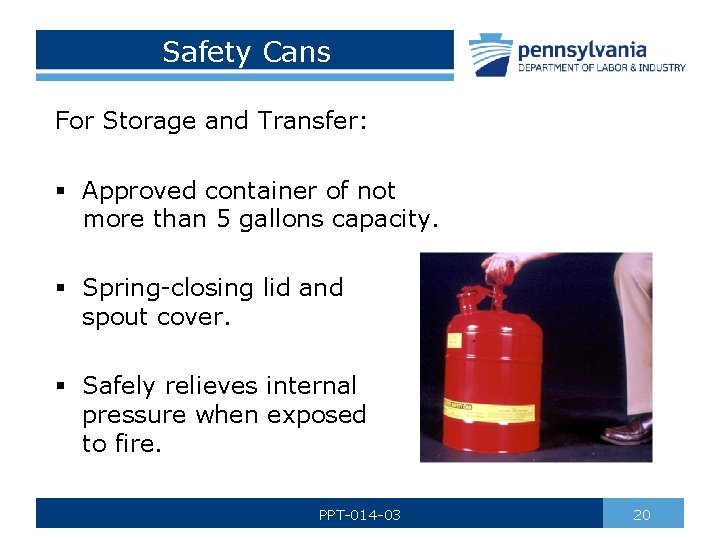
Safety Cans For Storage and Transfer: § Approved container of not more than 5 gallons capacity. § Spring-closing lid and spout cover. § Safely relieves internal pressure when exposed to fire. PPT-014 -03 20
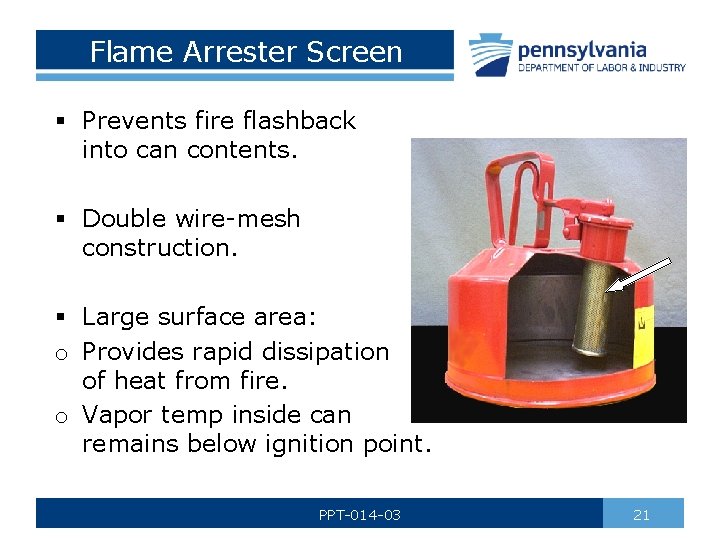
Flame Arrester Screen § Prevents fire flashback into can contents. § Double wire-mesh construction. § Large surface area: o Provides rapid dissipation of heat from fire. o Vapor temp inside can remains below ignition point. PPT-014 -03 21
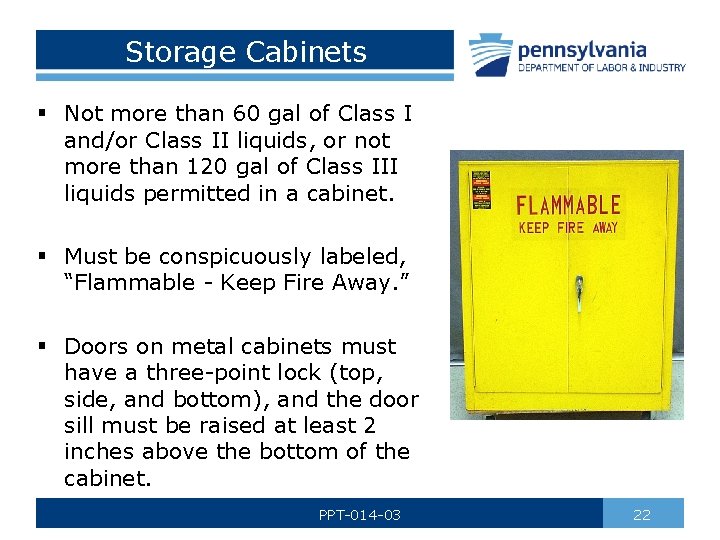
Storage Cabinets § Not more than 60 gal of Class I and/or Class II liquids, or not more than 120 gal of Class III liquids permitted in a cabinet. § Must be conspicuously labeled, “Flammable - Keep Fire Away. ” § Doors on metal cabinets must have a three-point lock (top, side, and bottom), and the door sill must be raised at least 2 inches above the bottom of the cabinet. PPT-014 -03 22
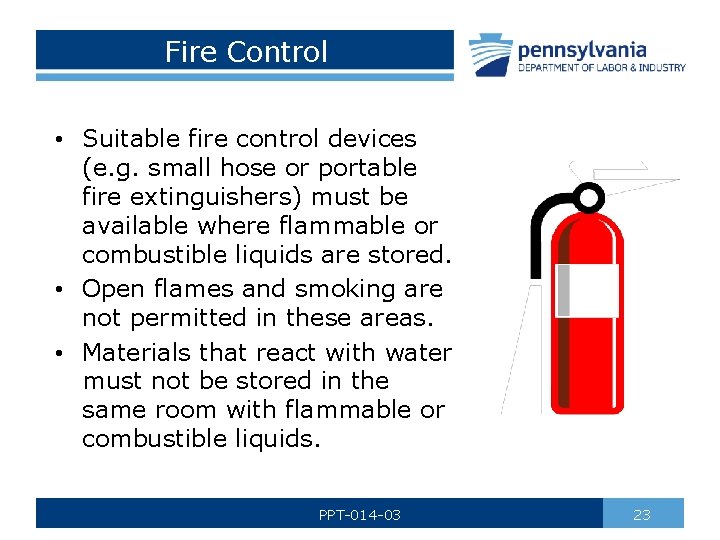
Fire Control • Suitable fire control devices (e. g. small hose or portable fire extinguishers) must be available where flammable or combustible liquids are stored. • Open flames and smoking are not permitted in these areas. • Materials that react with water must not be stored in the same room with flammable or combustible liquids. PPT-014 -03 23
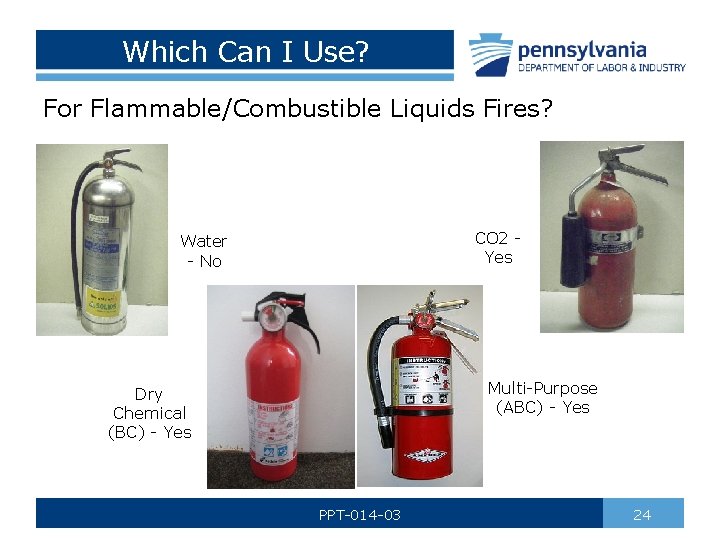
Which Can I Use? For Flammable/Combustible Liquids Fires? CO 2 Yes Water - No Multi-Purpose (ABC) - Yes Dry Chemical (BC) - Yes PPT-014 -03 24
Transferring Flammable Liquids Sizeable risk whenever flammable liquids are handled, OSHA allows only four methods for transferring: Through a closed piping system. From safety cans. By gravity through an approved self-closing safety faucet. By means of a safety pump. PPT-014 -03 25
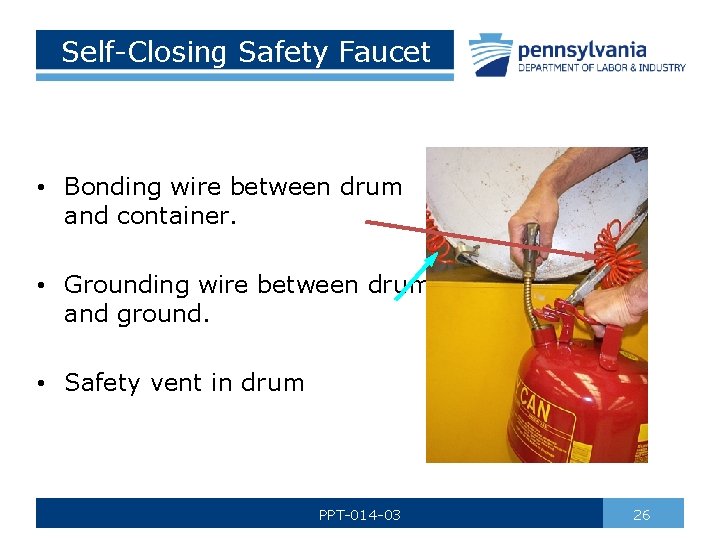
Self-Closing Safety Faucet • Bonding wire between drum and container. • Grounding wire between drum and ground. • Safety vent in drum PPT-014 -03 26
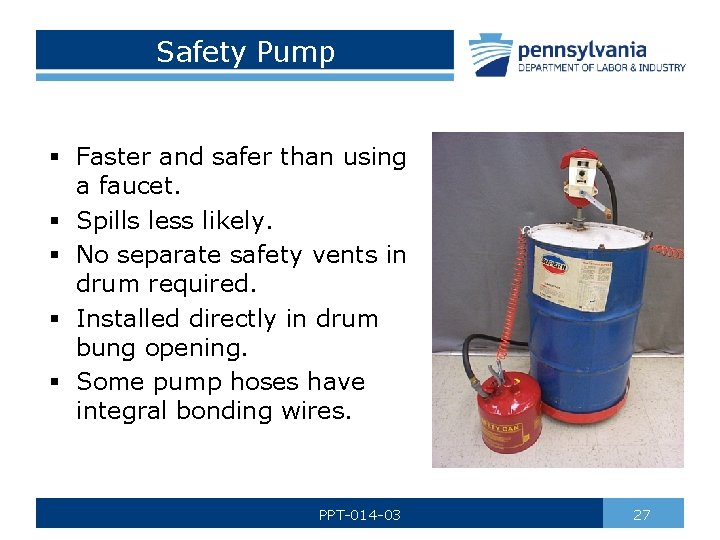
Safety Pump § Faster and safer than using a faucet. § Spills less likely. § No separate safety vents in drum required. § Installed directly in drum bung opening. § Some pump hoses have integral bonding wires. PPT-014 -03 27
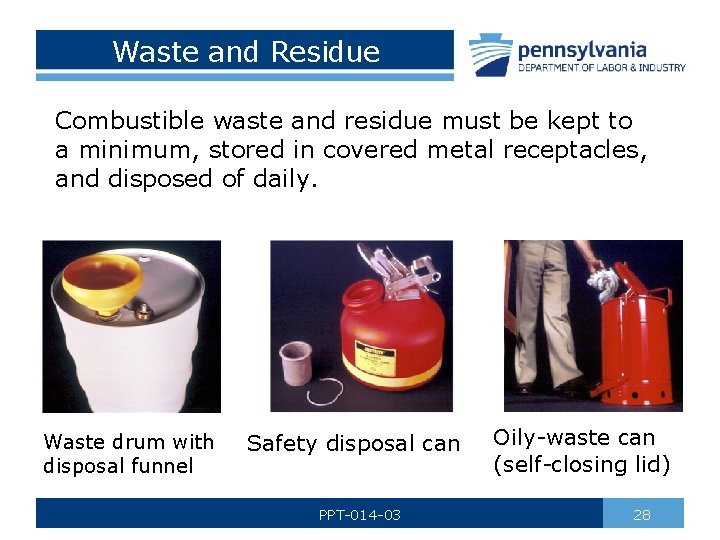
Waste and Residue Combustible waste and residue must be kept to a minimum, stored in covered metal receptacles, and disposed of daily. Waste drum with disposal funnel Safety disposal can PPT-014 -03 Oily-waste can (self-closing lid) 28
Safe Handling Fundamentals For Flammable Liquids: § Carefully read the manufacturer’s label on the container before using or storing it. § Practice good housekeeping in flammable liquid storage areas. § Clean up spills immediately, then place the rags used in a covered metal container. § Only use approved metal safety containers or original manufacturer’s container to store flammable liquids PPT-014 -03 29
Safe Handling Fundamentals For Flammable Liquids: § Keep the containers closed when not in use and store away from exits or passageways. § Use flammable liquids only where there is plenty of ventilation. § Keep flammable liquids away from ignition sources such as open flames, sparks, smoking, cutting, welding, etc. PPT-014 -03 30
Summary § The two primary hazards associated with flammable and combustible liquids are explosion and fire. § Safe handling and storage of flammable liquids requires the use of approved equipment and practices per OSHA standards. § An excellent reference on this topic is National Fire Protection Association Standard No. 30, Flammable and Combustible Liquids Code. PPT-014 -03 31
Contact Information Health & Safety Training Specialists 1171 South Cameron Street, Room 324 Harrisburg, PA 17104 -2501 (717) 772 -1635 RA-LI-BWC-PATHS@pa. gov Like us on Facebook! https: //www. facebook. com/BWCPATHS PPT-014 -03 32
Questions PPT-014 -03 33
- Slides: 33