
FLAMMABILITY TEST METHOD AND CRITERIA FOR AIRCRAFT ELECTRICAL
FLAMMABILITY TEST METHOD AND CRITERIA FOR AIRCRAFT ELECTRICAL WIRING Presented to: Fire Safety Team Management By: John Reinhardt, Project Manager, PMP Date: October, 2009 Location: WJH FAA Technical Center Federal Aviation Administration
Outline • Scope • Definitions • Test Apparatus • Test Specimens • Conditioning • Test Procedure • Report • Requirements Flammability Test Method And Criteria For Aircraft Electrical Wiring Federal Aviation Administration 2 of 67 2
Outline • Scope • Definitions • Test Apparatus • Test Specimens • Conditioning • Test Procedure • Report • Requirements Flammability Test Method And Criteria For Aircraft Electrical Wiring Federal Aviation Administration 3 of 67 3

Scope 1. SCOPE This test method is intended for use in determining the flammability characteristics of aircraft electric wire insulation, and materials used to provide additional protection to wires and cables, and comply with FAR 25. 1713. Flammability Test Method And Criteria For Aircraft Electrical Wiring Federal Aviation Administration 4 of 67 4
Outline • Scope • Definitions • Test Apparatus • Test Specimens • Conditioning • Test Procedure • Report • Requirements Flammability Test Method And Criteria For Aircraft Electrical Wiring Federal Aviation Administration 5 of 67 5
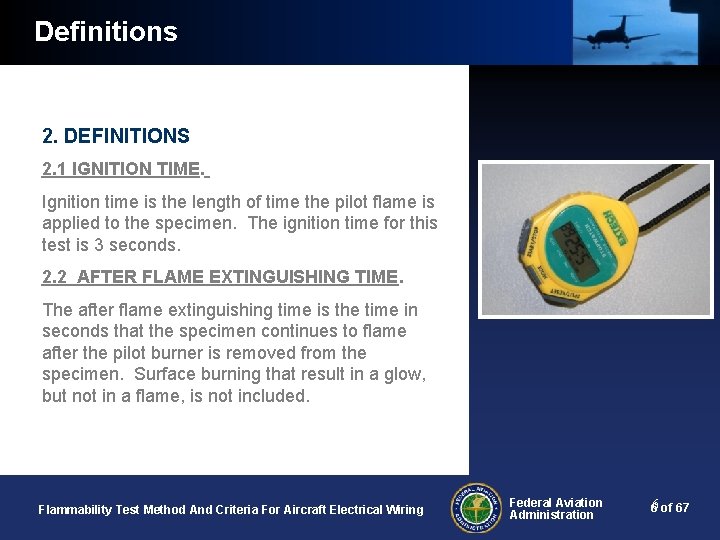
Definitions 2. DEFINITIONS 2. 1 IGNITION TIME. Ignition time is the length of time the pilot flame is applied to the specimen. The ignition time for this test is 3 seconds. 2. 2 AFTER FLAME EXTINGUISHING TIME. The after flame extinguishing time is the time in seconds that the specimen continues to flame after the pilot burner is removed from the specimen. Surface burning that result in a glow, but not in a flame, is not included. Flammability Test Method And Criteria For Aircraft Electrical Wiring Federal Aviation Administration 6 of 67 6
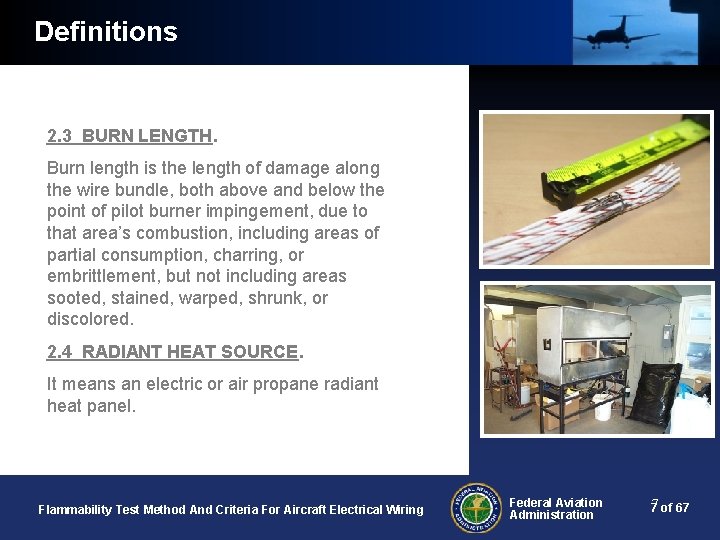
Definitions 2. 3 BURN LENGTH. Burn length is the length of damage along the wire bundle, both above and below the point of pilot burner impingement, due to that area’s combustion, including areas of partial consumption, charring, or embrittlement, but not including areas sooted, stained, warped, shrunk, or discolored. 2. 4 RADIANT HEAT SOURCE. It means an electric or air propane radiant heat panel. Flammability Test Method And Criteria For Aircraft Electrical Wiring Federal Aviation Administration 7 of 67 7
Outline • Scope • Definitions • Test Apparatus • Test Specimens • Conditioning • Test Procedure • Report • Requirements Flammability Test Method And Criteria For Aircraft Electrical Wiring Federal Aviation Administration 8 of 67 8
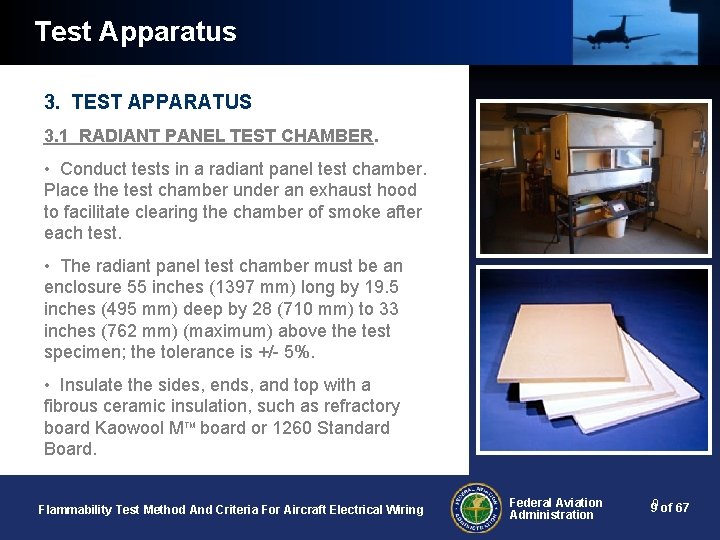
Test Apparatus 3. TEST APPARATUS 3. 1 RADIANT PANEL TEST CHAMBER. • Conduct tests in a radiant panel test chamber. Place the test chamber under an exhaust hood to facilitate clearing the chamber of smoke after each test. • The radiant panel test chamber must be an enclosure 55 inches (1397 mm) long by 19. 5 inches (495 mm) deep by 28 (710 mm) to 33 inches (762 mm) (maximum) above the test specimen; the tolerance is +/- 5%. • Insulate the sides, ends, and top with a fibrous ceramic insulation, such as refractory board Kaowool MTM board or 1260 Standard Board. Flammability Test Method And Criteria For Aircraft Electrical Wiring Federal Aviation Administration 9 of 67 9
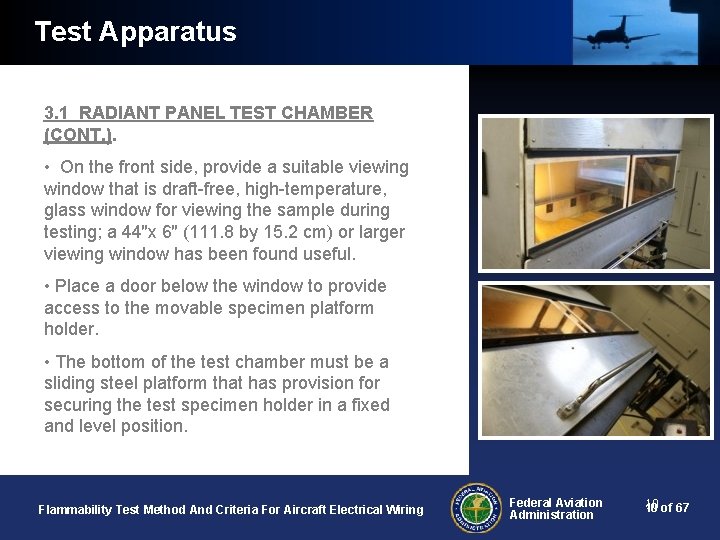
Test Apparatus 3. 1 RADIANT PANEL TEST CHAMBER (CONT. ). • On the front side, provide a suitable viewing window that is draft-free, high-temperature, glass window for viewing the sample during testing; a 44″x 6″ (111. 8 by 15. 2 cm) or larger viewing window has been found useful. • Place a door below the window to provide access to the movable specimen platform holder. • The bottom of the test chamber must be a sliding steel platform that has provision for securing the test specimen holder in a fixed and level position. Flammability Test Method And Criteria For Aircraft Electrical Wiring Federal Aviation Administration 10 of 67 10
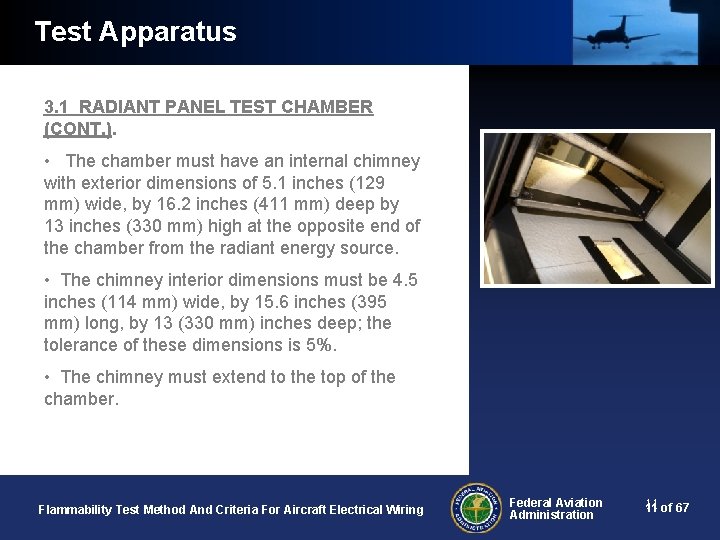
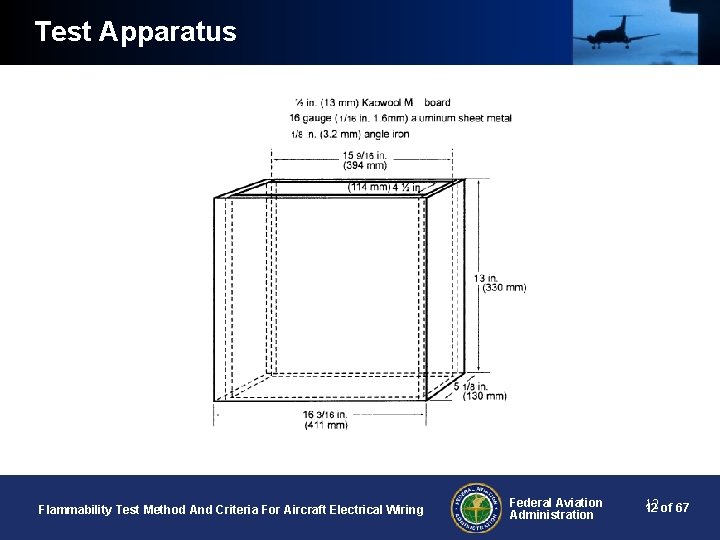
Test Apparatus 3. 1 RADIANT PANEL TEST CHAMBER (CONT. ). • The chamber must have an internal chimney with exterior dimensions of 5. 1 inches (129 mm) wide, by 16. 2 inches (411 mm) deep by 13 inches (330 mm) high at the opposite end of the chamber from the radiant energy source. • The chimney interior dimensions must be 4. 5 inches (114 mm) wide, by 15. 6 inches (395 mm) long, by 13 (330 mm) inches deep; the tolerance of these dimensions is 5%. • The chimney must extend to the top of the chamber. Flammability Test Method And Criteria For Aircraft Electrical Wiring Federal Aviation Administration 11 of 67 11
Test Apparatus Flammability Test Method And Criteria For Aircraft Electrical Wiring Federal Aviation Administration 12 of 67 12
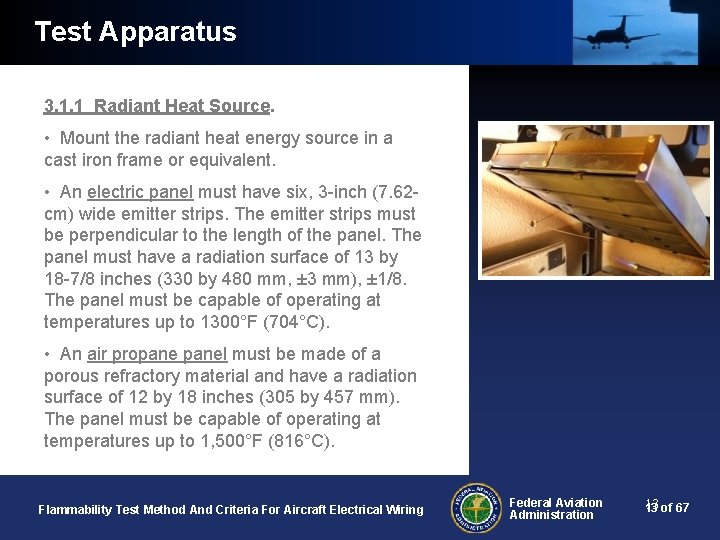
Test Apparatus 3. 1. 1 Radiant Heat Source. • Mount the radiant heat energy source in a cast iron frame or equivalent. • An electric panel must have six, 3 -inch (7. 62 cm) wide emitter strips. The emitter strips must be perpendicular to the length of the panel. The panel must have a radiation surface of 13 by 18 -7/8 inches (330 by 480 mm, ± 3 mm), ± 1/8. The panel must be capable of operating at temperatures up to 1300°F (704°C). • An air propanel must be made of a porous refractory material and have a radiation surface of 12 by 18 inches (305 by 457 mm). The panel must be capable of operating at temperatures up to 1, 500°F (816°C). Flammability Test Method And Criteria For Aircraft Electrical Wiring Federal Aviation Administration 13 of 67 13
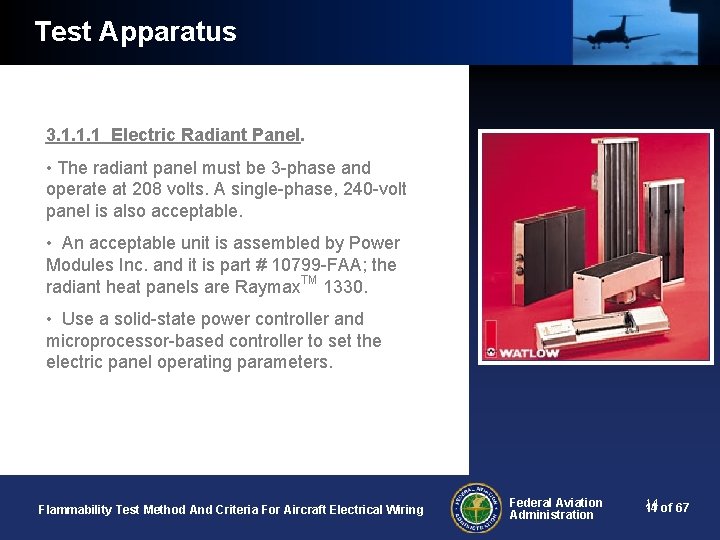
Test Apparatus 3. 1. 1. 1 Electric Radiant Panel. • The radiant panel must be 3 -phase and operate at 208 volts. A single-phase, 240 -volt panel is also acceptable. • An acceptable unit is assembled by Power Modules Inc. and it is part # 10799 -FAA; the radiant heat panels are Raymax. TM 1330. • Use a solid-state power controller and microprocessor-based controller to set the electric panel operating parameters. Flammability Test Method And Criteria For Aircraft Electrical Wiring Federal Aviation Administration 14 of 67 14
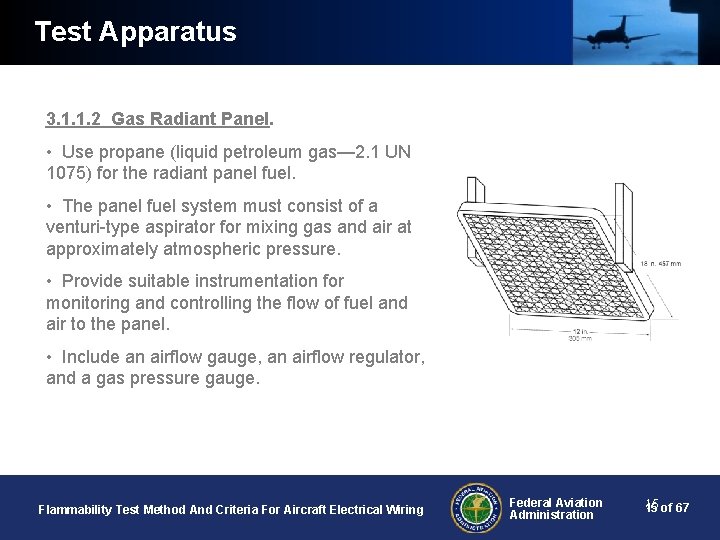
Test Apparatus 3. 1. 1. 2 Gas Radiant Panel. • Use propane (liquid petroleum gas— 2. 1 UN 1075) for the radiant panel fuel. • The panel fuel system must consist of a venturi-type aspirator for mixing gas and air at approximately atmospheric pressure. • Provide suitable instrumentation for monitoring and controlling the flow of fuel and air to the panel. • Include an airflow gauge, an airflow regulator, and a gas pressure gauge. Flammability Test Method And Criteria For Aircraft Electrical Wiring Federal Aviation Administration 15 of 67 15
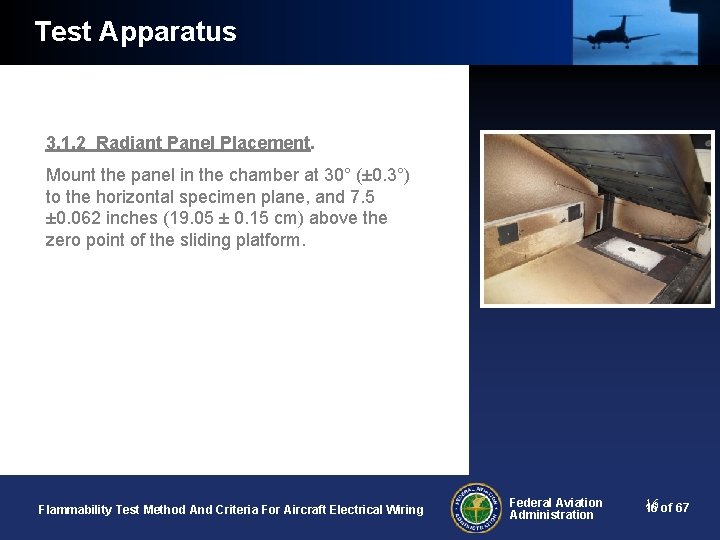
Test Apparatus 3. 1. 2 Radiant Panel Placement. Mount the panel in the chamber at 30° (± 0. 3°) to the horizontal specimen plane, and 7. 5 ± 0. 062 inches (19. 05 ± 0. 15 cm) above the zero point of the sliding platform. Flammability Test Method And Criteria For Aircraft Electrical Wiring Federal Aviation Administration 16 of 67 16
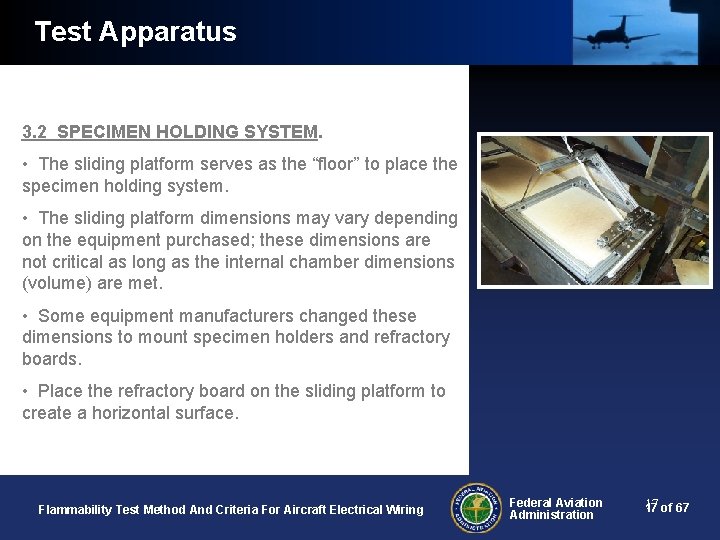
Test Apparatus 3. 2 SPECIMEN HOLDING SYSTEM. • The sliding platform serves as the “floor” to place the specimen holding system. • The sliding platform dimensions may vary depending on the equipment purchased; these dimensions are not critical as long as the internal chamber dimensions (volume) are met. • Some equipment manufacturers changed these dimensions to mount specimen holders and refractory boards. • Place the refractory board on the sliding platform to create a horizontal surface. Flammability Test Method And Criteria For Aircraft Electrical Wiring Federal Aviation Administration 17 of 67 17
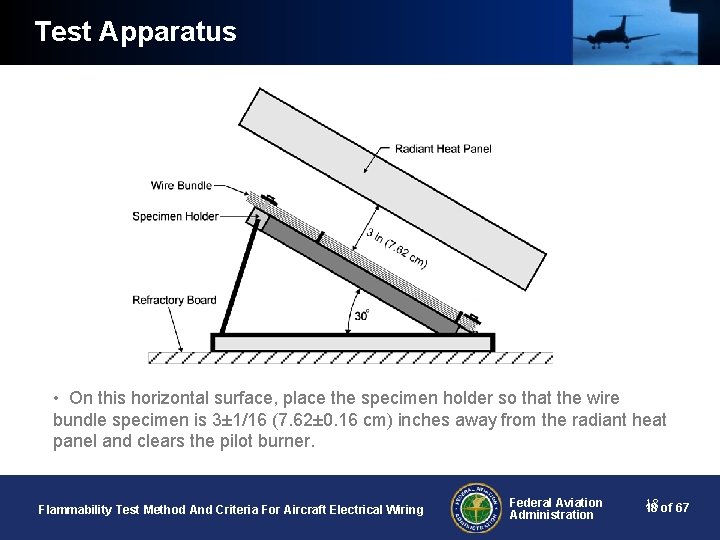
Test Apparatus • On this horizontal surface, place the specimen holder so that the wire bundle specimen is 3± 1/16 (7. 62± 0. 16 cm) inches away from the radiant heat panel and clears the pilot burner. Flammability Test Method And Criteria For Aircraft Electrical Wiring Federal Aviation Administration 18 of 67 18
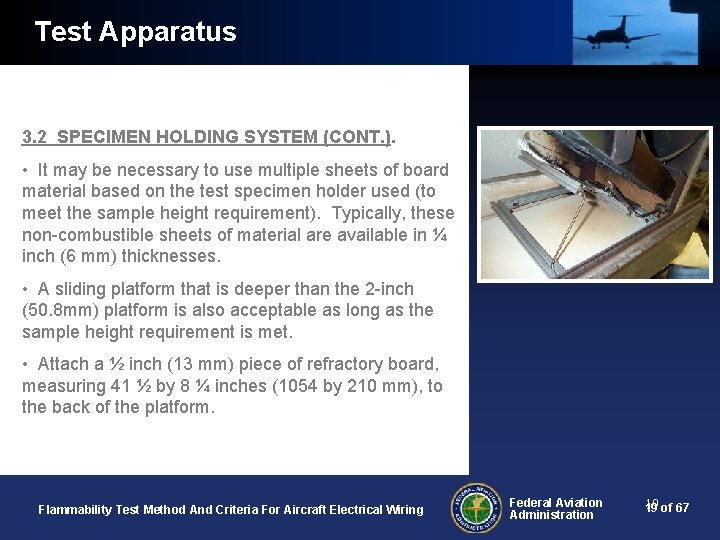
Test Apparatus 3. 2 SPECIMEN HOLDING SYSTEM (CONT. ). • It may be necessary to use multiple sheets of board material based on the test specimen holder used (to meet the sample height requirement). Typically, these non-combustible sheets of material are available in ¼ inch (6 mm) thicknesses. • A sliding platform that is deeper than the 2 -inch (50. 8 mm) platform is also acceptable as long as the sample height requirement is met. • Attach a ½ inch (13 mm) piece of refractory board, measuring 41 ½ by 8 ¼ inches (1054 by 210 mm), to the back of the platform. Flammability Test Method And Criteria For Aircraft Electrical Wiring Federal Aviation Administration 19 of 67 19
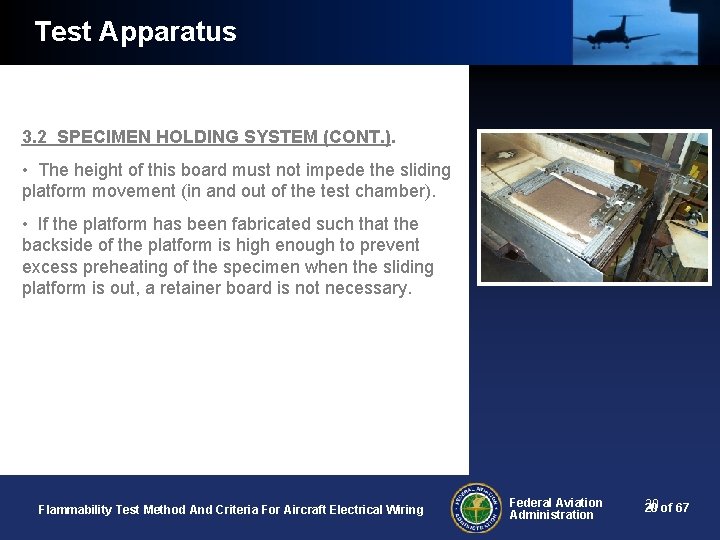
Test Apparatus 3. 2 SPECIMEN HOLDING SYSTEM (CONT. ). • The height of this board must not impede the sliding platform movement (in and out of the test chamber). • If the platform has been fabricated such that the backside of the platform is high enough to prevent excess preheating of the specimen when the sliding platform is out, a retainer board is not necessary. Flammability Test Method And Criteria For Aircraft Electrical Wiring Federal Aviation Administration 20 of 67 20
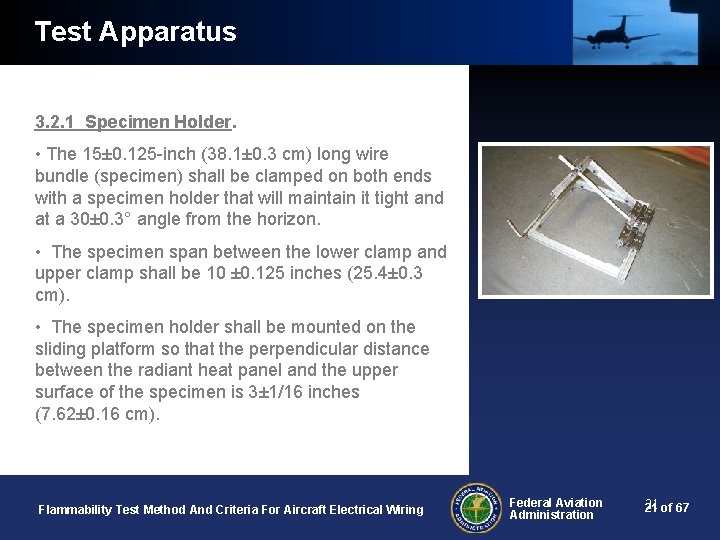
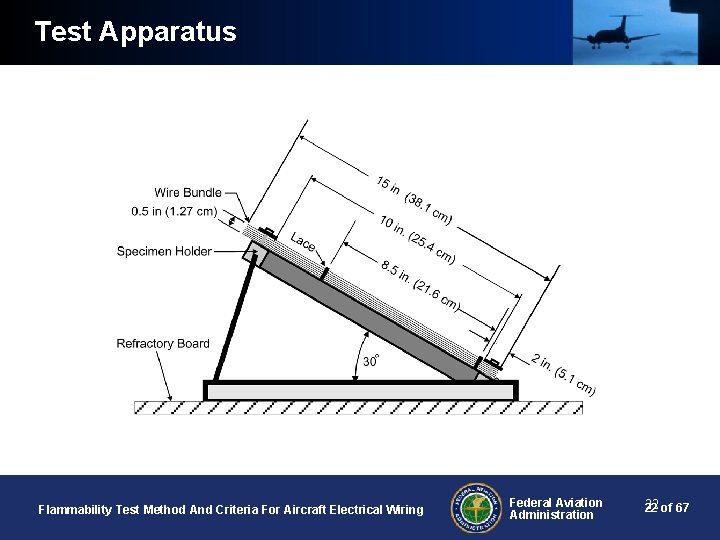
Test Apparatus 3. 2. 1 Specimen Holder. • The 15± 0. 125 -inch (38. 1± 0. 3 cm) long wire bundle (specimen) shall be clamped on both ends with a specimen holder that will maintain it tight and at a 30± 0. 3° angle from the horizon. • The specimen span between the lower clamp and upper clamp shall be 10 ± 0. 125 inches (25. 4± 0. 3 cm). • The specimen holder shall be mounted on the sliding platform so that the perpendicular distance between the radiant heat panel and the upper surface of the specimen is 3± 1/16 inches (7. 62± 0. 16 cm). Flammability Test Method And Criteria For Aircraft Electrical Wiring Federal Aviation Administration 21 of 67 21
Test Apparatus Flammability Test Method And Criteria For Aircraft Electrical Wiring Federal Aviation Administration 22 of 67 22
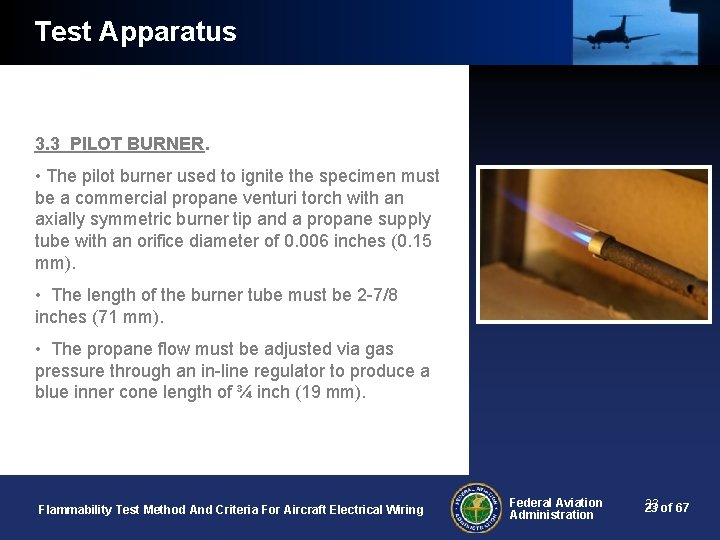
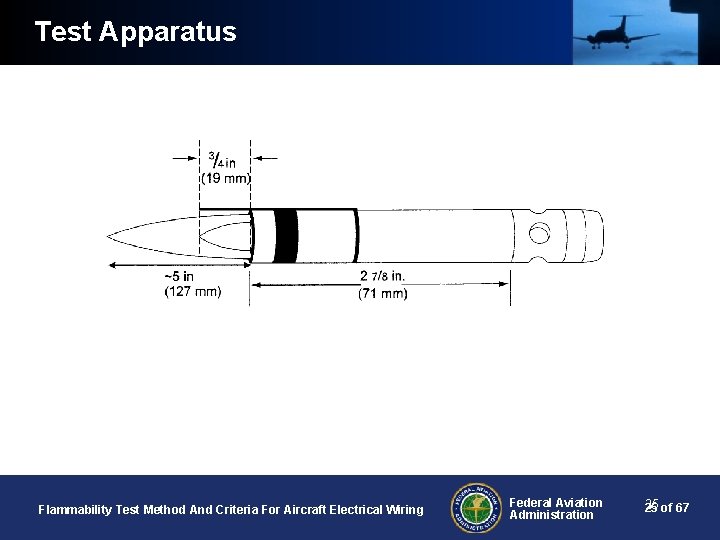
Test Apparatus 3. 3 PILOT BURNER. • The pilot burner used to ignite the specimen must be a commercial propane venturi torch with an axially symmetric burner tip and a propane supply tube with an orifice diameter of 0. 006 inches (0. 15 mm). • The length of the burner tube must be 2 -7/8 inches (71 mm). • The propane flow must be adjusted via gas pressure through an in-line regulator to produce a blue inner cone length of ¾ inch (19 mm). Flammability Test Method And Criteria For Aircraft Electrical Wiring Federal Aviation Administration 23 of 67 23
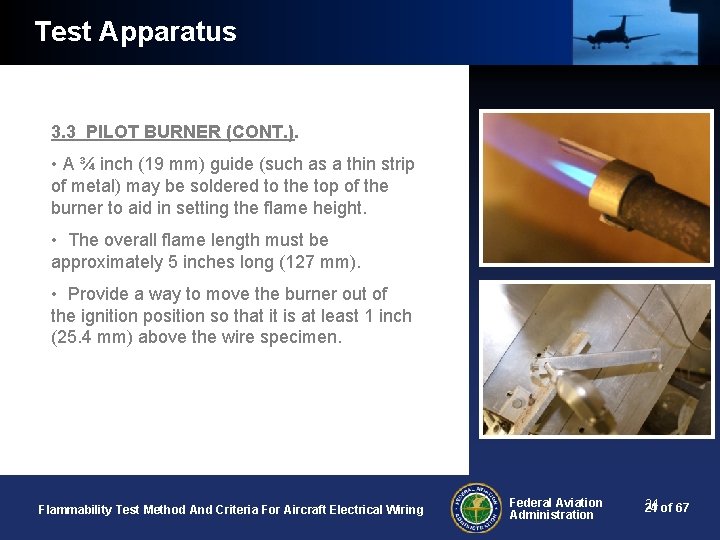
Test Apparatus 3. 3 PILOT BURNER (CONT. ). • A ¾ inch (19 mm) guide (such as a thin strip of metal) may be soldered to the top of the burner to aid in setting the flame height. • The overall flame length must be approximately 5 inches long (127 mm). • Provide a way to move the burner out of the ignition position so that it is at least 1 inch (25. 4 mm) above the wire specimen. Flammability Test Method And Criteria For Aircraft Electrical Wiring Federal Aviation Administration 24 of 67 24
Test Apparatus Flammability Test Method And Criteria For Aircraft Electrical Wiring Federal Aviation Administration 25 of 67 25
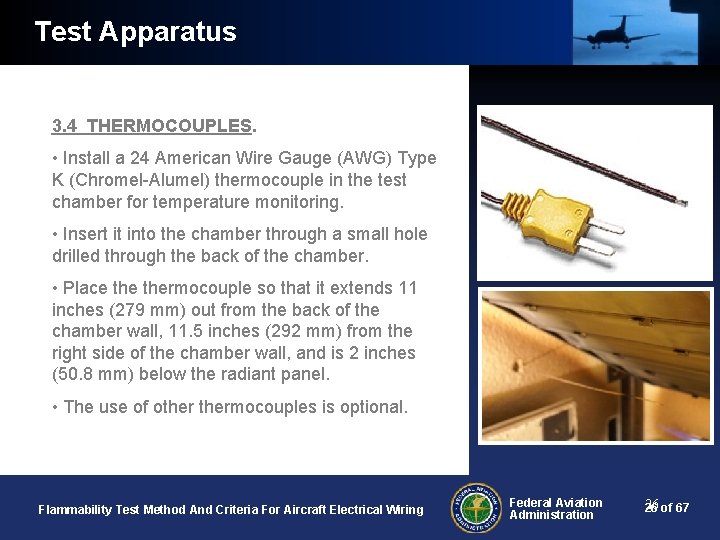
Test Apparatus 3. 4 THERMOCOUPLES. • Install a 24 American Wire Gauge (AWG) Type K (Chromel-Alumel) thermocouple in the test chamber for temperature monitoring. • Insert it into the chamber through a small hole drilled through the back of the chamber. • Place thermocouple so that it extends 11 inches (279 mm) out from the back of the chamber wall, 11. 5 inches (292 mm) from the right side of the chamber wall, and is 2 inches (50. 8 mm) below the radiant panel. • The use of othermocouples is optional. Flammability Test Method And Criteria For Aircraft Electrical Wiring Federal Aviation Administration 26 of 67 26
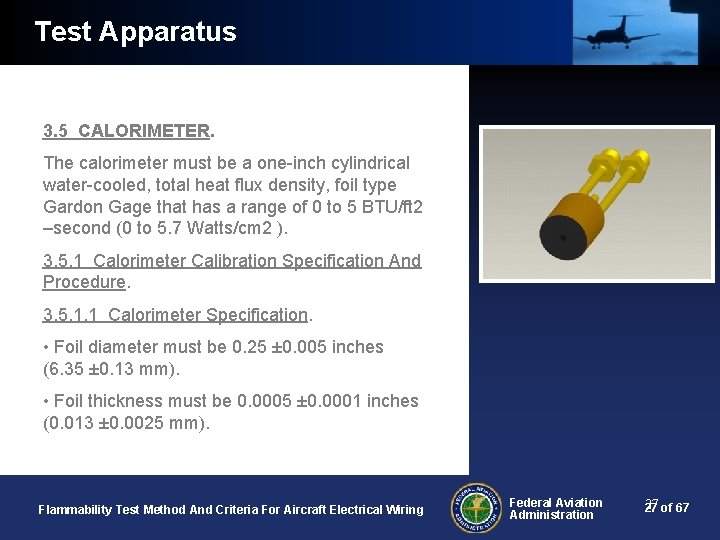
Test Apparatus 3. 5 CALORIMETER. The calorimeter must be a one-inch cylindrical water-cooled, total heat flux density, foil type Gardon Gage that has a range of 0 to 5 BTU/ft 2 –second (0 to 5. 7 Watts/cm 2 ). 3. 5. 1 Calorimeter Calibration Specification And Procedure. 3. 5. 1. 1 Calorimeter Specification. • Foil diameter must be 0. 25 ± 0. 005 inches (6. 35 ± 0. 13 mm). • Foil thickness must be 0. 0005 ± 0. 0001 inches (0. 013 ± 0. 0025 mm). Flammability Test Method And Criteria For Aircraft Electrical Wiring Federal Aviation Administration 27 of 67 27
Test Apparatus 3. 5. 1. 1 Calorimeter Specification. • Foil diameter must be 0. 25 ± 0. 005 inches (6. 35 ± 0. 13 mm). • Foil thickness must be 0. 0005 ± 0. 0001 inches (0. 013 ± 0. 0025 mm). • Foil material must be thermocouple grade constantan. • Temperature measurement must be a copper constantan thermocouple. • The copper center wire diameter must be 0. 0005 inches (0. 013 mm). • The entire face of the calorimeter must be lightly coated with “Black Velvet” paint having an emissivity of 96 or greater. Flammability Test Method And Criteria For Aircraft Electrical Wiring Federal Aviation Administration 28 of 67 28
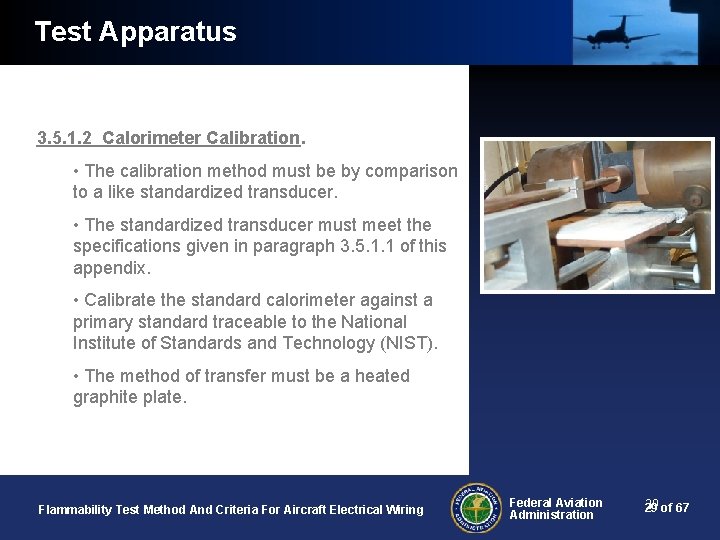
Test Apparatus 3. 5. 1. 2 Calorimeter Calibration. • The calibration method must be by comparison to a like standardized transducer. • The standardized transducer must meet the specifications given in paragraph 3. 5. 1. 1 of this appendix. • Calibrate the standard calorimeter against a primary standard traceable to the National Institute of Standards and Technology (NIST). • The method of transfer must be a heated graphite plate. Flammability Test Method And Criteria For Aircraft Electrical Wiring Federal Aviation Administration 29 of 67 29
Test Apparatus 3. 5. 1. 2 Calorimeter Calibration (Cont. ). • The graphite plate must be electrically heated, have a clear surface area on each side of the plate of at least 2 by 2 inches (51 by 50. 8 mm), and be 1/8 inch ± 1/16 inch thick (3. 2 ± 1. 6 mm). • Center the 2 transducers on opposite sides of the plates at equal distances from the plate. • The distance of the calorimeter to the plate must be no less than 0. 0625 inches (1. 6 mm), nor greater than 0. 375 inches (9. 5 mm). • The range used in calibration must be at least 0– 3. 5 BTUs/ft 2 second (0– 3. 9 Watts/cm 2) and no greater than 0– 5. 7 BTUs/ft 2 second (0– 6. 4 Watts/cm 2). • The recording device used must record the 2 transducers simultaneously or at least within 1/10 of each other. Flammability Test Method And Criteria For Aircraft Electrical Wiring Federal Aviation Administration 30 of 67 30
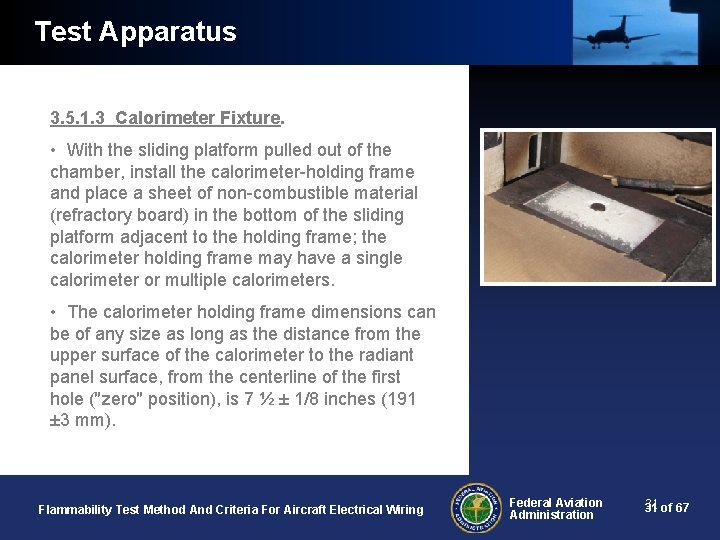
Test Apparatus 3. 5. 1. 3 Calorimeter Fixture. • With the sliding platform pulled out of the chamber, install the calorimeter-holding frame and place a sheet of non-combustible material (refractory board) in the bottom of the sliding platform adjacent to the holding frame; the calorimeter holding frame may have a single calorimeter or multiple calorimeters. • The calorimeter holding frame dimensions can be of any size as long as the distance from the upper surface of the calorimeter to the radiant panel surface, from the centerline of the first hole (″zero″ position), is 7 ½ ± 1/8 inches (191 ± 3 mm). Flammability Test Method And Criteria For Aircraft Electrical Wiring Federal Aviation Administration 31 of 67 31
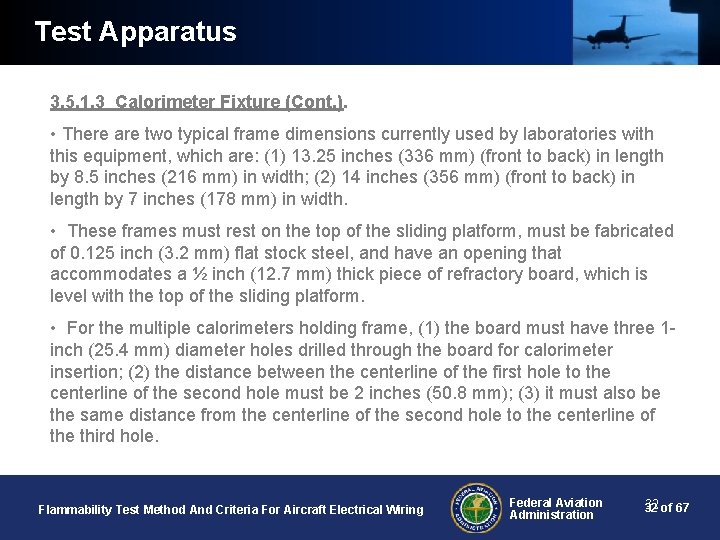
Test Apparatus 3. 5. 1. 3 Calorimeter Fixture (Cont. ). • There are two typical frame dimensions currently used by laboratories with this equipment, which are: (1) 13. 25 inches (336 mm) (front to back) in length by 8. 5 inches (216 mm) in width; (2) 14 inches (356 mm) (front to back) in length by 7 inches (178 mm) in width. • These frames must rest on the top of the sliding platform, must be fabricated of 0. 125 inch (3. 2 mm) flat stock steel, and have an opening that accommodates a ½ inch (12. 7 mm) thick piece of refractory board, which is level with the top of the sliding platform. • For the multiple calorimeters holding frame, (1) the board must have three 1 inch (25. 4 mm) diameter holes drilled through the board for calorimeter insertion; (2) the distance between the centerline of the first hole to the centerline of the second hole must be 2 inches (50. 8 mm); (3) it must also be the same distance from the centerline of the second hole to the centerline of the third hole. Flammability Test Method And Criteria For Aircraft Electrical Wiring Federal Aviation Administration 32 of 67 32
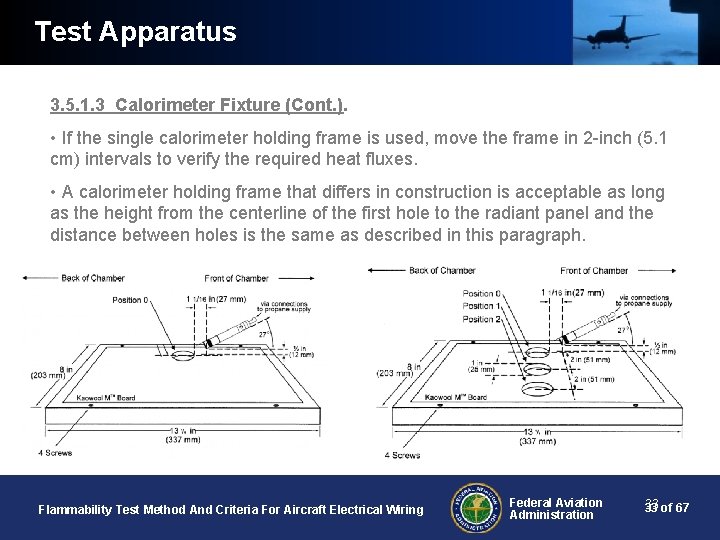
Test Apparatus 3. 5. 1. 3 Calorimeter Fixture (Cont. ). • If the single calorimeter holding frame is used, move the frame in 2 -inch (5. 1 cm) intervals to verify the required heat fluxes. • A calorimeter holding frame that differs in construction is acceptable as long as the height from the centerline of the first hole to the radiant panel and the distance between holes is the same as described in this paragraph. Flammability Test Method And Criteria For Aircraft Electrical Wiring Federal Aviation Administration 33 of 67 33
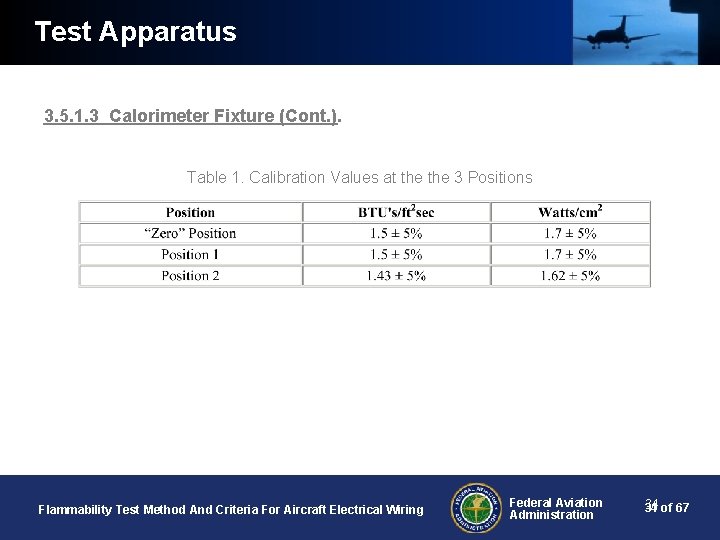
Test Apparatus 3. 5. 1. 3 Calorimeter Fixture (Cont. ). Table 1. Calibration Values at the 3 Positions Flammability Test Method And Criteria For Aircraft Electrical Wiring Federal Aviation Administration 34 of 67 34
Test Apparatus 3. 6 INSTRUMENTATION. • Provide a calibrated recording device with an appropriate range or a computerized data acquisition system to measure and record the outputs of the calorimeter and thermocouple. • The data acquisition system must be capable of recording the calorimeter output every second during calibration. Flammability Test Method And Criteria For Aircraft Electrical Wiring Federal Aviation Administration 35 of 67 35
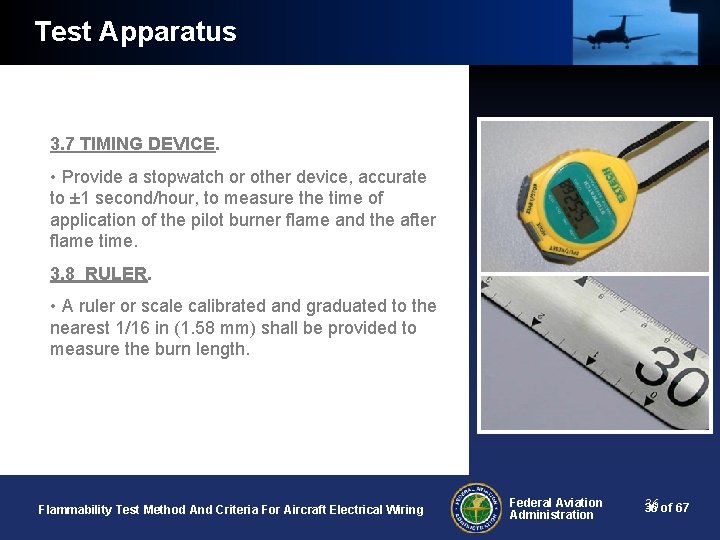
Test Apparatus 3. 7 TIMING DEVICE. • Provide a stopwatch or other device, accurate to ± 1 second/hour, to measure the time of application of the pilot burner flame and the after flame time. 3. 8 RULER. • A ruler or scale calibrated and graduated to the nearest 1/16 in (1. 58 mm) shall be provided to measure the burn length. Flammability Test Method And Criteria For Aircraft Electrical Wiring Federal Aviation Administration 36 of 67 36
Outline • Scope • Definitions • Test Apparatus • Test Specimens • Conditioning • Test Procedure • Report • Requirements Flammability Test Method And Criteria For Aircraft Electrical Wiring Federal Aviation Administration 37 of 67 37
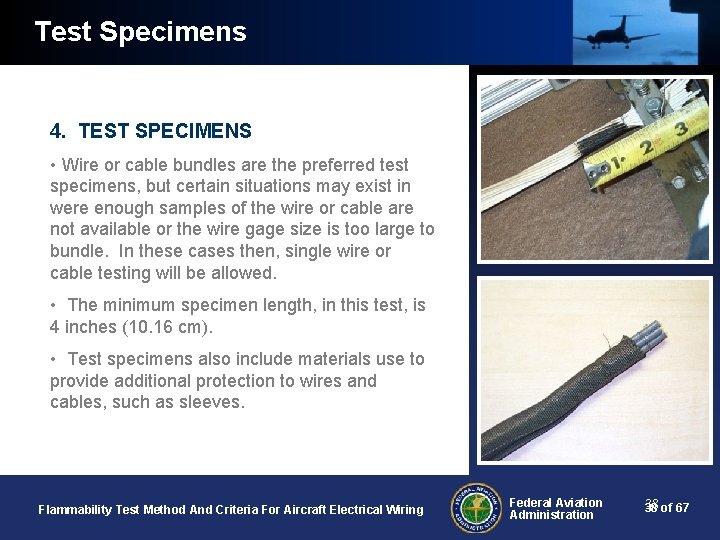
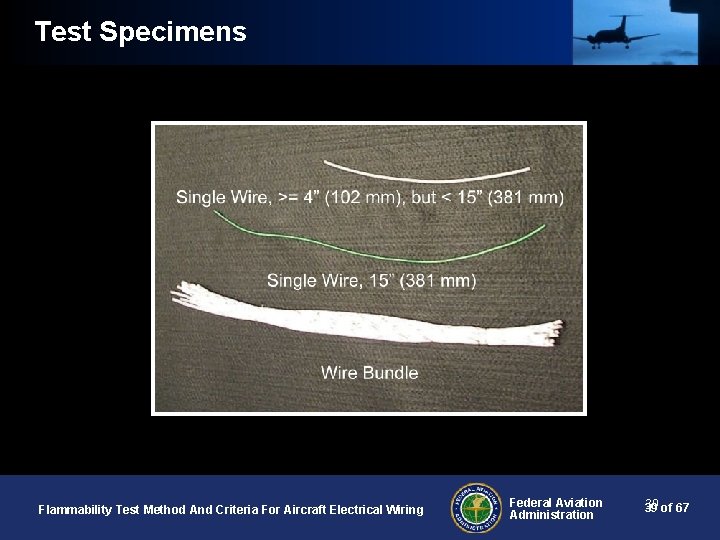
Test Specimens 4. TEST SPECIMENS • Wire or cable bundles are the preferred test specimens, but certain situations may exist in were enough samples of the wire or cable are not available or the wire gage size is too large to bundle. In these cases then, single wire or cable testing will be allowed. • The minimum specimen length, in this test, is 4 inches (10. 16 cm). • Test specimens also include materials use to provide additional protection to wires and cables, such as sleeves. Flammability Test Method And Criteria For Aircraft Electrical Wiring Federal Aviation Administration 38 of 67 38
Test Specimens Flammability Test Method And Criteria For Aircraft Electrical Wiring Federal Aviation Administration 39 of 67 39
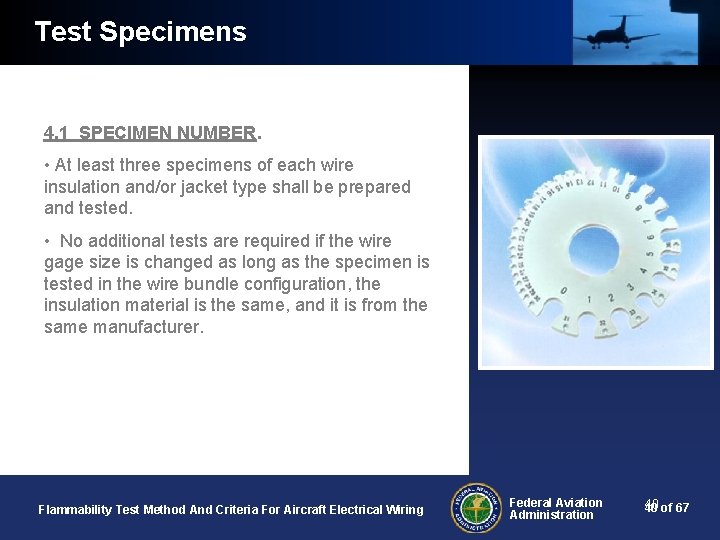
Test Specimens 4. 1 SPECIMEN NUMBER. • At least three specimens of each wire insulation and/or jacket type shall be prepared and tested. • No additional tests are required if the wire gage size is changed as long as the specimen is tested in the wire bundle configuration, the insulation material is the same, and it is from the same manufacturer. Flammability Test Method And Criteria For Aircraft Electrical Wiring Federal Aviation Administration 40 of 67 40
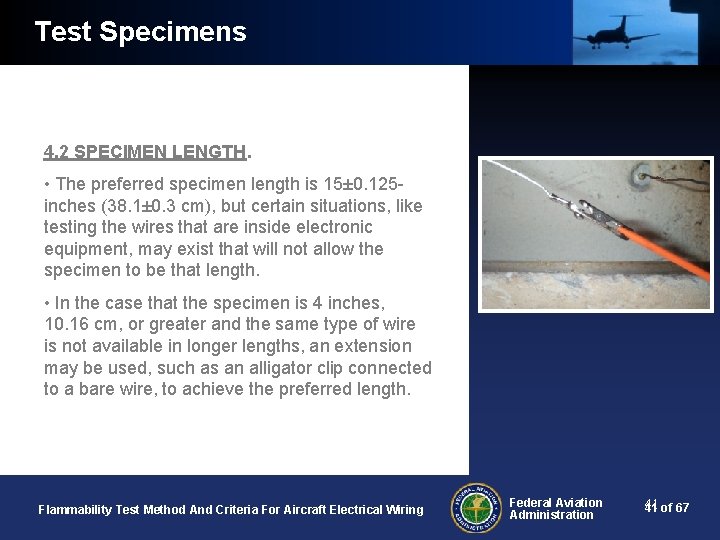
Test Specimens 4. 2 SPECIMEN LENGTH. • The preferred specimen length is 15± 0. 125 inches (38. 1± 0. 3 cm), but certain situations, like testing the wires that are inside electronic equipment, may exist that will not allow the specimen to be that length. • In the case that the specimen is 4 inches, 10. 16 cm, or greater and the same type of wire is not available in longer lengths, an extension may be used, such as an alligator clip connected to a bare wire, to achieve the preferred length. Flammability Test Method And Criteria For Aircraft Electrical Wiring Federal Aviation Administration 41 of 67 41
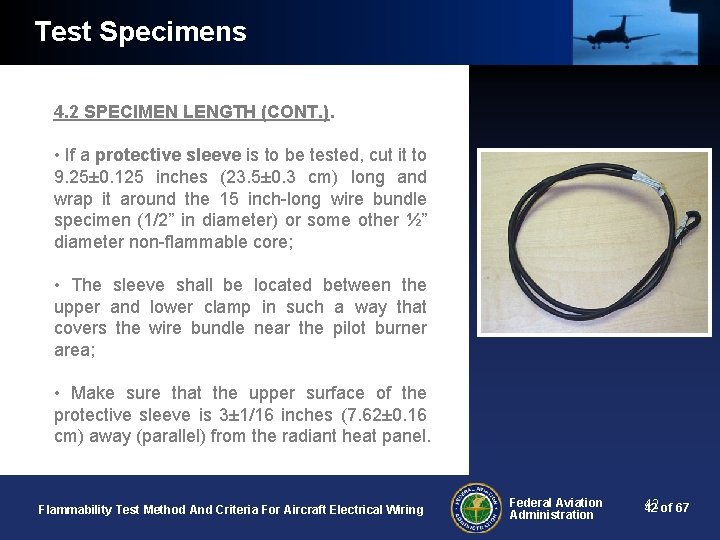
Test Specimens 4. 2 SPECIMEN LENGTH (CONT. ). • If a protective sleeve is to be tested, cut it to 9. 25± 0. 125 inches (23. 5± 0. 3 cm) long and wrap it around the 15 inch-long wire bundle specimen (1/2” in diameter) or some other ½” diameter non-flammable core; • The sleeve shall be located between the upper and lower clamp in such a way that covers the wire bundle near the pilot burner area; • Make sure that the upper surface of the protective sleeve is 3± 1/16 inches (7. 62± 0. 16 cm) away (parallel) from the radiant heat panel. Flammability Test Method And Criteria For Aircraft Electrical Wiring Federal Aviation Administration 42 of 67 42
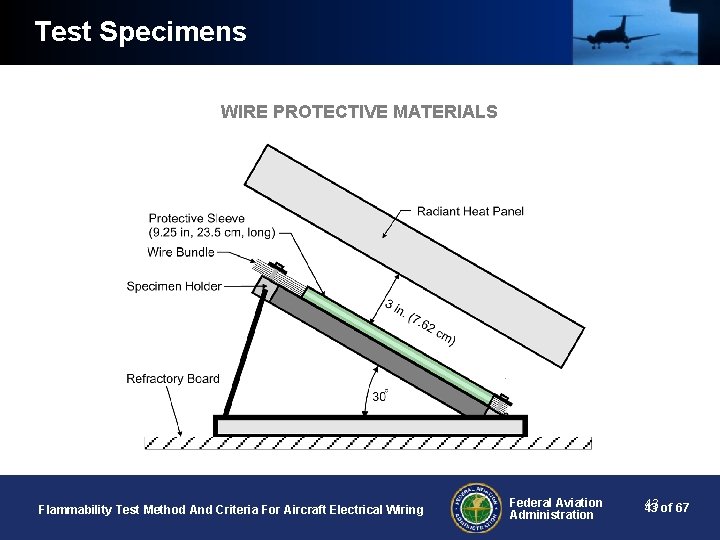
Test Specimens WIRE PROTECTIVE MATERIALS Flammability Test Method And Criteria For Aircraft Electrical Wiring Federal Aviation Administration 43 of 67 43
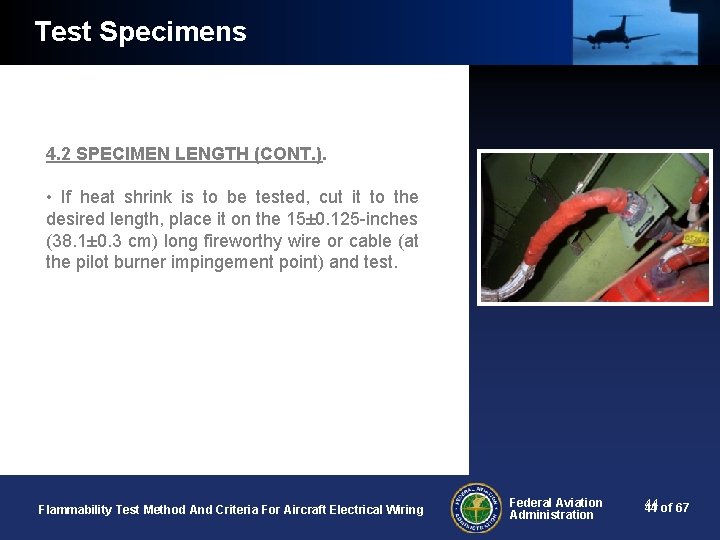
Test Specimens 4. 2 SPECIMEN LENGTH (CONT. ). • If heat shrink is to be tested, cut it to the desired length, place it on the 15± 0. 125 -inches (38. 1± 0. 3 cm) long fireworthy wire or cable (at the pilot burner impingement point) and test. Flammability Test Method And Criteria For Aircraft Electrical Wiring Federal Aviation Administration 44 of 67 44
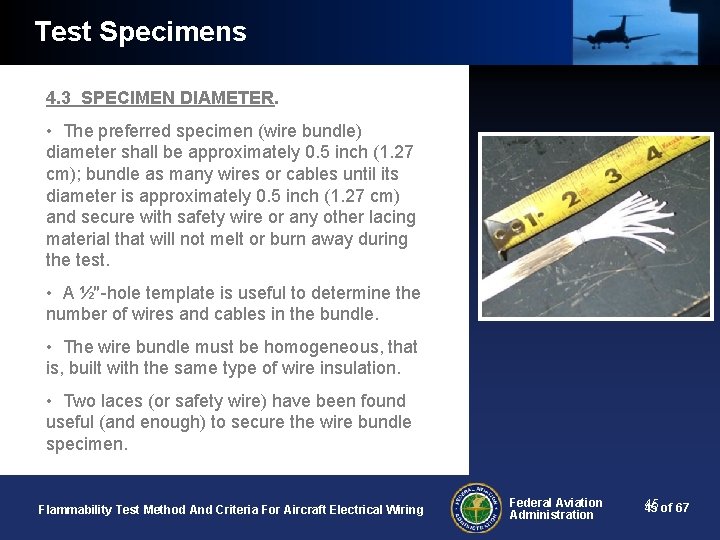
Test Specimens 4. 3 SPECIMEN DIAMETER. • The preferred specimen (wire bundle) diameter shall be approximately 0. 5 inch (1. 27 cm); bundle as many wires or cables until its diameter is approximately 0. 5 inch (1. 27 cm) and secure with safety wire or any other lacing material that will not melt or burn away during the test. • A ½″-hole template is useful to determine the number of wires and cables in the bundle. • The wire bundle must be homogeneous, that is, built with the same type of wire insulation. • Two laces (or safety wire) have been found useful (and enough) to secure the wire bundle specimen. Flammability Test Method And Criteria For Aircraft Electrical Wiring Federal Aviation Administration 45 of 67 45
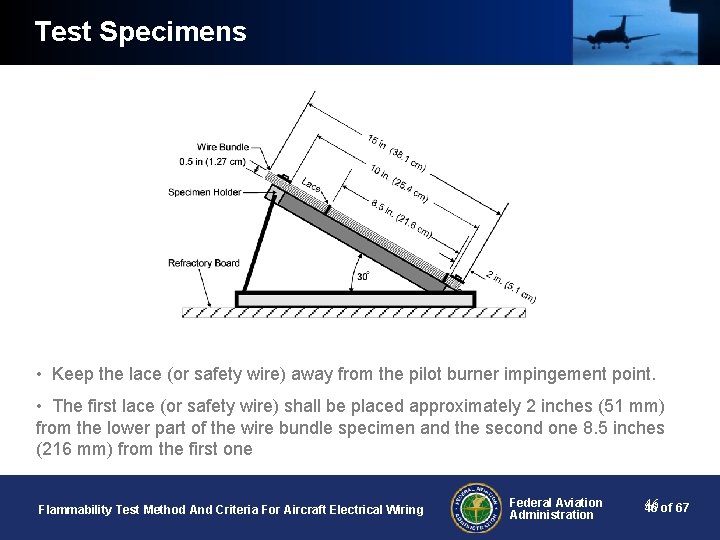
Test Specimens • Keep the lace (or safety wire) away from the pilot burner impingement point. • The first lace (or safety wire) shall be placed approximately 2 inches (51 mm) from the lower part of the wire bundle specimen and the second one 8. 5 inches (216 mm) from the first one Flammability Test Method And Criteria For Aircraft Electrical Wiring Federal Aviation Administration 46 of 67 46
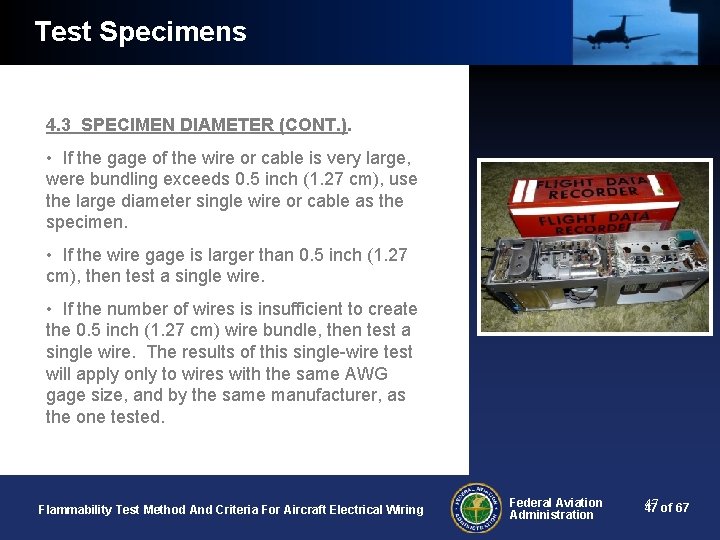
Test Specimens 4. 3 SPECIMEN DIAMETER (CONT. ). • If the gage of the wire or cable is very large, were bundling exceeds 0. 5 inch (1. 27 cm), use the large diameter single wire or cable as the specimen. • If the wire gage is larger than 0. 5 inch (1. 27 cm), then test a single wire. • If the number of wires is insufficient to create the 0. 5 inch (1. 27 cm) wire bundle, then test a single wire. The results of this single-wire test will apply only to wires with the same AWG gage size, and by the same manufacturer, as the one tested. Flammability Test Method And Criteria For Aircraft Electrical Wiring Federal Aviation Administration 47 of 67 47
Outline • Scope • Definitions • Test Apparatus • Test Specimens • Conditioning • Test Procedure • Report • Requirements Flammability Test Method And Criteria For Aircraft Electrical Wiring Federal Aviation Administration 48 of 67 48
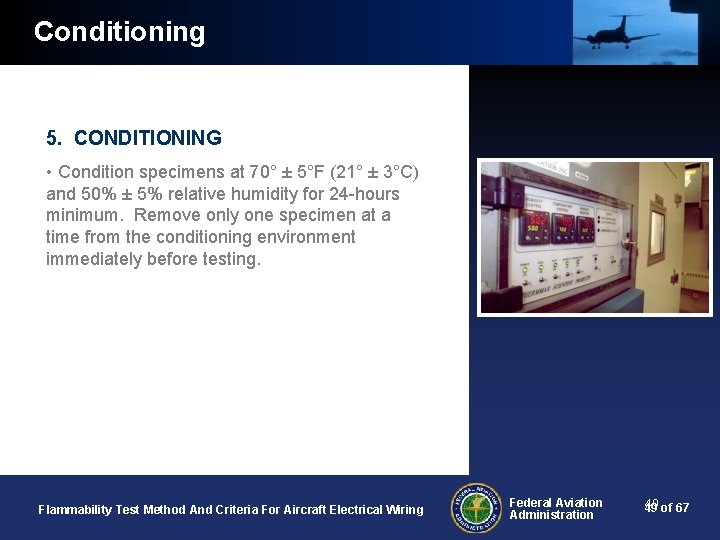
Conditioning 5. CONDITIONING • Condition specimens at 70° ± 5°F (21° ± 3°C) and 50% ± 5% relative humidity for 24 -hours minimum. Remove only one specimen at a time from the conditioning environment immediately before testing. Flammability Test Method And Criteria For Aircraft Electrical Wiring Federal Aviation Administration 49 of 67 49
Outline • Scope • Definitions • Test Apparatus • Test Specimens • Conditioning • Test Procedure • Report • Requirements Flammability Test Method And Criteria For Aircraft Electrical Wiring Federal Aviation Administration 50 of 67 50
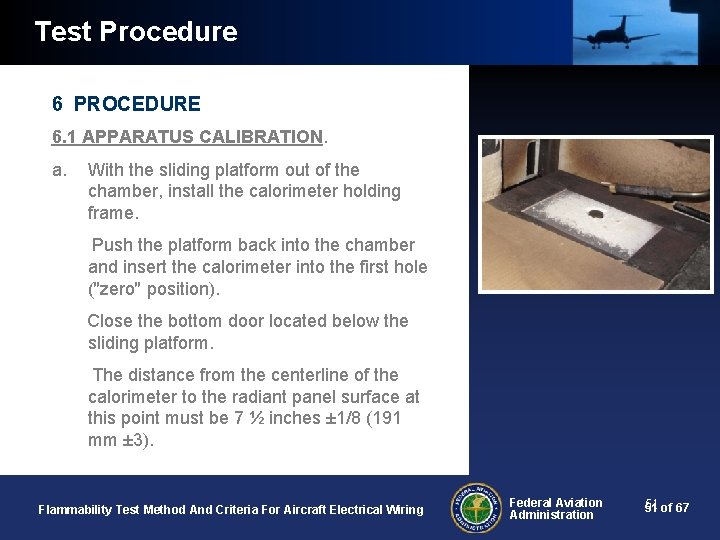
Test Procedure 6 PROCEDURE 6. 1 APPARATUS CALIBRATION. a. With the sliding platform out of the chamber, install the calorimeter holding frame. Push the platform back into the chamber and insert the calorimeter into the first hole (″zero″ position). Close the bottom door located below the sliding platform. The distance from the centerline of the calorimeter to the radiant panel surface at this point must be 7 ½ inches ± 1/8 (191 mm ± 3). Flammability Test Method And Criteria For Aircraft Electrical Wiring Federal Aviation Administration 51 of 67 51
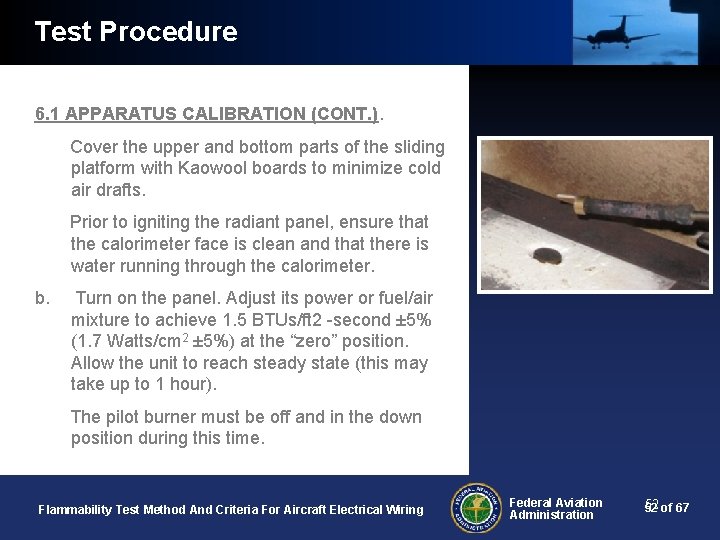
Test Procedure 6. 1 APPARATUS CALIBRATION (CONT. ). Cover the upper and bottom parts of the sliding platform with Kaowool boards to minimize cold air drafts. Prior to igniting the radiant panel, ensure that the calorimeter face is clean and that there is water running through the calorimeter. b. Turn on the panel. Adjust its power or fuel/air mixture to achieve 1. 5 BTUs/ft 2 -second ± 5% (1. 7 Watts/cm 2 ± 5%) at the “zero” position. Allow the unit to reach steady state (this may take up to 1 hour). The pilot burner must be off and in the down position during this time. Flammability Test Method And Criteria For Aircraft Electrical Wiring Federal Aviation Administration 52 of 67 52
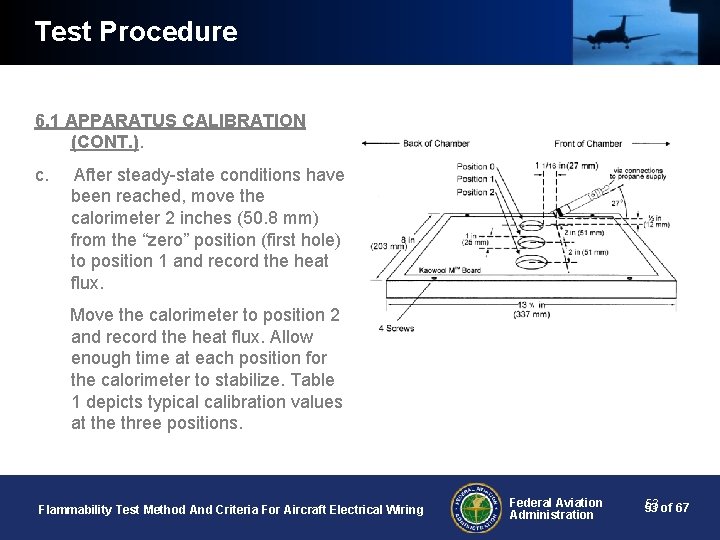
Test Procedure 6. 1 APPARATUS CALIBRATION (CONT. ). c. After steady-state conditions have been reached, move the calorimeter 2 inches (50. 8 mm) from the “zero” position (first hole) to position 1 and record the heat flux. Move the calorimeter to position 2 and record the heat flux. Allow enough time at each position for the calorimeter to stabilize. Table 1 depicts typical calibration values at the three positions. Flammability Test Method And Criteria For Aircraft Electrical Wiring Federal Aviation Administration 53 of 67 53
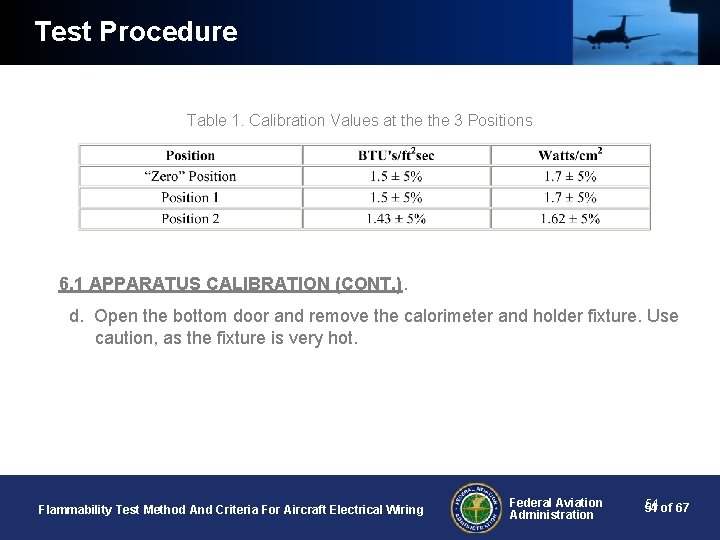
Test Procedure Table 1. Calibration Values at the 3 Positions 6. 1 APPARATUS CALIBRATION (CONT. ). d. Open the bottom door and remove the calorimeter and holder fixture. Use caution, as the fixture is very hot. Flammability Test Method And Criteria For Aircraft Electrical Wiring Federal Aviation Administration 54 of 67 54
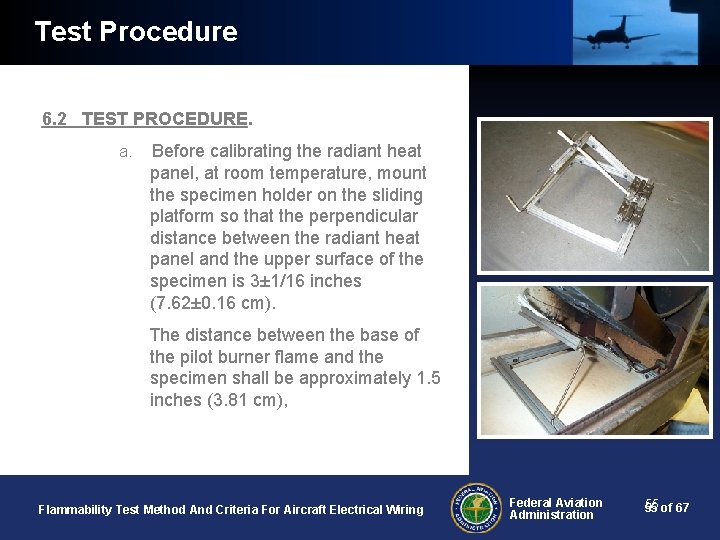
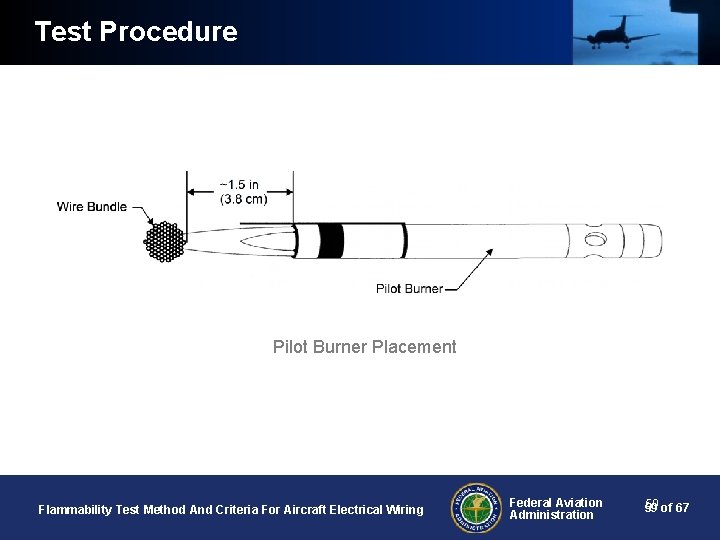
Test Procedure 6. 2 TEST PROCEDURE. a. Before calibrating the radiant heat panel, at room temperature, mount the specimen holder on the sliding platform so that the perpendicular distance between the radiant heat panel and the upper surface of the specimen is 3± 1/16 inches (7. 62± 0. 16 cm). The distance between the base of the pilot burner flame and the specimen shall be approximately 1. 5 inches (3. 81 cm), Flammability Test Method And Criteria For Aircraft Electrical Wiring Federal Aviation Administration 55 of 67 55
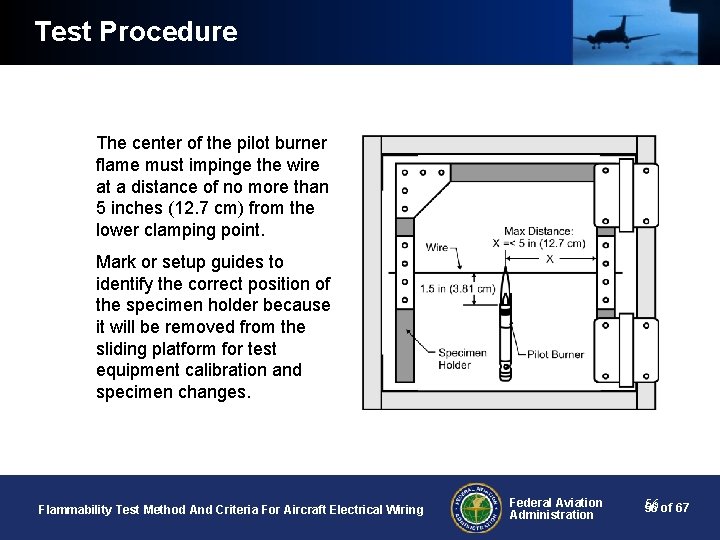
Test Procedure The center of the pilot burner flame must impinge the wire at a distance of no more than 5 inches (12. 7 cm) from the lower clamping point. Mark or setup guides to identify the correct position of the specimen holder because it will be removed from the sliding platform for test equipment calibration and specimen changes. Flammability Test Method And Criteria For Aircraft Electrical Wiring Federal Aviation Administration 56 of 67 56
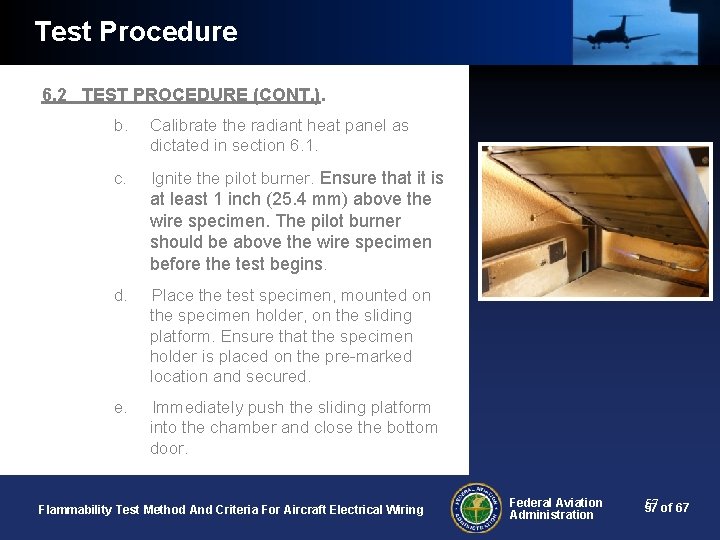
Test Procedure 6. 2 TEST PROCEDURE (CONT. ). b. Calibrate the radiant heat panel as dictated in section 6. 1. c. Ignite the pilot burner. Ensure that it is at least 1 inch (25. 4 mm) above the wire specimen. The pilot burner should be above the wire specimen before the test begins. d. Place the test specimen, mounted on the specimen holder, on the sliding platform. Ensure that the specimen holder is placed on the pre-marked location and secured. e. Immediately push the sliding platform into the chamber and close the bottom door. Flammability Test Method And Criteria For Aircraft Electrical Wiring Federal Aviation Administration 57 of 67 57
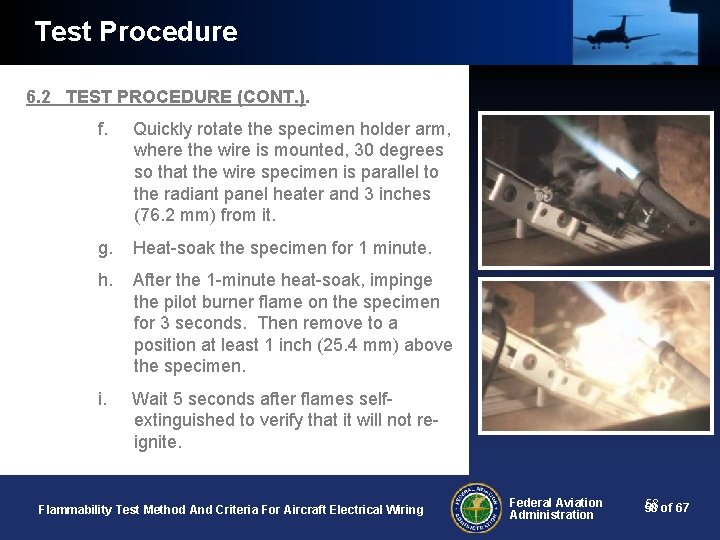
Test Procedure 6. 2 TEST PROCEDURE (CONT. ). f. Quickly rotate the specimen holder arm, where the wire is mounted, 30 degrees so that the wire specimen is parallel to the radiant panel heater and 3 inches (76. 2 mm) from it. g. Heat-soak the specimen for 1 minute. h. After the 1 -minute heat-soak, impinge the pilot burner flame on the specimen for 3 seconds. Then remove to a position at least 1 inch (25. 4 mm) above the specimen. i. Wait 5 seconds after flames selfextinguished to verify that it will not reignite. Flammability Test Method And Criteria For Aircraft Electrical Wiring Federal Aviation Administration 58 of 67 58
Test Procedure Pilot Burner Placement Flammability Test Method And Criteria For Aircraft Electrical Wiring Federal Aviation Administration 59 of 67 59
Outline • Scope • Definitions • Test Apparatus • Test Specimens • Conditioning • Test Procedure • Report • Requirements Flammability Test Method And Criteria For Aircraft Electrical Wiring Federal Aviation Administration 60 of 67 60
Report 7 REPORT 7. 1 MATERIAL IDENTIFICATION. • Fully identify the wire/cable bundle tested. 7. 2 TEST RESULTS. 7. 2. 1 After-Flame Time. • Report the after-flame time for each specimen tested. • Determine and record the average value for after flame extinguishing time. Flammability Test Method And Criteria For Aircraft Electrical Wiring Federal Aviation Administration 61 of 67 61
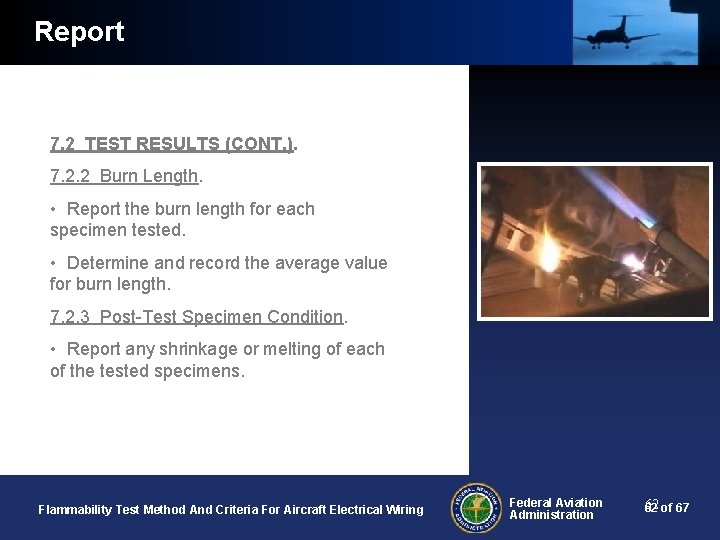
Report 7. 2 TEST RESULTS (CONT. ). 7. 2. 2 Burn Length. • Report the burn length for each specimen tested. • Determine and record the average value for burn length. 7. 2. 3 Post-Test Specimen Condition. • Report any shrinkage or melting of each of the tested specimens. Flammability Test Method And Criteria For Aircraft Electrical Wiring Federal Aviation Administration 62 of 67 62
Outline • Scope • Definitions • Test Apparatus • Test Specimens • Conditioning • Test Procedure • Report • Requirements Flammability Test Method And Criteria For Aircraft Electrical Wiring Federal Aviation Administration 63 of 67 63
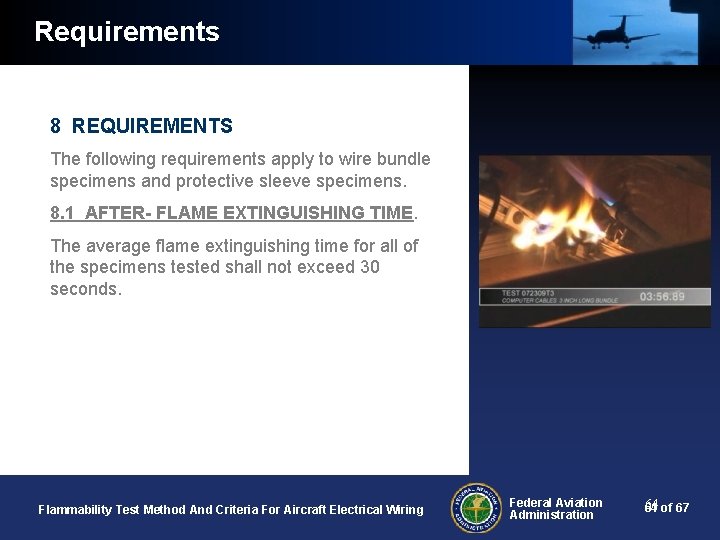
Requirements 8 REQUIREMENTS The following requirements apply to wire bundle specimens and protective sleeve specimens. 8. 1 AFTER- FLAME EXTINGUISHING TIME. The average flame extinguishing time for all of the specimens tested shall not exceed 30 seconds. Flammability Test Method And Criteria For Aircraft Electrical Wiring Federal Aviation Administration 64 of 67 64
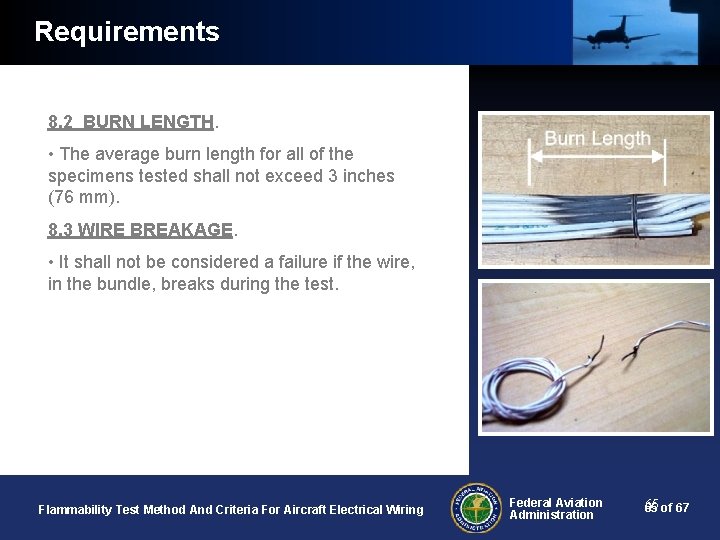
Requirements 8. 2 BURN LENGTH. • The average burn length for all of the specimens tested shall not exceed 3 inches (76 mm). 8. 3 WIRE BREAKAGE. • It shall not be considered a failure if the wire, in the bundle, breaks during the test. Flammability Test Method And Criteria For Aircraft Electrical Wiring Federal Aviation Administration 65 of 67 65
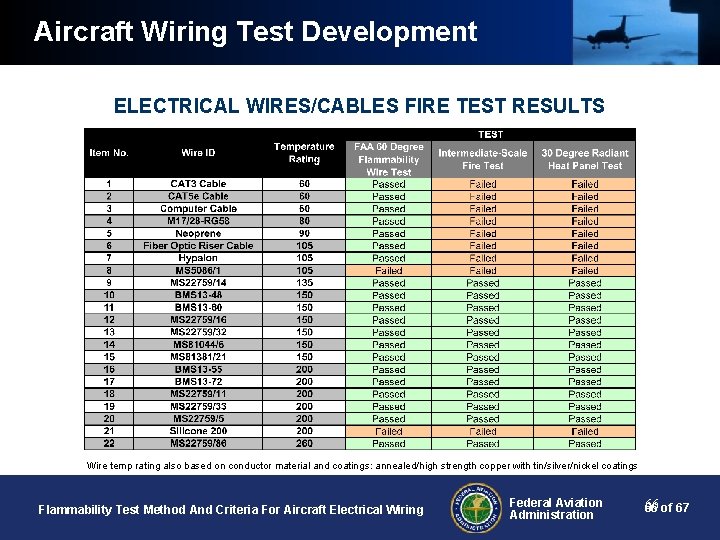
Aircraft Wiring Test Development ELECTRICAL WIRES/CABLES FIRE TEST RESULTS Wire temp rating also based on conductor material and coatings: annealed/high strength copper with tin/silver/nickel coatings Flammability Test Method And Criteria For Aircraft Electrical Wiring Federal Aviation Administration 66 of 67 66
Q&A • Questions? • Looking for laboratories that would like to participate in a Round Robin Exercise Go Back Flammability Test Method And Criteria For Aircraft Electrical Wiring Federal Aviation Administration 67 of 67 67
- Slides: 67