
Flameless Oxidation Combustor Development for a Sequential Combustion
"Flameless Oxidation Combustor Development for a Sequential Combustion Hybrid Turbofan Engine" Yeshayahou Levy Technion - ISRAEL http: //jet-engine-lab. technion. ac. il MY THANKS TO ALL CONTRIBUTORS • Dr. Valery Sherbaum, Technion • Dr. Vitali Ovcherenko, Technion • Dr. Vladimir Erenburg, Technion • Dr. Igor Geisinski, Technion • Mr. Alex Roizman, Technion • Mr. Dan Nahoom 14 th Israeli Symposium on Jet Engines and Gas Turbines, November 5 2015, Technion, Israel 14 th • Dr. Arvind Rao, Delft, The Netherlands • Prof. Mario Costa, IST, Portugal • Mr. Bruno Bernasrdes, IST, Portugal • Mr. David Nascimento, IST, Portugal Israeli Symposium on Jet Engines and Gas Turbines November 5 2015, Technion, Israel Turbo and Jet Engine Laboratory Technion – Israel 1 www. jet-engine-lab. technion. ac. il
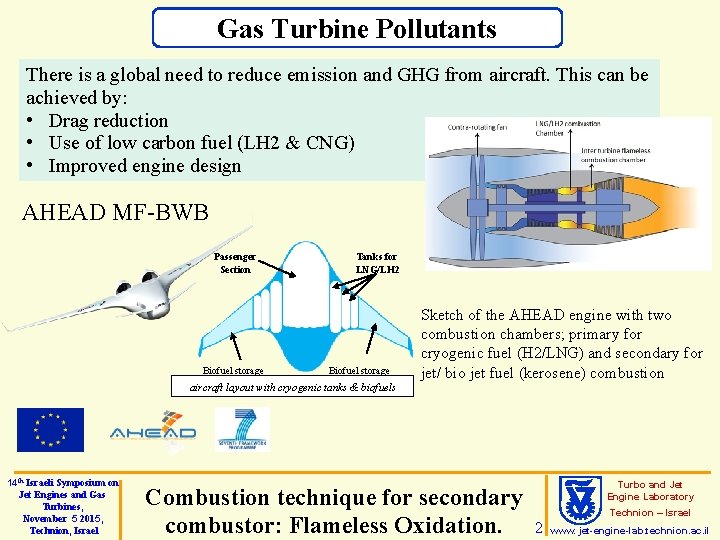
Gas Turbine Pollutants There is a global need to reduce emission and GHG from aircraft. This can be achieved by: • Drag reduction • Use of low carbon fuel (LH 2 & CNG) • Improved engine design AHEAD MF-BWB Passenger Section Biofuel storage Tanks for LNG/LH 2 Biofuel storage Sketch of the AHEAD engine with two combustion chambers; primary for cryogenic fuel (H 2/LNG) and secondary for jet/ bio jet fuel (kerosene) combustion aircraft layout with cryogenic tanks & biofuels 14 th Israeli Symposium on Jet Engines and Gas Turbines, November 5 2015, Technion, Israel Combustion technique for secondary combustor: Flameless Oxidation. Turbo and Jet Engine Laboratory Technion – Israel 2 www. jet-engine-lab. technion. ac. il

2200° C T conventional 1500° C 400° C 1300° C flameless Low NOx production X NOx FORMATION REGION 14 th Israeli Symposium on Jet Engines and Gas Turbines, November 5 2015, Technion, Israel The Concept of Flameless Gas Turbine Combustor Turbo and Jet Engine Laboratory Technion – Israel 3 www. jet-engine-lab. technion. ac. il
Flameless Oxidation Method for NOx Reduction Ref. : Prof. Arvind G. Rao, TU Delft 14 th Israeli Symposium on Jet Engines and Gas Turbines, November 5 2015, Technion, Israel Turbo and Jet Engine Laboratory Different Combustion Regimes Technion – Israel 4 www. jet-engine-lab. technion. ac. il

Split ratio: 1 : 4. 7 14 th Israeli Symposium on Jet Engines and Gas Turbines, November 5 2015, Technion, Israel Turbo and Jet Engine Laboratory Suggested combustor configuration Technion – Israel 5 www. jet-engine-lab. technion. ac. il

Chemical Kinetic Scheme for CFD Simulations 1. Select a reduced chemical kinetic mechanism for CFD simulations for specific fuel (using surrogate fuel instead if JP -8). 2. Verify the flame characteristics and emissions using the reduced mechanism with respect to the detailed mechanism and with experimental results. 3. “Surrogate A” was selected as an alternative to represent the JP 8. Surrogate A compounds Normal alkanes n-Decane, C 10 H 22 60 Cyclo alkanes Methyl-cyclo-hexane, C 7 H 14 20 Aromatics Toluene, C 7 H 8 20 100% 14 th Israeli Symposium on Jet Engines and Gas Turbines, November 5 2015, Technion, Israel Turbo and Jet Engine Laboratory Technion – Israel 6 www. jet-engine-lab. technion. ac. il

Simplified Chemical Kinetics Models for CFD simulations of Jet fuel combustion Comparison between detailed and reduced (“Kundu – Creck’) mechanism for “Surrogate A” and an experimentally based 2 -step mechanism by Meredith and Black (2006) was performed using CHEMKIN. Evaluation of different reduced model using CHEMKIN simulations Range not precisely Range whereby COKudu’s not evaluated precisely evaluated by mechanism Meredith’s mechanism Temperature vs. residence time CO mole fraction vs. residence time In GT and Jet Engine, the relevant residence time range is 1~ 10 ms & the temperature is the important parameter. Hence, the Meredith 2 -step mechanism was selected! Take Off. Inlet condition: Input mass gas fraction: g. H 2 O=0. 0656, g. O 2=0. 1731, g. N 2=0. 7613, mixture flow rate= 21. 73 kg/s, T=1185 K. Kerosene mass flow rate=0. 39 kg/s, Tfuel=300 K. P=8. 56 bar. 14 th Israeli Symposium on Jet Engines and Gas Turbines, November 5 2015, Technion, Israel Turbo and Jet Engine Laboratory Technion – Israel 7 www. jet-engine-lab. technion. ac. il

Experimental Verification of the detailed chemistry of “Surrogate-A” Fuel (from literature) Comparison between model Surrogate A and experimental data for Jet A at two initial temperatures From: K. Kumar, C. -J. Sung, X. Hui, 47 th AIAA Aerospace Sciences Meeting January 2009, Orlando. 14 th Israeli Symposium on Jet Engines and Gas Turbines, November 5 2015, Technion, Israel Turbo and Jet Engine Laboratory Technion – Israel 8 www. jet-engine-lab. technion. ac. il

Sample Results: Effect of air vitiation on ignition time Laboratory test conditions for AHEAD, T=973 K Vitiated Air t-ignition = 35 ms t. Fresh air. = 2. 4 ms, t. Vitiated air = 2. 9 ms Reduced Kundu – Creck (C 12 H 23) Tin (AHEAD)= 1185 K Air Vitiation slows combustion process In practice, the reactance increases their temperature above inlet temperature by mixing, thus reducing the actual ignition 14 Israeli Symposium on delay time. Turbo and Jet Engines and Gas th Turbines, November 5 2015, Technion, Israel Effect of vitiation on ignition time for Tin = 1185 K and Texit=1800 K Engine Laboratory Technion – Israel 9 www. jet-engine-lab. technion. ac. il

Sample Results: Effect of air vitiation on combustion temperature Reaction Temperature K Fresh air Vitiated air Res. time, ms Vitiation reduces combustion temperature 14 th Israeli Symposium on Jet Engines and Gas Turbines, November 5 2015, Technion, Israel Turbo and Jet Engine Laboratory Technion – Israel 10 www. jet-engine-lab. technion. ac. il

CFD Simulations Mesh; green arrows - fuel inlets, blue ones air inlets, white – outlet Fluent Code Discretization – 2 -nd order Turbulent model – K - ε Combustion – EDC (Eddy Dissipation Concept) model. 2 - Meredith & Black reaction mechanism → Recirculation Ratio ~ 1. 5 14 th Israeli Symposium on Jet Engines and Gas Turbines, November 5 2015, Technion, Israel Computational mesh &Velocity vectors indicating the large internal circulation Turbo and Jet Engine Laboratory Technion – Israel 11 www. jet-engine-lab. technion. ac. il

1920 K 1300 K 1200 K → Almost uniform temperature distribution Mass averaged static temperature at the exit 1299 K 14 th Israeli Symposium on Jet Engines and Gas Turbines, November 5 2015, Technion, Israel Turbo and Jet Engine Laboratory Static temperature distribution Technion – Israel 12 www. jet-engine-lab. technion. ac. il

→ Very little CO emission →high ηb CO mass-fraction at the exit – 30. 7 ppm 14 th Israeli Symposium on Jet Engines and Gas Turbines, November 5 2015, Technion, Israel CO distribution Turbo and Jet Engine Laboratory Technion – Israel 13 www. jet-engine-lab. technion. ac. il
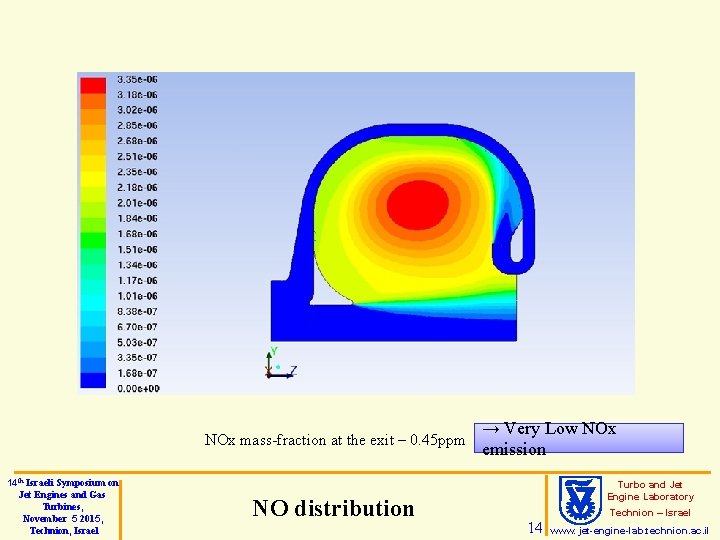
NOx mass-fraction at the exit – 0. 45 ppm 14 th Israeli Symposium on Jet Engines and Gas Turbines, November 5 2015, Technion, Israel NO distribution → Very Low NOx emission Turbo and Jet Engine Laboratory Technion – Israel 14 www. jet-engine-lab. technion. ac. il

Experimental verification of CFD simulations • Operating pressure 1 bar (atmosphreic), maximum air supply of 10 gr/sec • Size limitation of the test chamber (300 mm in diameter) determined the need to limit the model to 1/3 linear geometrical scale • similar residence time - Velocities reduced to 1/3 • similar temperature values at combustion zone and at the exit of the combustor. 14 th Israeli Symposium on Jet Engines and Gas Turbines, November 5 2015, Technion, Israel Turbo and Jet Engine Laboratory Scaling Down Criteria Technion – Israel 15 www. jet-engine-lab. technion. ac. il

Schematic Design Methane Combustion air Dilution air Exhaust Metal SS 310 14 th Israeli Symposium on Jet Engines and Gas Turbines, November 5 2015, Technion, Israel Turbo and Jet Engine Laboratory The reduced experimental model Technion – Israel 16 www. jet-engine-lab. technion. ac. il
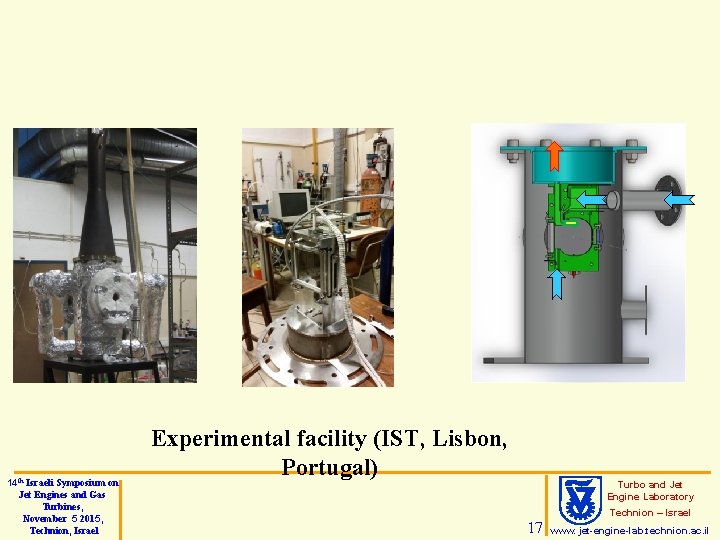
14 th Israeli Symposium on Jet Engines and Gas Turbines, November 5 2015, Technion, Israel Experimental facility (IST, Lisbon, Portugal) Turbo and Jet Engine Laboratory Technion – Israel 17 www. jet-engine-lab. technion. ac. il
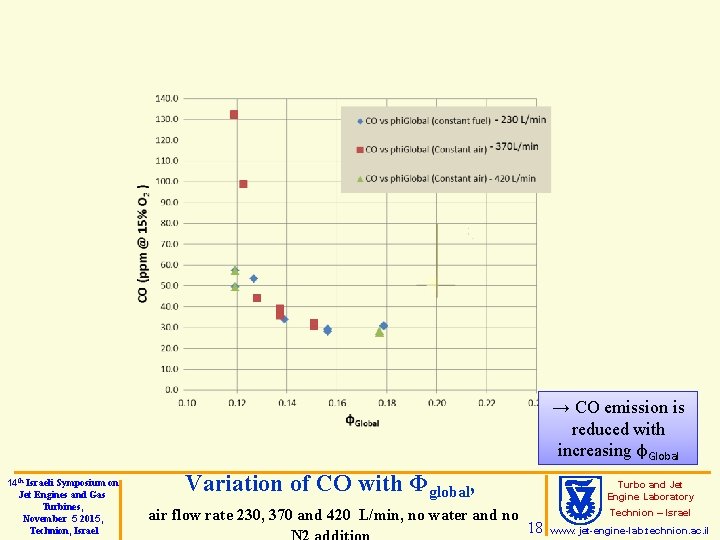
→ CO emission is reduced with increasing φGlobal 14 th Israeli Symposium on Jet Engines and Gas Turbines, November 5 2015, Technion, Israel Variation of CO with Φglobal, Turbo and Jet Engine Laboratory air flow rate 230, 370 and 420 L/min, no water and no Technion – Israel 18 www. jet-engine-lab. technion. ac. il
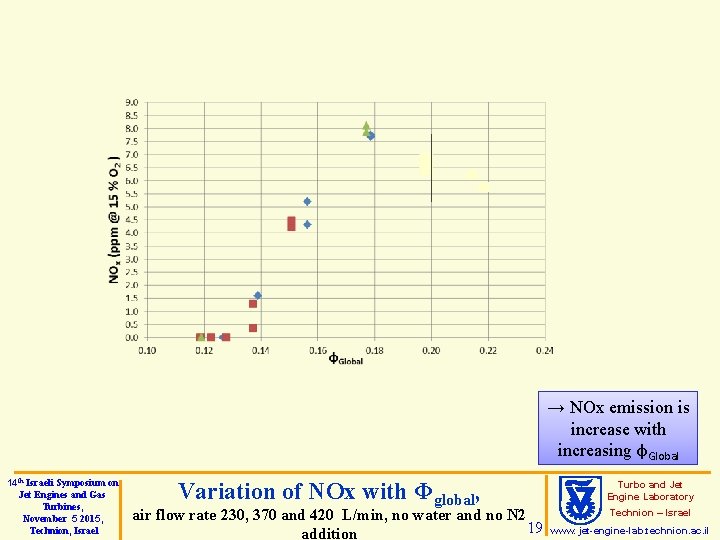
→ NOx emission is increase with increasing φGlobal 14 th Israeli Symposium on Jet Engines and Gas Turbines, November 5 2015, Technion, Israel Variation of NOx with Φglobal, air flow rate 230, 370 and 420 L/min, no water and no N 2 19 addition Turbo and Jet Engine Laboratory Technion – Israel www. jet-engine-lab. technion. ac. il
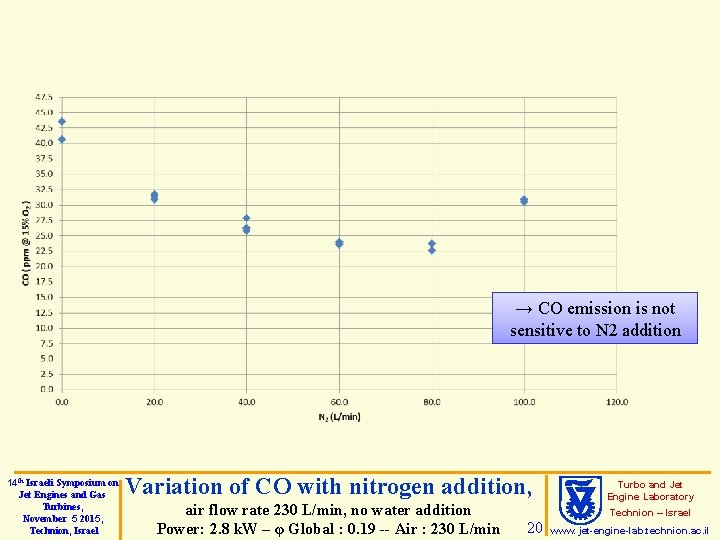
→ CO emission is not sensitive to N 2 addition 14 th Israeli Symposium on Jet Engines and Gas Turbines, November 5 2015, Technion, Israel Variation of CO with nitrogen addition, air flow rate 230 L/min, no water addition Power: 2. 8 k. W – φ Global : 0. 19 -- Air : 230 L/min Turbo and Jet Engine Laboratory Technion – Israel 20 www. jet-engine-lab. technion. ac. il

8. 0 7. 5 NOx (ppm @ 15% O 2 ) 7. 0 6. 5 6. 0 5. 5 5. 0 4. 5 4. 0 3. 5 3. 0 → NOx emission is reduced by N 2 addition 2. 5 2. 0 1. 5 1. 0 0. 5 0. 0 14 th Israeli Symposium on Jet Engines and Gas Turbines, November 5 2015, Technion, Israel 20. 0 40. 0 60. 0 N 2 (L/min) 80. 0 100. 0 120. 0 Variation of NOx with nitrogen addition, Turbo and Jet Engine Laboratory air flow rate 230 L/min, no water addition. Power: 2. 8 k. W --φ : 0. 19 , Water: 0 g/h Technion – Israel 21 www. jet-engine-lab. technion. ac. il

14 th Israeli Symposium on Jet Engines and Gas Turbines, November 5 2015, Technion, Israel Turbo and Jet The flame while increasing N 2 flow Engine Laboratory Technion – Israel rates, airflow 230 L/min, power: 2. 8 k. W – φ Global : 0. 1922 www. jet-engine-lab. technion. ac. il

40 L/min N 2 20 L/min N 2 Air: 420 L/min, φGlobal : 0. 18 Air: 220 L/min, φGlobal : 0. 18 40. 0 37. 5 35. 0 32. 5 CO (ppm @ 15 % O 2) 30. 0 27. 5 25. 0 22. 5 20. 0 17. 5 15. 0 12. 5 → CO emission is not sensitive to H 2 O addition 10. 0 7. 5 5. 0 2. 5 0. 00 14 th Israeli Symposium on Jet Engines and Gas Turbines, November 5 2015, Technion, Israel 250. 00 500. 00 750. 00 H 2 O (g/h) 1000. 00 1250. 00 1500. 00 Variation of CO with H 2 O, Φglobal =0. 18; blue: Air = 420 L/min, N 2 = 40 L/min; red: , Air = 220 L/min, N 2 = 20 L/min Turbo and Jet Engine Laboratory Technion – Israel 23 www. jet-engine-lab. technion. ac. il
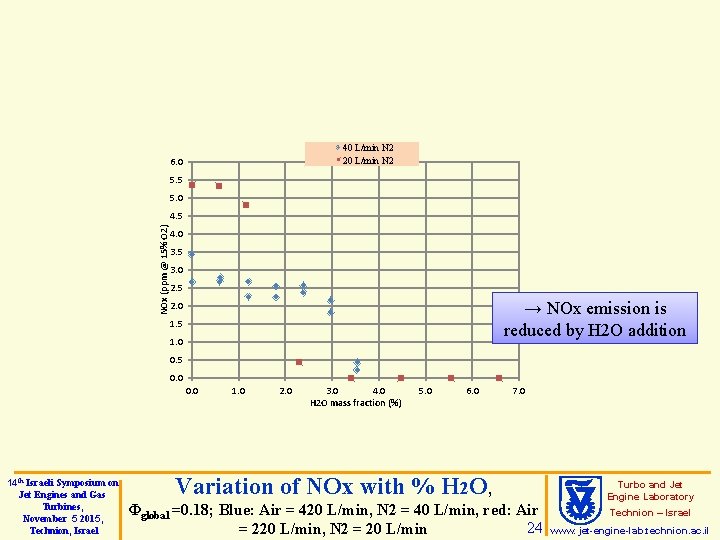
40 L/min N 2 20 L/min N 2 6. 0 5. 5 5. 0 NOx (ppm @ 15% O 2) 4. 5 4. 0 3. 5 3. 0 2. 5 → NOx emission is reduced by H 2 O addition 2. 0 1. 5 1. 0 0. 5 0. 0 14 th Israeli Symposium on Jet Engines and Gas Turbines, November 5 2015, Technion, Israel 1. 0 2. 0 3. 0 4. 0 H 2 O mass fraction (%) 5. 0 6. 0 7. 0 Variation of NOx with % H 2 O, Φglobal =0. 18; Blue: Air = 420 L/min, N 2 = 40 L/min, red: Air 24 = 220 L/min, N 2 = 20 L/min Turbo and Jet Engine Laboratory Technion – Israel www. jet-engine-lab. technion. ac. il
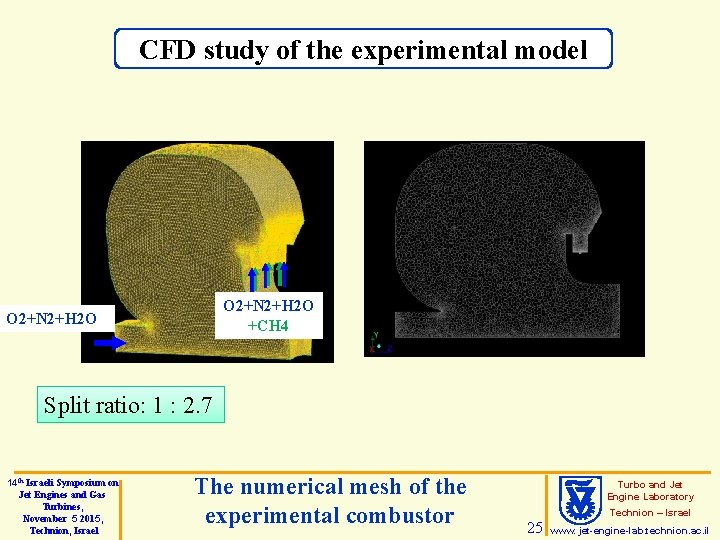
CFD study of the experimental model O 2+N 2+H 2 O +CH 4 O 2+N 2+H 2 O Split ratio: 1 : 2. 7 14 th Israeli Symposium on Jet Engines and Gas Turbines, November 5 2015, Technion, Israel The numerical mesh of the experimental combustor Turbo and Jet Engine Laboratory Technion – Israel 25 www. jet-engine-lab. technion. ac. il
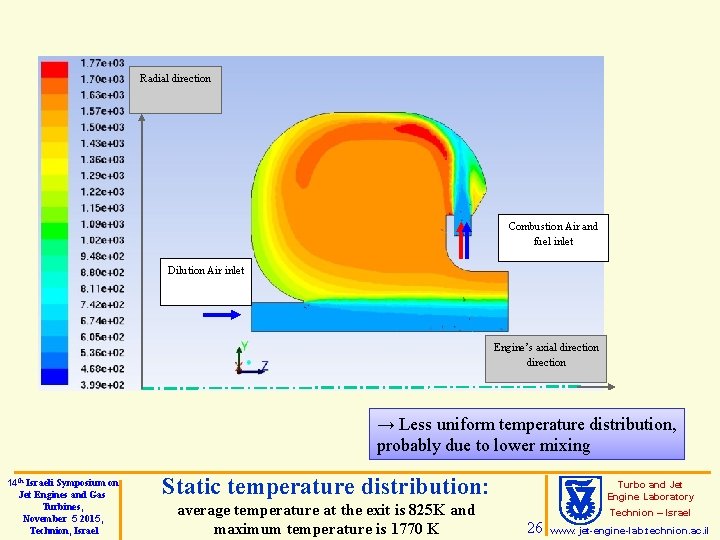
Radial direction Combustion Air and fuel inlet Dilution Air inlet Engine’s axial direction → Less uniform temperature distribution, probably due to lower mixing 14 th Israeli Symposium on Jet Engines and Gas Turbines, November 5 2015, Technion, Israel Static temperature distribution: average temperature at the exit is 825 K and maximum temperature is 1770 K Turbo and Jet Engine Laboratory Technion – Israel 26 www. jet-engine-lab. technion. ac. il
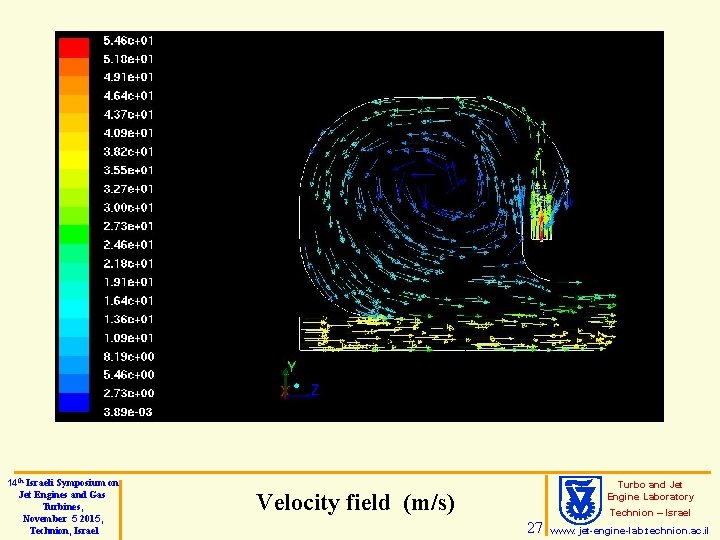
14 th Israeli Symposium on Jet Engines and Gas Turbines, November 5 2015, Technion, Israel Turbo and Jet Engine Laboratory Velocity field (m/s) Technion – Israel 27 www. jet-engine-lab. technion. ac. il
![[CO] at the exit ~ 41 ppm → Comparable low level of CO emission](http://slidetodoc.com/presentation_image/7d5c58481c0faef7d8cff3ec4584f334/image-28.jpg "[CO] at the exit ~ 41 ppm → Comparable low level of CO emission")
[CO] at the exit ~ 41 ppm → Comparable low level of CO emission as in full scale →high ηb 14 th Israeli Symposium on Jet Engines and Gas Turbines, November 5 2015, Technion, Israel CO mass-fraction Turbo and Jet Engine Laboratory Technion – Israel 28 www. jet-engine-lab. technion. ac. il
![[NO] at the exit ~ 0. 016 ppm → Comparable very low NOx level](http://slidetodoc.com/presentation_image/7d5c58481c0faef7d8cff3ec4584f334/image-29.jpg "[NO] at the exit ~ 0. 016 ppm → Comparable very low NOx level")
[NO] at the exit ~ 0. 016 ppm → Comparable very low NOx level of NOx emission as in full scale 14 th Israeli Symposium on Jet Engines and Gas Turbines, November 5 2015, Technion, Israel NO mass-fraction Turbo and Jet Engine Laboratory Technion – Israel 29 www. jet-engine-lab. technion. ac. il
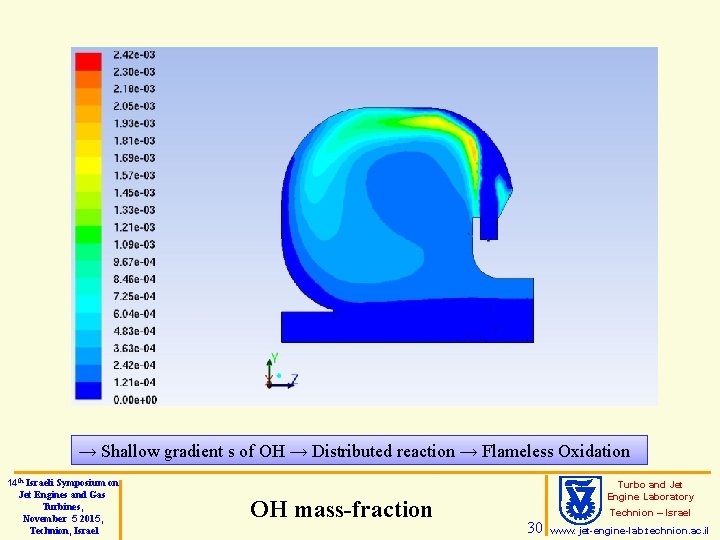
→ Shallow gradient s of OH → Distributed reaction → Flameless Oxidation 14 th Israeli Symposium on Jet Engines and Gas Turbines, November 5 2015, Technion, Israel OH mass-fraction Turbo and Jet Engine Laboratory Technion – Israel 30 www. jet-engine-lab. technion. ac. il
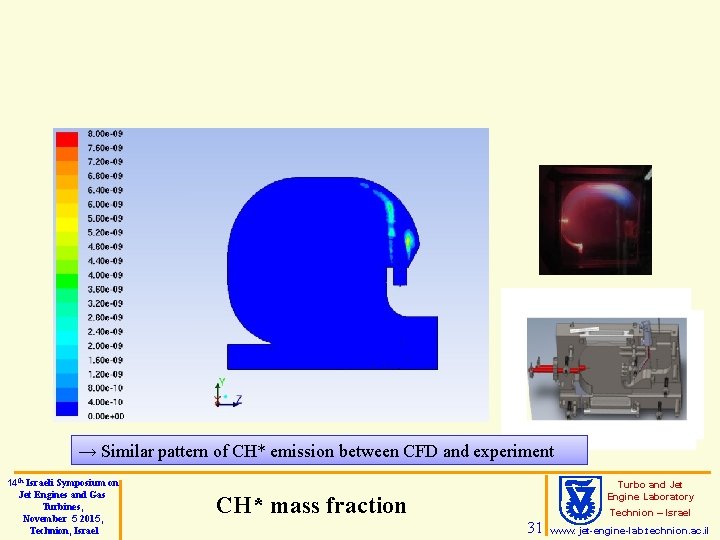
→ Similar pattern of CH* emission between CFD and experiment 14 th Israeli Symposium on Jet Engines and Gas Turbines, November 5 2015, Technion, Israel CH* mass fraction Turbo and Jet Engine Laboratory Technion – Israel 31 www. jet-engine-lab. technion. ac. il
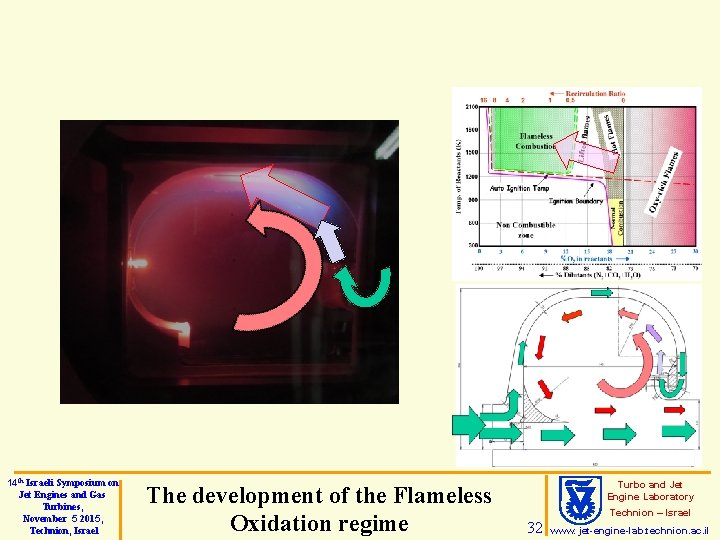
14 th Israeli Symposium on Jet Engines and Gas Turbines, November 5 2015, Technion, Israel The development of the Flameless Oxidation regime Turbo and Jet Engine Laboratory Technion – Israel 32 www. jet-engine-lab. technion. ac. il

Oxidant characteristics O 2 CFD simulation N 2 0. 190 0. 780 Experimental 0. 193 0. 776 results 14 th Israeli Symposium on Jet Engines and Gas Turbines, November 5 2015, Technion, Israel H 2 O Combustor performance Tin Texit [k] 0. 030 600 [k] 825 0. 031 583 822 CO UHC NOx ppmdv* ppmdv 41 <0. 0015 0. 016 22. 5 0. 7 0. 1 Turbo and Jet Engine Laboratory Verification of CFD results Technion – Israel 33 www. jet-engine-lab. technion. ac. il
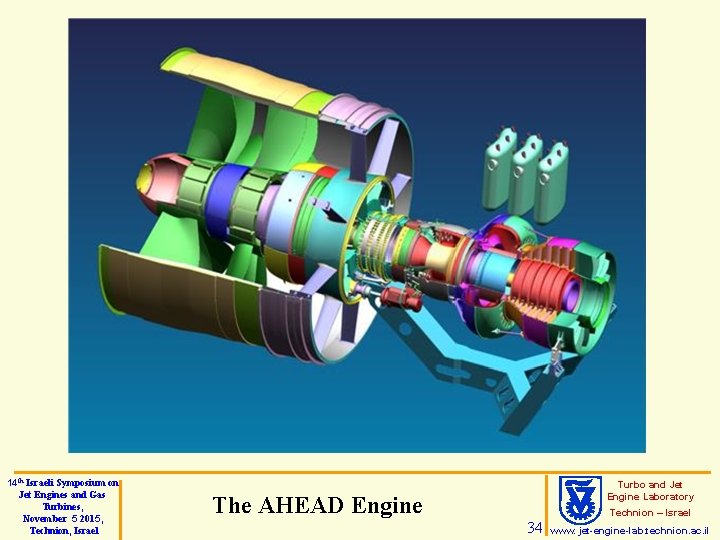
14 th Israeli Symposium on Jet Engines and Gas Turbines, November 5 2015, Technion, Israel The AHEAD Engine Turbo and Jet Engine Laboratory Technion – Israel 34 www. jet-engine-lab. technion. ac. il
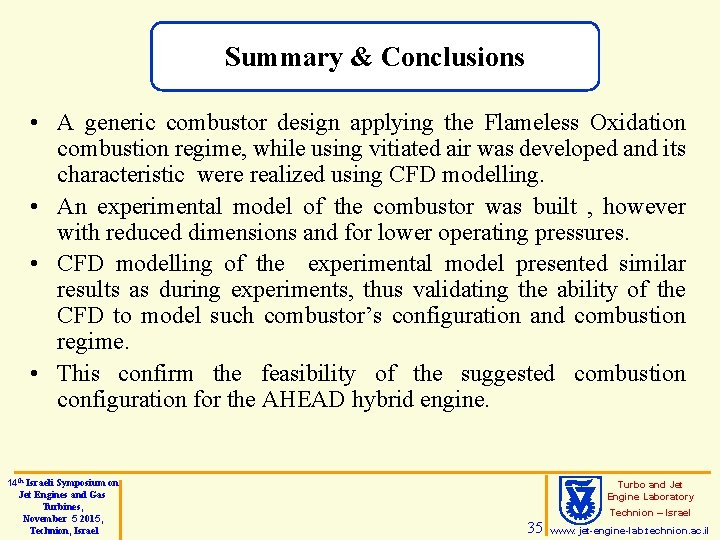
Summary & Conclusions • A generic combustor design applying the Flameless Oxidation combustion regime, while using vitiated air was developed and its characteristic were realized using CFD modelling. • An experimental model of the combustor was built , however with reduced dimensions and for lower operating pressures. • CFD modelling of the experimental model presented similar results as during experiments, thus validating the ability of the CFD to model such combustor’s configuration and combustion regime. • This confirm the feasibility of the suggested combustion configuration for the AHEAD hybrid engine. 14 th Israeli Symposium on Jet Engines and Gas Turbines, November 5 2015, Technion, Israel Turbo and Jet Engine Laboratory Technion – Israel 35 www. jet-engine-lab. technion. ac. il

Thank You…. . ! 14 th Israeli Symposium on Jet Engines and Gas Turbines, November 5 2015, Technion, Israel Turbo and Jet Engine Laboratory Technion – Israel 36 www. jet-engine-lab. technion. ac. il

COMBUSTOR DESIGN BASED ON CHEMKIN AND CFD SIMULATIONS (contd. . ) Performance requirements and emission limitations Combustor preliminary shape based on operational parameters and geometrical design limitations Fuel and Oxidizer distribution for primary and dilution zones Geometry CFD simulations Select model for Turbulence, Atomization, Combustion and Heat transfer Run calculation Comparison results Satisfactory agreement 14 th Israeli Symposium on Jet Engines and Gas Turbines, November 5 2015, Technion, Israel Not satisfactory Build grid and perform Grid verification Revise design Developed combustor model Turbo and Jet Engine Laboratory Technion – Israel 37 www. jet-engine-lab. technion. ac. il

LH 2 COMBUSTOR JP 8/BIO-JET FUELED COMBUSTOR D 1 D 2 L 14. 585 § LNG/ LH 2 Main Combustor § Kerosene/ Biofuel Secondary Flameless Combustor § Bleed air cooled by LH 2 § Shrouded fans § Higher Specific Thrust § Low Installation Penalty 14 th Israeli Symposium on Jet Engines and Gas Turbines, November 5 2015, Technion, Israel Turbo and Jet Engine Laboratory Technion – Israel 38 www. jet-engine-lab. technion. ac. il

Emissions under FLAMELESS conditions CO (dry volume ppm @ 15%O 2) CO vs Air_2 110. 0 100. 0 90. 0 80. 0 70. 0 60. 0 50. 0 40. 0 30. 0 20. 0 R 2 = 0. 8417 CO vs Air_2 Poly. (CO vs Air_2) 20 30 40 50 60 Secondary Air (L/min) 70 80 NOx (dry volume ppm @ 15%O 2) NOx vs Air_2 4. 5 4. 0 3. 5 3. 0 2. 5 2. 0 1. 5 1. 0 0. 5 0. 0 Nox vs Air_2 35 14 th Israeli Symposium on Jet Engines and Gas Turbines, November 5 2015, Technion, Israel 40 45 50 55 60 Secondary Air (L/min) 65 70 Secondary Air 75 Turbo and Jet Engine Laboratory Technion – Israel 39 www. jet-engine-lab. technion. ac. il

Towards complete Flameless combustion 1 4 14 th Israeli Symposium on Jet Engines and Gas Turbines, November 5 2015, Technion, Israel 4 2 3 5 6 Turbo and Jet Engine Laboratory Technion – Israel 40 www. jet-engine-lab. technion. ac. il
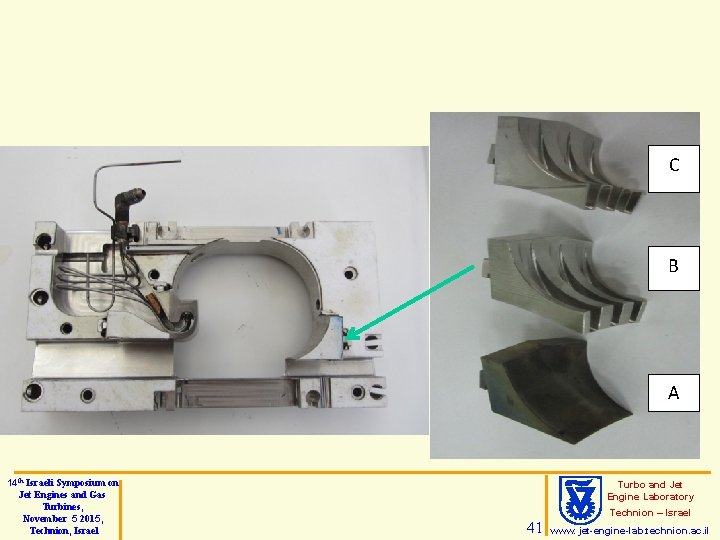
C B A 14 th Israeli Symposium on Jet Engines and Gas Turbines, November 5 2015, Technion, Israel Turbo and Jet Engine Laboratory Technion – Israel 41 www. jet-engine-lab. technion. ac. il
- Slides: 41