
FLAIL CHEST Anatomy 2 Overview of Chest Injuries

- Slides: 19
FLAIL CHEST
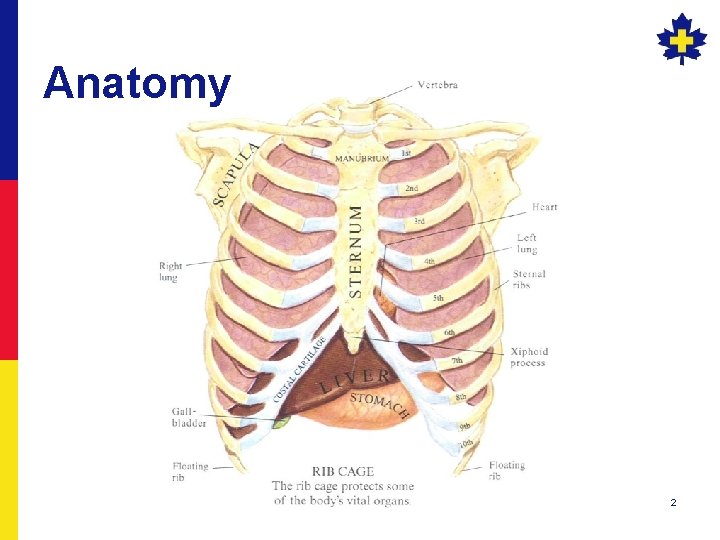
Anatomy 2
Overview of Chest Injuries p p p Can be life-threatening May result in damage to either the heart or the lung and cause severe internal bleeding Rib cage fractures may result in serious injury to vital organs Deep, open wounds allow air to enter the chest cavity Closed wounds usually involve injury to the ribs and possibly underlying structures 3
Signs of Chest Injuries An obvious chest wound p Impaired breathing p Irregular – or lack of – chest expansion p Coughing-up of blood p Shock p Subcutaneous emphysema: crackling sensation p 4
Closed Chest Injuries Rib fracture p Flail chest p Pneumothorax p 5
Rib Fracture Rib fractures are almost always the result of trauma (a blow) to the rib cage p Signs and Symptoms p n leaning toward the injured side n if the rib has punctured a lung, air can escape into the tissues of the chest wall creating a crackling sensation (- Subcutaneous Emphysema) n unwillingness to take a deep breath n complaining of local pain and tenderness n pain when moving the rib cage when breathing or coughing 6
Rib Fracture p Treatment n Give oxygen n Make the patient as comfortable as possible n Activate EMS and treat as Load and Go p Transport patient n in the position of maximum comfort on the injured side 7
Flail Chest Several adjacent ribs fractured in more than one place can produce a loose section of the chest wall p The flail section moves inward when the patient breathes in, and outward when the patient breathes out p This phenomenon is known as paradoxical movement p 8
Flail Chest p Signs and symptoms n shortness of breath n swelling over the injury site n shock n muscle splinting of the injury site n severe pain on inhalation/exhalation n possible paradoxical movement 9
Flail Chest p Treatment n Give oxygen as soon as possible n Be prepared to give AR n Help the patient get in a comfortable position and transport to medical aid. n Activate EMS and treat as Load and Go n Continue to monitor vital signs n Unless there is substantial bleeding, do not apply bulky padding or dressings 10
Use of Dressings on a Flail Chest p Only consider taped-on pad as a treatment in the following cases: n if there is likely to be a prolonged time before evacuation and access to medical care n if the patient has fatigued their chest muscles p To apply dressings n Press the segment inward with your gloved hand to stabilize it n Splint in the inward position with a pillow, large bulky dressing, or folded blanket or parka n Secure this thoroughly in place with tape n Be prepared to help breathing with AR n Do not hold in place with bandages encircling the chest. This would further impair the patient’s breathing effort 11
Pneumothorax p Is a condition that results from air entering the interpleural space. The air in the interpleural space compresses the lung and prevents normal breathing. p There are two types of pneumothorax: n Tension pneumothorax n Spontaneous pneumothorax 12
Pneumothorax p Signs and symptoms n reduction of normal respiratory movements on the affected side n a fall in blood pressure n weak and rapid pulse n a sudden sharp chest pain 13
Pneumothorax p Treatment for Tension Pneumothorax n Give oxygen n Activate EMS and treat as Load and Go n Continue to monitor vital signs p Treatment for Spontaneous Pneumothorax n Give oxygen n Transport to medical aid n The patient may prefer to be transported sitting up. 14
Open Chest Injuries p In penetration injuries of the chest wall, air can enter the interpleural space from the outside, causing the lung to collapse p Air moving back and forth through the chest wall results in what is often called a sucking chest wound, because of the sucking sound during inhalation 15
Open Chest Injuries p Signs and symptoms n increasing difficulty in breathing n frothy blood at the mouth/site of wound n rapid, weak pulse n cyanosis n falling blood pressure n localized chest pain 16
Open Chest Injuries p Treatment n Seal the wound with any airtight material n Tape the material in place on three sides. Leave the bottom (based on patient position) side unsealed to release accumulated air n Continually monitor the “dressing” to ensure that the seal is effective on inspiration only p Transport the patient n n n in a position of comfort in a position which will not impair breathing give oxygen monitor vital signs activate EMS and treat as Load and Go 17
Impaled Objects Impaled objects are things such as broken glass or large splinters that are both embedded into and protruding from the body p Signs and Symptoms p n Impaled objects are easily identified by sight 18
Impaled Objects p Treatment n do not move or remove the object n build up a dressing around the object to hold it in place during transportation n tape the dressing in place p Transport the patient n n p in the most comfortable position possible monitor respiration transport to medical aid immediately. activate EMS and treat as Load and Go continue to monitor vital signs If the object is obviously dangling from the skin or will cause extreme further damage, it should be removed 19