
FixingMaking Holes in Binaries The Easy The Hard

Fixing/Making Holes in Binaries The Easy, The Hard, The Time Consuming Shaun Clowes – shaun@securereality. com. au
What are we doing? Changing the behaviour of programs Directly modifying the program in it’s compiled (binary) form n n No source code No recompilation
Types of Binary Modification Two types: n n Static (executable file) modification Runtime (process) modification
Why modify binaries? For the usual reasons for working on software: n n n Fix bugs Add functionality Change behaviour
Why not just use source? No access to it n COTS Not readily available n Source code on a disk hidden in a cupboard behind mountains of other disks and CDs Running programs n 99. 999% uptime, no restart

Isn’t it too hard? Traditionally been in the too hard basket Depends on the objective n Normal value proposition It can be easy, it can also be very hard n n We’ll cover a variety of techniques All do need some coding skill
How’s this related to Security? Two aspects Defender n n Fix holes in vulnerable software No waiting for vendor patches Attacker n Backdoor/Trojan software
Scope Unix systems n n Solaris Linux ELF binaries Most concepts more generally applicable
Where to from here? All about ELF File patching In memory patching Library interception injectso - Run time library interception
Breakdown of ELF Need understanding of internal structure of executables ELF = Executable and Linkable Format Originally by Unix System Labs (USL) Adopted by Tool Interface Standards committee (TIS) Used in virtually every recent Unix
Breakdown of ELF Three main types of ELF files n n n Relocatable file – object file ready to be linked with others Executable Shared Object (Library) Only last two relevant Concentrate on Executables
Static Vs Dynamic Executables Static executables are self contained n They do not need any external code Dynamic executables use external data/code at run time n n Shared libraries Smaller executables Less disk/memory use Much more common
ELF ‘Views’ ELF describes two separate ‘views’ of an executable, a linking view and a loading view Linking view is used at static link time to combine relocatable files Loading view is used at run time to load and execute program
ELF ‘Views’ – Split
ELF Linking View Divides executable into many meaningful ‘Sections’ Sections have: n n n A name and type Requested memory location at run time Permissions (writable/executable)
ELF Linking View – Important Sections. interp Requested Dynamic linker. dynamic Dynamic linking information. symtab, . dynsym Symbols (static/dynamic). strtab, . dynstr. plt. rel. <x>. text. data String tables Procedure linkage table Relocations for section x Code Initialized data
ELF Linking View Not all sections needed at run time n n Information used for linking Debugging information Difference between link time and run time
ELF Loading View Much simpler view, divides executable into ‘Segments’ Describes n n Parts of file to be loaded into memory at run time Locations of important data at run time Segments have: n n A simple type Requested memory location Permissions (R/W/X) Size (in file and in memory)
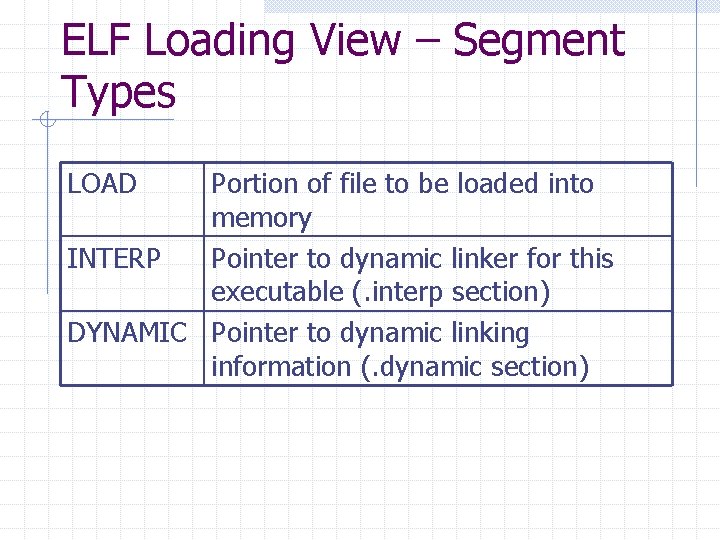
ELF Loading View – Segment Types LOAD Portion of file to be loaded into memory INTERP Pointer to dynamic linker for this executable (. interp section) DYNAMIC Pointer to dynamic linking information (. dynamic section)
ELF ‘Views’ - Linking to Loading
ELF Loading View Semantics of section table (Linking View) are irrelevant in Loading View Section information can be removed from executable n Good way to kill GNU libbfd programs
ELF Loaders Operating system routines to load executable and begin execution ELF is very flexible, Loaders aren’t n n Bugs and idiosyncrasies ELF files conforming to the specification don’t always run
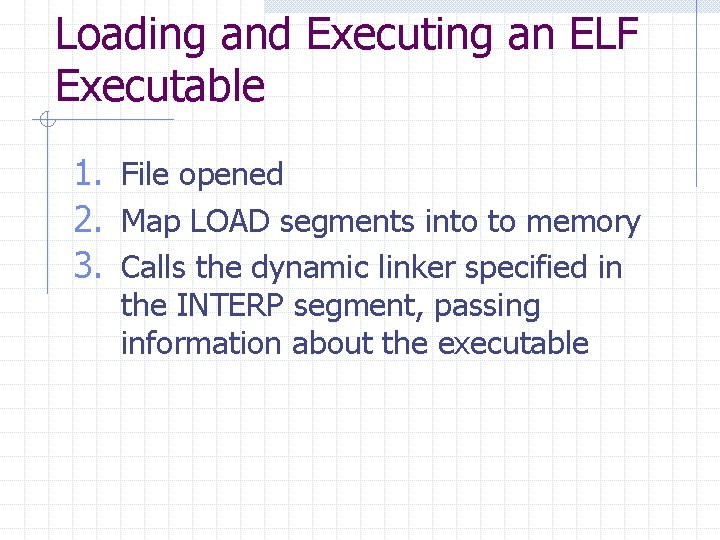
Loading and Executing an ELF Executable 1. File opened 2. Map LOAD segments into to memory 3. Calls the dynamic linker specified in the INTERP segment, passing information about the executable
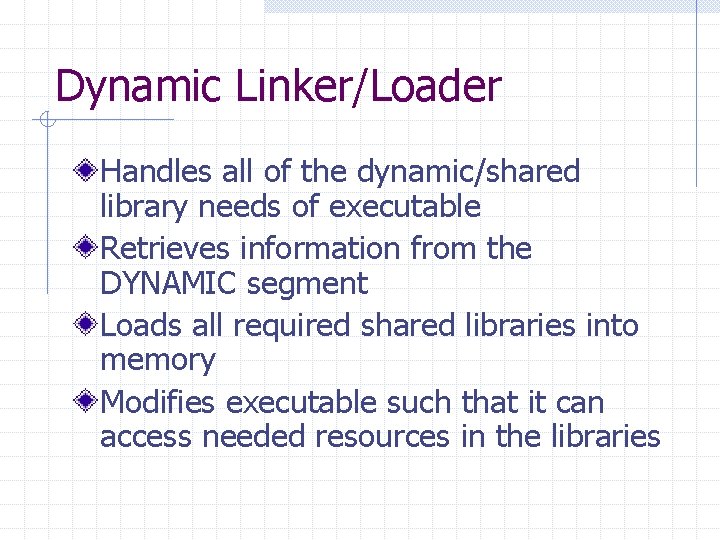
Dynamic Linker/Loader Handles all of the dynamic/shared library needs of executable Retrieves information from the DYNAMIC segment Loads all required shared libraries into memory Modifies executable such that it can access needed resources in the libraries
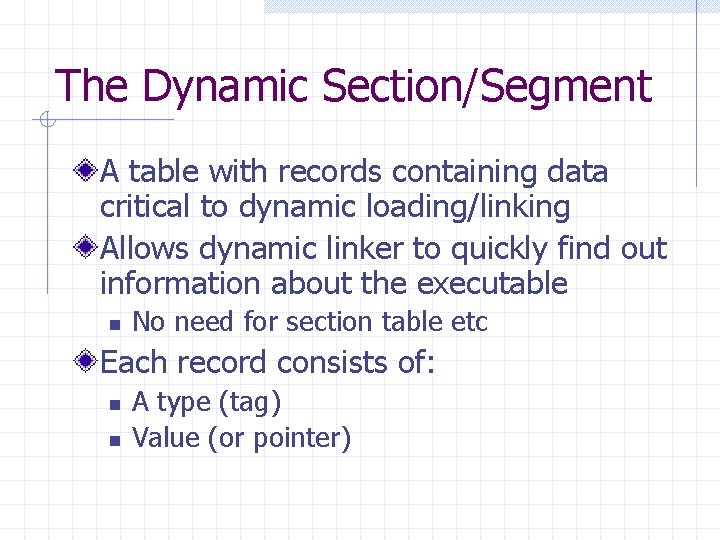
The Dynamic Section/Segment A table with records containing data critical to dynamic loading/linking Allows dynamic linker to quickly find out information about the executable n No need for section table etc Each record consists of: n n A type (tag) Value (or pointer)
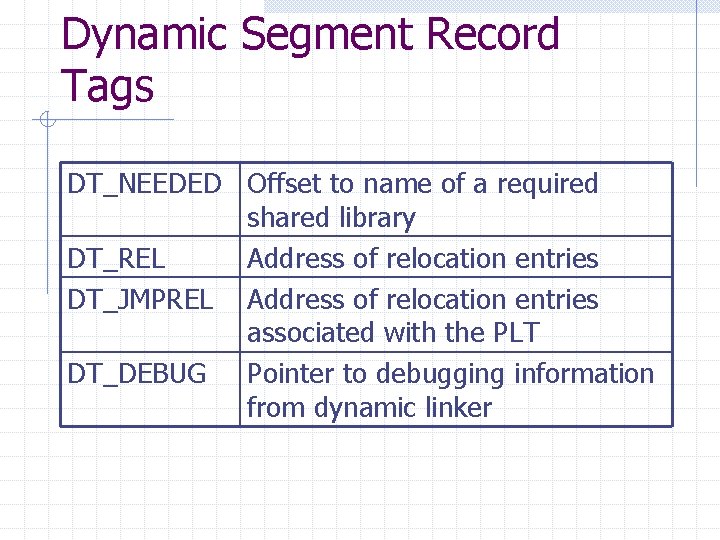
Dynamic Segment Record Tags DT_NEEDED Offset to name of a required shared library DT_REL Address of relocation entries DT_JMPREL Address of relocation entries associated with the PLT DT_DEBUG Pointer to debugging information from dynamic linker
Loading and Executing an ELF Executable 5. Map in shared libraries corresponding to DT_NEEDED entries 6. Add libraries to link map stored in area referenced by DT_DEBUG entry 7. Perform relocations
Relocations Tell Dynamic Linker to rewrite parts of executable to refer to external resources n Link to dynamic symbol table entries Needed to allow program to use code/data in shared libraries n Since address decided at run time
The Procedure Linkage Table Stored in the. plt section Allows executables to call functions that aren’t present at compile time n Shared library functions (e. g printf()) Set of function stubs n n Relocations point them to real location of the functions Normally relocated ‘lazily’
The Procedure Linkage Table
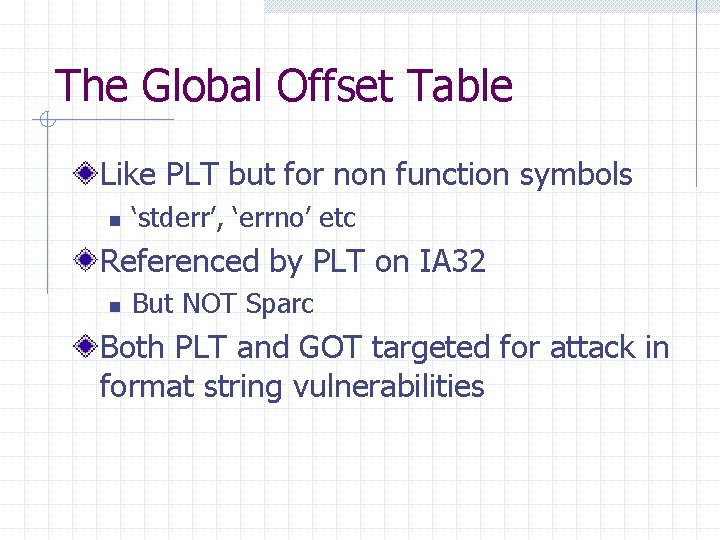
The Global Offset Table Like PLT but for non function symbols n ‘stderr’, ‘errno’ etc Referenced by PLT on IA 32 n But NOT Sparc Both PLT and GOT targeted for attack in format string vulnerabilities
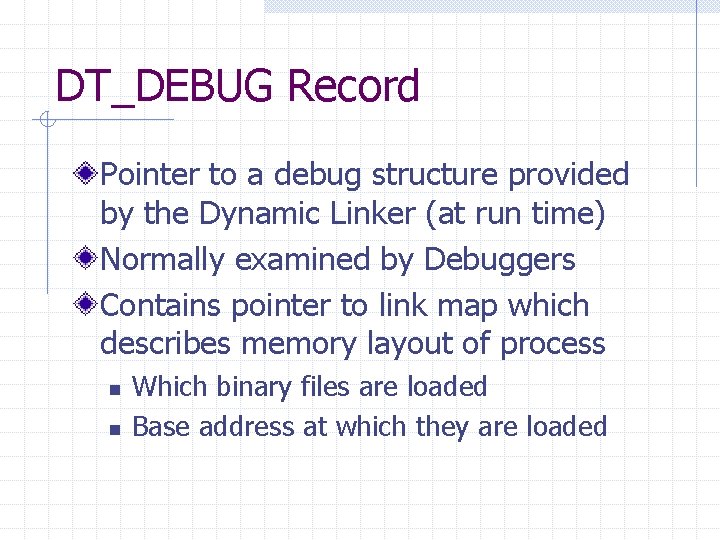
DT_DEBUG Record Pointer to a debug structure provided by the Dynamic Linker (at run time) Normally examined by Debuggers Contains pointer to link map which describes memory layout of process n n Which binary files are loaded Base address at which they are loaded
File Patching Statically modify code in executable file Need to: n n Insert additional code Link existing code to added code

File Patching
File Patching Need to understand existing code n n Disassembly Reverse Engineering New code n n Assembly Hybrid C
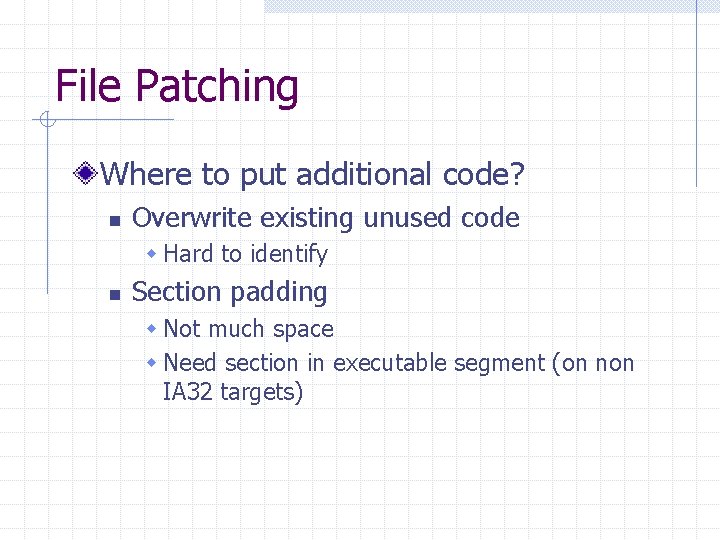
File Patching Where to put additional code? n Overwrite existing unused code w Hard to identify n Section padding w Not much space w Need section in executable segment (on non IA 32 targets)
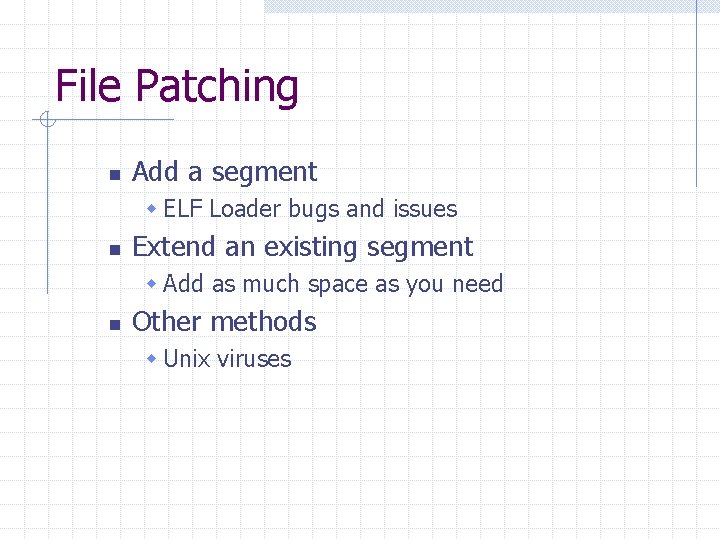
File Patching n Add a segment w ELF Loader bugs and issues n Extend an existing segment w Add as much space as you need n Other methods w Unix viruses
File Patching – Extending a Segment

File Patching Demo
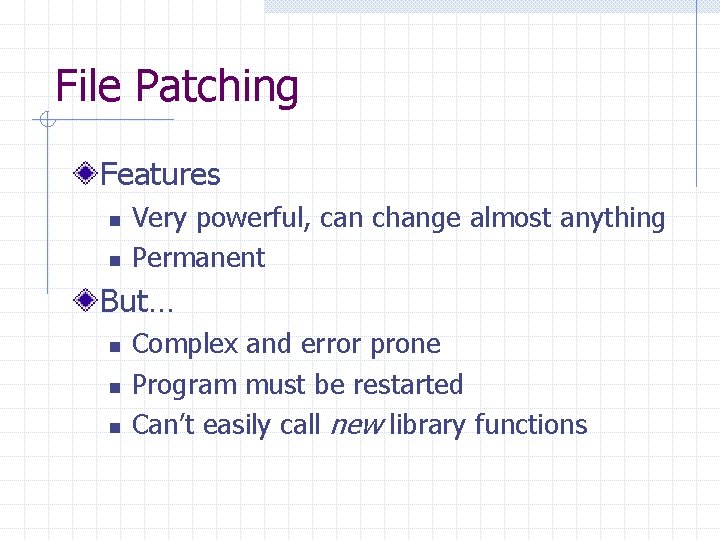
File Patching Features n n Very powerful, can change almost anything Permanent But… n n n Complex and error prone Program must be restarted Can’t easily call new library functions
In Core Patching Exactly like file patching but performed on process memory image Modify process memory using ptrace() or procfs
In Core Patching Where to put additional code? n Memory space must be mapped executable w Except under IA 32 n Overwrite unused code w Hard to identify n Use segment padding w Segments padded to page boundaries
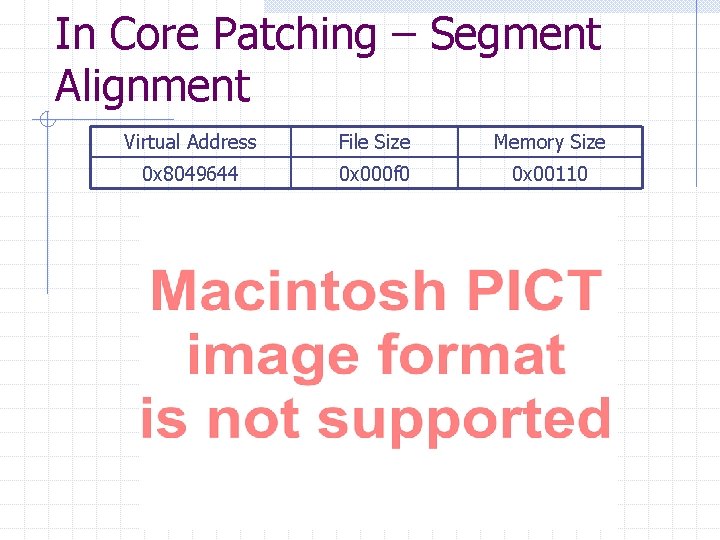
In Core Patching – Segment Alignment Virtual Address File Size Memory Size 0 x 8049644 0 x 000 f 0 0 x 00110
In Core Patching Demo
In Core Patching Features n n n Very powerful, can change almost anything Non permanent Can be performed on running process But… n n Complex and error prone Can easily kill target Limited space for new code Can’t easily call new library functions
Library Interception Dynamic loader resolves at run time all external symbols (dynamic relocations) n n GOT – Data relocations PLT – Function relocations How?
Library Interception Reads DT_NEEDED entries in PT_DYNAMIC segment Loads files and adds them to link map Then goes on to process relocations
Library Interception – Process View
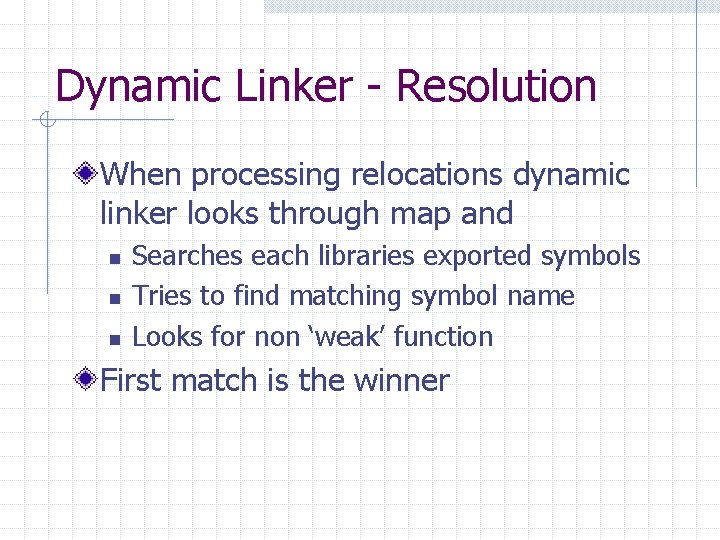
Dynamic Linker - Resolution When processing relocations dynamic linker looks through map and n n n Searches each libraries exported symbols Tries to find matching symbol name Looks for non ‘weak’ function First match is the winner
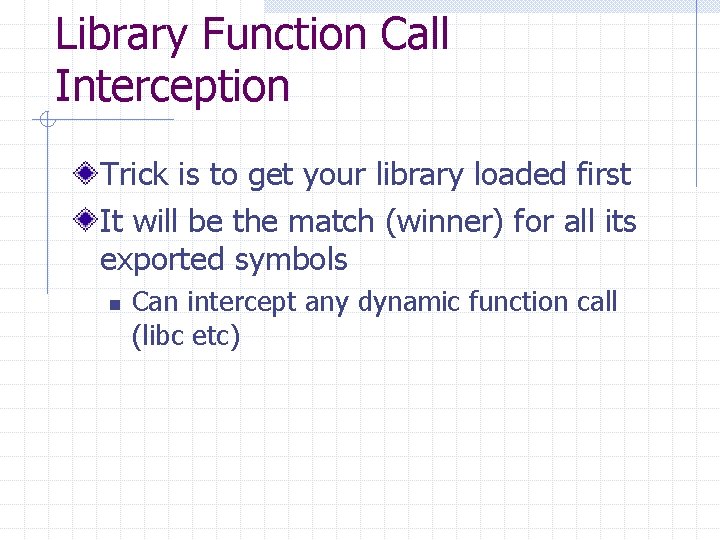
Library Function Call Interception Trick is to get your library loaded first It will be the match (winner) for all its exported symbols n Can intercept any dynamic function call (libc etc)
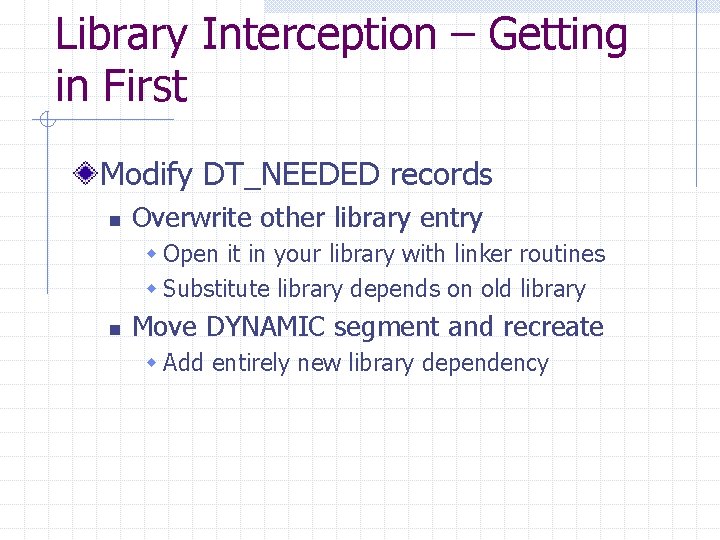
Library Interception – Getting in First Modify DT_NEEDED records n Overwrite other library entry w Open it in your library with linker routines w Substitute library depends on old library n Move DYNAMIC segment and recreate w Add entirely new library dependency
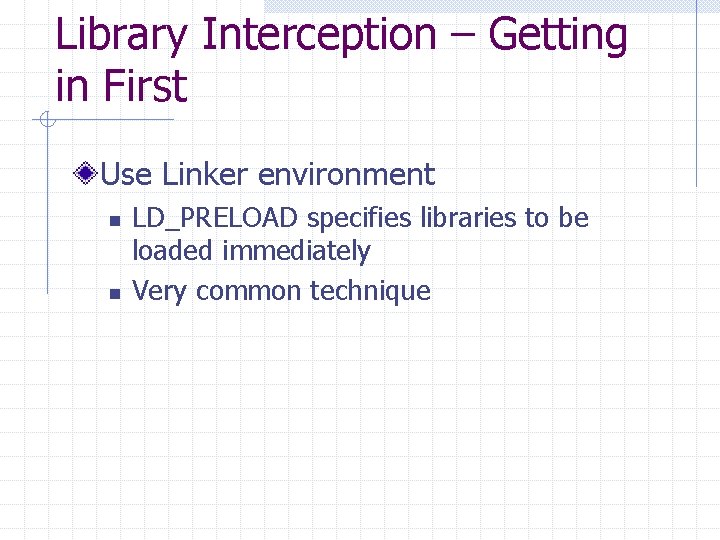
Library Interception – Getting in First Use Linker environment n n LD_PRELOAD specifies libraries to be loaded immediately Very common technique
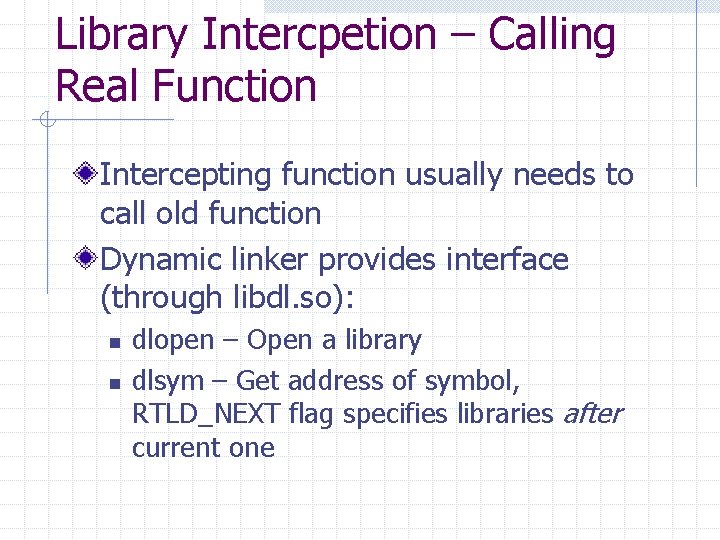
Library Intercpetion – Calling Real Function Intercepting function usually needs to call old function Dynamic linker provides interface (through libdl. so): n n dlopen – Open a library dlsym – Get address of symbol, RTLD_NEXT flag specifies libraries after current one
Library Interception - Demo
Library Interception Features n Easy and simple w All interception code can be done in C n n Safe Can call any library functions easily
Library Interception But… n n n LD_PRELOAD not permanent DT_NEEDED approach library in place at all times Program must be restarted
injectso – Runtime Library Interception injectso is like Inj. Lib for Windows Injects a shared library into a running program Much harder on Unix than in Windows n Operating system provides minimal support
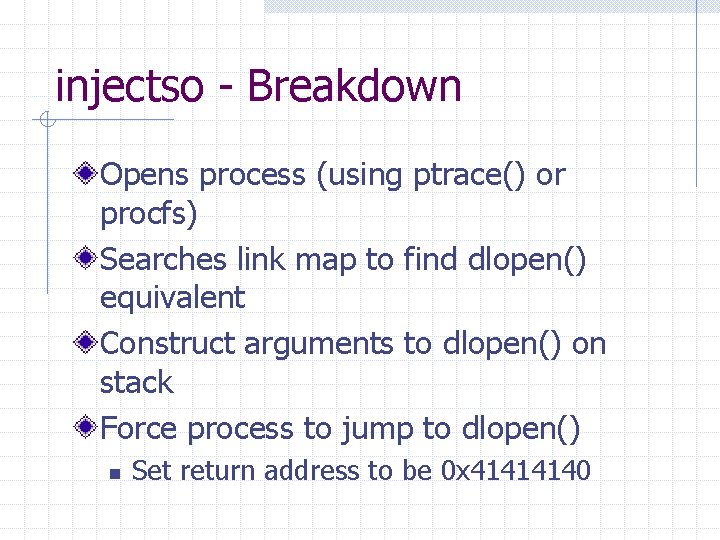
injectso - Breakdown Opens process (using ptrace() or procfs) Searches link map to find dlopen() equivalent Construct arguments to dlopen() on stack Force process to jump to dlopen() n Set return address to be 0 x 41414140
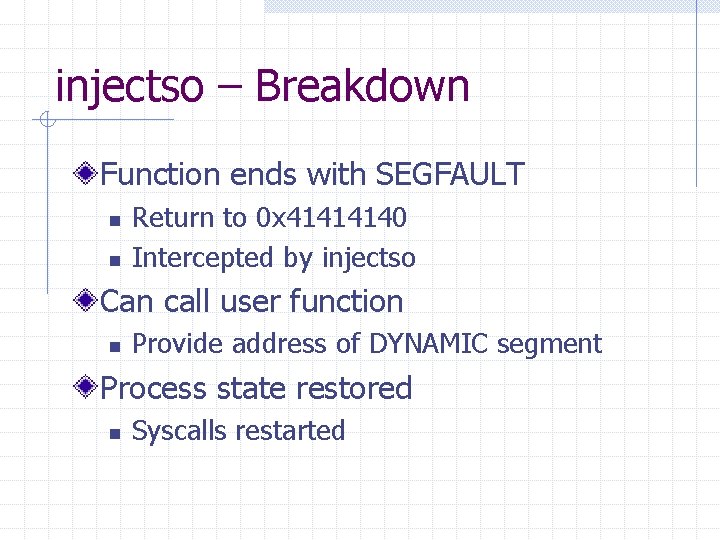
injectso – Breakdown Function ends with SEGFAULT n n Return to 0 x 41414140 Intercepted by injectso Can call user function n Provide address of DYNAMIC segment Process state restored n Syscalls restarted
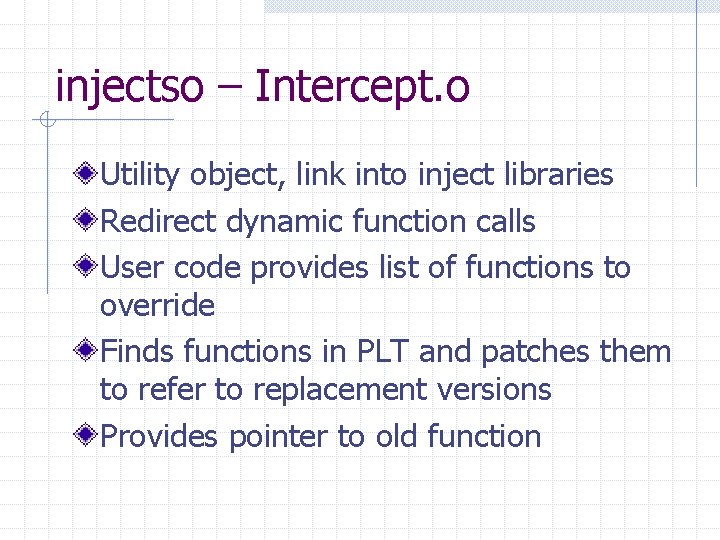
injectso – Intercept. o Utility object, link into inject libraries Redirect dynamic function calls User code provides list of functions to override Finds functions in PLT and patches them to refer to replacement versions Provides pointer to old function
injectso – Intercept. o
injectso Demo
injectso Features n n Simple Flexible No modifications to binary file No disk files w Library can be deleted after injection n Service does not need to be restarted
injectso Technical Features n n ‘Unlimited’ space for code No trampolines w Executable/Writable memory not required n n Can call any library functions easily Can override any library functions easily But… n Not permanent

Thankyou for listening! Questions? Secure. Reality Web Site: http: //www. securereality. com. au Email: shaun@securereality. com. au
- Slides: 65