
Fixing Service Failures Chapter 13 If they dont

- Slides: 29
Fixing Service Failures Chapter 13 “…If they don’t tell you they’ll likely just walk away shaking their heads and they’ll never come back…” Carl Sewell, Customers for Life “Do whatever is necessary to take care of guests. ” J. Willard Marriott, Jr.
Fixing Service Failures • No Perfect Systems – Guest sees, experiences and evaluates • Remember intangibility?
Fixing Service Failures • Service Failure – Something goes wrong • Constantly measure quality to minimize – When failure occurs, fix it!
SERVICE FAILURES: TYPES, WHERE, AND WHY
Types of Service Failures • Service product failures • Failure to meet explicit or implicit customer requests • Failures caused by employee actions or inactions • Failures caused by other guests, random events, or circumstances beyond control of organization
Critical Incidents During Service Encounters • Failures in service itself • Inappropriate employee actions, negative attitudes, or bad behaviors • Unsatisfactory employee response to service failure
Dimensions of Failure • Customer failure • Where failures happen • Severity of failure and recovery
Types of Service Failures • Customer Failure – Can’t let it destroy experience, or guest’s feelings about organization – Solve guests’ problem • Why, they created it? – Take away a positive impression • Leave happy in spite of themselves!
Where Failures Happen • Moments of truth • Service product inadequate • Failure to meet expectations
Severity of Failure and Recovery • Catastrophic to insignificant • Customer defines nature and severity – Some recovery will fix – Some recovery will make things worse • Guest insulted or embarrassed – their perception • Best action may be to neutralize angry guest
THE IMPORTANCE OF FIXING SERVICE FAILURES
Price of Failure • Costs money to lose customer • Lost revenue – Those who do not return – Those who might have come but will not because of negative word-of-mouth • Instantly accessible due to Internet
Price of Failure • Unhappy customers twice as likely to spread bad versus happy customers who spread good
Customer’s Response to Failure • Unhappy or dissatisfied is focus of service recovery – Never return – Complains – not necessarily a bad thing – Bad-mouthing organization – Retaliation – Worst-case scenario • Avenger
Value of Positive Publicity: Bad-Mouth versus Wow • Credibility – People telling people – Anonymous testimonials • Evangelists – Have positive message for all to hear! – Exceeding expectations – the WOW!
Dealing with Service Failures • How the Recovery is Handled – Positive or negative impact – Much better, or much worse off • May be more important than original failure • How recovery is handled – Message to employees
Dealing with Service Failures • Looking for service failures – Complaint as monitoring device • Complaints while still within the experience – Encouraging complaints – Body language as complaint – Do not forget to ask • As simple as, “Is/Was everything OK? ”
RECOVERING FROM SERVICE FAILURE
How to Handle a Service Failure • Do something quickly • Benefits of quick recovery – Reduces overall expense of retaining guests – Less expensive to fix problem on-the-spot – More likely guest will stay with organization
How Do Customers Evaluate Recovery Efforts? • Distributive justice – Outcome fairness – as assessed by guest • “We’re sorry” may not always be enough • Procedural justice – A hassle filled with red tape?
How Do Customers Evaluate Recovery Efforts? • Interactional justice – Treated with respect and courtesy • “Day in court” • Informational justice – Satisfaction with information and communication provided – transparency • Are you a victim of “unexplained wait? ”
How the Recovery is Managed • Fairness different with situation and people • Which “justice” is most important/influential in satisfying guest? • Fairly treated – Likely to come back – Spread good words – Be satisfied with experience
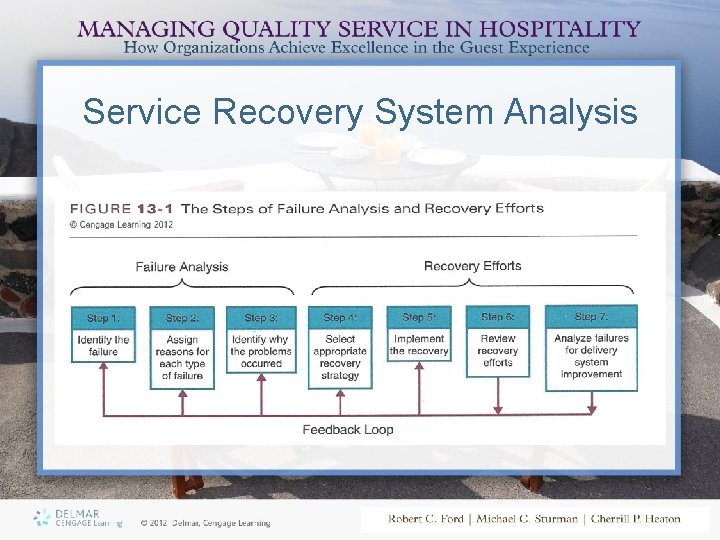
Service Recovery System Analysis
Characteristics of a Good Recovery Strategy • Ensure failure is addressed quickly • Communicate clearly to employees • Should be flexible enough to accommodate different types of failures and different expectations
Customer Defines Failures • Not making it better makes it worse – Does your strategy improve the situation? • Does rigidity of your system leave you unprepared to deal with exceptions? • Costs of failure to guests – It’s not my fault, why should I wait, call back or drive back?
Customer Defines Failures • Making it right not being enough – May have to do more! – What should compensation actually be? • Being wrong with dignity – Theme park lock out – Poor experience should not prevail over good
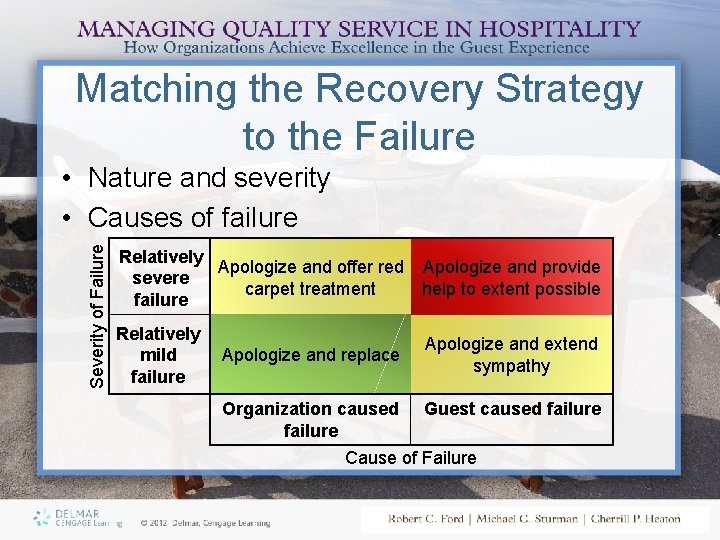
Matching the Recovery Strategy to the Failure Severity of Failure • Nature and severity • Causes of failure Relatively Apologize and offer red severe carpet treatment failure Apologize and provide help to extent possible Relatively mild failure Apologize and extend sympathy Apologize and replace Organization caused failure Guest caused failure Cause of Failure
From Bad to Good • Learning from failures • Service recovery – From Ow! to Wow!
Successful Service Recovery “…the integrative actions a company takes to re-establish customer satisfaction and loyalty after a service failure (customer recovery), to ensure that failure incidents encourage learning and process improvement (process recovery) and to train and reward employees for this purpose (employee recovery). ”