
Fixedtarget Drell Yan Present Future Wolfgang Lorenzon 3

- Slides: 35
Fixed-target Drell Yan -- Present & Future Wolfgang Lorenzon 3 D-PDF Workshop, Frascati, Italy (2 -December-2016) This work is supported by 1
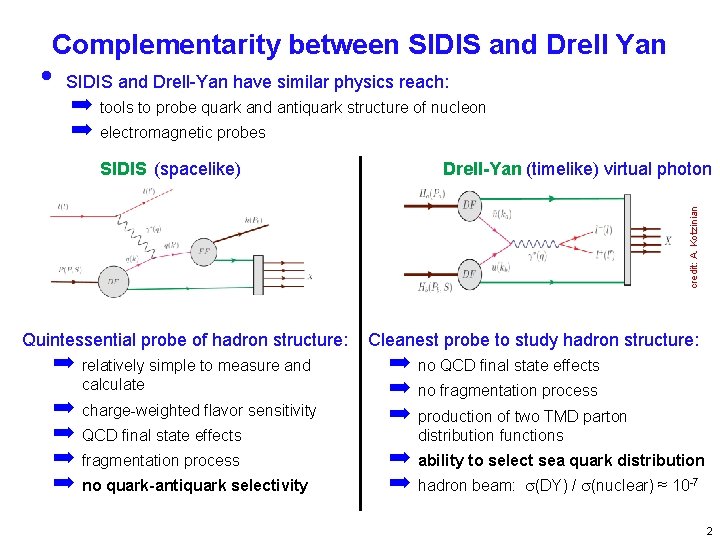
Complementarity between SIDIS and Drell Yan • SIDIS and Drell-Yan have similar physics reach: ➡ tools to probe quark and antiquark structure of nucleon ➡ electromagnetic probes Drell-Yan (timelike) virtual photon credit: A. Kotzinian SIDIS (spacelike) Quintessential probe of hadron structure: Cleanest probe to study hadron structure: ➡ relatively simple to measure and calculate ➡ charge-weighted flavor sensitivity ➡ QCD final state effects ➡ fragmentation process ➡ no quark-antiquark selectivity ➡ no QCD final state effects ➡ no fragmentation process ➡ production of two TMD parton distribution functions ➡ ability to select sea quark distribution ➡ hadron beam: s(DY) / s(nuclear) ≈ 10 -7 2
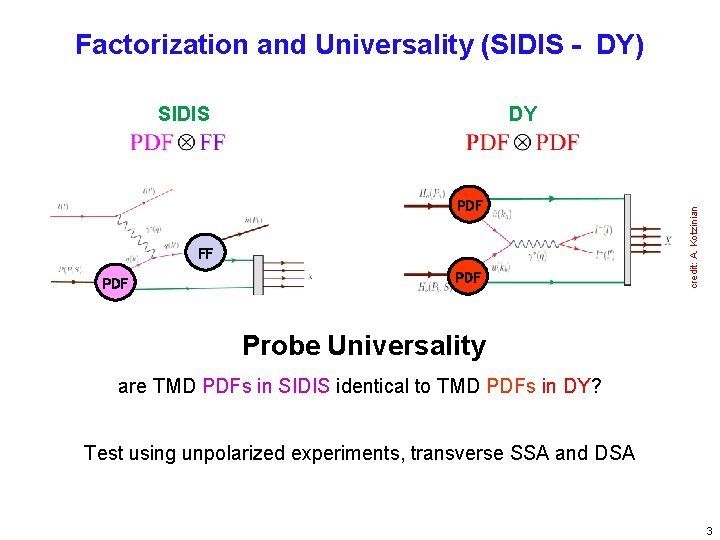
Factorization and Universality (SIDIS - DY) DY PDF FF PDF credit: A. Kotzinian SIDIS Probe Universality are TMD PDFs in SIDIS identical to TMD PDFs in DY? Test using unpolarized experiments, transverse SSA and DSA 3
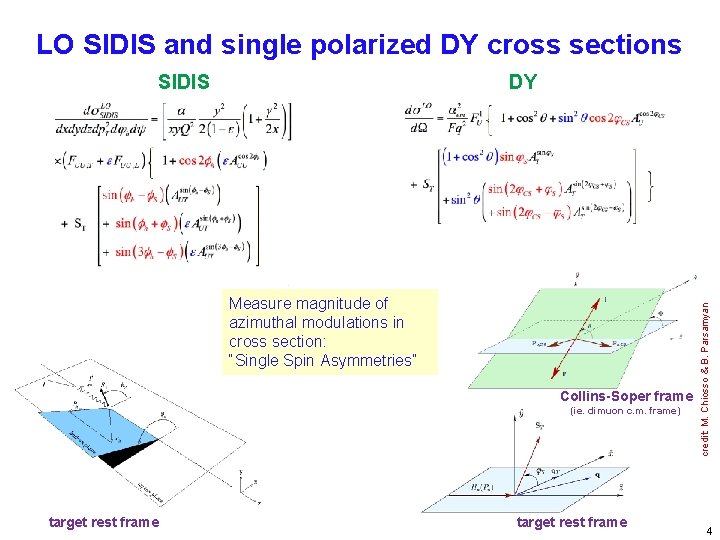
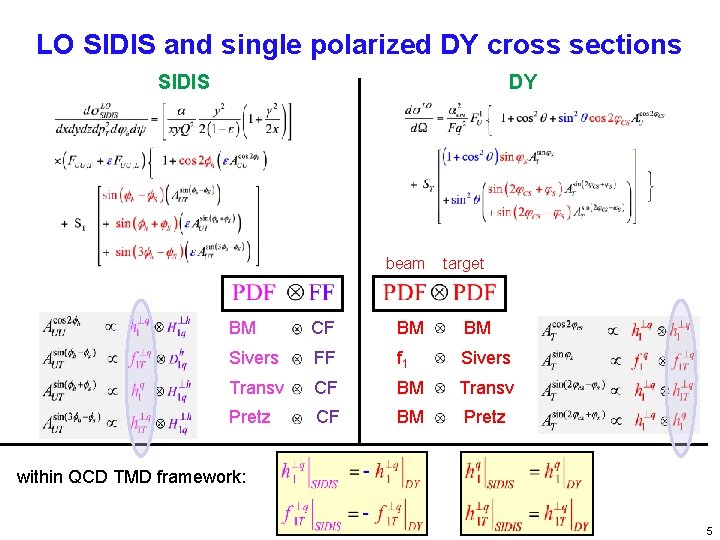
LO SIDIS and single polarized DY cross sections DY Measure magnitude of azimuthal modulations in cross section: “Single Spin Asymmetries” Collins-Soper frame (ie. dimuon c. m. frame) target rest frame credit: M. Chiosso & B. Parsamyan SIDIS 4
LO SIDIS and single polarized DY cross sections SIDIS DY beam target BM CF BM Sivers FF f 1 Sivers Transv CF BM Transv Pretz CF BM Pretz within QCD TMD framework: 5
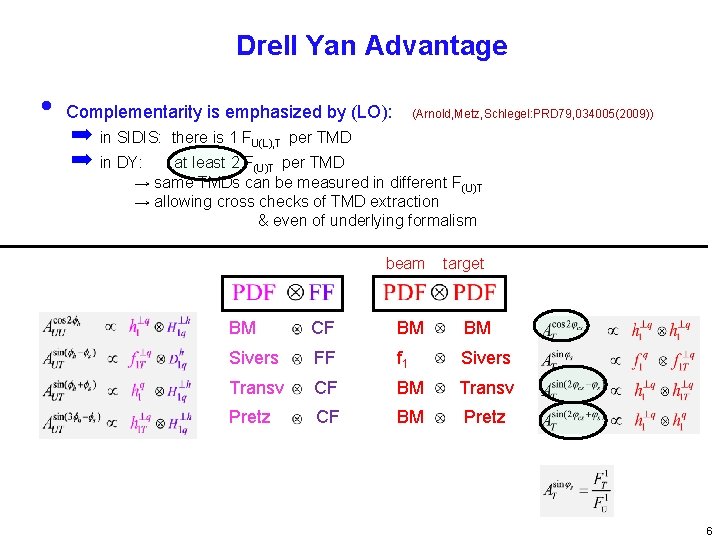
Drell Yan Advantage • Complementarity is emphasized by (LO): (Arnold, Metz, Schlegel: PRD 79, 034005(2009)) ➡ in SIDIS: there is 1 FU(L), T per TMD ➡ in DY: at least 2 F(U)T per TMD → same TMDs can be measured in different F(U)T → allowing cross checks of TMD extraction & even of underlying formalism beam target BM CF BM Sivers FF f 1 Sivers Transv CF BM Transv Pretz CF BM Pretz 6
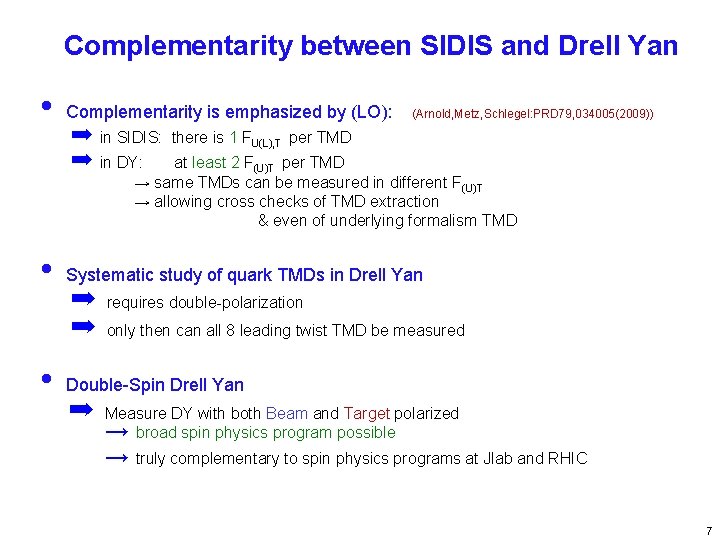
Complementarity between SIDIS and Drell Yan • Complementarity is emphasized by (LO): (Arnold, Metz, Schlegel: PRD 79, 034005(2009)) ➡ in SIDIS: there is 1 FU(L), T per TMD ➡ in DY: at least 2 F(U)T per TMD → same TMDs can be measured in different F(U)T → allowing cross checks of TMD extraction & even of underlying formalism TMD • Systematic study of quark TMDs in Drell Yan • Double-Spin Drell Yan ➡ requires double-polarization ➡ only then can all 8 leading twist TMD be measured ➡ Measure DY with both Beam and Target polarized → broad spin physics program possible → truly complementary to spin physics programs at Jlab and RHIC 7
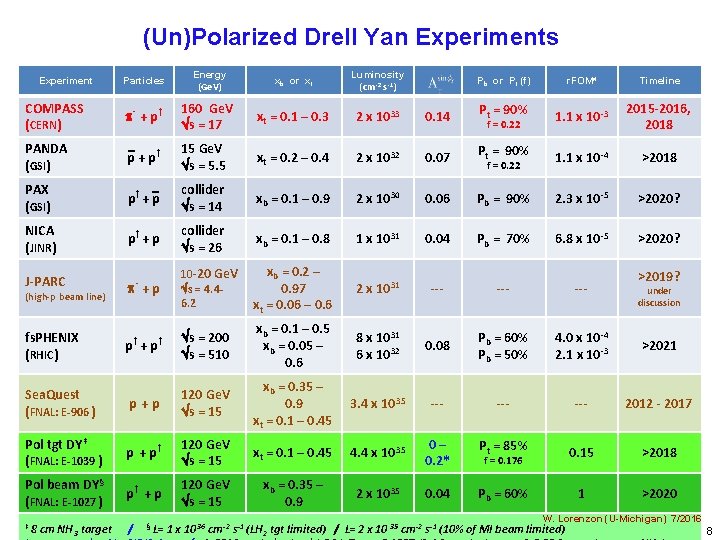
(Un)Polarized Drell Yan Experiments Particles Energy (Ge. V) xb or xt Luminosity (cm -2 s-1) COMPASS (CERN ) p- + p ↑ 160 Ge. V s = 17 xt = 0. 1 – 0. 3 2 x 10 33 PANDA (GSI) p + p↑ 15 Ge. V s = 5. 5 xt = 0. 2 – 0. 4 PAX (GSI) p↑ + p collider s = 14 NICA (JINR) p↑ + p Experiment J-PARC (high-p beam line) fs. PHENIX (RHIC ) - p +p ↑ Pb or Pt (f) r. FOM# Timeline 0. 14 Pt = 90% 1. 1 x 10 -3 2015 -2016, 2018 2 x 10 32 0. 07 Pt = 90% 1. 1 x 10 -4 >2018 xb = 0. 1 – 0. 9 2 x 10 30 0. 06 Pb = 90% 2. 3 x 10 -5 >2020? collider s = 26 xb = 0. 1 – 0. 8 1 x 10 31 0. 04 Pb = 70% 6. 8 x 10 -5 >2020? 10 -20 Ge. V s = 4. 46. 2 xb = 0. 2 – 0. 97 xt = 0. 06 – 0. 6 2 x 10 31 --- --- s = 200 s = 510 xb = 0. 1 – 0. 5 xb = 0. 05 – 0. 6 8 x 10 31 6 x 10 32 0. 08 Pb = 60% Pb = 50% 4. 0 x 10 -4 2. 1 x 10 -3 >2021 xb = 0. 35 – 0. 9 xt = 0. 1 – 0. 45 3. 4 x 10 35 --- --- 2012 - 2017 f = 0. 22 >2019? under discussion Sea. Quest (FNAL: E-906 ) p +p 120 Ge. V s = 15 Pol tgt DY ‡ (FNAL: E-1039 ) p + p↑ 120 Ge. V s = 15 xt = 0. 1 – 0. 45 4. 4 x 10 35 0– 0. 2* Pt = 85% 0. 15 >2018 Pol beam DY § (FNAL: E-1027 ) p↑ + p 120 Ge. V s = 15 xb = 0. 35 – 0. 9 2 x 10 35 0. 04 Pb = 60% 1 >2020 ‡ 8 / cm NH 3 target § L= f = 0. 176 W. Lorenzon (U-Michigan) 7/2016 1 x 10 36 cm -2 s-1 (LH 2 tgt limited) / L= 2 x 10 35 cm -2 s-1 (10% of MI beam limited) 8
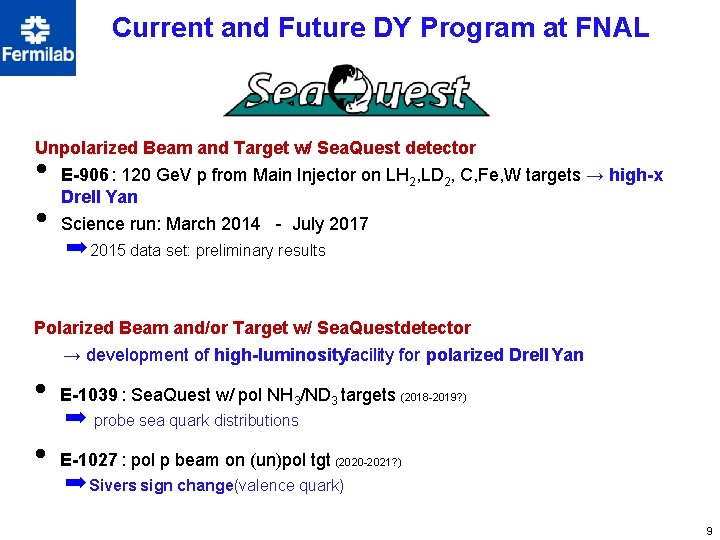
Current and Future DY Program at FNAL Unpolarized Beam and Target w/ Sea. Quest detector • • E-906 : 120 Ge. V p from Main Injector on LH 2, LD 2, C, Fe, W targets → high-x Drell Yan Science run: March 2014 - July 2017 ➡ 2015 data set: preliminary results Polarized Beam and/or Target w/ Sea. Questdetector → development of high-luminosity facility for polarized Drell Yan • • E-1039 : Sea. Quest w/ pol NH 3/ND 3 targets (2018 -2019? ) ➡ probe sea quark distributions E-1027 : pol p beam on (un)pol tgt (2020 -2021? ) ➡ Sivers sign change(valence quark) 9
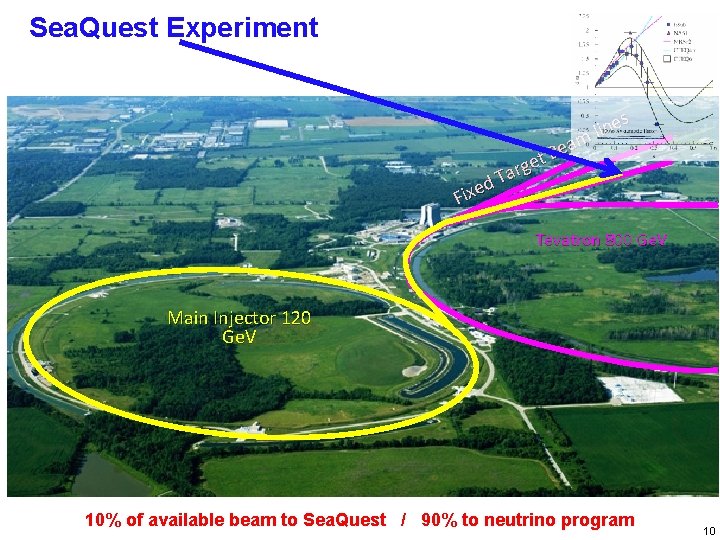
Sea. Quest Experiment et g r Ta d e Fix s ine l m Bea Tevatron 800 Ge. V Main Injector 120 Ge. V 10% of available beam to Sea. Quest / 90% to neutrino program 10
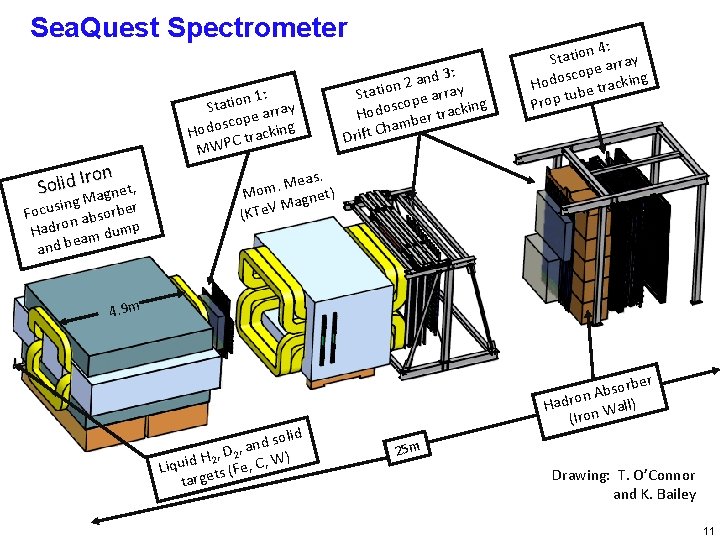
Sea. Quest Spectrometer n 1: o i t a t S array e p o c s Hodo tracking C MWP on r I d i l , So agnet ing M Focus absorber n Hadro am dump e and b nd 3: a 2 n Statio ope array ng sc Hodo ber tracki am rift Ch n 4: o i t a t S array e p o c s Hodo e tracking tub Prop D eas. M. m Mo gnet) a M (KTe. V 4. 9 m solid d n a , D 2, , W) H 2 d i Liqu (Fe, C s t e g tar orber s b A n Hadro n Wall) (Iro 25 m Drawing: T. O’Connor and K. Bailey 11
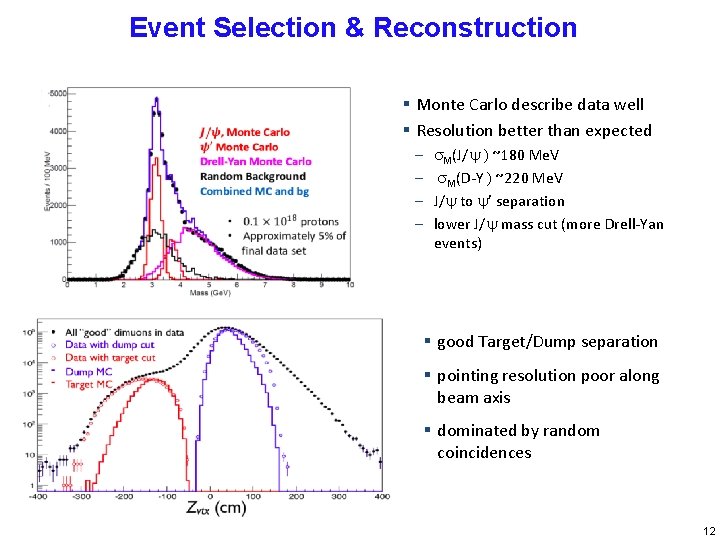
Event Selection & Reconstruction § Monte Carlo describe data well § Resolution better than expected – – s. M(J/y ) ~180 Me. V s. M(D-Y ) ~220 Me. V J/y to y’ separation lower J/y mass cut (more Drell-Yan events) § good Target/Dump separation § pointing resolution poor along beam axis § dominated by random coincidences 12
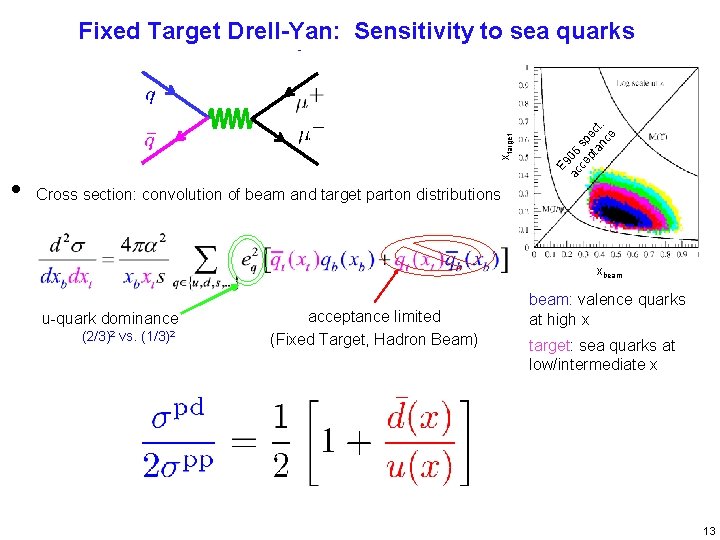
xtarget E 9 ac 06 ce sp pt ec an t. ce Fixed Target Drell-Yan: Sensitivity to sea quarks Drell-Yan Spectrometer for E 906 • Cross section: convolution of beam and target parton distributions xbeam u-quark dominance (2/3)2 vs. (1/3)2 acceptance limited (Fixed Target, Hadron Beam) beam: valence quarks at high x target: sea quarks at low/intermediate x 13
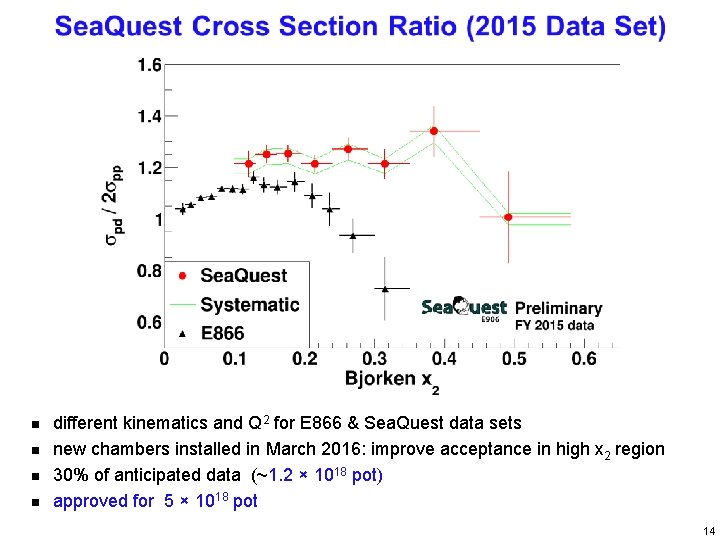
n n different kinematics and Q 2 for E 866 & Sea. Quest data sets new chambers installed in March 2016: improve acceptance in high x 2 region 30% of anticipated data (~1. 2 × 10¹⁸ pot) approved for 5 × 10¹⁸ pot 14
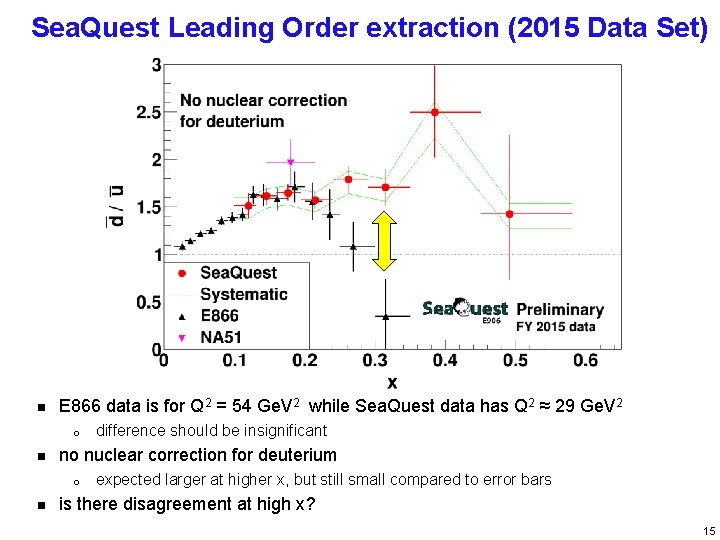
Sea. Quest Leading Order extraction (2015 Data Set) n E 866 data is for Q 2 = 54 Ge. V 2 while Sea. Quest data has Q 2 ≈ 29 Ge. V 2 o n no nuclear correction for deuterium o n difference should be insignificant expected larger at higher x, but still small compared to error bars is there disagreement at high x? 15
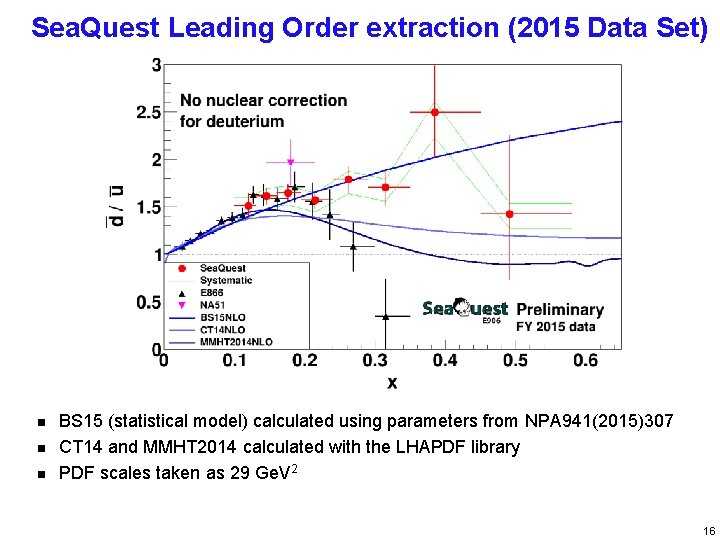
Sea. Quest Leading Order extraction (2015 Data Set) n n n BS 15 (statistical model) calculated using parameters from NPA 941(2015)307 CT 14 and MMHT 2014 calculated with the LHAPDF library PDF scales taken as 29 Ge. V 2 16
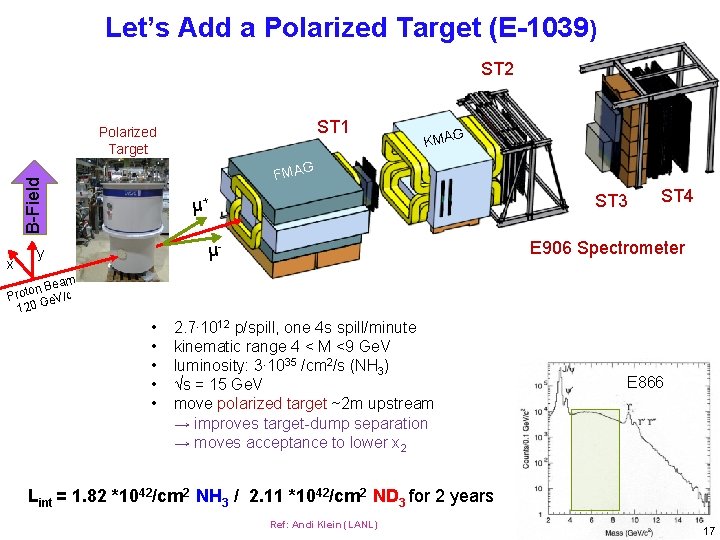
Let’s Add a Polarized Target (E-1039) ST 2 ST 1 Polarized Target KMAG B-Field G x FMA ST 3 μ+ x E 906 Spectrometer μ- y ST 4 am n Be o t o r P /c Ge. V 120 • • • 2. 7∙ 1012 p/spill, one 4 s spill/minute kinematic range 4 < M <9 Ge. V luminosity: 3∙ 1035 /cm 2/s (NH 3) √s = 15 Ge. V move polarized target ~2 m upstream → improves target-dump separation → moves acceptance to lower x 2 E 866 Lint = 1. 82 *1042/cm 2 NH 3 / 2. 11 *1042/cm 2 ND 3 for 2 years Ref: Andi Klein (LANL) 17
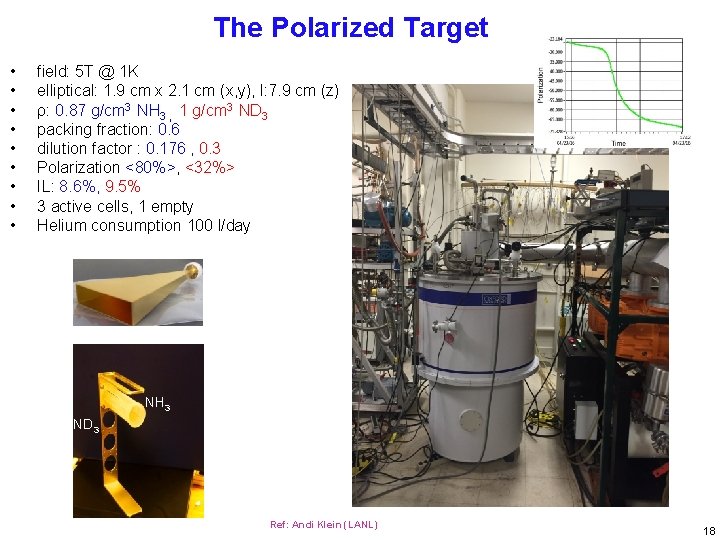
The Polarized Target • • • field: 5 T @ 1 K elliptical: 1. 9 cm x 2. 1 cm (x, y), l: 7. 9 cm (z) ρ: 0. 87 g/cm 3 NH 3 , 1 g/cm 3 ND 3 packing fraction: 0. 6 dilution factor : 0. 176 , 0. 3 Polarization <80%>, <32%> IL: 8. 6%, 9. 5% 3 active cells, 1 empty Helium consumption 100 l/day NH 3 ND 3 Ref: Andi Klein (LANL) 18
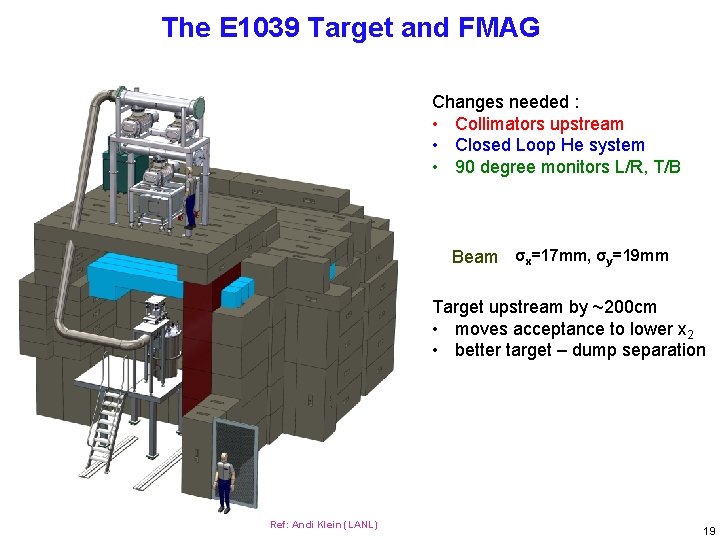
The E 1039 Target and FMAG Changes needed : • Collimators upstream • Closed Loop He system • 90 degree monitors L/R, T/B Beam σx=17 mm, σy=19 mm Target upstream by ~200 cm • moves acceptance to lower x 2 • better target – dump separation Ref: Andi Klein (LANL) 19
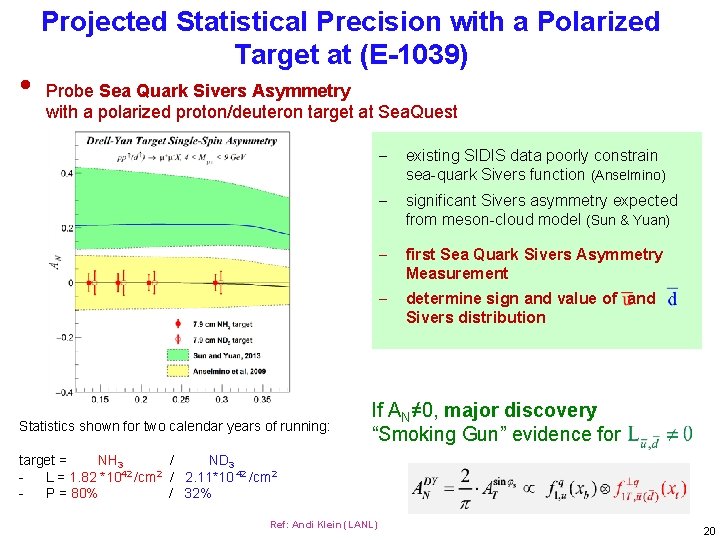
• Projected Statistical Precision with a Polarized Target at (E-1039) Probe Sea Quark Sivers Asymmetry with a polarized proton/deuteron target at Sea. Quest ‒ existing SIDIS data poorly constrain sea-quark Sivers function (Anselmino) ‒ significant Sivers asymmetry expected from meson-cloud model (Sun & Yuan) Statistics shown for two calendar years of running: ‒ first Sea Quark Sivers Asymmetry Measurement ‒ determine sign and value of and Sivers distribution If AN≠ 0, major discovery: “Smoking Gun” evidence for target = NH 3 / ND 3 - L = 1. 82 *1042 /cm 2 / 2. 11*10 42 /cm 2 - P = 80% / 32% Ref: Andi Klein (LANL) 20
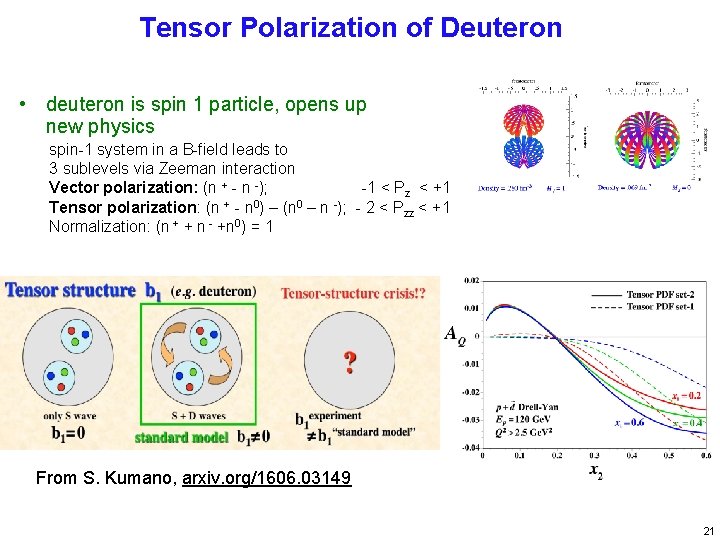
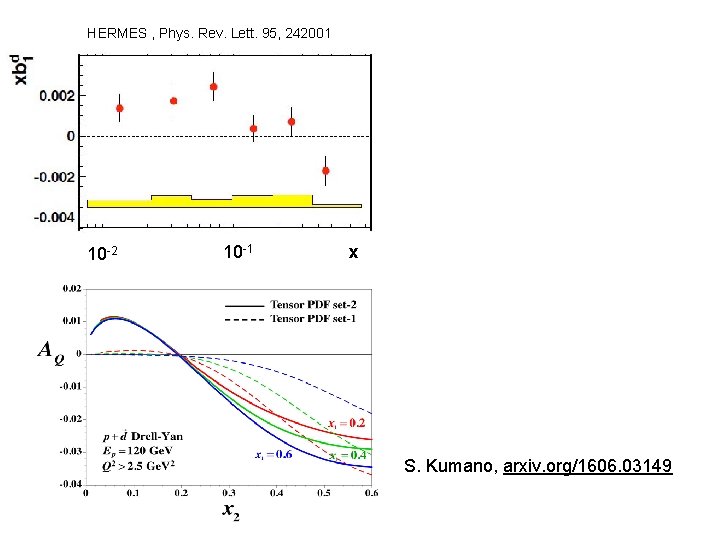
Tensor Polarization of Deuteron • deuteron is spin 1 particle, opens up new physics spin-1 system in a B-field leads to 3 sublevels via Zeeman interaction Vector polarization: (n + - n -); -1 < Pz < +1 Tensor polarization: (n + - n 0) – (n 0 – n -); - 2 < Pzz < +1 Normalization: (n + + n - +n 0) = 1 From S. Kumano, arxiv. org/1606. 03149 21
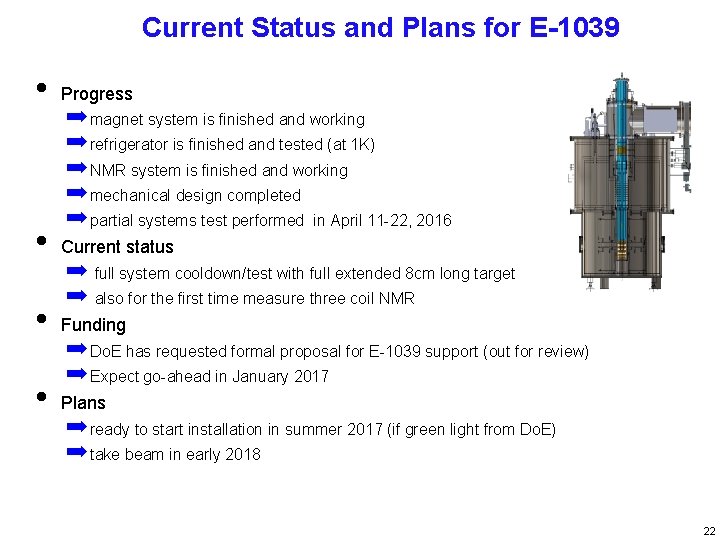
Current Status and Plans for E-1039 • Progress • Current status • Funding • Plans ➡ magnet system is finished and working ➡ refrigerator is finished and tested (at 1 K) ➡ NMR system is finished and working ➡ mechanical design completed ➡ partial systems test performed in April 11 -22, 2016 ➡ full system cooldown/test with full extended 8 cm long target ➡ also for the first time measure three coil NMR ➡ Do. E has requested formal proposal for E-1039 support (out for review) ➡ Expect go-ahead in January 2017 ➡ ready to start installation in summer 2017 (if green light from Do. E) ➡ take beam in early 2018 22
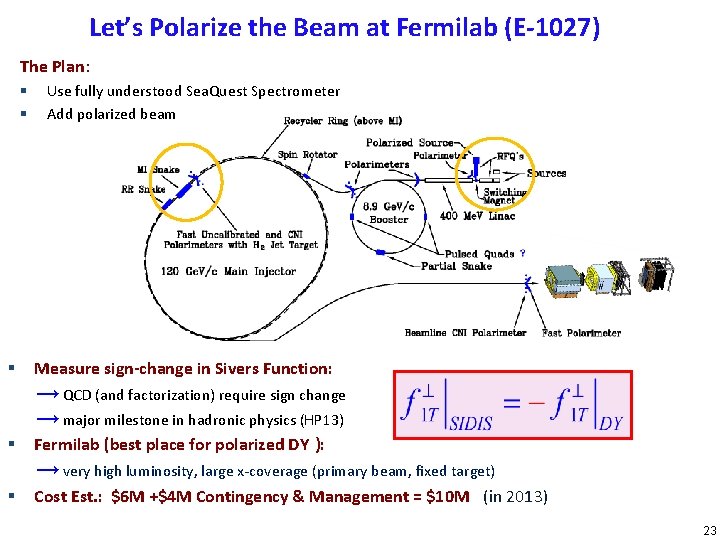
Let’s Polarize the Beam at Fermilab (E-1027) The Plan: § § Use fully understood Sea. Quest Spectrometer Add polarized beam § Measure sign-change in Sivers Function: § Fermilab (best place for polarized DY ): § Cost Est. : $6 M +$4 M Contingency & Management = $10 M (in 2013) → QCD (and factorization) require sign change → major milestone in hadronic physics (HP 13) → very high luminosity, large x-coverage (primary beam, fixed target) 23
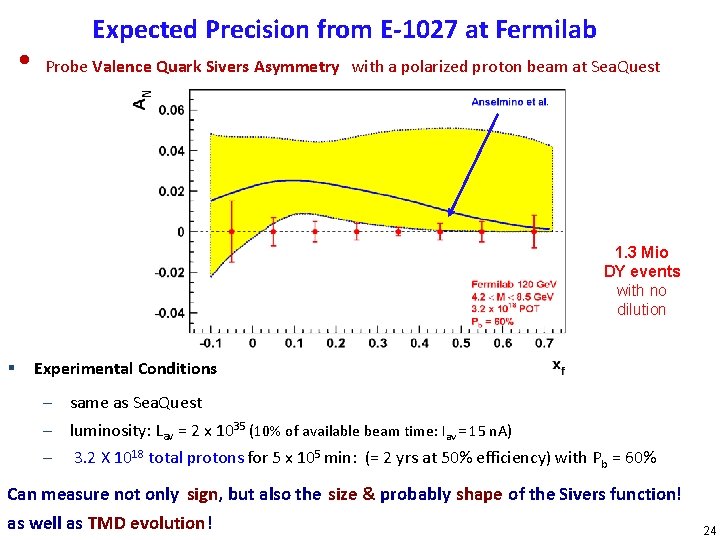
• Expected Precision from E-1027 at Fermilab Probe Valence Quark Sivers Asymmetry with a polarized proton beam at Sea. Quest 1. 3 Mio DY events with no dilution § Experimental Conditions – same as Sea. Quest – luminosity: Lav = 2 x 1035 (10% of available beam time: Iav = 15 n. A) – 3. 2 X 10¹⁸ total protons for 5 x 10⁵ min: (= 2 yrs at 50% efficiency) with Pb = 60% Can measure not only sign, but also the size & probably shape of the Sivers function! as well as TMD evolution! 24
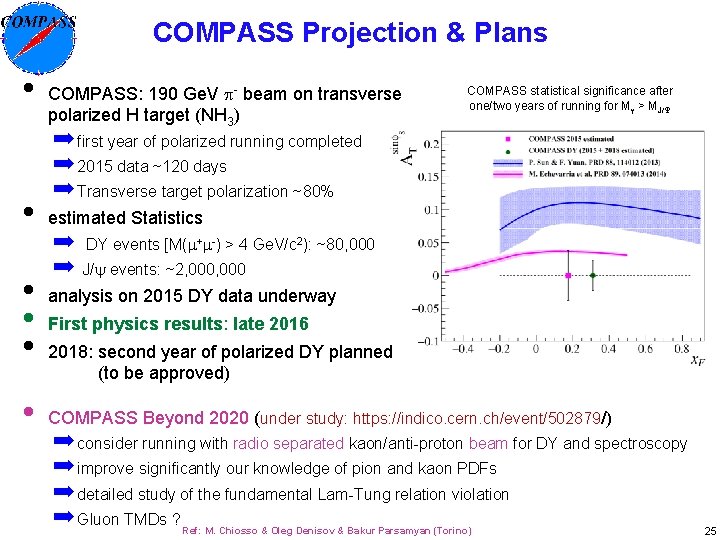
COMPASS Projection & Plans • • • COMPASS: 190 Ge. V p- beam on transverse polarized H target (NH 3) COMPASS statistical significance after one/two years of running for Mg > MJ/Y ➡ first year of polarized running completed ➡ 2015 data ~120 days ➡ Transverse target polarization ~80% estimated Statistics ➡ DY events [M(m+m-) > 4 Ge. V/c 2): ~80, 000 ➡ J/y events: ~2, 000 analysis on 2015 DY data underway First physics results: late 2016 2018: second year of polarized DY planned (to be approved) COMPASS Beyond 2020 (under study: https: //indico. cern. ch/event/502879/) ➡ consider running with radio separated kaon/anti-proton beam for DY and spectroscopy ➡ improve significantly our knowledge of pion and kaon PDFs ➡ detailed study of the fundamental Lam-Tung relation violation ➡ Gluon TMDs ? Ref: M. Chiosso & Oleg Denisov & Bakur Parsamyan (Torino) 25
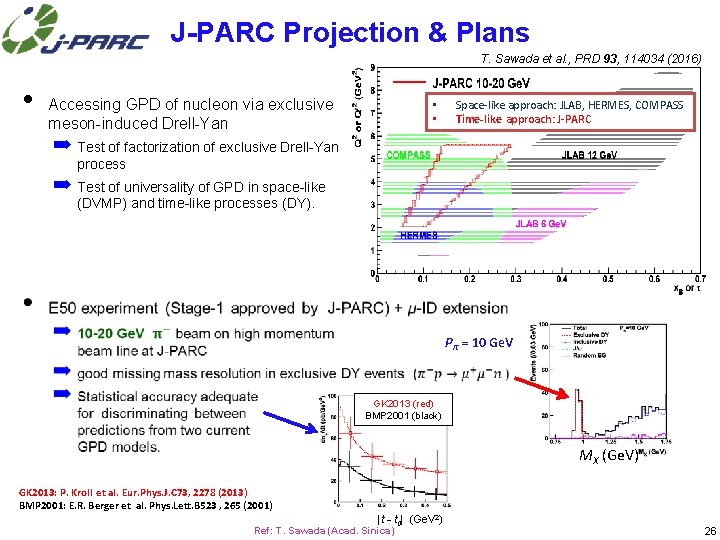
J-PARC Projection & Plans T. Sawada et al. , PRD 93, 114034 (2016) • Accessing GPD of nucleon via exclusive meson-induced Drell-Yan • • Space-like approach: JLAB, HERMES, COMPASS Time-like approach: J-PARC ➡ Test of factorization of exclusive Drell-Yan process ➡ Test of universality of GPD in space-like (DVMP) and time-like processes (DY). Pπ = 10 Ge. V GK 2013 (red) BMP 2001 (black) MX (Ge. V) GK 2013: P. Kroll et al. Eur. Phys. J. C 73, 2278 (2013) BMP 2001: E. R. Berger et al. Phys. Lett. B 523 , 265 (2001) |t - t 0| (Ge. V 2) Ref: T. Sawada (Acad. Sinica) 26
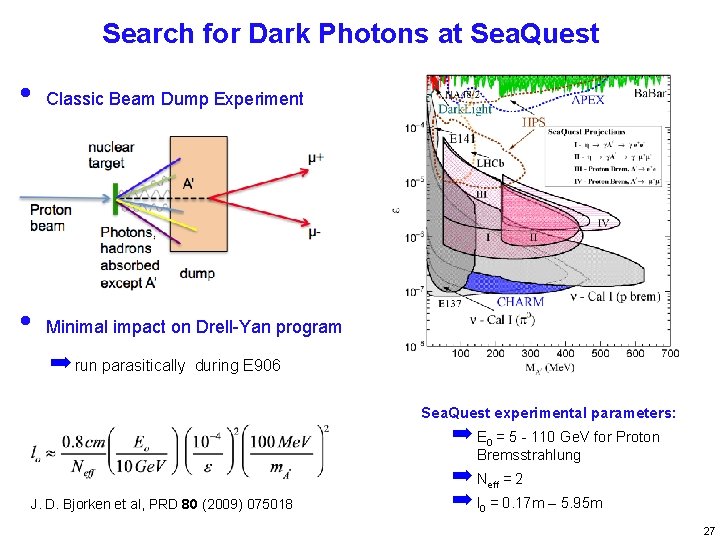
Search for Dark Photons at Sea. Quest • Classic Beam Dump Experiment • Minimal impact on Drell-Yan program ➡ run parasitically during E 906 Sea. Quest experimental parameters: ➡ E 0 = 5 - 110 Ge. V for Proton Bremsstrahlung J. D. Bjorken et al, PRD 80 (2009) 075018 ➡ Neff = 2 ➡ l 0 = 0. 17 m – 5. 95 m 27
Conclusions • There is an exciting Drell Yan program with polarized/unpolarized beams and targets underway → although experimentally more challenging, it has some clear • advantages over SIDIS Future opportunities look very promising → support from hadronic community vital to move forward • We are eagerly awaiting results from COMPASS on the sign-change • Hope to answer some of the questions: → later this year? or early next year? → How much do the quarks and gluons contribute to the nucleon spin? → In particular, what is the role of the sea quarks? → Is there significant orbital angular momentum? → Does TMD formalism work? Does Sivers function change sign? 28
Thank You 29
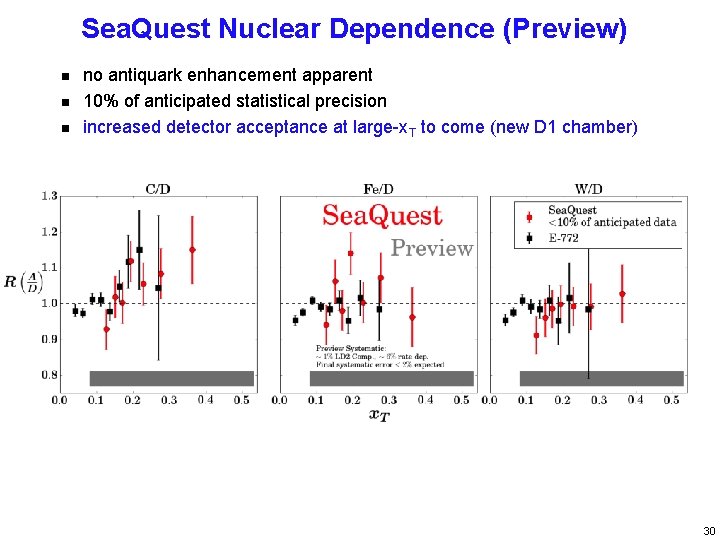
Sea. Quest Nuclear Dependence (Preview) n no antiquark enhancement apparent 10% of anticipated statistical precision increased detector acceptance at large-x. T to come (new D 1 chamber) 30
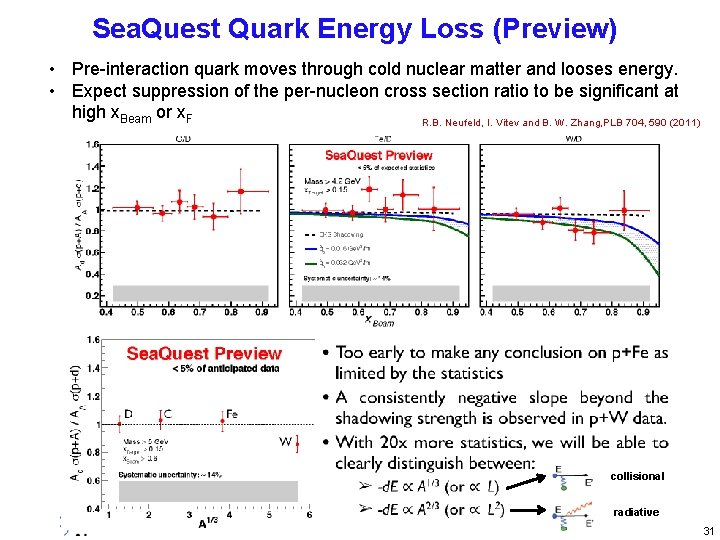
Sea. Quest Quark Energy Loss (Preview) • Pre-interaction quark moves through cold nuclear matter and looses energy. • Expect suppression of the per-nucleon cross section ratio to be significant at high x. Beam or x. F R. B. Neufeld, I. Vitev and B. W. Zhang, PLB 704, 590 (2011) collisional radiative 31
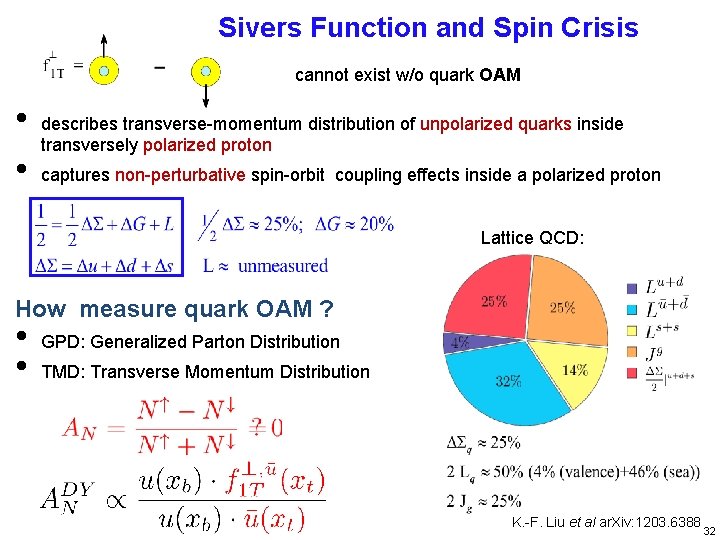
Sivers Function and Spin Crisis cannot exist w/o quark OAM • • describes transverse-momentum distribution of unpolarized quarks inside transversely polarized proton captures non-perturbative spin-orbit coupling effects inside a polarized proton Lattice QCD: How measure quark OAM ? • • GPD: Generalized Parton Distribution TMD: Transverse Momentum Distribution K. -F. Liu et al ar. Xiv: 1203. 6388 32
HERMES , Phys. Rev. Lett. 95, 242001 10 -2 10 -1 x S. Kumano, arxiv. org/1606. 03149
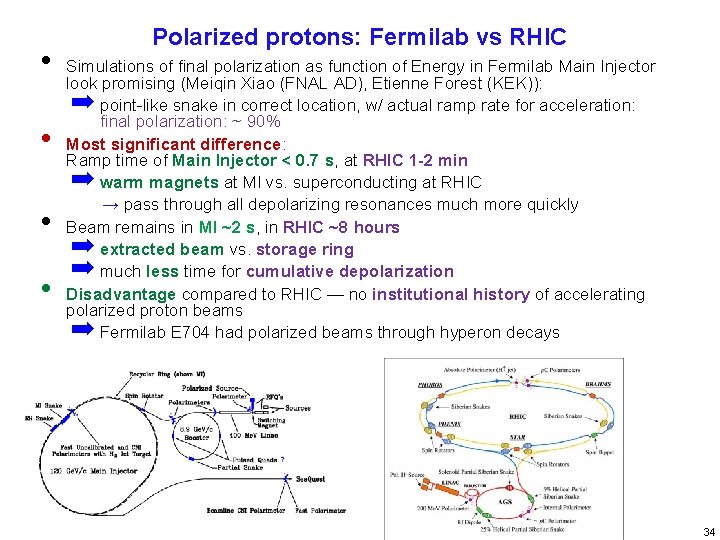
• • Polarized protons: Fermilab vs RHIC Simulations of final polarization as function of Energy in Fermilab Main Injector look promising (Meiqin Xiao (FNAL AD), Etienne Forest (KEK)): ➡ point-like snake in correct location, w/ actual ramp rate for acceleration: final polarization: ~ 90% Most significant difference: Ramp time of Main Injector < 0. 7 s, at RHIC 1 -2 min ➡ warm magnets at MI vs. superconducting at RHIC → pass through all depolarizing resonances much more quickly Beam remains in MI ~2 s, in RHIC ~8 hours ➡ extracted beam vs. storage ring ➡ much less time for cumulative depolarization Disadvantage compared to RHIC — no institutional history of accelerating polarized proton beams ➡ Fermilab E 704 had polarized beams through hyperon decays 34
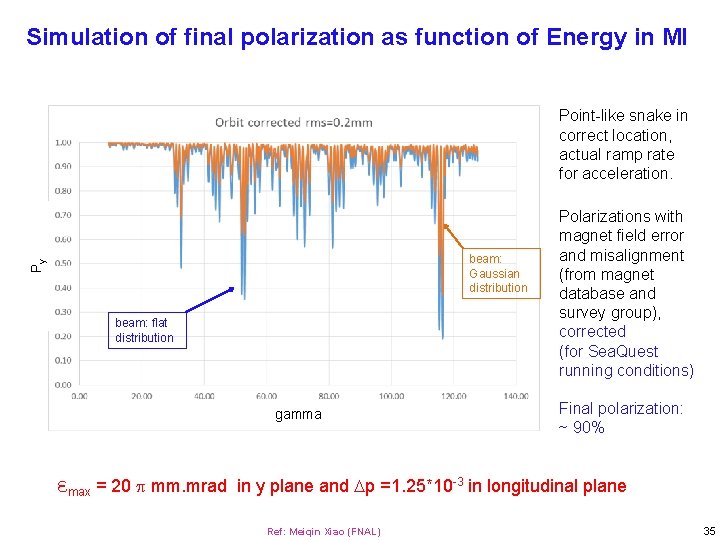
Simulation of final polarization as function of Energy in MI Point-like snake in correct location, actual ramp rate for acceleration. Py beam: Gaussian distribution beam: flat distribution gamma Polarizations with magnet field error and misalignment (from magnet database and survey group), corrected (for Sea. Quest running conditions) Final polarization: ~ 90% emax = 20 p mm. mrad in y plane and Dp =1. 25*10 -3 in longitudinal plane Ref: Meiqin Xiao (FNAL) 35