
Fixed Route Quality of Service Transit Capacity Quality

- Slides: 57
Fixed Route Quality of Service Transit Capacity & Quality of Service Manual, 3 rd Edition
Presentation Overview Learning objectives Performance points of view Quality of service factors Quality of service framework Quality of service measures Applications Transit Capacity & Quality of Service Manual, 3 rd Edition
Learning Objectives Gain an understanding of the different stakeholder perspectives that can be taken with respect to transit performance Understand the key components of passengers’ perceptions of transit service quality Be able to define quality of service (QOS) Become familiar with the TCQSM’s approach to fixed-route QOS: § Framework § Service measures focused toward transit agencies § Multimodal level of service measure focused toward planning and engineering applications Become familiar with potential applications of the manual’s QOS measures to real-world transportation planning and transit activities Transit Capacity & Quality of Service Manual, 3 rd Edition
Changes from the 2 nd Edition Reorganized transit quality of service framework § Clearer guidance on performance measures that can be applied to stop, route/street segment, and system levels of analysis Removed level of service (LOS) letters from QOS tables § Responding to transit agency concerns about being “graded” § Allows more or fewer service levels, as appropriate for a given measure Added a new “multimodal transit LOS measure” § Responding to planning agency needs for multimodal LOS evalution § Can be used in conjunction with corresponding measures for the auto, pedestrian, and bicycle modes § Spreadsheet tool provided to help calculate the measure New section on potential applications of QOS to real-world transit and transportation planning activities Transit Capacity & Quality of Service Manual, 3 rd Edition
Performance Points of View Transit Capacity & Quality of Service Manual, 3 rd Edition
Transit Performance Viewpoints What aspects of transit performance might each of these groups be most interested in? § § The transit agency The community as a whole The public works department Transit passengers Transit Capacity & Quality of Service Manual, 3 rd Edition
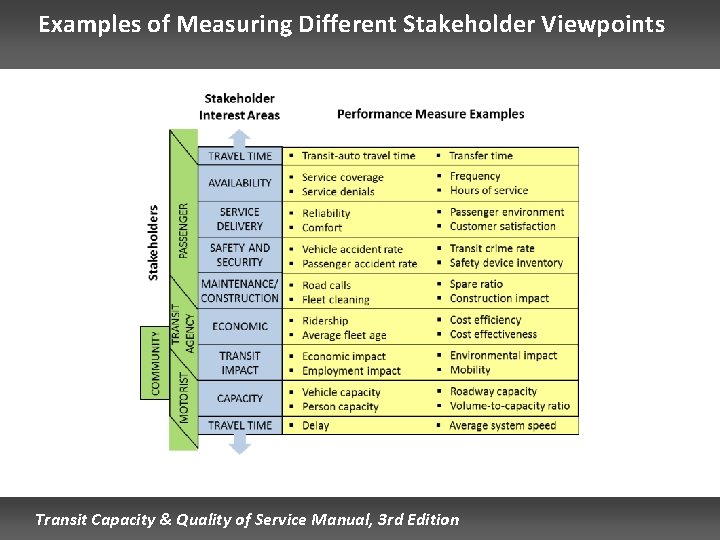
Examples of Measuring Different Stakeholder Viewpoints Transit Capacity & Quality of Service Manual, 3 rd Edition
The Ultimate Transit Service As a passenger, what would your ideal transit service be like? Transit Capacity & Quality of Service Manual, 3 rd Edition
The Ultimate Transit Service Since we can’t have the ultimate transit service, what trade-offs do we make? Transit Capacity & Quality of Service Manual, 3 rd Edition
Transit Performance Viewpoints Quality of service focuses on the passenger point of view Other points of view are also valid and need to be considered § May have conflicting objectives (e. g. , passenger comfort vs. agency resources) § Best-quality passenger service may not be feasible or desirable Transit Capacity & Quality of Service Manual, 3 rd Edition
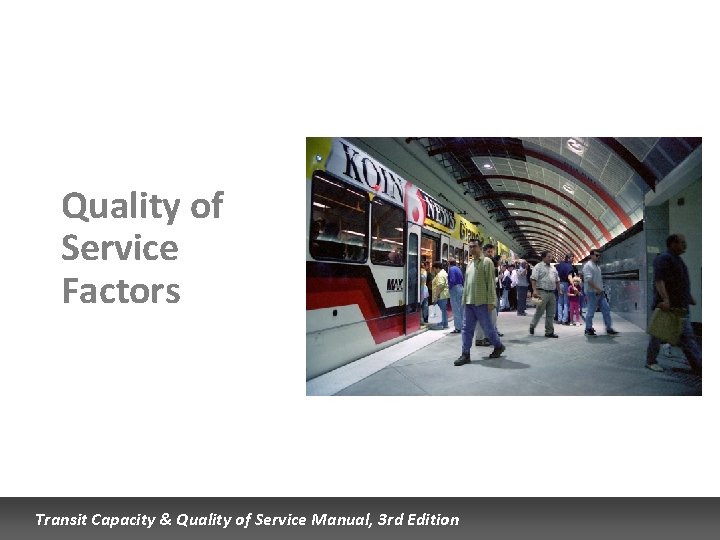
Quality of Service Factors Transit Capacity & Quality of Service Manual, 3 rd Edition
What Matters to Customers? Customer satisfaction surveys provide insights § TCRP Project B-11 (customer satisfaction surveying methods) § Florida transit agency on-board surveys § NCHRP Project 3 -92 (multimodal urban street level of service) Typical factors: § § § Frequency, wait time, service span Reliability Service close to home, destination Crowding Fares, driver friendliness, safety/security Transit Capacity & Quality of Service Manual, 3 rd Edition
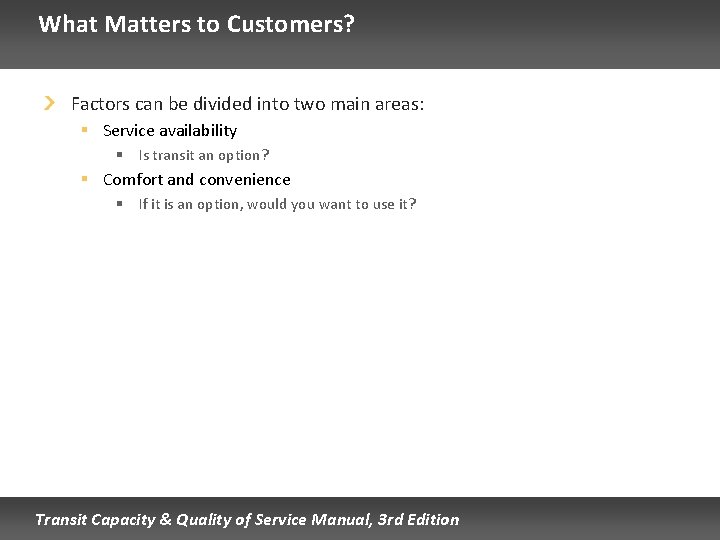
What Matters to Customers? Factors can be divided into two main areas: § Service availability § Is transit an option? § Comfort and convenience § If it is an option, would you want to use it? Transit Capacity & Quality of Service Manual, 3 rd Edition
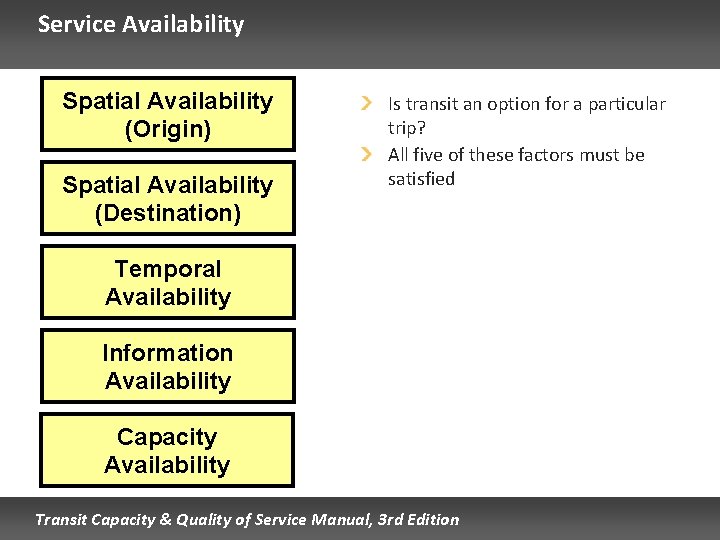
Service Availability Spatial Availability (Origin) Spatial Availability (Destination) Is transit an option for a particular trip? All five of these factors must be satisfied Temporal Availability Information Availability Capacity Availability Transit Capacity & Quality of Service Manual, 3 rd Edition
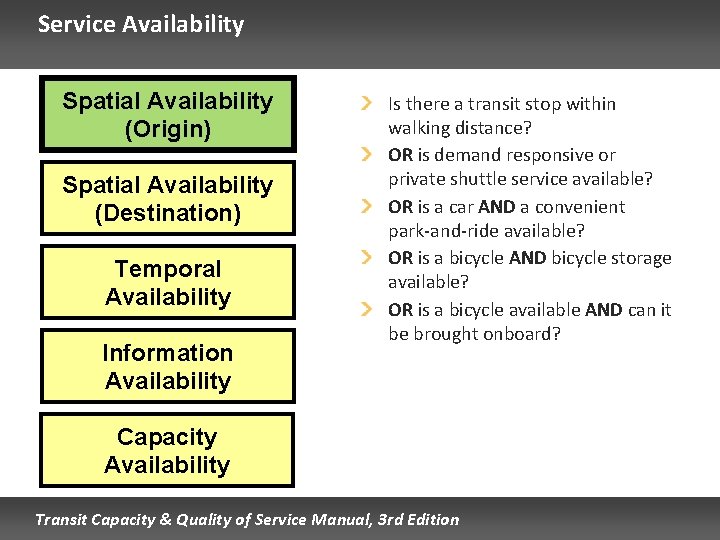
Service Availability Spatial Availability (Origin) Spatial Availability (Destination) Temporal Availability Information Availability Is there a transit stop within walking distance? OR is demand responsive or private shuttle service available? OR is a car AND a convenient park-and-ride available? OR is a bicycle AND bicycle storage available? OR is a bicycle available AND can it be brought onboard? Capacity Availability Transit Capacity & Quality of Service Manual, 3 rd Edition
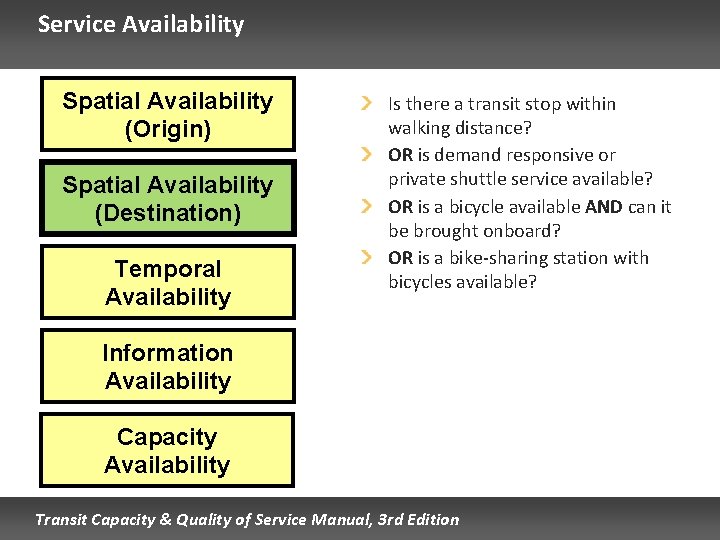
Service Availability Spatial Availability (Origin) Spatial Availability (Destination) Temporal Availability Is there a transit stop within walking distance? OR is demand responsive or private shuttle service available? OR is a bicycle available AND can it be brought onboard? OR is a bike-sharing station with bicycles available? Information Availability Capacity Availability Transit Capacity & Quality of Service Manual, 3 rd Edition
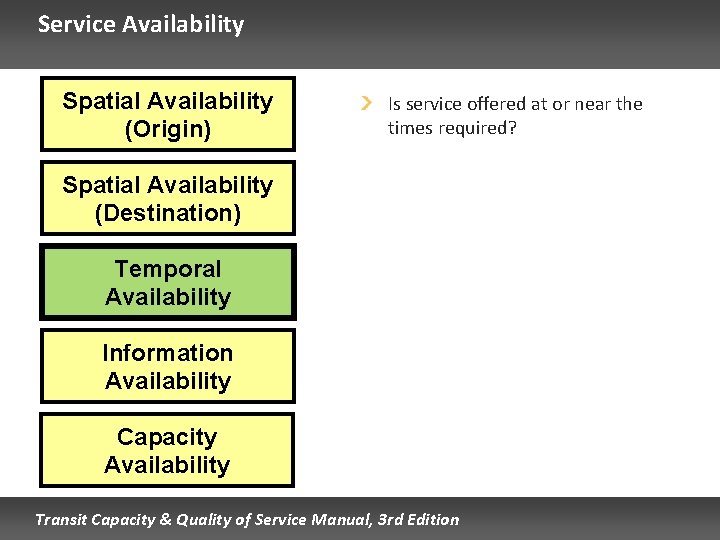
Service Availability Spatial Availability (Origin) Is service offered at or near the times required? Spatial Availability (Destination) Temporal Availability Information Availability Capacity Availability Transit Capacity & Quality of Service Manual, 3 rd Edition
Service Availability Spatial Availability (Origin) Spatial Availability (Destination) Temporal Availability Are the schedule and routing known? OR is telephone, text, or Internet information offered, the service available when customers use it, and the information accurately provided? Information Availability Capacity Availability Transit Capacity & Quality of Service Manual, 3 rd Edition
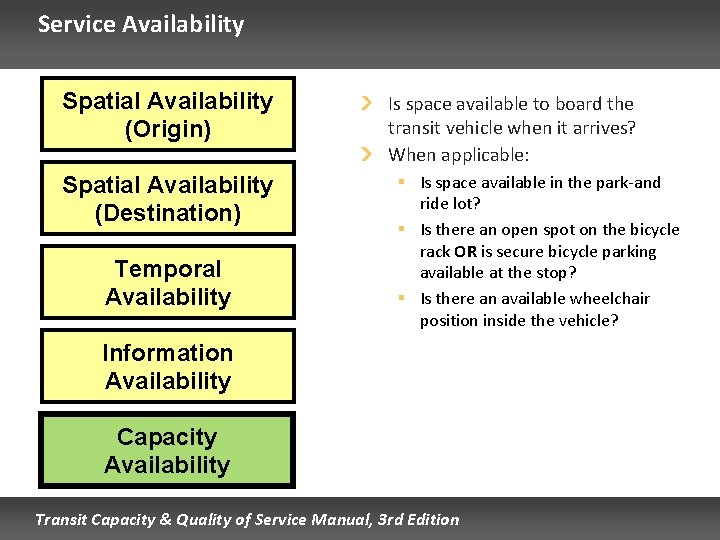
Service Availability Spatial Availability (Origin) Spatial Availability (Destination) Temporal Availability Is space available to board the transit vehicle when it arrives? When applicable: § Is space available in the park-and ride lot? § Is there an open spot on the bicycle rack OR is secure bicycle parking available at the stop? § Is there an available wheelchair position inside the vehicle? Information Availability Capacity Availability Transit Capacity & Quality of Service Manual, 3 rd Edition
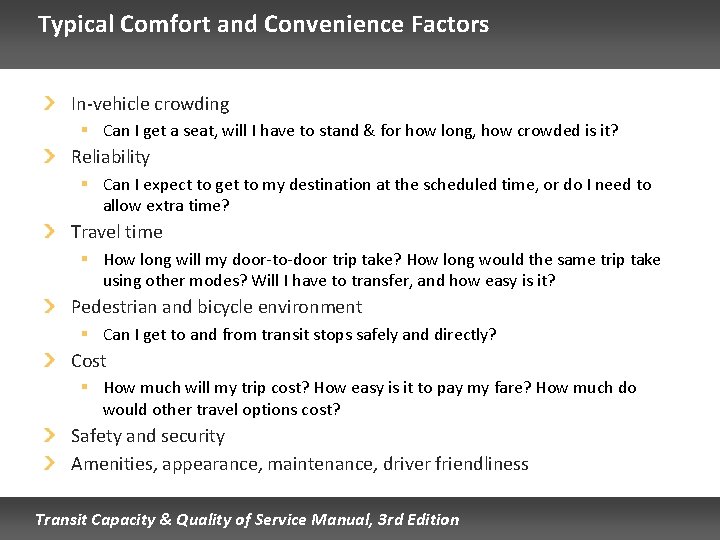
Typical Comfort and Convenience Factors In-vehicle crowding § Can I get a seat, will I have to stand & for how long, how crowded is it? Reliability § Can I expect to get to my destination at the scheduled time, or do I need to allow extra time? Travel time § How long will my door-to-door trip take? How long would the same trip take using other modes? Will I have to transfer, and how easy is it? Pedestrian and bicycle environment § Can I get to and from transit stops safely and directly? Cost § How much will my trip cost? How easy is it to pay my fare? How much do would other travel options cost? Safety and security Amenities, appearance, maintenance, driver friendliness Transit Capacity & Quality of Service Manual, 3 rd Edition
Quality of Service Framework Transit Capacity & Quality of Service Manual, 3 rd Edition
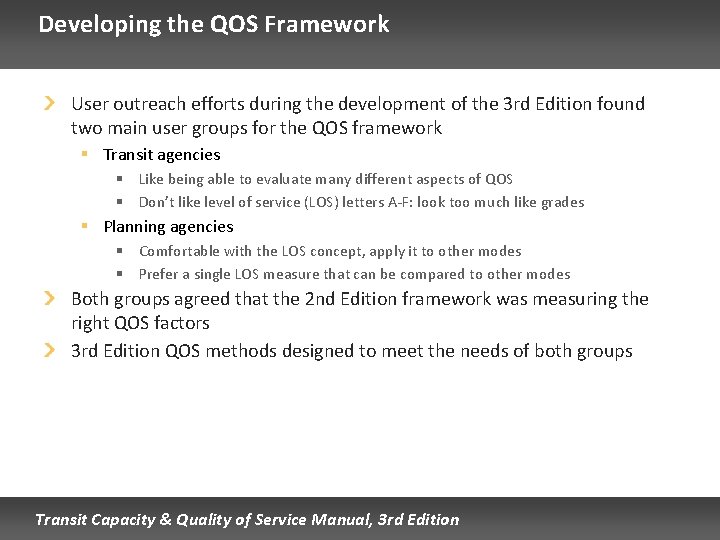
Developing the QOS Framework User outreach efforts during the development of the 3 rd Edition found two main user groups for the QOS framework § Transit agencies § Like being able to evaluate many different aspects of QOS § Don’t like level of service (LOS) letters A-F: look too much like grades § Planning agencies § Comfortable with the LOS concept, apply it to other modes § Prefer a single LOS measure that can be compared to other modes Both groups agreed that the 2 nd Edition framework was measuring the right QOS factors 3 rd Edition QOS methods designed to meet the needs of both groups Transit Capacity & Quality of Service Manual, 3 rd Edition
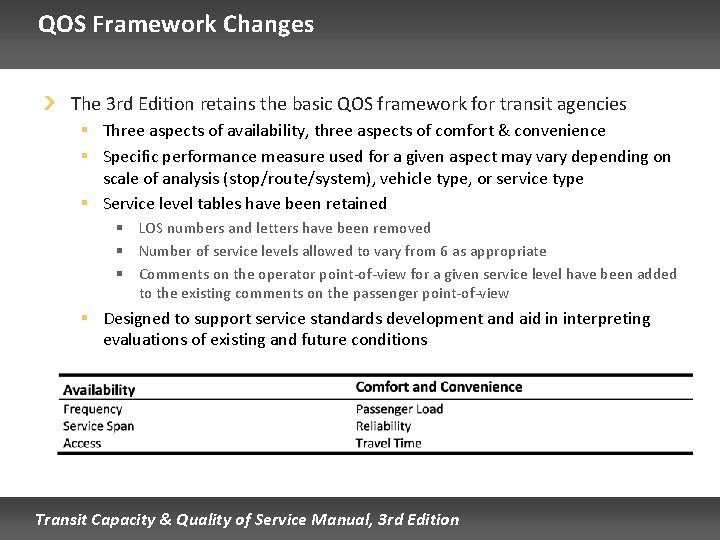
QOS Framework Changes The 3 rd Edition retains the basic QOS framework for transit agencies § Three aspects of availability, three aspects of comfort & convenience § Specific performance measure used for a given aspect may vary depending on scale of analysis (stop/route/system), vehicle type, or service type § Service level tables have been retained § LOS numbers and letters have been removed § Number of service levels allowed to vary from 6 as appropriate § Comments on the operator point-of-view for a given service level have been added to the existing comments on the passenger point-of-view § Designed to support service standards development and aid in interpreting evaluations of existing and future conditions Transit Capacity & Quality of Service Manual, 3 rd Edition
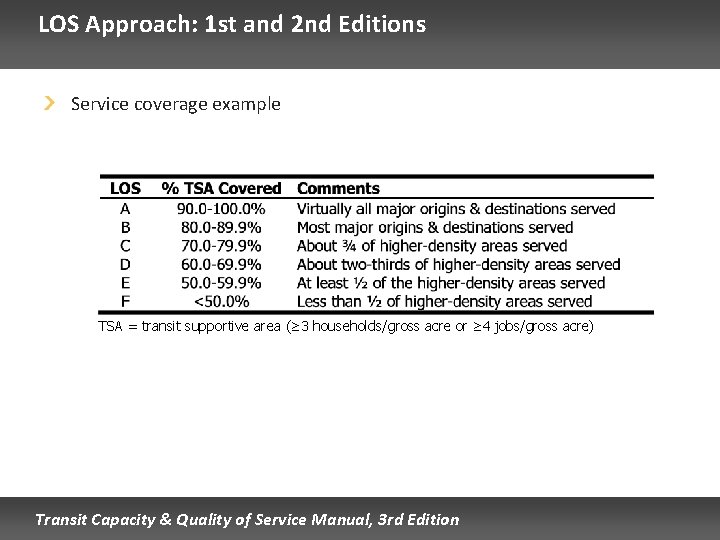
LOS Approach: 1 st and 2 nd Editions Service coverage example TSA = transit supportive area (≥ 3 households/gross acre or ≥ 4 jobs/gross acre) Transit Capacity & Quality of Service Manual, 3 rd Edition
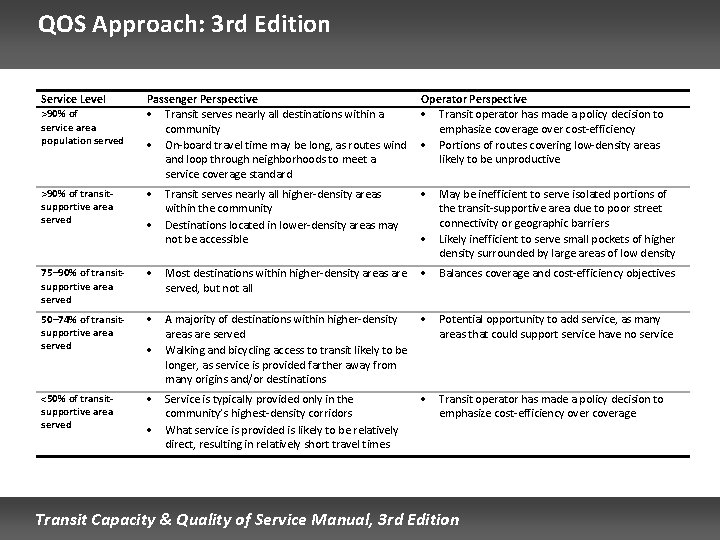
QOS Approach: 3 rd Edition Service Level >90% of service area population served Passenger Perspective Operator Perspective Transit serves nearly all destinations within a Transit operator has made a policy decision to community emphasize coverage over cost-efficiency On-board travel time may be long, as routes wind Portions of routes covering low-density areas and loop through neighborhoods to meet a likely to be unproductive service coverage standard >90% of transitsupportive area served Transit serves nearly all higher-density areas within the community Destinations located in lower-density areas may not be accessible May be inefficient to serve isolated portions of the transit-supportive area due to poor street connectivity or geographic barriers Likely inefficient to serve small pockets of higher density surrounded by large areas of low density 75– 90% of transitsupportive area served Most destinations within higher-density areas are Balances coverage and cost-efficiency objectives served, but not all 50– 74% of transitsupportive area served A majority of destinations within higher-density Potential opportunity to add service, as many areas are served areas that could support service have no service Walking and bicycling access to transit likely to be longer, as service is provided farther away from many origins and/or destinations <50% of transitsupportive area served Service is typically provided only in the community’s highest-density corridors What service is provided is likely to be relatively direct, resulting in relatively short travel times Transit operator has made a policy decision to emphasize cost-efficiency over coverage Transit Capacity & Quality of Service Manual, 3 rd Edition
Multimodal Transit LOS Measure The 3 rd Edition adds a “multimodal transit LOS measure” for planning agencies § Measure developed by the NCHRP 3 -92 project and subsequently incorporated into the Highway Capacity Manual 2010 § Provides A-F letters indicating the level of service § Incorporates most of the same factors in the QOS framework, but provides a single LOS measure § Access to transit: pedestrian environment § Waiting for transit: frequency, reliability, shelter/bench presence § On-board experience: passenger loads, transit speed § Index values and associated LOS letters can be directly compared to those from companion measures for the auto, bicycle, and pedestrian modes § Can be used to evaluate trade-offs in traveler satisfaction when allocating street right-of-way between modes Spreadsheet included on the CD-ROM to help perform the calculations Transit Capacity & Quality of Service Manual, 3 rd Edition
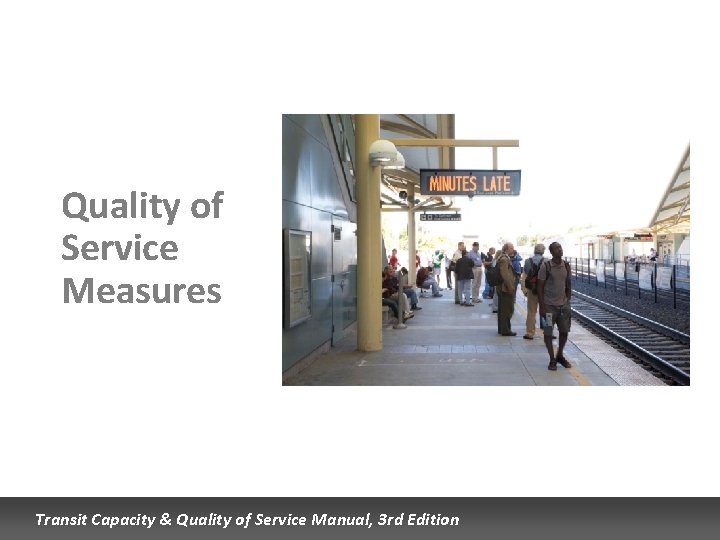
Quality of Service Measures Transit Capacity & Quality of Service Manual, 3 rd Edition
Frequency Transit service can only be used at discrete times § If service is only offered hourly, there is a very small window of time during the hour when a transit trip can be started immediately More-frequent service provides more opportunities for immediate travel § Transit service more closely resembles competing modes (auto, bicycle, pedestrian) in terms of departure time convenience Frequency is attractive to passengers § Ridership increases as frequency increases, although a diminishing returns principle applies Frequency is a key driver of operating costs § Improvements to speed and reliability can allow better frequency at the same cost When transfers are involved, frequency is only as good as the weakest link in the trip Transit Capacity & Quality of Service Manual, 3 rd Edition
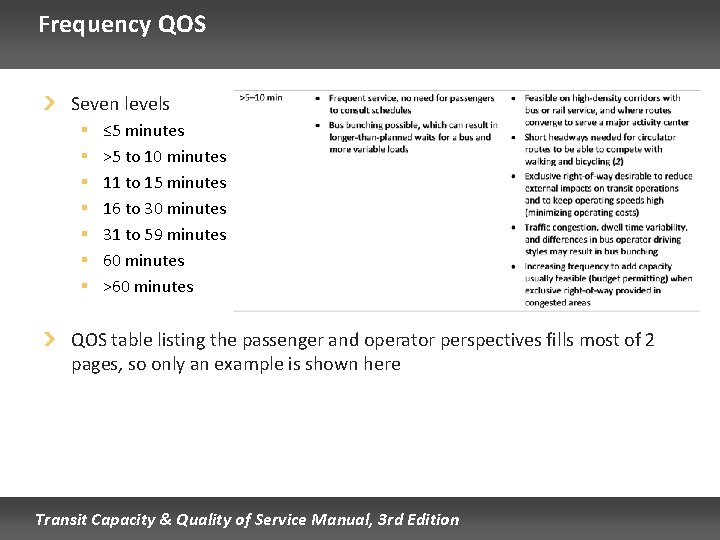
Frequency QOS Seven levels § § § § ≤ 5 minutes >5 to 10 minutes 11 to 15 minutes 16 to 30 minutes 31 to 59 minutes 60 minutes >60 minutes QOS table listing the passenger and operator perspectives fills most of 2 pages, so only an example is shown here Transit Capacity & Quality of Service Manual, 3 rd Edition
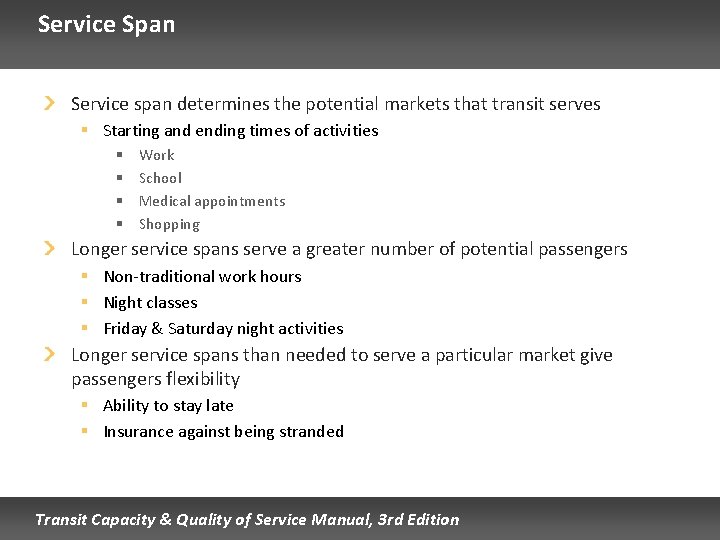
Service Span Service span determines the potential markets that transit serves § Starting and ending times of activities § § Work School Medical appointments Shopping Longer service spans serve a greater number of potential passengers § Non-traditional work hours § Night classes § Friday & Saturday night activities Longer service spans than needed to serve a particular market give passengers flexibility § Ability to stay late § Insurance against being stranded Transit Capacity & Quality of Service Manual, 3 rd Edition
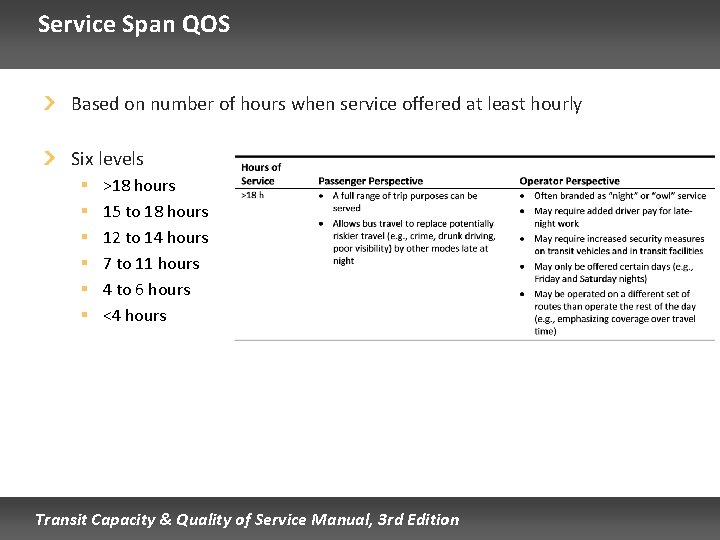
Service Span QOS Based on number of hours when service offered at least hourly Six levels § § § >18 hours 15 to 18 hours 12 to 14 hours 7 to 11 hours 4 to 6 hours <4 hours Transit Capacity & Quality of Service Manual, 3 rd Edition
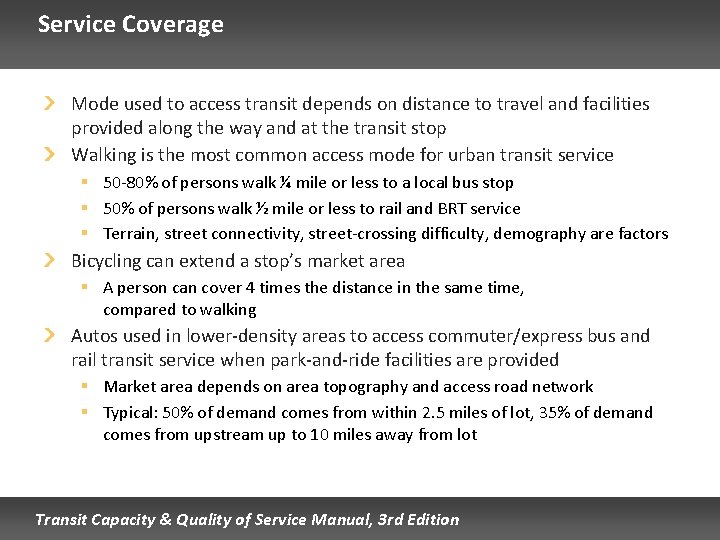
Service Coverage Mode used to access transit depends on distance to travel and facilities provided along the way and at the transit stop Walking is the most common access mode for urban transit service § 50 -80% of persons walk ¼ mile or less to a local bus stop § 50% of persons walk ½ mile or less to rail and BRT service § Terrain, street connectivity, street-crossing difficulty, demography are factors Bicycling can extend a stop’s market area § A person can cover 4 times the distance in the same time, compared to walking Autos used in lower-density areas to access commuter/express bus and rail transit service when park-and-ride facilities are provided § Market area depends on area topography and access road network § Typical: 50% of demand comes from within 2. 5 miles of lot, 35% of demand comes from upstream up to 10 miles away from lot Transit Capacity & Quality of Service Manual, 3 rd Edition
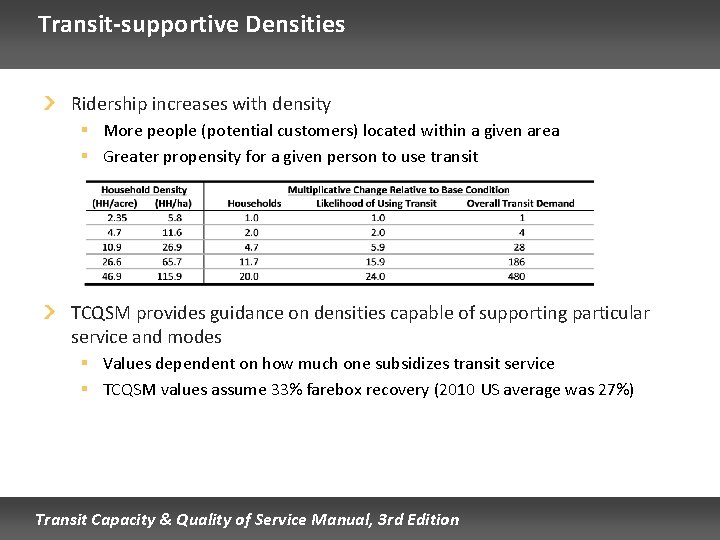
Transit-supportive Densities Ridership increases with density § More people (potential customers) located within a given area § Greater propensity for a given person to use transit TCQSM provides guidance on densities capable of supporting particular service and modes § Values dependent on how much one subsidizes transit service § TCQSM values assume 33% farebox recovery (2010 US average was 27%) Transit Capacity & Quality of Service Manual, 3 rd Edition
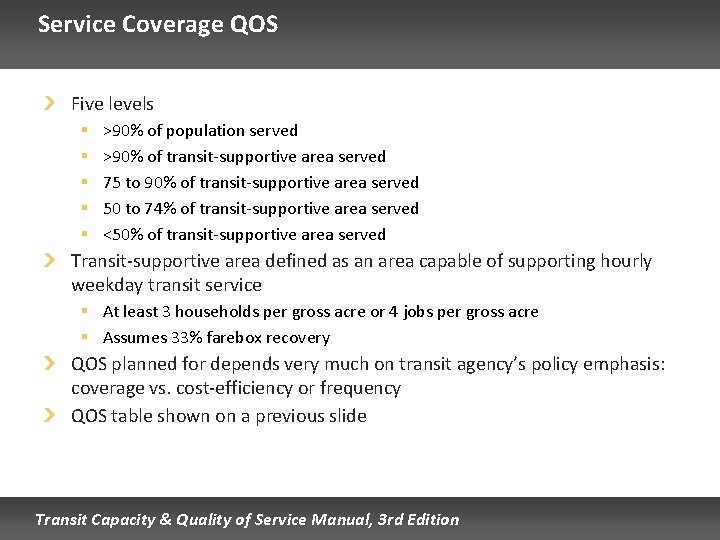
Service Coverage QOS Five levels § § § >90% of population served >90% of transit-supportive area served 75 to 90% of transit-supportive area served 50 to 74% of transit-supportive area served <50% of transit-supportive area served Transit-supportive area defined as an area capable of supporting hourly weekday transit service § At least 3 households per gross acre or 4 jobs per gross acre § Assumes 33% farebox recovery QOS planned for depends very much on transit agency’s policy emphasis: coverage vs. cost-efficiency or frequency QOS table shown on a previous slide Transit Capacity & Quality of Service Manual, 3 rd Edition
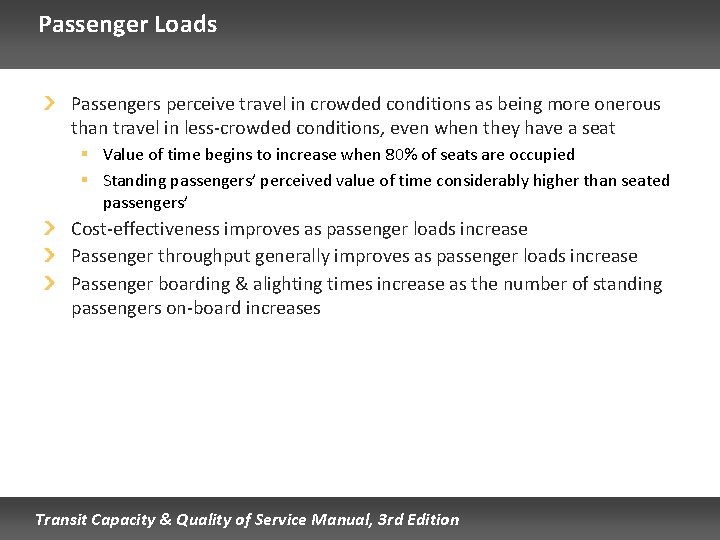
Passenger Loads Passengers perceive travel in crowded conditions as being more onerous than travel in less-crowded conditions, even when they have a seat § Value of time begins to increase when 80% of seats are occupied § Standing passengers’ perceived value of time considerably higher than seated passengers’ Cost-effectiveness improves as passenger loads increase Passenger throughput generally improves as passenger loads increase Passenger boarding & alighting times increase as the number of standing passengers on-board increases Transit Capacity & Quality of Service Manual, 3 rd Edition
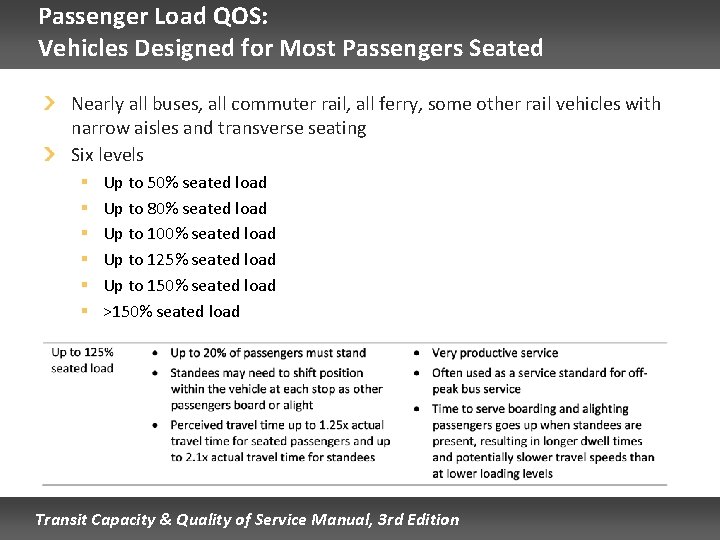
Passenger Load QOS: Vehicles Designed for Most Passengers Seated Nearly all buses, all commuter rail, all ferry, some other rail vehicles with narrow aisles and transverse seating Six levels § § § Up to 50% seated load Up to 80% seated load Up to 100% seated load Up to 125% seated load Up to 150% seated load >150% seated load Transit Capacity & Quality of Service Manual, 3 rd Edition
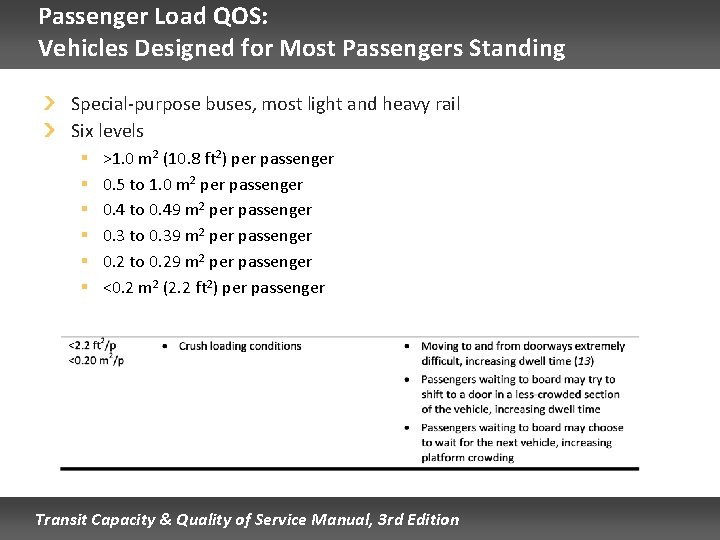
Passenger Load QOS: Vehicles Designed for Most Passengers Standing Special-purpose buses, most light and heavy rail Six levels § § § >1. 0 m 2 (10. 8 ft 2) per passenger 0. 5 to 1. 0 m 2 per passenger 0. 4 to 0. 49 m 2 per passenger 0. 3 to 0. 39 m 2 per passenger 0. 2 to 0. 29 m 2 per passenger <0. 2 m 2 (2. 2 ft 2) per passenger Transit Capacity & Quality of Service Manual, 3 rd Edition
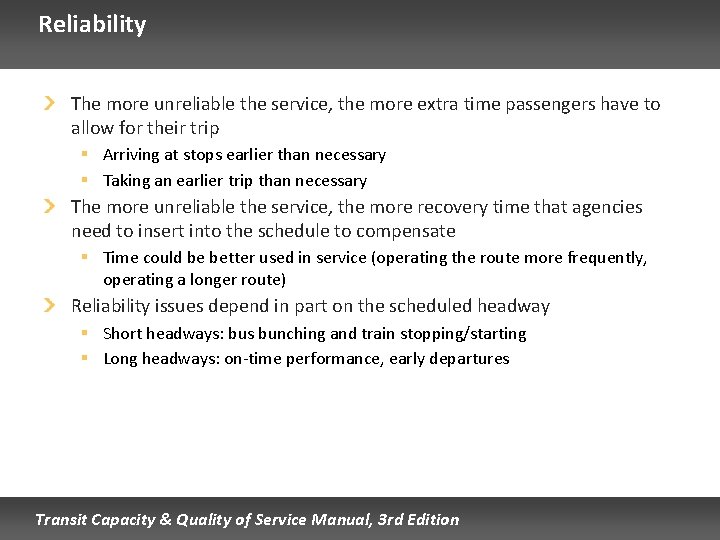
Reliability The more unreliable the service, the more extra time passengers have to allow for their trip § Arriving at stops earlier than necessary § Taking an earlier trip than necessary The more unreliable the service, the more recovery time that agencies need to insert into the schedule to compensate § Time could be better used in service (operating the route more frequently, operating a longer route) Reliability issues depend in part on the scheduled headway § Short headways: bus bunching and train stopping/starting § Long headways: on-time performance, early departures Transit Capacity & Quality of Service Manual, 3 rd Edition
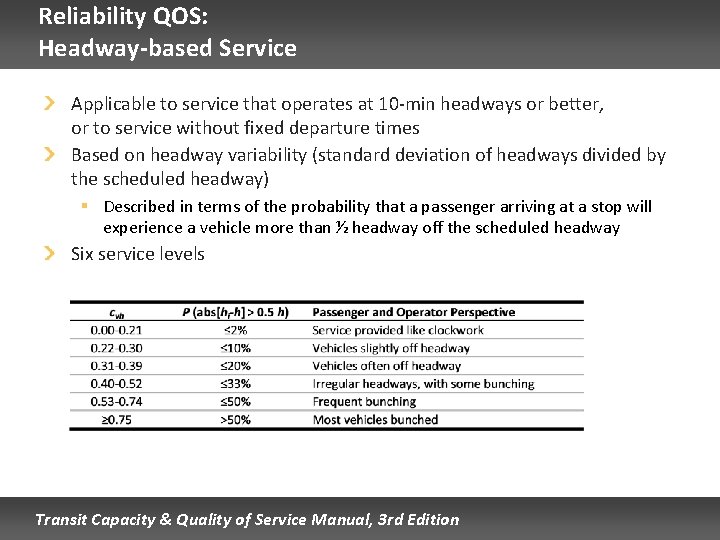
Reliability QOS: Headway-based Service Applicable to service that operates at 10 -min headways or better, or to service without fixed departure times Based on headway variability (standard deviation of headways divided by the scheduled headway) § Described in terms of the probability that a passenger arriving at a stop will experience a vehicle more than ½ headway off the scheduled headway Six service levels Transit Capacity & Quality of Service Manual, 3 rd Edition
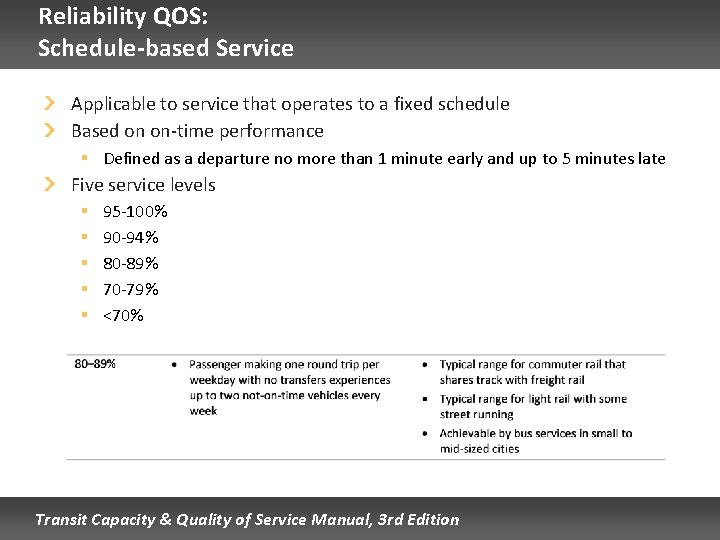
Reliability QOS: Schedule-based Service Applicable to service that operates to a fixed schedule Based on on-time performance § Defined as a departure no more than 1 minute early and up to 5 minutes late Five service levels § § § 95 -100% 90 -94% 80 -89% 70 -79% <70% Transit Capacity & Quality of Service Manual, 3 rd Edition
Travel Time Travel time is an important consideration in mode choice Travel time impacts operating costs: the slower the route, the more vehicles that are required to be in service to provide a given headway Transit Capacity & Quality of Service Manual, 3 rd Edition
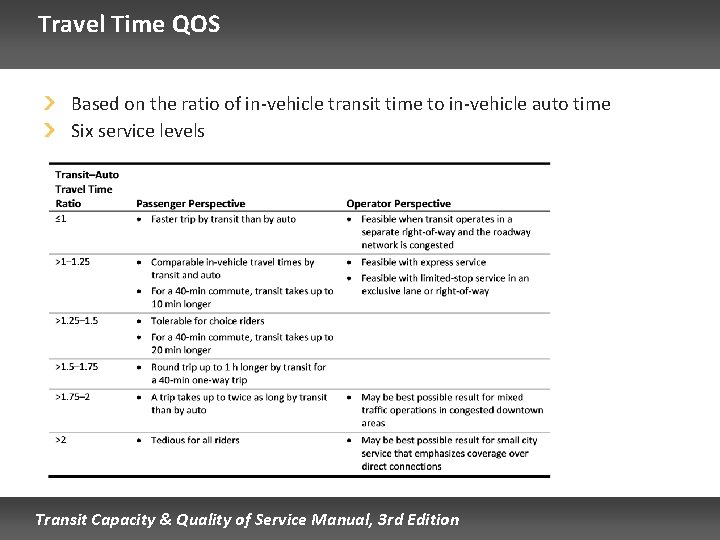
Travel Time QOS Based on the ratio of in-vehicle transit time to in-vehicle auto time Six service levels Transit Capacity & Quality of Service Manual, 3 rd Edition
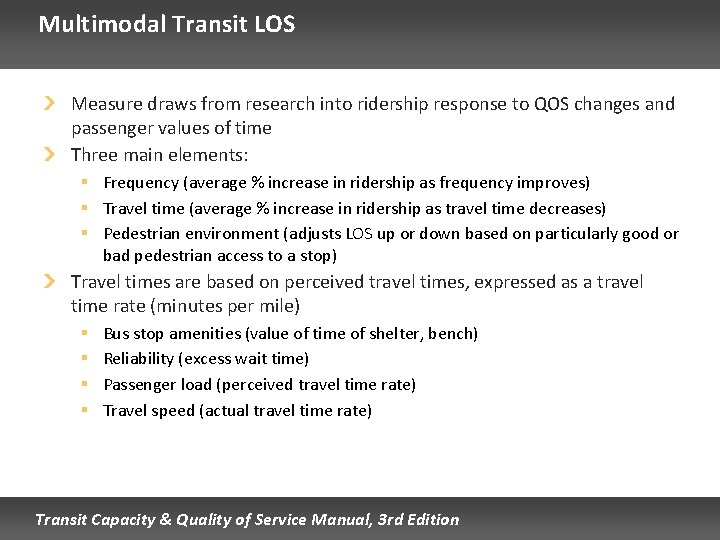
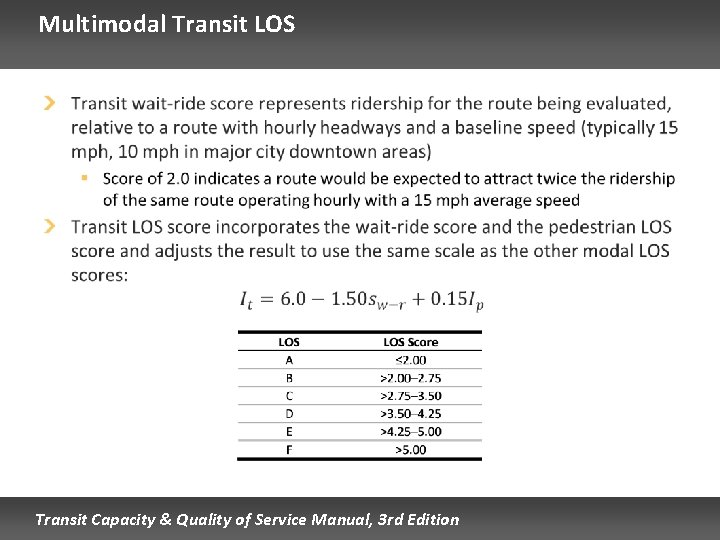
Multimodal Transit LOS Measure draws from research into ridership response to QOS changes and passenger values of time Three main elements: § Frequency (average % increase in ridership as frequency improves) § Travel time (average % increase in ridership as travel time decreases) § Pedestrian environment (adjusts LOS up or down based on particularly good or bad pedestrian access to a stop) Travel times are based on perceived travel times, expressed as a travel time rate (minutes per mile) § § Bus stop amenities (value of time of shelter, bench) Reliability (excess wait time) Passenger load (perceived travel time rate) Travel speed (actual travel time rate) Transit Capacity & Quality of Service Manual, 3 rd Edition
Multimodal Transit LOS Transit Capacity & Quality of Service Manual, 3 rd Edition
Demand Responsive QOS There is a corresponding QOS framework and measures for demand responsive transit § Covered in the DRT presentation Transit Capacity & Quality of Service Manual, 3 rd Edition
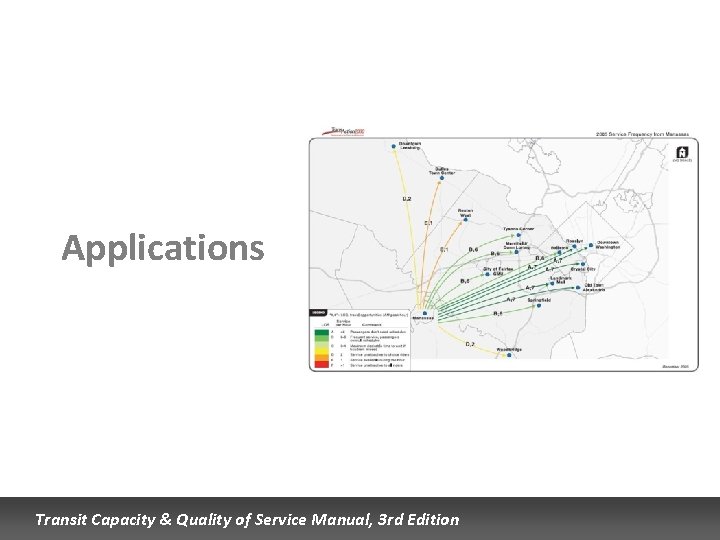
Applications Transit Capacity & Quality of Service Manual, 3 rd Edition
Potential Applications Comprehensive planning Long-range transportation planning Statewide transportation planning Service standards development Comprehensive operational analysis Transit development plans Service planning Corridor planning Transit Capacity & Quality of Service Manual, 3 rd Edition
Comprehensive Planning Multimodal comprehensive plans provide goals, policies, and objectives for the transit service provided, or desired to be provided, within a city or county § Service goals may be aspirational (city/county is not the service provider) § Service goals may become the basis for service standards (city/county is the service provider) QOS measures relating to availability can be used in setting objectives § For example, minimum span of service for trunk and local routes Information in QOS chapters can be used to demonstrate the impact of different land use densities, street connectivity, and sidewalk provision policies on transit access § Impact on ridership § Impact on number of households/persons with transit access § Impact on transit operating costs (e. g. , number of route miles required to meet a service coverage goal) Transit Capacity & Quality of Service Manual, 3 rd Edition
Long-range Transportation Planning LRTPs identify city- or region-wide transportation needs over a longer period of time (e. g. , 20 years) § If plan preparer is not the service provider, LRTPs often focus on the actions that can be taken to support transit (e. g. , sidewalk improvements) § If plan preparer is the service provider, the transit element may be more specific and contain many of the elements of a transit development plan A common application of the TCQSM 1 st and 2 nd Editions was to evaluate existing transit service quality Much more valuable to also use it to evaluate service quality provided by various future alternatives, to aid decision-making Possible types of analysis: § Activity center analysis (origin–destination trips) § Corridor analysis (transit streets, priority/frequent bus network) § Service coverage analysis (areawide, corridor) Transit Capacity & Quality of Service Manual, 3 rd Edition
Statewide Transportation Planning QOS measures derivable from National Transit Database data can be used to track trends in fixed-route transit provision across the state § Statewide, or broken out into population ranges Example measures § Average system peak-period headway § Average system speed (revenue miles/revenue hours) § System service span Measures require no special data collection Transit Capacity & Quality of Service Manual, 3 rd Edition
Service Standards Development Service standards are used to state the QOS the transit agency intends to deliver and to compare actual performance to promised/targeted performance The redesign of the QOS framework for the 3 rd Edition was done with service standards development in mind Set service standards based on desired passenger QOS to be delivered and available agency resources The comments on the passenger and operator perspectives for each service level in the QOS tables can be used to match agency goals to a corresponding service level Transit Capacity & Quality of Service Manual, 3 rd Edition
Comprehensive Operational Analysis COAs provide a detailed, route-by-route evaluation of existing service and an evaluation of systemwide operations § May be conducted in conjunction with, or immediately prior to, a transit development plan update QOS measures can be incorporated into a COA to: § Describe evaluation results in terms of passenger experiences § Compare results to established service standards § Compare changes in results from the previous analysis When archived AVL and APC data are not available to an agency, COAs provide a rare opportunity to evaluate in detail the comfort and convenience aspects of transit service § Passenger loads, reliability, travel time/speed Availability measures can be used as part of an environmental justice analysis, comparing relative service quality between areas Transit Capacity & Quality of Service Manual, 3 rd Edition
Transit Development Plans TDPs set out a transit agency’s near-term service strategy Example applications: § Mapping current and/or planned conditions (route-by-route, street-by-street) § Frequency, hours of service, loading, reliability, coverage § Service levels help to group routes on the basis of similar service quality § Prioritizing improvments § Loading, reliability, transit–auto travel time § Service equity & environmental justice comparisons § Comparing relative service quality between communities § Peer reviews § Relatively few QOS measures derivable from National Transit Database data (see statewide transportation planning slide for examples) § May be possible to directly contact peers to obtain additional QOS-related information § Exhibit 5 -42 gives examples of potential measures and data sources Transit Capacity & Quality of Service Manual, 3 rd Edition
Service Planning Service monitoring § Regularly compare existing service to adopted service standards, and make adjustments as needed when service falls outside the standards § Loading, reliability are commonly monitored § QOS tables can be used to set realistic expectations Service development § Identify service requirements for new/future developments when fully built out § Identify and prioritize origin–destination patterns that may require quicker transit connections § Prioritize locations/corridors for transit prefererential treatments and/or operations measures to improve speed and reliability Transit Capacity & Quality of Service Manual, 3 rd Edition
Corridor Planning Corridor master plans, preliminary design/project development studies, and premium transit studies address improvements over an extended section of roadway § Transit may the focus of the study, or one of multiple modes addressed Example applications: § Scoping transit improvements (guideways, spot improvements) § Identifying access improvements to transit stops § Determining required service frequency to meet a given ridership demand at a given passenger load service standard Transit Capacity & Quality of Service Manual, 3 rd Edition
More Information TCRP Report 165: TCQSM § Chapter 4, Quality of Service Concepts § Chapter 5, Quality of Service Methods The TCQSM is available as: § Free individual printed copies and PDF downloads through the TCRP Dissemination Program http: //www. tcrponline. org § Free PDF downloads directly from TCRP http: //www. trb. org/TCRP/Public/TCRP. aspx (Publications section) or simply do an Internet search for the report number (e. g. , TCRP Report 165) § Individual or multiple copy purchases from the TRB Bookstore http: //books. trbbookstore. org/ Transit Capacity & Quality of Service Manual, 3 rd Edition
Acknowledgments and Permissions Presentation author § Paul Ryus (Kittelson & Associates, Inc. ) Photo credits § All photos: Paul Ryus This presentation was developed through TCRP Project A-15 C § Research team: Kittelson & Associates; Parsons Brinkerhoff, Quade & Douglass; KFH Group; Texas A&M Transportation Institute; and Arup § This presentation and its contents may be freely distributed and used, with appropriate credit to the presentation authors and photographers, and the Transit Cooperative Research Program Transit Capacity & Quality of Service Manual, 3 rd Edition