
FIXED LADDER SAFETY REVIEW JAC Safety Committee Meeting
- Slides: 22
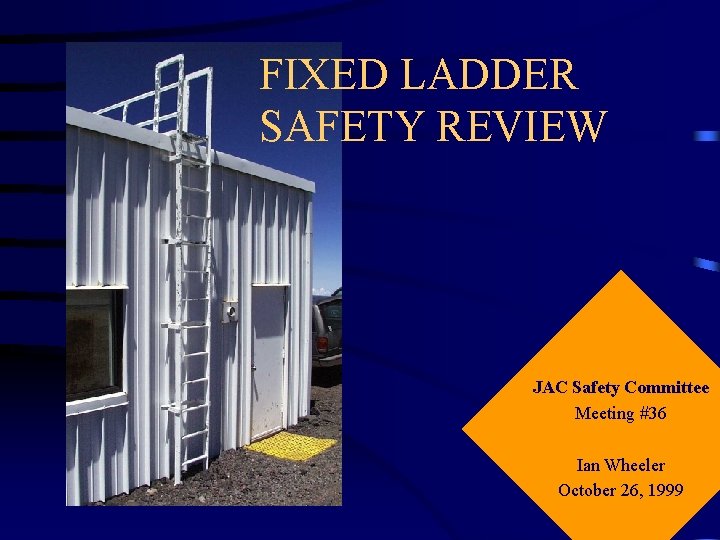
FIXED LADDER SAFETY REVIEW JAC Safety Committee Meeting #36 Ian Wheeler October 26, 1999
Background • Staff observations and cursory surveys prior to September 1999 prompted a more comprehensive review of the fixed ladders in the UKIRT, JCMT, and Hilo facilities. • Report titled Fixed Ladder Safety Review (21 Oct 99) is this comprehensive review.
Aim • “Run through” report: – methodology – highlight some examples – potential costs
Discussion/Desired Outcome • Agreement on methodology, i. e. , not strictly about compliance but risk assessment • Review recommendations
Report Scope • Intended as a review document, it identifies ladder deficiencies, outlines corrective action, and lists possible options. • Contains recommendations to replace or modify seven ladder assemblies. • Requires discussion to determine priority and action plan for any rectification work.
What makes a ladder Safe? Analysis Methodology • The JAC Health and Safety Manual states: “The minimum standards for safety will be those laid down by the State of Hawaii Occupational Safety and Health standards. The JAC is also required to comply not only with the state standards but, where the requirements are more stringent, and where it is reasonably practicable with UK standards encompassed by the Health and Safety at Work Act 1974”.
Methodology - Standards • Workplace Health, Safety and Welfare Regulations (ACOP, paragraph 13, page 21) • British Standards (BS-5395: 1985) • Occupational Safety and Health Administration (OSHA 3124, 1997 revised)
Methodology - Implementation • Significant criteria from standards were identified. • A risk assessment was performed in order to assess the implications of non-compliance with standards, allowing deviations to be placed into an appropriate risk category (low, medium, or high). • High risk deficiencies require corrective action.
Methodology - Application • Two possible approaches: 1. Complete an individual risk assessment for each ladder. OR 2. Complete a general risk assessment based on non-compliance with standards.
Results • Total of 21 ladders surveyed. • No ladders surveyed fully complied with either BS or OSHA. • Extent of non-compliance and associated risks that determine whether corrective action is required. • 7 ladders cited for corrective action.
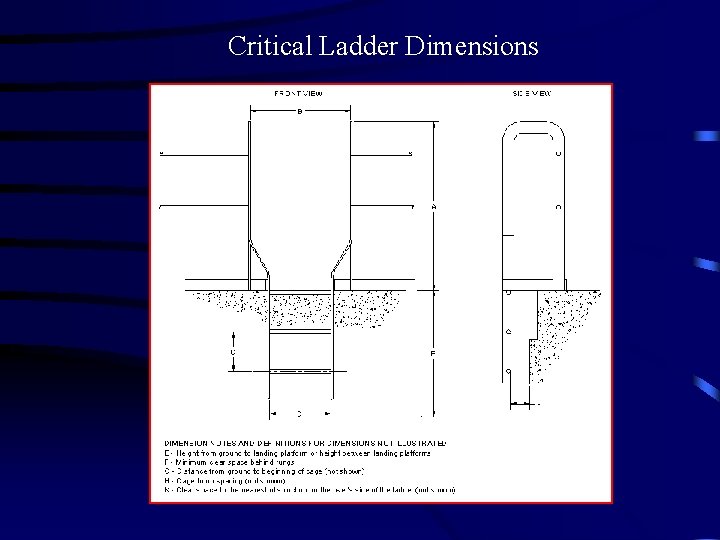
Critical Ladder Dimensions
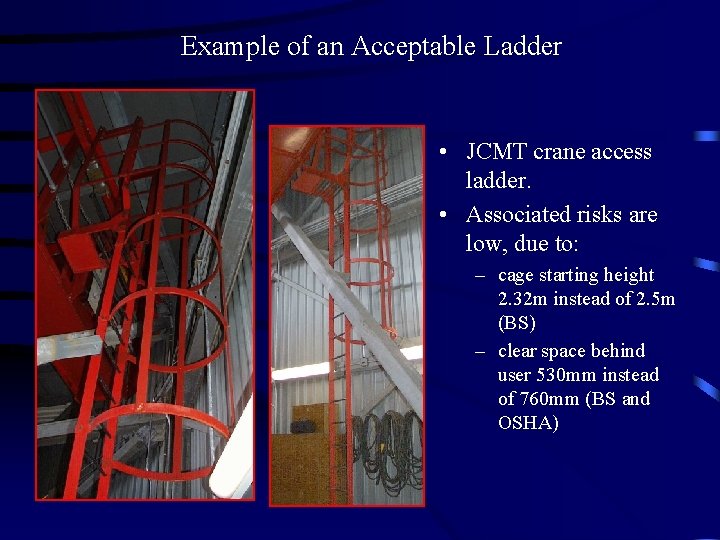
Example of an Acceptable Ladder • JCMT crane access ladder. • Associated risks are low, due to: – cage starting height 2. 32 m instead of 2. 5 m (BS) – clear space behind user 530 mm instead of 760 mm (BS and OSHA)
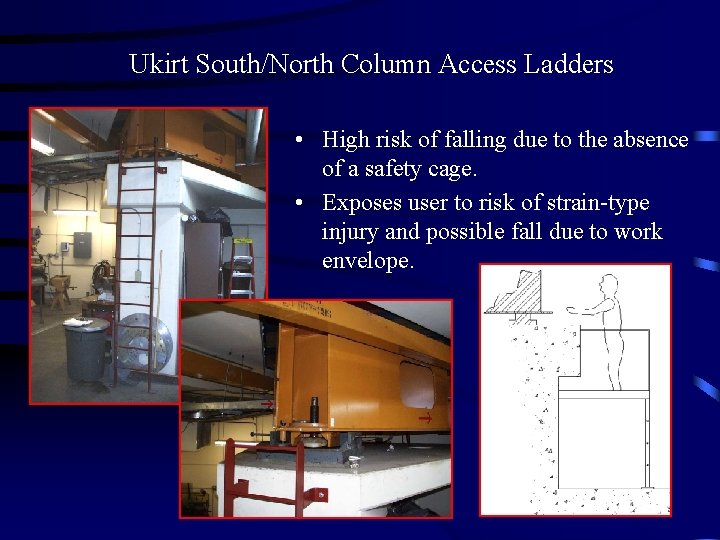
Ukirt South/North Column Access Ladders • High risk of falling due to the absence of a safety cage. • Exposes user to risk of strain-type injury and possible fall due to work envelope.
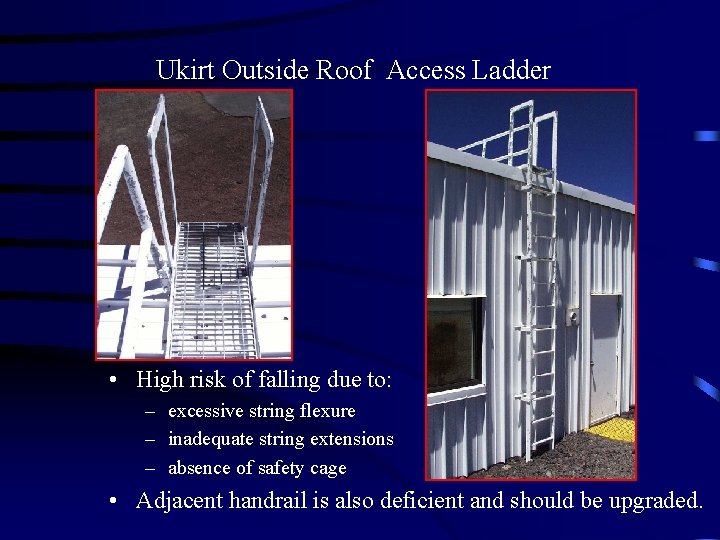
Ukirt Outside Roof Access Ladder • High risk of falling due to: – excessive string flexure – inadequate string extensions – absence of safety cage • Adjacent handrail is also deficient and should be upgraded.
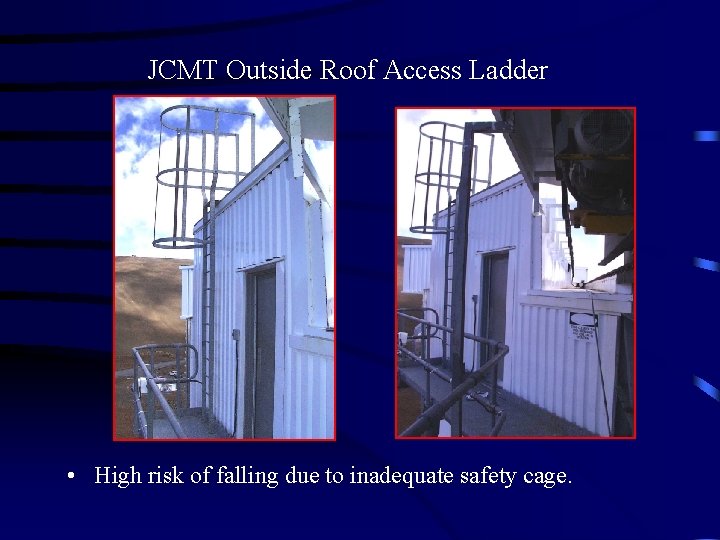
JCMT Outside Roof Access Ladder • High risk of falling due to inadequate safety cage.
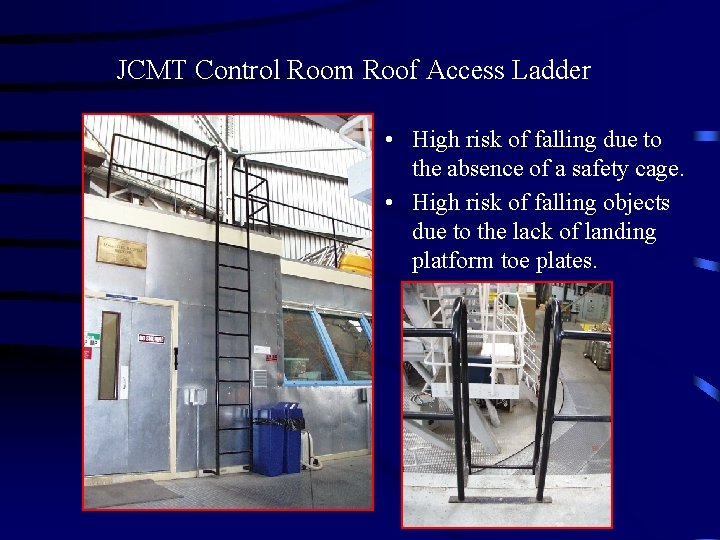
JCMT Control Room Roof Access Ladder • High risk of falling due to the absence of a safety cage. • High risk of falling objects due to the lack of landing platform toe plates.
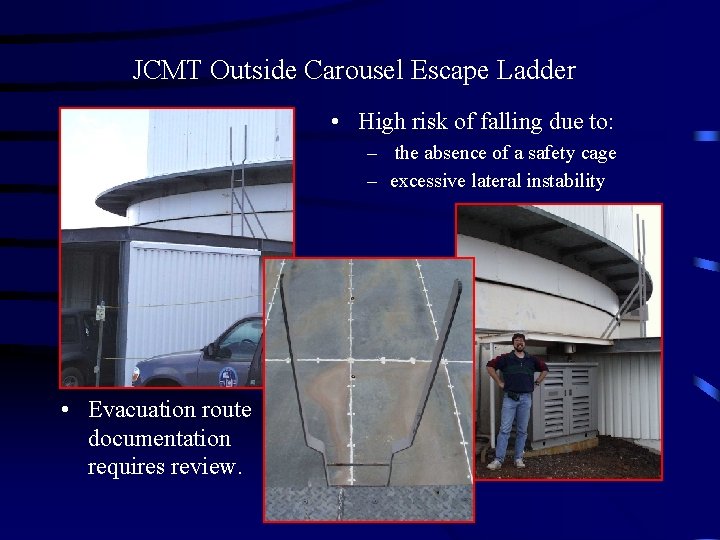
JCMT Outside Carousel Escape Ladder • High risk of falling due to: – the absence of a safety cage – excessive lateral instability • Evacuation route documentation requires review.
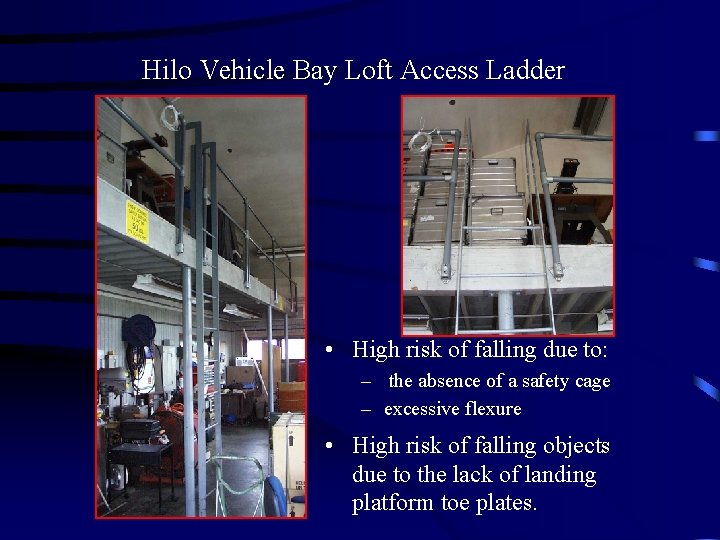
Hilo Vehicle Bay Loft Access Ladder • High risk of falling due to: – the absence of a safety cage – excessive flexure • High risk of falling objects due to the lack of landing platform toe plates.
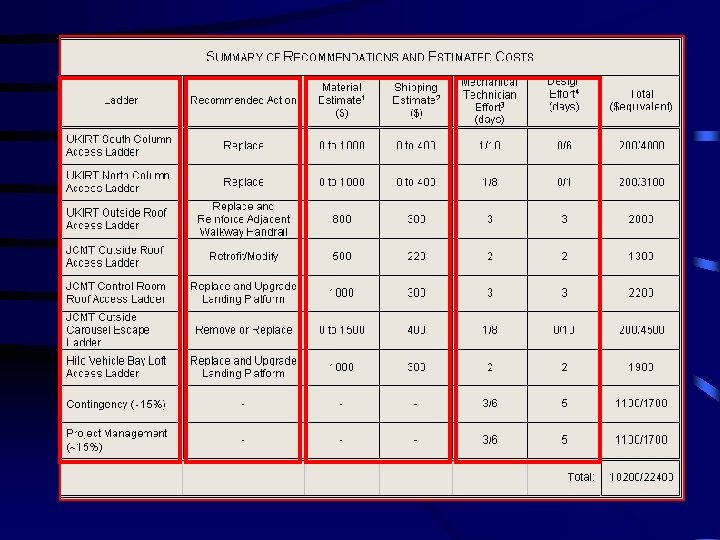
Recommendations • Remove, replace or modify 7 ladders. • Conduct review of building evacuation route documentation.
Estimated Costs • Implementing all 7 recommendations as given would result in the following estimated costs: – Material costs range $4420 to $9120 – Total effort range 23 days to 63 days (installation and design) – J 1 OBC has $1 k provision for ladder work in FY 99
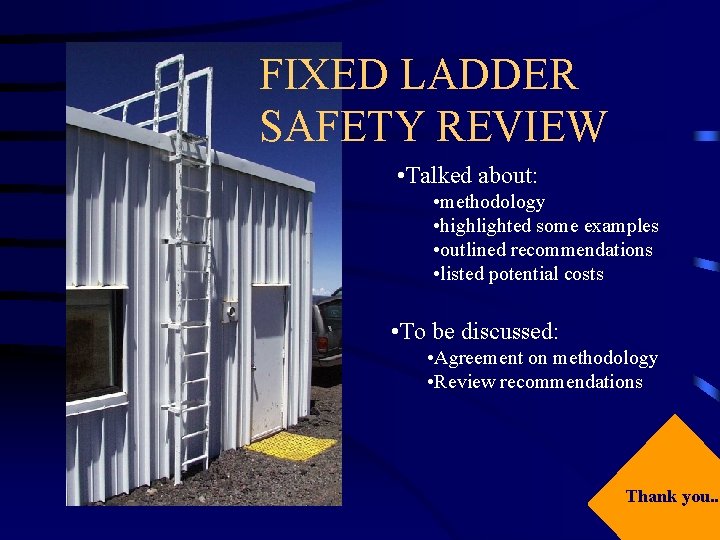
FIXED LADDER SAFETY REVIEW • Talked about: • methodology • highlighted some examples • outlined recommendations • listed potential costs • To be discussed: • Agreement on methodology • Review recommendations Thank you. . .