
Fixed Income Division Correlation Skew and Target Redemption

- Slides: 14
Fixed Income Division Correlation, Skew and Target Redemption Inverse Floaters Martin Baxter Fixed Income Quantitative Research Developments in Quantitative Finance Isaac Newton Institute, 7 July 2005, 4. 10 pm © Nomura International plc 7 July 2005
Fixed Income Division Outline of talk n No theorems n Modelling issues linked to actual trade type n Description of trade type and its characteristics n Correlation and skew issues n Individual solutions n Combining both correlation and skew n Work for academics © Nomura International plc 7 July 2005 Correlation Skew and TRIFs 1
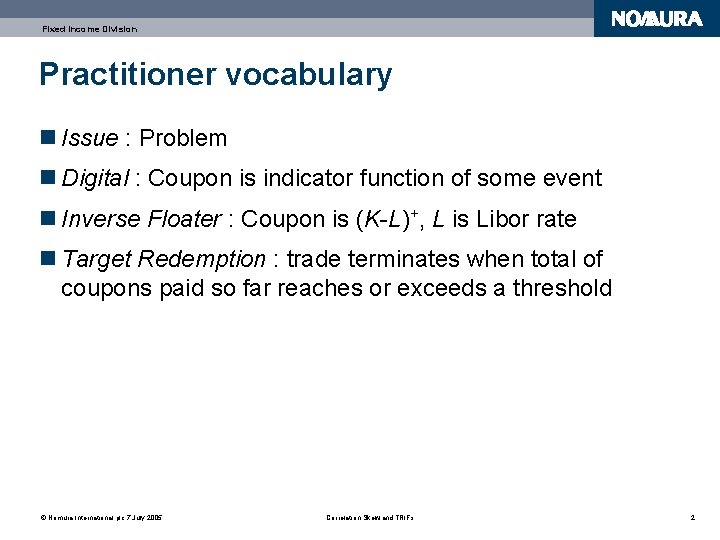
Fixed Income Division Practitioner vocabulary n Issue : Problem n Digital : Coupon is indicator function of some event n Inverse Floater : Coupon is (K-L)+, L is Libor rate n Target Redemption : trade terminates when total of coupons paid so far reaches or exceeds a threshold © Nomura International plc 7 July 2005 Correlation Skew and TRIFs 2
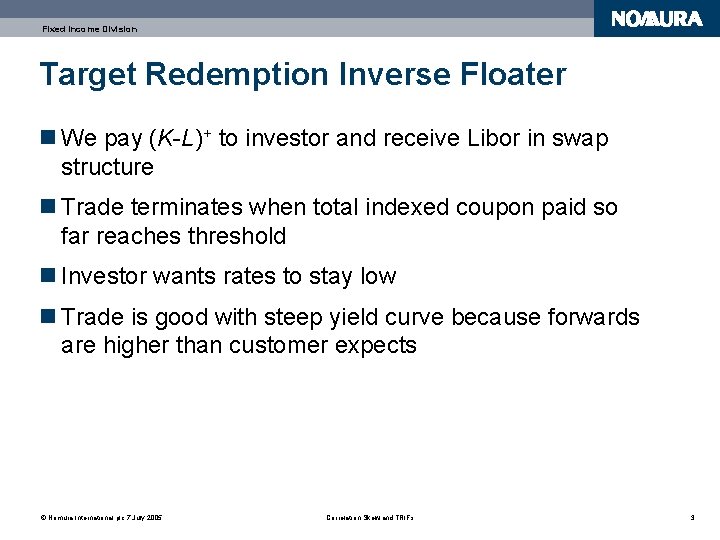
Fixed Income Division Target Redemption Inverse Floater n We pay (K-L)+ to investor and receive Libor in swap structure n Trade terminates when total indexed coupon paid so far reaches threshold n Investor wants rates to stay low n Trade is good with steep yield curve because forwards are higher than customer expects © Nomura International plc 7 July 2005 Correlation Skew and TRIFs 3
Fixed Income Division Correlation issue n For us, we want the Libors to be highly correlated n increases the chance they are all high n Like being long swaptions and short caplets n Essential feature to include in the model © Nomura International plc 7 July 2005 Correlation Skew and TRIFs 4
Fixed Income Division Skew issues n Coupon is floor struck at K n when K is not at-the-money, skew is relevant n Trade often looks like a digital on a swap floating leg n Swap strike is lower than K and digital in nature n Implied BS digital vol <> Implied BS call/put vol n Digital strike is also dynamic n We don’t know where it is © Nomura International plc 7 July 2005 Correlation Skew and TRIFs 5
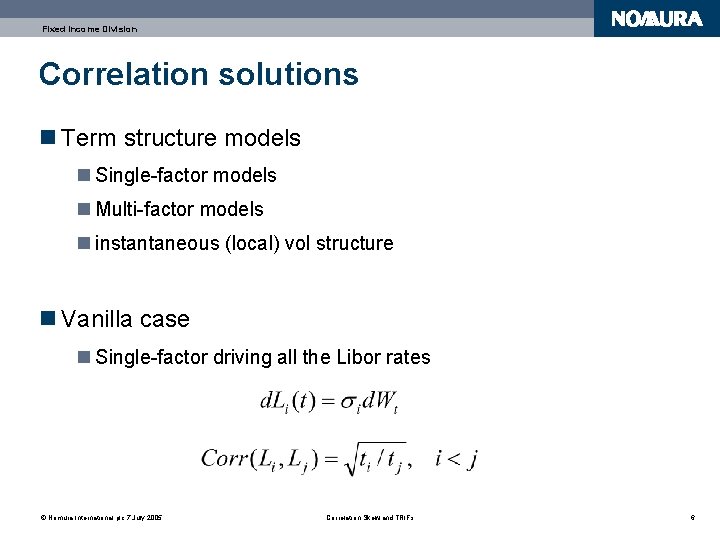
Fixed Income Division Correlation solutions n Term structure models n Single-factor models n Multi-factor models n instantaneous (local) vol structure n Vanilla case n Single-factor driving all the Libor rates © Nomura International plc 7 July 2005 Correlation Skew and TRIFs 6
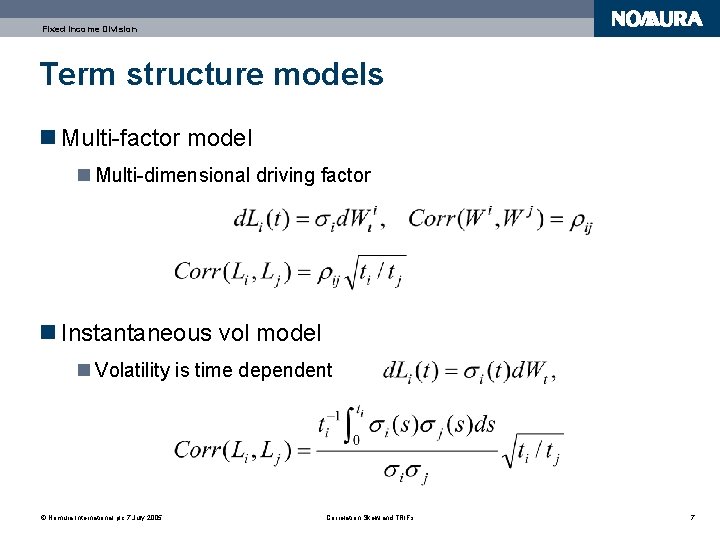
Fixed Income Division Term structure models n Multi-factor model n Multi-dimensional driving factor n Instantaneous vol model n Volatility is time dependent © Nomura International plc 7 July 2005 Correlation Skew and TRIFs 7
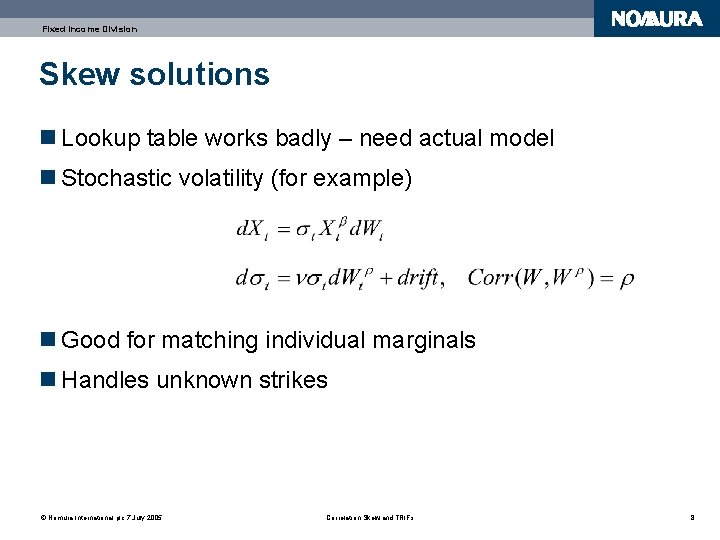
Fixed Income Division Skew solutions n Lookup table works badly – need actual model n Stochastic volatility (for example) n Good for matching individual marginals n Handles unknown strikes © Nomura International plc 7 July 2005 Correlation Skew and TRIFs 8
Fixed Income Division Combining correlation and skew n Term structure model with stochastic vol n Evolution of rates and vols n Correlation structure n Forward skew © Nomura International plc 7 July 2005 Correlation Skew and TRIFs 9
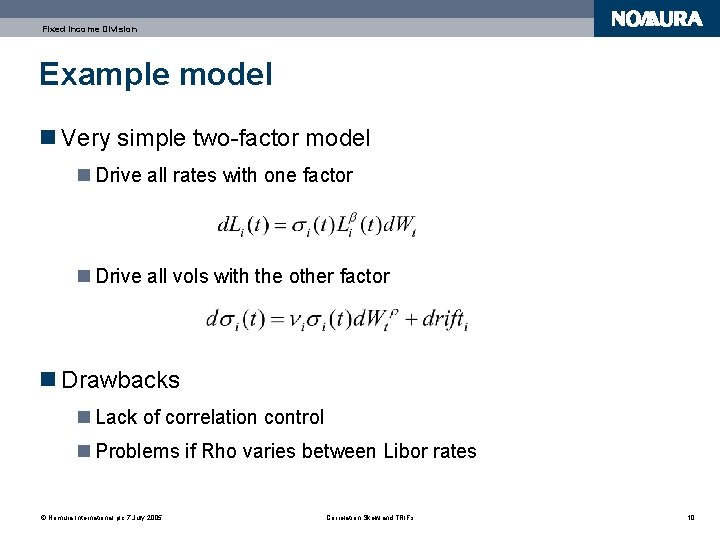
Fixed Income Division Example model n Very simple two-factor model n Drive all rates with one factor n Drive all vols with the other factor n Drawbacks n Lack of correlation control n Problems if Rho varies between Libor rates © Nomura International plc 7 July 2005 Correlation Skew and TRIFs 10
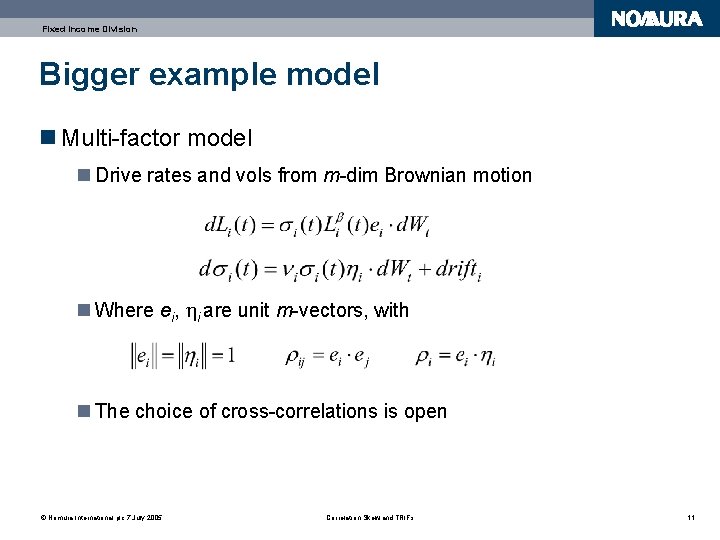
Fixed Income Division Bigger example model n Multi-factor model n Drive rates and vols from m-dim Brownian motion n Where ei, hi are unit m-vectors, with n The choice of cross-correlations is open © Nomura International plc 7 July 2005 Correlation Skew and TRIFs 11
Fixed Income Division Things to do n Choice of dimension and correlation vectors n Keep it sensible and implementable n Match the market prices and dynamics n Local stochastic volatility model n Forward skew n Extend to jointly calibrate to n Caplets and swaptions n Caplet skew and swaption skew © Nomura International plc 7 July 2005 Correlation Skew and TRIFs 12
Fixed Income Division © Nomura International plc 7 July 2005 Correlation Skew and TRIFs 13