
Fixed and continuous beam Visit for more Learning
Fixed and continuous beam Visit for more Learning Resources
NEED FOR SUPPORT n THE LOAD CARRYING STRUCTURES NEED SUPPORTS TO AVOID -DEFORMATION -BENDING -INSTABILITY
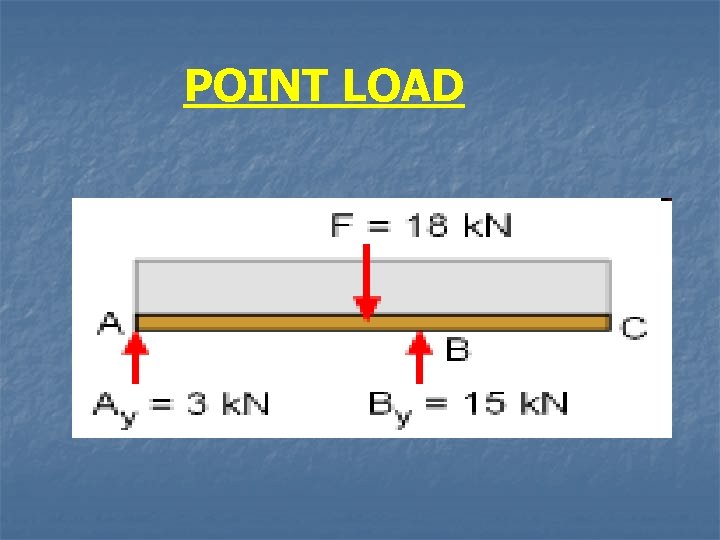
POINT LOAD

UDL Length =l Length = L

UNIFORMLY VARYING LOAD

COMBINED UDL AND UVL W= 1500 N/m =
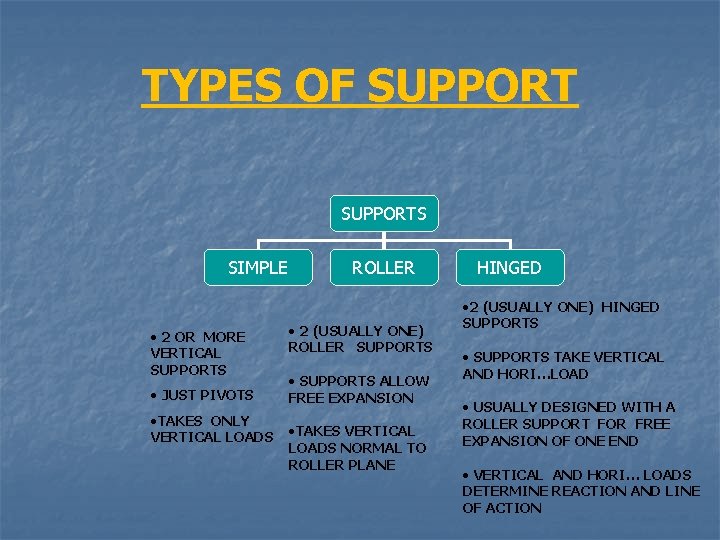
TYPES OF SUPPORTS SIMPLE • 2 OR MORE VERTICAL SUPPORTS • JUST PIVOTS • TAKES ONLY VERTICAL LOADS ROLLER • 2 (USUALLY ONE) ROLLER SUPPORTS • SUPPORTS ALLOW FREE EXPANSION • TAKES VERTICAL LOADS NORMAL TO ROLLER PLANE HINGED • 2 (USUALLY ONE) HINGED SUPPORTS • SUPPORTS TAKE VERTICAL AND HORI…LOAD • USUALLY DESIGNED WITH A ROLLER SUPPORT FOR FREE EXPANSION OF ONE END • VERTICAL AND HORI… LOADS DETERMINE REACTION AND LINE OF ACTION
Types of Support n n n In order for loaded parts to remain in equilibrium, the balancing forces are the reaction forces at the supports Most real life products have support geometries which differ from the idealized case Designer must select the conservative case
Types of Support n n n Guided is support at the end of the beams that prevent rotation, but permits longitudinal and transverse displacement Free or unsupported is when the beam is totally free to rotate in any direction Held is support at the end of the beam that prevents longitudinal and transverse displacement but permits rotation
Types of Support n n Simply Supported is support at the end of the beam that prevents transverse displacement, but permits rotation and longitudinal displacement Fixed is support at the ends of the beam that prevents rotation and transverse displacement, but permits longitudinal displacement
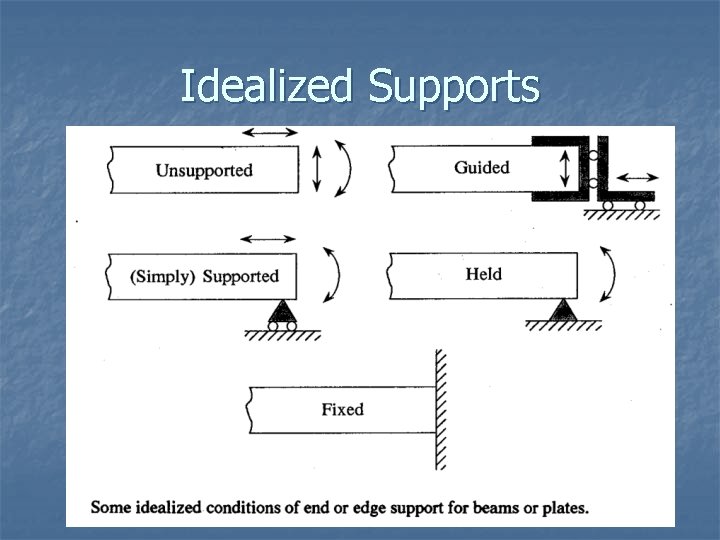
Idealized Supports
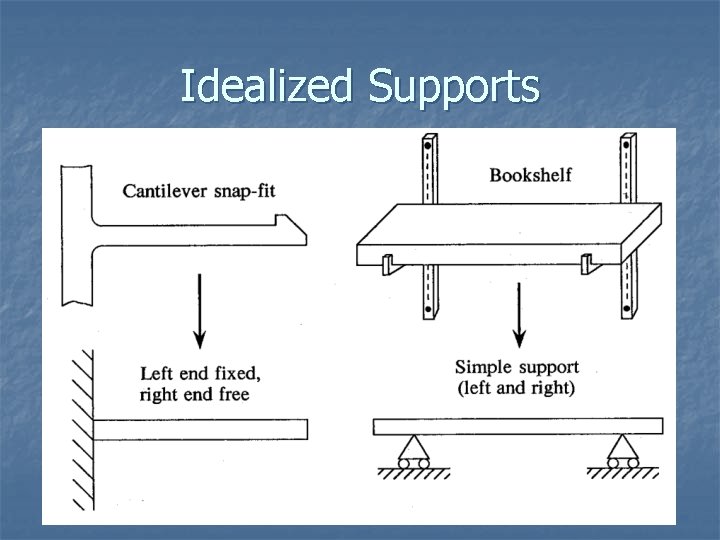
Idealized Supports
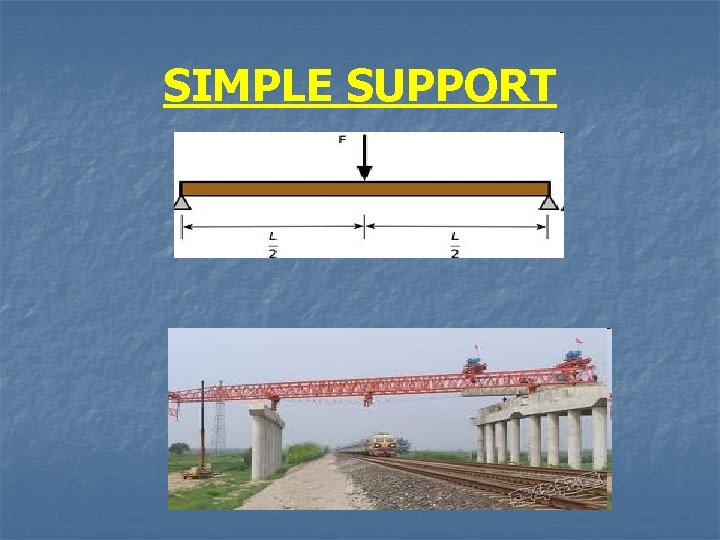
SIMPLE SUPPORT
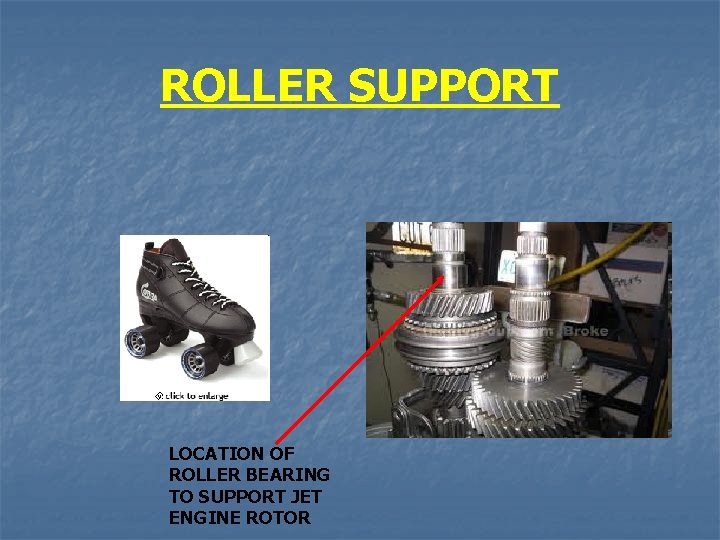
ROLLER SUPPORT LOCATION OF ROLLER BEARING TO SUPPORT JET ENGINE ROTOR
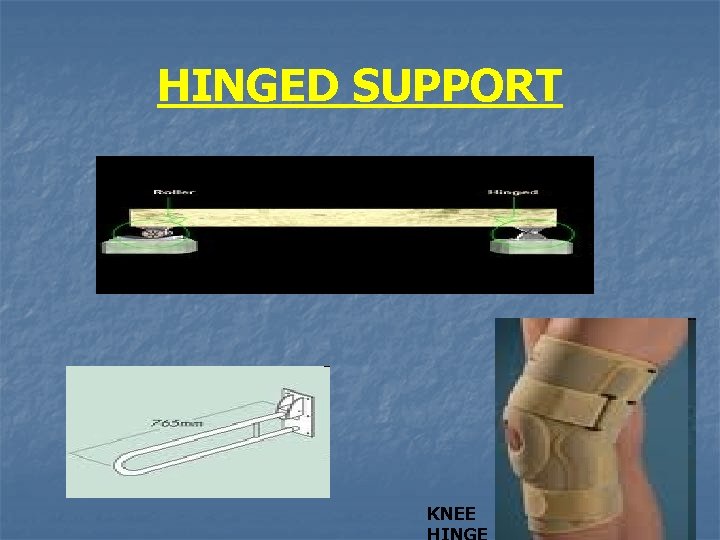
HINGED SUPPORT KNEE
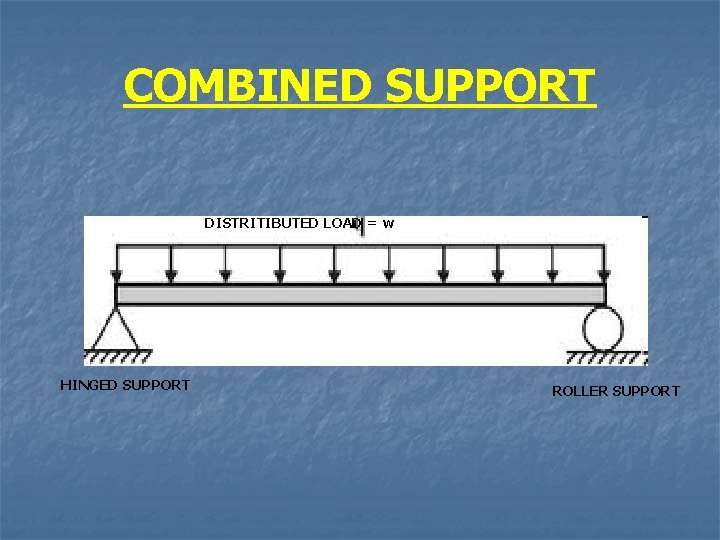
COMBINED SUPPORT DISTRITIBUTED LOAD = w HINGED SUPPORT ROLLER SUPPORT
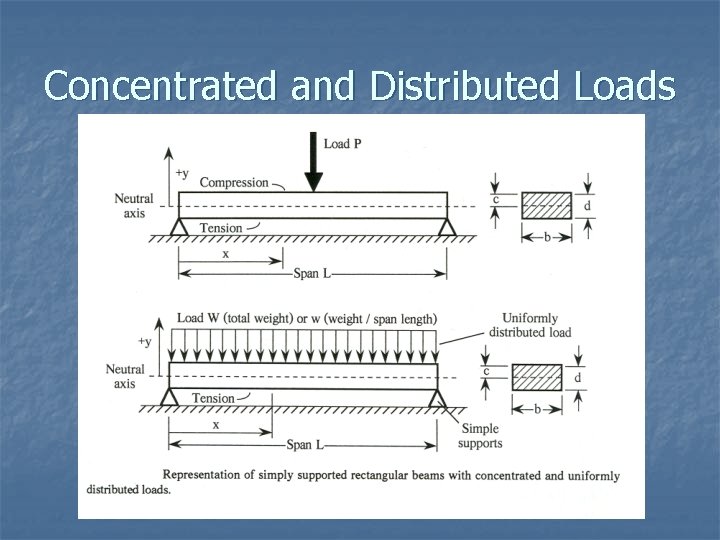
Concentrated and Distributed Loads
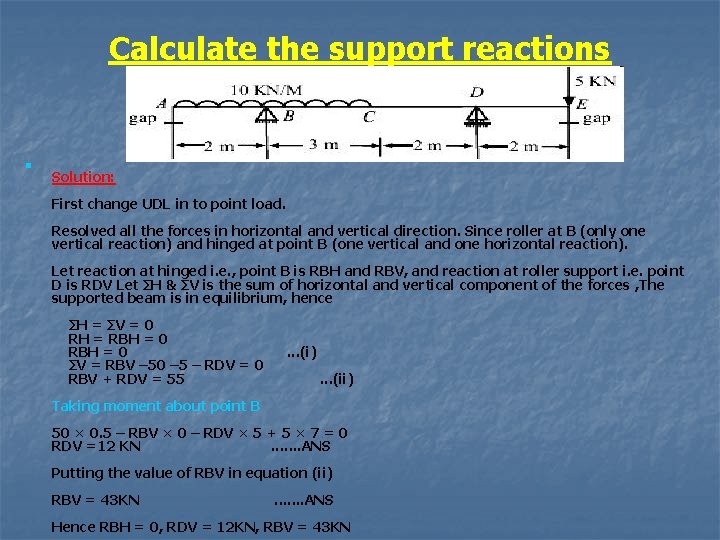
Calculate the support reactions n Solution: First change UDL in to point load. Resolved all the forces in horizontal and vertical direction. Since roller at B (only one vertical reaction) and hinged at point B (one vertical and one horizontal reaction). Let reaction at hinged i. e. , point B is RBH and RBV, and reaction at roller support i. e. point D is RDV Let ΣH & ΣV is the sum of horizontal and vertical component of the forces , The supported beam is in equilibrium, hence ΣH = ΣV = 0 RH = RBH = 0 . . . (i) ΣV = RBV – 50 – 5 – RDV = 0 RBV + RDV = 55 . . . (ii) Taking moment about point B 50 × 0. 5 – RBV × 0 – RDV × 5 + 5 × 7 = 0 RDV =12 KN . . . . ANS Putting the value of RBV in equation (ii) RBV = 43 KN . . . . ANS Hence RBH = 0, RDV = 12 KN, RBV = 43 KN

Types of loads • Concentrated loads (eg. P 1, P 2, P 3, P 4 ) • When a load is spread along the axis of a beam is a distributed load. Distributed loads are measured by their intensity q (force per unit distance) • Uniformly distributed load has constant intensity q (fig 4 -2 a) • • A varying load has an intensity q that changes with distance along the axis. Linearly varying load from q 1 - q 2 (fig 4 -2 b) Another kind of load is a couple of moment M 1 acting on the overhanging beam (fig 4 -2 c) FIG. 4 -2 Types of beams: (a) simple beam, (b) cantilever beam, and (c) beam with an overhang

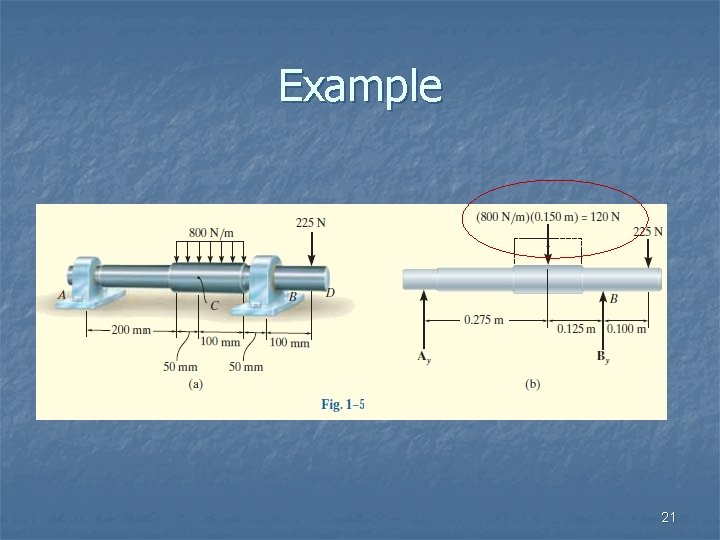
Distributed Load For calculation purposes, distributed load can be represented as a single load acting on the center point of the distributed area. Total force = area of distributed load (W : height and L: length) Point of action: center point of the area 20
Example 21

Example 22
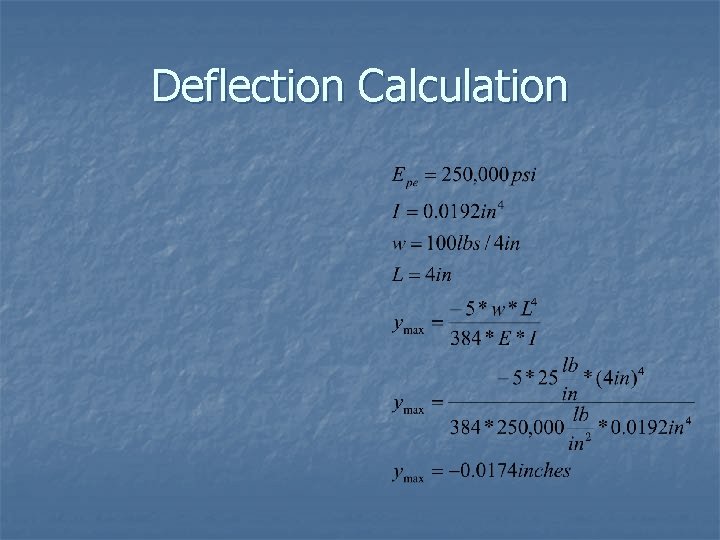
Deflection Calculation
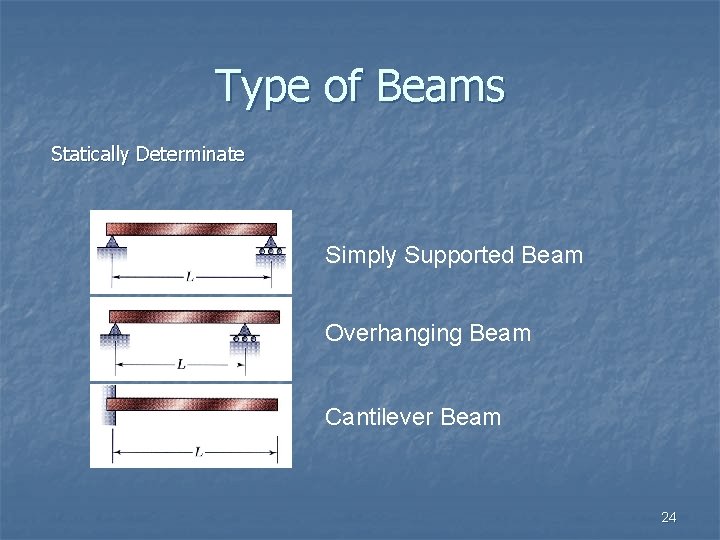
Type of Beams Statically Determinate Simply Supported Beam Overhanging Beam Cantilever Beam 24
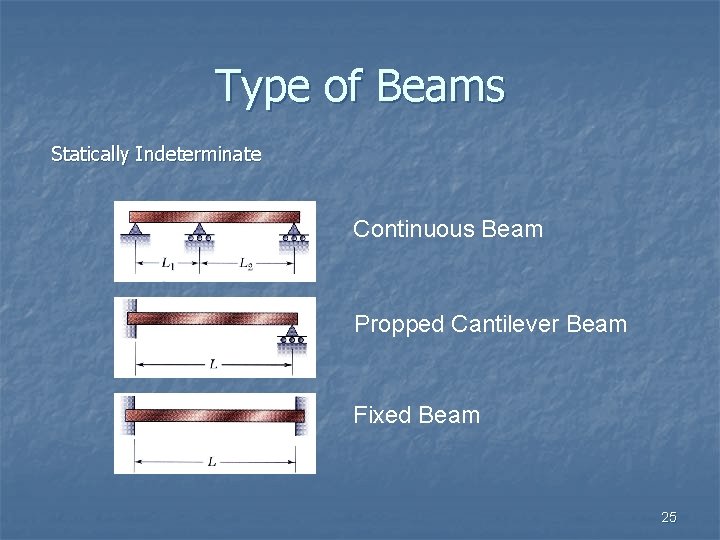
Type of Beams Statically Indeterminate Continuous Beam Propped Cantilever Beam Fixed Beam 25
26
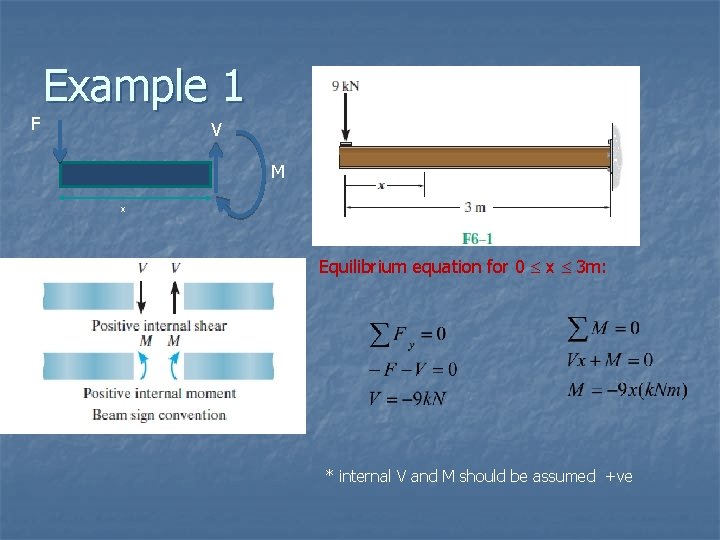
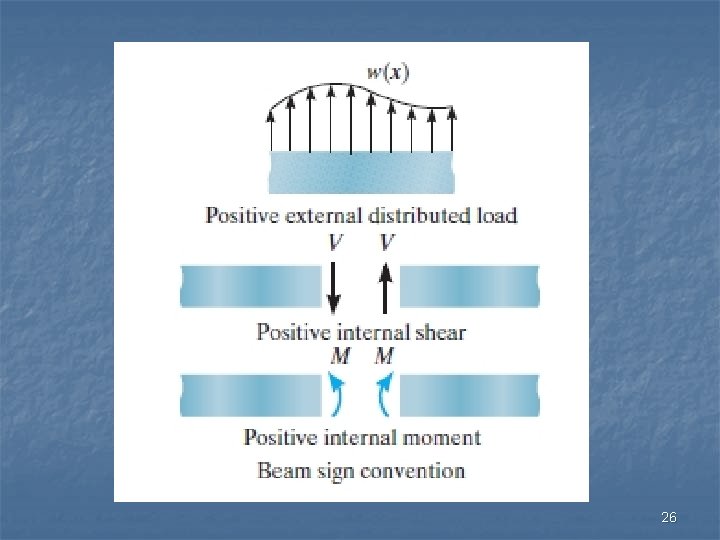
F Example 1 A V B M x Equilibrium equation for 0 x 3 m: * internal V and M should be assumed +ve

THANK YOU For more detail contact us
- Slides: 28