
FiveMinute Settlement Program Vendor Briefing Session AEMO 5

Five-Minute Settlement Program: Vendor Briefing Session AEMO 5 MS Program Team MONDAY, 3 RD DECEMBER 2018 AEMO OFFICES: MELBOURNE, LEVEL 22, 530 COLLINS STREET SYDNEY, LEVEL 2, 20 BOND STREET WEBINAR: DETAILS INCLUDED IN AGENDA 1
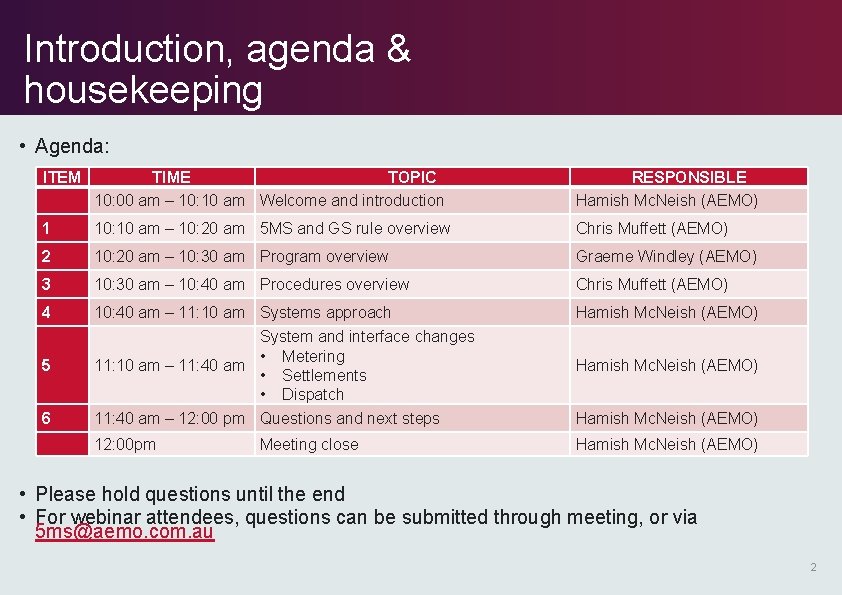
Introduction, agenda & housekeeping • Agenda: ITEM TIME TOPIC 10: 00 am – 10: 10 am Welcome and introduction RESPONSIBLE Hamish Mc. Neish (AEMO) 1 10: 10 am – 10: 20 am 5 MS and GS rule overview Chris Muffett (AEMO) 2 10: 20 am – 10: 30 am Program overview Graeme Windley (AEMO) 3 10: 30 am – 10: 40 am Procedures overview Chris Muffett (AEMO) 4 10: 40 am – 11: 10 am Systems approach System and interface changes • Metering 11: 10 am – 11: 40 am • Settlements • Dispatch 11: 40 am – 12: 00 pm Questions and next steps Hamish Mc. Neish (AEMO) 12: 00 pm Hamish Mc. Neish (AEMO) 5 6 Meeting close Hamish Mc. Neish (AEMO) • Please hold questions until the end • For webinar attendees, questions can be submitted through meeting, or via 5 ms@aemo. com. au 2
Five-Minute Settlement and Global Settlement rule overview Chris Muffett 3
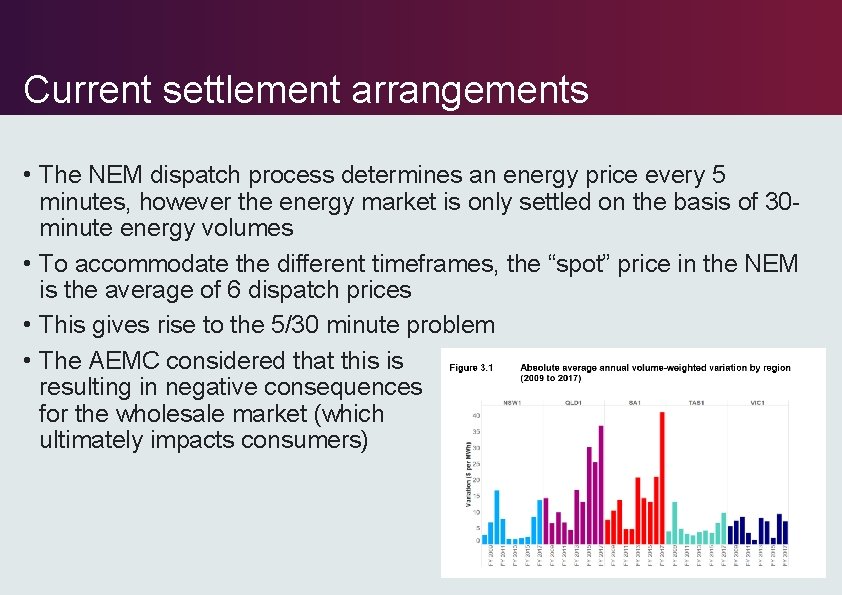
Current settlement arrangements • The NEM dispatch process determines an energy price every 5 minutes, however the energy market is only settled on the basis of 30 minute energy volumes • To accommodate the different timeframes, the “spot” price in the NEM is the average of 6 dispatch prices • This gives rise to the 5/30 minute problem • The AEMC considered that this is resulting in negative consequences for the wholesale market (which ultimately impacts consumers)
Five-minute settlement • The AEMC has determined that from 1 July 2021, the NEM will be directly settled using 5 -minute prices (i. e. the current 5 -minute dispatch price will become the trading or “spot” price) • To support this, metering will progressively change to 5 -minute: • All type 1 -3, type 7, and some type 4 connection points must be 5 -minute prior to go-live • New meters installed after 1 December 2018 must be 5 -minute capable • Bids/offers are also changing: • Scheduled participants must submit bids/offers with 5 -minute granularity
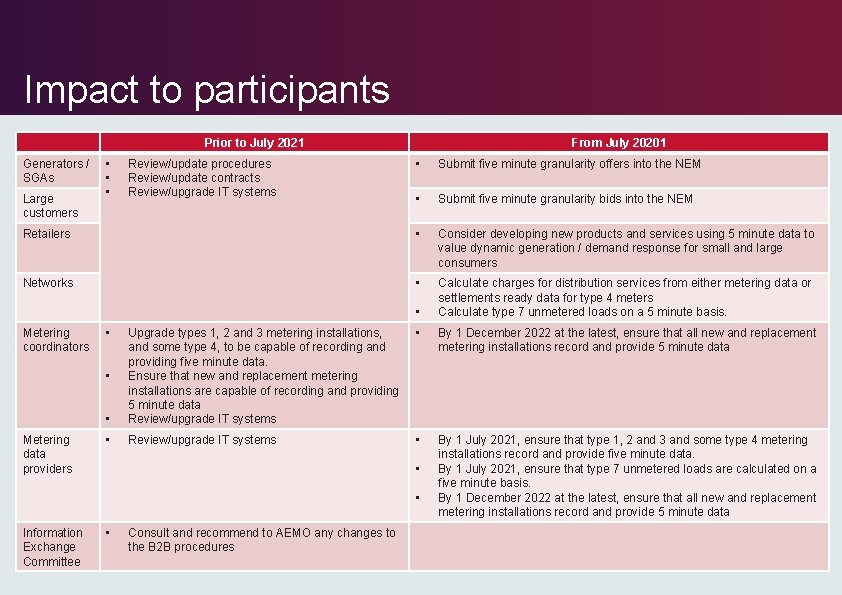
Impact to participants Prior to July 2021 • Submit five minute granularity offers into the NEM • Submit five minute granularity bids into the NEM Retailers • Consider developing new products and services using 5 minute data to value dynamic generation / demand response for small and large consumers Networks • Calculate charges for distribution services from either metering data or settlements ready data for type 4 meters Calculate type 7 unmetered loads on a 5 minute basis. Generators / SGAs Large customers • • • From July 20201 Review/update procedures Review/update contracts Review/upgrade IT systems • Metering coordinators • • By 1 December 2022 at the latest, ensure that all new and replacement metering installations record and provide 5 minute data • Upgrade types 1, 2 and 3 metering installations, and some type 4, to be capable of recording and providing five minute data. Ensure that new and replacement metering installations are capable of recording and providing 5 minute data Review/upgrade IT systems • By 1 July 2021, ensure that type 1, 2 and 3 and some type 4 metering installations record and provide five minute data. By 1 July 2021, ensure that type 7 unmetered loads are calculated on a five minute basis. By 1 December 2022 at the latest, ensure that all new and replacement metering installations record and provide 5 minute data • Metering data providers • • Information Exchange Committee • Consult and recommend to AEMO any changes to the B 2 B procedures
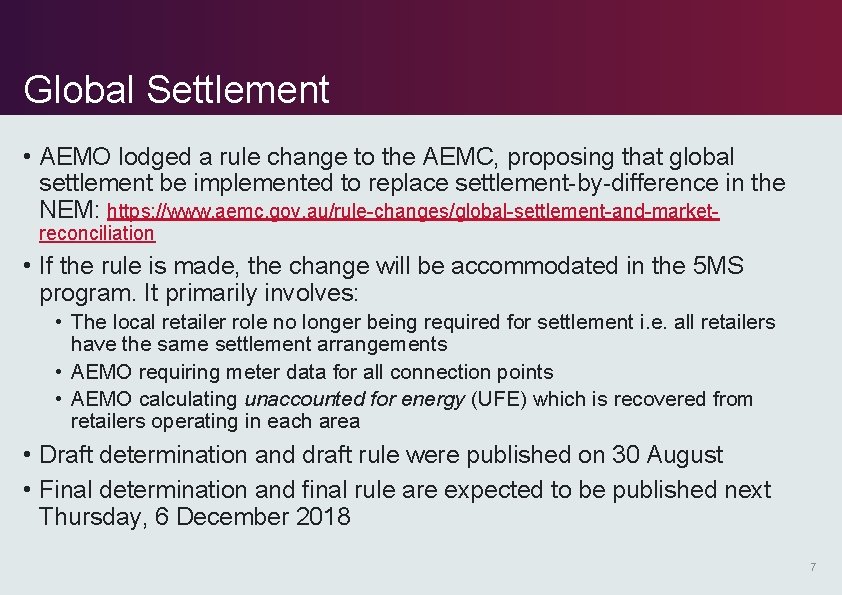
Global Settlement • AEMO lodged a rule change to the AEMC, proposing that global settlement be implemented to replace settlement-by-difference in the NEM: https: //www. aemc. gov. au/rule-changes/global-settlement-and-marketreconciliation • If the rule is made, the change will be accommodated in the 5 MS program. It primarily involves: • The local retailer role no longer being required for settlement i. e. all retailers have the same settlement arrangements • AEMO requiring meter data for all connection points • AEMO calculating unaccounted for energy (UFE) which is recovered from retailers operating in each area • Draft determination and draft rule were published on 30 August • Final determination and final rule are expected to be published next Thursday, 6 December 2018 7
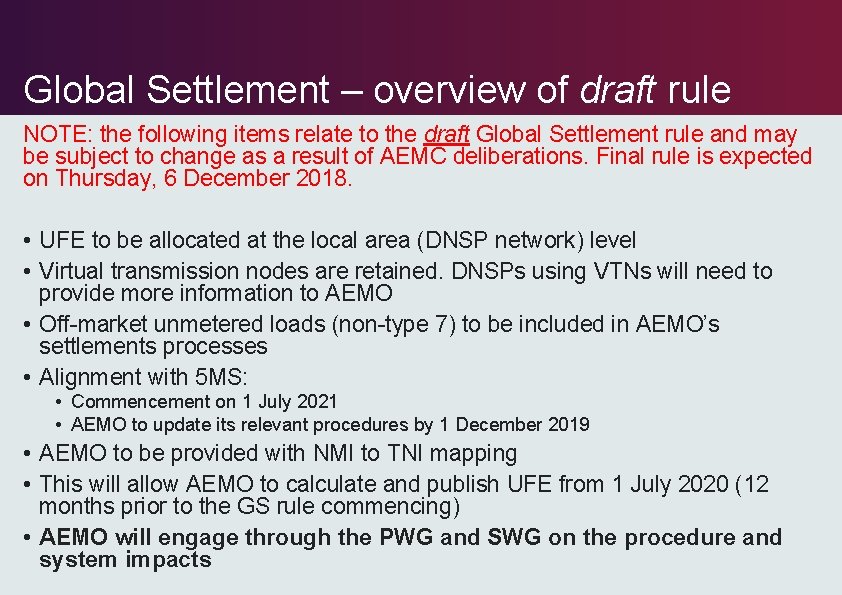
Global Settlement – overview of draft rule NOTE: the following items relate to the draft Global Settlement rule and may be subject to change as a result of AEMC deliberations. Final rule is expected on Thursday, 6 December 2018. • UFE to be allocated at the local area (DNSP network) level • Virtual transmission nodes are retained. DNSPs using VTNs will need to provide more information to AEMO • Off-market unmetered loads (non-type 7) to be included in AEMO’s settlements processes • Alignment with 5 MS: • Commencement on 1 July 2021 • AEMO to update its relevant procedures by 1 December 2019 • AEMO to be provided with NMI to TNI mapping • This will allow AEMO to calculate and publish UFE from 1 July 2020 (12 months prior to the GS rule commencing) • AEMO will engage through the PWG and SWG on the procedure and system impacts
Program overview Graeme Windley 9
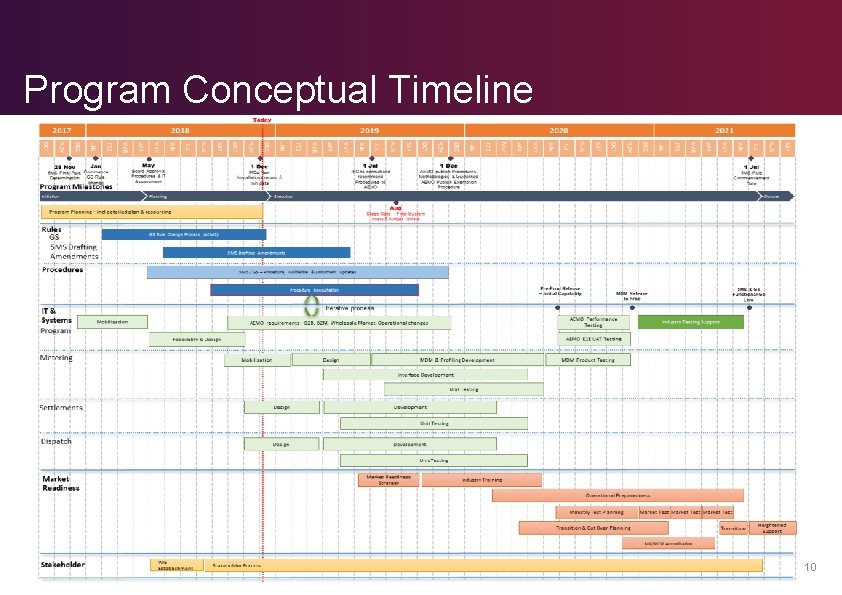
Program Conceptual Timeline 10
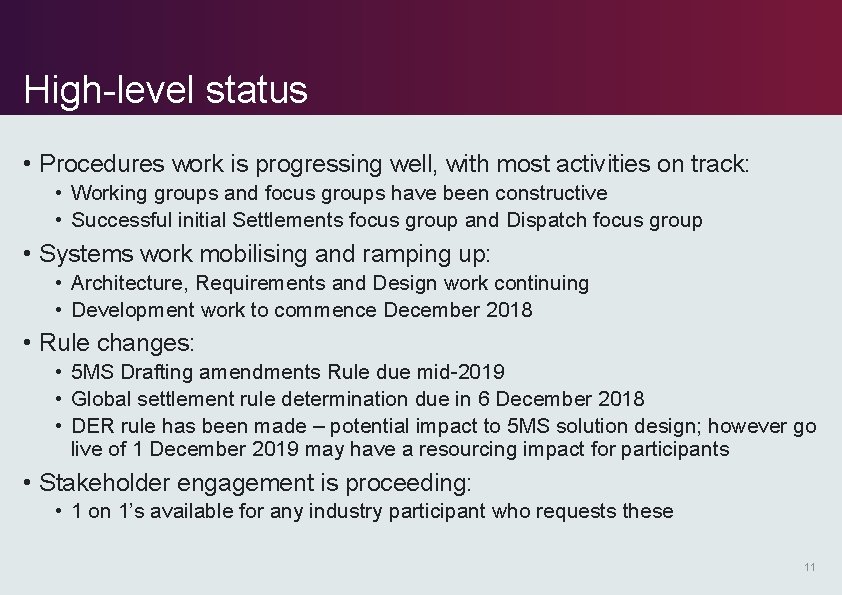
High-level status • Procedures work is progressing well, with most activities on track: • Working groups and focus groups have been constructive • Successful initial Settlements focus group and Dispatch focus group • Systems work mobilising and ramping up: • Architecture, Requirements and Design work continuing • Development work to commence December 2018 • Rule changes: • 5 MS Drafting amendments Rule due mid-2019 • Global settlement rule determination due in 6 December 2018 • DER rule has been made – potential impact to 5 MS solution design; however go live of 1 December 2019 may have a resourcing impact for participants • Stakeholder engagement is proceeding: • 1 on 1’s available for any industry participant who requests these 11
Procedures overview Chris Muffett 12
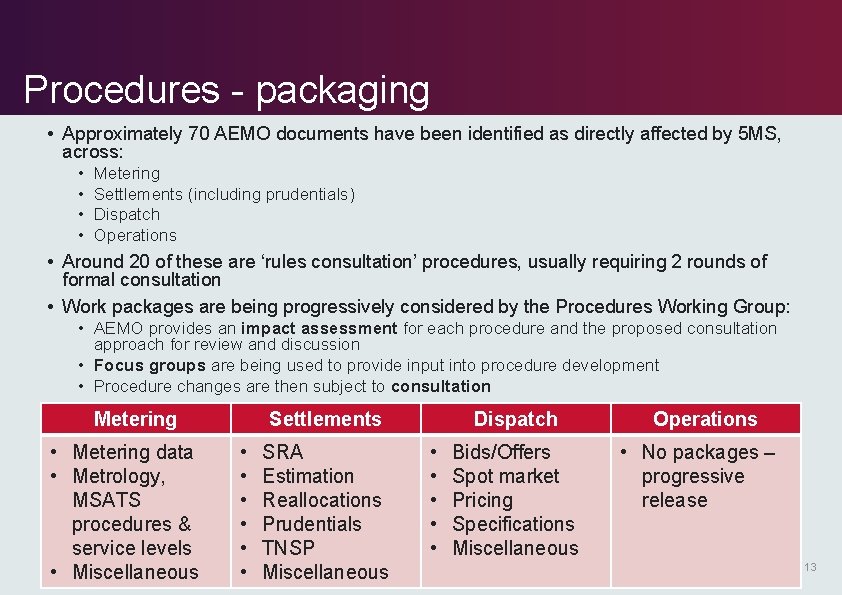
Procedures - packaging • Approximately 70 AEMO documents have been identified as directly affected by 5 MS, across: • • Metering Settlements (including prudentials) Dispatch Operations • Around 20 of these are ‘rules consultation’ procedures, usually requiring 2 rounds of formal consultation • Work packages are being progressively considered by the Procedures Working Group: • AEMO provides an impact assessment for each procedure and the proposed consultation approach for review and discussion • Focus groups are being used to provide input into procedure development • Procedure changes are then subject to consultation Metering • Metering data • Metrology, MSATS procedures & service levels • Miscellaneous Settlements • • • SRA Estimation Reallocations Prudentials TNSP Miscellaneous Dispatch • • • Bids/Offers Spot market Pricing Specifications Miscellaneous Operations • No packages – progressive release 13
Systems approach Hamish Mc. Neish 14
Systems Working Group (SWG) • Meets monthly • Open to software vendors, or system integrators • The SWG provides a forum to: • Inform and consult during AEMO’s and Industry’s IT development on changes to AEMO’s participant facing systems • Ensure sufficient information and systems are provided to support industry’s own system change • Ensure a clear approach and timeline to AEMO system implementation and deployment • Allow Industry to raise concerns or issues early in the system development process • Seek feedback on proposed changes and the impacts to industry stakeholders, including vendors • Refer to the Terms of Reference available at: http: //aemo. com. au/Electricity/National. Electricity-Market-NEM/Five-Minute-Settlement
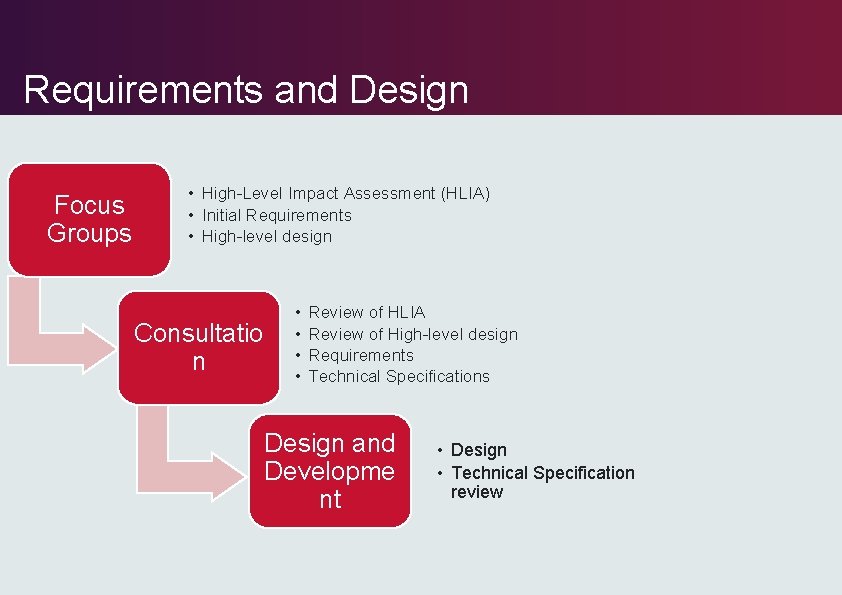
Requirements and Design Focus Groups • High-Level Impact Assessment (HLIA) • Initial Requirements • High-level design Consultatio n • • Review of HLIA Review of High-level design Requirements Technical Specifications Design and Developme nt • Design • Technical Specification review
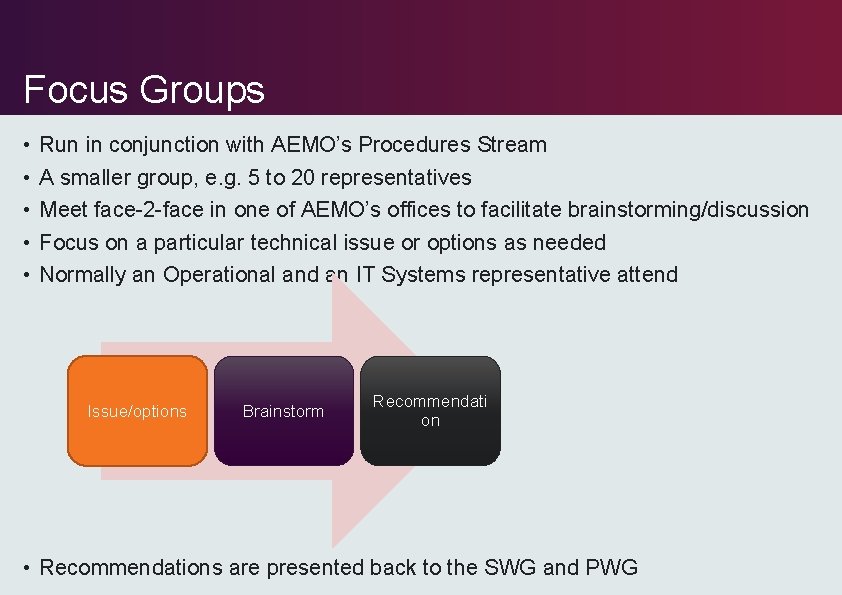
Focus Groups • • • Run in conjunction with AEMO’s Procedures Stream A smaller group, e. g. 5 to 20 representatives Meet face-2 -face in one of AEMO’s offices to facilitate brainstorming/discussion Focus on a particular technical issue or options as needed Normally an Operational and an IT Systems representative attend Issue/options Brainstorm Recommendati on • Recommendations are presented back to the SWG and PWG
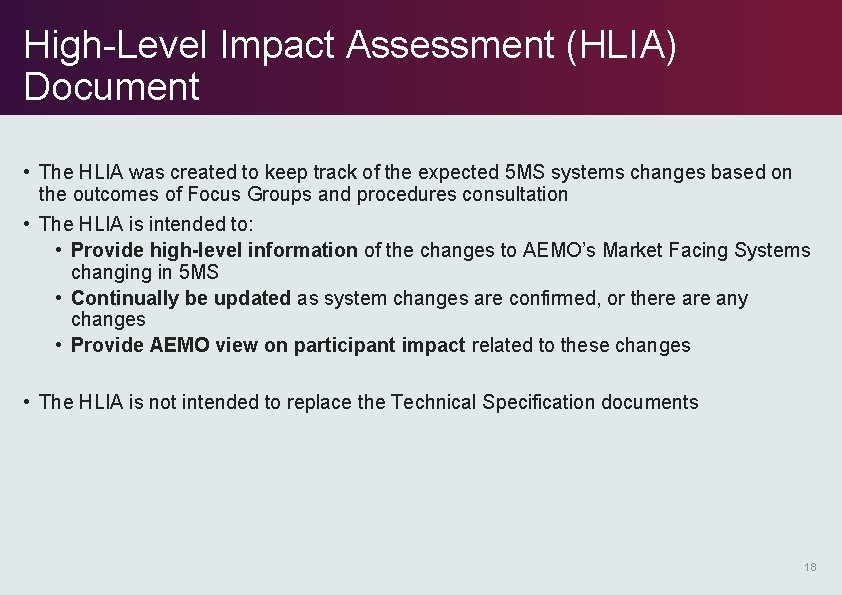
High-Level Impact Assessment (HLIA) Document • The HLIA was created to keep track of the expected 5 MS systems changes based on the outcomes of Focus Groups and procedures consultation • The HLIA is intended to: • Provide high-level information of the changes to AEMO’s Market Facing Systems changing in 5 MS • Continually be updated as system changes are confirmed, or there any changes • Provide AEMO view on participant impact related to these changes • The HLIA is not intended to replace the Technical Specification documents 18
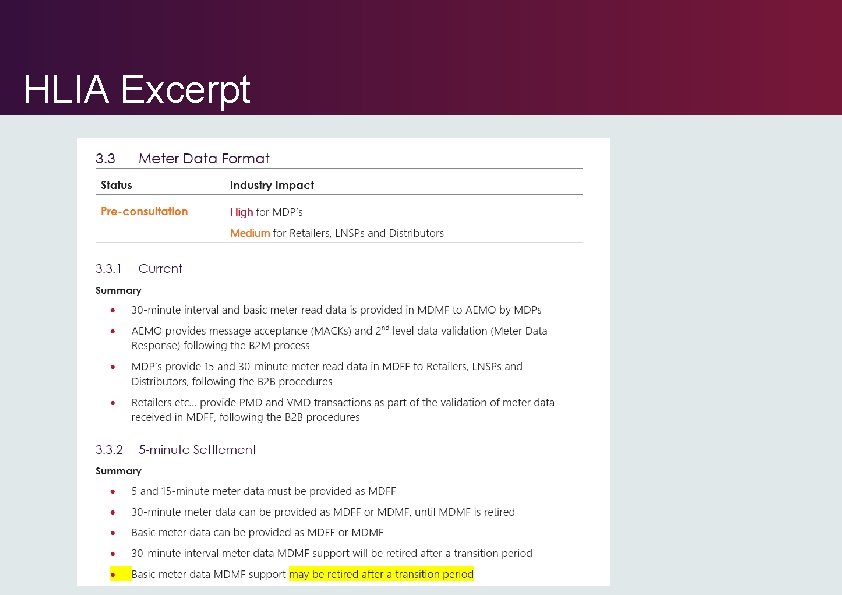
HLIA Excerpt
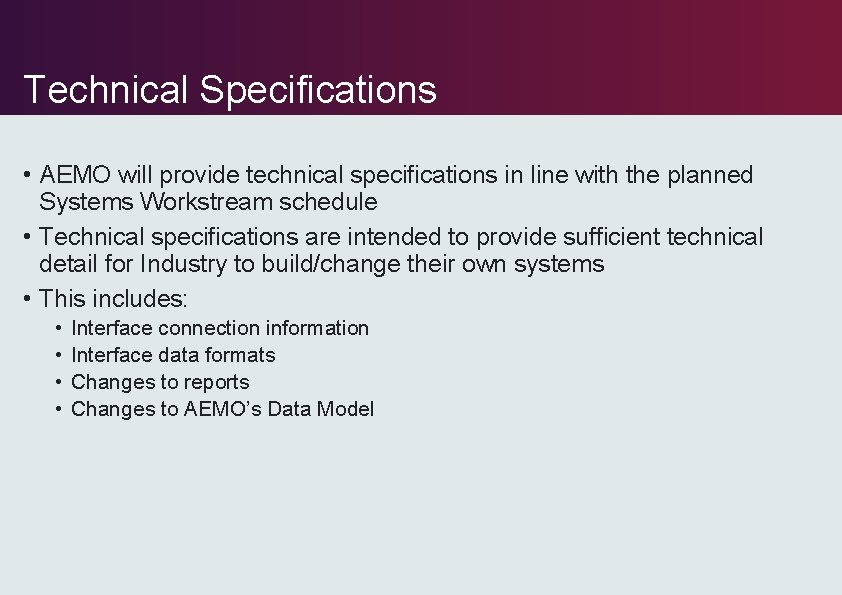
Technical Specifications • AEMO will provide technical specifications in line with the planned Systems Workstream schedule • Technical specifications are intended to provide sufficient technical detail for Industry to build/change their own systems • This includes: • • Interface connection information Interface data formats Changes to reports Changes to AEMO’s Data Model
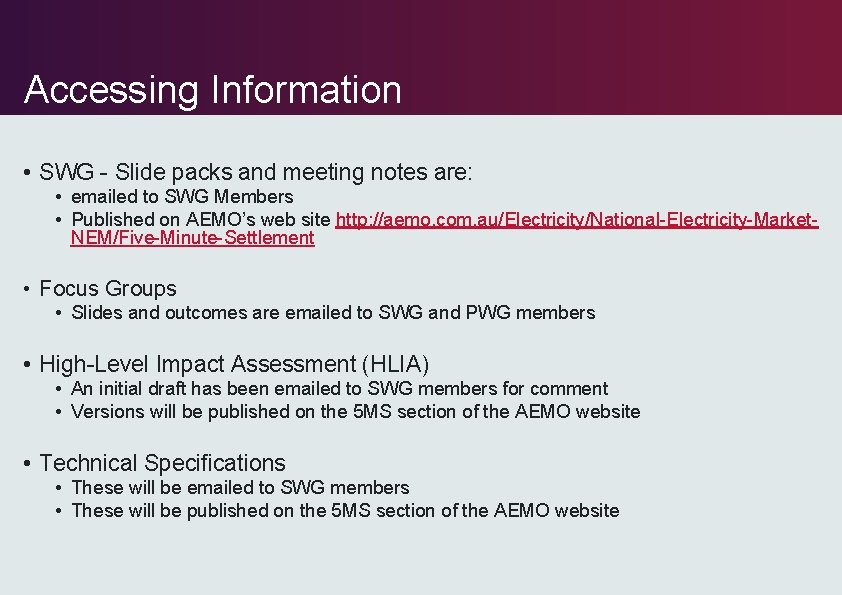
Accessing Information • SWG - Slide packs and meeting notes are: • emailed to SWG Members • Published on AEMO’s web site http: //aemo. com. au/Electricity/National-Electricity-Market. NEM/Five-Minute-Settlement • Focus Groups • Slides and outcomes are emailed to SWG and PWG members • High-Level Impact Assessment (HLIA) • An initial draft has been emailed to SWG members for comment • Versions will be published on the 5 MS section of the AEMO website • Technical Specifications • These will be emailed to SWG members • These will be published on the 5 MS section of the AEMO website
External Testing Hamish Mc. Neish 22
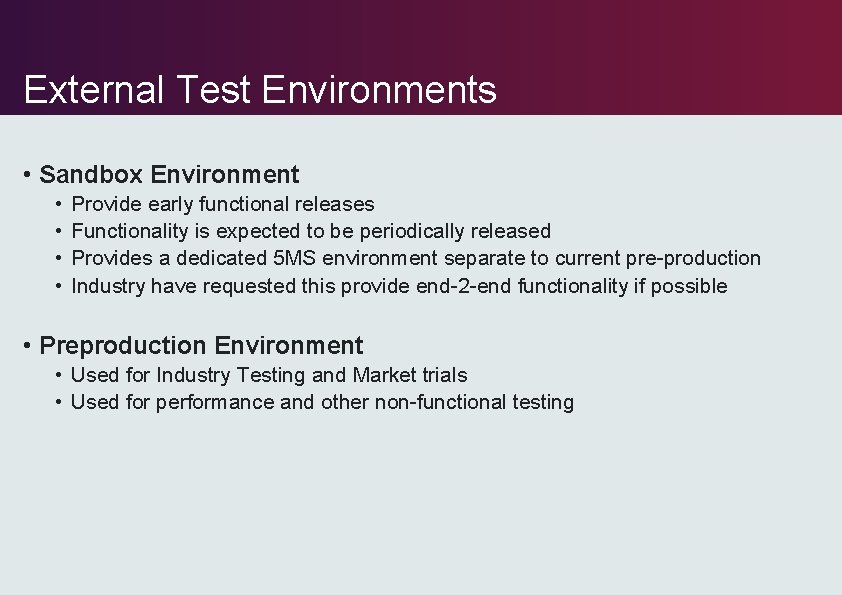
External Test Environments • Sandbox Environment • • Provide early functional releases Functionality is expected to be periodically released Provides a dedicated 5 MS environment separate to current pre-production Industry have requested this provide end-2 -end functionality if possible • Preproduction Environment • Used for Industry Testing and Market trials • Used for performance and other non-functional testing
Proposed Timeline Hamish Mc. Neish 24
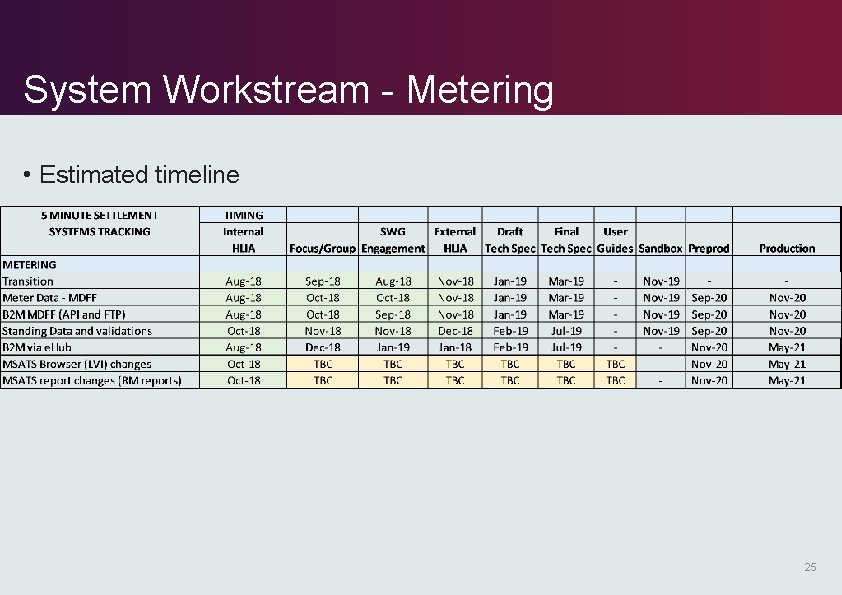
System Workstream - Metering • Estimated timeline 25
System Workstream - Dispatch • Estimated timeline 26
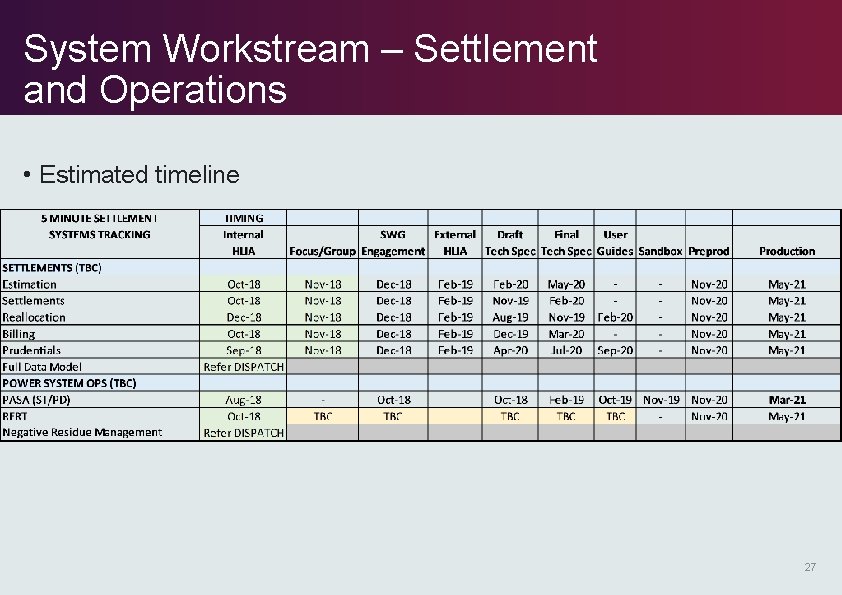
System Workstream – Settlement and Operations • Estimated timeline 27
System and interface changes Hamish Mc. Neish 28
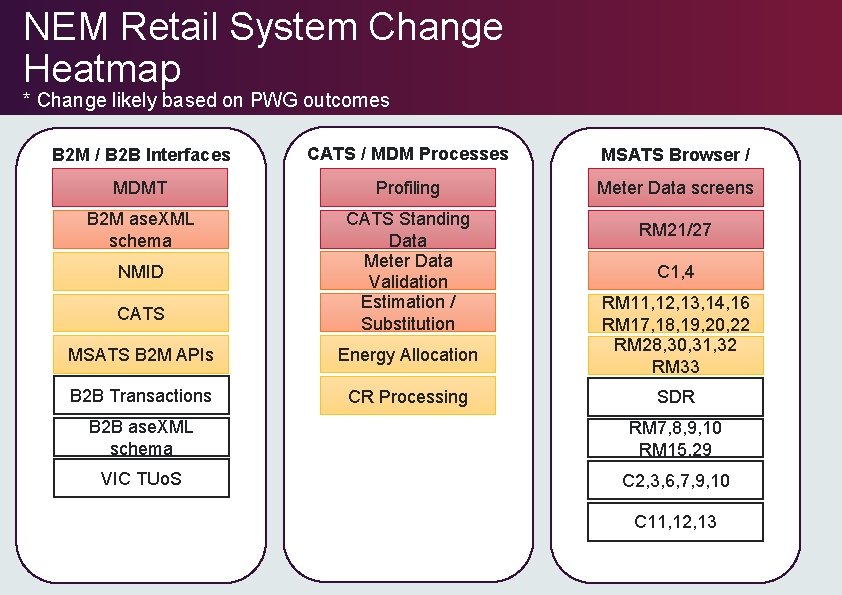
NEM Retail System Change Heatmap * Change likely based on PWG outcomes B 2 M / B 2 B Interfaces CATS / MDM Processes MDMT Profiling B 2 M ase. XML schema CATS Standing Data Meter Data Validation Estimation / Substitution NMID CATS MSATS B 2 M APIs Energy Allocation B 2 B Transactions CR Processing MSATS Browser / Reports Meter Data screens RM 21/27 C 1, 4 RM 11, 12, 13, 14, 16 RM 17, 18, 19, 20, 22 RM 28, 30, 31, 32 RM 33 SDR B 2 B ase. XML schema RM 7, 8, 9, 10 RM 15, 29 VIC TUo. S C 2, 3, 6, 7, 9, 10 C 11, 12, 13
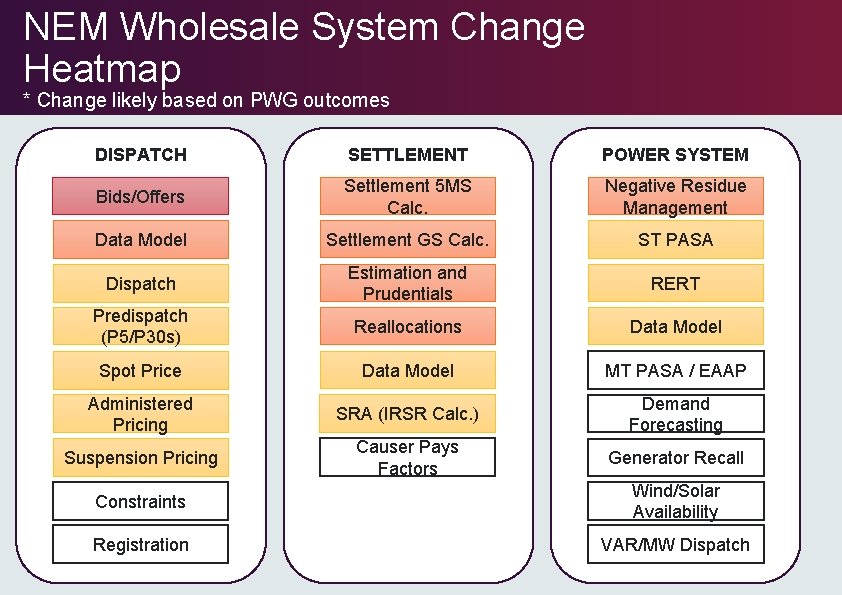
NEM Wholesale System Change Heatmap * Change likely based on PWG outcomes DISPATCH SETTLEMENT POWER SYSTEM Bids/Offers Settlement 5 MS Calc. Negative Residue Management Data Model Settlement GS Calc. ST PASA Dispatch Estimation and Prudentials RERT Predispatch (P 5/P 30 s) Reallocations Data Model Spot Price Data Model MT PASA / EAAP Administered Pricing SRA (IRSR Calc. ) Demand Forecasting Suspension Pricing Causer Pays Factors Generator Recall Constraints Wind/Solar Availability Registration VAR/MW Dispatch
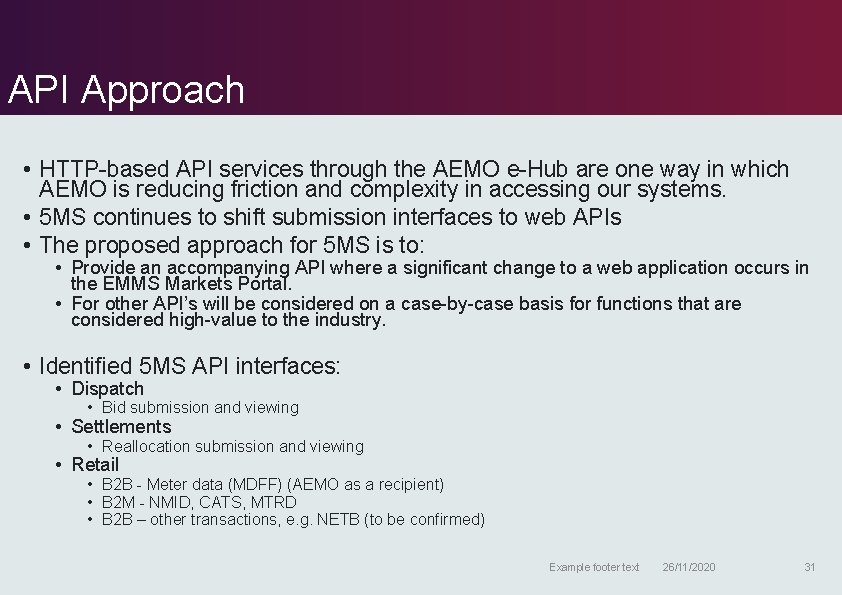
API Approach • HTTP-based API services through the AEMO e-Hub are one way in which AEMO is reducing friction and complexity in accessing our systems. • 5 MS continues to shift submission interfaces to web APIs • The proposed approach for 5 MS is to: • Provide an accompanying API where a significant change to a web application occurs in the EMMS Markets Portal. • For other API’s will be considered on a case-by-case basis for functions that are considered high-value to the industry. • Identified 5 MS API interfaces: • Dispatch • Bid submission and viewing • Settlements • Reallocation submission and viewing • Retail • B 2 B - Meter data (MDFF) (AEMO as a recipient) • B 2 M - NMID, CATS, MTRD • B 2 B – other transactions, e. g. NETB (to be confirmed) Example footer text 26/11/2020 31
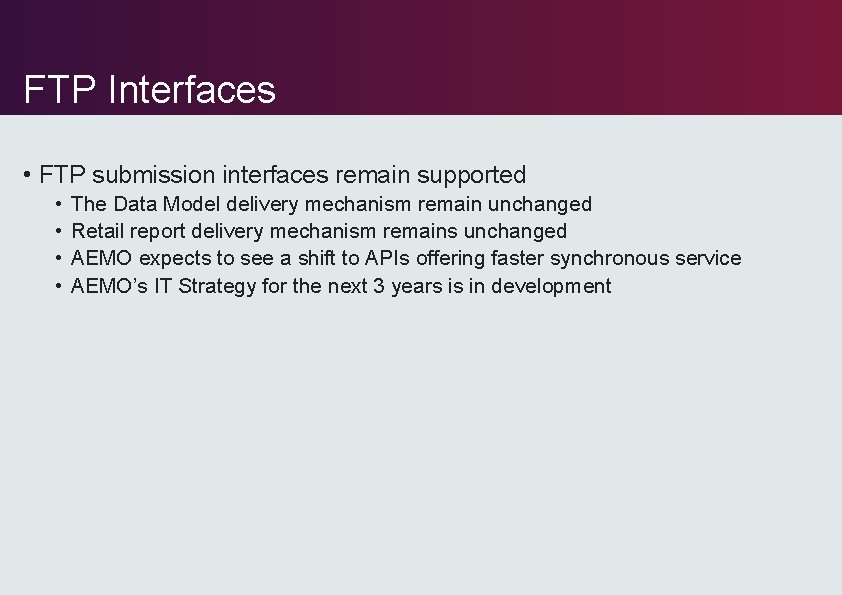
FTP Interfaces • FTP submission interfaces remain supported • • The Data Model delivery mechanism remain unchanged Retail report delivery mechanism remains unchanged AEMO expects to see a shift to APIs offering faster synchronous service AEMO’s IT Strategy for the next 3 years is in development
Metering Hamish Mc. Neish 33
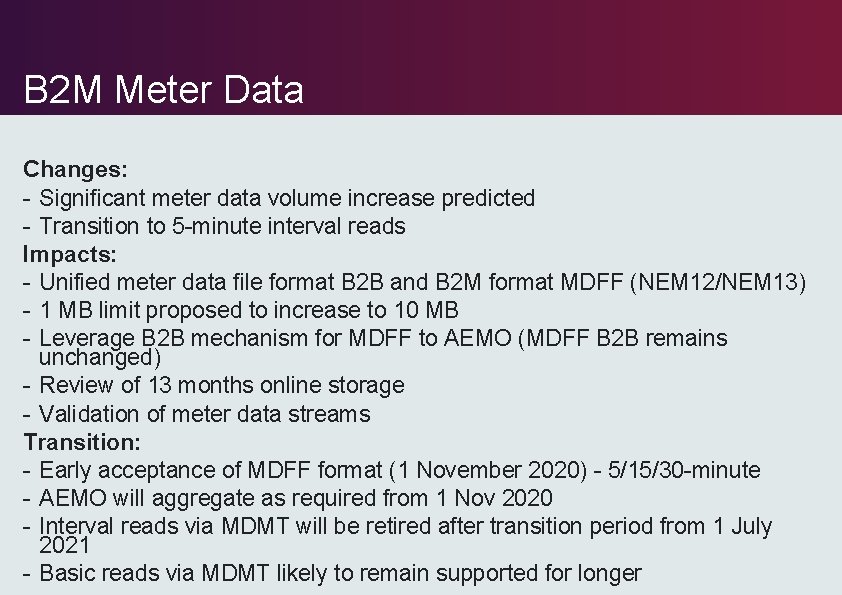
B 2 M Meter Data Changes: - Significant meter data volume increase predicted - Transition to 5 -minute interval reads Impacts: - Unified meter data file format B 2 B and B 2 M format MDFF (NEM 12/NEM 13) - 1 MB limit proposed to increase to 10 MB - Leverage B 2 B mechanism for MDFF to AEMO (MDFF B 2 B remains unchanged) - Review of 13 months online storage - Validation of meter data streams Transition: - Early acceptance of MDFF format (1 November 2020) - 5/15/30 -minute - AEMO will aggregate as required from 1 Nov 2020 - Interval reads via MDMT will be retired after transition period from 1 July 2021 - Basic reads via MDMT likely to remain supported for longer
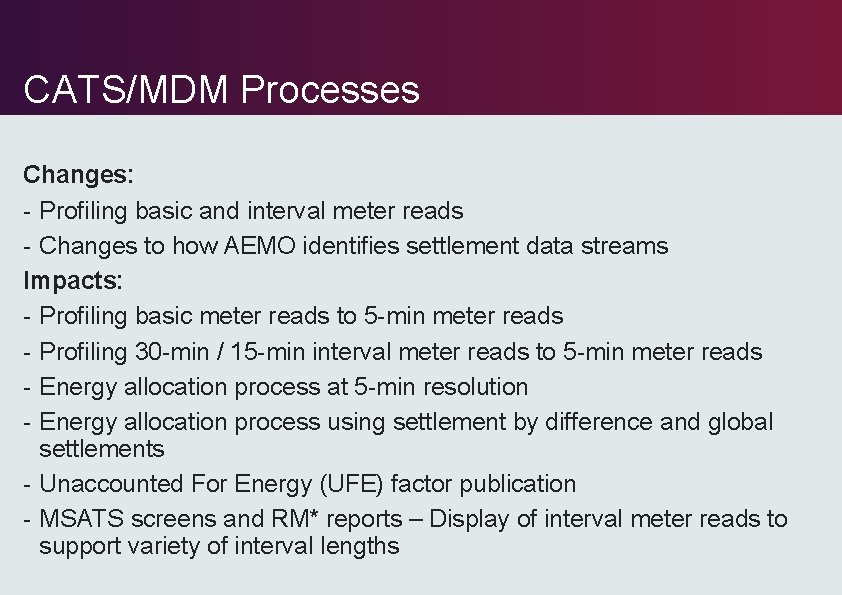
CATS/MDM Processes Changes: - Profiling basic and interval meter reads - Changes to how AEMO identifies settlement data streams Impacts: - Profiling basic meter reads to 5 -min meter reads - Profiling 30 -min / 15 -min interval meter reads to 5 -min meter reads - Energy allocation process at 5 -min resolution - Energy allocation process using settlement by difference and global settlements - Unaccounted For Energy (UFE) factor publication - MSATS screens and RM* reports – Display of interval meter reads to support variety of interval lengths
Settlement Hamish Mc. Neish 36
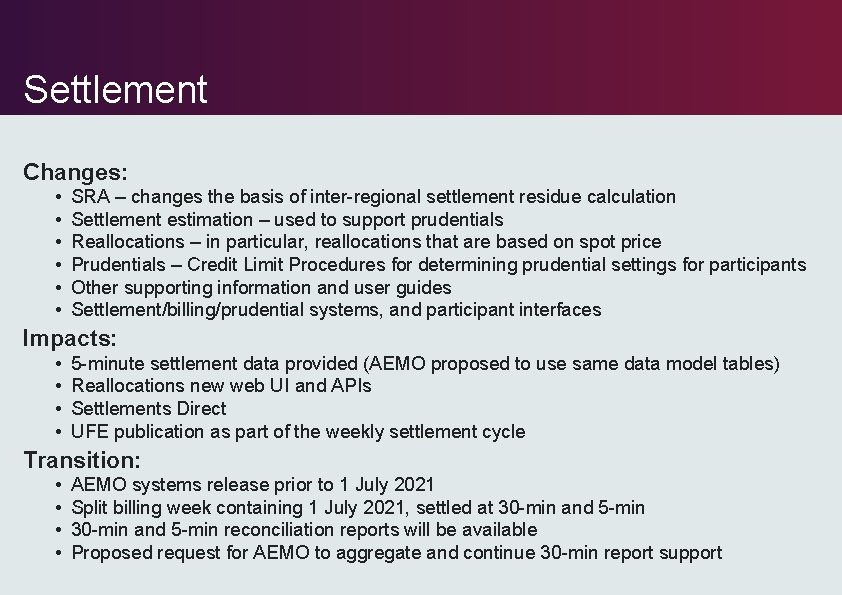
Settlement Changes: • • • SRA – changes the basis of inter-regional settlement residue calculation Settlement estimation – used to support prudentials Reallocations – in particular, reallocations that are based on spot price Prudentials – Credit Limit Procedures for determining prudential settings for participants Other supporting information and user guides Settlement/billing/prudential systems, and participant interfaces Impacts: • • 5 -minute settlement data provided (AEMO proposed to use same data model tables) Reallocations new web UI and APIs Settlements Direct UFE publication as part of the weekly settlement cycle Transition: • • AEMO systems release prior to 1 July 2021 Split billing week containing 1 July 2021, settled at 30 -min and 5 -min reconciliation reports will be available Proposed request for AEMO to aggregate and continue 30 -min report support
Dispatch and Power Systems Hamish Mc. Neish 38
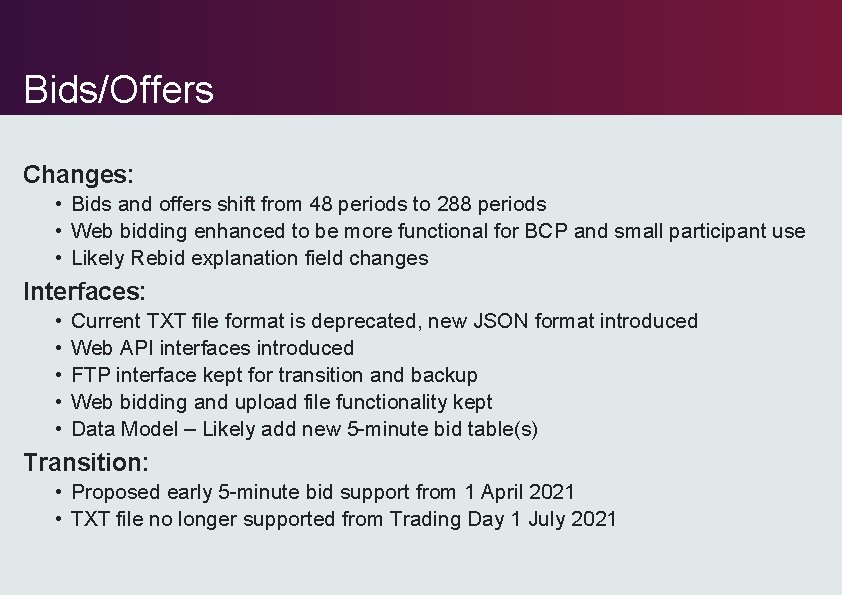
Bids/Offers Changes: • Bids and offers shift from 48 periods to 288 periods • Web bidding enhanced to be more functional for BCP and small participant use • Likely Rebid explanation field changes Interfaces: • • • Current TXT file format is deprecated, new JSON format introduced Web API interfaces introduced FTP interface kept for transition and backup Web bidding and upload file functionality kept Data Model – Likely add new 5 -minute bid table(s) Transition: • Proposed early 5 -minute bid support from 1 April 2021 • TXT file no longer supported from Trading Day 1 July 2021
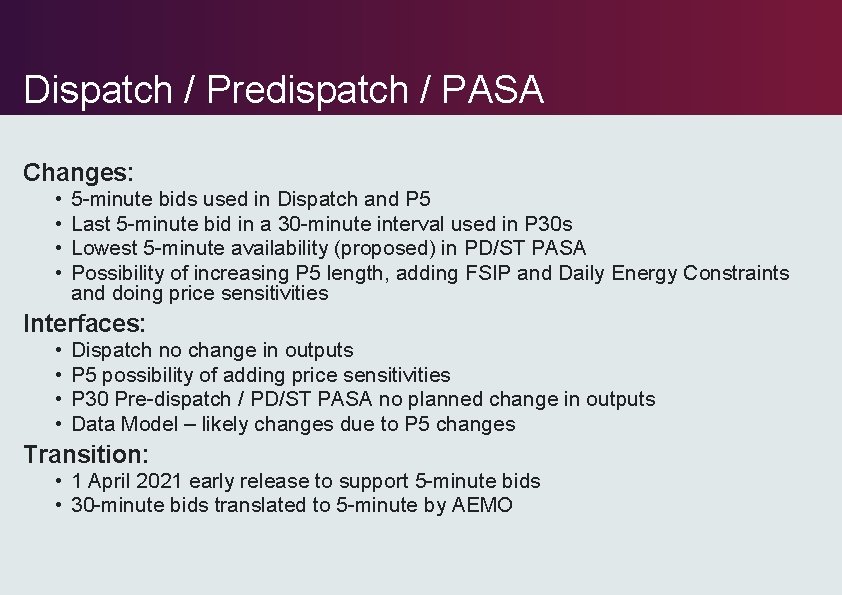
Dispatch / Predispatch / PASA Changes: • • 5 -minute bids used in Dispatch and P 5 Last 5 -minute bid in a 30 -minute interval used in P 30 s Lowest 5 -minute availability (proposed) in PD/ST PASA Possibility of increasing P 5 length, adding FSIP and Daily Energy Constraints and doing price sensitivities Interfaces: • • Dispatch no change in outputs P 5 possibility of adding price sensitivities P 30 Pre-dispatch / PD/ST PASA no planned change in outputs Data Model – likely changes due to P 5 changes Transition: • 1 April 2021 early release to support 5 -minute bids • 30 -minute bids translated to 5 -minute by AEMO
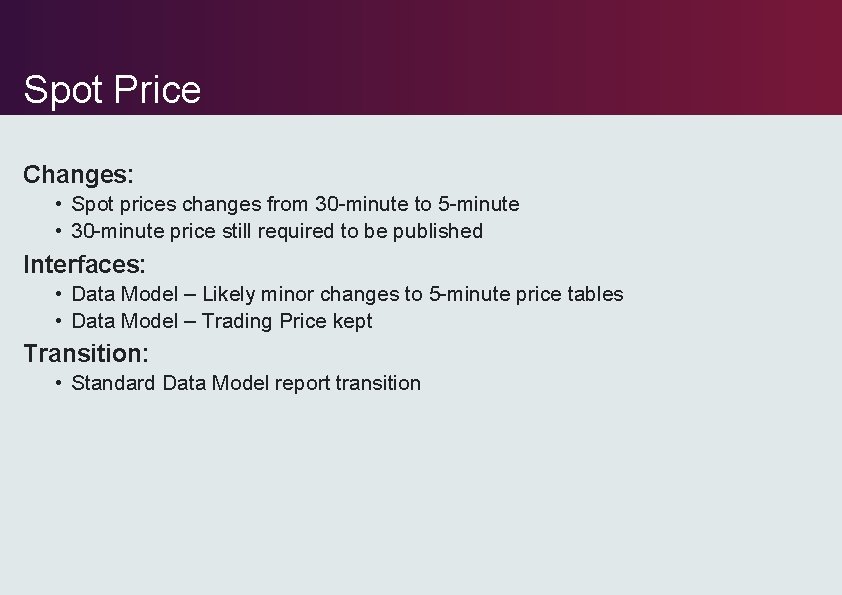
Spot Price Changes: • Spot prices changes from 30 -minute to 5 -minute • 30 -minute price still required to be published Interfaces: • Data Model – Likely minor changes to 5 -minute price tables • Data Model – Trading Price kept Transition: • Standard Data Model report transition
Questions and next steps Hamish Mc. Neish 42

43
- Slides: 43