
FiveMinute Check over Chapter 4 CCSS ThenNow New
- Slides: 39
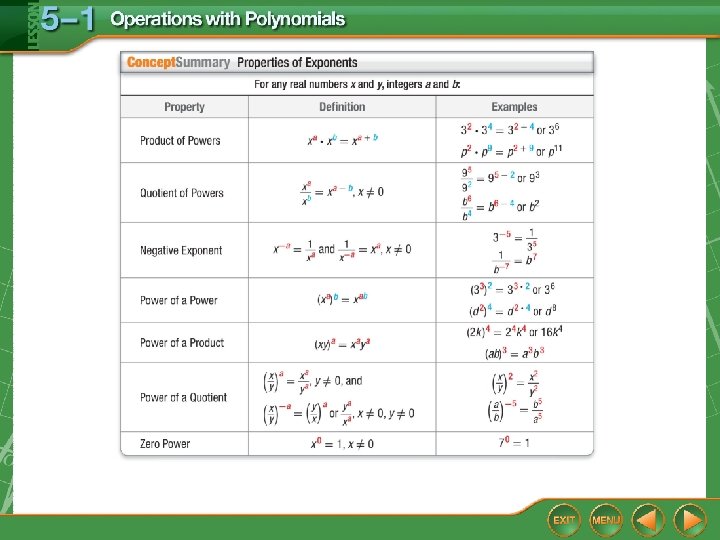
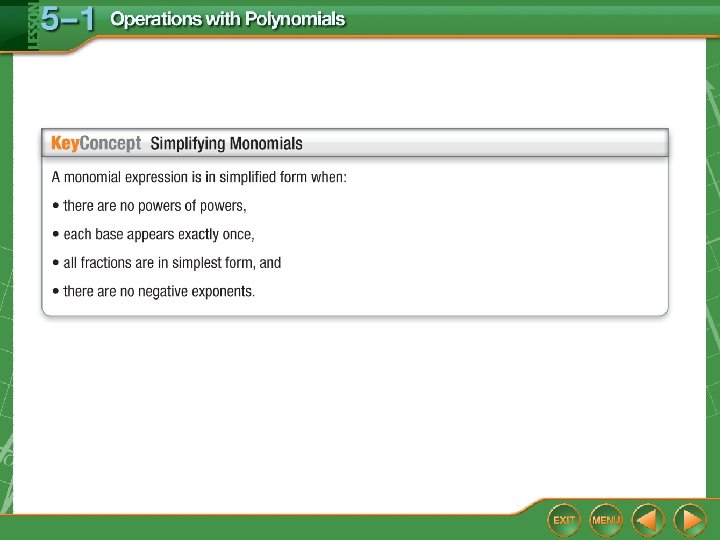
Five-Minute Check (over Chapter 4) CCSS Then/Now New Vocabulary Concept Summary: Properties of Exponents Key Concept: Simplifying Monomials Example 1: Simplify Expressions Example 2: Degree of a Polynomial Example 3: Simplify Polynomial Expressions Example 4: Simplify by Using the Distributive Property Example 5: Real-World Example: Write a Polynomial Expression Example 6: Multiply Polynomials
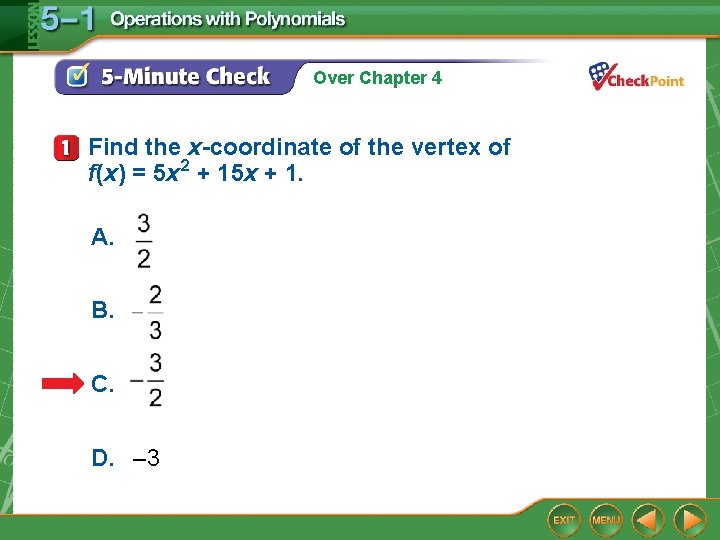
Over Chapter 4 Find the x-coordinate of the vertex of f(x) = 5 x 2 + 15 x + 1. A. B. C. D. – 3
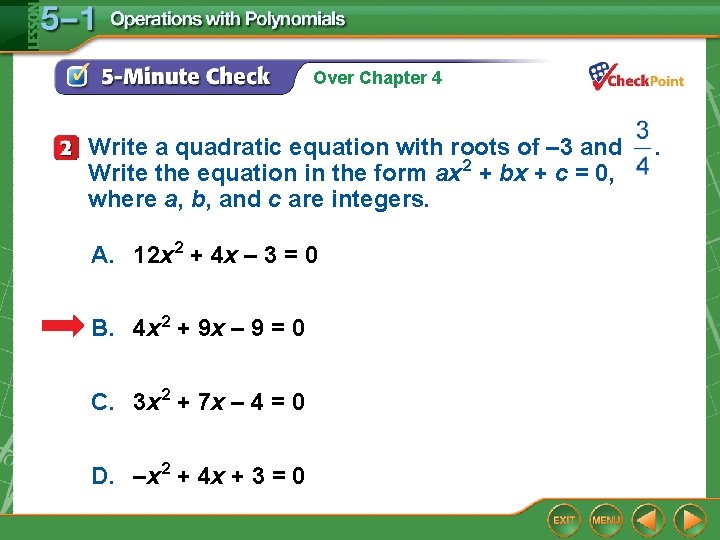
Over Chapter 4 Write a quadratic equation with roots of – 3 and Write the equation in the form ax 2 + bx + c = 0, where a, b, and c are integers. A. 12 x 2 + 4 x – 3 = 0 B. 4 x 2 + 9 x – 9 = 0 C. 3 x 2 + 7 x – 4 = 0 D. –x 2 + 4 x + 3 = 0 .
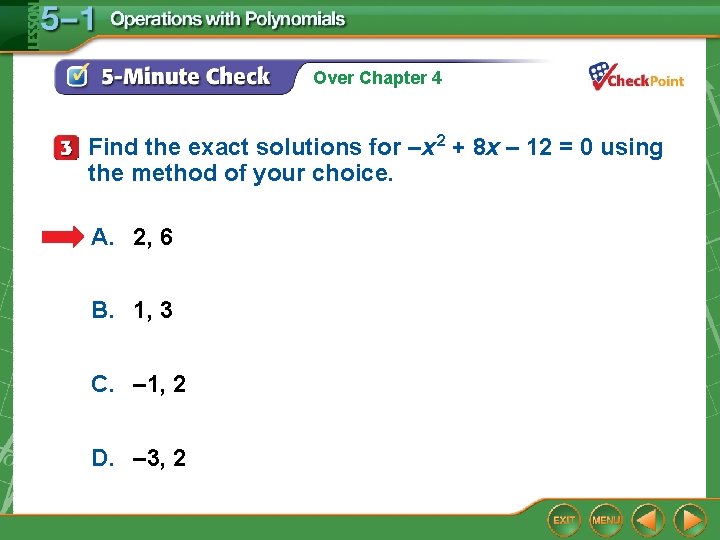
Over Chapter 4 Find the exact solutions for –x 2 + 8 x – 12 = 0 using the method of your choice. A. 2, 6 B. 1, 3 C. – 1, 2 D. – 3, 2
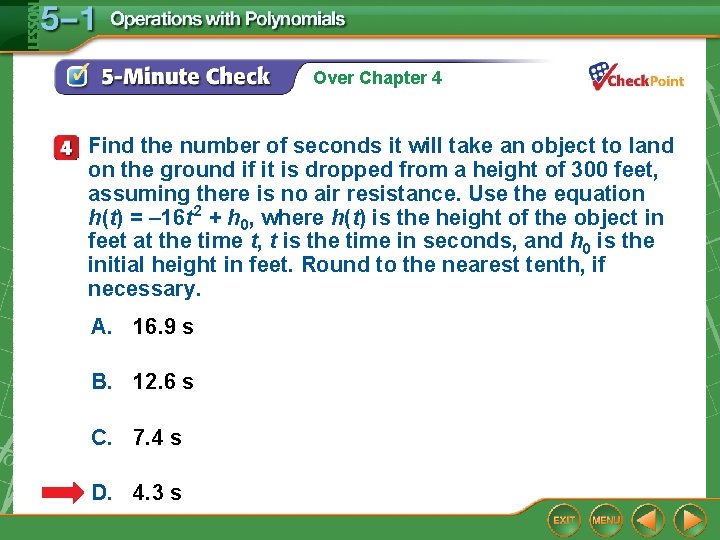
Over Chapter 4 Find the number of seconds it will take an object to land on the ground if it is dropped from a height of 300 feet, assuming there is no air resistance. Use the equation h(t) = – 16 t 2 + h 0, where h(t) is the height of the object in feet at the time t, t is the time in seconds, and h 0 is the initial height in feet. Round to the nearest tenth, if necessary. A. 16. 9 s B. 12. 6 s C. 7. 4 s D. 4. 3 s
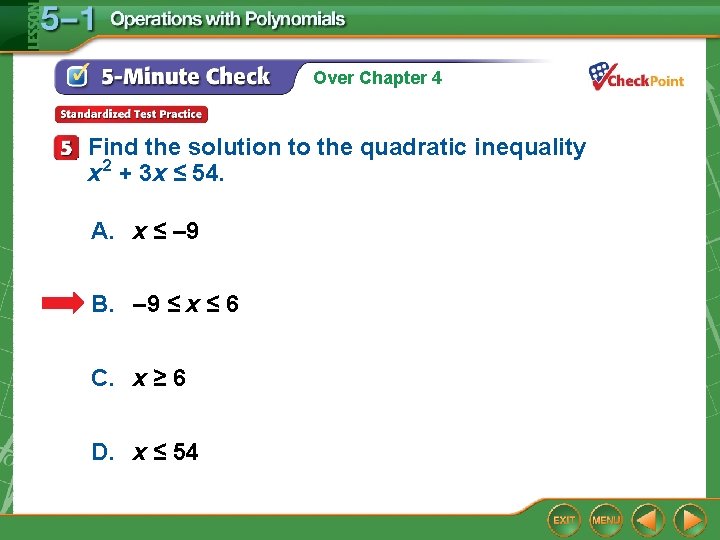
Over Chapter 4 Find the solution to the quadratic inequality x 2 + 3 x ≤ 54. A. x ≤ – 9 B. – 9 ≤ x ≤ 6 C. x ≥ 6 D. x ≤ 54
Content Standards A. APR. 1 Understand that polynomials form a system analogous to the integers, namely, they are closed under the operations of addition, subtraction, and multiplication; add, subtract, and multiply polynomials. Mathematical Practices 2 Reason abstractly and quantitatively.
You evaluated powers. • Multiply, divide, and simplify monomials and expressions involving powers. • Add, subtract, and multiply polynomials.
• simplify • degree of a polynomial
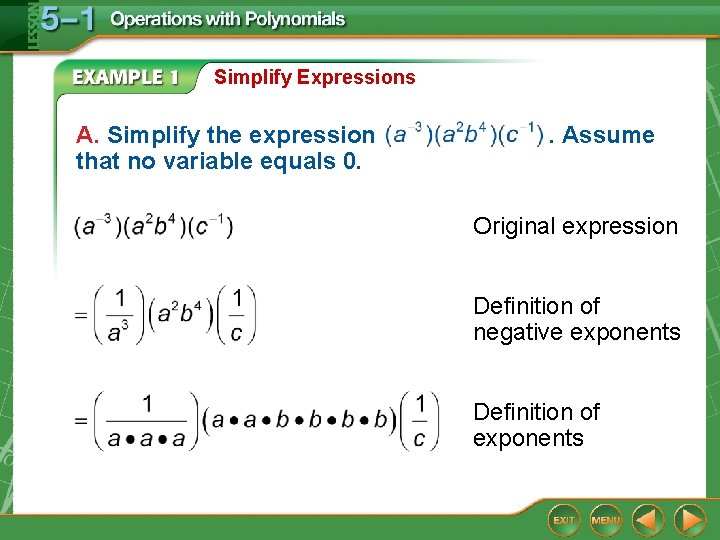
Simplify Expressions A. Simplify the expression that no variable equals 0. . Assume Original expression Definition of negative exponents Definition of exponents
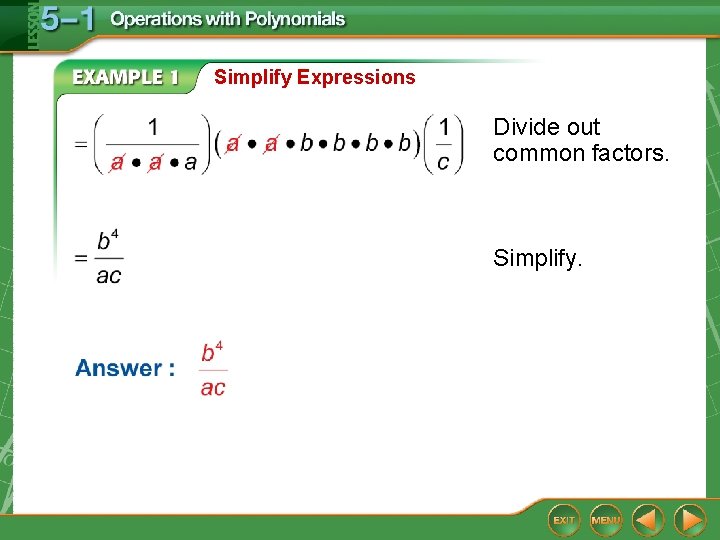
Simplify Expressions Divide out common factors. Simplify.
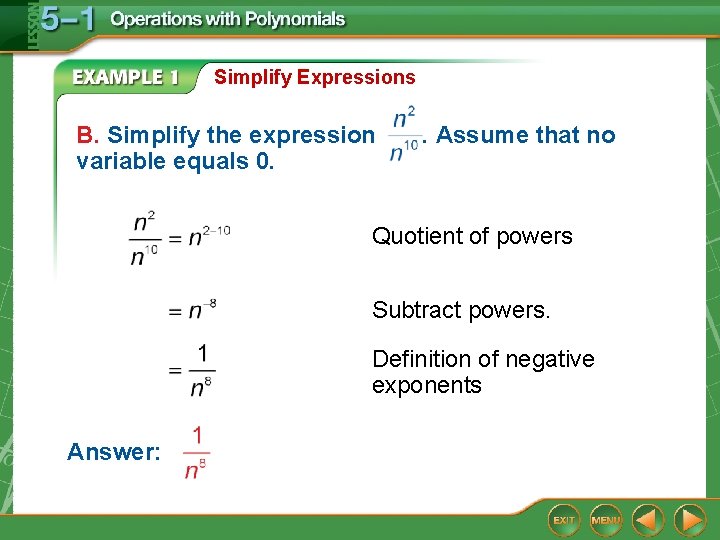
Simplify Expressions B. Simplify the expression variable equals 0. . Assume that no Quotient of powers Subtract powers. Definition of negative exponents Answer:
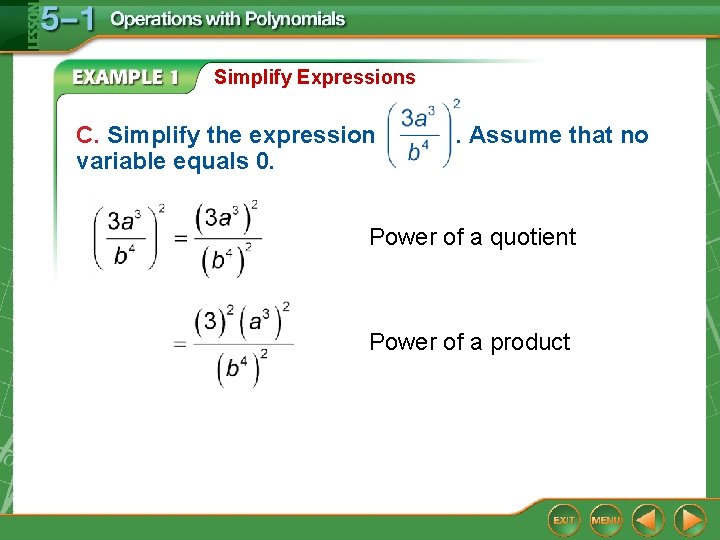
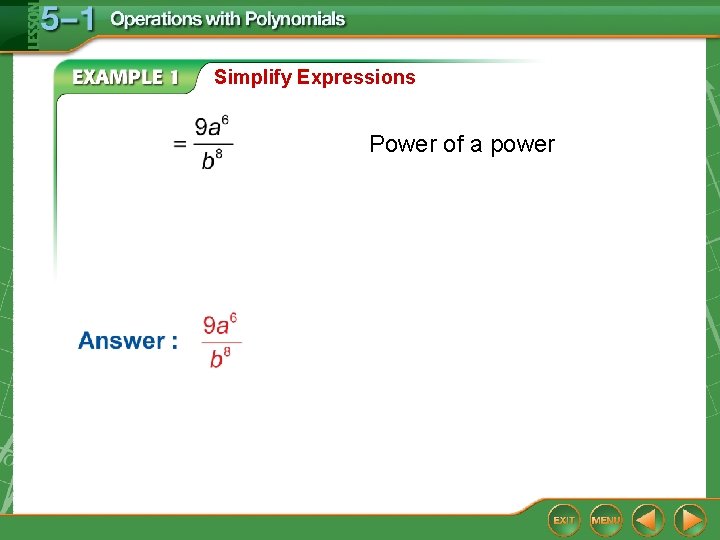
Simplify Expressions C. Simplify the expression variable equals 0. . Assume that no Power of a quotient Power of a product
Simplify Expressions Power of a power
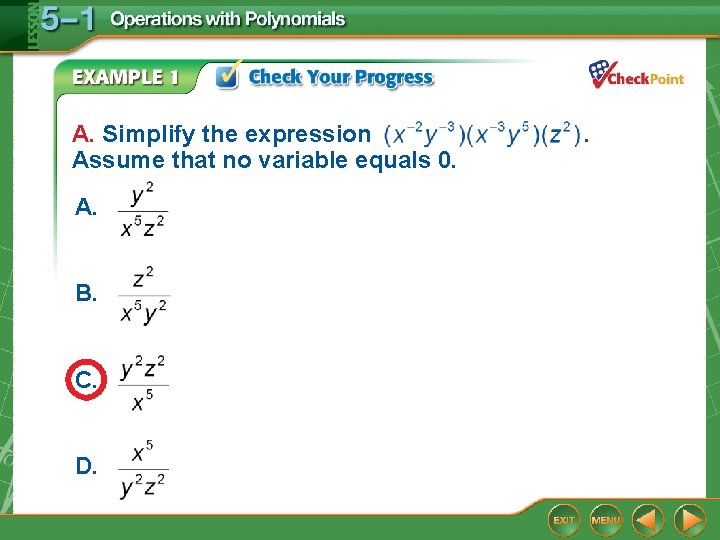
A. Simplify the expression Assume that no variable equals 0. A. B. C. D. .
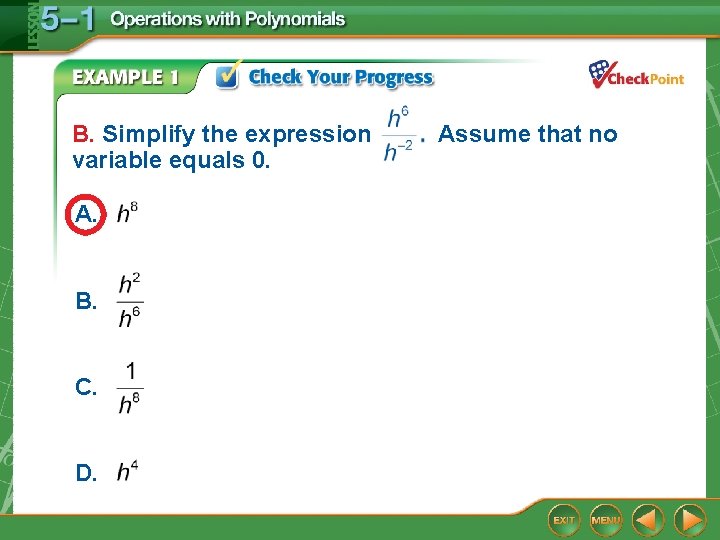
B. Simplify the expression variable equals 0. A. B. C. D. Assume that no
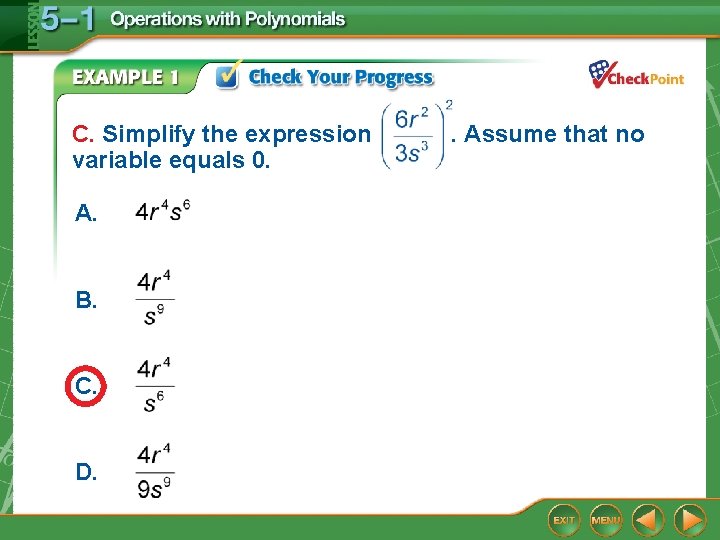
C. Simplify the expression variable equals 0. A. B. C. D. . Assume that no
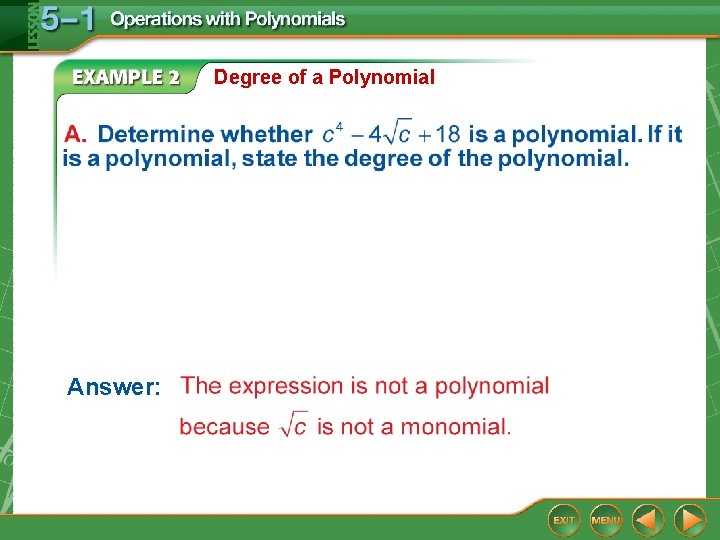
Degree of a Polynomial Answer:
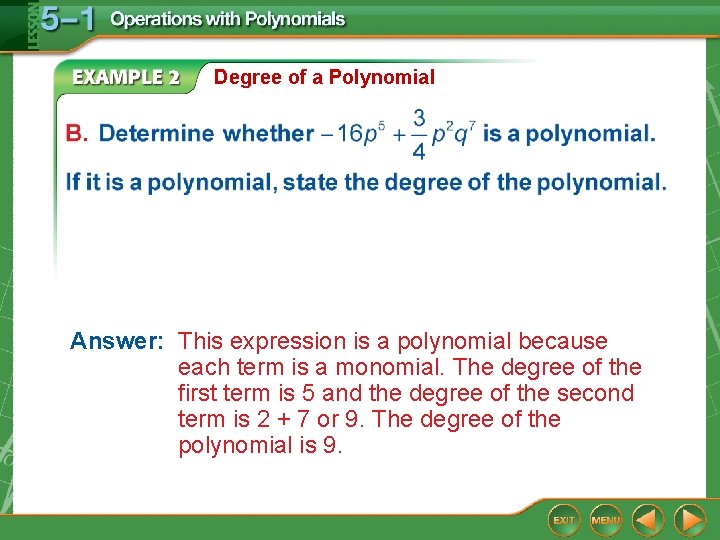
Degree of a Polynomial Answer: This expression is a polynomial because each term is a monomial. The degree of the first term is 5 and the degree of the second term is 2 + 7 or 9. The degree of the polynomial is 9.
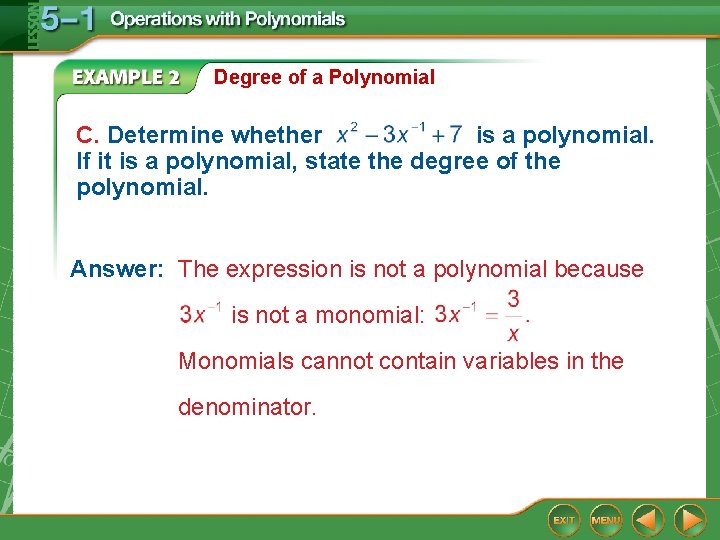
Degree of a Polynomial C. Determine whether is a polynomial. If it is a polynomial, state the degree of the polynomial. Answer: The expression is not a polynomial because is not a monomial: Monomials cannot contain variables in the denominator.
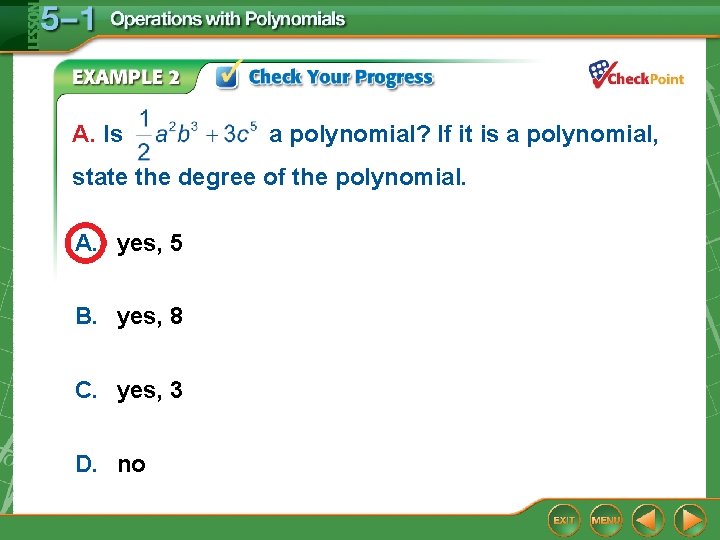
A. Is a polynomial? If it is a polynomial, state the degree of the polynomial. A. yes, 5 B. yes, 8 C. yes, 3 D. no
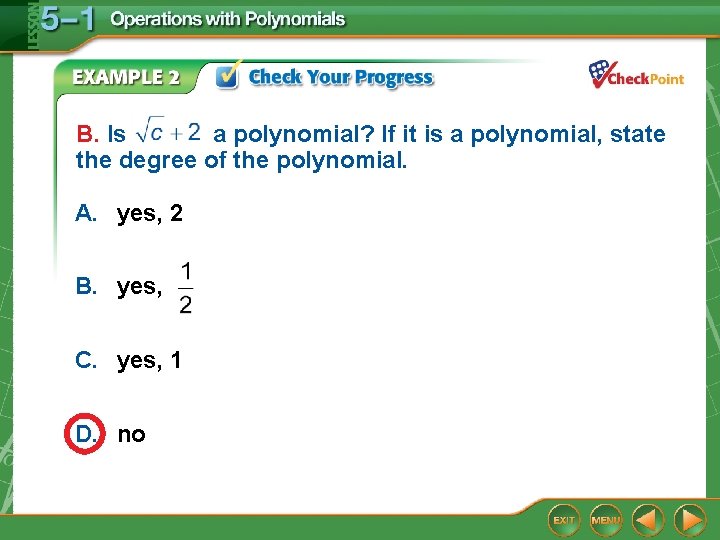
B. Is a polynomial? If it is a polynomial, state the degree of the polynomial. A. yes, 2 B. yes, C. yes, 1 D. no
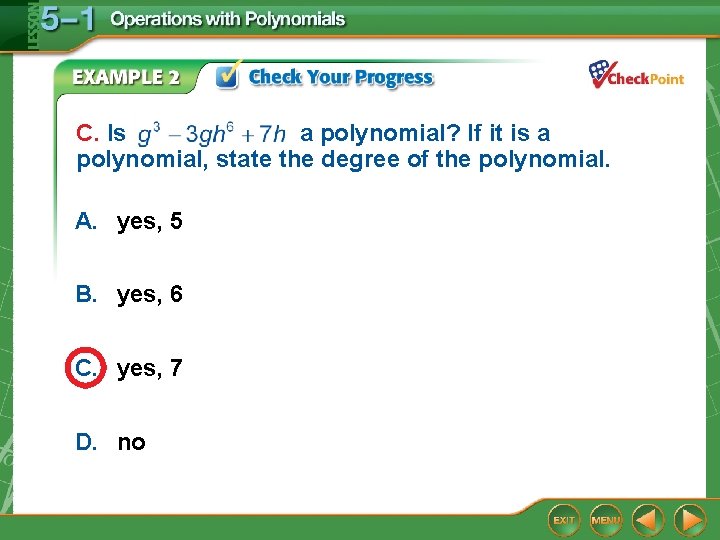
C. Is a polynomial? If it is a polynomial, state the degree of the polynomial. A. yes, 5 B. yes, 6 C. yes, 7 D. no
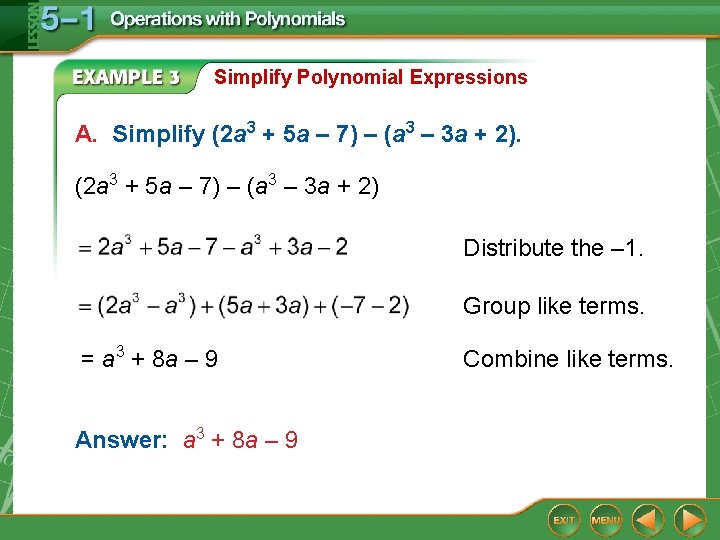
Simplify Polynomial Expressions A. Simplify (2 a 3 + 5 a – 7) – (a 3 – 3 a + 2) Distribute the – 1. Group like terms. = a 3 + 8 a – 9 Answer: a 3 + 8 a – 9 Combine like terms.
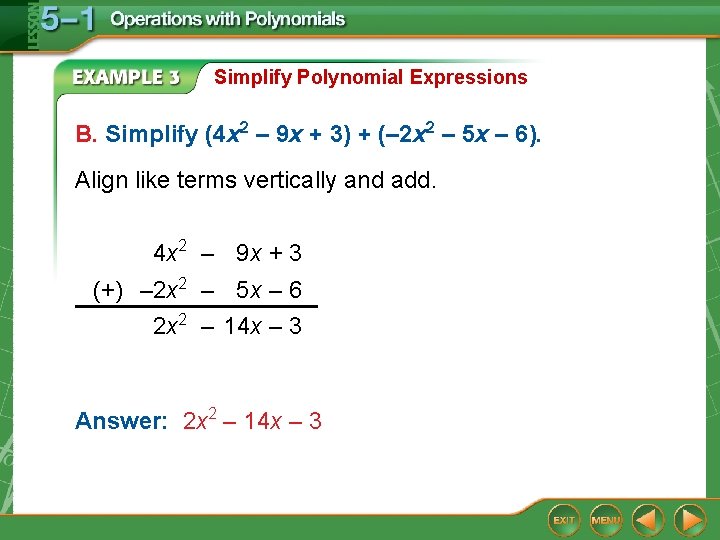
Simplify Polynomial Expressions B. Simplify (4 x 2 – 9 x + 3) + (– 2 x 2 – 5 x – 6). Align like terms vertically and add. 4 x 2 – 9 x + 3 (+) – 2 x 2 – 5 x – 6 2 x 2 – 14 x – 3 Answer: 2 x 2 – 14 x – 3
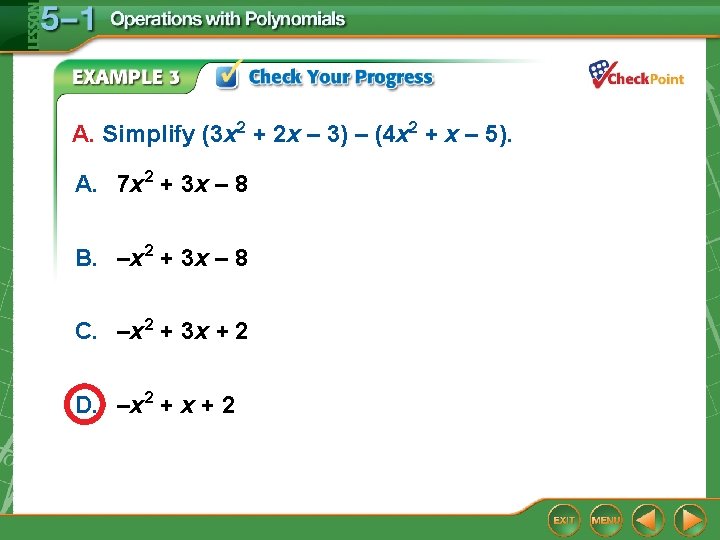
A. Simplify (3 x 2 + 2 x – 3) – (4 x 2 + x – 5). A. 7 x 2 + 3 x – 8 B. –x 2 + 3 x – 8 C. –x 2 + 3 x + 2 D. –x 2 + x + 2
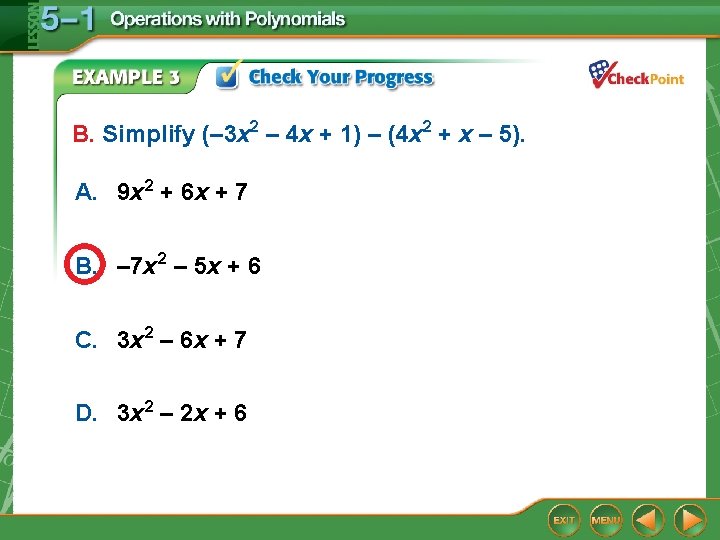
B. Simplify (– 3 x 2 – 4 x + 1) – (4 x 2 + x – 5). A. 9 x 2 + 6 x + 7 B. – 7 x 2 – 5 x + 6 C. 3 x 2 – 6 x + 7 D. 3 x 2 – 2 x + 6
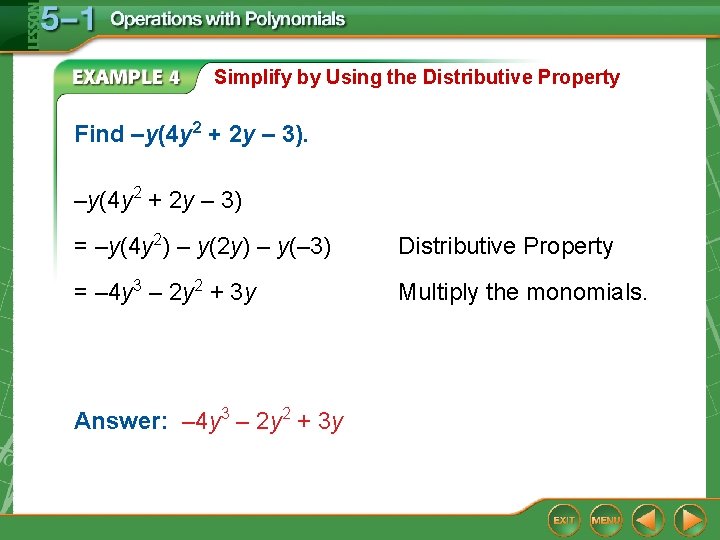
Simplify by Using the Distributive Property Find –y(4 y 2 + 2 y – 3) = –y(4 y 2) – y(2 y) – y(– 3) Distributive Property = – 4 y 3 – 2 y 2 + 3 y Multiply the monomials. Answer: – 4 y 3 – 2 y 2 + 3 y
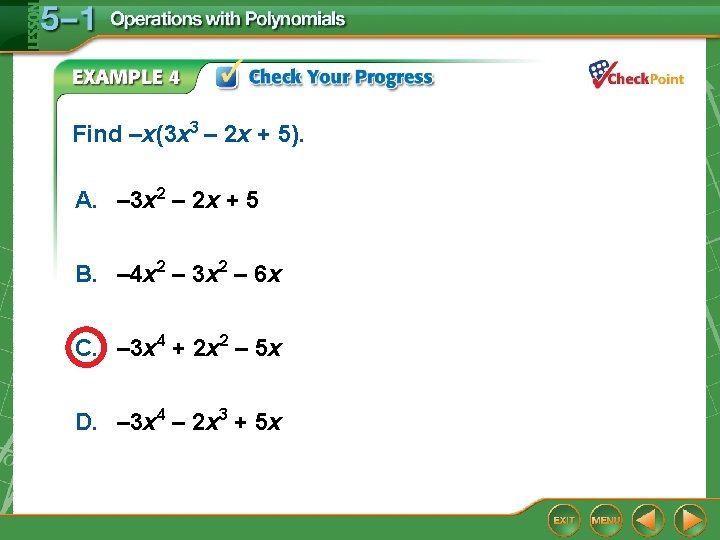
Find –x(3 x 3 – 2 x + 5). A. – 3 x 2 – 2 x + 5 B. – 4 x 2 – 3 x 2 – 6 x C. – 3 x 4 + 2 x 2 – 5 x D. – 3 x 4 – 2 x 3 + 5 x
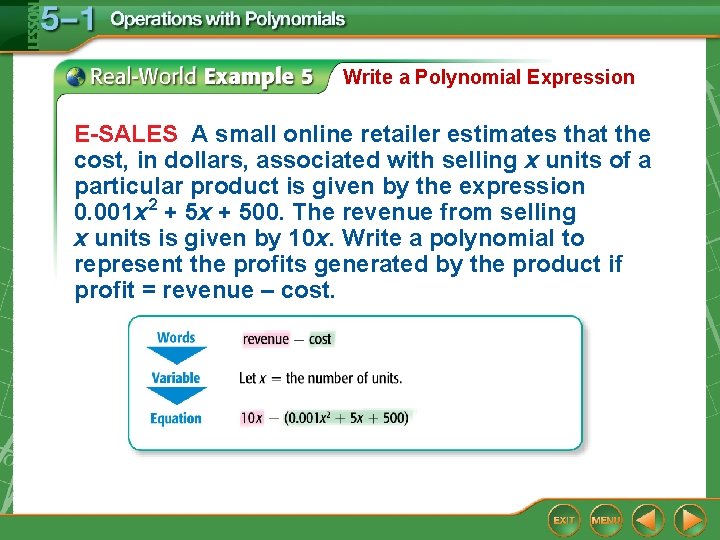
Write a Polynomial Expression E-SALES A small online retailer estimates that the cost, in dollars, associated with selling x units of a particular product is given by the expression 0. 001 x 2 + 5 x + 500. The revenue from selling x units is given by 10 x. Write a polynomial to represent the profits generated by the product if profit = revenue – cost.
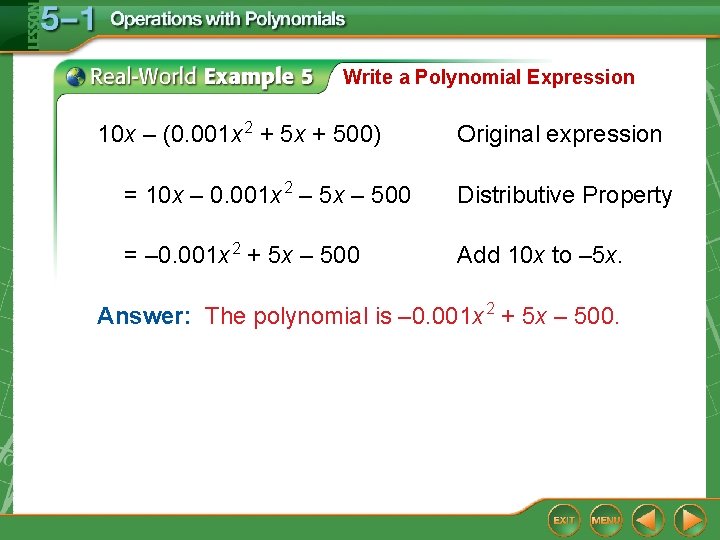
Write a Polynomial Expression 10 x – (0. 001 x 2 + 5 x + 500) Original expression = 10 x – 0. 001 x 2 – 5 x – 500 Distributive Property = – 0. 001 x 2 + 5 x – 500 Add 10 x to – 5 x. Answer: The polynomial is – 0. 001 x 2 + 5 x – 500.
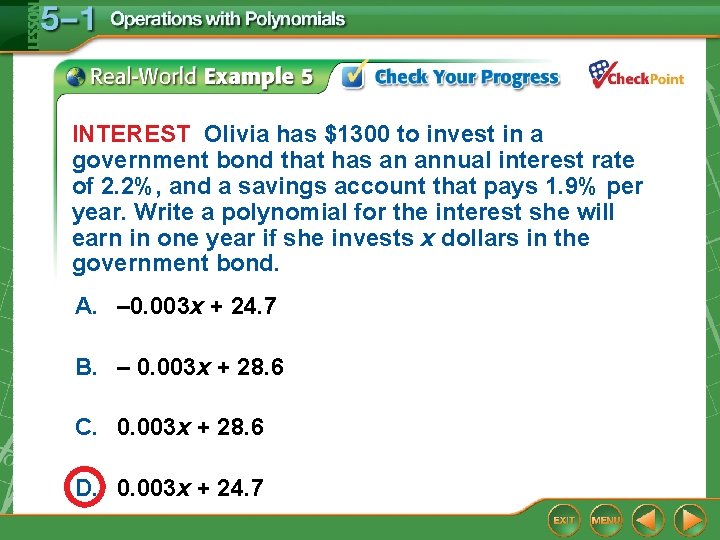
INTEREST Olivia has $1300 to invest in a government bond that has an annual interest rate of 2. 2%, and a savings account that pays 1. 9% per year. Write a polynomial for the interest she will earn in one year if she invests x dollars in the government bond. A. – 0. 003 x + 24. 7 B. – 0. 003 x + 28. 6 C. 0. 003 x + 28. 6 D. 0. 003 x + 24. 7
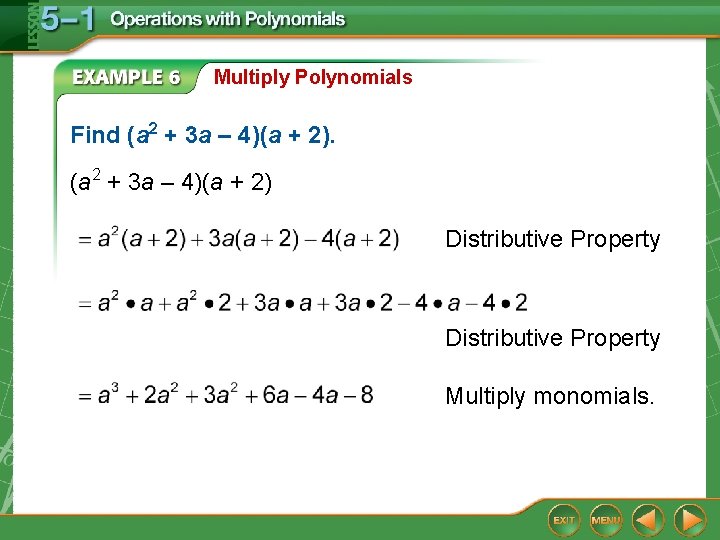
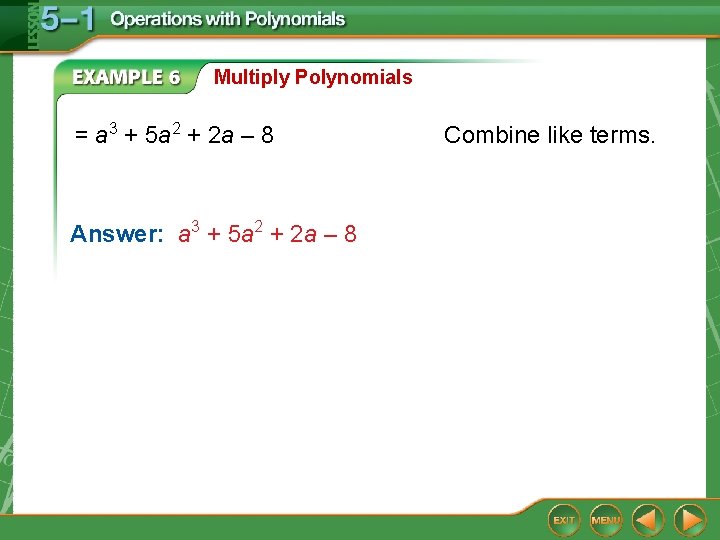
Multiply Polynomials Find (a 2 + 3 a – 4)(a + 2) Distributive Property Multiply monomials.
Multiply Polynomials = a 3 + 5 a 2 + 2 a – 8 Answer: a 3 + 5 a 2 + 2 a – 8 Combine like terms.
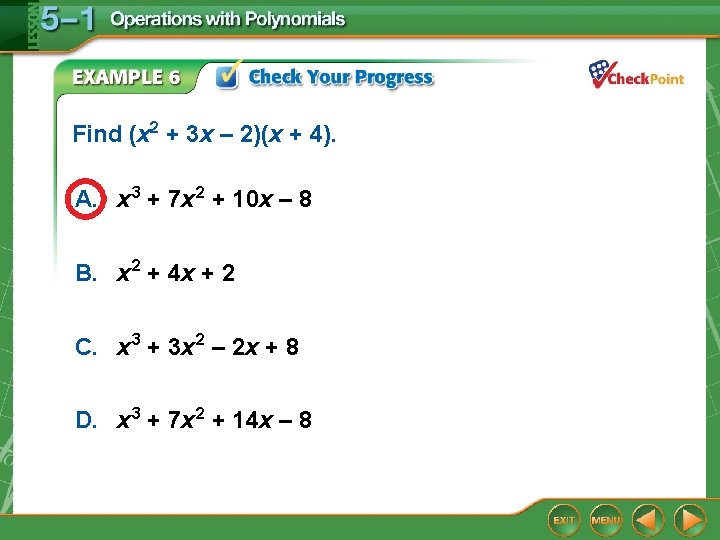
Find (x 2 + 3 x – 2)(x + 4). A. x 3 + 7 x 2 + 10 x – 8 B. x 2 + 4 x + 2 C. x 3 + 3 x 2 – 2 x + 8 D. x 3 + 7 x 2 + 14 x – 8