
Five Slides about Xray Photoelectron Spectroscopy XPS Created
Five Slides about X-ray Photoelectron Spectroscopy (XPS) Created by Sophia Hayes (Washington University, hayes@wustl. edu), Sarah St. Angelo (Dickenson College, stangels@dickenson. edu), Kathy Van Heuvelen (Harvey Mudd College, vanheuvelen@g. hmc. edu), and Megan E. Strayer (The Pennsylvania State University, strayerme@gmail. com), and posted on VIPEr (www. ionicviper. org) on June 27, 2013. Copyright Sophia Hayes 2013. This work is licensed under the Creative Commons Attribution. Non. Commerical-Share. Alike 3. 0 Unported License. To view a copy of this license visit http: //creativecommons. org/about/license/.
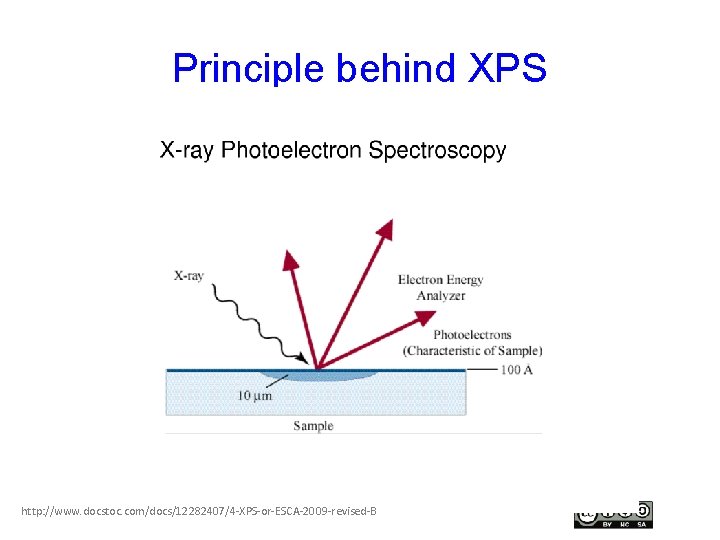
Principle behind XPS http: //www. docstoc. com/docs/12282407/4 -XPS-or-ESCA-2009 -revised-B
What can you do with XPS? • XPS is typically thought of as a chemical identification tool—one of the tool that is especially useful for surfaces. • Photoelectrons are emitted from a sample after irradiation with x-rays. • The binding energy of the photoelectrons are recorded by a detector. Both the binding energy, and the intensity of the peak, allow for a variety of characteristics to be determined: • Which element(s) are present? • What is the oxidation state—to what is the element bound, locally? • The quantity of the element present. • Applications: – Thin film characterization, identifying elements from Li through U (but not H and He) – Applicable to a wide range of solid materials (but not liquids or gases) – Quantitative analysis, even as a function of depth (“profiling”)
What are some fun facts about XPS? • Pros • Detection limits: 0. 01 to 1 at% • Resolution (lateral): 10 um - mm • Resolution (depth): 10 – 200 A • Cons – XPS is an ultra-high vacuum technique; samples must be non-volatile.
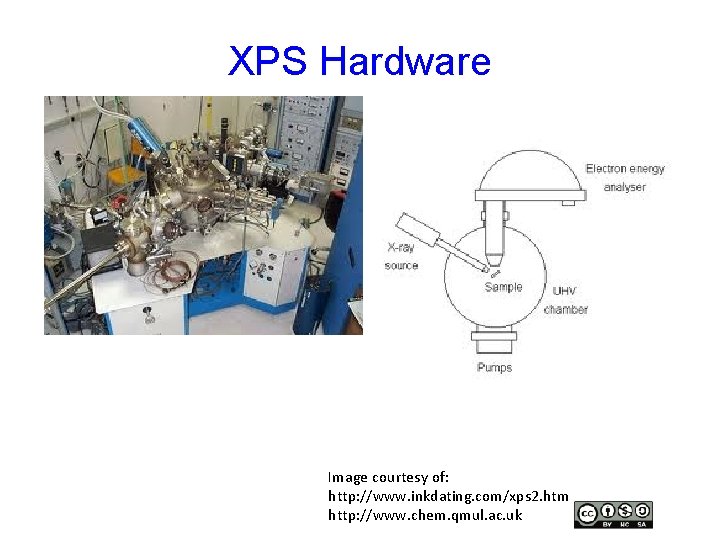
XPS Hardware Image courtesy of: http: //www. inkdating. com/xps 2. htm http: //www. chem. qmul. ac. uk
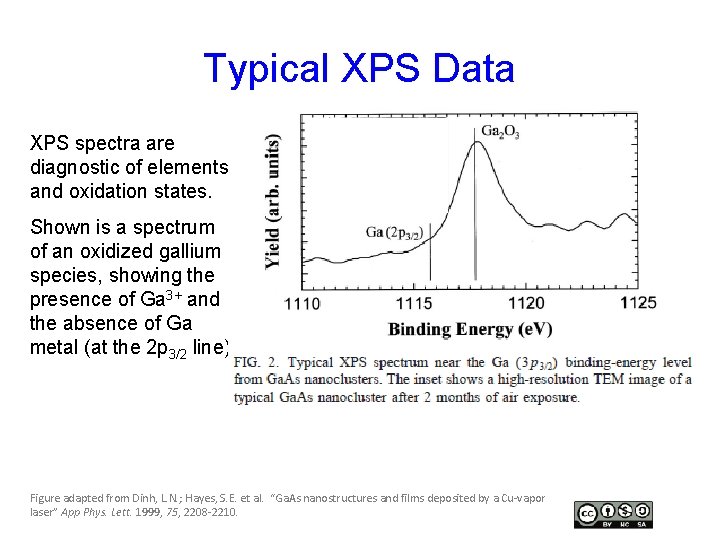
Typical XPS Data XPS spectra are diagnostic of elements and oxidation states. Shown is a spectrum of an oxidized gallium species, showing the presence of Ga 3+ and the absence of Ga metal (at the 2 p 3/2 line) Figure adapted from Dinh, L. N. ; Hayes, S. E. et al. “Ga. As nanostructures and films deposited by a Cu-vapor laser” App Phys. Lett. 1999, 75, 2208 -2210.
- Slides: 6