
Five bestpractice steps to make your research open
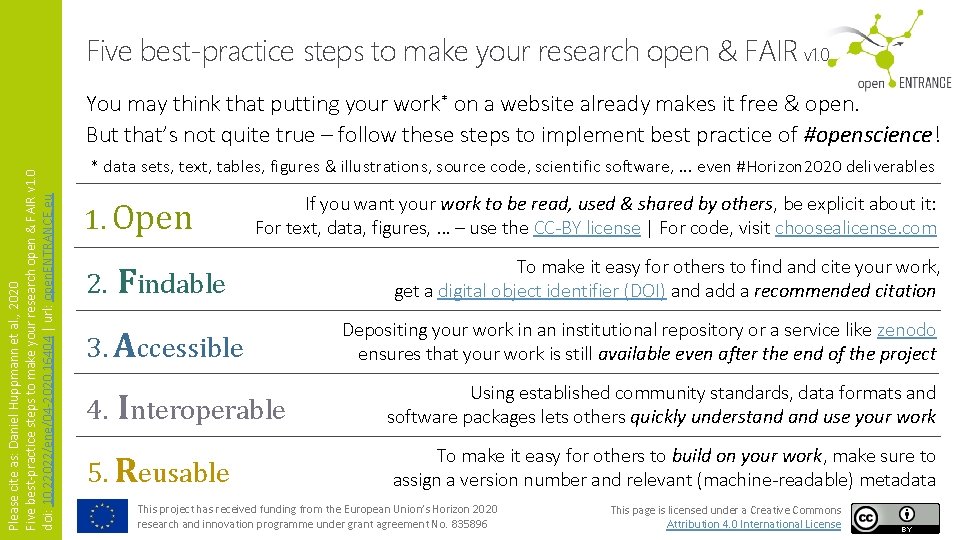
Five best-practice steps to make your research open & FAIR v 1. 0 Please cite as: Daniel Huppmann et al. , 2020 Five best-practice steps to make your research open & FAIR v 1. 0 doi: 10. 22022/ene/04 -2020. 16404 | url: open. ENTRANCE. eu You may think that putting your work* on a website already makes it free & open. But that’s not quite true – follow these steps to implement best practice of #openscience! * data sets, text, tables, figures & illustrations, source code, scientific software, . . . even #Horizon 2020 deliverables 1. Open 2. If you want your work to be read, used & shared by others, be explicit about it: For text, data, figures, . . . – use the CC-BY license | For code, visit choosealicense. com Findable 3. Accessible To make it easy for others to find and cite your work, get a digital object identifier (DOI) and add a recommended citation Depositing your work in an institutional repository or a service like zenodo ensures that your work is still available even after the end of the project 4. Interoperable Using established community standards, data formats and software packages lets others quickly understand use your work 5. Reusable To make it easy for others to build on your work, make sure to assign a version number and relevant (machine-readable) metadata This project has received funding from the European Union’s Horizon 2020 research and innovation programme under grant agreement No. 835896 This page is licensed under a Creative Commons Attribution 4. 0 International License
- Slides: 1