
Fitting Machining INTERPRET TECHNICAL DRAWING MEM 09002 B
Fitting & Machining INTERPRET TECHNICAL DRAWING MEM 09002 B (4 POINTS) UNIT 3 – GEOMETRIC CONSTRUCTION THEORY
Contents GEOMETRIC CONSTRUCTION Learning Outcomes/Assessment & Resources 3 Geometric Construction with Compass / Divider Using a Compass 3 -4 Geometry 5 -10 Geometric Construction • Bisecting a Given Line 11 • Bisecting a Given Arc • Bisecting an Angle • Duplicating a given angle • Dividing a Line into Equal Parts • Constructing an Angle of 90º • Constructing an Angle of 45º • Constructing Angles of 30º and 60º • Constructing Angles of 75º and 15º • Constructing Parallel lines • Constructing an Angle of 90º using the 3, 4, 5 Triangle Method • Dividing the Circumference of a Circle into Six Equal Parts. 12 13 14 15 16 17 18 19 20 21 22 Construction with Tee Square and Set Squares • Using a Tee Square and Set Squares 23 23 - 27 Optional Activities • Constructing an Arc or Circle Tangent to Two Given Lines at any point. 28 • Constructing an Arc of Given Radius Tangent to Two Circles 2930 • Constructing an Arc of Given Radius Tangent to a Circle and straight Line. • Construction Challenge Exercises Unit 3 – Geometric Construction © New South Wales Technical and Further Education Commission, 2017 (TAFE NSW – WSI) 31 32 2
Geometric Construction Learning Outcome On completion of this unit you will be able to construct geometric shapes as used in the metal industries. Assessment Competency will be assessed by training tasks in geometric construction throughout this section. Please detach training tasks and forward them, together with the Training Task Assessment Sheet, to your supervisor for assessment on completion of this unit. Instruments you will need: Compass Eraser soft pencil type Masking tape Pencils F. 2 H Scale rule Drawing board Tee square Set squares 45º and 60º 30º (300 mm approximately) Unit 3 – Geometric Construction © New South Wales Technical and Further Education Commission, 2017 (TAFE NSW – WSI) 3
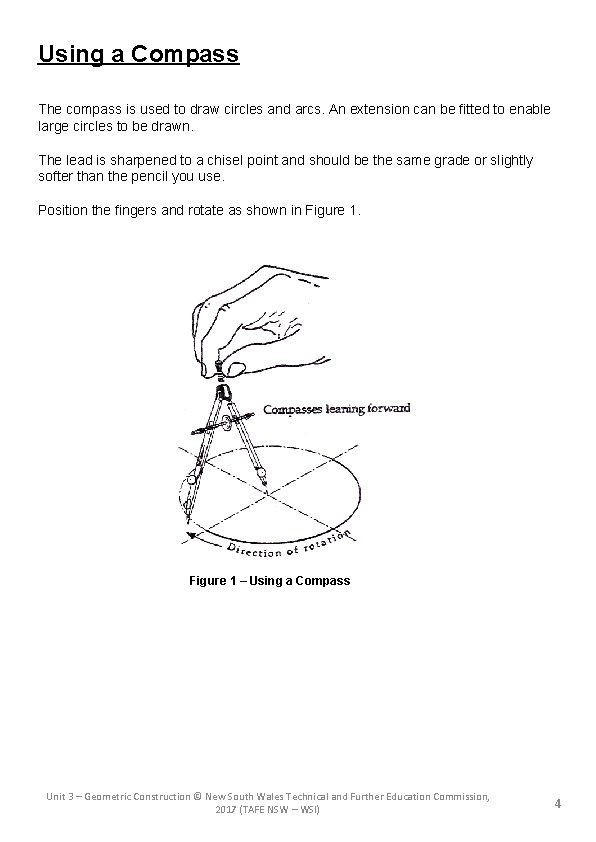
Using a Compass The compass is used to draw circles and arcs. An extension can be fitted to enable large circles to be drawn. The lead is sharpened to a chisel point and should be the same grade or slightly softer than the pencil you use. Position the fingers and rotate as shown in Figure 1 – Using a Compass Unit 3 – Geometric Construction © New South Wales Technical and Further Education Commission, 2017 (TAFE NSW – WSI) 4

To draw a circle of specified diameter, set your compass from a rule to a radius which corresponds to half the diameter. Figure 2 – Drawing a circle of specified diameter To draw an arc of a given radius set the compass from a rule to the size specified. Figure 3 – Drawing an arc of a given radius Unit 3 – Geometric Construction © New South Wales Technical and Further Education Commission, 2017 (TAFE NSW – WSI) 5
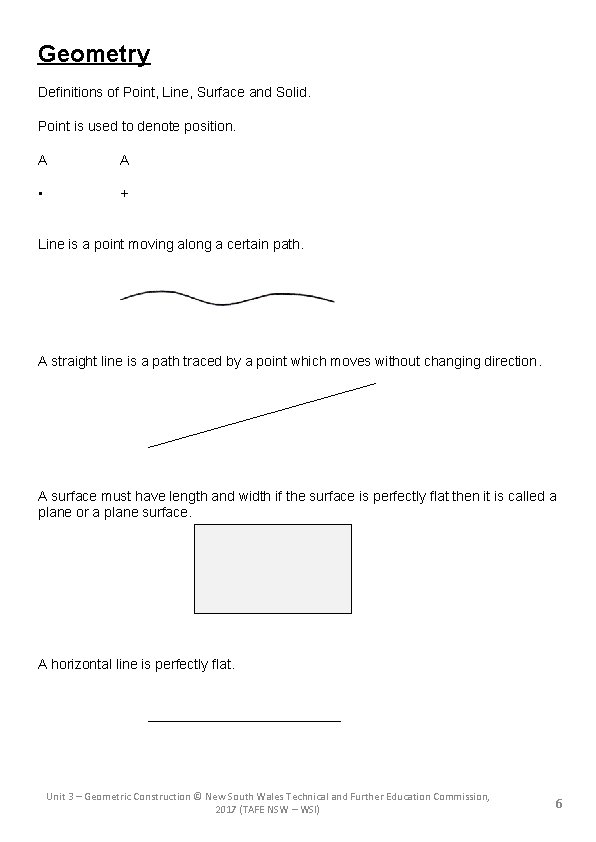
Geometry Definitions of Point, Line, Surface and Solid. Point is used to denote position. A A • + Line is a point moving along a certain path. A straight line is a path traced by a point which moves without changing direction. A surface must have length and width if the surface is perfectly flat then it is called a plane or a plane surface. A horizontal line is perfectly flat. Unit 3 – Geometric Construction © New South Wales Technical and Further Education Commission, 2017 (TAFE NSW – WSI) 6
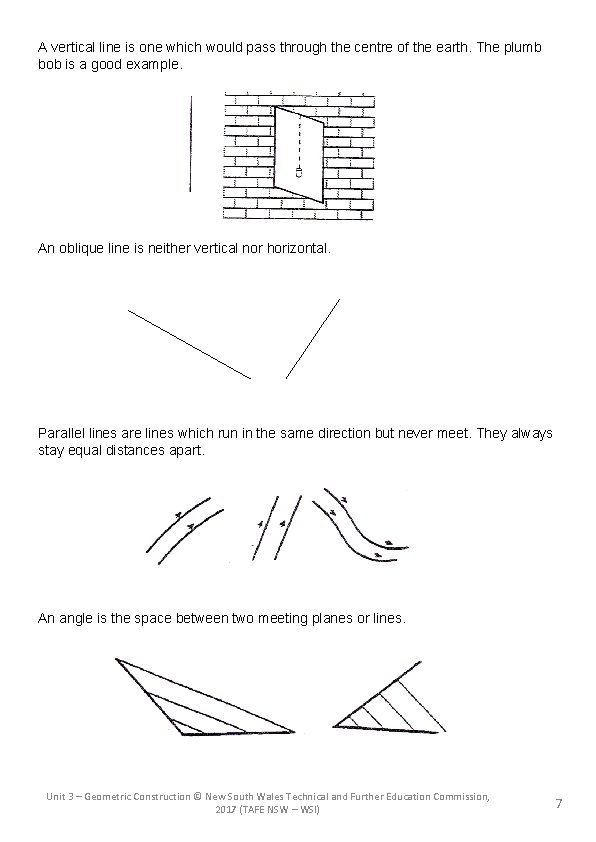
A vertical line is one which would pass through the centre of the earth. The plumb bob is a good example. An oblique line is neither vertical nor horizontal. Parallel lines are lines which run in the same direction but never meet. They always stay equal distances apart. An angle is the space between two meeting planes or lines. Unit 3 – Geometric Construction © New South Wales Technical and Further Education Commission, 2017 (TAFE NSW – WSI) 7

Circle is a plane figure bounded by a curved line which is an equal distance from a fixed point called the centre. The circumference is a line which forms the boundary of a circle. he arc is a part of the circumference of a circle. The radius is the line drawn from the centre of the circle to the circumference. Note the plural of radius is radii. Unit 3 – Geometric Construction © New South Wales Technical and Further Education Commission, 2017 (TAFE NSW – WSI) 8
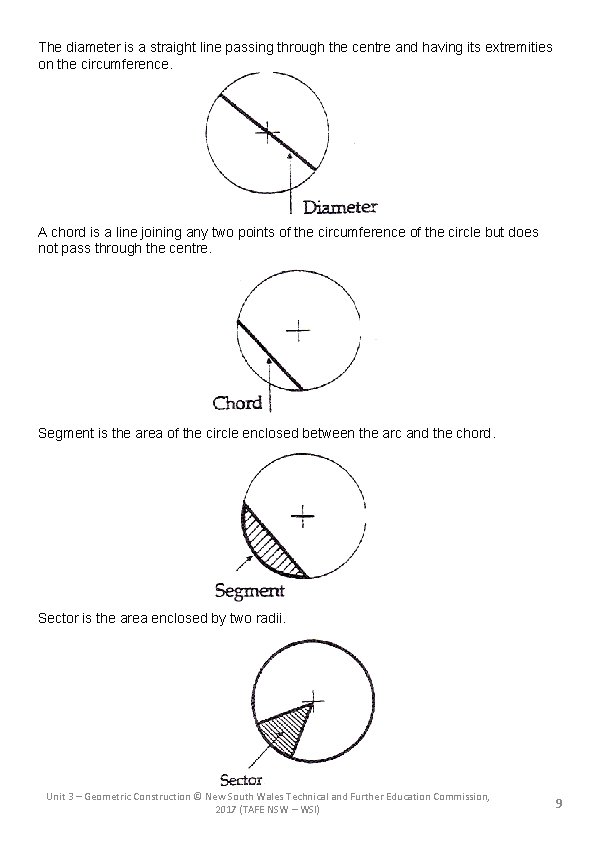
The diameter is a straight line passing through the centre and having its extremities on the circumference. A chord is a line joining any two points of the circumference of the circle but does not pass through the centre. Segment is the area of the circle enclosed between the arc and the chord. Sector is the area enclosed by two radii. Unit 3 – Geometric Construction © New South Wales Technical and Further Education Commission, 2017 (TAFE NSW – WSI) 9
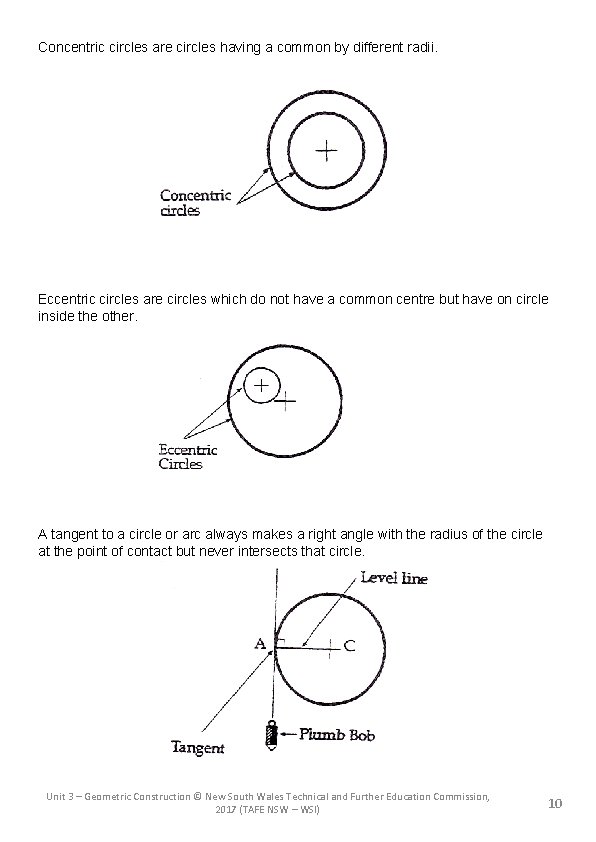
Concentric circles are circles having a common by different radii. Eccentric circles are circles which do not have a common centre but have on circle inside the other. A tangent to a circle or arc always makes a right angle with the radius of the circle at the point of contact but never intersects that circle. Unit 3 – Geometric Construction © New South Wales Technical and Further Education Commission, 2017 (TAFE NSW – WSI) 10
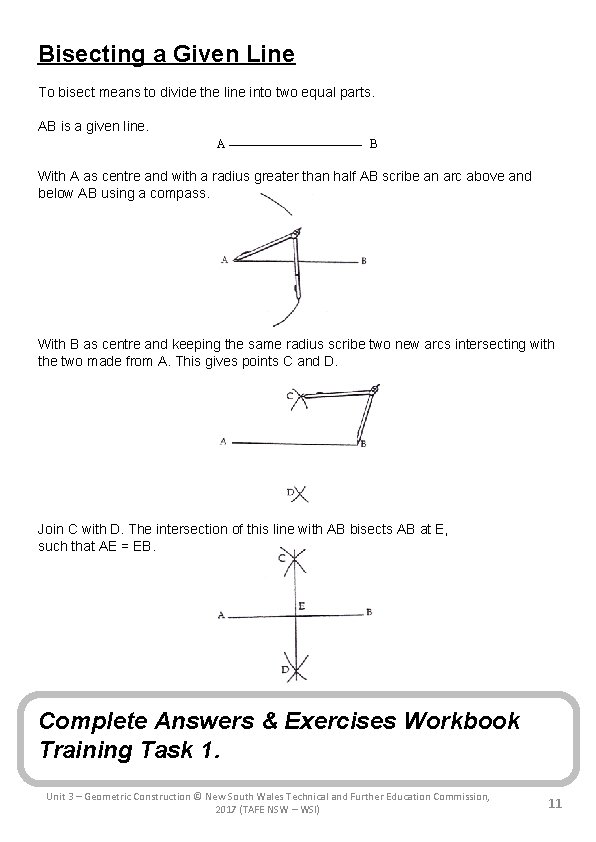
Bisecting a Given Line To bisect means to divide the line into two equal parts. AB is a given line. A B With A as centre and with a radius greater than half AB scribe an arc above and below AB using a compass. With B as centre and keeping the same radius scribe two new arcs intersecting with the two made from A. This gives points C and D. Join C with D. The intersection of this line with AB bisects AB at E, such that AE = EB. Complete Answers & Exercises Workbook Training Task 1. Unit 3 – Geometric Construction © New South Wales Technical and Further Education Commission, 2017 (TAFE NSW – WSI) 11
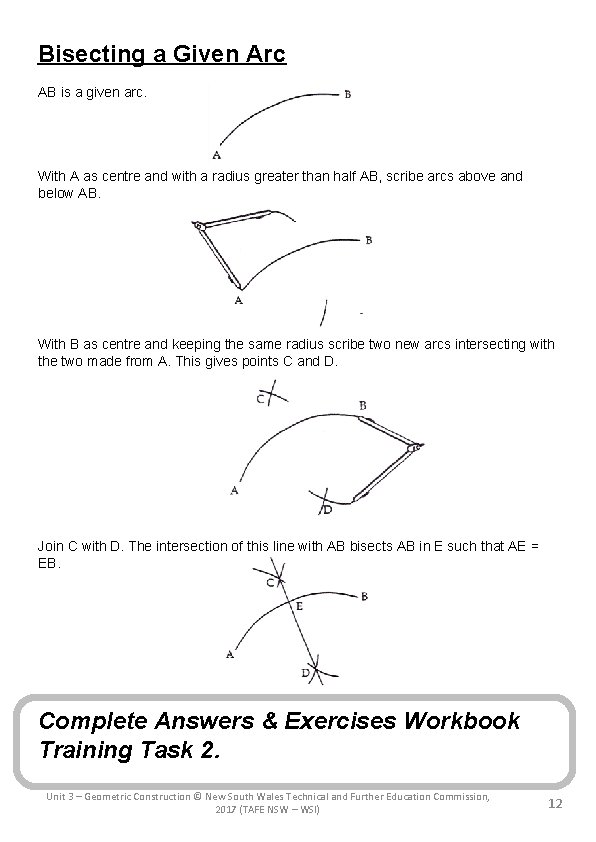
Bisecting a Given Arc AB is a given arc. With A as centre and with a radius greater than half AB, scribe arcs above and below AB. With B as centre and keeping the same radius scribe two new arcs intersecting with the two made from A. This gives points C and D. Join C with D. The intersection of this line with AB bisects AB in E such that AE = EB. Complete Answers & Exercises Workbook Training Task 2. Unit 3 – Geometric Construction © New South Wales Technical and Further Education Commission, 2017 (TAFE NSW – WSI) 12
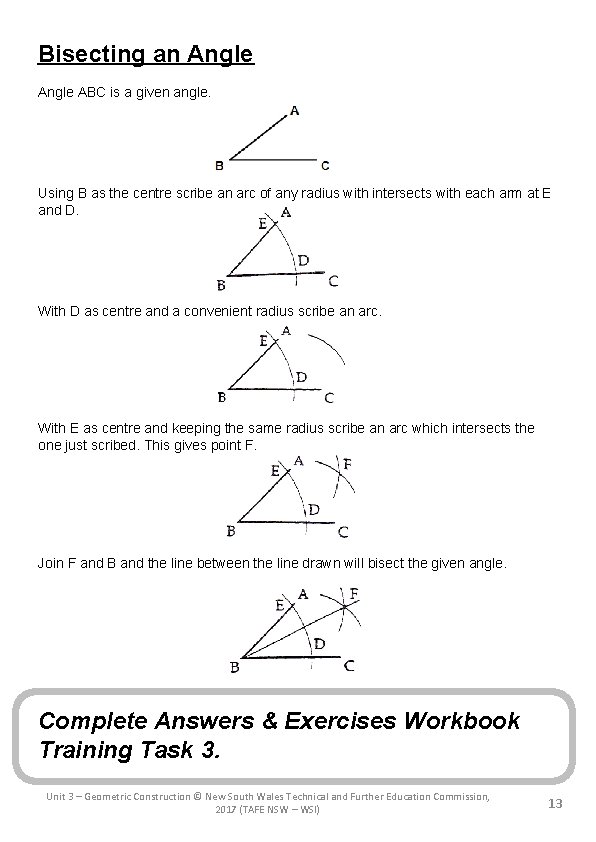
Bisecting an Angle ABC is a given angle. Using B as the centre scribe an arc of any radius with intersects with each arm at E and D. With D as centre and a convenient radius scribe an arc. With E as centre and keeping the same radius scribe an arc which intersects the one just scribed. This gives point F. Join F and B and the line between the line drawn will bisect the given angle. Complete Answers & Exercises Workbook Training Task 3. Unit 3 – Geometric Construction © New South Wales Technical and Further Education Commission, 2017 (TAFE NSW – WSI) 13
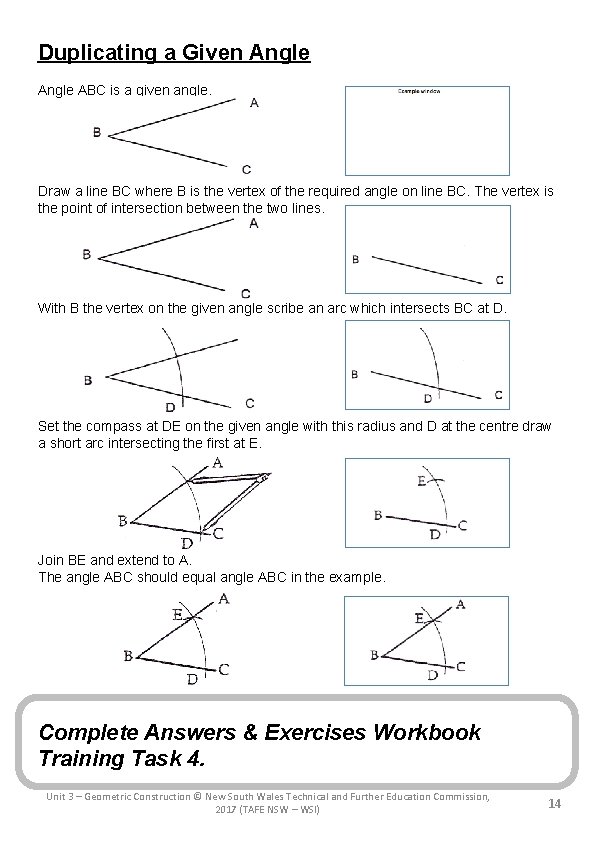
Duplicating a Given Angle ABC is a given angle. Draw a line BC where B is the vertex of the required angle on line BC. The vertex is the point of intersection between the two lines. With B the vertex on the given angle scribe an arc which intersects BC at D. Set the compass at DE on the given angle with this radius and D at the centre draw a short arc intersecting the first at E. Join BE and extend to A. The angle ABC should equal angle ABC in the example. Complete Answers & Exercises Workbook Training Task 4. Unit 3 – Geometric Construction © New South Wales Technical and Further Education Commission, 2017 (TAFE NSW – WSI) 14
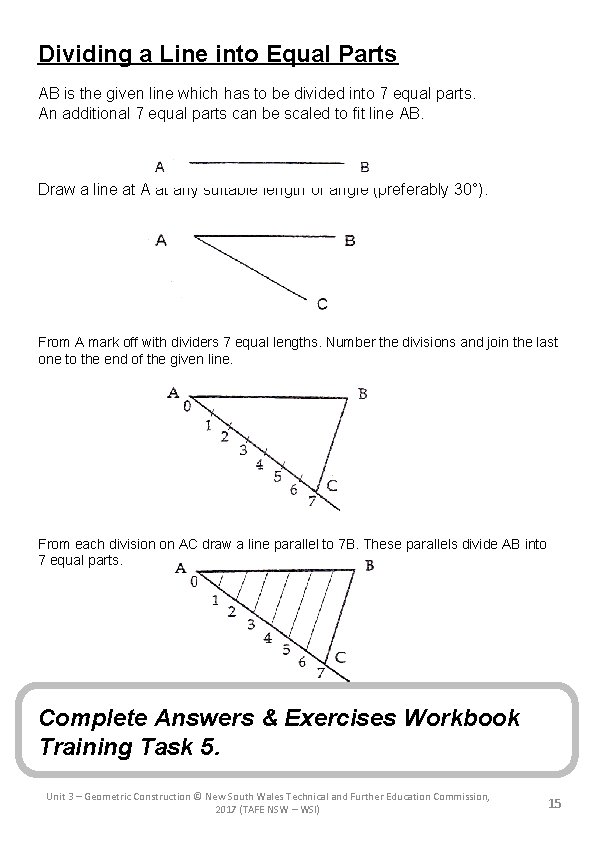
Dividing a Line into Equal Parts AB is the given line which has to be divided into 7 equal parts. An additional 7 equal parts can be scaled to fit line AB. Draw a line at A at any suitable length or angle (preferably 30°). From A mark off with dividers 7 equal lengths. Number the divisions and join the last one to the end of the given line. From each division on AC draw a line parallel to 7 B. These parallels divide AB into 7 equal parts. Complete Answers & Exercises Workbook Training Task 5. Unit 3 – Geometric Construction © New South Wales Technical and Further Education Commission, 2017 (TAFE NSW – WSI) 15
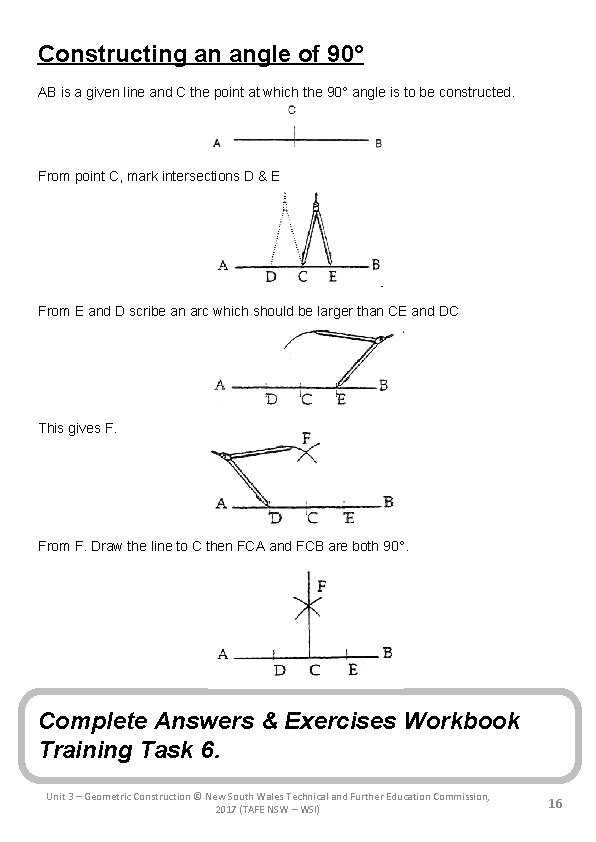
Constructing an angle of 90° AB is a given line and C the point at which the 90° angle is to be constructed. From point C, mark intersections D & E From E and D scribe an arc which should be larger than CE and DC This gives F. From F. Draw the line to C then FCA and FCB are both 90°. Complete Answers & Exercises Workbook Training Task 6. Unit 3 – Geometric Construction © New South Wales Technical and Further Education Commission, 2017 (TAFE NSW – WSI) 16
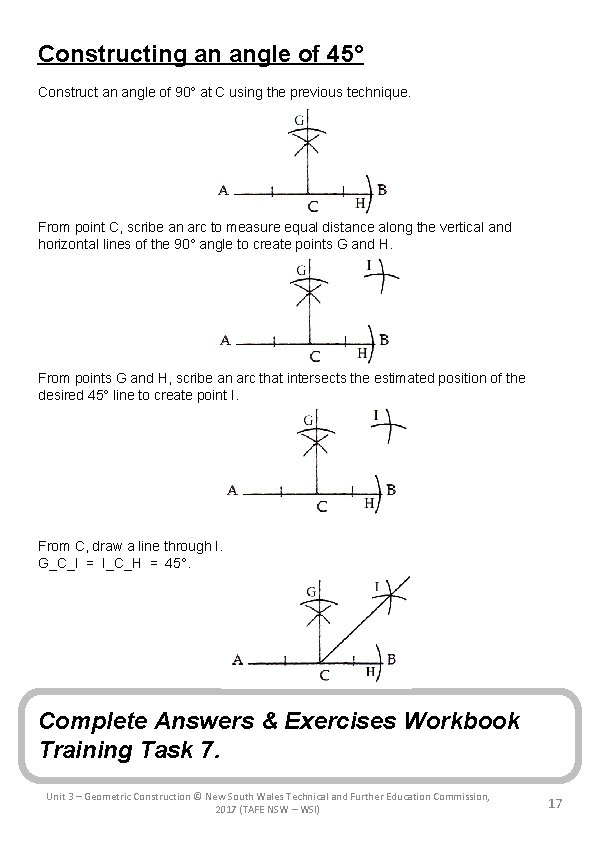
Constructing an angle of 45° Construct an angle of 90° at C using the previous technique. From point C, scribe an arc to measure equal distance along the vertical and horizontal lines of the 90° angle to create points G and H. From points G and H, scribe an arc that intersects the estimated position of the desired 45° line to create point I. From C, draw a line through I. G_C_I = I_C_H = 45°. Complete Answers & Exercises Workbook Training Task 7. Unit 3 – Geometric Construction © New South Wales Technical and Further Education Commission, 2017 (TAFE NSW – WSI) 17
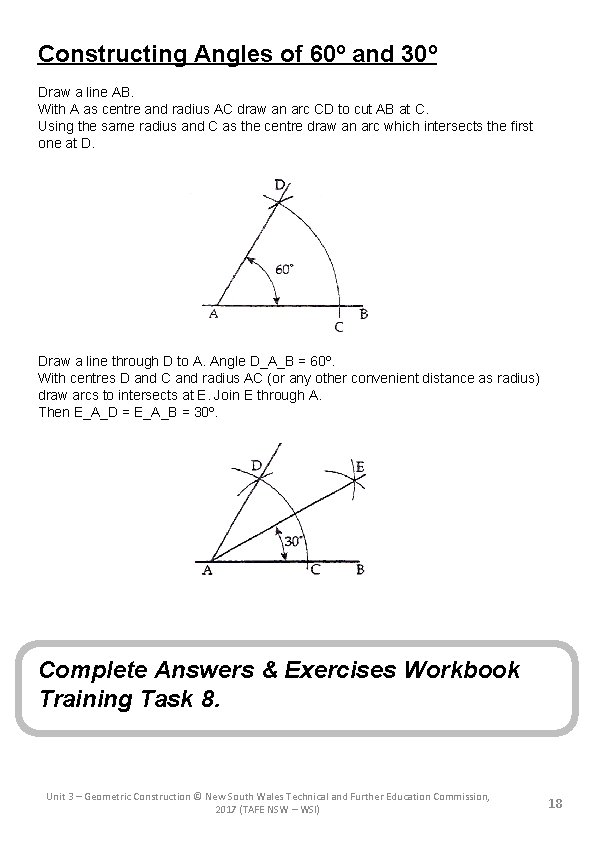
Constructing Angles of 60º and 30º Draw a line AB. With A as centre and radius AC draw an arc CD to cut AB at C. Using the same radius and C as the centre draw an arc which intersects the first one at D. Draw a line through D to A. Angle D_A_B = 60º. With centres D and C and radius AC (or any other convenient distance as radius) draw arcs to intersects at E. Join E through A. Then E_A_D = E_A_B = 30º. Complete Answers & Exercises Workbook Training Task 8. Unit 3 – Geometric Construction © New South Wales Technical and Further Education Commission, 2017 (TAFE NSW – WSI) 18
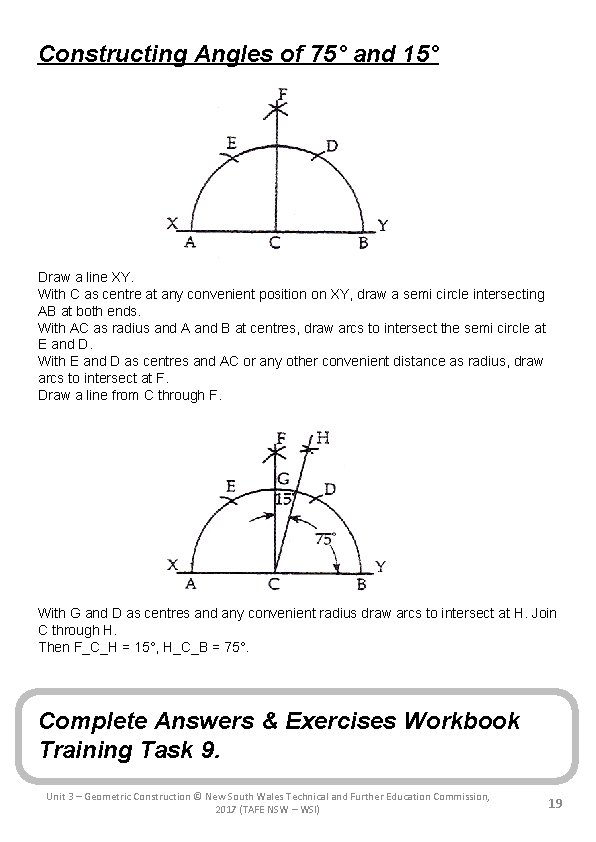
Constructing Angles of 75° and 15° Draw a line XY. With C as centre at any convenient position on XY, draw a semi circle intersecting AB at both ends. With AC as radius and A and B at centres, draw arcs to intersect the semi circle at E and D. With E and D as centres and AC or any other convenient distance as radius, draw arcs to intersect at F. Draw a line from C through F. With G and D as centres and any convenient radius draw arcs to intersect at H. Join C through H. Then F_C_H = 15°, H_C_B = 75°. Complete Answers & Exercises Workbook Training Task 9. Unit 3 – Geometric Construction © New South Wales Technical and Further Education Commission, 2017 (TAFE NSW – WSI) 19
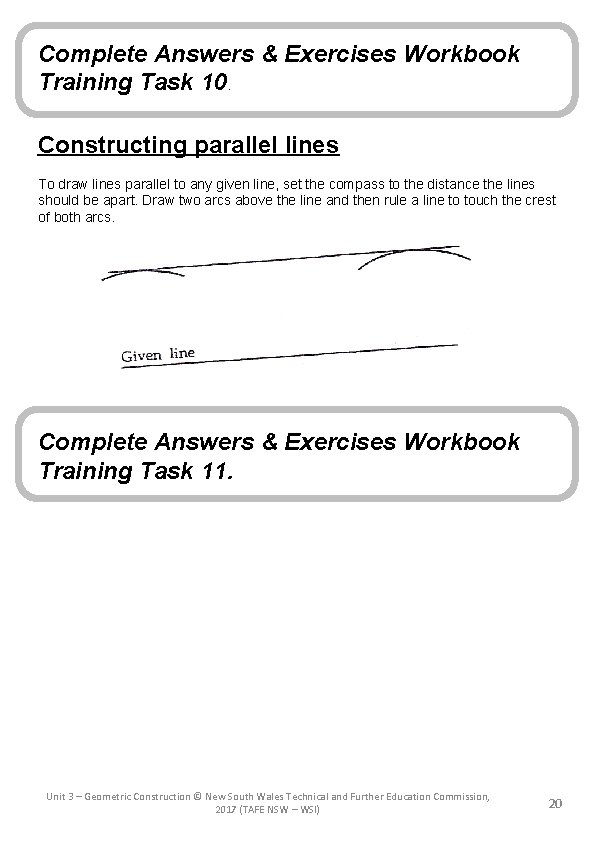
Complete Answers & Exercises Workbook Training Task 10. Constructing parallel lines To draw lines parallel to any given line, set the compass to the distance the lines should be apart. Draw two arcs above the line and then rule a line to touch the crest of both arcs. Complete Answers & Exercises Workbook Training Task 11. Unit 3 – Geometric Construction © New South Wales Technical and Further Education Commission, 2017 (TAFE NSW – WSI) 20
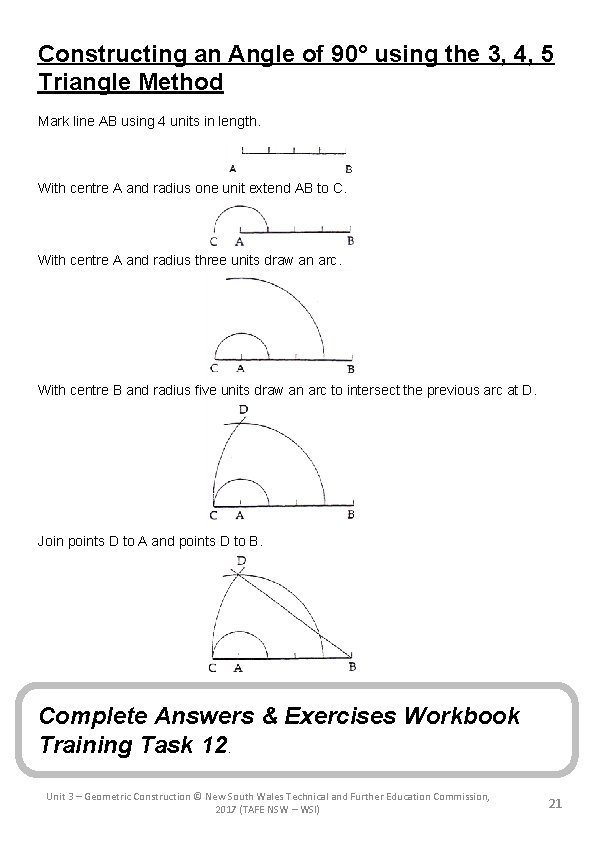
Constructing an Angle of 90° using the 3, 4, 5 Triangle Method Mark line AB using 4 units in length. With centre A and radius one unit extend AB to C. With centre A and radius three units draw an arc. With centre B and radius five units draw an arc to intersect the previous arc at D. Join points D to A and points D to B. Complete Answers & Exercises Workbook Training Task 12. Unit 3 – Geometric Construction © New South Wales Technical and Further Education Commission, 2017 (TAFE NSW – WSI) 21
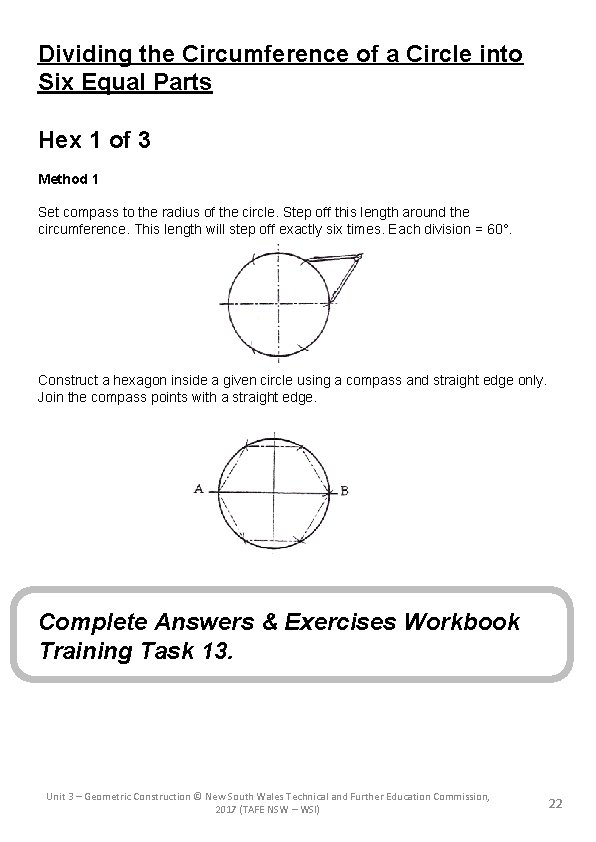
Dividing the Circumference of a Circle into Six Equal Parts Hex 1 of 3 Method 1 Set compass to the radius of the circle. Step off this length around the circumference. This length will step off exactly six times. Each division = 60°. Construct a hexagon inside a given circle using a compass and straight edge only. Join the compass points with a straight edge. Complete Answers & Exercises Workbook Training Task 13. Unit 3 – Geometric Construction © New South Wales Technical and Further Education Commission, 2017 (TAFE NSW – WSI) 22
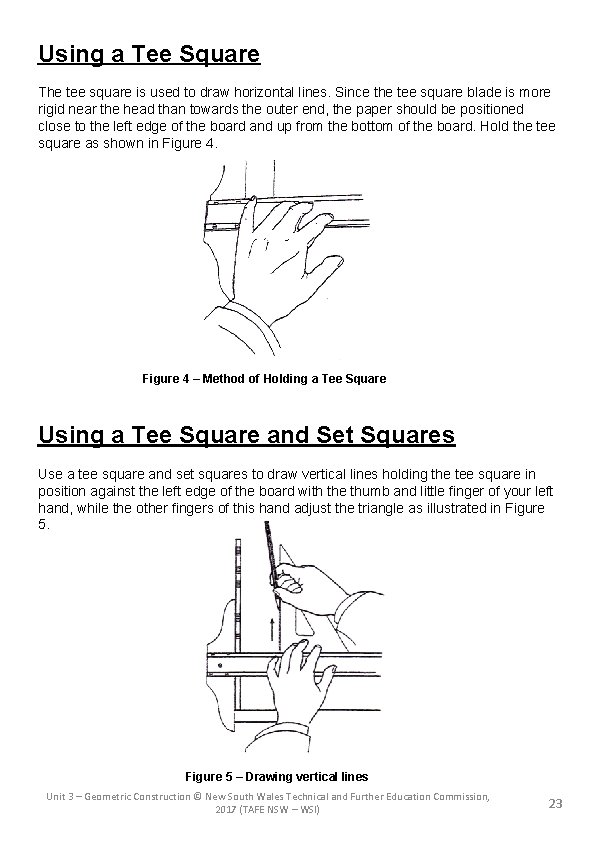
Using a Tee Square The tee square is used to draw horizontal lines. Since the tee square blade is more rigid near the head than towards the outer end, the paper should be positioned close to the left edge of the board and up from the bottom of the board. Hold the tee square as shown in Figure 4 – Method of Holding a Tee Square Using a Tee Square and Set Squares Use a tee square and set squares to draw vertical lines holding the tee square in position against the left edge of the board with the thumb and little finger of your left hand, while the other fingers of this hand adjust the triangle as illustrated in Figure 5 – Drawing vertical lines Unit 3 – Geometric Construction © New South Wales Technical and Further Education Commission, 2017 (TAFE NSW – WSI) 23
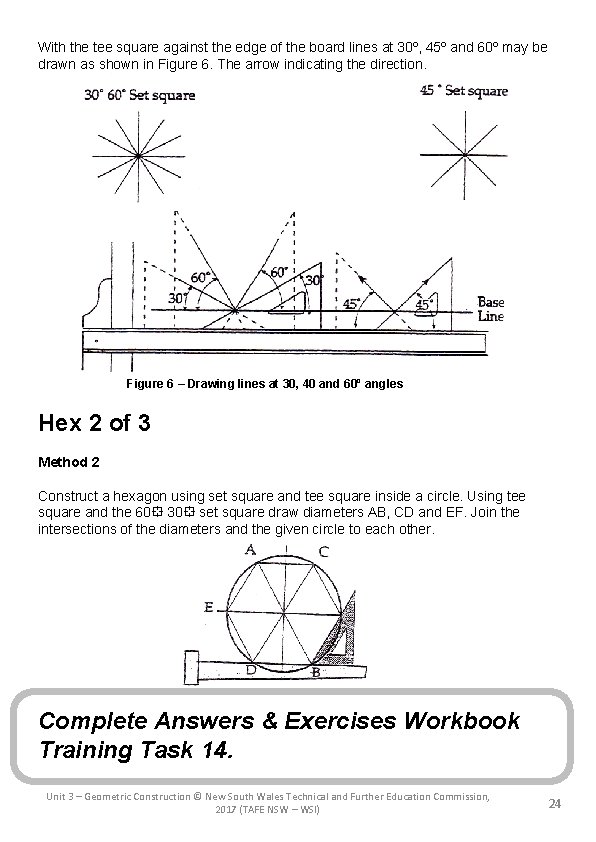
With the tee square against the edge of the board lines at 30º, 45º and 60º may be drawn as shown in Figure 6. The arrow indicating the direction. Figure 6 – Drawing lines at 30, 40 and 60º angles Hex 2 of 3 Method 2 Construct a hexagon using set square and tee square inside a circle. Using tee square and the 60 30 set square draw diameters AB, CD and EF. Join the intersections of the diameters and the given circle to each other. Complete Answers & Exercises Workbook Training Task 14. Unit 3 – Geometric Construction © New South Wales Technical and Further Education Commission, 2017 (TAFE NSW – WSI) 24
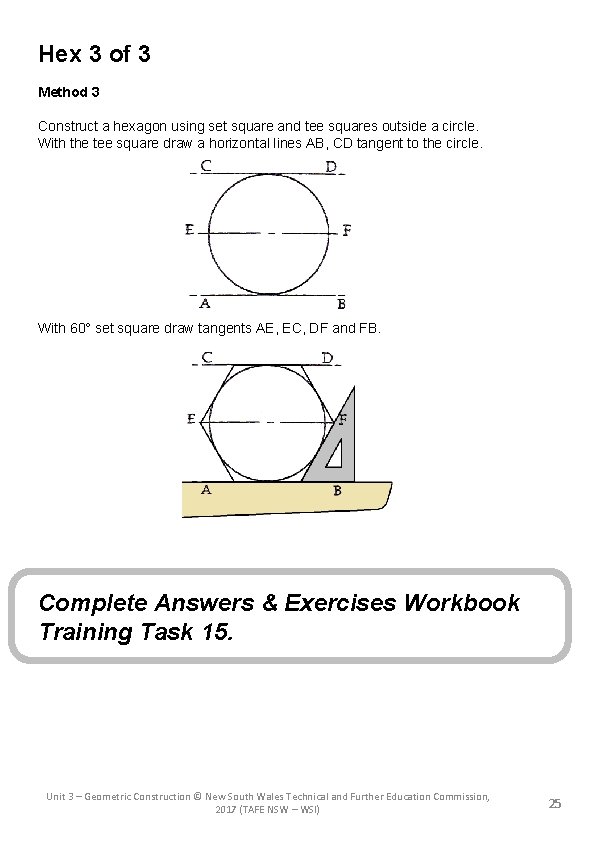
Hex 3 of 3 Method 3 Construct a hexagon using set square and tee squares outside a circle. With the tee square draw a horizontal lines AB, CD tangent to the circle. With 60° set square draw tangents AE, EC, DF and FB. Complete Answers & Exercises Workbook Training Task 15. Unit 3 – Geometric Construction © New South Wales Technical and Further Education Commission, 2017 (TAFE NSW – WSI) 25
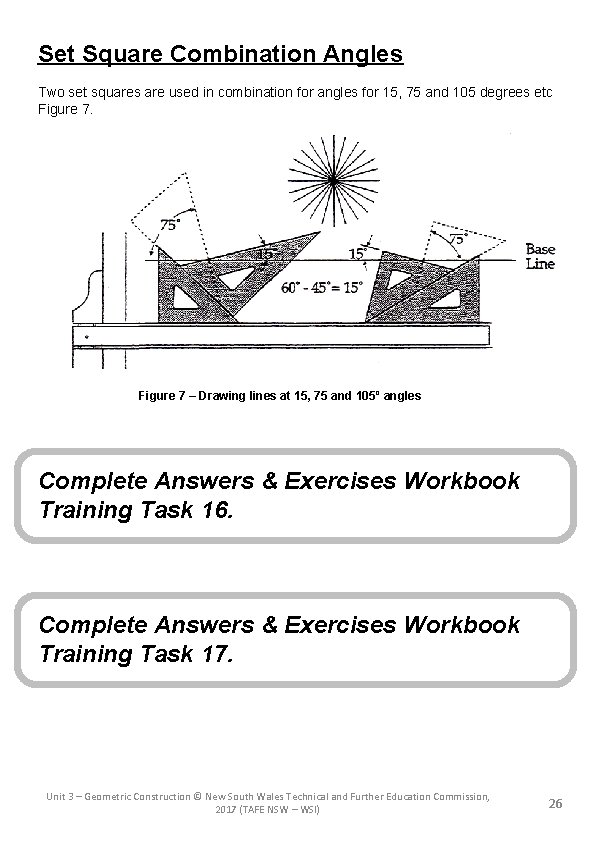
Set Square Combination Angles Two set squares are used in combination for angles for 15, 75 and 105 degrees etc Figure 7 – Drawing lines at 15, 75 and 105º angles Complete Answers & Exercises Workbook Training Task 16. Complete Answers & Exercises Workbook Training Task 17. Unit 3 – Geometric Construction © New South Wales Technical and Further Education Commission, 2017 (TAFE NSW – WSI) 26
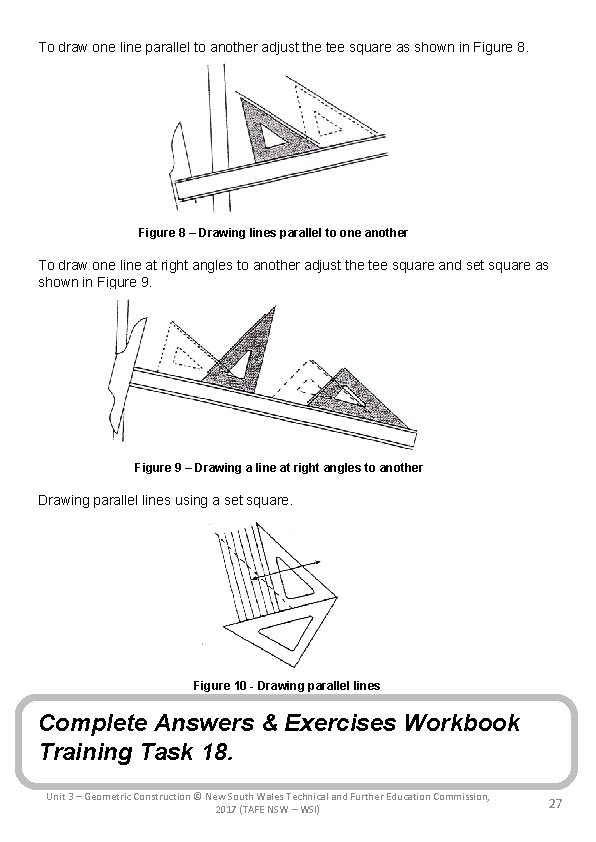
To draw one line parallel to another adjust the tee square as shown in Figure 8 – Drawing lines parallel to one another To draw one line at right angles to another adjust the tee square and set square as shown in Figure 9 – Drawing a line at right angles to another Drawing parallel lines using a set square. Figure 10 - Drawing parallel lines Complete Answers & Exercises Workbook Training Task 18. Unit 3 – Geometric Construction © New South Wales Technical and Further Education Commission, 2017 (TAFE NSW – WSI) 27
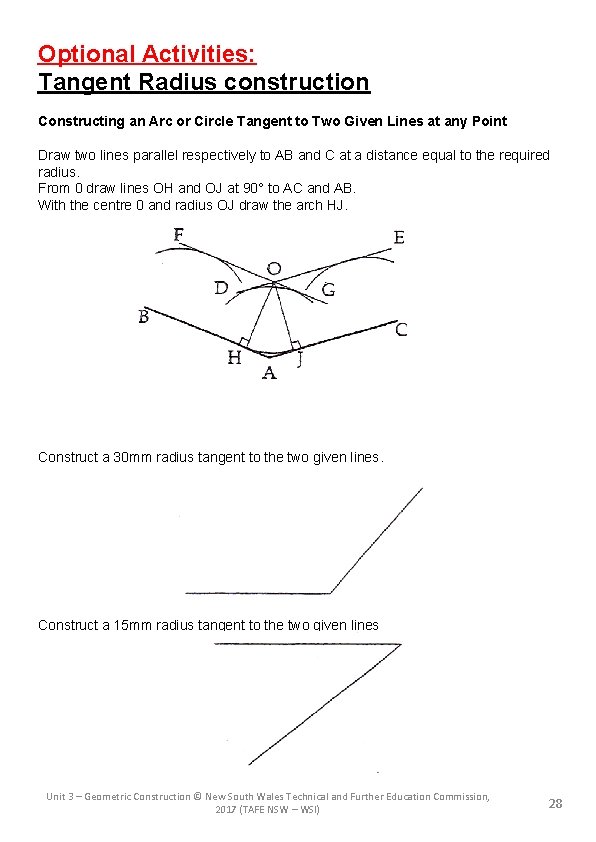
Optional Activities: Tangent Radius construction Constructing an Arc or Circle Tangent to Two Given Lines at any Point Draw two lines parallel respectively to AB and C at a distance equal to the required radius. From 0 draw lines OH and OJ at 90° to AC and AB. With the centre 0 and radius OJ draw the arch HJ. Construct a 30 mm radius tangent to the two given lines. Construct a 15 mm radius tangent to the two given lines Unit 3 – Geometric Construction © New South Wales Technical and Further Education Commission, 2017 (TAFE NSW – WSI) 28
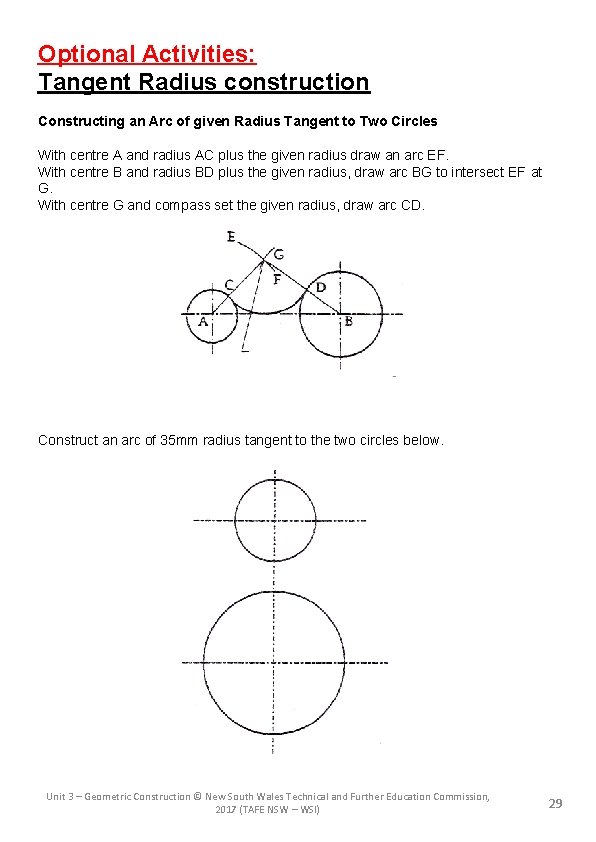
Optional Activities: Tangent Radius construction Constructing an Arc of given Radius Tangent to Two Circles With centre A and radius AC plus the given radius draw an arc EF. With centre B and radius BD plus the given radius, draw arc BG to intersect EF at G. With centre G and compass set the given radius, draw arc CD. Construct an arc of 35 mm radius tangent to the two circles below. Unit 3 – Geometric Construction © New South Wales Technical and Further Education Commission, 2017 (TAFE NSW – WSI) 29
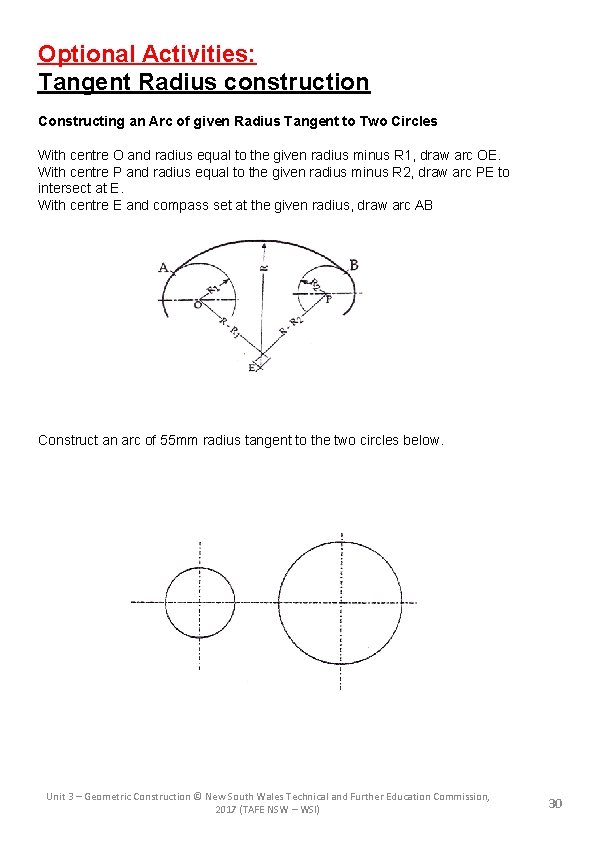
Optional Activities: Tangent Radius construction Constructing an Arc of given Radius Tangent to Two Circles With centre O and radius equal to the given radius minus R 1, draw arc OE. With centre P and radius equal to the given radius minus R 2, draw arc PE to intersect at E. With centre E and compass set at the given radius, draw arc AB Construct an arc of 55 mm radius tangent to the two circles below. Unit 3 – Geometric Construction © New South Wales Technical and Further Education Commission, 2017 (TAFE NSW – WSI) 30
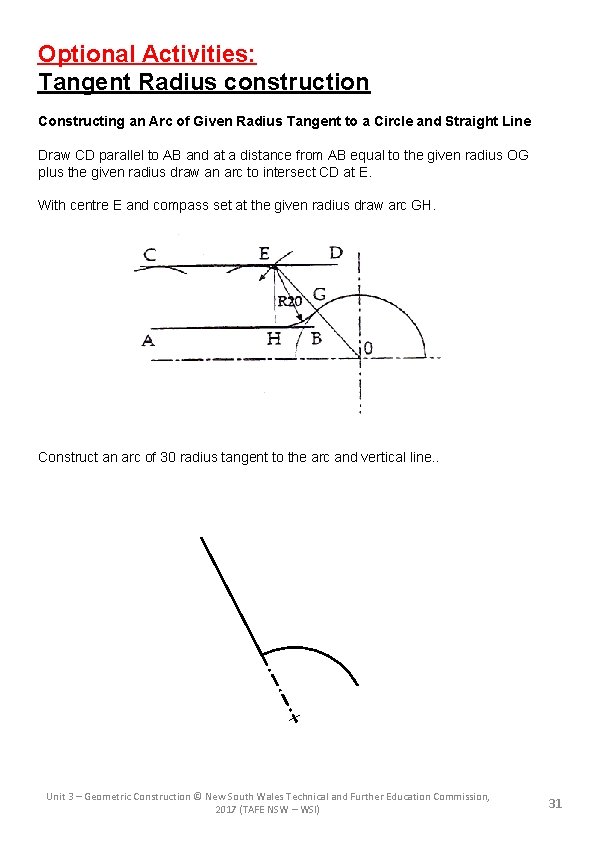
Optional Activities: Tangent Radius construction Constructing an Arc of Given Radius Tangent to a Circle and Straight Line Draw CD parallel to AB and at a distance from AB equal to the given radius OG plus the given radius draw an arc to intersect CD at E. With centre E and compass set at the given radius draw arc GH. Construct an arc of 30 radius tangent to the arc and vertical line. . Unit 3 – Geometric Construction © New South Wales Technical and Further Education Commission, 2017 (TAFE NSW – WSI) 31
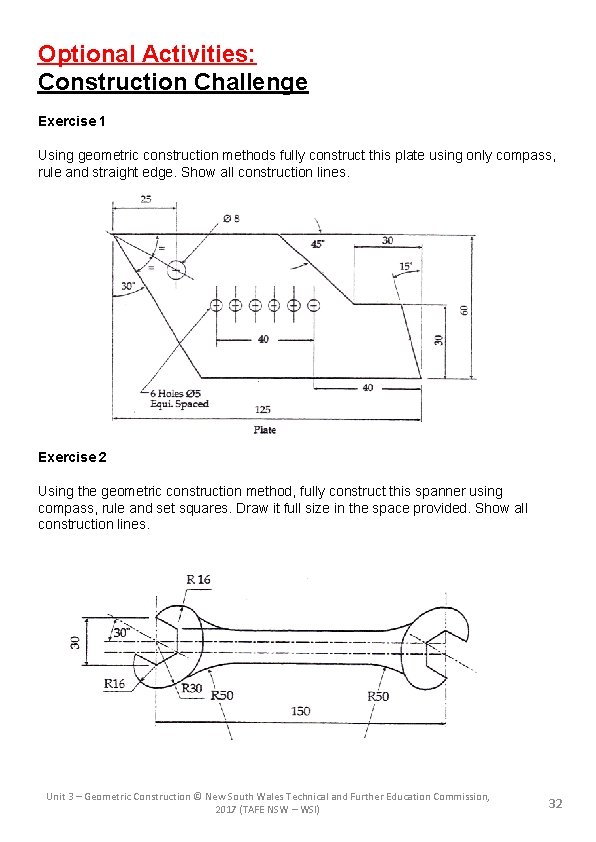
Optional Activities: Construction Challenge Exercise 1 Using geometric construction methods fully construct this plate using only compass, rule and straight edge. Show all construction lines. Exercise 2 Using the geometric construction method, fully construct this spanner using compass, rule and set squares. Draw it full size in the space provided. Show all construction lines. Unit 3 – Geometric Construction © New South Wales Technical and Further Education Commission, 2017 (TAFE NSW – WSI) 32
- Slides: 32