
Fitness to Return to Driving An Evaluation of
- Slides: 1
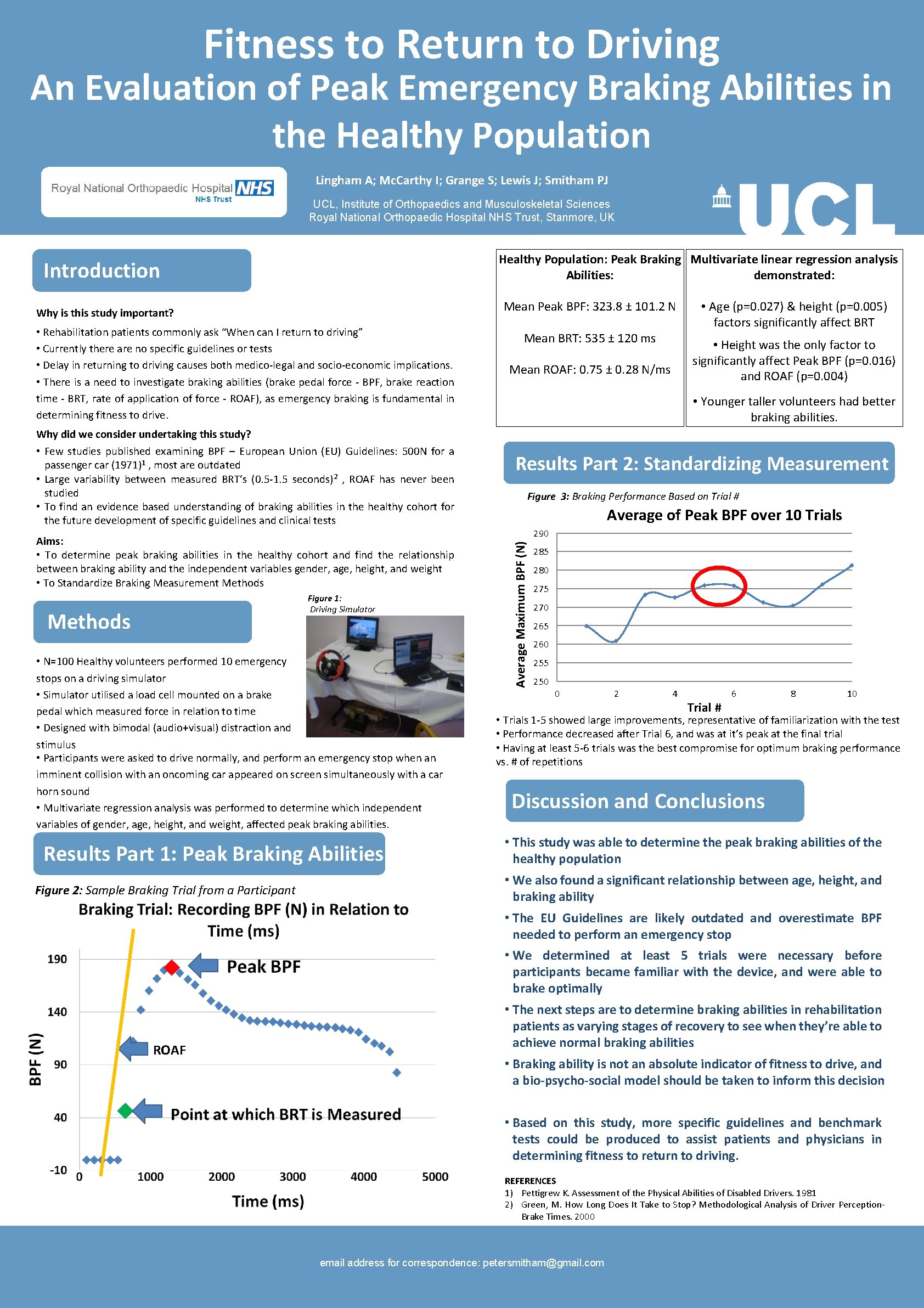
Fitness to Return to Driving An Evaluation of Peak Emergency Braking Abilities in the Healthy Population Lingham A; Mc. Carthy I; Grange S; Lewis J; Smitham PJ UCL, Institute of Orthopaedics and Musculoskeletal Sciences Royal National Orthopaedic Hospital NHS Trust, Stanmore, UK Healthy Population: Peak Braking Multivariate linear regression analysis Abilities: demonstrated: Introduction Mean Peak BPF: 323. 8 ± 101. 2 N • Rehabilitation patients commonly ask “When can I return to driving” • Currently there are no specific guidelines or tests • Delay in returning to driving causes both medico-legal and socio-economic implications. • There is a need to investigate braking abilities (brake pedal force - BPF, brake reaction time - BRT, rate of application of force - ROAF), as emergency braking is fundamental in determining fitness to drive. Why did we consider undertaking this study? • Few studies published examining BPF – European Union (EU) Guidelines: 500 N for a passenger car (1971)1 , most are outdated • Large variability between measured BRT’s (0. 5 -1. 5 seconds)2 , ROAF has never been studied • To find an evidence based understanding of braking abilities in the healthy cohort for the future development of specific guidelines and clinical tests Aims: • To determine peak braking abilities in the healthy cohort and find the relationship between braking ability and the independent variables gender, age, height, and weight • To Standardize Braking Measurement Methods Figure 1: Driving Simulator Methods • N=100 Healthy volunteers performed 10 emergency stops on a driving simulator • Simulator utilised a load cell mounted on a brake pedal which measured force in relation to time • Designed with bimodal (audio+visual) distraction and stimulus • Participants were asked to drive normally, and perform an emergency stop when an imminent collision with an oncoming car appeared on screen simultaneously with a car horn sound • Multivariate regression analysis was performed to determine which independent variables of gender, age, height, and weight, affected peak braking abilities. Results Part 1: Peak Braking Abilities Figure 2: Sample Braking Trial from a Participant Mean BRT: 535 ± 120 ms • Age (p=0. 027) & height (p=0. 005) factors significantly affect BRT • Height was the only factor to significantly affect Peak BPF (p=0. 016) and ROAF (p=0. 004) Mean ROAF: 0. 75 ± 0. 28 N/ms • Younger taller volunteers had better braking abilities. 59 Results Part 2: Standardizing Measurement Figure 3: Braking Performance Based on Trial # 19 290 Average Maximum BPF (N) Why is this study important? Average of Peak BPF over 10 Trials 285 7 280 275 270 265 260 255 250 0 2 4 Trial # 6 8 10 • Trials 1 -5 showed large improvements, representative of familiarization with the test • Performance decreased after Trial 6, and was at it’s peak at the final trial • Having at least 5 -6 trials was the best compromise for optimum braking performance vs. # of repetitions Discussion and Conclusions • This study was able to determine the peak braking abilities of the healthy population • We also found a significant relationship between age, height, and braking ability • The EU Guidelines are likely outdated and overestimate BPF needed to perform an emergency stop • We determined at least 5 trials were necessary before participants became familiar with the device, and were able to brake optimally ROAF • The next steps are to determine braking abilities in rehabilitation patients as varying stages of recovery to see when they’re able to achieve normal braking abilities • Braking ability is not an absolute indicator of fitness to drive, and a bio-psycho-social model should be taken to inform this decision • Based on this study, more specific guidelines and benchmark tests could be produced to assist patients and physicians in determining fitness to return to driving. REFERENCES 1) Pettigrew K. Assessment of the Physical Abilities of Disabled Drivers. 1981 2) Green, M. How Long Does It Take to Stop? Methodological Analysis of Driver Perception. Brake Times. 2000 email address for correspondence: petersmitham@gmail. com