
Fitness Safety and Avoiding Injuries Safety First Ways

- Slides: 10
Fitness Safety and Avoiding Injuries Safety First Ways to protect yourself during exercise • • Use the correct safety equipment for an activity Pay attention to other people, objects, and the weather Play or exercise at your skill level and know your limits Warm up before exercise and cool down afterward Stay within the areas designated for a given activity Obey all rules and restrictions Practice good sportsmanship
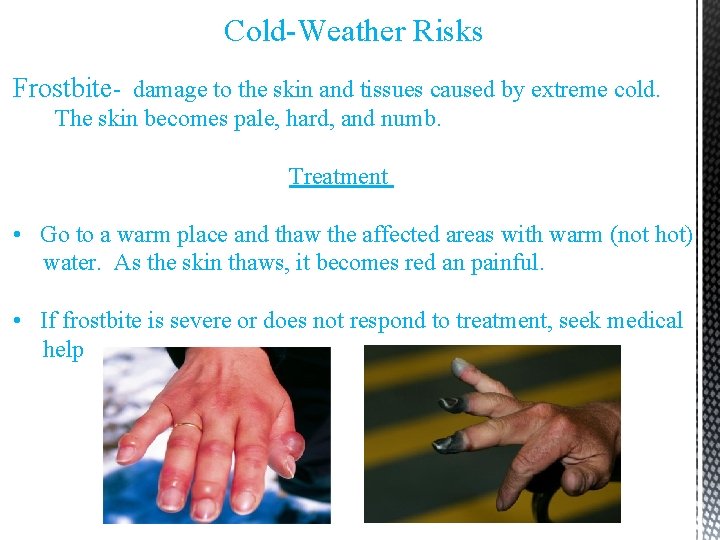
Cold-Weather Risks Frostbite- damage to the skin and tissues caused by extreme cold. The skin becomes pale, hard, and numb. Treatment • Go to a warm place and thaw the affected areas with warm (not hot) water. As the skin thaws, it becomes red an painful. • If frostbite is severe or does not respond to treatment, seek medical help
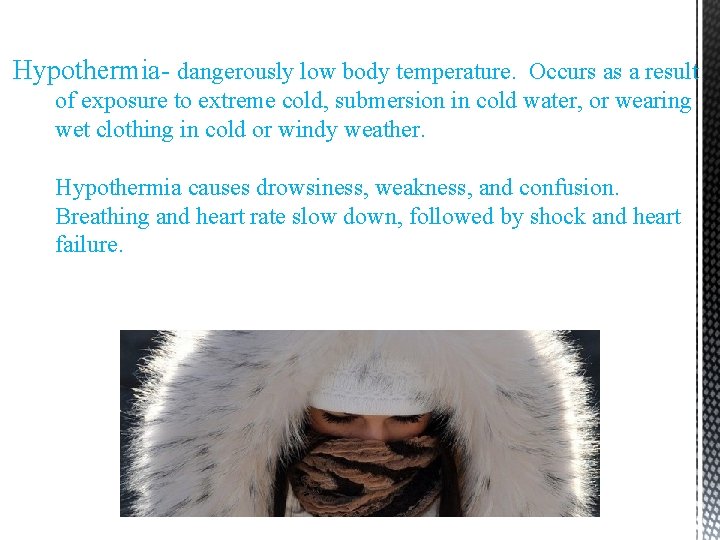
Hypothermia- dangerously low body temperature. Occurs as a result of exposure to extreme cold, submersion in cold water, or wearing wet clothing in cold or windy weather. Hypothermia causes drowsiness, weakness, and confusion. Breathing and heart rate slow down, followed by shock and heart failure.
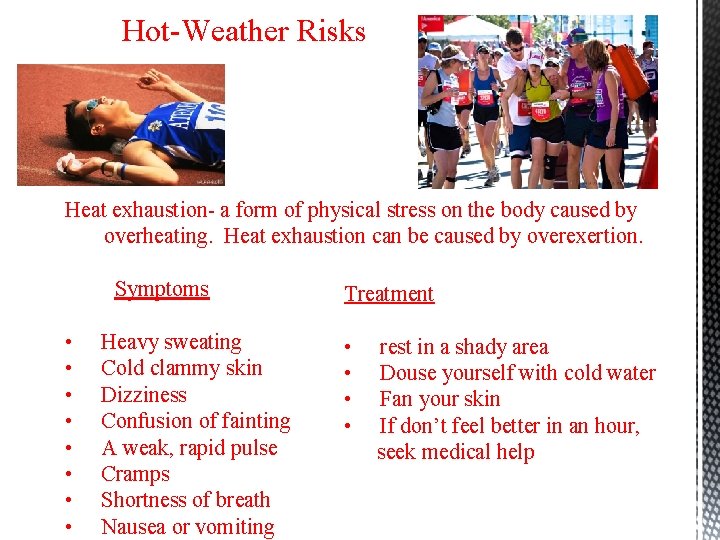
Hot-Weather Risks Heat exhaustion- a form of physical stress on the body caused by overheating. Heat exhaustion can be caused by overexertion. Symptoms • • Heavy sweating Cold clammy skin Dizziness Confusion of fainting A weak, rapid pulse Cramps Shortness of breath Nausea or vomiting Treatment • • rest in a shady area Douse yourself with cold water Fan your skin If don’t feel better in an hour, seek medical help
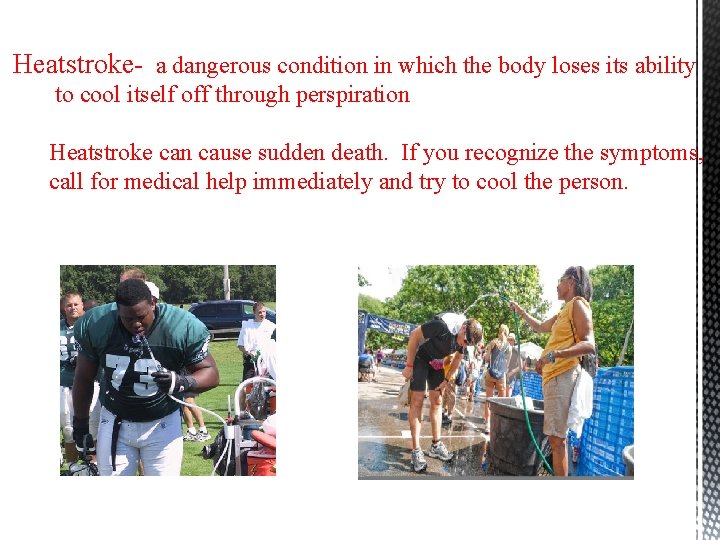
Heatstroke- a dangerous condition in which the body loses its ability to cool itself off through perspiration Heatstroke can cause sudden death. If you recognize the symptoms, call for medical help immediately and try to cool the person.
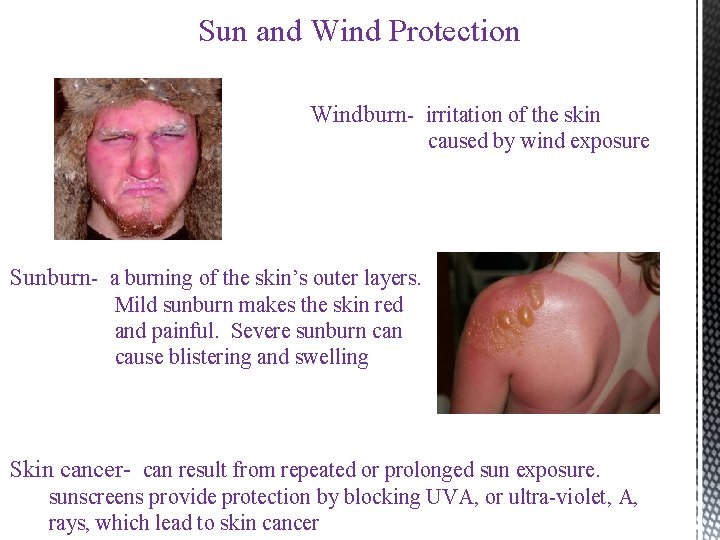
Sun and Wind Protection Windburn- irritation of the skin caused by wind exposure Sunburn- a burning of the skin’s outer layers. Mild sunburn makes the skin red and painful. Severe sunburn cause blistering and swelling Skin cancer- can result from repeated or prolonged sun exposure. sunscreens provide protection by blocking UVA, or ultra-violet, A, rays, which lead to skin cancer
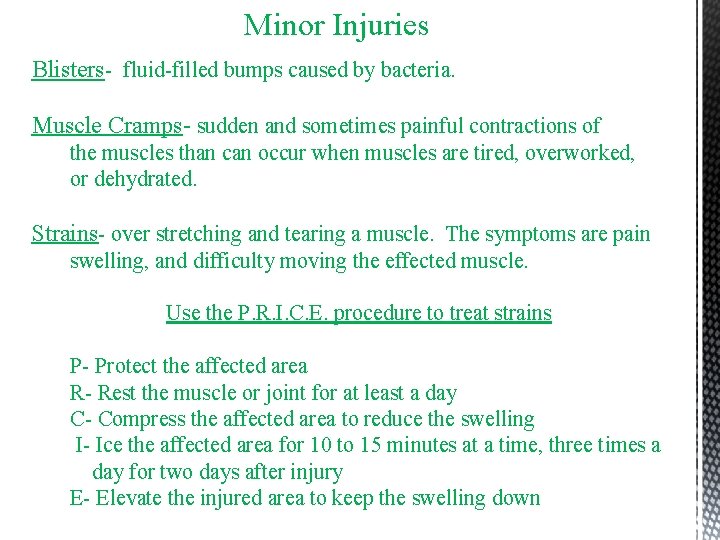
Minor Injuries Blisters- fluid-filled bumps caused by bacteria. Muscle Cramps- sudden and sometimes painful contractions of the muscles than can occur when muscles are tired, overworked, or dehydrated. Strains- over stretching and tearing a muscle. The symptoms are pain swelling, and difficulty moving the effected muscle. Use the P. R. I. C. E. procedure to treat strains P- Protect the affected area R- Rest the muscle or joint for at least a day C- Compress the affected area to reduce the swelling I- Ice the affected area for 10 to 15 minutes at a time, three times a day for two days after injury E- Elevate the injured area to keep the swelling down
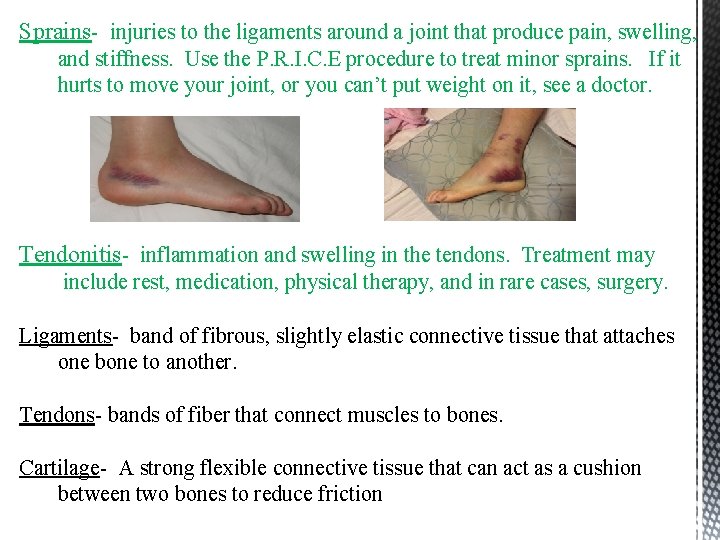
Sprains- injuries to the ligaments around a joint that produce pain, swelling, and stiffness. Use the P. R. I. C. E procedure to treat minor sprains. If it hurts to move your joint, or you can’t put weight on it, see a doctor. Tendonitis- inflammation and swelling in the tendons. Treatment may include rest, medication, physical therapy, and in rare cases, surgery. Ligaments- band of fibrous, slightly elastic connective tissue that attaches one bone to another. Tendons- bands of fiber that connect muscles to bones. Cartilage- A strong flexible connective tissue that can act as a cushion between two bones to reduce friction
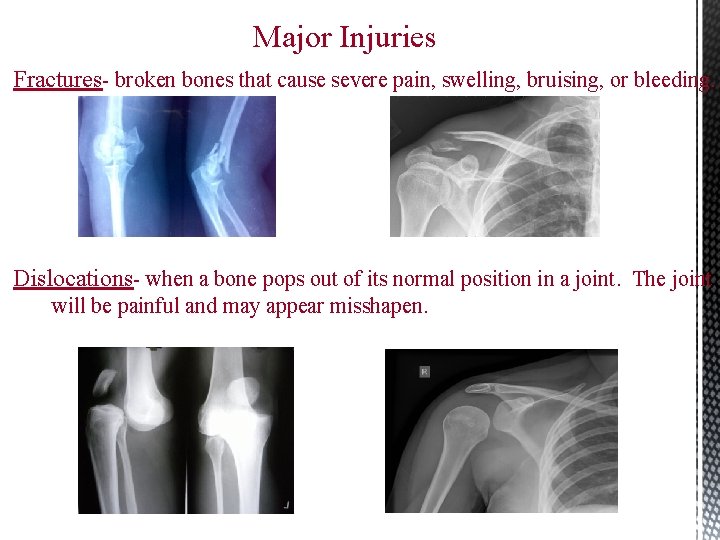
Major Injuries Fractures- broken bones that cause severe pain, swelling, bruising, or bleeding. Dislocations- when a bone pops out of its normal position in a joint. The joint will be painful and may appear misshapen.
Concussion- an injury to the brain that can result in a severe headache, unconsciousness, or memory loss. A severe concussion cause brain damage. Signs of brain damage include vomiting, confusion, seizures, or weakness to one side of the body.