
Fitness Principles and Concepts 6 Dimensions of Wellness


- Slides: 22
Fitness Principles and Concepts
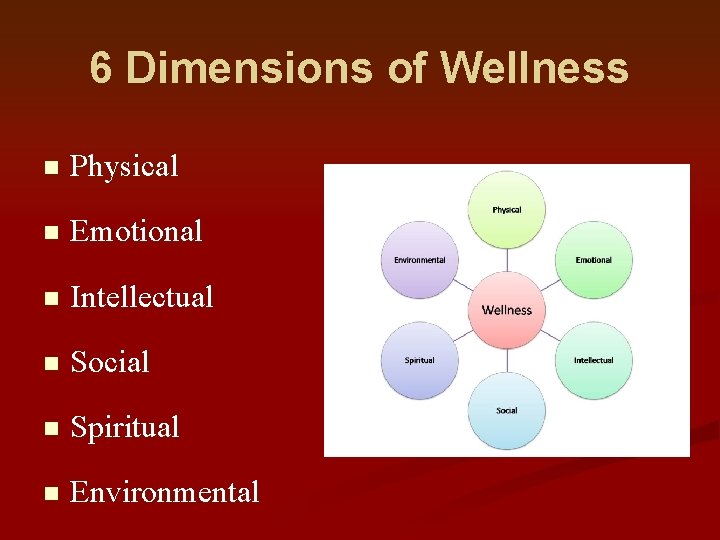
6 Dimensions of Wellness n Physical n Emotional n Intellectual n Social n Spiritual n Environmental
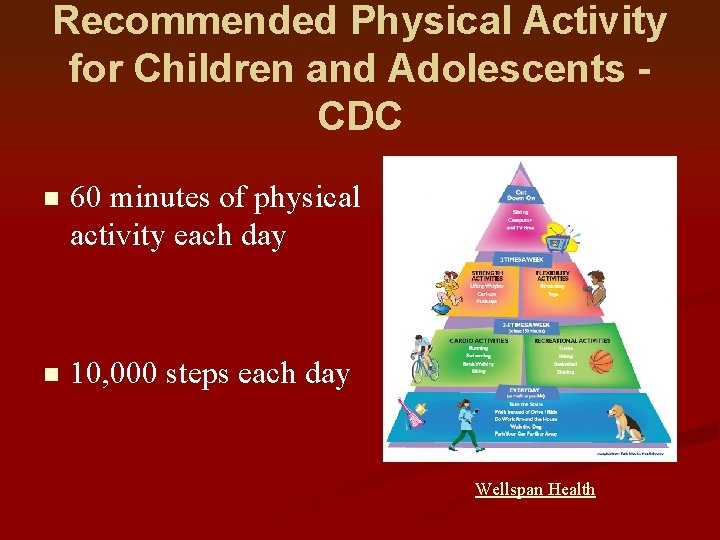
Recommended Physical Activity for Children and Adolescents CDC n 60 minutes of physical activity each day n 10, 000 steps each day Wellspan Health
Types of Activities n Lifestyle Activities: Activities performed daily or nearly every day such as yard work or housework. n Active Aerobics: Activities building cardiovascular fitness such as biking, jogging, and dance. n Active Sports and Recreation: Activities that build fitness and skills such as basketball, hiking, tennis, and dance. n Inactivity and Sedentary Living: Inactivity which should be limited includes TV, computers, and video games.
Balancing Calories n Calories in should equal calories out to maintain body weight. n Increase physical activity or reduce calorie intake to lose weight. n 3500 kcal = 1 pound of fat
Choose. My. Plate. gov n The USDA replaced the food pyramid with Choose. My. Plate. The plate shows the portions of each type of food you should have in each meal. n Go to their website for more nutritional information.
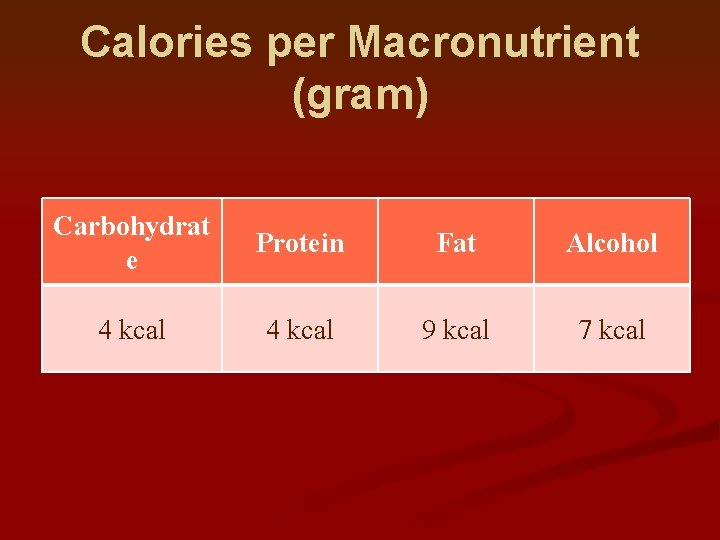
Calories per Macronutrient (gram) Carbohydrat e Protein Fat Alcohol 4 kcal 9 kcal 7 kcal
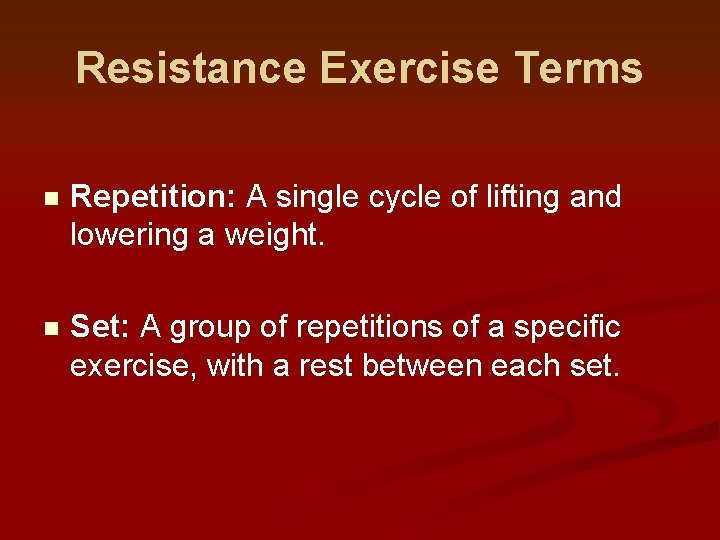
Resistance Exercise Terms n Repetition: A single cycle of lifting and lowering a weight. n Set: A group of repetitions of a specific exercise, with a rest between each set.
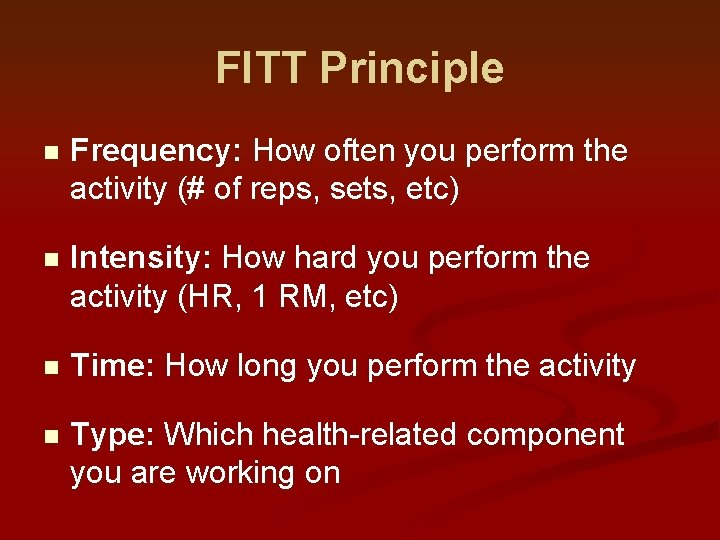
FITT Principle n Frequency: How often you perform the activity (# of reps, sets, etc) n Intensity: How hard you perform the activity (HR, 1 RM, etc) n Time: How long you perform the activity n Type: Which health-related component you are working on
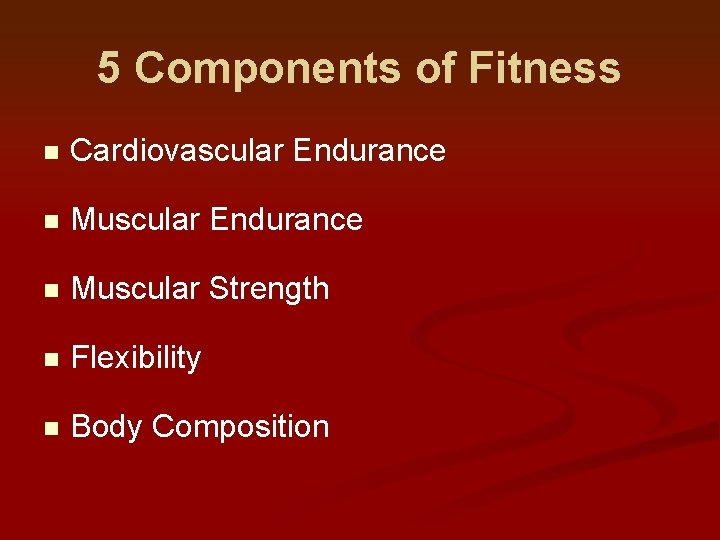
5 Components of Fitness n Cardiovascular Endurance n Muscular Strength n Flexibility n Body Composition
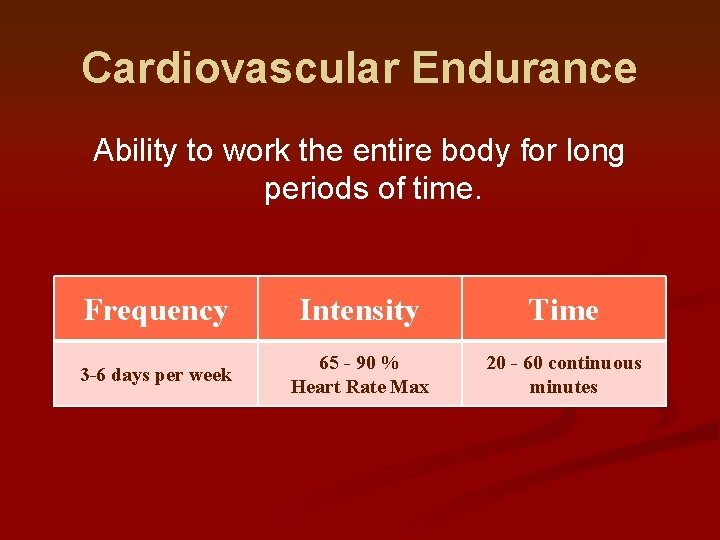
Cardiovascular Endurance Ability to work the entire body for long periods of time. Frequency Intensity Time 3 -6 days per week 65 - 90 % Heart Rate Max 20 - 60 continuous minutes
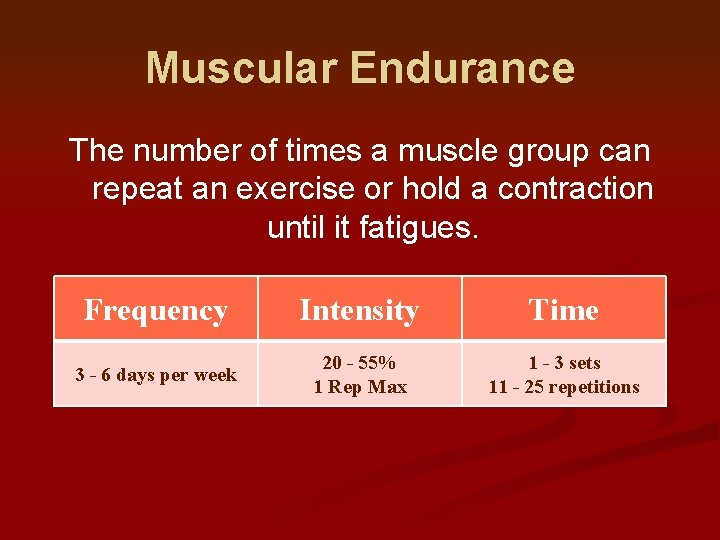
Muscular Endurance The number of times a muscle group can repeat an exercise or hold a contraction until it fatigues. Frequency Intensity Time 3 - 6 days per week 20 - 55% 1 Rep Max 1 - 3 sets 11 - 25 repetitions
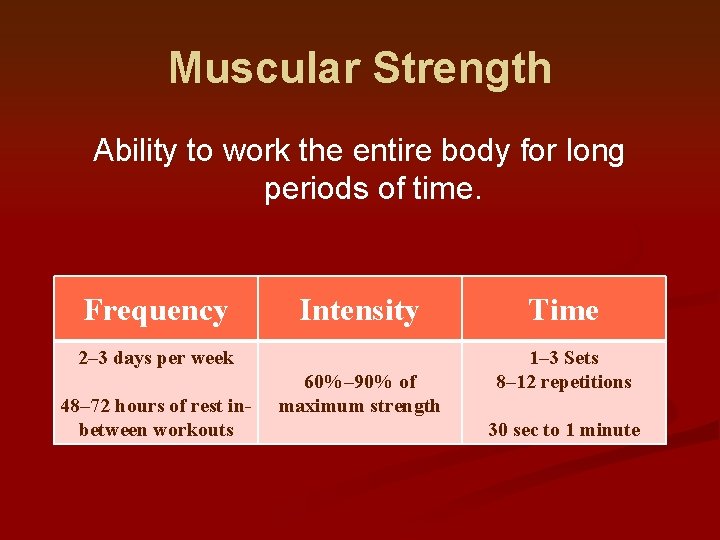
Muscular Strength Ability to work the entire body for long periods of time. Frequency Intensity 2– 3 days per week 48– 72 hours of rest inbetween workouts 60%– 90% of maximum strength Time 1– 3 Sets 8– 12 repetitions 30 sec to 1 minute
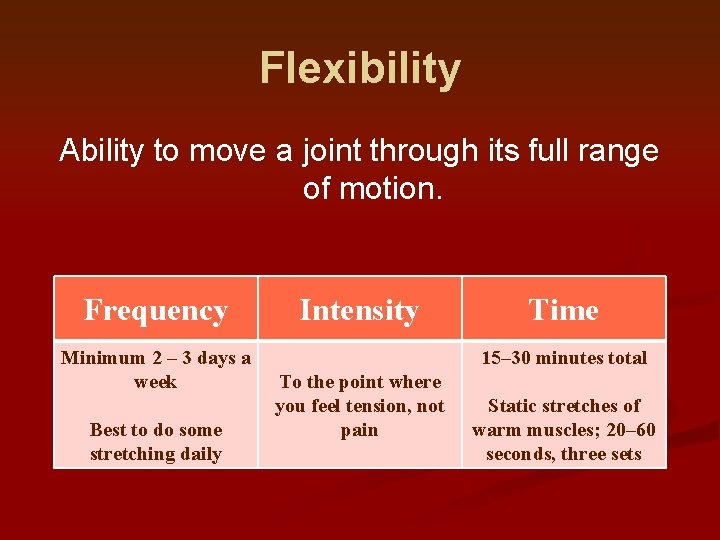
Flexibility Ability to move a joint through its full range of motion. Frequency Minimum 2 – 3 days a week Best to do some stretching daily Intensity Time 15– 30 minutes total To the point where you feel tension, not pain Static stretches of warm muscles; 20– 60 seconds, three sets
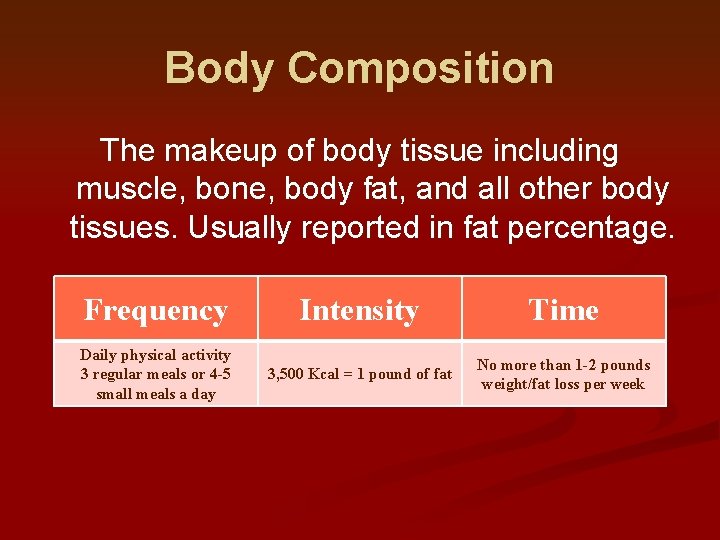
Body Composition The makeup of body tissue including muscle, bone, body fat, and all other body tissues. Usually reported in fat percentage. Frequency Intensity Time Daily physical activity 3 regular meals or 4 -5 small meals a day 3, 500 Kcal = 1 pound of fat No more than 1 -2 pounds weight/fat loss per week
BMI n Weight in Kilograms divided by Height in Meters squared (kg/m 2). n While not the most accurate, this is a cheap and fast indicator of body composition for the general population.
Overload and Progression n Overload: To improve a health-related component, you must do more than what your body normally does. n Progression: The amount of intensity should be increased gradually.
Specificity n To increase a particular part of any healthrelated component, you must work on that particular area. n For example, to increase abdominal strength you must exercise the abdominal region.
Skill Related Physical Fitness Components n Agility: Ability to change the body’s position quickly. n Balance: Ability to be stable while standing still or moving. n Coordination: Ability to use senses together with 1 or more body parts.
Skill Related Physical Fitness Components n Power: Ability to generate muscular force quickly. n Reaction Time: The amount of time it takes to move once you realize the need to. n Speed: Ability to perform a movement or cover a distance in a short period of time.
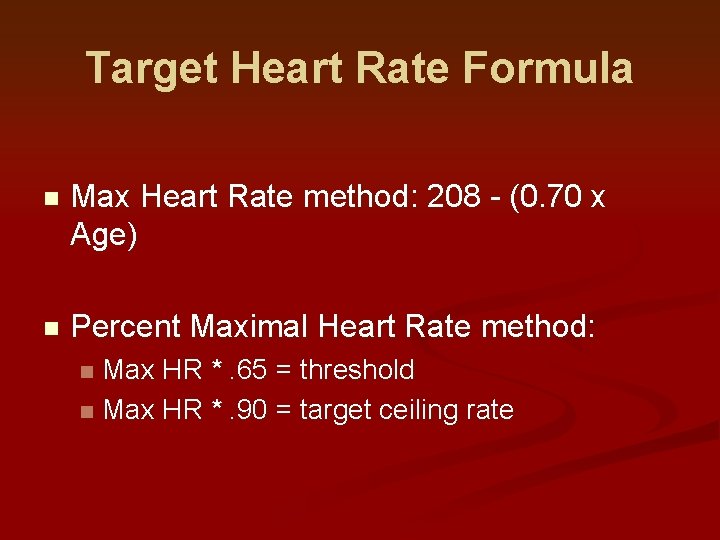
Target Heart Rate Formula n Max Heart Rate method: 208 - (0. 70 x Age) n Percent Maximal Heart Rate method: Max HR *. 65 = threshold n Max HR *. 90 = target ceiling rate n
Injuries - R. I. C. E. Method n This method is used to immediately treat injuries in order to speed up recovery. R: Rest n I: Ice n C: Compression n E: Elevate n