
Fit For Purpose Example Capability Analysis 11 May
Fit For Purpose Example Capability Analysis 11 May 2010 Shelton Lee (Contractor) Architecture, Standards & Interoperability Directorate Office of the Do. D Deputy Chief Information Officer shelton. lee@lmco. com 1
Introduction • Use Capability Viewpoint models to capture 3 alternatives – Alt 1 – DOTMLPF solution (training) – Alt 2 – Minor Materiel solution – Alt 3 – System solution • Supporting models: – Alt 1: OV-4, OV-6 a – SV-1 hierarchy – SV-1 interface model, OV-6 c • Capability Measures Matrix • Fit for Purpose View based on the data – Dashboard 2
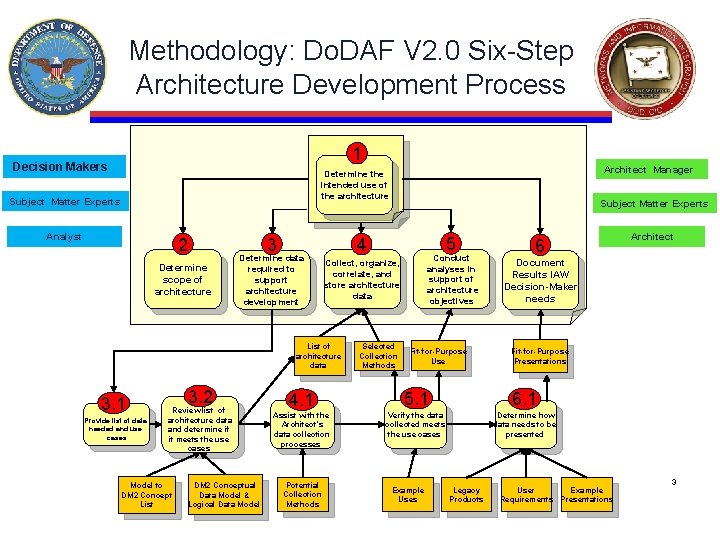
Methodology: Do. DAF V 2. 0 Six-Step Architecture Development Process 1 Decision Makers Architect Manager Determine the intended use of the architecture Subject Matter Experts Analyst 2 Determine scope of architecture 3 Determine data required to support architecture development Provide list of data needed and use cases 3. 2 Review list of architecture data and determine if it meets the use cases Model to DM 2 Concept List DM 2 Conceptual Data Model & Logical Data Model 5 4 Conduct analyses in support of architecture objectives Collect, organize, correlate, and store architecture data List of architecture data 3. 1 Subject Matter Experts Selected Collection Methods Fit-for-Purpose Use 6 Document Results IAW Decision-Maker needs Fit-for-Purpose Presentations 4. 1 5. 1 6. 1 Assist with the Architect’s data collection processes Verify the data collected meets the use cases Determine how data needs to be presented Potential Collection Methods Example Uses Legacy Products Architect User Example Requirements Presentations 3
What is a Capability “The ability to achieve a desired effect under specified standards and conditions through combinations of means and ways across DOTMLPF to perform a set of tasks to execute a specified course of action. ” Source: CJCSI 3170. 01 G, Joint Capabilities Integration and Development System 4
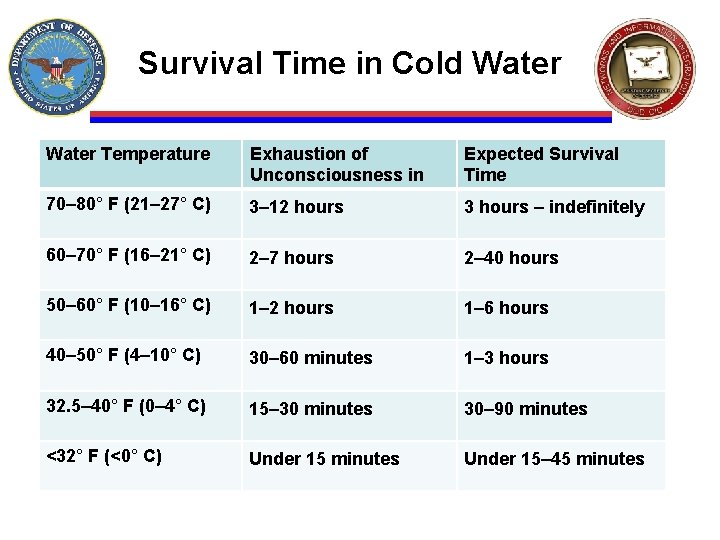
Survival Time in Cold Water Temperature Exhaustion of Unconsciousness in Expected Survival Time 70– 80° F (21– 27° C) 3– 12 hours 3 hours – indefinitely 60– 70° F (16– 21° C) 2– 7 hours 2– 40 hours 50– 60° F (10– 16° C) 1– 2 hours 1– 6 hours 40– 50° F (4– 10° C) 30– 60 minutes 1– 3 hours 32. 5– 40° F (0– 4° C) 15– 30 minutes 30– 90 minutes <32° F (<0° C) Under 15 minutes Under 15– 45 minutes
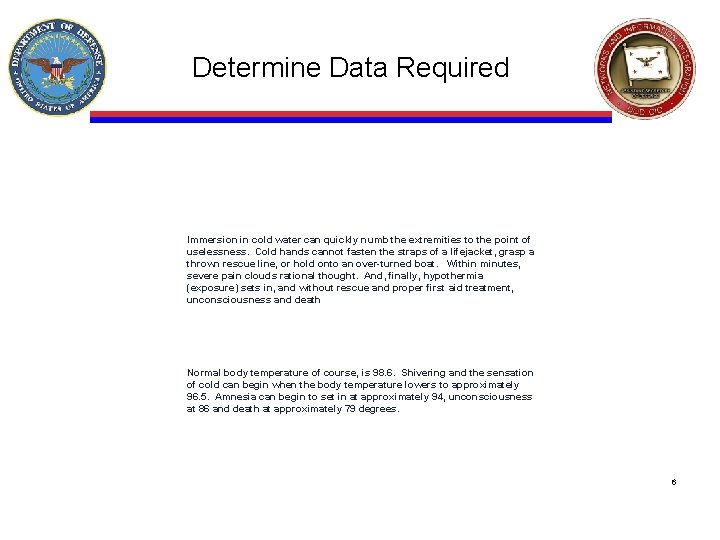
Determine Data Required Immersion in cold water can quickly numb the extremities to the point of uselessness. Cold hands cannot fasten the straps of a lifejacket, grasp a thrown rescue line, or hold onto an over-turned boat. Within minutes, severe pain clouds rational thought. And, finally, hypothermia (exposure) sets in, and without rescue and proper first aid treatment, unconsciousness and death Normal body temperature of course, is 98. 6. Shivering and the sensation of cold can begin when the body temperature lowers to approximately 96. 5. Amnesia can begin to set in at approximately 94, unconsciousness at 86 and death at approximately 79 degrees. 6
Search & Rescue Concept of Operations When the US pilot is shot down or has a mishaps resulting with the pilot in water the request to organize the search and rescue operations is forwarded to the Coalition SAR coordinating unit. The SAR coordinating unit tries to obtain available rescue pick-up resources and synchronize them with medical facility to be used during the operation. Under normal situations this is not a problem. 7
Search & Rescue As-Is State & Problem Statement In sea states of 7 or greater there are inadequate resources available to perform a successful search & rescue Rate is 40 percent in sea states 7 or greater Require significant US military and other government resources resulting in little or no positive outcome 8
Search & Rescue To-Be State & Desired Operational Outcome Goal: Achieve a Rescue Rate of 100 percent in high sea states of 10 or less 9
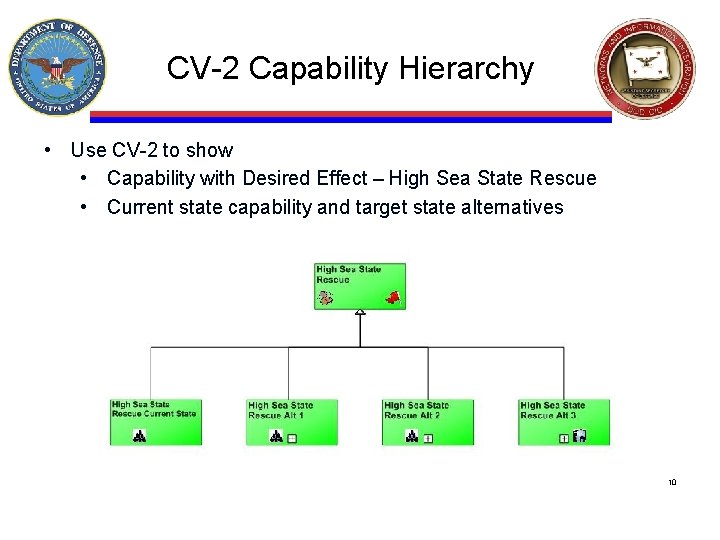
CV-2 Capability Hierarchy • Use CV-2 to show • Capability with Desired Effect – High Sea State Rescue • Current state capability and target state alternatives 10
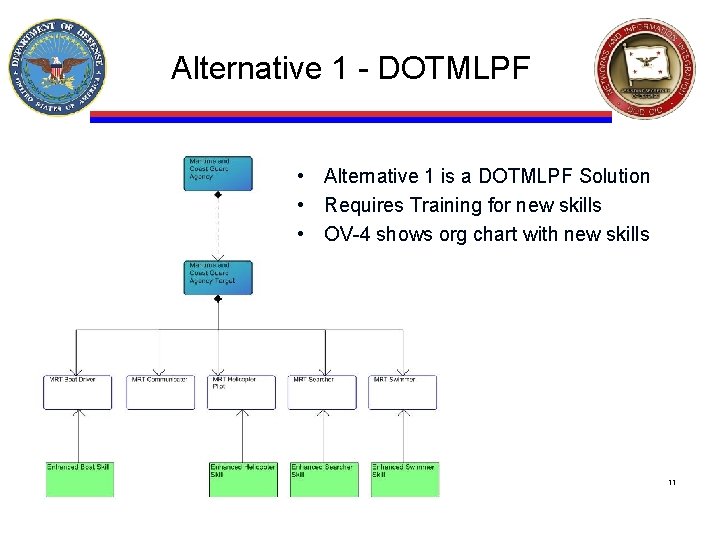
Alternative 1 - DOTMLPF • Alternative 1 is a DOTMLPF Solution • Requires Training for new skills • OV-4 shows org chart with new skills 11
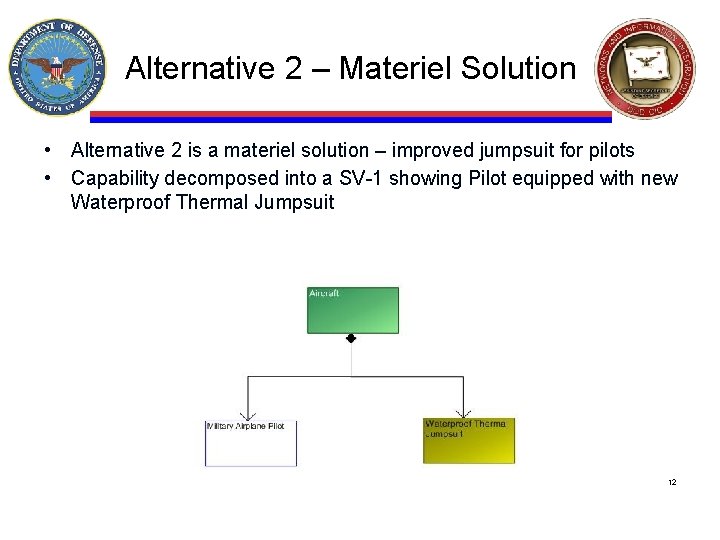
Alternative 2 – Materiel Solution • Alternative 2 is a materiel solution – improved jumpsuit for pilots • Capability decomposed into a SV-1 showing Pilot equipped with new Waterproof Thermal Jumpsuit 12
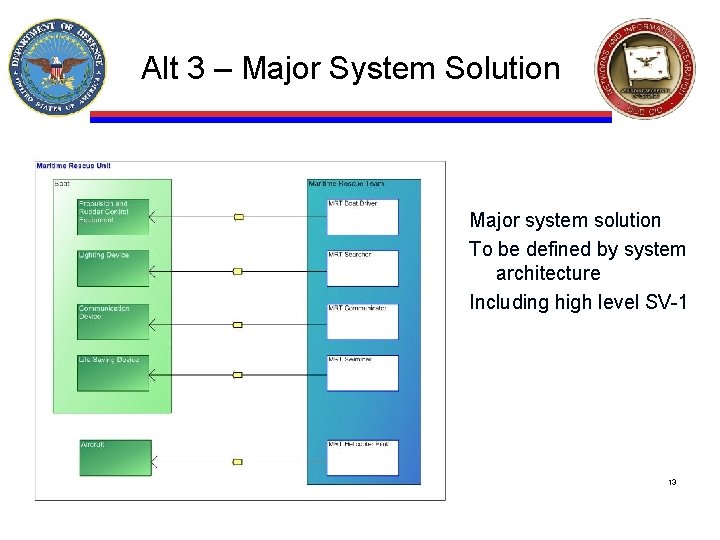
Alt 3 – Major System Solution Major system solution To be defined by system architecture Including high level SV-1 13
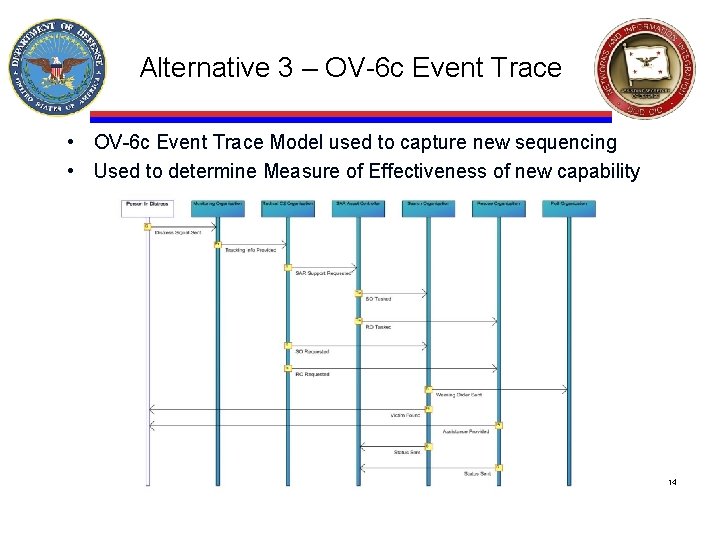
Alternative 3 – OV-6 c Event Trace • OV-6 c Event Trace Model used to capture new sequencing • Used to determine Measure of Effectiveness of new capability 14
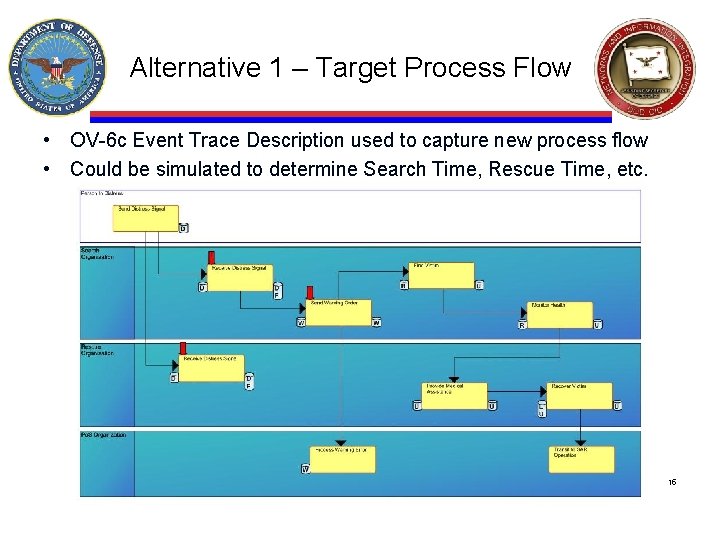
Alternative 1 – Target Process Flow • OV-6 c Event Trace Description used to capture new process flow • Could be simulated to determine Search Time, Rescue Time, etc. 15
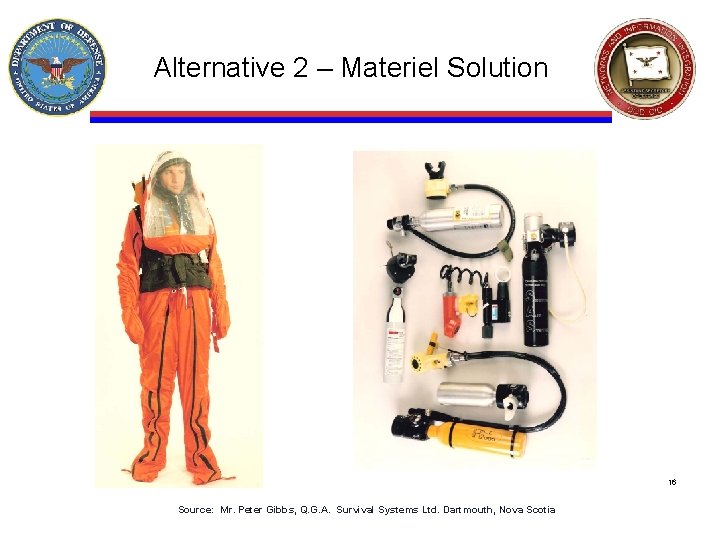
Alternative 2 – Materiel Solution 16 Source: Mr. Peter Gibbs, Q. G. A. Survival Systems Ltd. Dartmouth, Nova Scotia
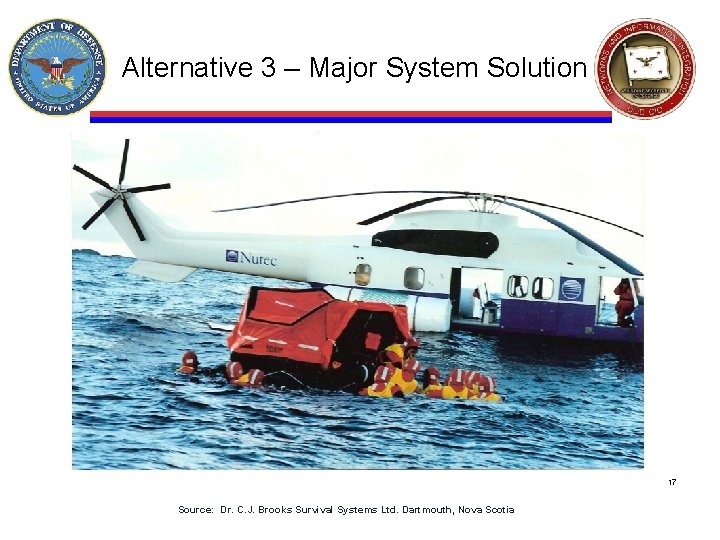
Alternative 3 – Major System Solution 17 Source: Dr. C. J. Brooks Survival Systems Ltd. Dartmouth, Nova Scotia
Measure Guidelines: 1. Keep measures simple. A simple measure requires only a single measurement (e. g. , hours to develop an operation order). 2. Measures and criteria should reflect an understanding of activity. 3. Measures and criteria should reflect how an activity contributes to mission success. 4. Measures should be sensitive to the impact of conditions. 5. Measures should be developed that distinguish among multiple levels of performance. 6. Measures should focus on the outputs, results of performance, or on the process to achieve the activity. 7. Measures should try to take advantage of the strengths of both absolute and relative scales. 18 Source: Joint Mission Thread Measures Development Standard Operating Procedures (SOP) Draft , 3 May 2010
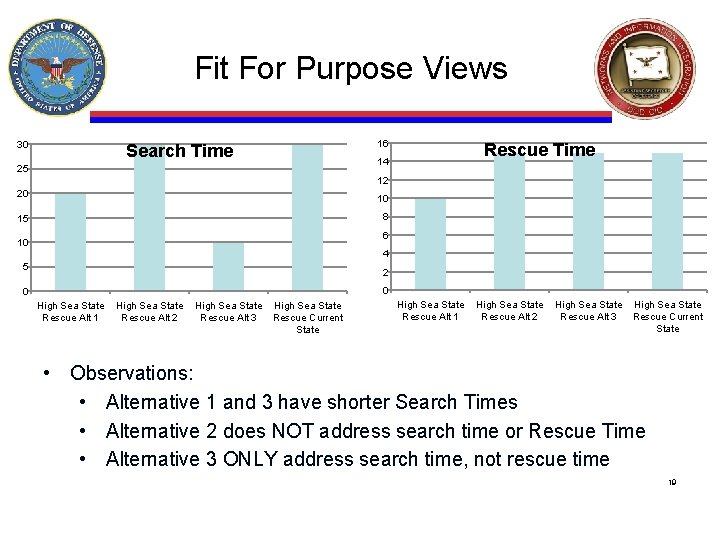
Fit For Purpose Views 30 16 Search Time Rescue Time 14 25 12 20 10 15 8 6 10 4 5 2 0 0 High Sea State Rescue Alt 1 High Sea State Rescue Alt 2 High Sea State Rescue Alt 3 High Sea State Rescue Current State • Observations: • Alternative 1 and 3 have shorter Search Times • Alternative 2 does NOT address search time or Rescue Time • Alternative 3 ONLY address search time, not rescue time 19
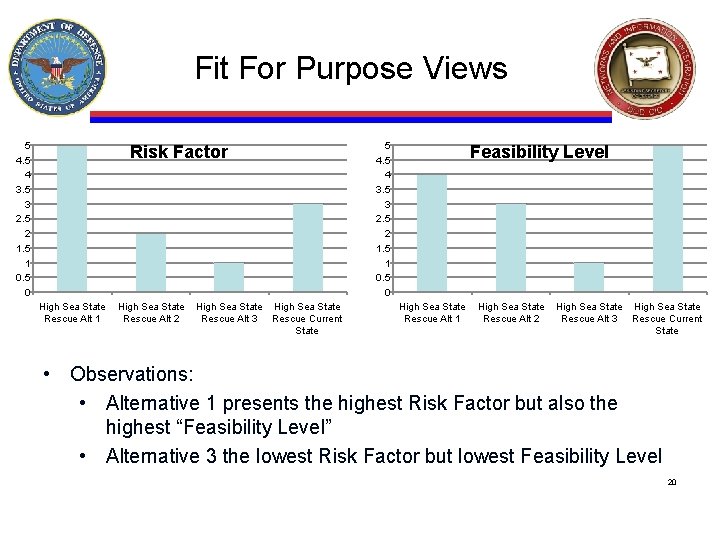
Fit For Purpose Views 5 4 3. 5 3 2. 5 2 1. 5 1 0. 5 0 Risk Factor High Sea State Rescue Alt 1 High Sea State Rescue Alt 2 High Sea State Rescue Alt 3 Rescue Current State 5 4 3. 5 3 2. 5 2 1. 5 1 0. 5 0 Feasibility Level High Sea State Rescue Alt 1 High Sea State Rescue Alt 2 High Sea State Rescue Alt 3 Rescue Current State • Observations: • Alternative 1 presents the highest Risk Factor but also the highest “Feasibility Level” • Alternative 3 the lowest Risk Factor but lowest Feasibility Level 20
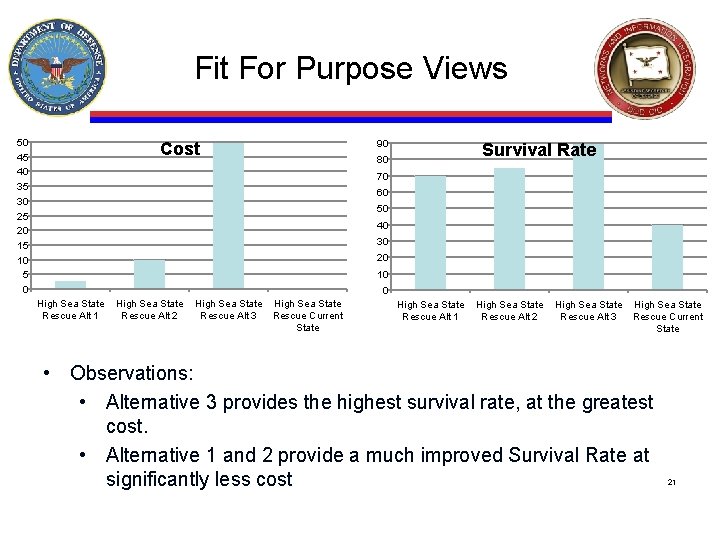
Fit For Purpose Views 50 45 40 35 30 25 20 15 10 5 0 90 Cost Survival Rate 80 70 60 50 40 30 20 10 0 High Sea State Rescue Alt 1 High Sea State Rescue Alt 2 High Sea State Rescue Alt 3 High Sea State Rescue Current State • Observations: • Alternative 3 provides the highest survival rate, at the greatest cost. • Alternative 1 and 2 provide a much improved Survival Rate at significantly less cost 21
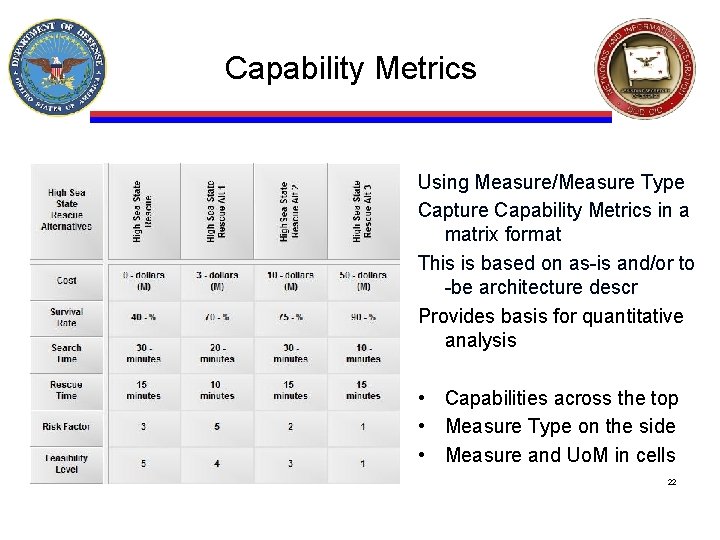
Capability Metrics Using Measure/Measure Type Capture Capability Metrics in a matrix format This is based on as-is and/or to -be architecture descr Provides basis for quantitative analysis • Capabilities across the top • Measure Type on the side • Measure and Uo. M in cells 22
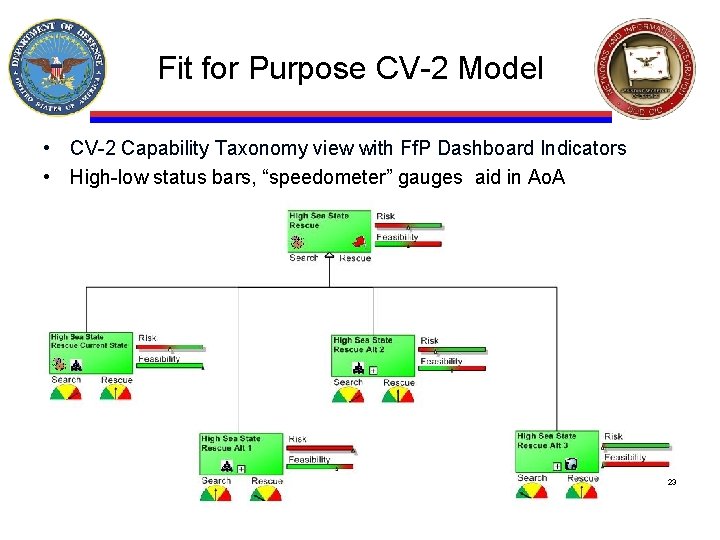
Fit for Purpose CV-2 Model • CV-2 Capability Taxonomy view with Ff. P Dashboard Indicators • High-low status bars, “speedometer” gauges aid in Ao. A 23
Capability-Based Assessment (CBA) If a Capability-Based Assessment (CBA) is available, the measures development process should leverage information already developed as a part of the JCIDS process. The CBA identifies scenarios, military objectives, mission outcomes, associated desired effects, and task representations. This process lines up well with the JMT construct and the Senior Warfighters Forum (SWar. F) prioritized list of capability attributes (Table 3) for battlespace awareness, command control, logistics, and net-centric capabilities. 24
- Slides: 24