
FISMA Next Generation Managing Risk in an Environment
- Slides: 26
FISMA Next Generation Managing Risk in an Environment of Advanced Persistent Cyber Threats NASA IT Summit August 16, 2010 Dr. Ron Ross Computer Security Division Information Technology Laboratory NATIONAL INSTITUTE OF STANDARDS AND TECHNOLOGY
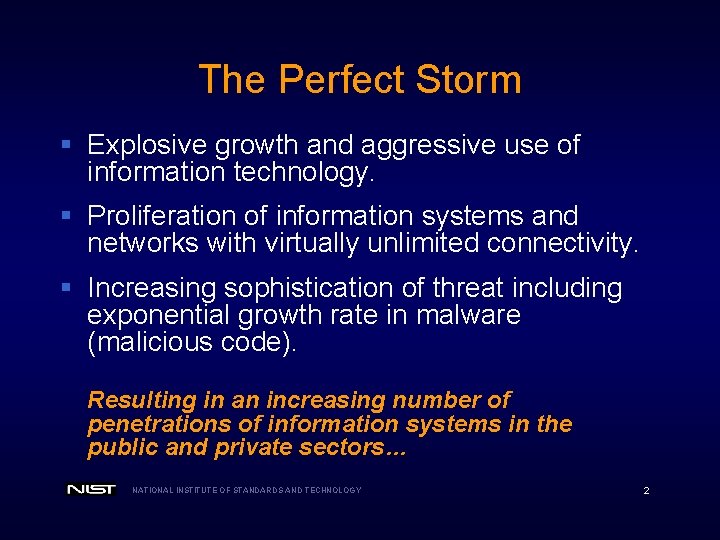
The Perfect Storm § Explosive growth and aggressive use of information technology. § Proliferation of information systems and networks with virtually unlimited connectivity. § Increasing sophistication of threat including exponential growth rate in malware (malicious code). Resulting in an increasing number of penetrations of information systems in the public and private sectors… NATIONAL INSTITUTE OF STANDARDS AND TECHNOLOGY 2
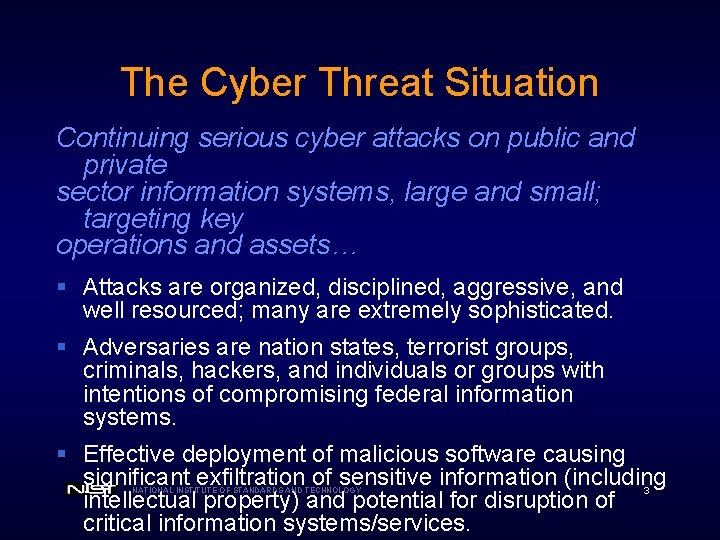
The Cyber Threat Situation Continuing serious cyber attacks on public and private sector information systems, large and small; targeting key operations and assets… § Attacks are organized, disciplined, aggressive, and well resourced; many are extremely sophisticated. § Adversaries are nation states, terrorist groups, criminals, hackers, and individuals or groups with intentions of compromising federal information systems. § Effective deployment of malicious software causing significant exfiltration of sensitive information (including 3 intellectual property) and potential for disruption of critical information systems/services. NATIONAL INSTITUTE OF STANDARDS AND TECHNOLOGY
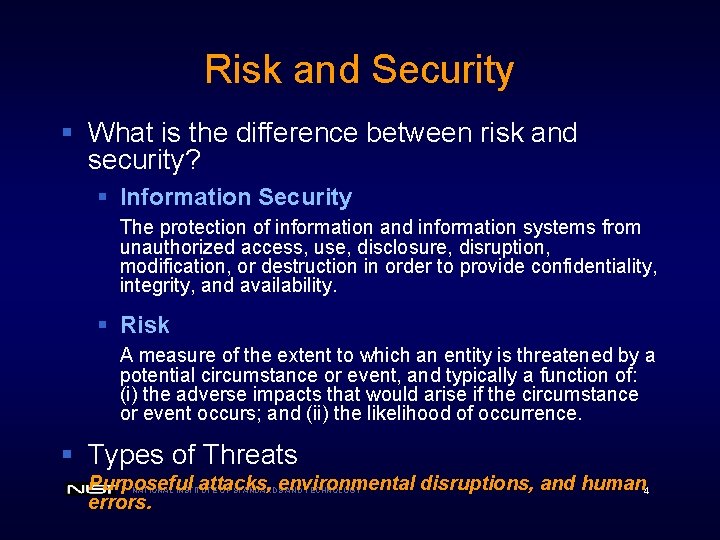
Risk and Security § What is the difference between risk and security? § Information Security The protection of information and information systems from unauthorized access, use, disclosure, disruption, modification, or destruction in order to provide confidentiality, integrity, and availability. § Risk A measure of the extent to which an entity is threatened by a potential circumstance or event, and typically a function of: (i) the adverse impacts that would arise if the circumstance or event occurs; and (ii) the likelihood of occurrence. § Types of Threats Purposeful attacks, environmental disruptions, and human 4 errors. NATIONAL INSTITUTE OF STANDARDS AND TECHNOLOGY
Information technology is our greatest strength and at the same time, our greatest weakness… NATIONAL INSTITUTE OF STANDARDS AND TECHNOLOGY 5
We expend far too many resources on back-end security… (chasing the latest vulnerabilities and patching systems) and far too few resources on front -end security… (building information security into IT products and systems) NATIONAL INSTITUTE OF STANDARDS AND TECHNOLOGY 6
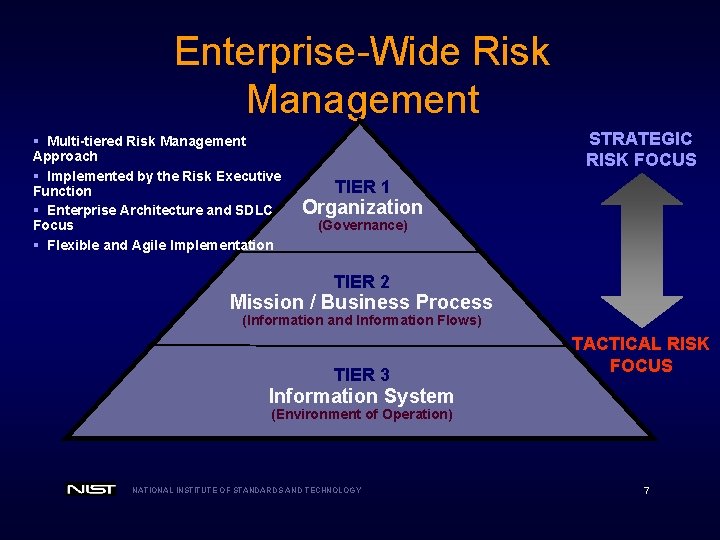
Enterprise-Wide Risk Management § Multi-tiered Risk Management Approach § Implemented by the Risk Executive Function § Enterprise Architecture and SDLC Focus § Flexible and Agile Implementation STRATEGIC RISK FOCUS TIER 1 Organization (Governance) TIER 2 Mission / Business Process (Information and Information Flows) TIER 3 TACTICAL RISK FOCUS Information System (Environment of Operation) NATIONAL INSTITUTE OF STANDARDS AND TECHNOLOGY 7
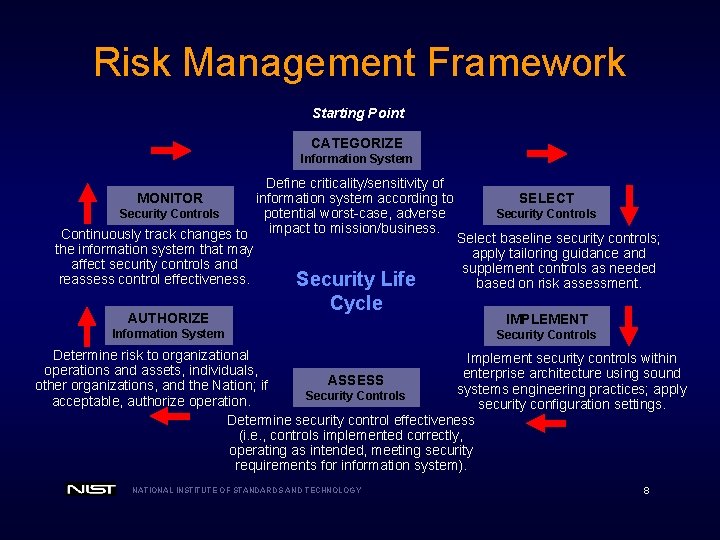
Risk Management Framework Starting Point CATEGORIZE Information System Define criticality/sensitivity of information system according to MONITOR SELECT potential worst-case, adverse Security Controls impact to mission/business. Continuously track changes to Select baseline security controls; the information system that may apply tailoring guidance and affect security controls and supplement controls as needed reassess control effectiveness. Security Life based on risk assessment. AUTHORIZE Cycle Information System IMPLEMENT Security Controls Determine risk to organizational Implement security controls within operations and assets, individuals, enterprise architecture using sound ASSESS other organizations, and the Nation; if systems engineering practices; apply Security Controls acceptable, authorize operation. security configuration settings. Determine security control effectiveness (i. e. , controls implemented correctly, operating as intended, meeting security requirements for information system). NATIONAL INSTITUTE OF STANDARDS AND TECHNOLOGY 8
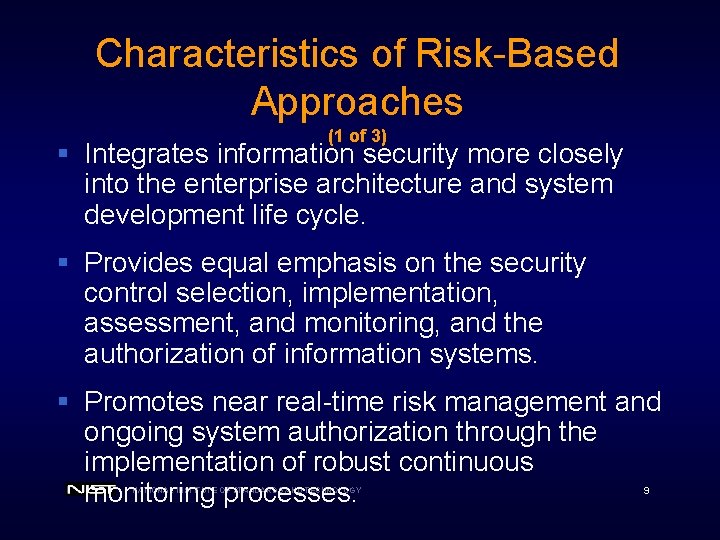
Characteristics of Risk-Based Approaches (1 of 3) § Integrates information security more closely into the enterprise architecture and system development life cycle. § Provides equal emphasis on the security control selection, implementation, assessment, and monitoring, and the authorization of information systems. § Promotes near real-time risk management and ongoing system authorization through the implementation of robust continuous monitoring processes. NATIONAL INSTITUTE OF STANDARDS AND TECHNOLOGY 9
Characteristics of Risk-Based Approaches (2 of 3) § Links risk management activities at the organization, mission, and information system levels through a risk executive (function). § Establishes responsibility and accountability for security controls deployed within organizational information systems and inherited by those systems. NATIONAL INSTITUTE OF STANDARDS AND TECHNOLOGY 10
Characteristics of Risk-Based Approaches (3 of 3) § Encourages the use of automation to: § Increase consistency, effectiveness, and timeliness of security control implementation and functionality; and § Provide senior leaders the necessary information to take credible, risk-based decisions with regard to the information systems supporting their core missions and business functions. NATIONAL INSTITUTE OF STANDARDS AND TECHNOLOGY 11
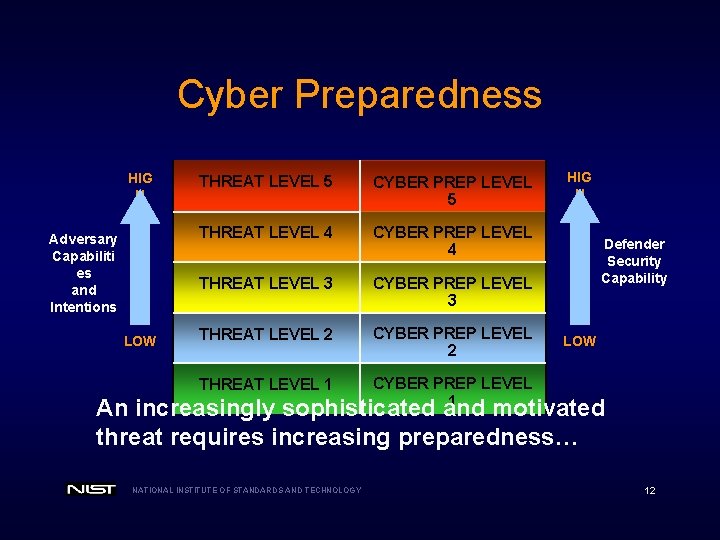
Cyber Preparedness HIG H Adversary Capabiliti es and Intentions LOW THREAT LEVEL 5 CYBER PREP LEVEL 5 THREAT LEVEL 4 CYBER PREP LEVEL 4 THREAT LEVEL 3 CYBER PREP LEVEL 3 THREAT LEVEL 2 CYBER PREP LEVEL 2 THREAT LEVEL 1 CYBER PREP LEVEL 1 HIG H Defender Security Capability LOW An increasingly sophisticated and motivated threat requires increasing preparedness… NATIONAL INSTITUTE OF STANDARDS AND TECHNOLOGY 12
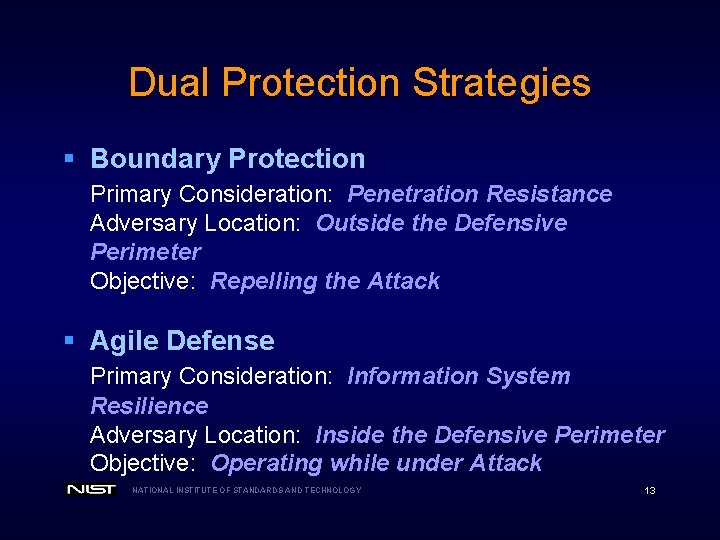
Dual Protection Strategies § Boundary Protection Primary Consideration: Penetration Resistance Adversary Location: Outside the Defensive Perimeter Objective: Repelling the Attack § Agile Defense Primary Consideration: Information System Resilience Adversary Location: Inside the Defensive Perimeter Objective: Operating while under Attack NATIONAL INSTITUTE OF STANDARDS AND TECHNOLOGY 13
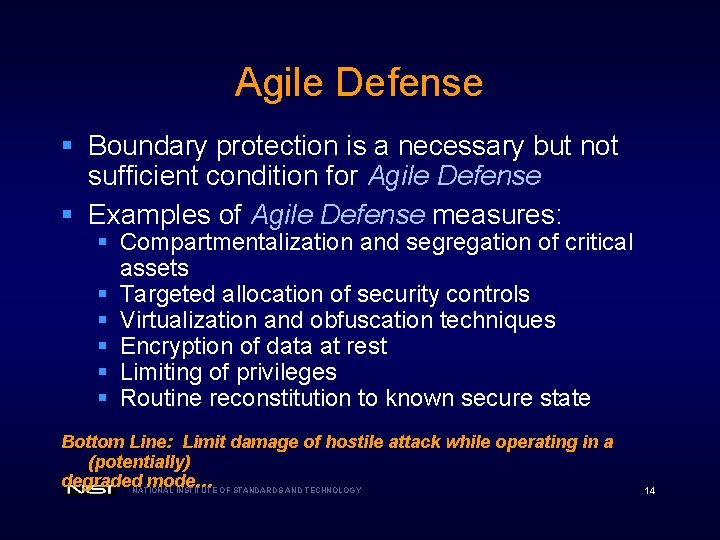
Agile Defense § Boundary protection is a necessary but not sufficient condition for Agile Defense § Examples of Agile Defense measures: § Compartmentalization and segregation of critical assets § Targeted allocation of security controls § Virtualization and obfuscation techniques § Encryption of data at rest § Limiting of privileges § Routine reconstitution to known secure state Bottom Line: Limit damage of hostile attack while operating in a (potentially) degraded mode… NATIONAL INSTITUTE OF STANDARDS AND TECHNOLOGY 14
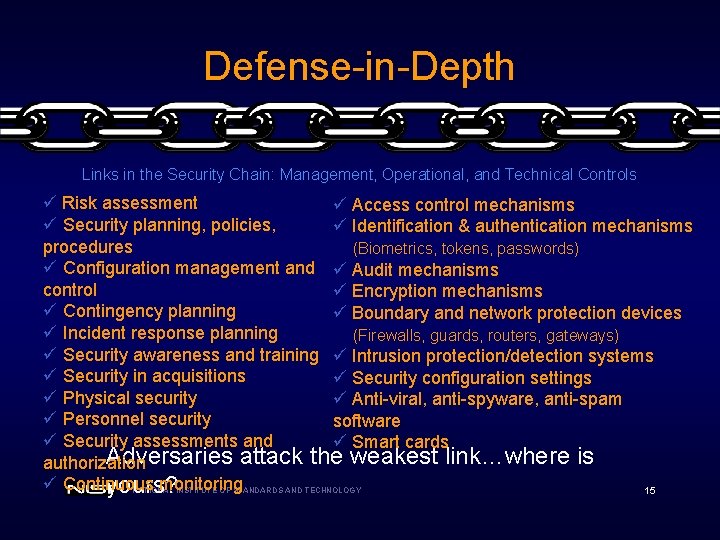
Defense-in-Depth Links in the Security Chain: Management, Operational, and Technical Controls ü Risk assessment ü Access control mechanisms ü Security planning, policies, ü Identification & authentication mechanisms procedures (Biometrics, tokens, passwords) ü Configuration management and ü Audit mechanisms control ü Encryption mechanisms ü Contingency planning ü Boundary and network protection devices ü Incident response planning (Firewalls, guards, routers, gateways) ü Security awareness and training ü Intrusion protection/detection systems ü Security in acquisitions ü Security configuration settings ü Physical security ü Anti-viral, anti-spyware, anti-spam ü Personnel security software ü Security assessments and ü Smart cards Adversaries attack the weakest link…where is authorization ü Continuous monitoring NATIONAL INSTITUTE OF STANDARDS AND TECHNOLOGY yours? 15
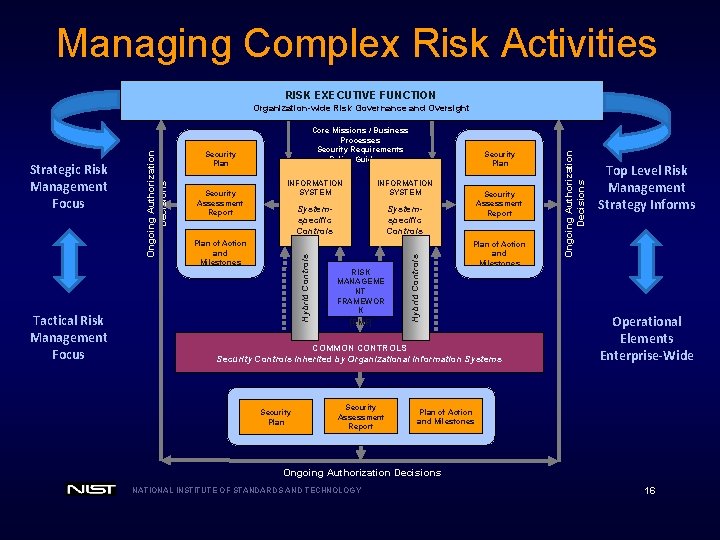
Managing Complex Risk Activities RISK EXECUTIVE FUNCTION Security Assessment Report Security Plan INFORMATION SYSTEM Systemspecific Controls Plan of Action and Milestones RISK MANAGEME NT FRAMEWOR K (RMF) Security Assessment Report Plan of Action and Milestones COMMON CONTROLS Security Controls Inherited by Organizational Information Systems Security Plan Security Assessment Report Ongoing Authorization Decisions Security Plan Hybrid Controls Tactical Risk Management Focus Core Missions / Business Processes Security Requirements Policy Guidance Hybrid Controls Strategic Risk Management Focus Ongoing Authorization Decisions Organization-wide Risk Governance and Oversight Top Level Risk Management Strategy Informs Operational Elements Enterprise-Wide Plan of Action and Milestones Ongoing Authorization Decisions NATIONAL INSTITUTE OF STANDARDS AND TECHNOLOGY 16
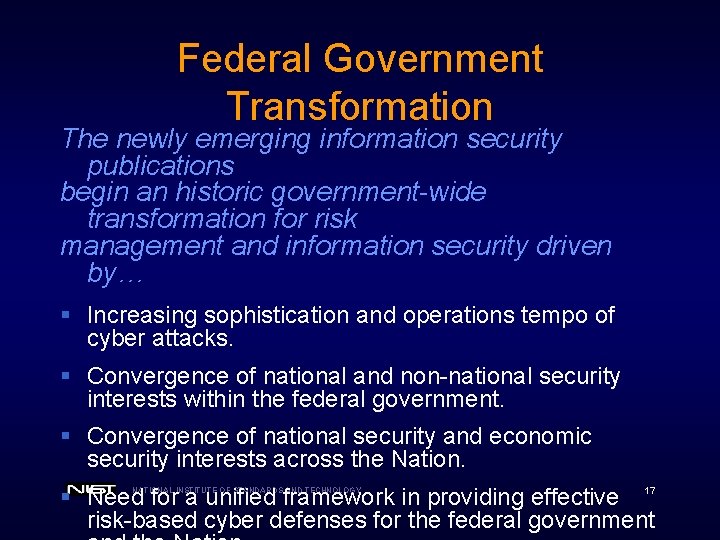
Federal Government Transformation The newly emerging information security publications begin an historic government-wide transformation for risk management and information security driven by… § Increasing sophistication and operations tempo of cyber attacks. § Convergence of national and non-national security interests within the federal government. § Convergence of national security and economic security interests across the Nation. § Need for a unified framework in providing effective 17 risk-based cyber defenses for the federal government NATIONAL INSTITUTE OF STANDARDS AND TECHNOLOGY
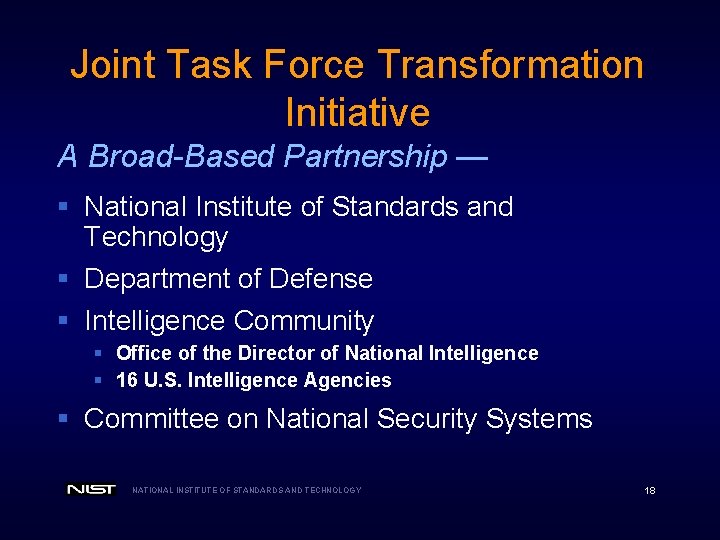
Joint Task Force Transformation Initiative A Broad-Based Partnership — § National Institute of Standards and Technology § Department of Defense § Intelligence Community § Office of the Director of National Intelligence § 16 U. S. Intelligence Agencies § Committee on National Security Systems NATIONAL INSTITUTE OF STANDARDS AND TECHNOLOGY 18
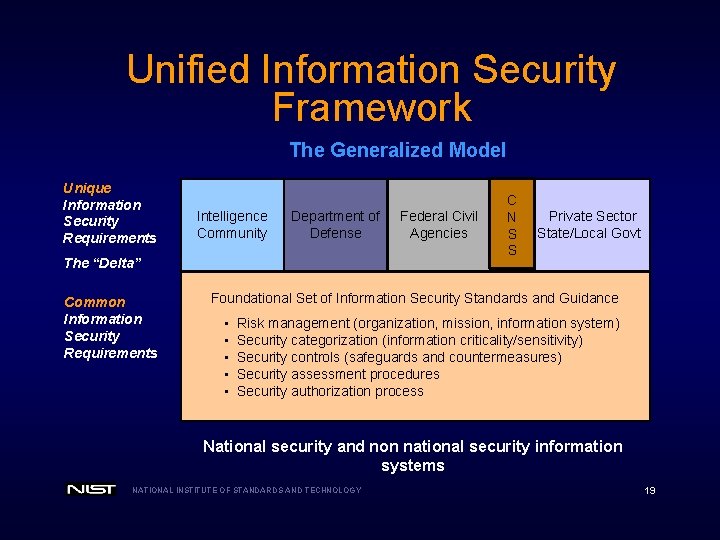
Unified Information Security Framework The Generalized Model Unique Information Security Requirements Intelligence Community Department of Defense The “Delta” Common Information Security Requirements Federal Civil Agencies C N S S Private Sector State/Local Govt Foundational Set of Information Security Standards and Guidance • • • Risk management (organization, mission, information system) Security categorization (information criticality/sensitivity) Security controls (safeguards and countermeasures) Security assessment procedures Security authorization process National security and non national security information systems NATIONAL INSTITUTE OF STANDARDS AND TECHNOLOGY 19
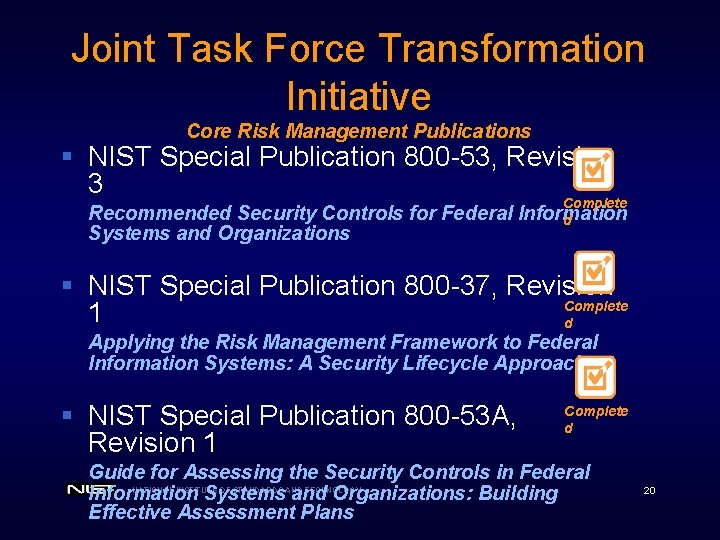
Joint Task Force Transformation Initiative Core Risk Management Publications § NIST Special Publication 800 -53, Revision 3 Complete Recommended Security Controls for Federal Information d Systems and Organizations § NIST Special Publication 800 -37, Revision Complete 1 d Applying the Risk Management Framework to Federal Information Systems: A Security Lifecycle Approach § NIST Special Publication 800 -53 A, Revision 1 Complete d Guide for Assessing the Security Controls in Federal Information Systems and Organizations: Building Effective Assessment Plans NATIONAL INSTITUTE OF STANDARDS AND TECHNOLOGY 20
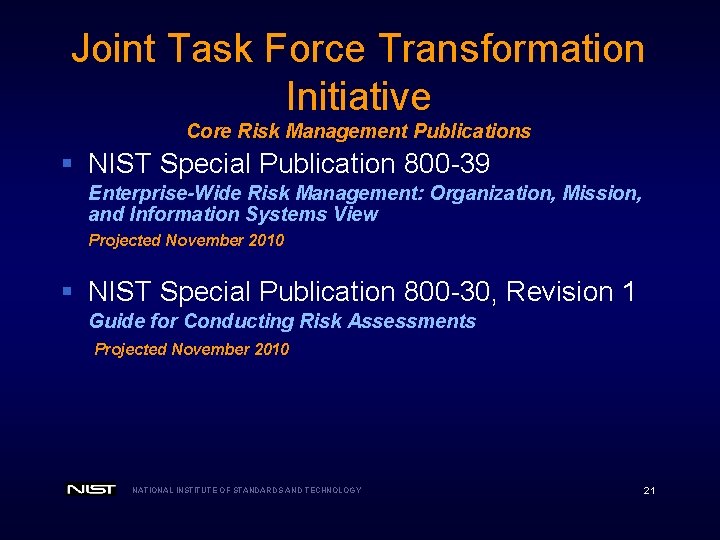
Joint Task Force Transformation Initiative Core Risk Management Publications § NIST Special Publication 800 -39 Enterprise-Wide Risk Management: Organization, Mission, and Information Systems View Projected November 2010 § NIST Special Publication 800 -30, Revision 1 Guide for Conducting Risk Assessments Projected November 2010 NATIONAL INSTITUTE OF STANDARDS AND TECHNOLOGY 21
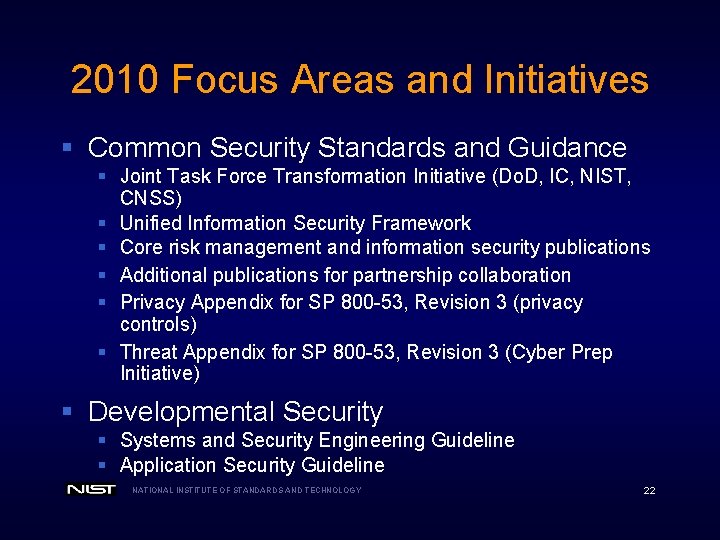
2010 Focus Areas and Initiatives § Common Security Standards and Guidance § Joint Task Force Transformation Initiative (Do. D, IC, NIST, CNSS) § Unified Information Security Framework § Core risk management and information security publications § Additional publications for partnership collaboration § Privacy Appendix for SP 800 -53, Revision 3 (privacy controls) § Threat Appendix for SP 800 -53, Revision 3 (Cyber Prep Initiative) § Developmental Security § Systems and Security Engineering Guideline § Application Security Guideline NATIONAL INSTITUTE OF STANDARDS AND TECHNOLOGY 22
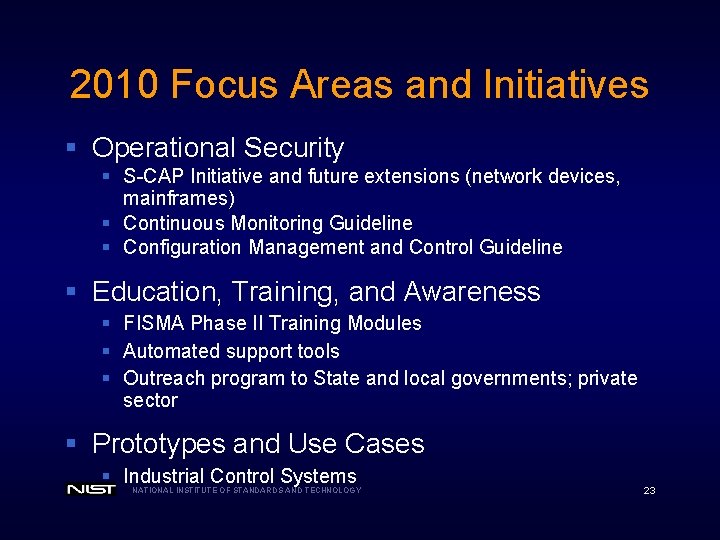
2010 Focus Areas and Initiatives § Operational Security § S-CAP Initiative and future extensions (network devices, mainframes) § Continuous Monitoring Guideline § Configuration Management and Control Guideline § Education, Training, and Awareness § FISMA Phase II Training Modules § Automated support tools § Outreach program to State and local governments; private sector § Prototypes and Use Cases § Industrial Control Systems NATIONAL INSTITUTE OF STANDARDS AND TECHNOLOGY 23
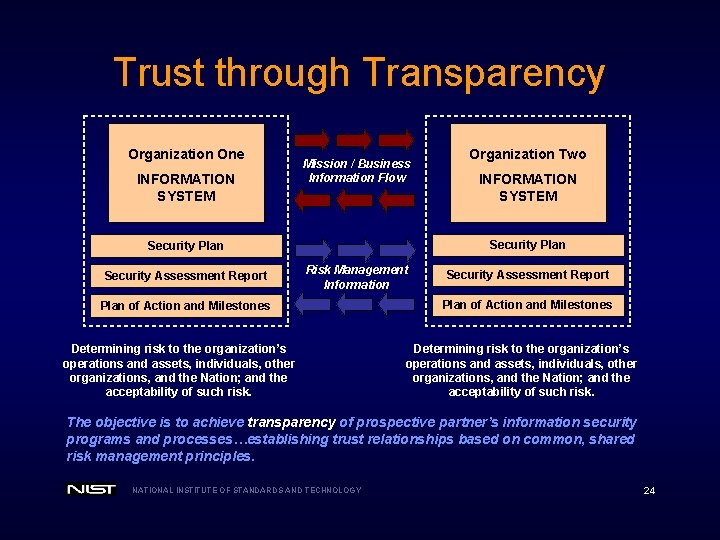
Trust through Transparency Organization One INFORMATION SYSTEM Mission / Business Information Flow INFORMATION SYSTEM Security Plan Security Assessment Report Organization Two Risk Management Information Plan of Action and Milestones Determining risk to the organization’s operations and assets, individuals, other organizations, and the Nation; and the acceptability of such risk. Security Assessment Report Plan of Action and Milestones Determining risk to the organization’s operations and assets, individuals, other organizations, and the Nation; and the acceptability of such risk. The objective is to achieve transparency of prospective partner’s information security programs and processes…establishing trust relationships based on common, shared risk management principles. NATIONAL INSTITUTE OF STANDARDS AND TECHNOLOGY 24
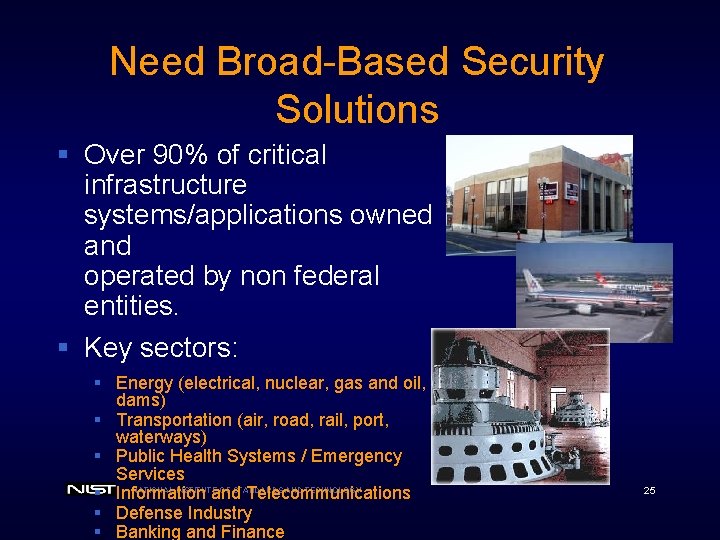
Need Broad-Based Security Solutions § Over 90% of critical infrastructure systems/applications owned and operated by non federal entities. § Key sectors: § Energy (electrical, nuclear, gas and oil, dams) § Transportation (air, road, rail, port, waterways) § Public Health Systems / Emergency Services NATIONAL INSTITUTE OF STANDARDS AND TECHNOLOGY § Information and Telecommunications § Defense Industry § Banking and Finance 25
Contact Information 100 Bureau Drive Mailstop 8930 Gaithersburg, MD USA 20899 -8930 Project Leader Administrative Support Dr. Ron Ross (301) 975 -5390 ron. ross@nist. gov Peggy Himes (301) 975 -2489 peggy. himes@nist. gov Senior Information Security Researchers and Technical Support Marianne Swanson (301) 975 -3293 marianne. swanson@nist. gov Kelley Dempsey (301) 975 -2827 kelley. dempsey@nist. gov Pat Toth (301) 975 -5140 patricia. toth@nist. gov Arnold Johnson (301) 975 -3247 arnold. johnson@nist. gov Web: csrc. nist. gov/sec-cert Comments: sec-cert@nist. gov NATIONAL INSTITUTE OF STANDARDS AND TECHNOLOGY 26