
Fisioterapi Psikiatri dan Kesehatan Mental PERTEMUAN 11 Abdul

Fisioterapi Psikiatri dan Kesehatan Mental PERTEMUAN 11 Abdul Chalik Meidian & Jerry Maratis PRODI S 1 Fisioterapi

KEMAMPUAN AKHIR YANG DIHARAPKAN • Mahasiswa mampu memahami konsep dan peran fisioterapi pada gangguan psikiatri dan kesehatan mental
No Health Without Mental Health • Health is defined as a state of complete physical, mental and social well-being and not merely the absence of disease or infirmity. (WHO, 1946)
No Health Without Mental Health • Mental health is defined as a condition that permits a state of optimal physical, mental and social wellbeing and is not merely the absence of desease. (WHO, 2010) • Mental health related to the promotion of well-being, the prevention of mental disorders and the treatment and rehabilitation of people affected by mental disorders. (WHO, 2010)
Good Mental Health • Good mental health is more than the absence of diagnosable mental problem. • A person’s mental health affect different aspects of life. • Mental health involves having a good relationship with family and having supportive friends with the ability to reflect upon and share feelings. • Regarding leisure time, mental health involves having hobbies, exercising on a regular basis and having regular vacation time.
Good Mental Health • A healthy lifestyle that includes: – Healthy eating habits – Not smoking or drinking – Not taking drugs – Being able to achieve some goals in life • A mental health problem interferes with – Emotional – Social ablity
Good Mental Health • Good mental health is fundamental to the well-being of : – individuals, – families – and communities.
Poor mental health • Poor mental health is identified as one of the biggest causes of : – disability, – poor quality of life – and reduced productivity.
Mental illnes or disorder • Mental illnes or disorder is defined : – Is a syndrome characterized by a clinically significant disturbance in an individual’s cognition, emotion regulation or behaviour – The condition reflects dysfunction of the psychological, biological or development processes underlying mental functioning (American Psychiatric Association, 2013) • In clinical practice, disorder occur in a variety of forms and symptoms can overlap. • Distinctions are made between: – Mild – Moderate – Severe
Mental health and stigma • Stigma is a mark of digrace associated with a particular circumstance, quality of person (Stevenson, 2015) • Stigma is prejudice based on negative stereotyping (Corrigan, 2004) • The pain of mentall illness is significant, but the added layer of stigma affects: (Hinshaw, 2017) – – – Personal well-being Economic productivity and public health Fuelling a vicious cycle of lowered expectations Deep shame Hopelessness
Mental health and stigma • Physiotherapy generally also have the important role of informing people in a correct manner. • To decrease stigmatization, several steps can be taken: 1. Help identify and eliminate misconceptions about mental illness 2. Contribute to the prevention of mental health problems 3. Inform individual adequately about mental health and refer them when necessary to specialized professionals in mental health and psychiatry 4. Offer physiotherapy interventions to individuals with unstable mental health.
Mental health condition • In the 2007 National Survey of Mental Health and Wellbeing of Adults, 1 in 5 adults reported having had a mental disorder within 12 months of the survey being undertaken. • Some 45 per cent of Australians identified having had a mental health disorder at some point in their life • and 25 per cent of people with a musculoskeletal condition were also identified as having a mental health condition.
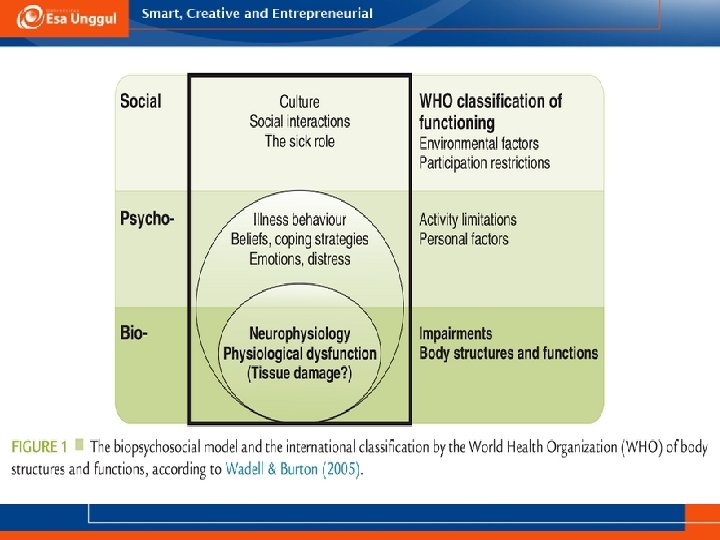
Mental health condition • Mental health conditions are influenced by a complex interplay of – biological, – psychological, – social, – environmental – and economic factors.
Mental health condition • People affected by mental health disorders have higher levels of mortality and morbidity, with an increased prevalence of : – – – cardiovascular disease, ischaemic heart disease, hypertension, diabetes, respiratory disease and suicide.
Mental health condition • A strong association between people with mental health conditions reporting multiple pain sites has also been identified.
Mental health condition • The correlations between poor mental health and an increased prevalence of – chronic and preventable diseases, – musculoskeletal conditions – and multiple areas of pain emphasises the need for an effective and holistic multidisciplinary approach to the management of this condition.
Mental health condition • Combinations of disorders have a cumulative effect on disability with 75 per cent of people with both physical and mental health conditions reporting mild to severe disability.
The Role of Physiotherapy in Mental Health Disorder (Kaur, et. al. 2013) • In this era of exponential growth of: – Metabolic syndrome – Obesity – Lifestyle modification Could be a cost effective way to improve health and quality of life • Life style modification can assume great importance in individuals especially with serious mental illness
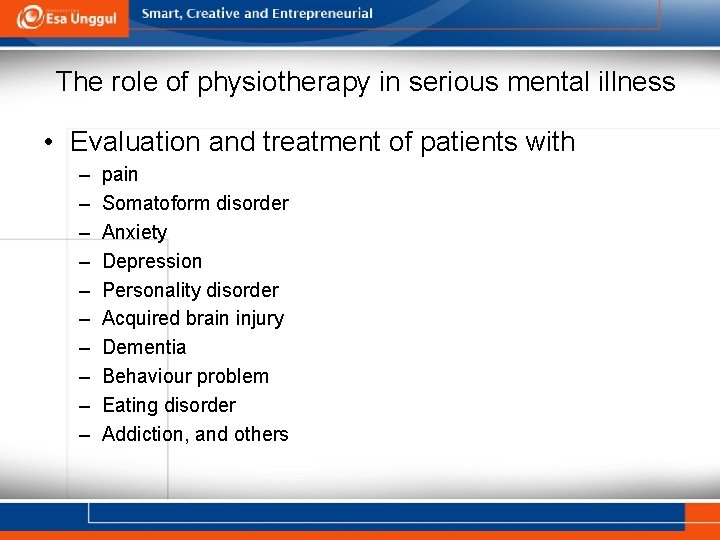
The role of physiotherapy in serious mental illness • Evaluation and treatment of patients with – – – – – pain Somatoform disorder Anxiety Depression Personality disorder Acquired brain injury Dementia Behaviour problem Eating disorder Addiction, and others
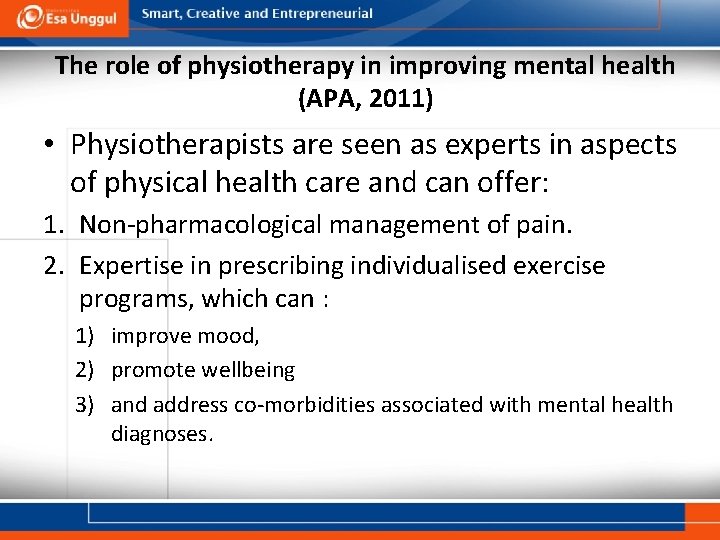
The role of physiotherapy in improving mental health (APA, 2011) • Physiotherapists are seen as experts in aspects of physical health care and can offer: 1. Non-pharmacological management of pain. 2. Expertise in prescribing individualised exercise programs, which can : 1) improve mood, 2) promote wellbeing 3) and address co-morbidities associated with mental health diagnoses.
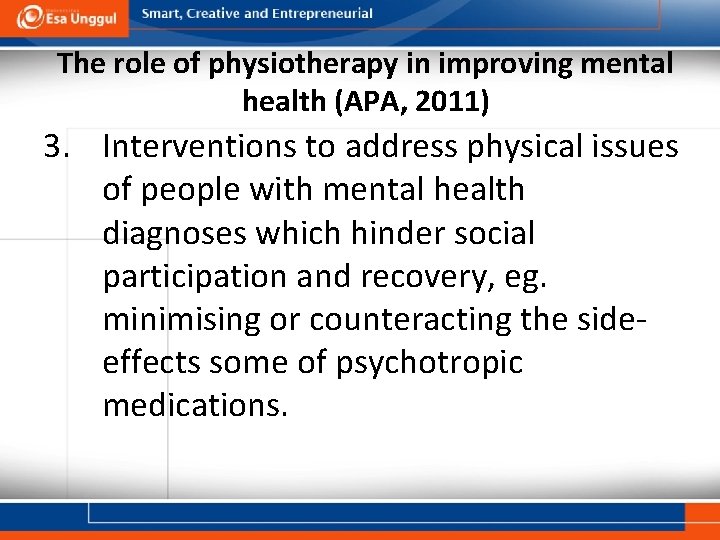
The role of physiotherapy in improving mental health (APA, 2011) 3. Interventions to address physical issues of people with mental health diagnoses which hinder social participation and recovery, eg. minimising or counteracting the sideeffects some of psychotropic medications.
The role of physiotherapy in improving mental health (APA, 2011) 4. Expertise in motivating, where appropriate, patients and promoting self-management in the context of : – mental health – and physical health issues. 5. Management of falls and mobility issues for older people and developmental issues for : – children – and young people.
The role of physiotherapy in improving mental health (APA, 2011) 6. Expert advice and intervention to address impaired body awareness and reduce dissociation (disconnection from ‘thoughts, feelings, memories or sense of identity’) associated with poor mental health. 7. Development and delivery of individuallytailored lifestyle and weight management advice and programs.
Referensi: 1. Australian Physiotherapy Association, 2011. Mental Health and Physiotherapy. www. physiotherapy. asn. au 2. Kaur, J. Masaun, M. Bhatia, MS. 2013. Role of physiotherapy in mental health disosders. New Delhi: Delhi Psychiatry Journal 3. Probst, M. Skjaerven, L. H. 2017. Physiotherapy in Mental Health and Psychiatry: a scientific and clinical based approach. Poland: Elsevier
- Slides: 25