
Fishing for positronic compounds Dario Bressanini Universit dellInsubria

Fishing for positronic compounds Dario Bressanini Università dell’Insubria, Como, ITALY QMC in the Apuan Alps VII 2012 TTI Vallico Sotto
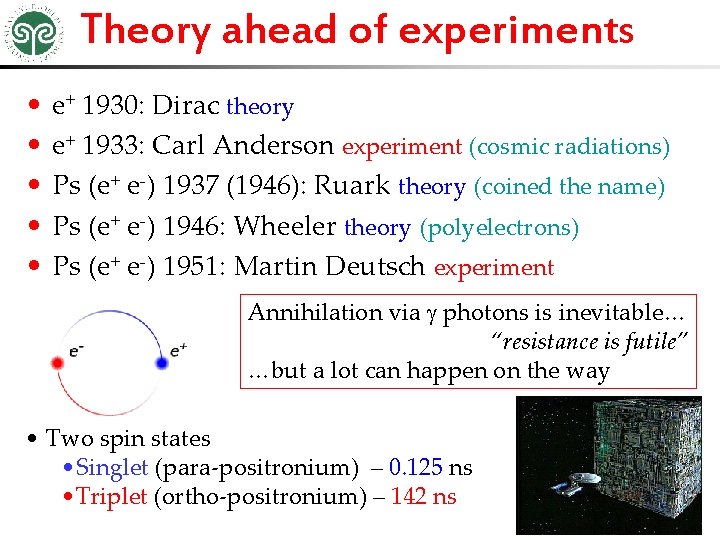
Theory ahead of experiments • • • e+ 1930: Dirac theory e+ 1933: Carl Anderson experiment (cosmic radiations) Ps (e+ e-) 1937 (1946): Ruark theory (coined the name) Ps (e+ e-) 1946: Wheeler theory (polyelectrons) Ps (e+ e-) 1951: Martin Deutsch experiment Annihilation via g photons is inevitable… “resistance is futile” …but a lot can happen on the way • Two spin states • Singlet (para-positronium) – 0. 125 ns • Triplet (ortho-positronium) – 142 ns
Time scales
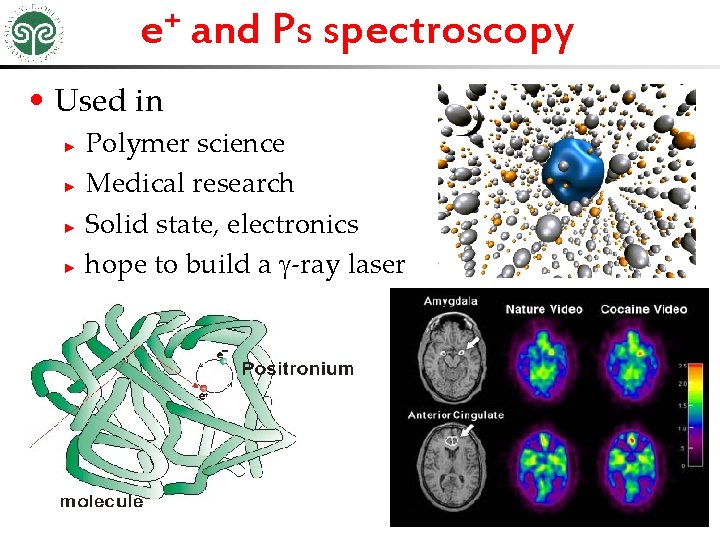
e+ and Ps spectroscopy • Used in Polymer science ► Medical research ► Solid state, electronics ► hope to build a g-ray laser ►
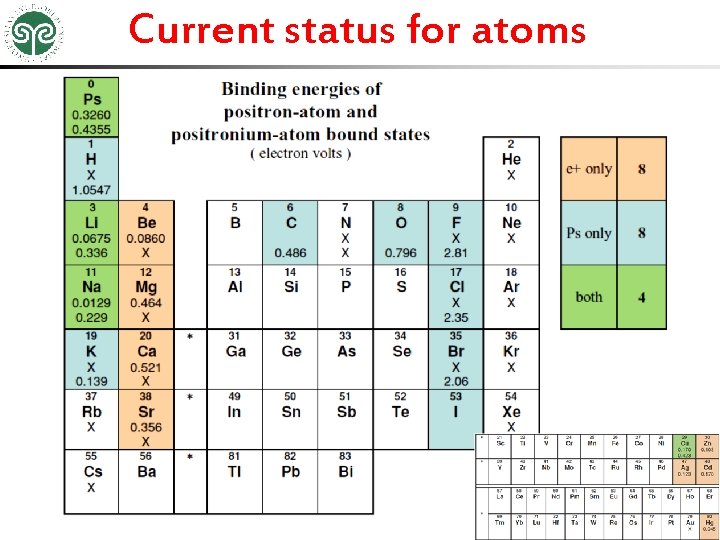
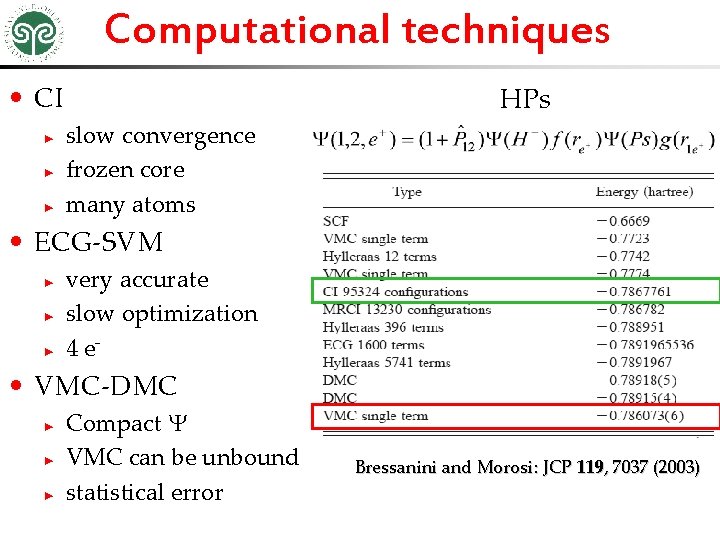
Theory ahead of experiments • Ps- (e+ e- e-) and Ps+ (e+ e+ e-) ► ► ► inconsistent nomenclature A- means Ae- , an added electron (as usual) A+ means Ae+ , an added positron (but not always) 1946, 1947: Wheeler, Hylleraas theory 1981 Ps- seen in experiment by Mills • HPs (p+ e+ e- e-) ► ► 1947, Hylleraas & Ore theory Seen in experiment 1992 Schrader • Many calculations on atomic bound states, very few experimental results (more with molecules)
Current status for atoms
Computational techniques • CI ► ► ► HPs slow convergence frozen core many atoms • ECG-SVM ► ► ► very accurate slow optimization 4 e- • VMC-DMC ► ► ► Compact Y VMC can be unbound statistical error Bressanini and Morosi: JCP 119, 7037 (2003)
Polyleptons
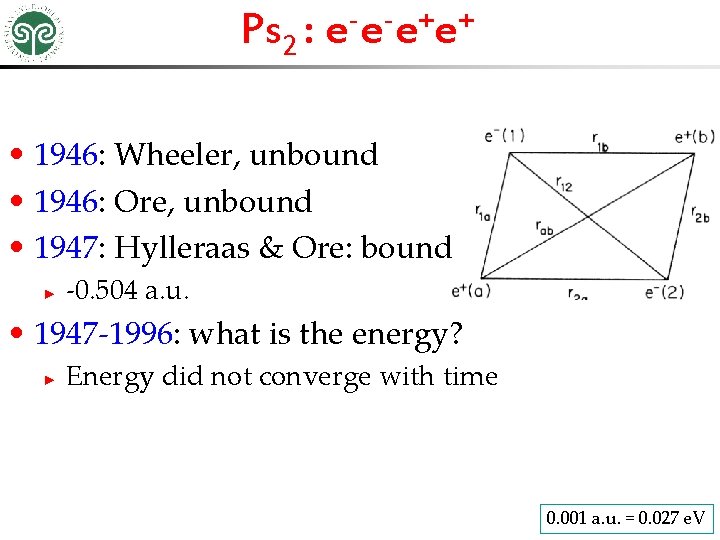
Ps 2 : e-e-e+e+ • 1946: Wheeler, unbound • 1946: Ore, unbound • 1947: Hylleraas & Ore: bound ► -0. 504 a. u. • 1947 -1996: what is the energy? ► Energy did not converge with time 0. 001 a. u. = 0. 027 e. V
The energy of Ps 2 • 1996 -1997: Energy controversy resolved -0. 51601(1) DMC (1997, Bressanini et al. ) ► agrees with Frolov & Smith, hylleraas (1996) ►-0. 516003788 Matyus & Reiher ECG 2012 ► 0. 001 a. u. = 0. 027 e. V
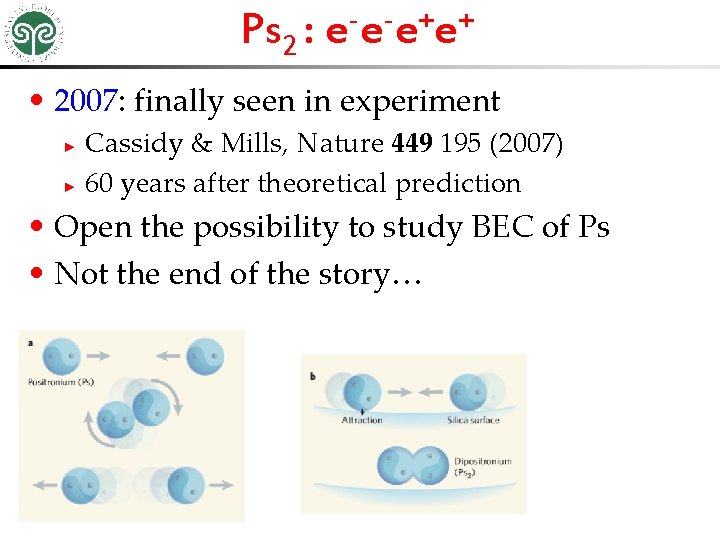
Ps 2 : e-e-e+e+ • 2007: finally seen in experiment Cassidy & Mills, Nature 449 195 (2007) ► 60 years after theoretical prediction ► • Open the possibility to study BEC of Ps • Not the end of the story…
Ps 2 : e-e-e+e+ • Symmetry of Ps 2 must include charge conjugation: e- e+ ► problems with early calculations • 1993: isomorph to D 2 h group (Kinghorn & Poshusta) 0+(A 1) ground state + + ► 0 (B 2), 0 (E) excited states ► • 1998: Varga, Usukura, Suzuki ECG ► 1 -(B 2) bound L=1 state E = -0. 334408 a. u. • 2012: L=1 state detected experimentally
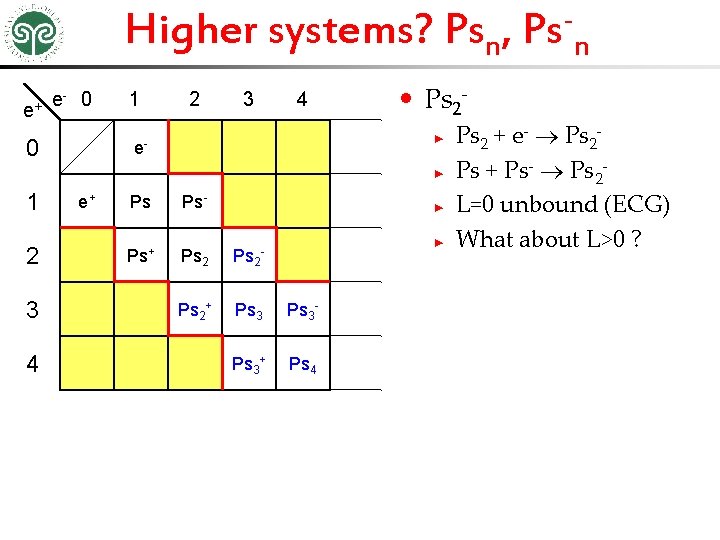
Higher systems? Psn, Ps-n e+ e- 0 0 1 2 3 4 • Ps 2► e- ► 1 2 3 4 e+ Ps Ps- Ps+ Ps 2+ Ps 3 - Ps 3+ Ps 4 ► ► - Ps 2 + e- Ps 2 Ps + Ps- Ps 2 L=0 unbound (ECG) What about L>0 ?
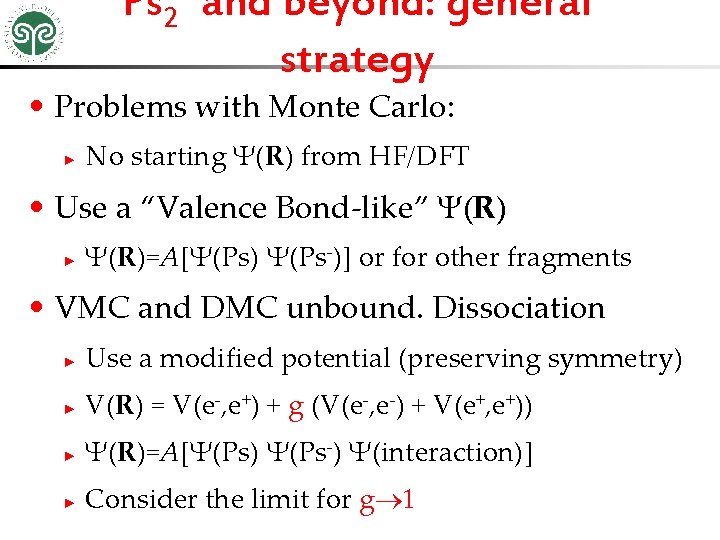
Ps 2 - and beyond: general strategy • Problems with Monte Carlo: ► No starting Y(R) from HF/DFT • Use a “Valence Bond-like” Y(R) ► Y(R)=A[Y(Ps) Y(Ps-)] or for other fragments • VMC and DMC unbound. Dissociation ► Use a modified potential (preserving symmetry) ► V(R) = V(e-, e+) + g (V(e-, e-) + V(e+, e+)) ► Y(R)=A[Y(Ps) Y(Ps-) Y(interaction)] ► Consider the limit for g 1
Ps 2 - total energy • E(L=1) < E(L=0)
Ps 2 - binding energy • L=0 is unbound • L=1 is probably unbound… • …but with better nodes?
Ps 3 and Ps 3 • Preliminary results • Ps 3 and Ps 3 unbound so far • Not explored yet all excited states
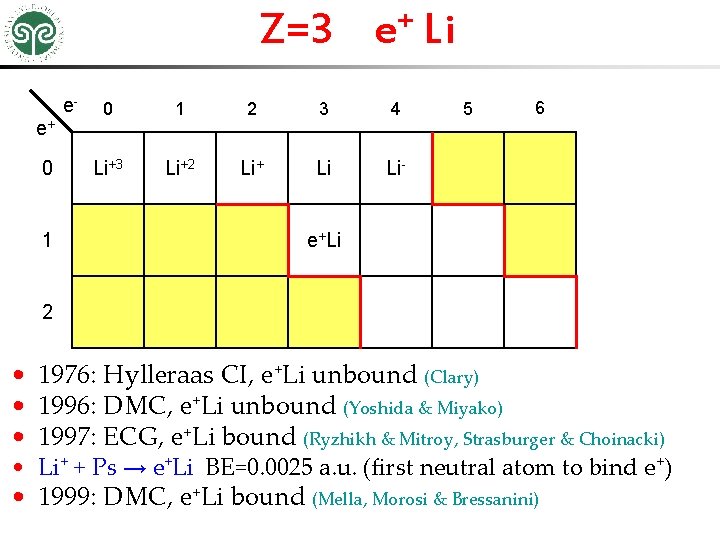
Z=3 e+ Li ee+ 0 1 2 3 4 Li+3 Li+2 Li+ Li Li- 5 6 e+Li 2 • 1976: Hylleraas CI, e+Li unbound (Clary) • 1996: DMC, e+Li unbound (Yoshida & Miyako) • 1997: ECG, e+Li bound (Ryzhikh & Mitroy, Strasburger & Choinacki) • Li+ + Ps → e+Li BE=0. 0025 a. u. (first neutral atom to bind e+) • 1999: DMC, e+Li bound (Mella, Morosi & Bressanini)
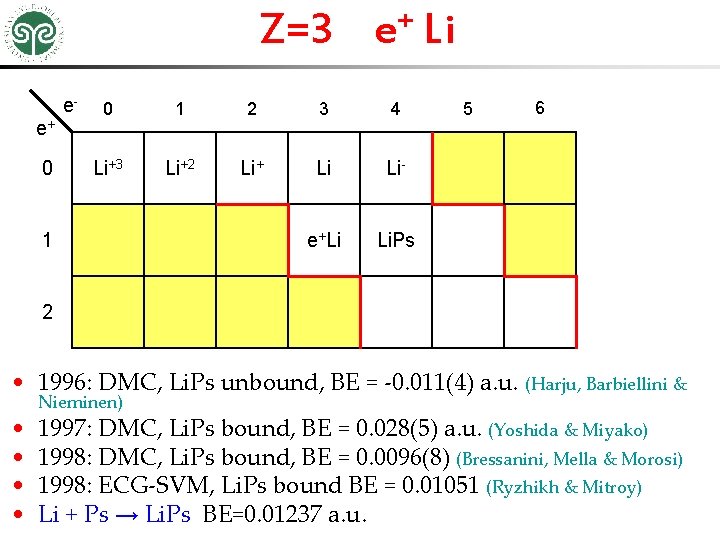
Z=3 e+ Li ee+ 0 0 1 2 3 4 Li+3 Li+2 Li+ Li Li- e+Li Li. Ps 1 5 6 2 • 1996: DMC, Li. Ps unbound, BE = -0. 011(4) a. u. (Harju, Barbiellini & • • Nieminen) 1997: DMC, Li. Ps bound, BE = 0. 028(5) a. u. (Yoshida & Miyako) 1998: DMC, Li. Ps bound, BE = 0. 0096(8) (Bressanini, Mella & Morosi) 1998: ECG-SVM, Li. Ps bound BE = 0. 01051 (Ryzhikh & Mitroy) Li + Ps → Li. Ps BE=0. 01237 a. u.
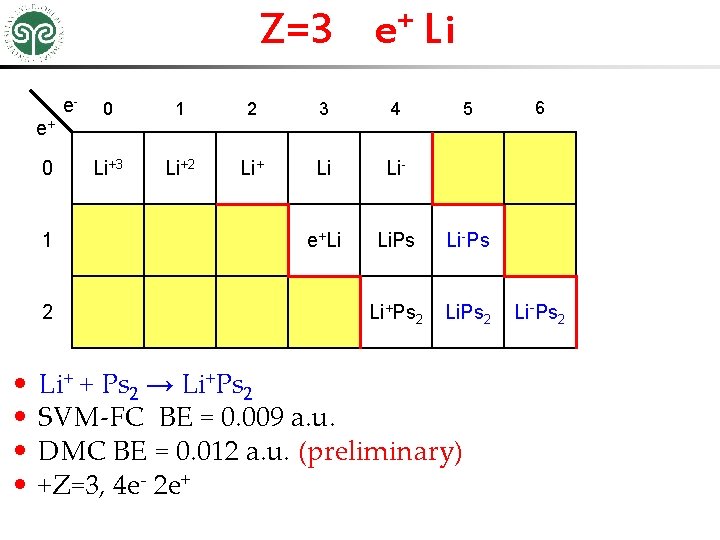
Z=3 e+ Li ee+ 0 1 2 • • 0 1 2 3 4 5 Li+3 Li+2 Li+ Li Li- e+Li Li. Ps Li-Ps Li+Ps 2 Li+ + Ps 2 → Li+Ps 2 SVM-FC BE = 0. 009 a. u. DMC BE = 0. 012 a. u. (preliminary) +Z=3, 4 e- 2 e+ 6 Li-Ps 2
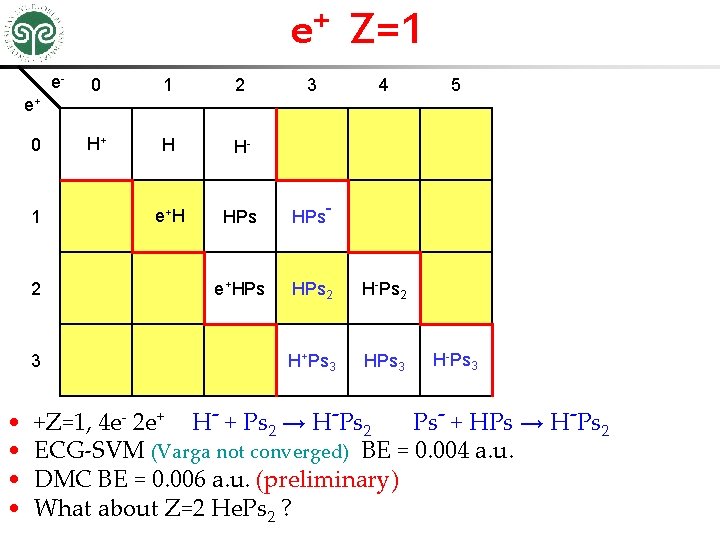
e+ Z=1 e- 0 1 2 3 4 H+ H H- e+ H HPs- e+HPs 2 H-Ps 2 H+Ps 3 HPs 3 5 e+ 0 1 2 3 • • H-Ps 3 +Z=1, 4 e- 2 e+ H- + Ps 2 → H-Ps 2 Ps- + HPs → H-Ps 2 ECG-SVM (Varga not converged) BE = 0. 004 a. u. DMC BE = 0. 006 a. u. (preliminary) What about Z=2 He. Ps 2 ?
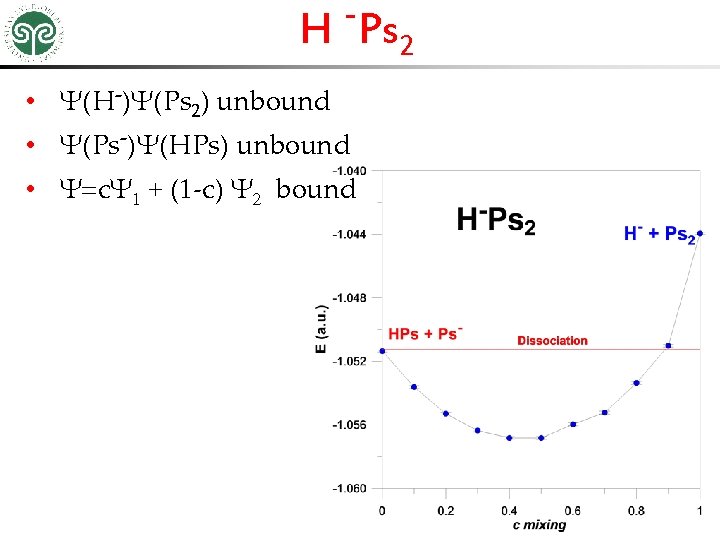
H Ps • Y(H-)Y(Ps 2) unbound • Y(Ps-)Y(HPs) unbound • Y=c. Y 1 + (1 -c) Y 2 bound 2
Fishing for positronic compounds How many e-? e +? Which atom? Which state?
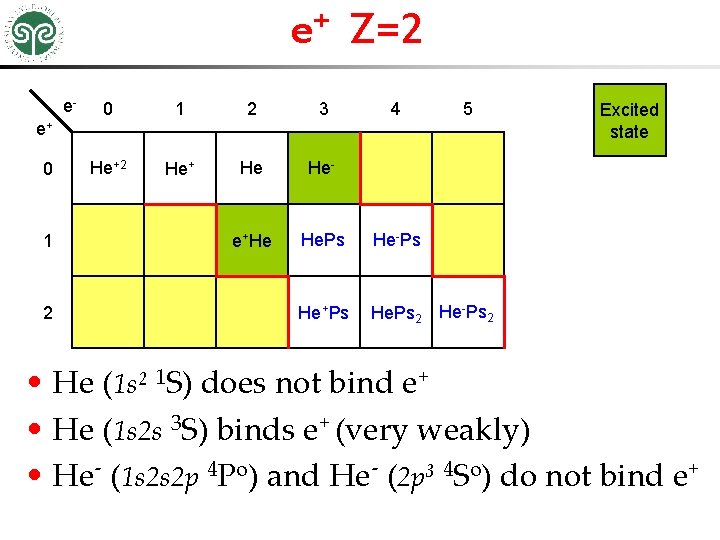
e+ Z=2 e- 0 1 2 3 4 5 He+2 He+ He He- e+He He. Ps He-Ps He+Ps He. Ps 2 He-Ps 2 e+ 0 1 2 Excited state • He (1 s 2 1 S) does not bind e+ • He (1 s 2 s 3 S) binds e+ (very weakly) • He- (1 s 2 s 2 p 4 Po) and He- (2 p 3 4 So) do not bind e+
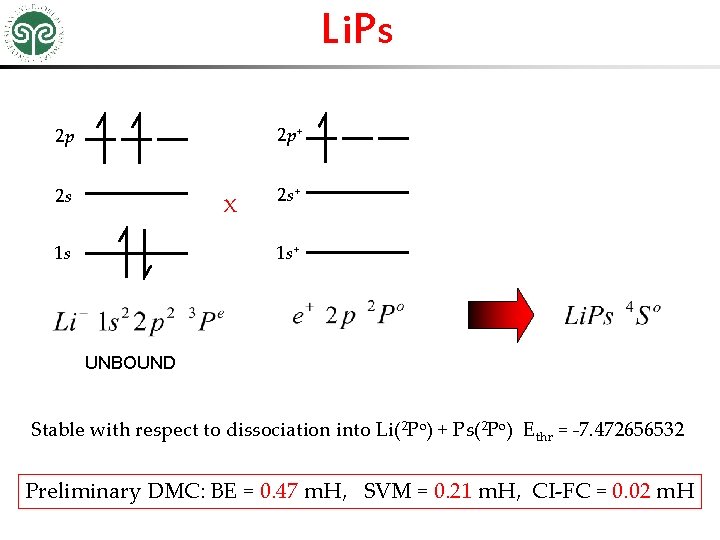
Li. Ps 2 p 2 p+ 2 s 2 s+ x 1 s+ 1 s UNBOUND Stable with respect to dissociation into Li(2 Po) + Ps(2 Po) Ethr = -7. 472656532 Preliminary DMC: BE = 0. 47 m. H, SVM = 0. 21 m. H, CI-FC = 0. 02 m. H
Molecules
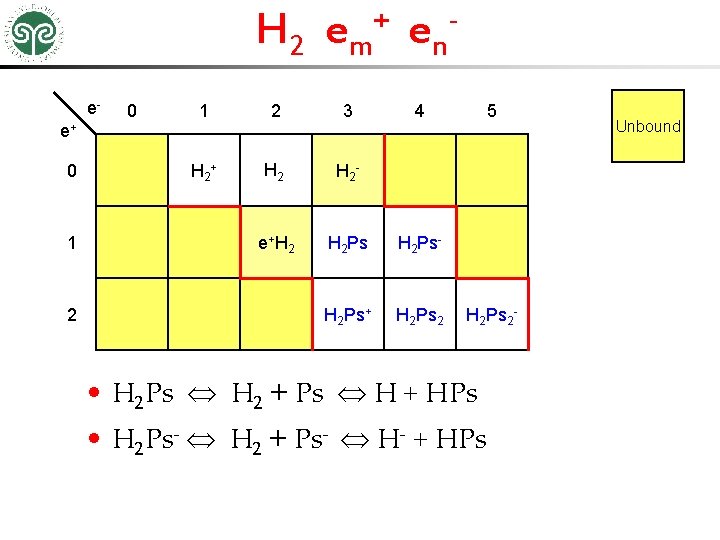
H 2 em + e n e- 0 1 2 3 4 H 2 + H 2 - e+ H 2 Ps- H 2 Ps+ H 2 Ps 2 5 e+ 0 1 2 H 2 Ps 2 - • H 2 Ps H 2 + Ps H + HPs • H 2 Ps- H 2 + Ps- H- + HPs Unbound
H 2 Ps-

Thank you Still a lot of work to do
- Slides: 29