
Fisheye Lens Distortion Correction on Multicore and Hardware
- Slides: 30
Fisheye Lens Distortion Correction on Multicore and Hardware Accelerator Platforms Konstantis Christos D. Daloukas 1 Antonopoulos 1 Nikolaos Bellas 1 Department of Computer and Communications Engineering University of Thessaly Volos, Greece 1 2 Motorola Inc. Schaumburg, IL, USA Sek M. Chai 2
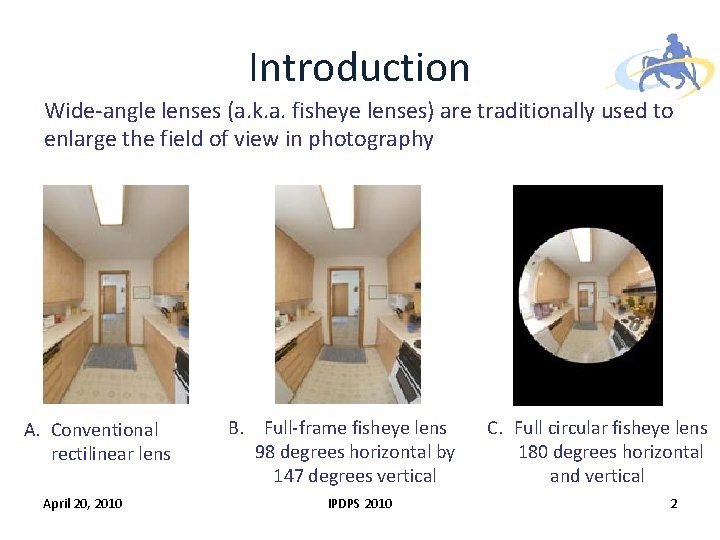
Introduction Wide-angle lenses (a. k. a. fisheye lenses) are traditionally used to enlarge the field of view in photography A. Conventional rectilinear lens April 20, 2010 B. Full-frame fisheye lens 98 degrees horizontal by 147 degrees vertical IPDPS 2010 C. Full circular fisheye lens 180 degrees horizontal and vertical 2
Introduction • Main Applications – – – Meteorology Astronomy Robot Navigation Video Surveillance Video Conferencing Digital Cameras • The incoming rays are mapped onto a spherical surface • Such mapping introduces barrel distortion April 20, 2010 IPDPS 2010 3
Motivation • Explore the mapping of the algorithm’s inherent parallelism on three contemporary platforms: – x 86 Chip Multiprocessor (Core 2 Quad) – Cell B. E. processor – Virtex-4 FPGA • Present a detailed characterization of the performance using both high- and low-level metrics April 20, 2010 IPDPS 2010 4
Outline • Introduction • Wide-angle Lenses Distortion Correction Algorithm • Description of Target Platforms • Algorithm Optimizations • Performance Evaluation • Conclusions April 20, 2010 IPDPS 2010 5
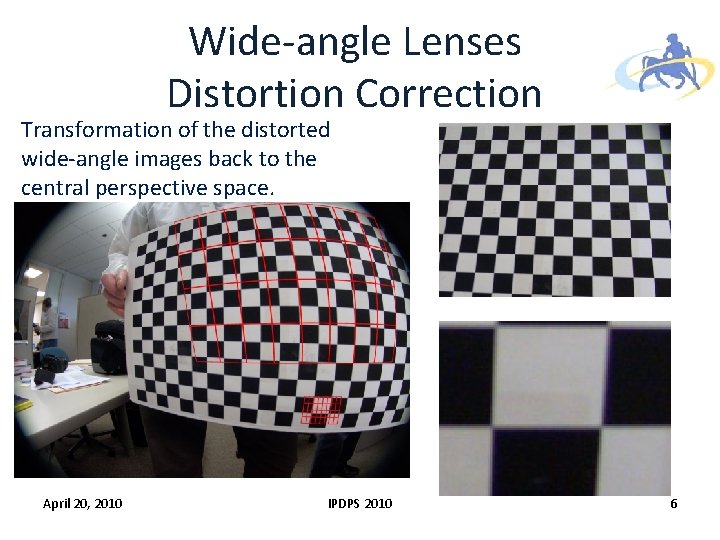
Wide-angle Lenses Distortion Correction Transformation of the distorted wide-angle images back to the central perspective space. April 20, 2010 IPDPS 2010 6
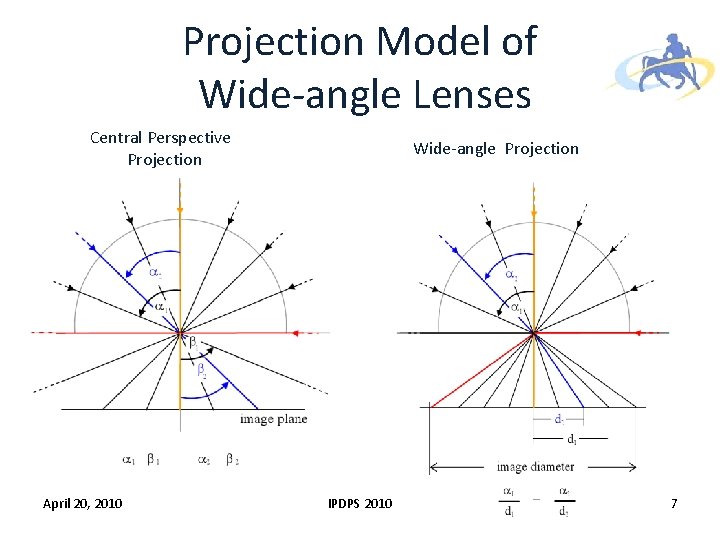
Projection Model of Wide-angle Lenses Central Perspective Projection April 20, 2010 Wide-angle Projection IPDPS 2010 7
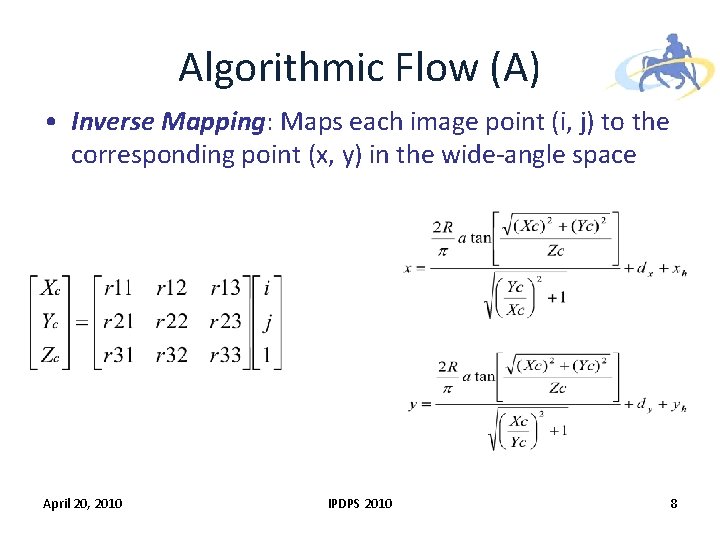
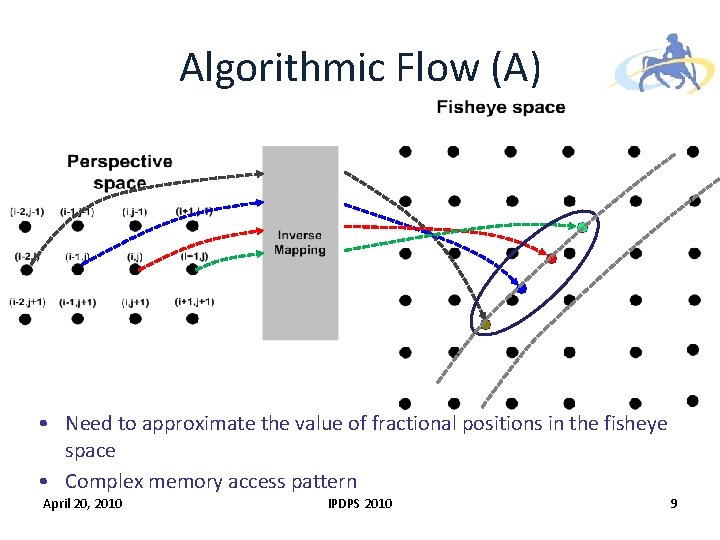
Algorithmic Flow (A) • Inverse Mapping: Maps each image point (i, j) to the corresponding point (x, y) in the wide-angle space April 20, 2010 IPDPS 2010 8
Algorithmic Flow (A) • Need to approximate the value of fractional positions in the fisheye space • Complex memory access pattern April 20, 2010 IPDPS 2010 9
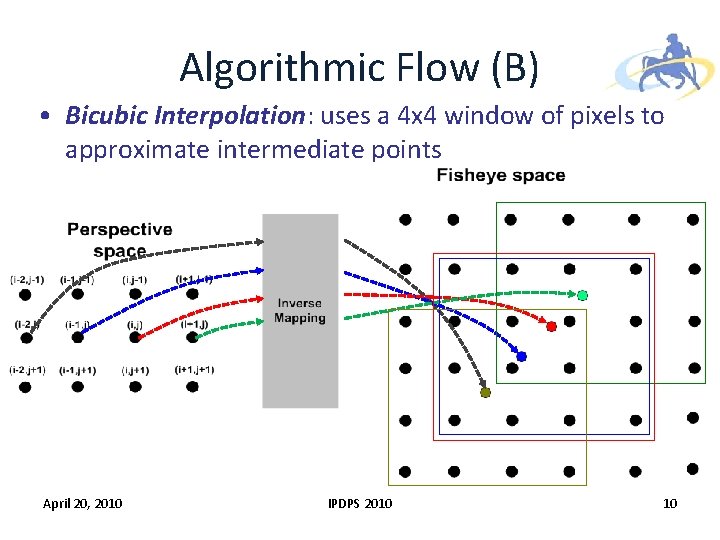
Algorithmic Flow (B) • Bicubic Interpolation: uses a 4 x 4 window of pixels to approximate intermediate points April 20, 2010 IPDPS 2010 10
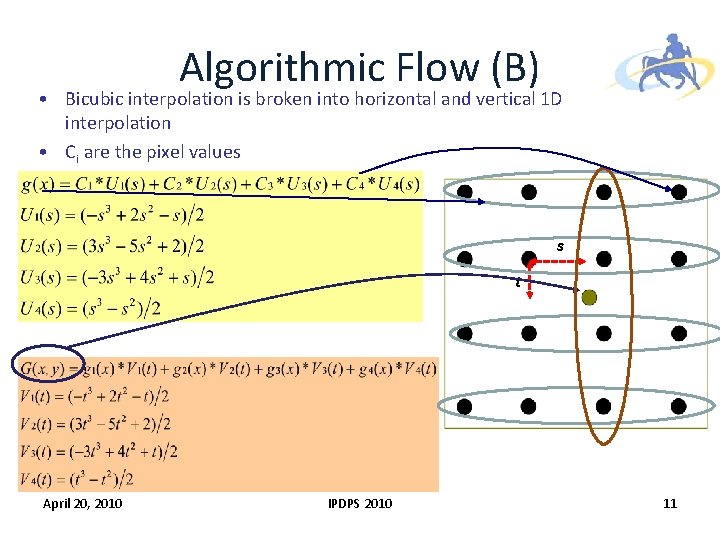
Algorithmic Flow (B) • Bicubic interpolation is broken into horizontal and vertical 1 D interpolation • Ci are the pixel values s t April 20, 2010 IPDPS 2010 11
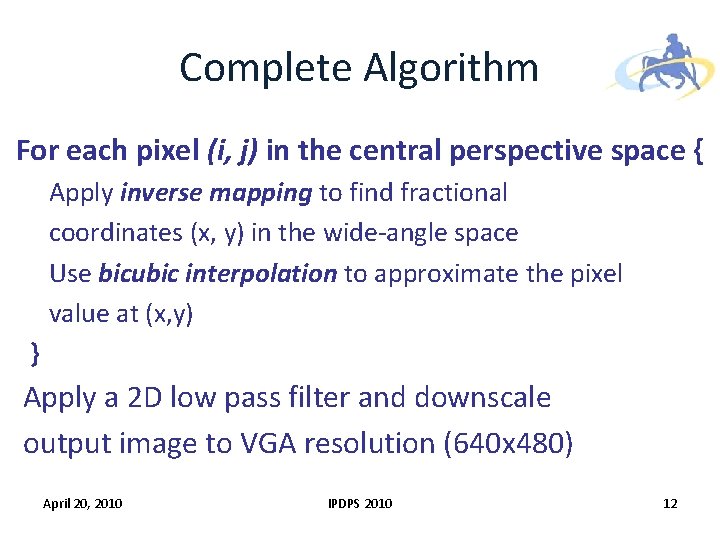
Complete Algorithm For each pixel (i, j) in the central perspective space { Apply inverse mapping to find fractional coordinates (x, y) in the wide-angle space Use bicubic interpolation to approximate the pixel value at (x, y) } Apply a 2 D low pass filter and downscale output image to VGA resolution (640 x 480) April 20, 2010 IPDPS 2010 12
Outline • Introduction • Wide-angle Lenses Distortion Correction Algorithm • Description of Target Platforms • Algorithm Optimizations • Performance Evaluation • Conclusions April 20, 2010 IPDPS 2010 13
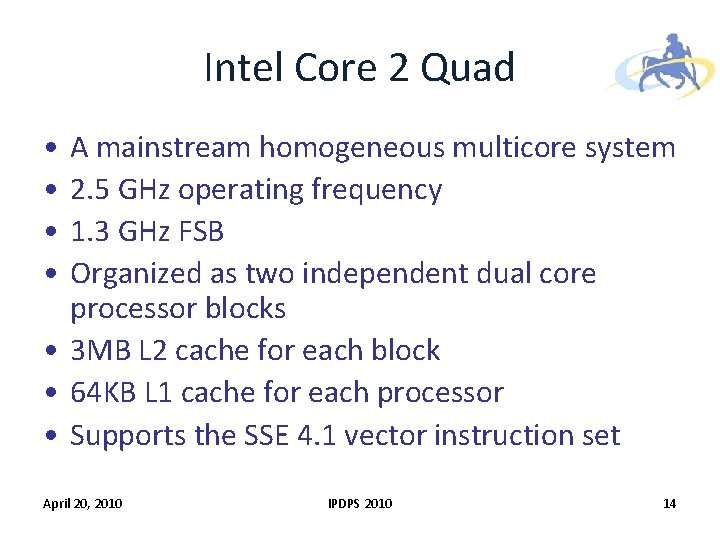
Intel Core 2 Quad • • A mainstream homogeneous multicore system 2. 5 GHz operating frequency 1. 3 GHz FSB Organized as two independent dual core processor blocks • 3 MB L 2 cache for each block • 64 KB L 1 cache for each processor • Supports the SSE 4. 1 vector instruction set April 20, 2010 IPDPS 2010 14
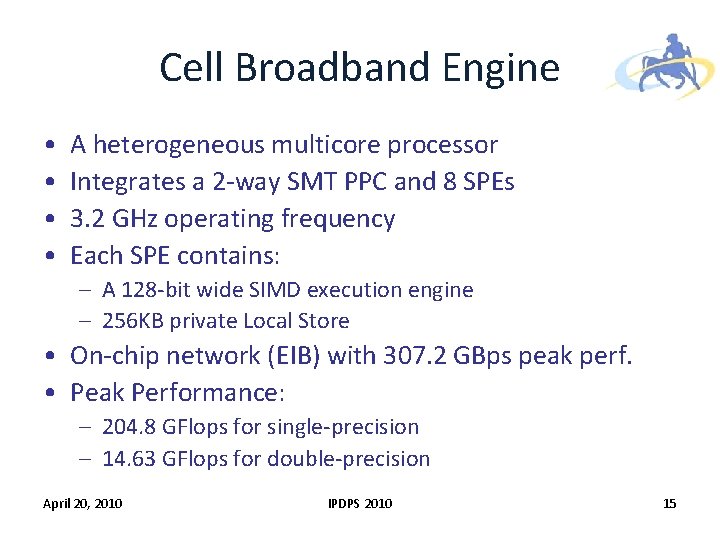
Cell Broadband Engine • • A heterogeneous multicore processor Integrates a 2 -way SMT PPC and 8 SPEs 3. 2 GHz operating frequency Each SPE contains: – A 128 -bit wide SIMD execution engine – 256 KB private Local Store • On-chip network (EIB) with 307. 2 GBps peak perf. • Peak Performance: – 204. 8 GFlops for single-precision – 14. 63 GFlops for double-precision April 20, 2010 IPDPS 2010 15
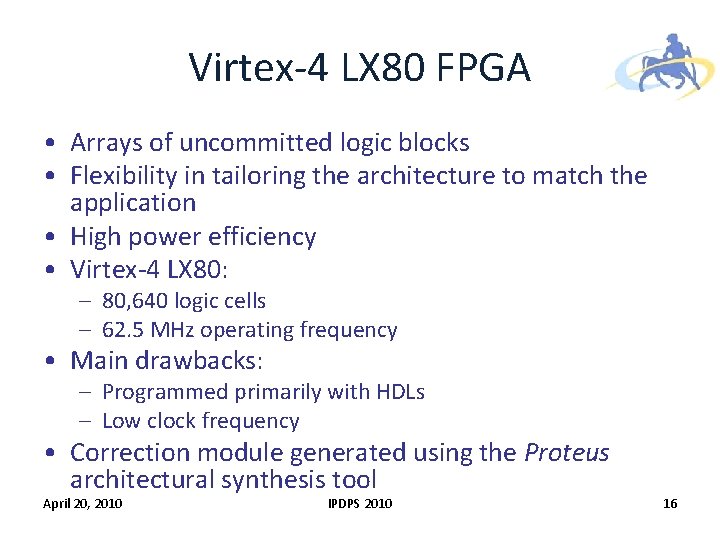
Virtex-4 LX 80 FPGA • Arrays of uncommitted logic blocks • Flexibility in tailoring the architecture to match the application • High power efficiency • Virtex-4 LX 80: – 80, 640 logic cells – 62. 5 MHz operating frequency • Main drawbacks: – Programmed primarily with HDLs – Low clock frequency • Correction module generated using the Proteus architectural synthesis tool April 20, 2010 IPDPS 2010 16
Proteus • Produces hardware accelerators that follow the streaming paradigm – Produces several load/store units and the datapath as well • The application is expressed using an assembly -like streaming DFG • Source code is modulo-scheduled with II = 2 • Generate 100 K lines of synthesizable Verilog from 800 lines of code April 20, 2010 IPDPS 2010 17
Outline • Introduction • Wide-angle Lenses Distortion Correction Algorithm • Description of Target Platforms • Algorithm Optimizations • Performance Evaluation • Conclusions April 20, 2010 IPDPS 2010 18
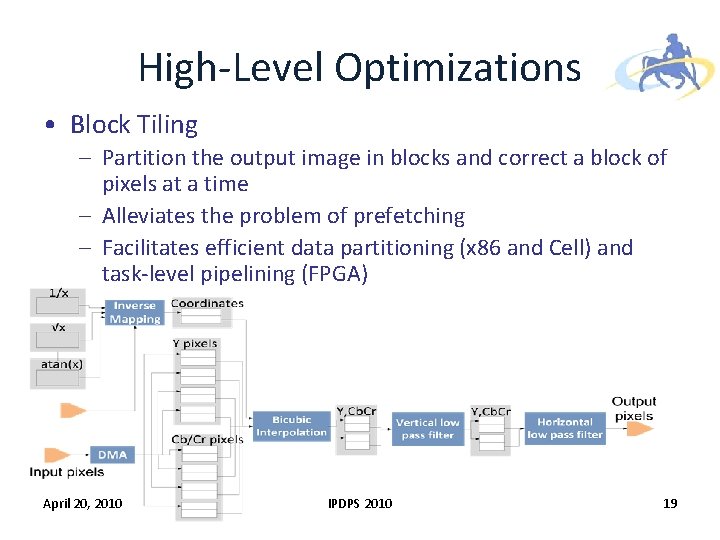
High-Level Optimizations • Block Tiling – Partition the output image in blocks and correct a block of pixels at a time – Alleviates the problem of prefetching – Facilitates efficient data partitioning (x 86 and Cell) and task-level pipelining (FPGA) April 20, 2010 IPDPS 2010 19
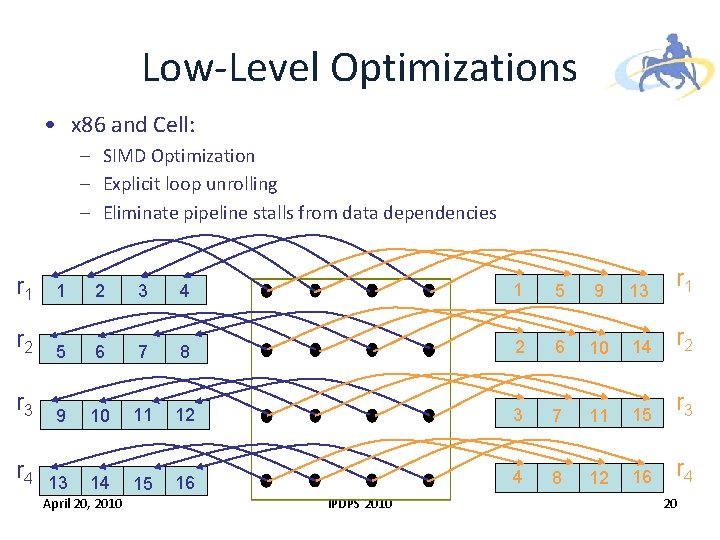
Low-Level Optimizations • x 86 and Cell: – SIMD Optimization – Explicit loop unrolling – Eliminate pipeline stalls from data dependencies r 1 1 2 3 4 1 5 9 13 r 1 r 2 5 6 7 8 2 6 10 14 r 2 r 3 9 10 11 12 3 7 11 15 r 3 16 4 8 12 16 r 4 13 14 April 20, 2010 15 IPDPS 2010 20
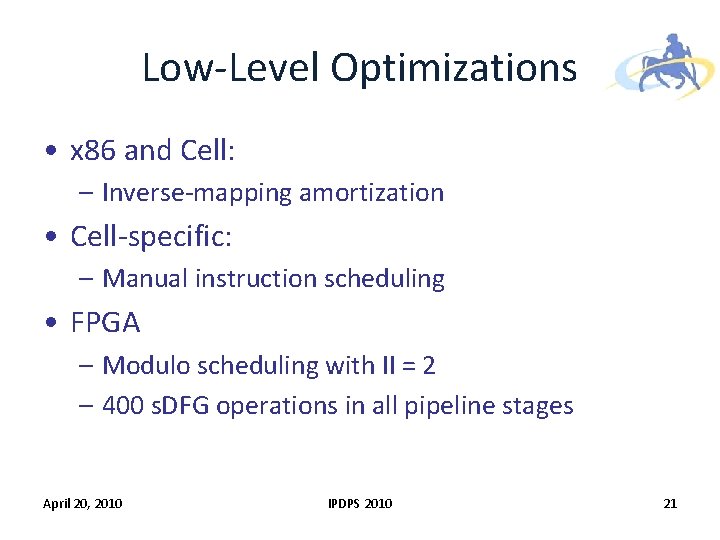
Low-Level Optimizations • x 86 and Cell: – Inverse-mapping amortization • Cell-specific: – Manual instruction scheduling • FPGA – Modulo scheduling with II = 2 – 400 s. DFG operations in all pipeline stages April 20, 2010 IPDPS 2010 21
Outline • Introduction • Wide-angle Lenses Distortion Correction Algorithm • Description of Target Platforms • Algorithm Optimizations • Performance Evaluation • Conclusions April 20, 2010 IPDPS 2010 22
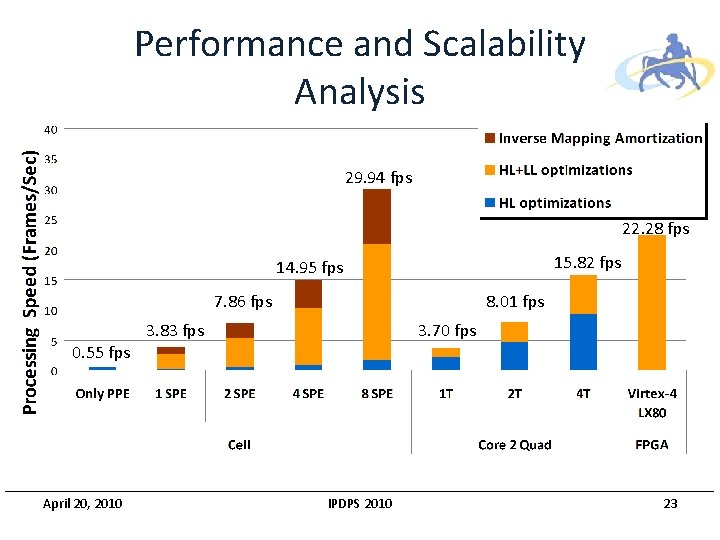
Performance and Scalability Analysis 29. 94 fps 22. 28 fps 15. 82 fps 14. 95 fps 7. 86 fps 8. 01 fps 3. 83 fps 3. 70 fps 0. 55 fps April 20, 2010 IPDPS 2010 23
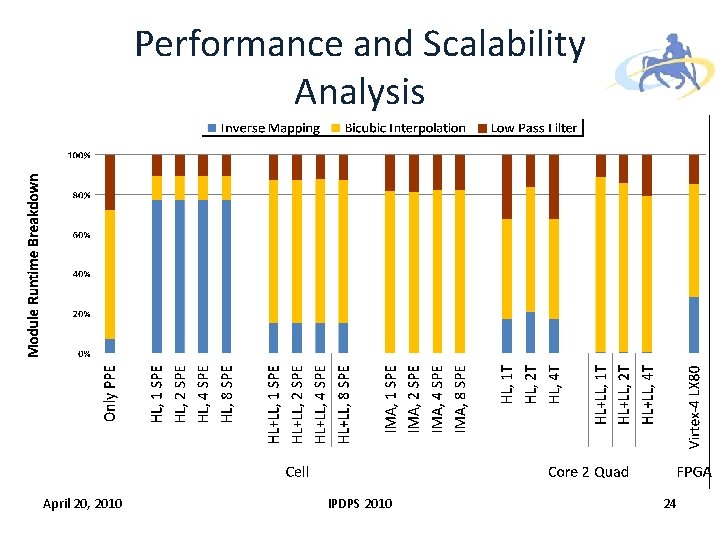
Performance and Scalability Analysis April 20, 2010 IPDPS 2010 24
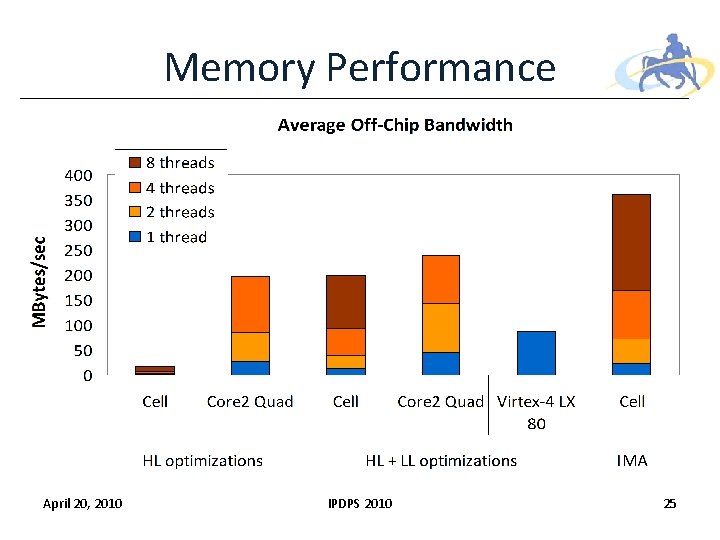
Memory Performance April 20, 2010 IPDPS 2010 25
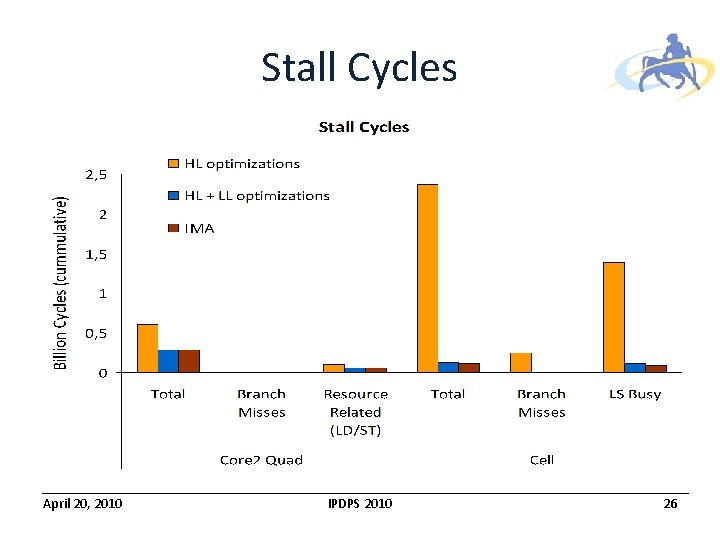
Stall Cycles April 20, 2010 IPDPS 2010 26
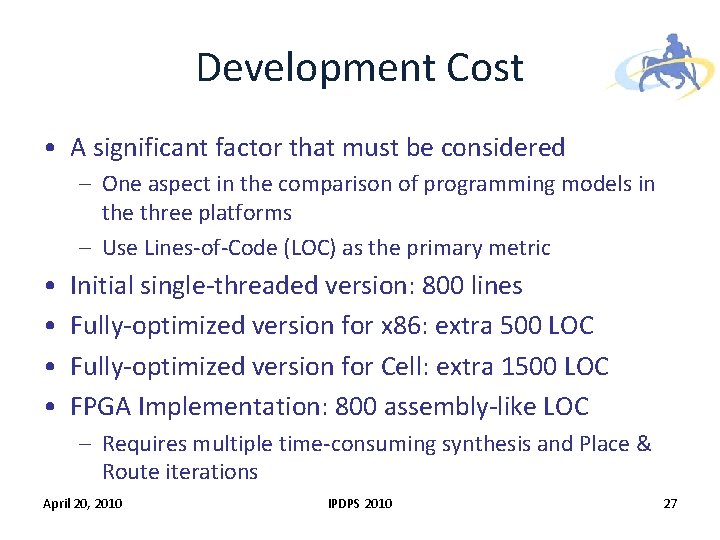
Development Cost • A significant factor that must be considered – One aspect in the comparison of programming models in the three platforms – Use Lines-of-Code (LOC) as the primary metric • • Initial single-threaded version: 800 lines Fully-optimized version for x 86: extra 500 LOC Fully-optimized version for Cell: extra 1500 LOC FPGA Implementation: 800 assembly-like LOC – Requires multiple time-consuming synthesis and Place & Route iterations April 20, 2010 IPDPS 2010 27
Outline • Introduction • Wide-angle Lenses Distortion Correction Algorithm • Description of Target Platforms • Algorithm Optimizations • Performance Evaluation • Conclusions April 20, 2010 IPDPS 2010 28
Conclusions • Presented the implementation of a real-time image warping algorithm – Analyzed and characterized the performance on all underlying architectures – Applied a series of optimizations and identified their effect • Commercially available general purpose multi-cores not capable of handling real-time distortion correction • Exotic architectures such as Cell or FPGAs offer the necessary computational power – Significantly higher development cost – Advanced tools, development models and support environments can alleviate this effort April 20, 2010 IPDPS 2010 29
Acknowledgements • We would like to thank Barcelona Supercomputing Center for providing us with access to their IBM QS 20 blade • This project is partially supported by the EC Marie Curie International Reintegration Grant (IRG) 223819 April 20, 2010 IPDPS 2010 30