
Fishes Chapter 30 30 2 Fishes n Fishes


- Slides: 31
Fishes Chapter 30
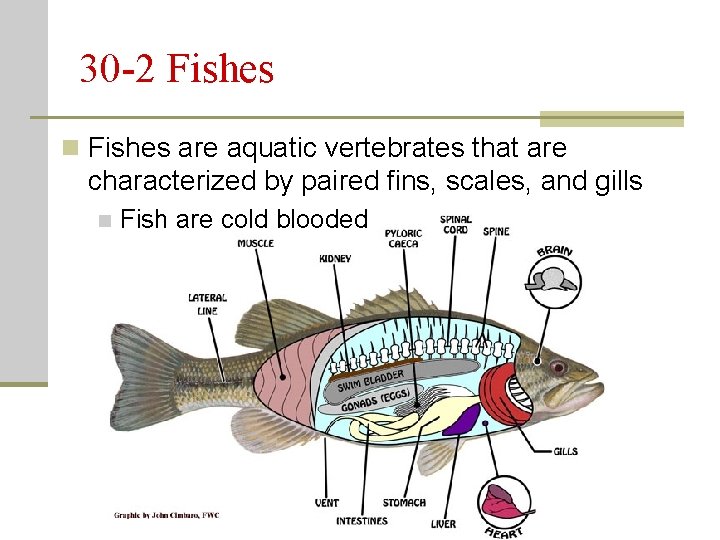
30 -2 Fishes n Fishes are aquatic vertebrates that are characterized by paired fins, scales, and gills n Fish are cold blooded
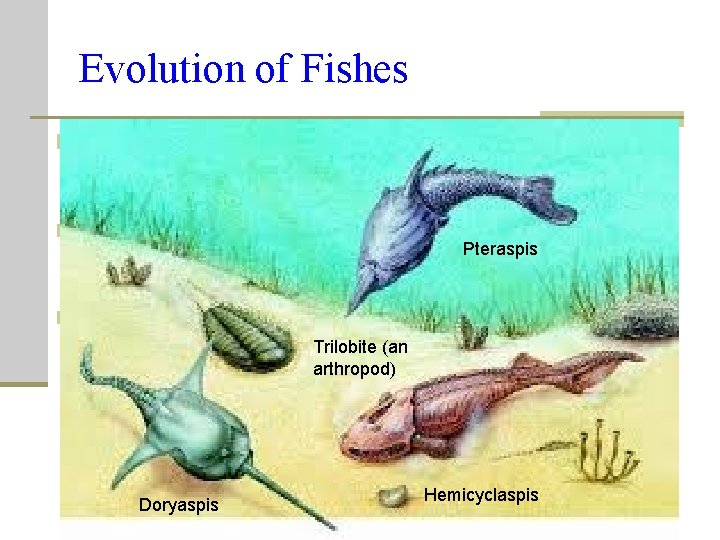
Evolution of Fishes n Jawless n armored with bony plates (about 400 million yrs ago). n Jaws n allowed fish better feeding ability as well as defense. Pteraspis n Paired fins n n Trilobite (an aided movement arthropod) provided more control of movement. Doryaspis Hemicyclaspis
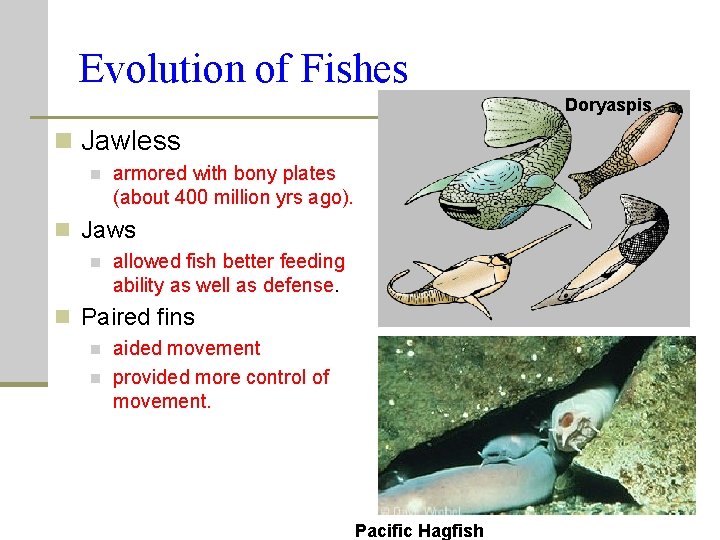
Evolution of Fishes Doryaspis n Jawless n armored with bony plates (about 400 million yrs ago). n Jaws n allowed fish better feeding ability as well as defense. n Paired fins n n aided movement provided more control of movement. Pacific Hagfish
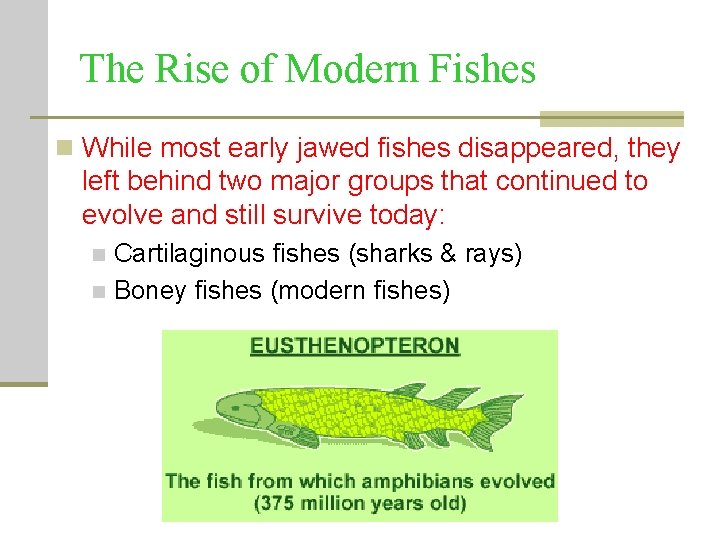
The Rise of Modern Fishes n While most early jawed fishes disappeared, they left behind two major groups that continued to evolve and still survive today: Cartilaginous fishes (sharks & rays) n Boney fishes (modern fishes) n
Form & Function in Fishes n Adaptations to aquatic life n various modes of feeding n specialized structures for gas exchange n paired fins for locomotion
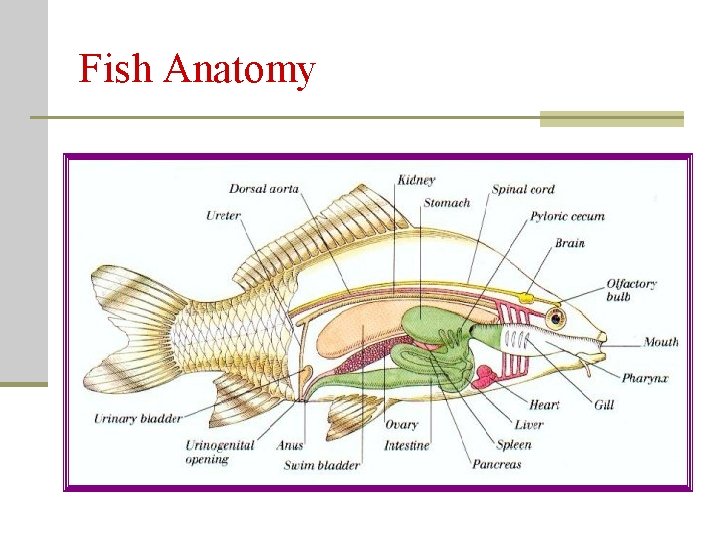
Fish Anatomy
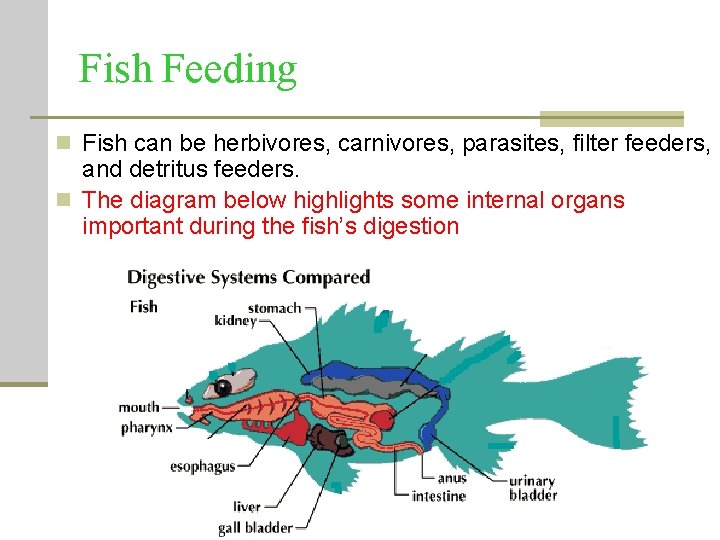
Fish Feeding n Fish can be herbivores, carnivores, parasites, filter feeders, and detritus feeders. n The diagram below highlights some internal organs important during the fish’s digestion
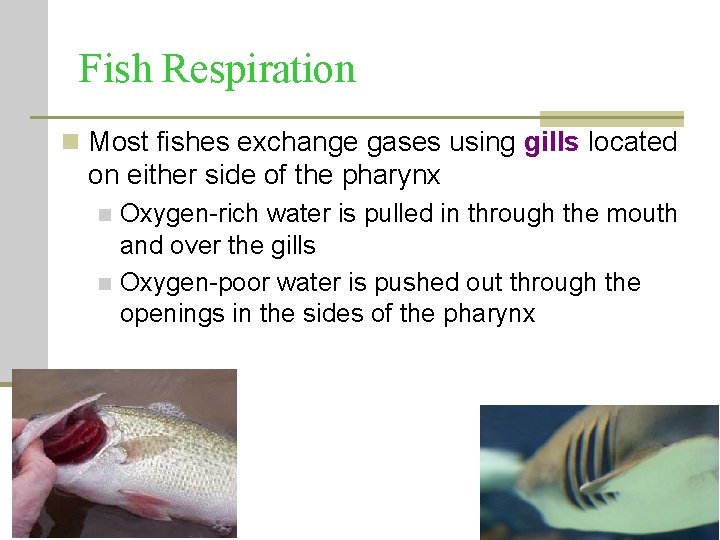
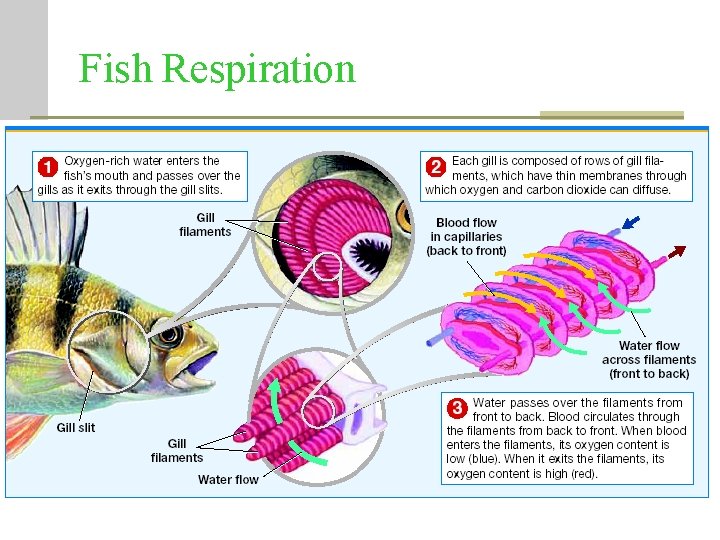
Fish Respiration n Most fishes exchange gases using gills located on either side of the pharynx Oxygen-rich water is pulled in through the mouth and over the gills n Oxygen-poor water is pushed out through the openings in the sides of the pharynx n
Fish Respiration
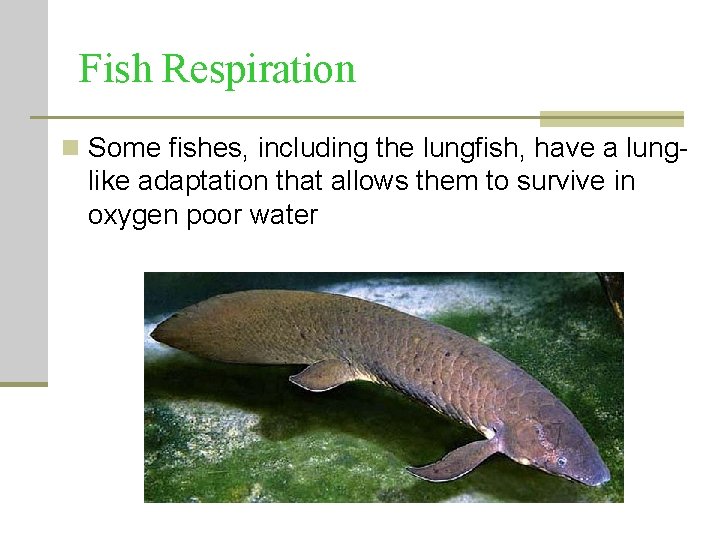
Fish Respiration n Some fishes, including the lungfish, have a lung- like adaptation that allows them to survive in oxygen poor water
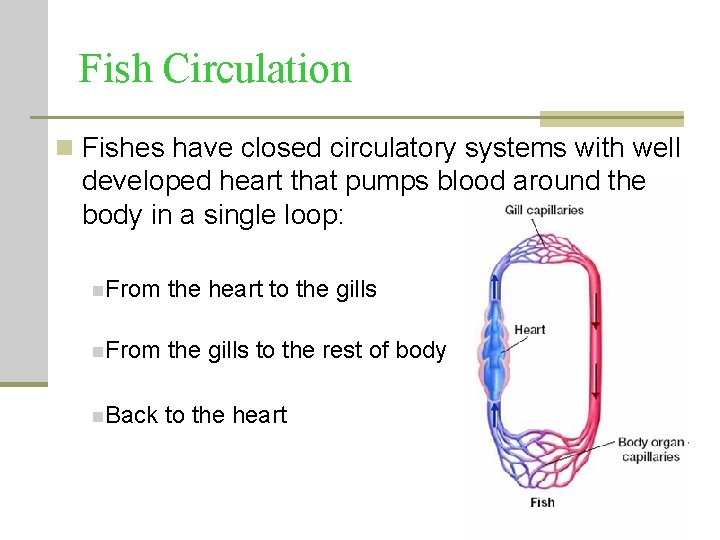
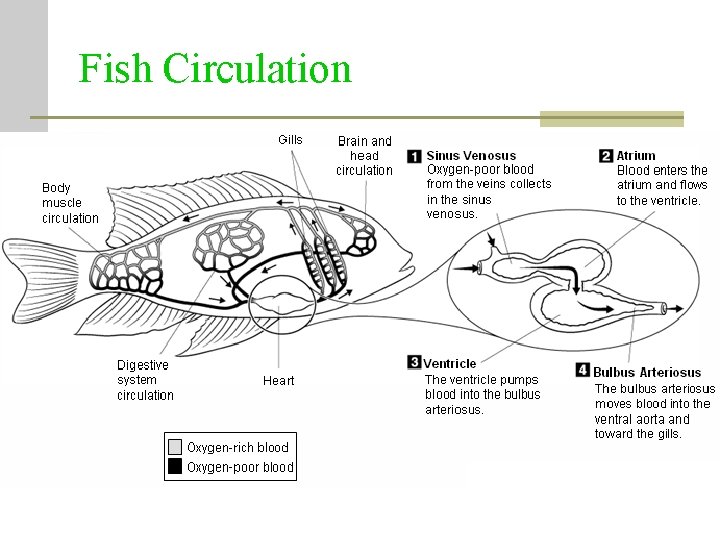
Fish Circulation n Fishes have closed circulatory systems with well developed heart that pumps blood around the body in a single loop: n. From the heart to the gills n. From the gills to the rest of body n. Back to the heart
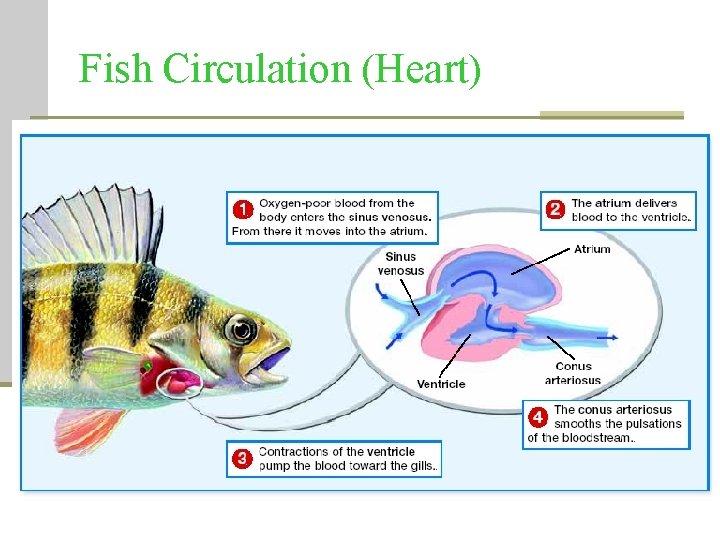
Fish Circulation (Heart)
Fish Circulation
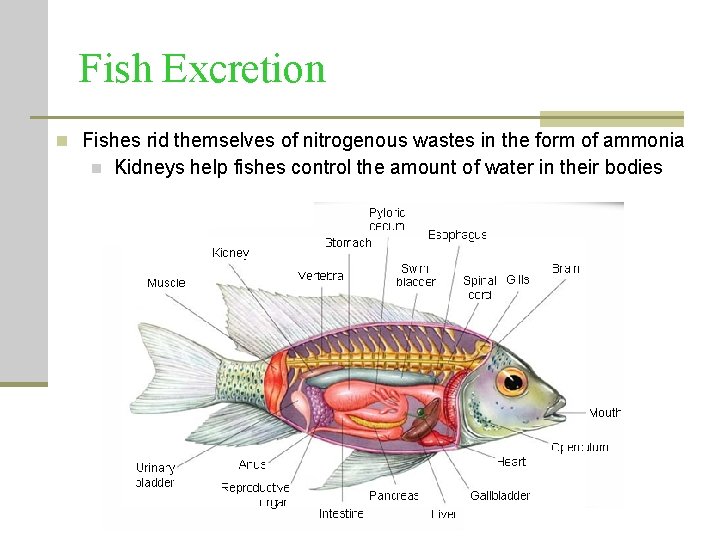
Fish Excretion n Fishes rid themselves of nitrogenous wastes in the form of ammonia n Kidneys help fishes control the amount of water in their bodies
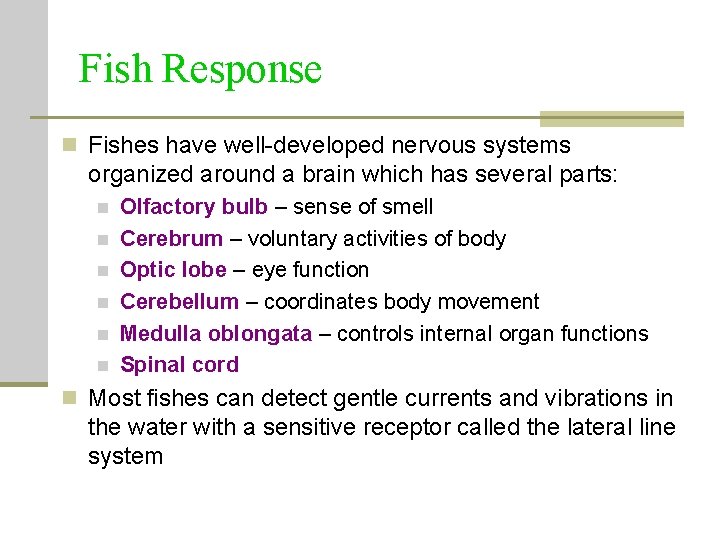
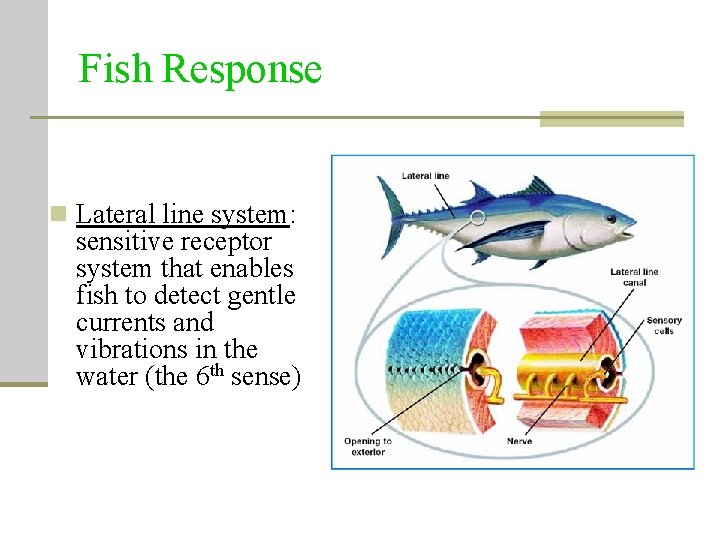
Fish Response n Fishes have well-developed nervous systems organized around a brain which has several parts: n n n Olfactory bulb – sense of smell Cerebrum – voluntary activities of body Optic lobe – eye function Cerebellum – coordinates body movement Medulla oblongata – controls internal organ functions Spinal cord n Most fishes can detect gentle currents and vibrations in the water with a sensitive receptor called the lateral line system
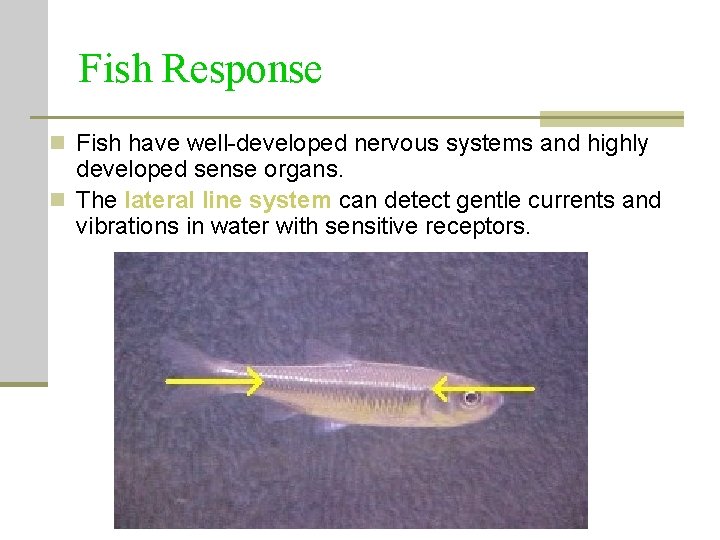
Fish Response n Fish have well-developed nervous systems and highly developed sense organs. n The lateral line system can detect gentle currents and vibrations in water with sensitive receptors.
Fish Response n Lateral line system: sensitive receptor system that enables fish to detect gentle currents and vibrations in the water (the 6 th sense)
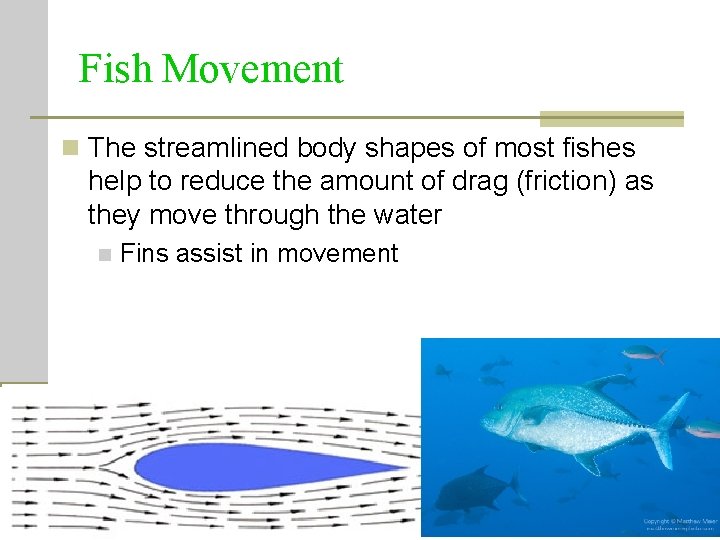
Fish Movement n The streamlined body shapes of most fishes help to reduce the amount of drag (friction) as they move through the water n Fins assist in movement
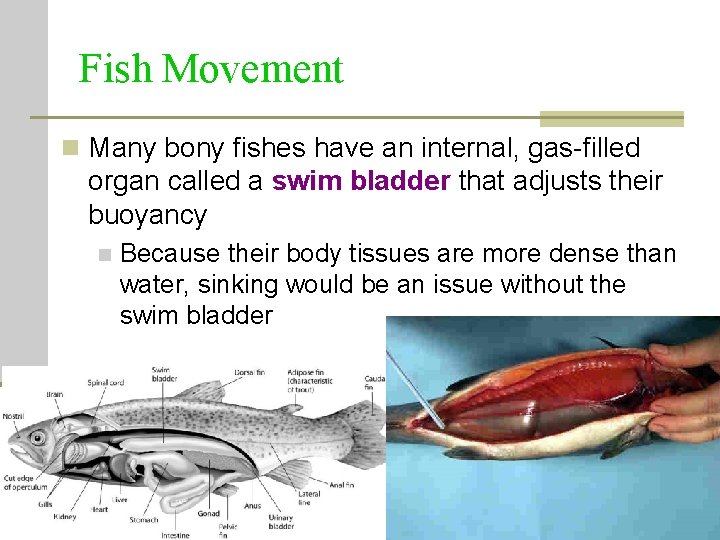
Fish Movement n Many bony fishes have an internal, gas-filled organ called a swim bladder that adjusts their buoyancy n Because their body tissues are more dense than water, sinking would be an issue without the swim bladder
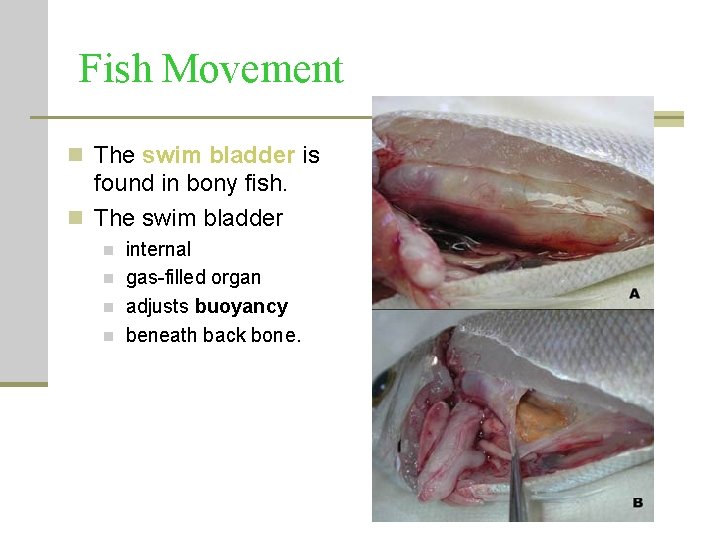
Fish Movement n The swim bladder is found in bony fish. n The swim bladder n n internal gas-filled organ adjusts buoyancy beneath back bone.
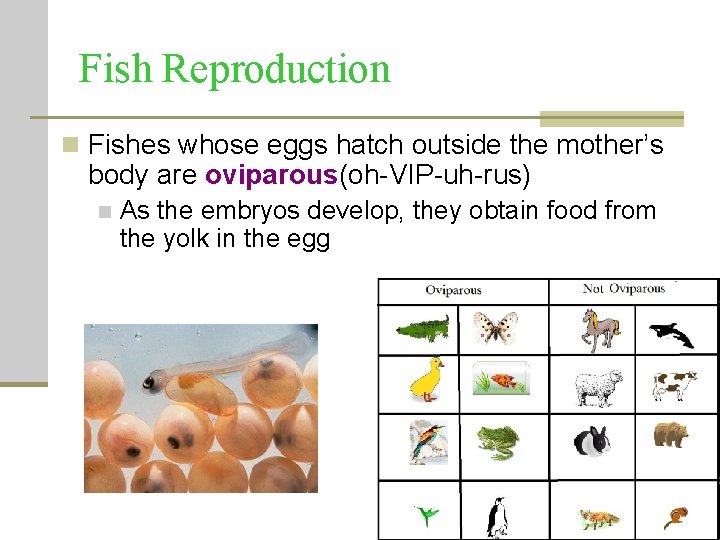
Fish Reproduction n Fishes whose eggs hatch outside the mother’s body are oviparous(oh-VIP-uh-rus) n As the embryos develop, they obtain food from the yolk in the egg
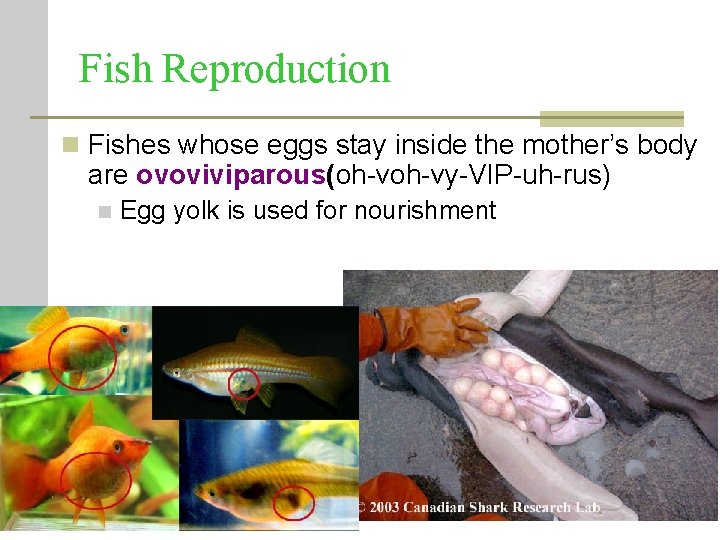
Fish Reproduction n Fishes whose eggs stay inside the mother’s body are ovoviviparous(oh-vy-VIP-uh-rus) n Egg yolk is used for nourishment
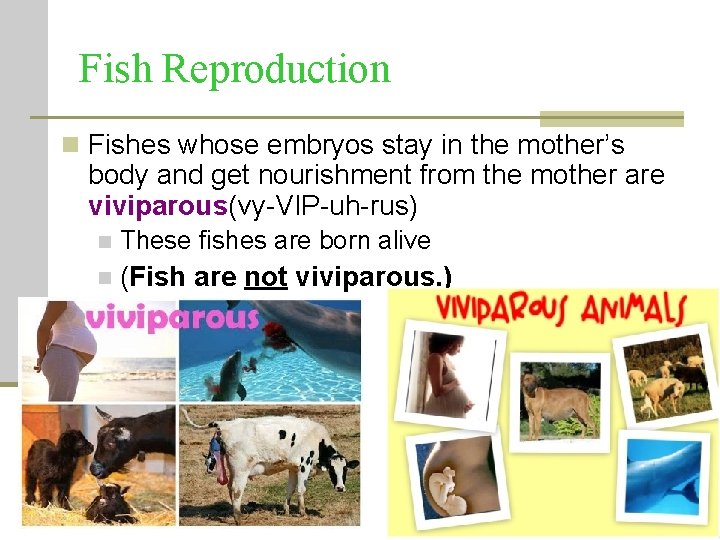
Fish Reproduction n Fishes whose embryos stay in the mother’s body and get nourishment from the mother are viviparous(vy-VIP-uh-rus) n These fishes are born alive n (Fish are not viviparous. )
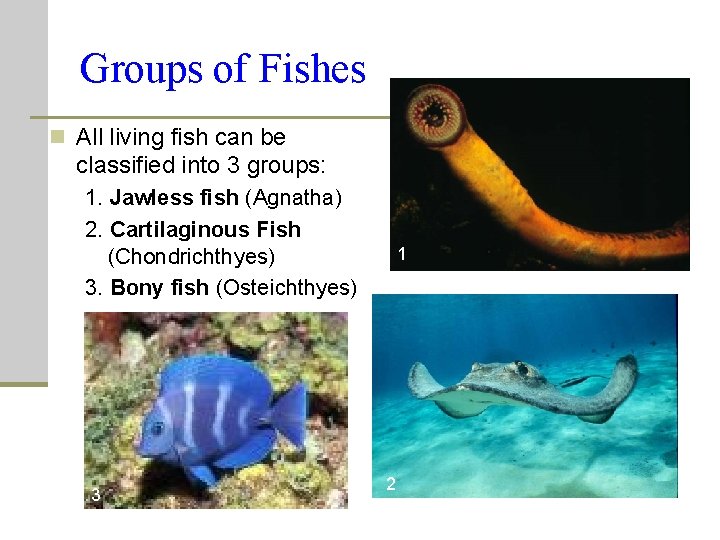
Groups of Fishes n All living fish can be classified into 3 groups: 1. Jawless fish (Agnatha) 2. Cartilaginous Fish (Chondrichthyes) 3. Bony fish (Osteichthyes) 3 1 2
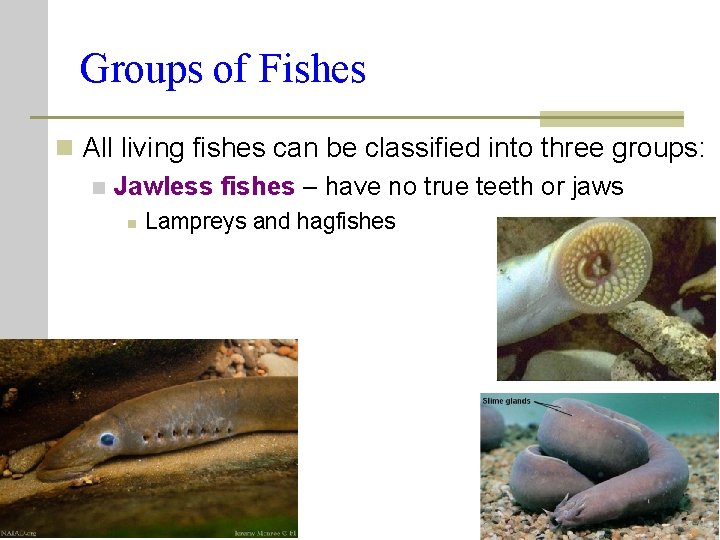
Groups of Fishes n All living fishes can be classified into three groups: n Jawless fishes – have no true teeth or jaws n Lampreys and hagfishes
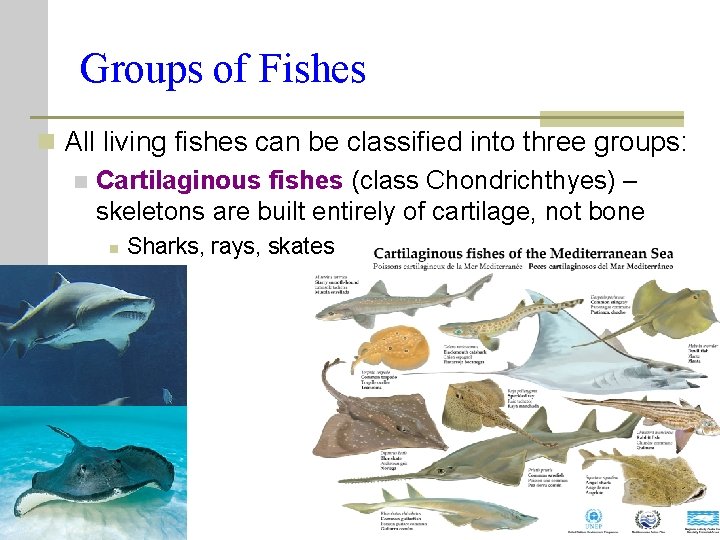
Groups of Fishes n All living fishes can be classified into three groups: n Cartilaginous fishes (class Chondrichthyes) – skeletons are built entirely of cartilage, not bone n Sharks, rays, skates
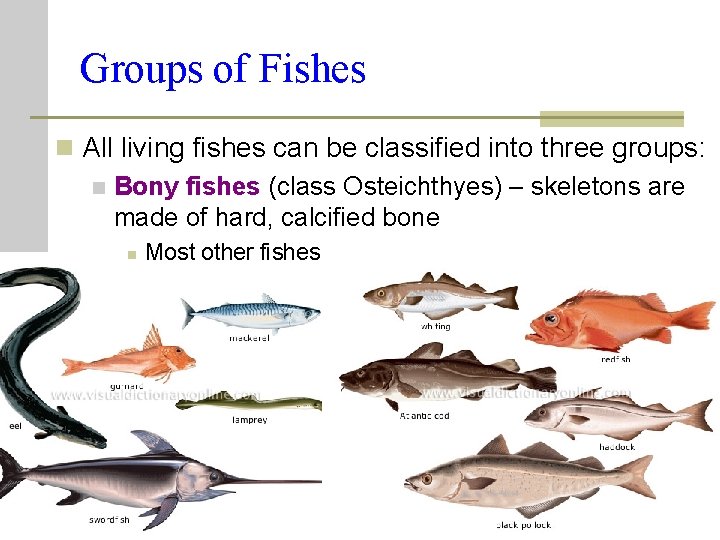
Groups of Fishes n All living fishes can be classified into three groups: n Bony fishes (class Osteichthyes) – skeletons are made of hard, calcified bone n Most other fishes
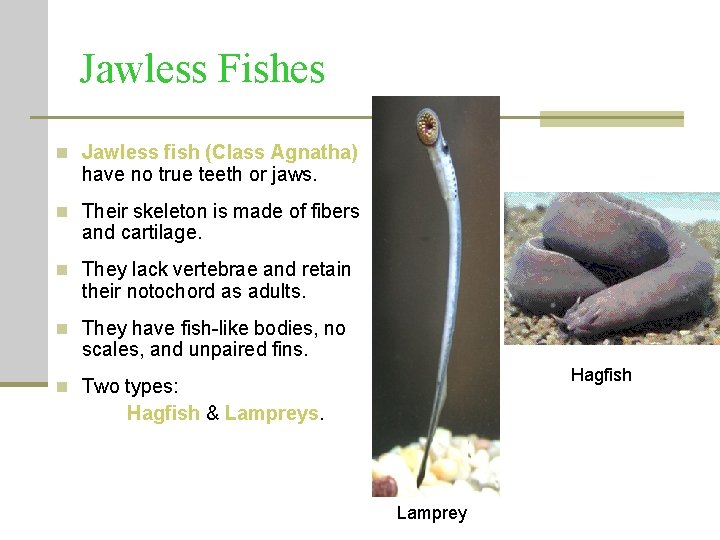
Jawless Fishes n Jawless fish (Class Agnatha) have no true teeth or jaws. n Their skeleton is made of fibers and cartilage. n They lack vertebrae and retain their notochord as adults. n They have fish-like bodies, no scales, and unpaired fins. Hagfish n Two types: Hagfish & Lampreys. Lamprey
Cartilage Fishes n Belong to Class n n Chondrichthyes. Includes sharks, skates, rays. The skeleton is entirely cartilage (no bone). Possess tooth-like scales. Gills are not protected with bony covering.
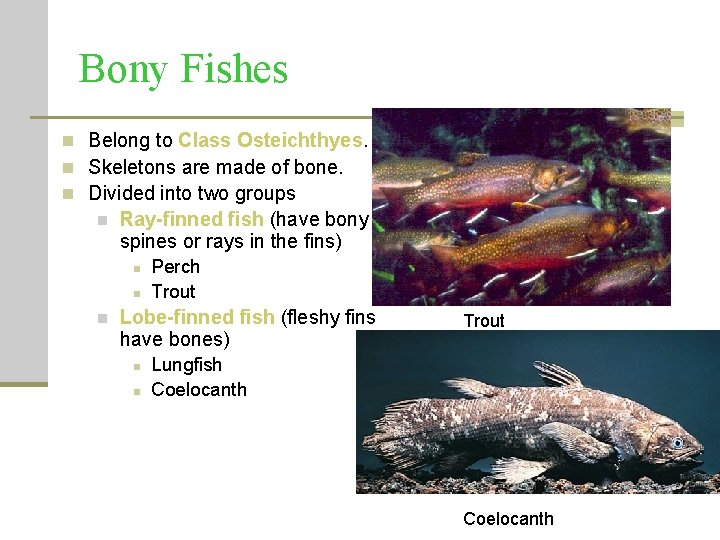
Bony Fishes n Belong to Class Osteichthyes. n Skeletons are made of bone. n Divided into two groups n Ray-finned fish (have bony spines or rays in the fins) n n n Perch Trout Lobe-finned fish (fleshy fins have bones) n n Trout Lungfish Coelocanth