
Fish and Amphibians Chapter 30 TURBOBLAST Edition What
Fish and Amphibians Chapter 30 TURBOBLAST Edition!
What is a fish? ? • All fish are: – Chordates, vertebrates, bilaterally symmetrical coelomates – Have endoskeleton, closed circulatory systems, nervous systems with complex brains & sense organs, efficient respiratory systems • Ichthyology: the study of fish (Gr: icthyes = fish)
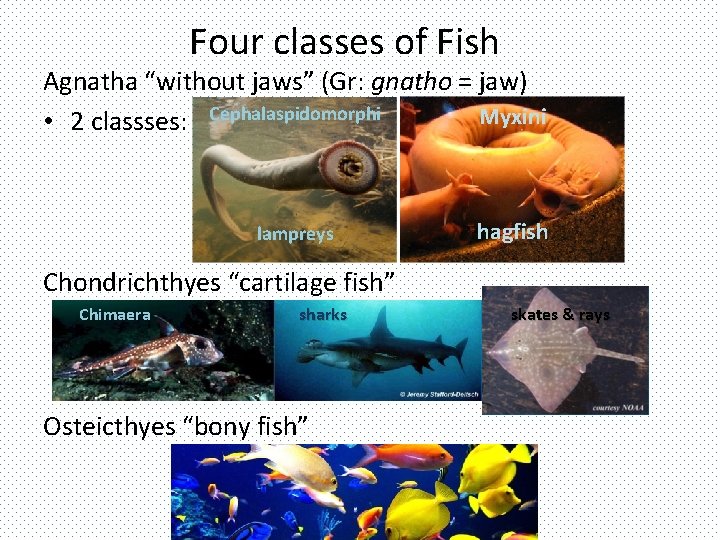
Four classes of Fish Agnatha “without jaws” (Gr: gnatho = jaw) Myxini • 2 classses: Cephalaspidomorphi lampreys hagfish Chondrichthyes “cartilage fish” Chimaera sharks Osteicthyes “bony fish” skates & rays
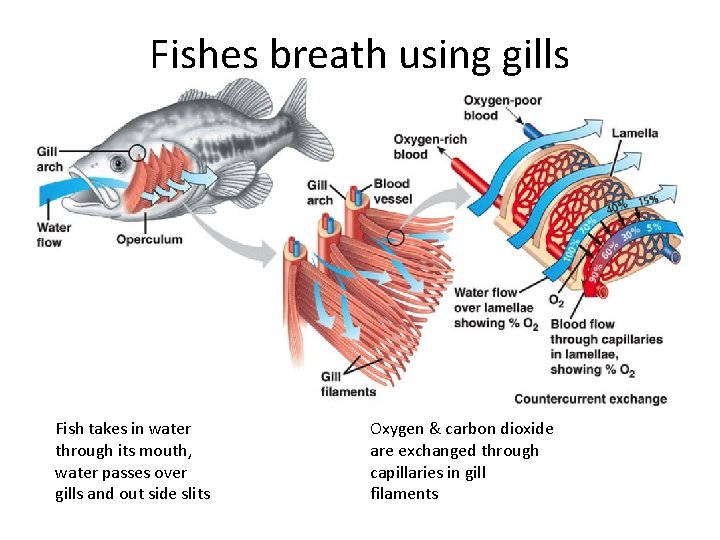
Fishes breath using gills Fish takes in water through its mouth, water passes over gills and out side slits Oxygen & carbon dioxide are exchanged through capillaries in gill filaments
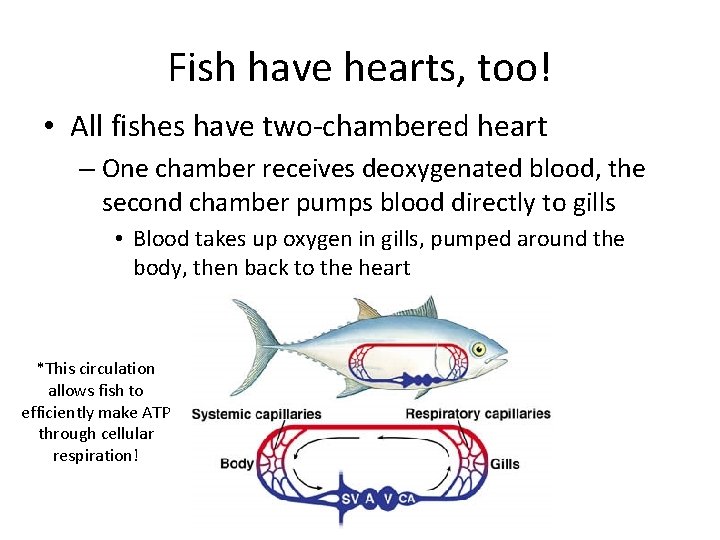
Fish have hearts, too! • All fishes have two-chambered heart – One chamber receives deoxygenated blood, the second chamber pumps blood directly to gills • Blood takes up oxygen in gills, pumped around the body, then back to the heart *This circulation allows fish to efficiently make ATP through cellular respiration!

Sexual reproduction • External fertilization in most fishes – Simultaneous release of gametes into water – Sometimes deposited in protected areas (plants, rocks, etc. ) – Most fishes produce large #s of eggs at once, some produce small # of larger eggs • Cartilaginous fish have internal fertilization – Skates deposit fertilized eggs on ocean floor – Some sharks & rays carry developing young inside bodies • Spawning – bony fish (external fertilization & development), produce millions of eggs, provide little to no care for young, only a few survive until adulthood (ex. Salmon, cod) https: //www. youtube. com/watch? v=Jgp 6 Ojpfr. Qo – Some adults protect young fry when threatened by danger (Ex. Gouramis, cichlids, tilapia http: //youtu. be/Qkmmp. Srbbj. M
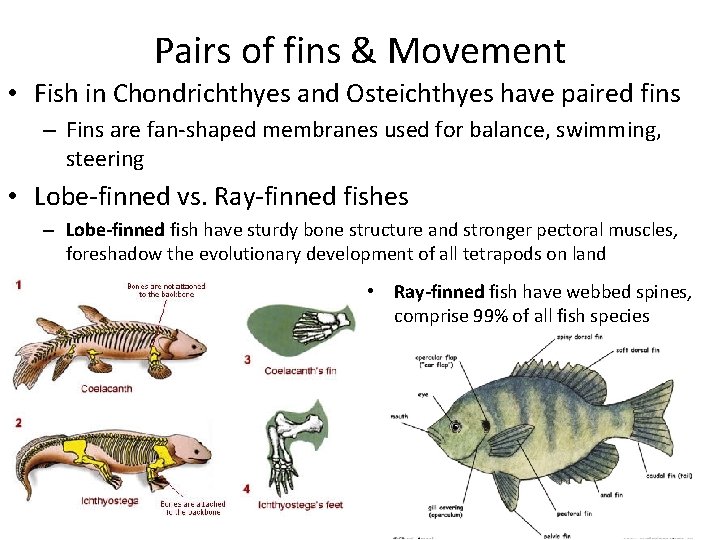
Pairs of fins & Movement • Fish in Chondrichthyes and Osteichthyes have paired fins – Fins are fan-shaped membranes used for balance, swimming, steering • Lobe-finned vs. Ray-finned fishes – Lobe-finned fish have sturdy bone structure and stronger pectoral muscles, foreshadow the evolutionary development of all tetrapods on land • Ray-finned fish have webbed spines, comprise 99% of all fish species
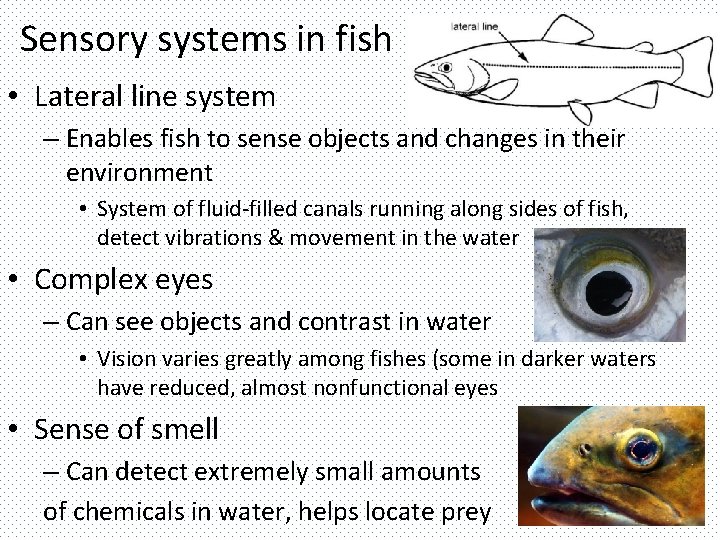
Sensory systems in fish • Lateral line system – Enables fish to sense objects and changes in their environment • System of fluid-filled canals running along sides of fish, detect vibrations & movement in the water • Complex eyes – Can see objects and contrast in water • Vision varies greatly among fishes (some in darker waters have reduced, almost nonfunctional eyes • Sense of smell – Can detect extremely small amounts of chemicals in water, helps locate prey
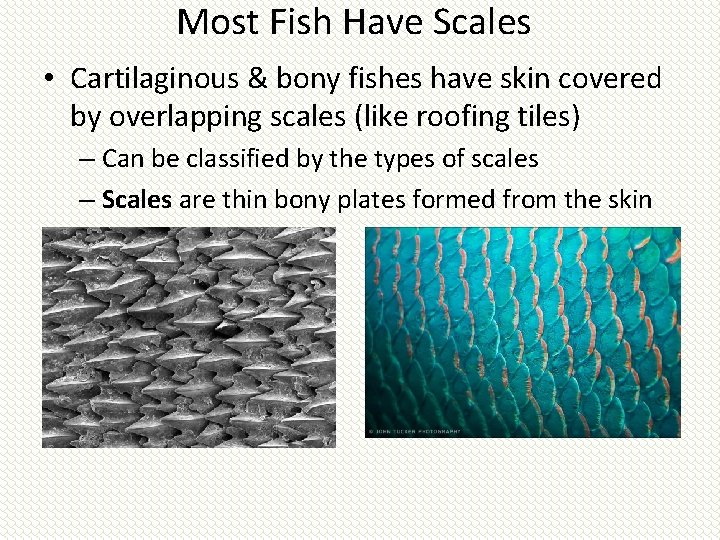
Most Fish Have Scales • Cartilaginous & bony fishes have skin covered by overlapping scales (like roofing tiles) – Can be classified by the types of scales – Scales are thin bony plates formed from the skin
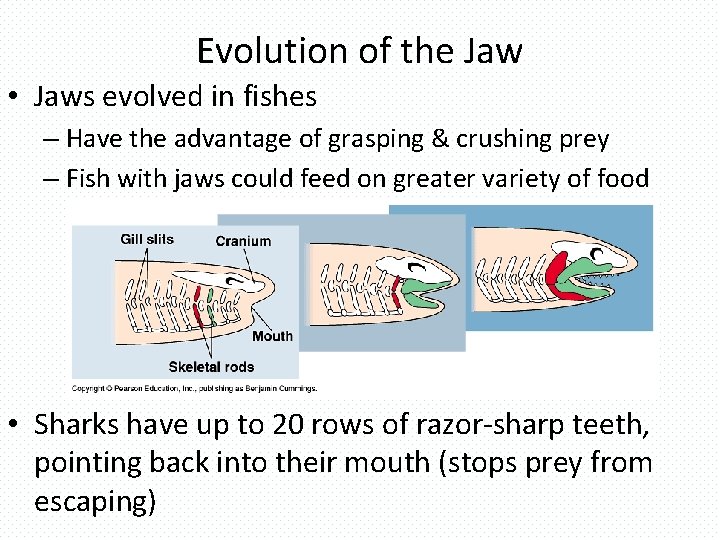
Evolution of the Jaw • Jaws evolved in fishes – Have the advantage of grasping & crushing prey – Fish with jaws could feed on greater variety of food • Sharks have up to 20 rows of razor-sharp teeth, pointing back into their mouth (stops prey from escaping)
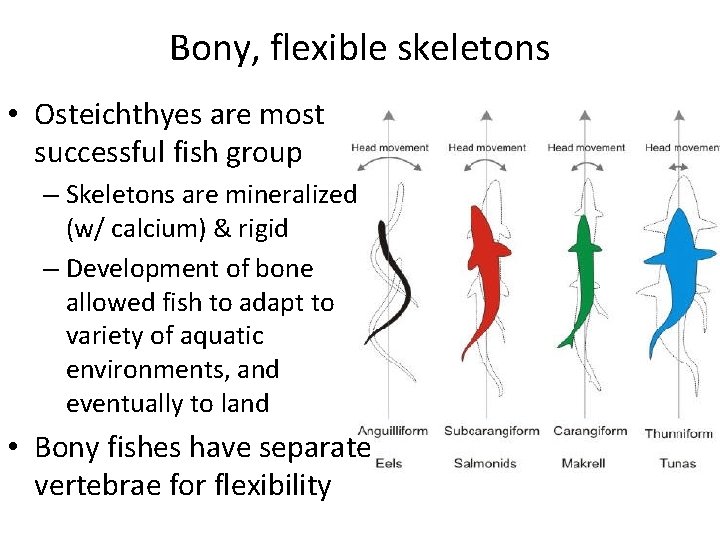
Bony, flexible skeletons • Osteichthyes are most successful fish group – Skeletons are mineralized (w/ calcium) & rigid – Development of bone allowed fish to adapt to variety of aquatic environments, and eventually to land • Bony fishes have separate vertebrae for flexibility
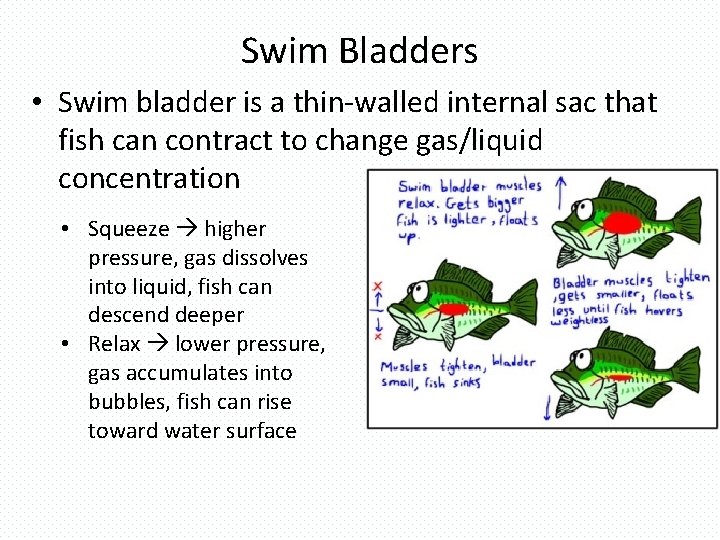
Swim Bladders • Swim bladder is a thin-walled internal sac that fish can contract to change gas/liquid concentration • Squeeze higher pressure, gas dissolves into liquid, fish can descend deeper • Relax lower pressure, gas accumulates into bubbles, fish can rise toward water surface
Fish Diversity • Hagfish & Lampreys are jawless, and feed with a rasping, suckerlike mouth http: //youtu. be/t. KTRv 3 hx 1 s 0 http: //youtu. be/-SYh. OD 1 Yx 10 – Skeletons are made of flexible cartilage – Hagfish create thick slime to avoid predators, tie into knots to slip out of tight spots while feeding http: //youtu. be/pmaal 7 Hf 0 WA http: //youtu. be/5 k. S 64 P-o 5 m. U • Sharks, skates and rays are cartilaginous fishes – Similar to 100, 000 year old fossils, considered “living fossils” – Sharks are most well-known predators of the oceans http: //youtu. be/i. LHTt. Dbt. DFA – Rays & skates have flat bodies, feed near ocean floor http: //youtu. be/9 D 06 j__CZHs • Lobe-finned fishes – 6 species (ex. lungfish, coelacanth) • Ray-finned fishes - ~30, 000 species (ex. catfish, perch, salmon, cod) http: //youtu. be/c. Ig. HEhzi. Ux. U
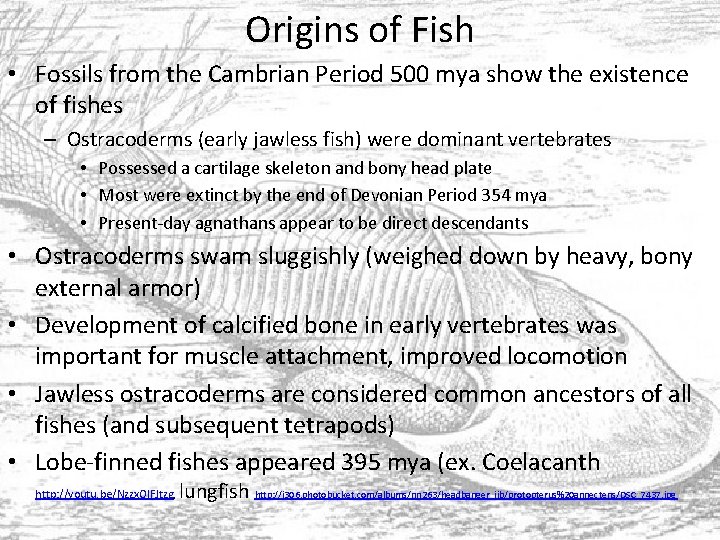
Origins of Fish • Fossils from the Cambrian Period 500 mya show the existence of fishes – Ostracoderms (early jawless fish) were dominant vertebrates • Possessed a cartilage skeleton and bony head plate • Most were extinct by the end of Devonian Period 354 mya • Present-day agnathans appear to be direct descendants • Ostracoderms swam sluggishly (weighed down by heavy, bony external armor) • Development of calcified bone in early vertebrates was important for muscle attachment, improved locomotion • Jawless ostracoderms are considered common ancestors of all fishes (and subsequent tetrapods) • Lobe-finned fishes appeared 395 mya (ex. Coelacanth http: //youtu. be/Nzzx. Ol. FJtzg, lungfish http: //i 306. photobucket. com/albums/nn 263/headbanger_jib/protopterus%20 annectens/DSC_7437. jpg
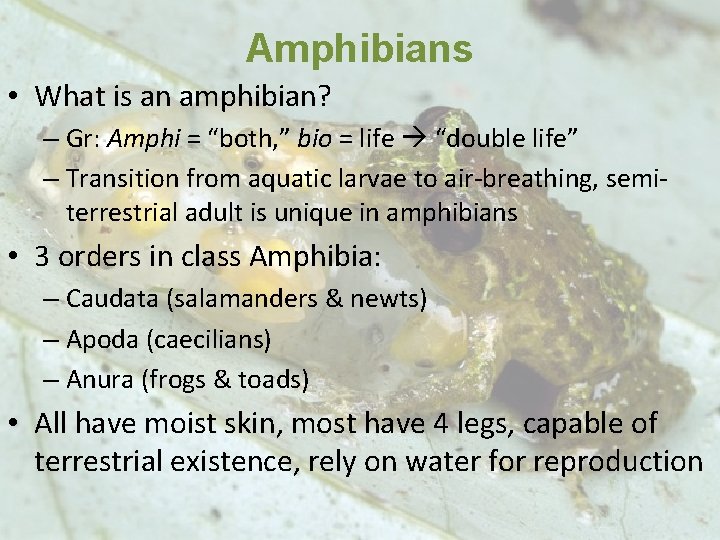
Amphibians • What is an amphibian? – Gr: Amphi = “both, ” bio = life “double life” – Transition from aquatic larvae to air-breathing, semiterrestrial adult is unique in amphibians • 3 orders in class Amphibia: – Caudata (salamanders & newts) – Apoda (caecilians) – Anura (frogs & toads) • All have moist skin, most have 4 legs, capable of terrestrial existence, rely on water for reproduction
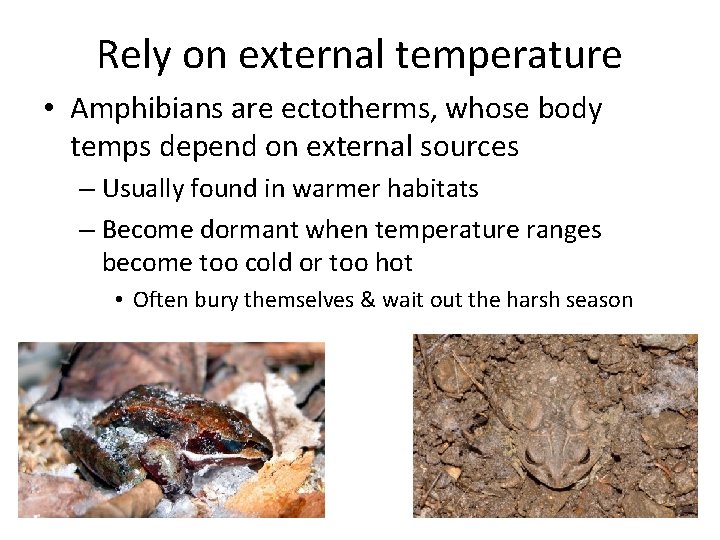
Rely on external temperature • Amphibians are ectotherms, whose body temps depend on external sources – Usually found in warmer habitats – Become dormant when temperature ranges become too cold or too hot • Often bury themselves & wait out the harsh season
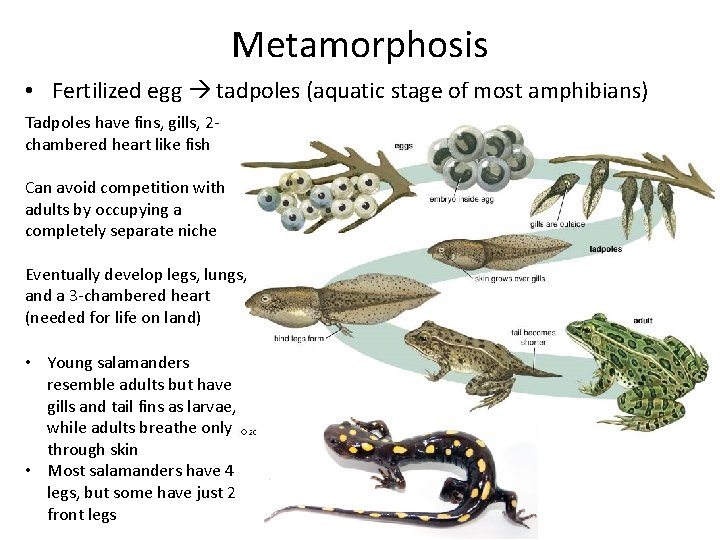
Metamorphosis • Fertilized egg tadpoles (aquatic stage of most amphibians) Tadpoles have fins, gills, 2 chambered heart like fish Can avoid competition with adults by occupying a completely separate niche Eventually develop legs, lungs, and a 3 -chambered heart (needed for life on land) • Young salamanders resemble adults but have gills and tail fins as larvae, while adults breathe only through skin • Most salamanders have 4 legs, but some have just 2 front legs
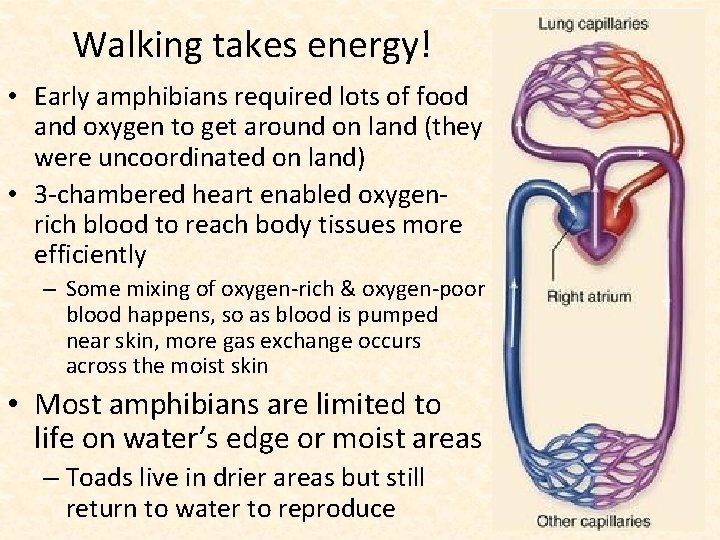
Walking takes energy! • Early amphibians required lots of food and oxygen to get around on land (they were uncoordinated on land) • 3 -chambered heart enabled oxygenrich blood to reach body tissues more efficiently – Some mixing of oxygen-rich & oxygen-poor blood happens, so as blood is pumped near skin, more gas exchange occurs across the moist skin • Most amphibians are limited to life on water’s edge or moist areas – Toads live in drier areas but still return to water to reproduce
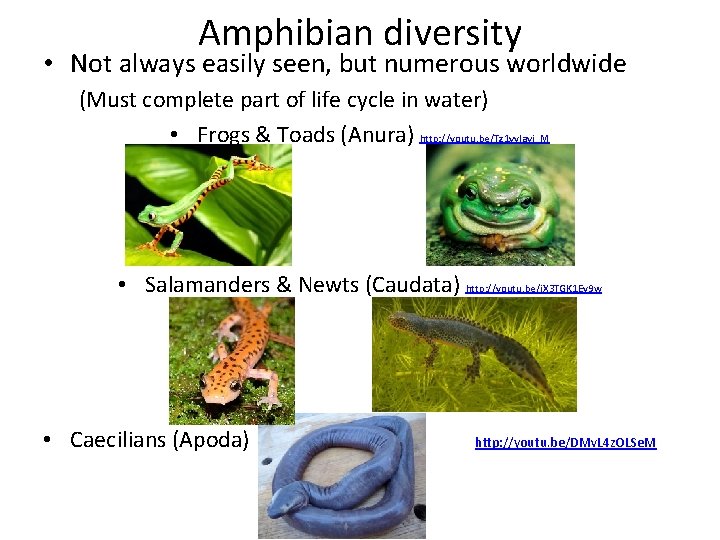
Amphibian diversity • Not always easily seen, but numerous worldwide (Must complete part of life cycle in water) • Frogs & Toads (Anura) http: //youtu. be/Tz 1 vy. Iavi_M • Salamanders & Newts (Caudata) http: //youtu. be/j. X 3 TGK 1 Ey 9 w • Caecilians (Apoda) http: //youtu. be/DMv. L 4 z. OLSe. M
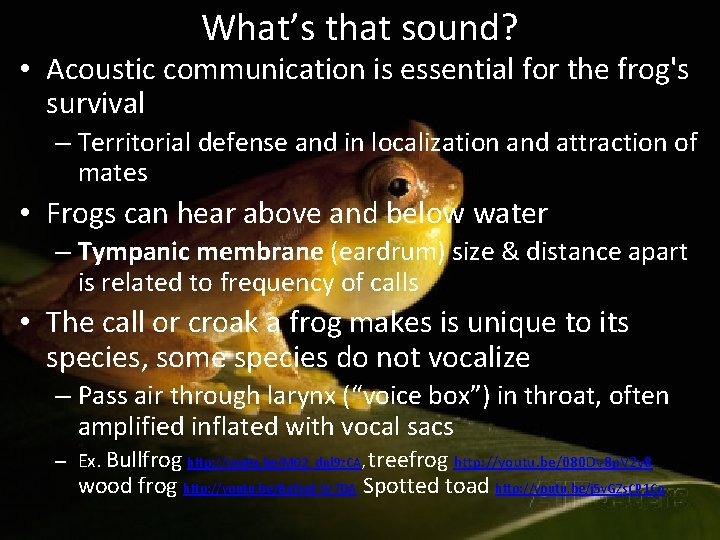
What’s that sound? • Acoustic communication is essential for the frog's survival – Territorial defense and in localization and attraction of mates • Frogs can hear above and below water – Tympanic membrane (eardrum) size & distance apart is related to frequency of calls • The call or croak a frog makes is unique to its species, some species do not vocalize – Pass air through larynx (“voice box”) in throat, often amplified inflated with vocal sacs – Ex. Bullfrog http: //youtu. be/M 02_dnl 9 z. CA, treefrog http: //youtu. be/080 Dv 8 p. V 2 y 8 wood frog http: //youtu. be/Ba. Tret-W 7 DA Spotted toad http: //youtu. be/j 5 v. GZs. CP 1 Co
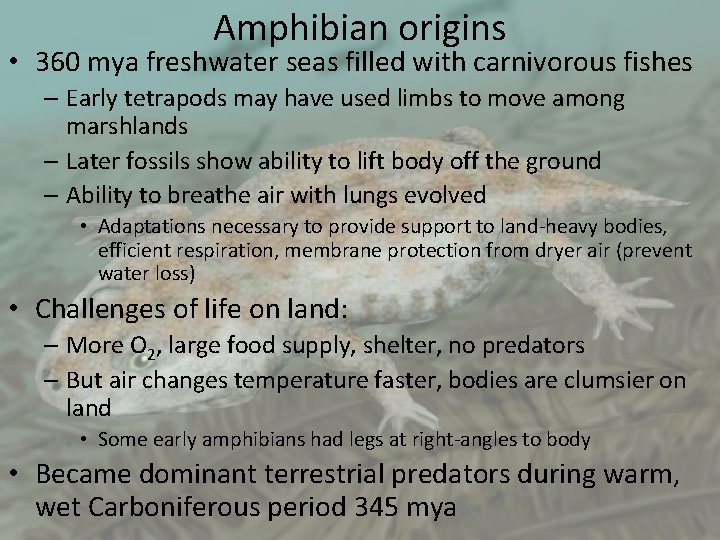
Amphibian origins • 360 mya freshwater seas filled with carnivorous fishes – Early tetrapods may have used limbs to move among marshlands – Later fossils show ability to lift body off the ground – Ability to breathe air with lungs evolved • Adaptations necessary to provide support to land-heavy bodies, efficient respiration, membrane protection from dryer air (prevent water loss) • Challenges of life on land: – More O 2, large food supply, shelter, no predators – But air changes temperature faster, bodies are clumsier on land • Some early amphibians had legs at right-angles to body • Became dominant terrestrial predators during warm, wet Carboniferous period 345 mya
- Slides: 21