
Fiscal Policy How the government uses discretionary fiscal
- Slides: 21
Fiscal Policy How the government uses discretionary fiscal policy to influence the economies performance
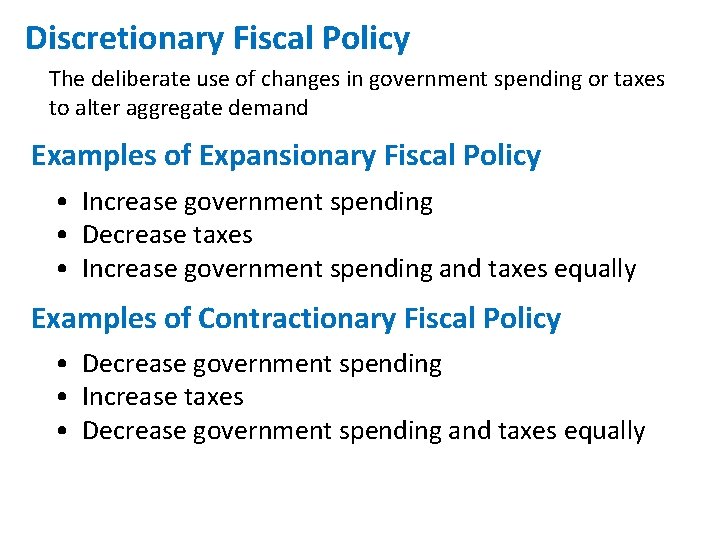
Discretionary Fiscal Policy The deliberate use of changes in government spending or taxes to alter aggregate demand Examples of Expansionary Fiscal Policy • Increase government spending • Decrease taxes • Increase government spending and taxes equally Examples of Contractionary Fiscal Policy • Decrease government spending • Increase taxes • Decrease government spending and taxes equally
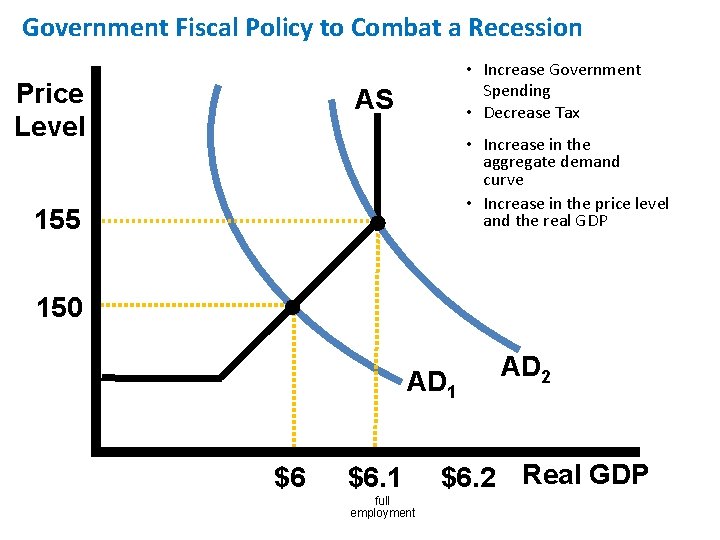
Government Fiscal Policy to Combat a Recession Price Level • Increase Government Spending • Decrease Tax AS • Increase in the aggregate demand curve • Increase in the price level and the real GDP 155 150 AD 1 $6 $6. 1 full employment AD 2 $6. 2 Real GDP
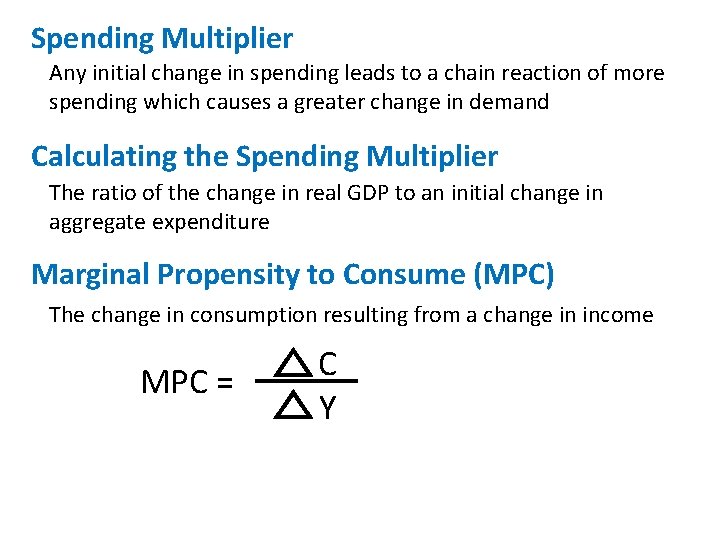
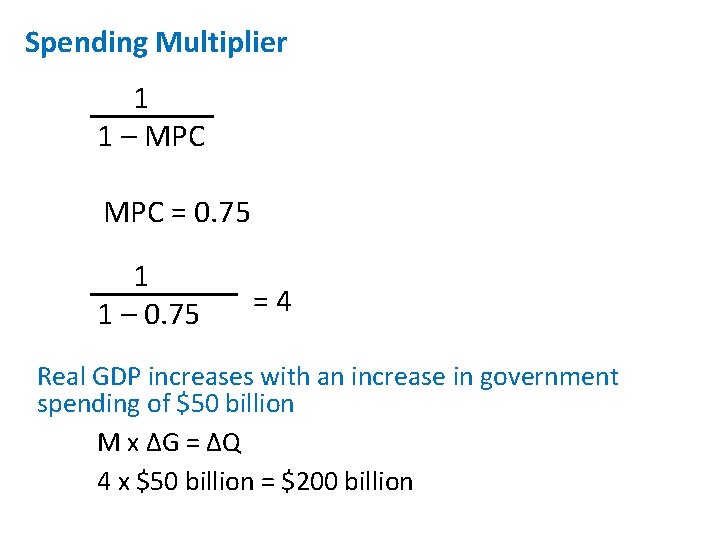
Spending Multiplier Any initial change in spending leads to a chain reaction of more spending which causes a greater change in demand Calculating the Spending Multiplier The ratio of the change in real GDP to an initial change in aggregate expenditure Marginal Propensity to Consume (MPC) The change in consumption resulting from a change in income MPC = C Y
Spending Multiplier 1 1 – MPC = 0. 75 1 1 – 0. 75 =4 Real GDP increases with an increase in government spending of $50 billion M x ΔG = ΔQ 4 x $50 billion = $200 billion
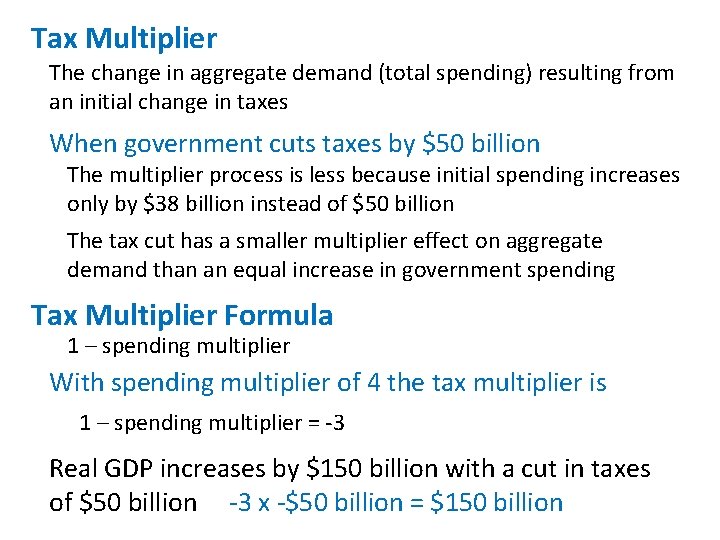
Tax Multiplier The change in aggregate demand (total spending) resulting from an initial change in taxes When government cuts taxes by $50 billion The multiplier process is less because initial spending increases only by $38 billion instead of $50 billion The tax cut has a smaller multiplier effect on aggregate demand than an equal increase in government spending Tax Multiplier Formula 1 – spending multiplier With spending multiplier of 4 the tax multiplier is 1 – spending multiplier = -3 Real GDP increases by $150 billion with a cut in taxes of $50 billion -3 x -$50 billion = $150 billion
The MPC can change from one time period to another Fiscal policy be used to combat inflation when the economy is operating in the intermediate range of the aggregate supply curve
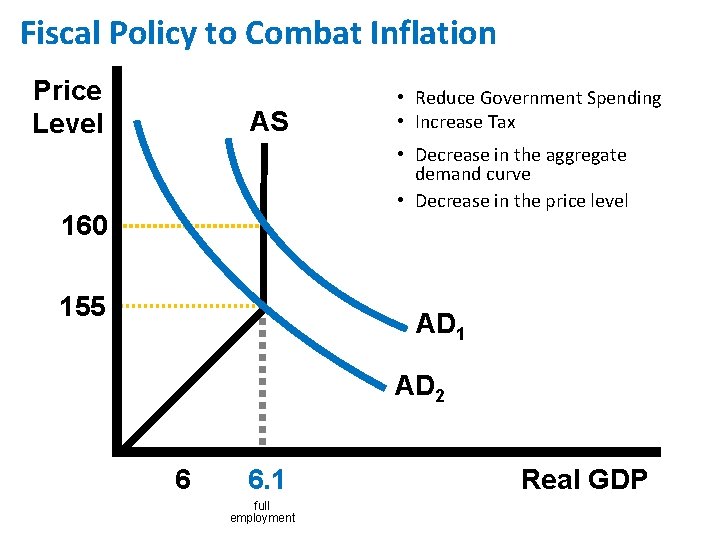
Fiscal Policy to Combat Inflation Price Level AS • Reduce Government Spending • Increase Tax • Decrease in the aggregate demand curve • Decrease in the price level 160 155 AD 1 AD 2 6 6. 1 full employment Real GDP
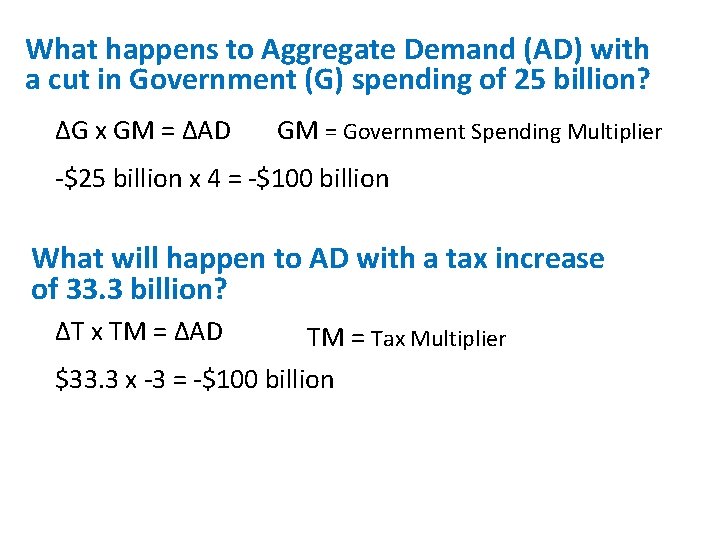
What happens to Aggregate Demand (AD) with a cut in Government (G) spending of 25 billion? ΔG x GM = ΔAD GM = Government Spending Multiplier -$25 billion x 4 = -$100 billion What will happen to AD with a tax increase of 33. 3 billion? ΔT x TM = ΔAD TM = Tax Multiplier $33. 3 x -3 = -$100 billion
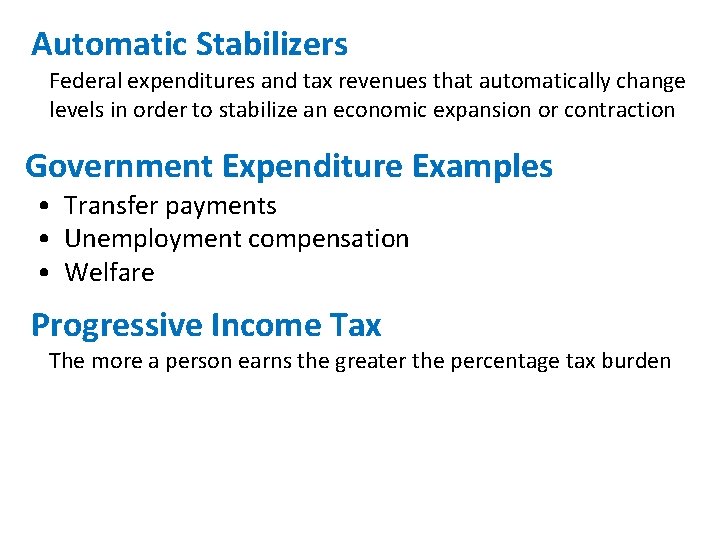
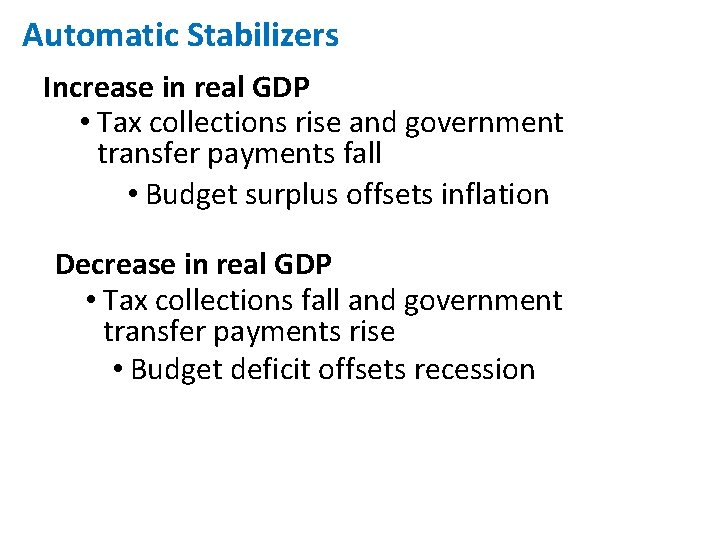
Automatic Stabilizers Federal expenditures and tax revenues that automatically change levels in order to stabilize an economic expansion or contraction Government Expenditure Examples • Transfer payments • Unemployment compensation • Welfare Progressive Income Tax The more a person earns the greater the percentage tax burden
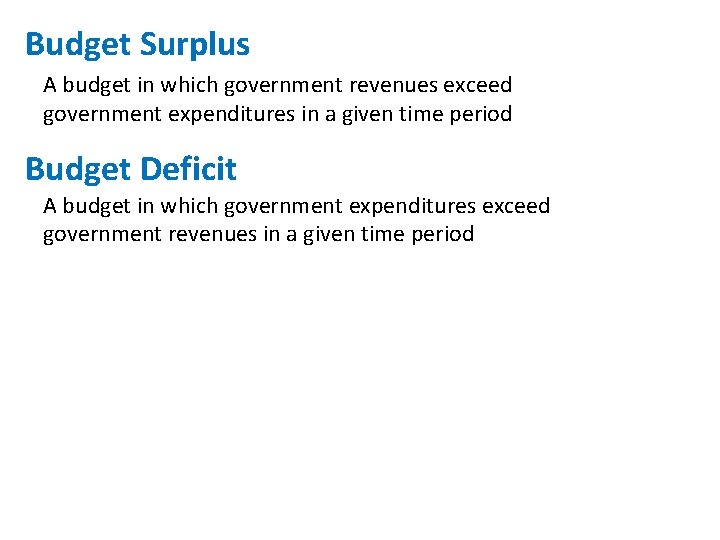
Budget Surplus A budget in which government revenues exceed government expenditures in a given time period Budget Deficit A budget in which government expenditures exceed government revenues in a given time period
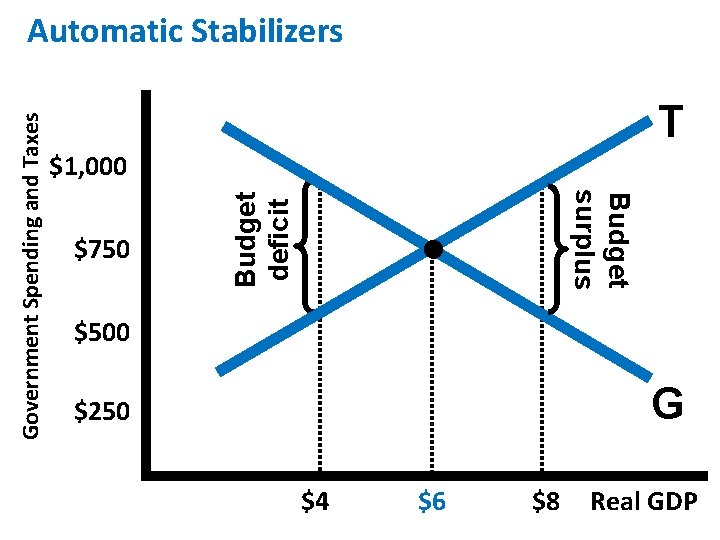
T $1, 000 Budget deficit $750 Budget surplus Government Spending and Taxes Automatic Stabilizers $500 G $250 $4 $6 $8 Real GDP
Automatic Stabilizers Increase in real GDP • Tax collections rise and government transfer payments fall • Budget surplus offsets inflation Decrease in real GDP • Tax collections fall and government transfer payments rise • Budget deficit offsets recession
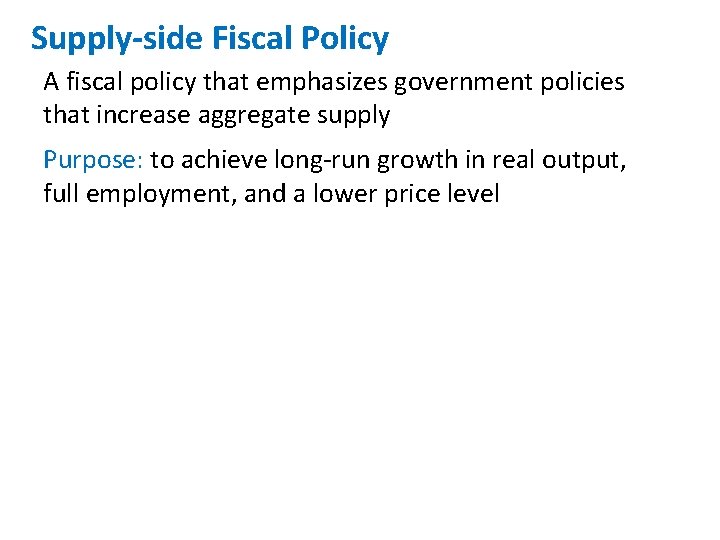
Supply-side Fiscal Policy A fiscal policy that emphasizes government policies that increase aggregate supply Purpose: to achieve long-run growth in real output, full employment, and a lower price level
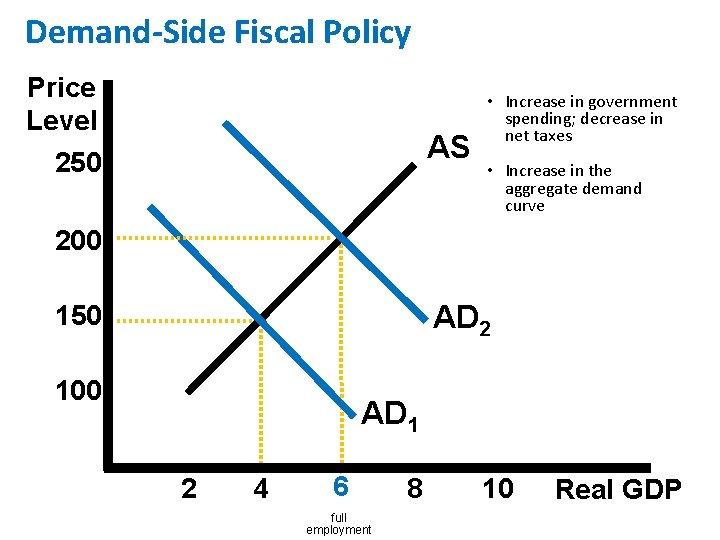
Demand-Side Fiscal Policy Price Level AS 250 • Increase in government spending; decrease in net taxes • Increase in the aggregate demand curve 200 AD 2 150 100 AD 1 2 4 6 full employment 8 10 Real GDP
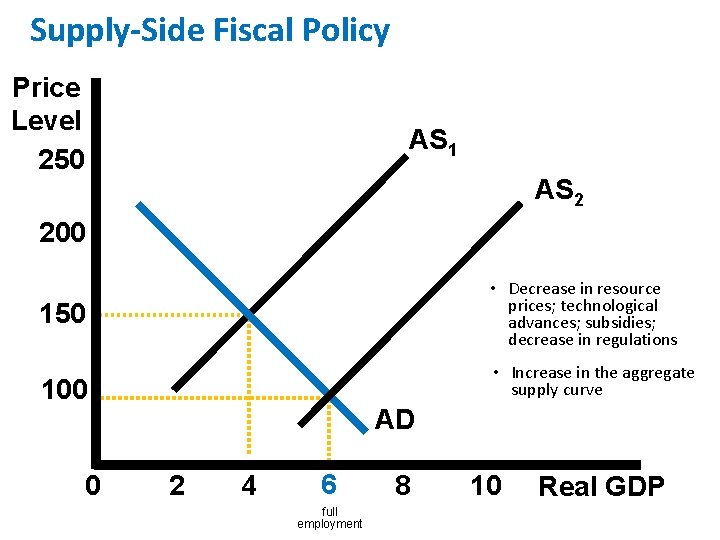
Supply-Side Fiscal Policy Price Level 250 AS 1 AS 2 200 150 • Decrease in resource prices; technological advances; subsidies; decrease in regulations 100 • Increase in the aggregate supply curve 0 AD 2 4 6 full employment 8 10 Real GDP
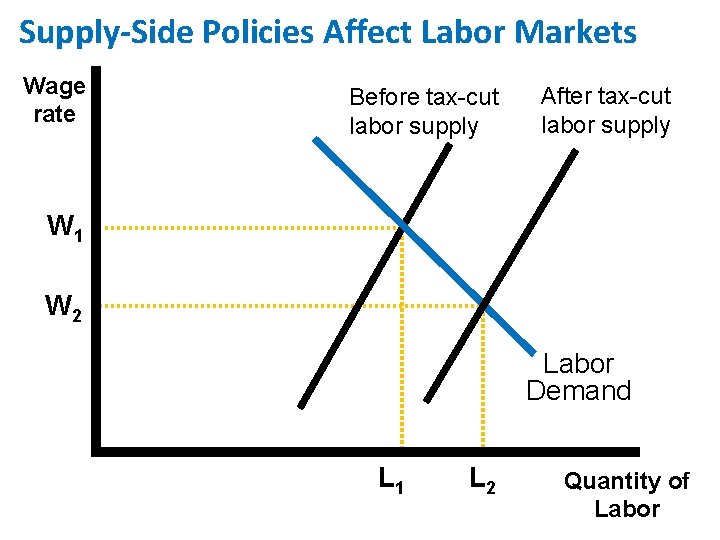
Supply-Side Policies Affect Labor Markets Wage rate Before tax-cut labor supply After tax-cut labor supply W 1 W 2 Labor Demand L 1 L 2 Quantity of Labor
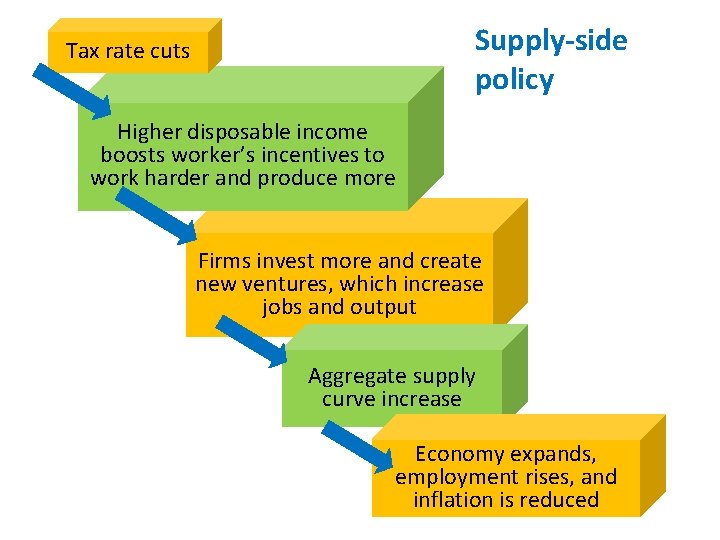
Supply-side policy Tax rate cuts Higher disposable income boosts worker’s incentives to work harder and produce more Firms invest more and create new ventures, which increase jobs and output Aggregate supply curve increase Economy expands, employment rises, and inflation is reduced
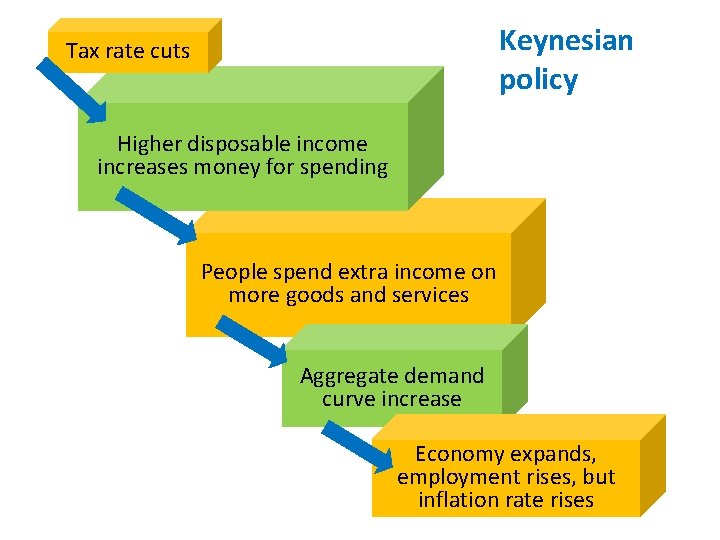
Keynesian policy Tax rate cuts Higher disposable income increases money for spending People spend extra income on more goods and services Aggregate demand curve increase Economy expands, employment rises, but inflation rate rises
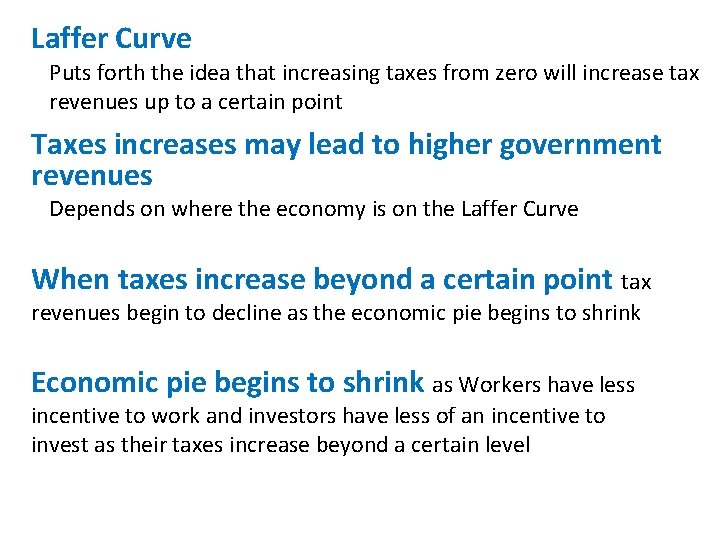
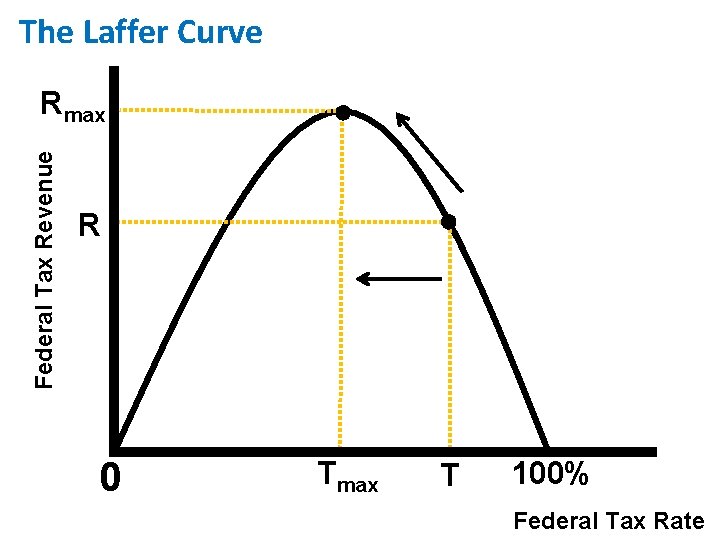
Laffer Curve Puts forth the idea that increasing taxes from zero will increase tax revenues up to a certain point Taxes increases may lead to higher government revenues Depends on where the economy is on the Laffer Curve When taxes increase beyond a certain point tax revenues begin to decline as the economic pie begins to shrink Economic pie begins to shrink as Workers have less incentive to work and investors have less of an incentive to invest as their taxes increase beyond a certain level
The Laffer Curve Federal Tax Revenue Rmax R 0 Tmax T 100% Federal Tax Rate