
FISCAL POLICY 10 a The Spending Multiplier This
- Slides: 48
FISCAL POLICY 10 a – The Spending Multiplier This web quiz may appear as two pages on tablets and laptops. I recommend that you view it as one page by clicking on the open book icon at the bottom of the page.
FISCAL POLICY 10 a – The Spending Multiplier TOPICS: • Consumption and Saving Schedules • APC, APS, MPC, MPS • The Multiplier Effect • The Multiplier with Inflation • The Complex Multiplier
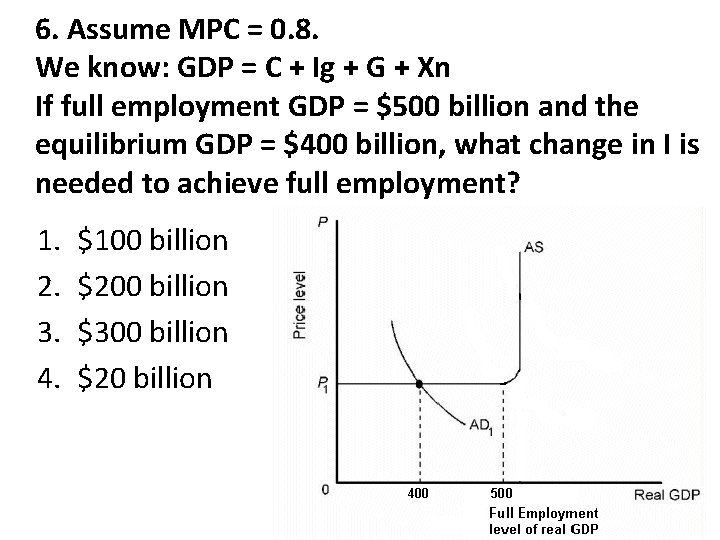
10 a – The Spending Multiplier Outcomes / Must Know: • Recognize, construct, and explain the consumption and saving schedules. • Calculate and differentiate between the average and marginal propensities to consume (and save). • Provide an intuitive explanation of the multiplier effect. • We know that GDP = C + Ig + G + Xn. • If at full employment GDP equals $500 billion, but it is currently at $400 billion, then what increase in investment (I) is needed to achieve full employment? MPC = 0. 8 • Calculate the multiplier and changes in real GDP given information about changes in spending and the marginal propensities. • Discuss why the actual multiplier may differ from theoretical examples (complex multiplier). • Why might a payroll tax cut have a bigger impact on GDP than a cut in income tax rates? Is MPC the same at all income levels? OR If you cut taxes on lower income people and raise the same amount of taxes from higher income people, what effect, if any, will it have on aggregate demand? • How does the spending multiplier work in "reverse"? • Describe the reasons for the instability in investment spending
10 a – The Spending Multiplier KEY TERMS: multiplier effect, consumption schedule, saving schedule, APC, APS, MPC, MPS, leakages and injections, income=expenditures stream, simple multiplier, complex (actual) multiplier, multiplier w/ changes in the price level (IN),
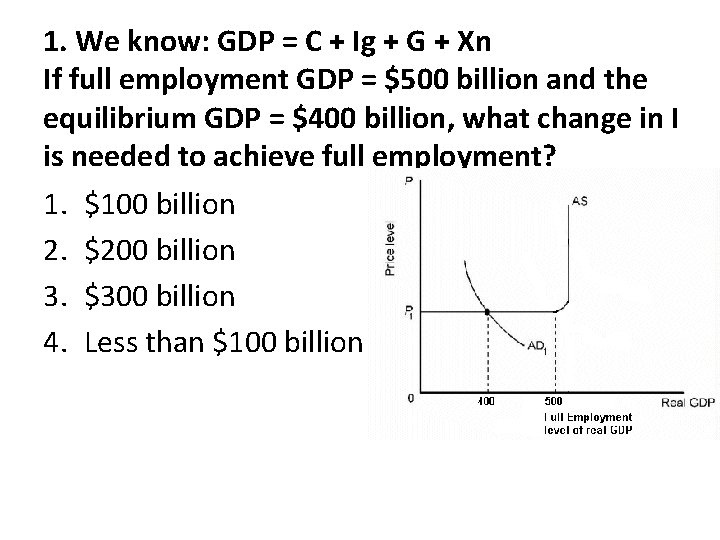
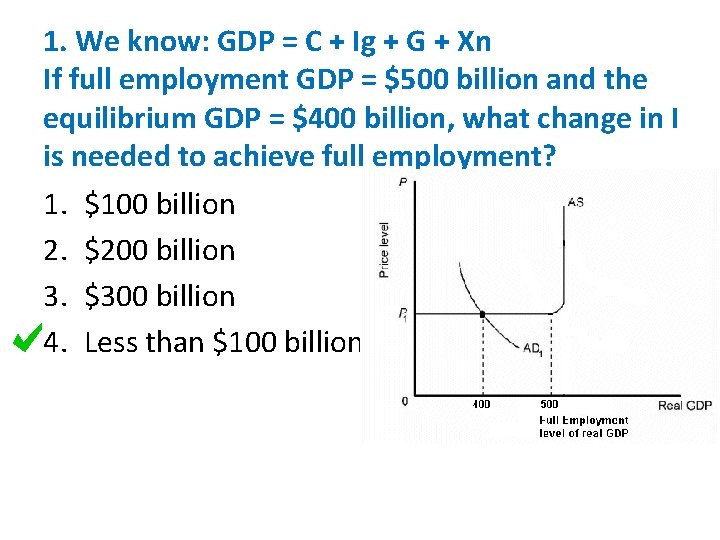
1. We know: GDP = C + Ig + G + Xn If full employment GDP = $500 billion and the equilibrium GDP = $400 billion, what change in I is needed to achieve full employment? 1. $100 billion 2. $200 billion 3. $300 billion 4. Less than $100 billion
1. We know: GDP = C + Ig + G + Xn If full employment GDP = $500 billion and the equilibrium GDP = $400 billion, what change in I is needed to achieve full employment? 1. $100 billion 2. $200 billion 3. $300 billion 4. Less than $100 billion
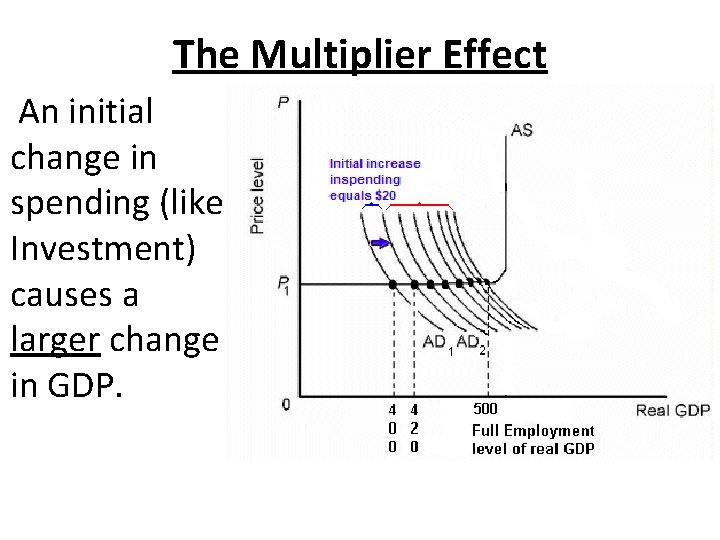
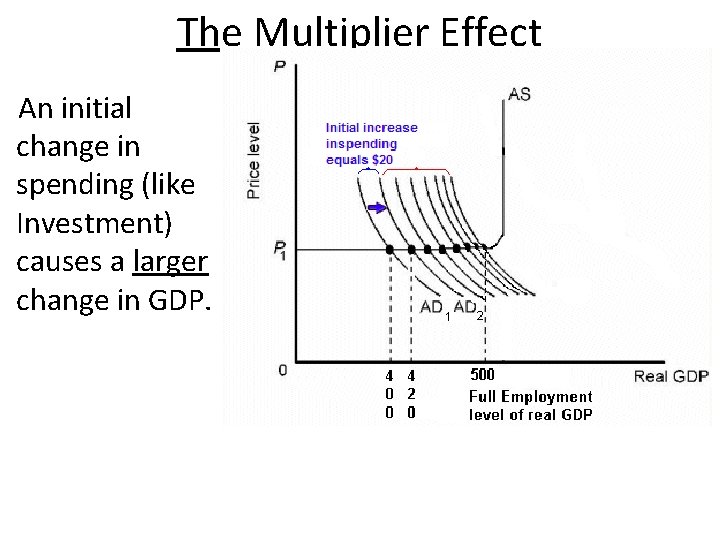
The Multiplier Effect An initial change in spending (like Investment) causes a larger change in GDP.
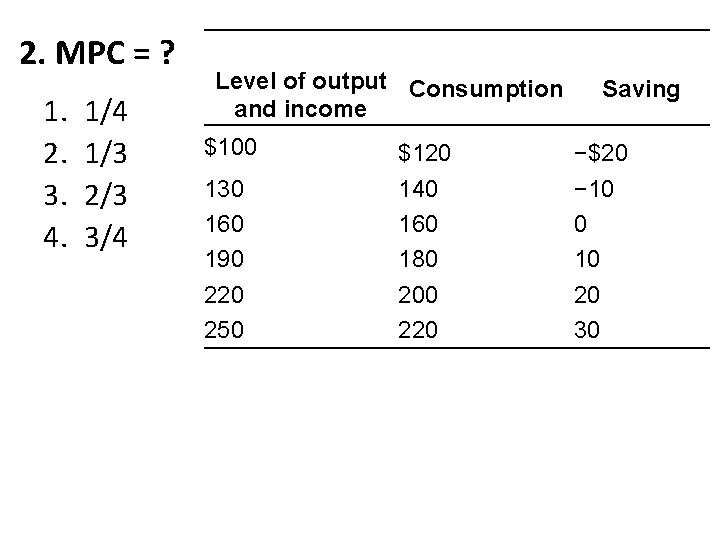
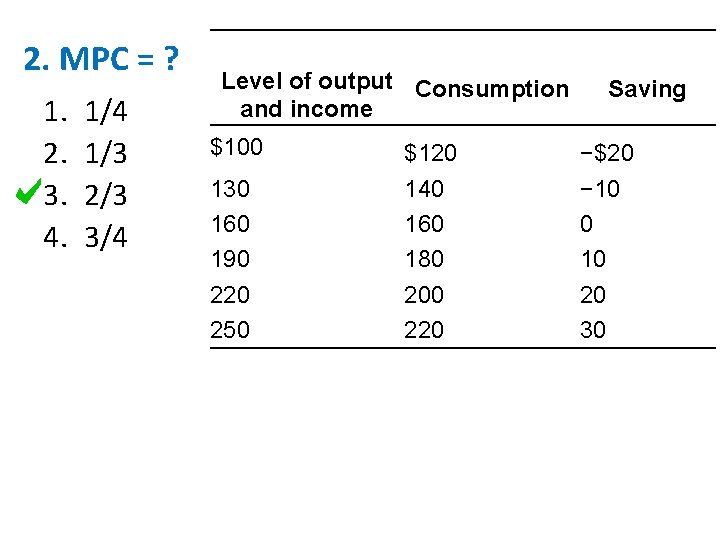
2. MPC = ? 1. 2. 3. 4. 1/4 1/3 2/3 3/4 Level of output Consumption and income $100 130 160 190 220 250 $120 140 160 180 200 220 Saving −$20 − 10 0 10 20 30
2. MPC = ? 1. 2. 3. 4. 1/4 1/3 2/3 3/4 Level of output Consumption and income $100 130 160 190 220 250 $120 140 160 180 200 220 Saving −$20 − 10 0 10 20 30
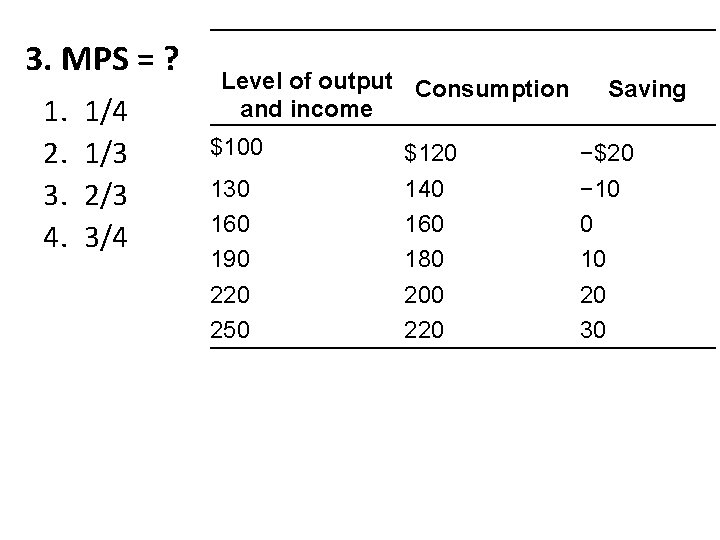
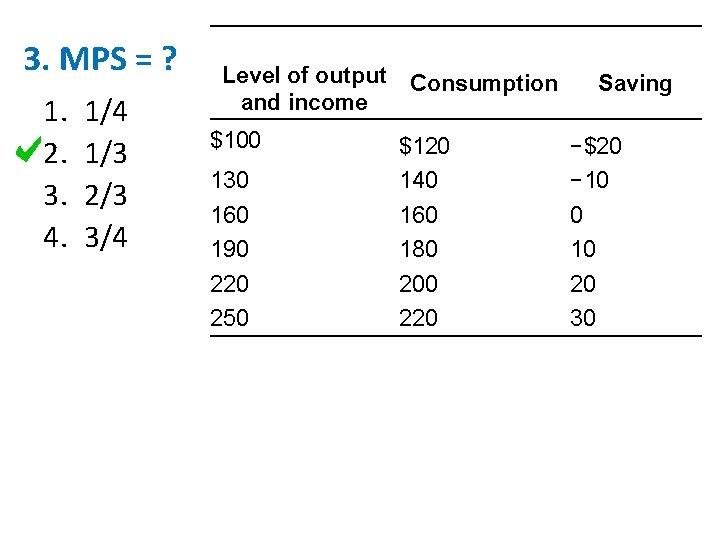
3. MPS = ? 1. 2. 3. 4. 1/4 1/3 2/3 3/4 Level of output Consumption and income $100 130 160 190 220 250 $120 140 160 180 200 220 Saving −$20 − 10 0 10 20 30
3. MPS = ? 1. 2. 3. 4. 1/4 1/3 2/3 3/4 Level of output and income $100 130 160 190 220 250 Consumption $120 140 160 180 200 220 Saving −$20 − 10 0 10 20 30
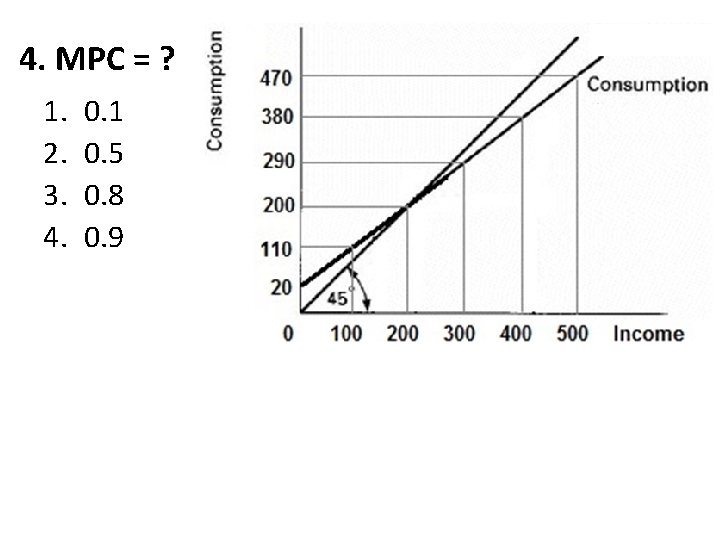
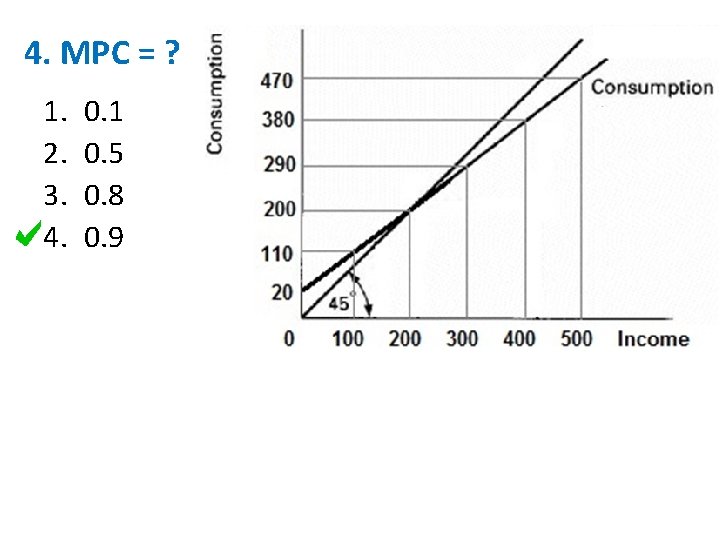
4. MPC = ? 1. 2. 3. 4. 0. 1 0. 5 0. 8 0. 9
4. MPC = ? 1. 2. 3. 4. 0. 1 0. 5 0. 8 0. 9
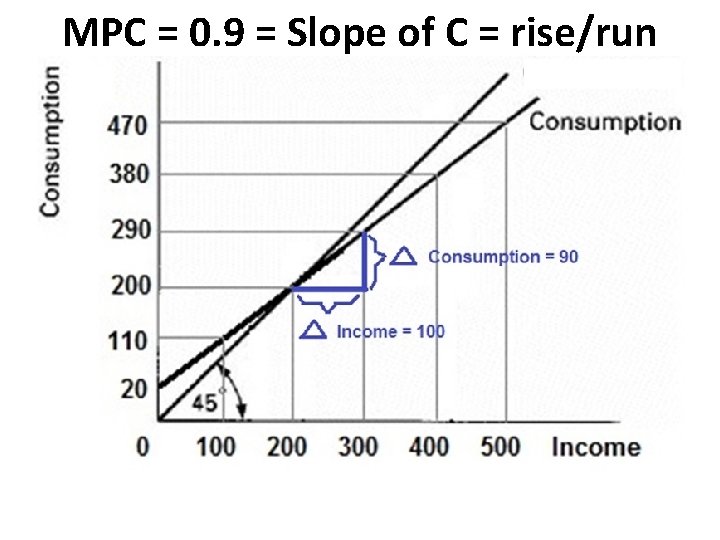
MPC = 0. 9 = Slope of C = rise/run
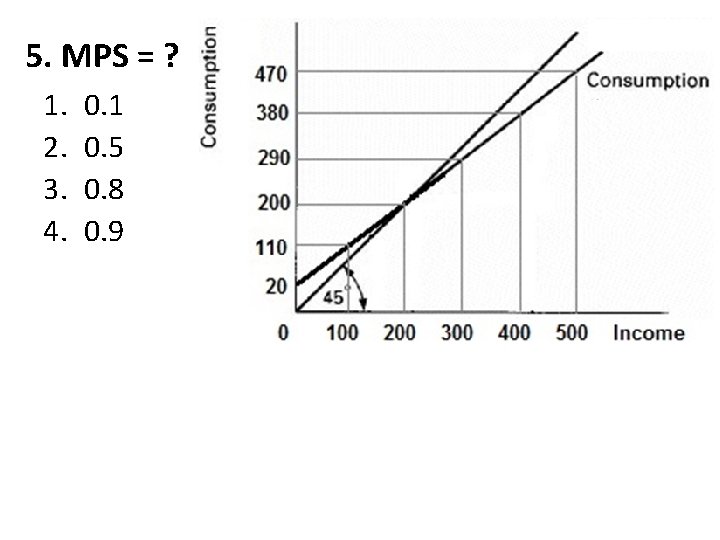
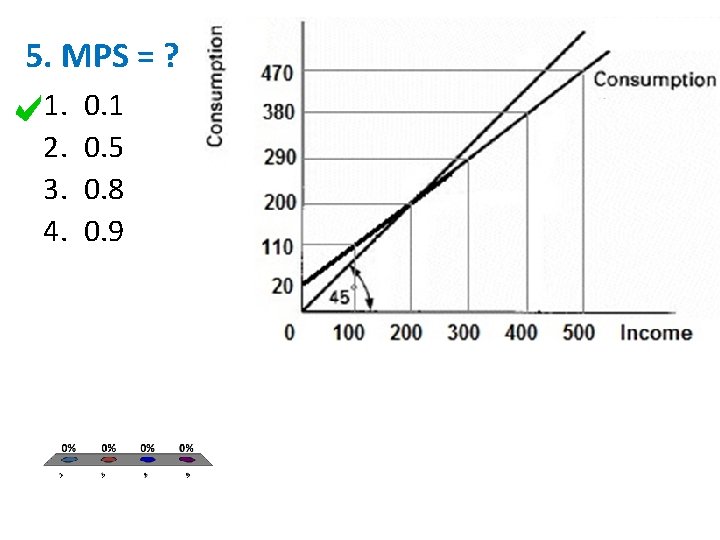
5. MPS = ? 1. 2. 3. 4. 0. 1 0. 5 0. 8 0. 9
5. MPS = ? 1. 2. 3. 4. 0. 1 0. 5 0. 8 0. 9
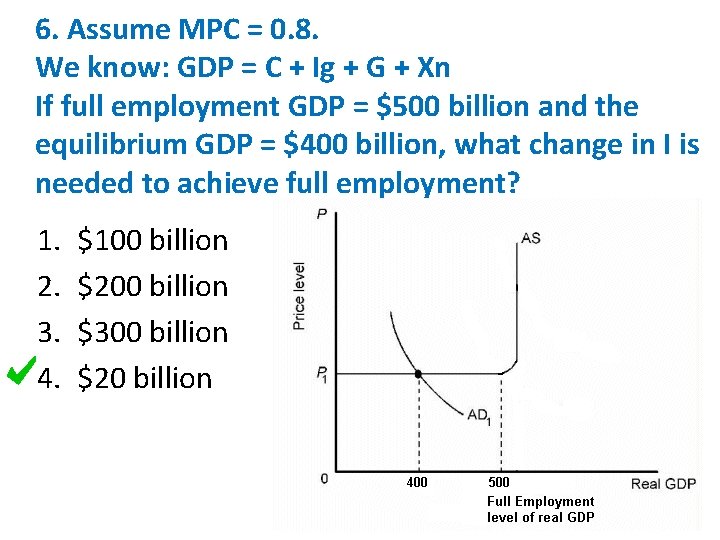
6. Assume MPC = 0. 8. We know: GDP = C + Ig + G + Xn If full employment GDP = $500 billion and the equilibrium GDP = $400 billion, what change in I is needed to achieve full employment? 1. 2. 3. 4. $100 billion $200 billion $300 billion $20 billion
6. Assume MPC = 0. 8. We know: GDP = C + Ig + G + Xn If full employment GDP = $500 billion and the equilibrium GDP = $400 billion, what change in I is needed to achieve full employment? 1. 2. 3. 4. $100 billion $200 billion $300 billion $20 billion
The Multiplier Effect An initial change in spending (like Investment) causes a larger change in GDP.
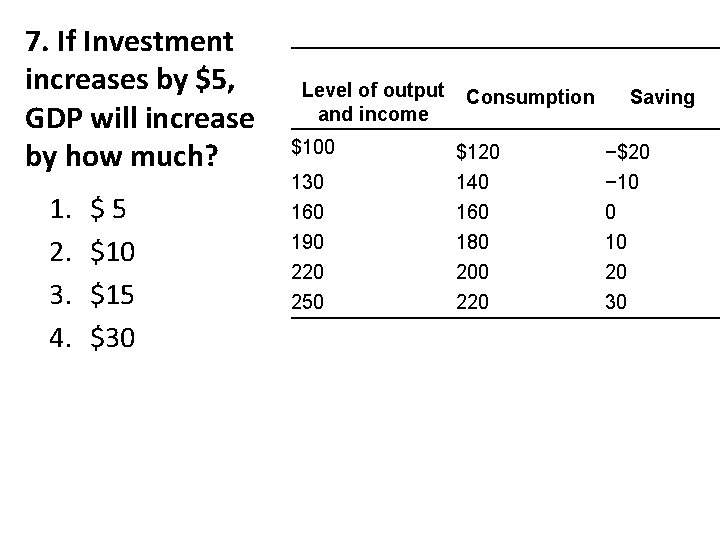
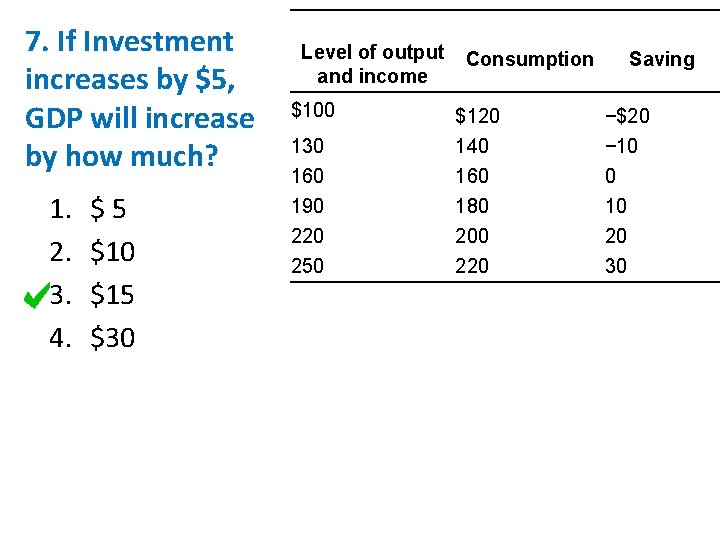
7. If Investment increases by $5, GDP will increase by how much? 1. 2. 3. 4. $5 $10 $15 $30 Level of output and income Consumption Saving $100 $120 −$20 130 160 190 220 250 140 160 180 200 220 − 10 0 10 20 30
7. If Investment increases by $5, GDP will increase by how much? 1. 2. 3. 4. $5 $10 $15 $30 Level of output and income Consumption Saving $100 $120 −$20 130 140 − 10 160 0 190 180 10 220 20 250 220 30
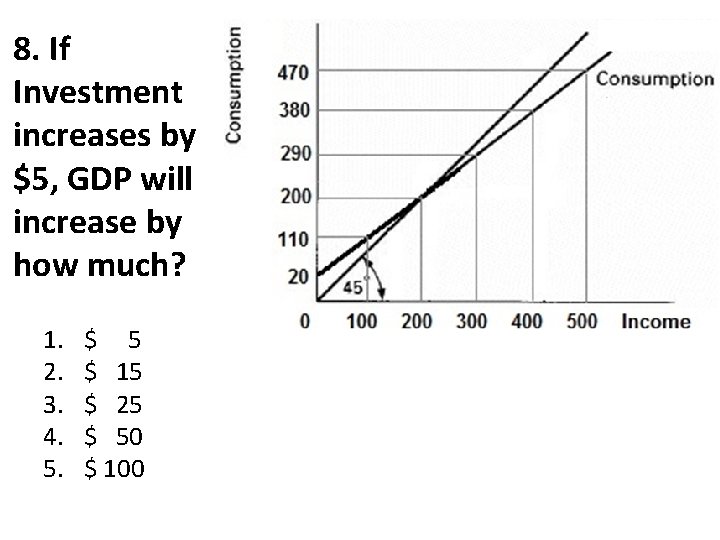
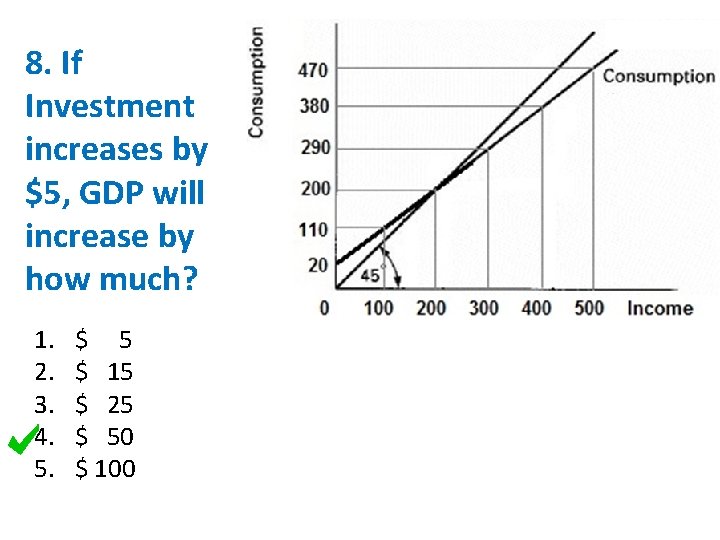
8. If Investment increases by $5, GDP will increase by how much? 1. 2. 3. 4. 5. $ 5 $ 15 $ 25 $ 50 $ 100
8. If Investment increases by $5, GDP will increase by how much? 1. 2. 3. 4. 5. $ 5 $ 15 $ 25 $ 50 $ 100
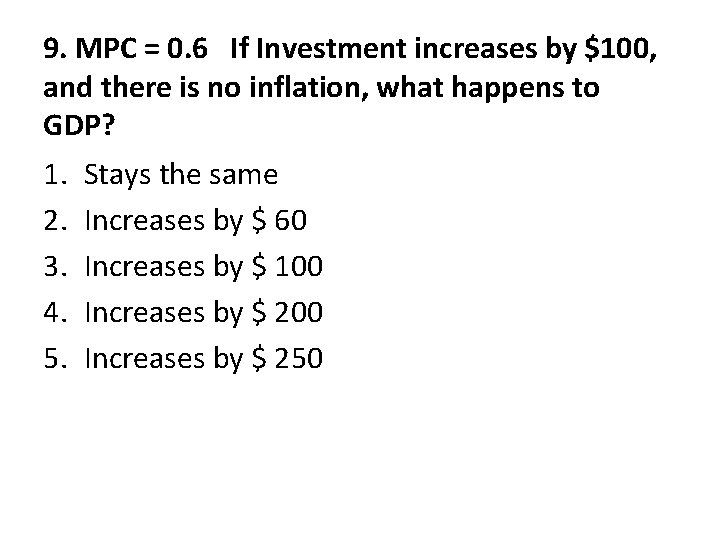
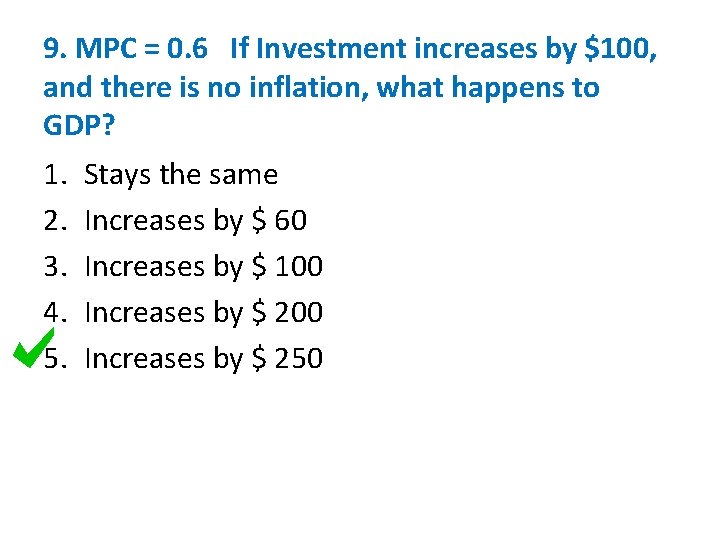
9. MPC = 0. 6 If Investment increases by $100, and there is no inflation, what happens to GDP? 1. 2. 3. 4. 5. Stays the same Increases by $ 60 Increases by $ 100 Increases by $ 250
9. MPC = 0. 6 If Investment increases by $100, and there is no inflation, what happens to GDP? 1. 2. 3. 4. 5. Stays the same Increases by $ 60 Increases by $ 100 Increases by $ 250
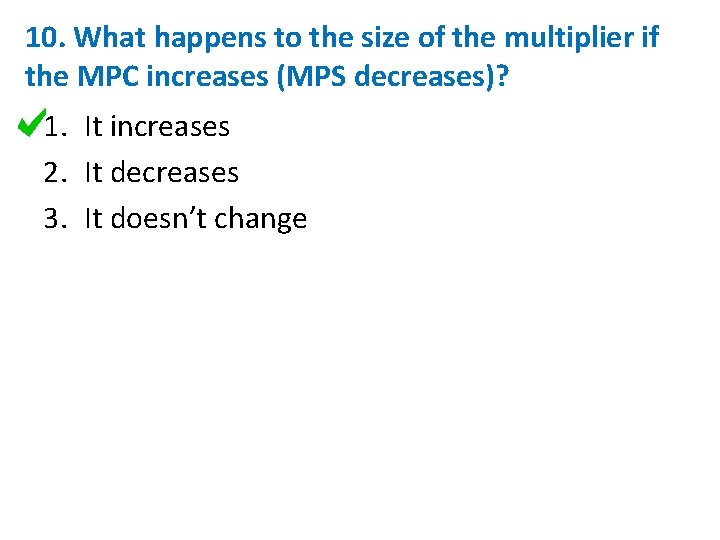
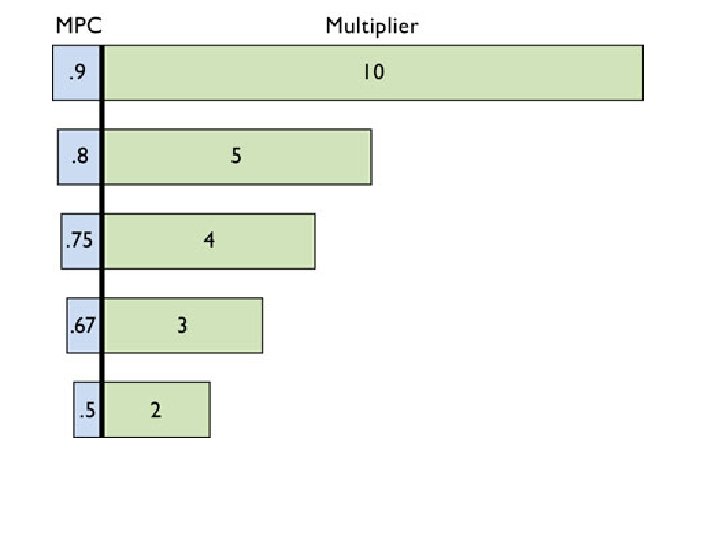
10. What happens to the size of the multiplier if the MPC increases (MPS decreases)? 1. It increases 2. It decreases 3. It doesn’t change
10. What happens to the size of the multiplier if the MPC increases (MPS decreases)? 1. It increases 2. It decreases 3. It doesn’t change
11. We have been assuming that MPC is constant over all income levels. Which is true “in the real world”? 1. MPC is constant 2. MPC is higher for the rich 3. MPC is higher for the poor.
11. We have been assuming that MPC is constant over all income levels. Which is true “in the real world”? 1. MPC is constant 2. MPC is higher for the rich 3. MPC is higher for the poor.
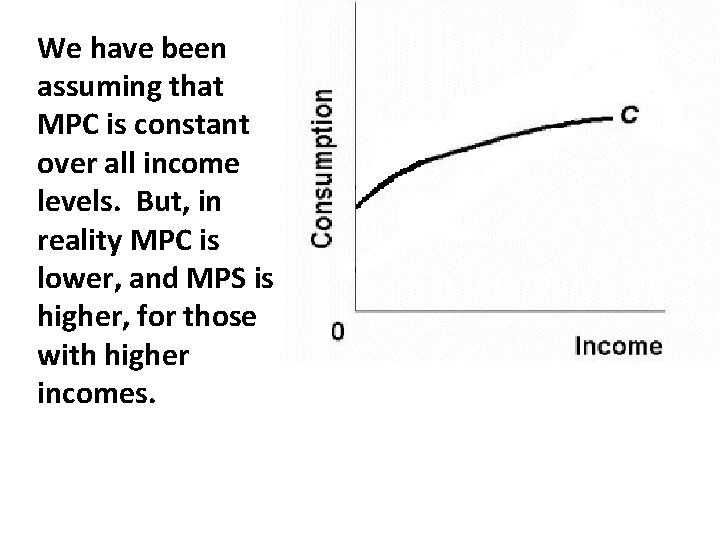
We have been assuming that MPC is constant over all income levels. But, in reality MPC is lower, and MPS is higher, for those with higher incomes.
12. Which would be a more effective expansionary FP? 1. Cutting taxes on the poor 2. Cutting taxes on the rich
12. Which would be a more effective expansionary FP? 1. Cutting taxes on the poor 2. Cutting taxes on the rich
13. If you cut taxes on lower income people and raise the same amount of taxes from higher income people, what effect, if any, will it have on aggregate demand? 1. No effect 2. AD will increase (and UE decrease) 3. AD will decrease (and UE increase)
13. If you cut taxes on lower income people and raise the same amount of taxes from higher income people, what effect, if any, will it have on aggregate demand? 1. No effect 2. AD will increase (and UE decrease) 3. AD will decrease (and UE increase)
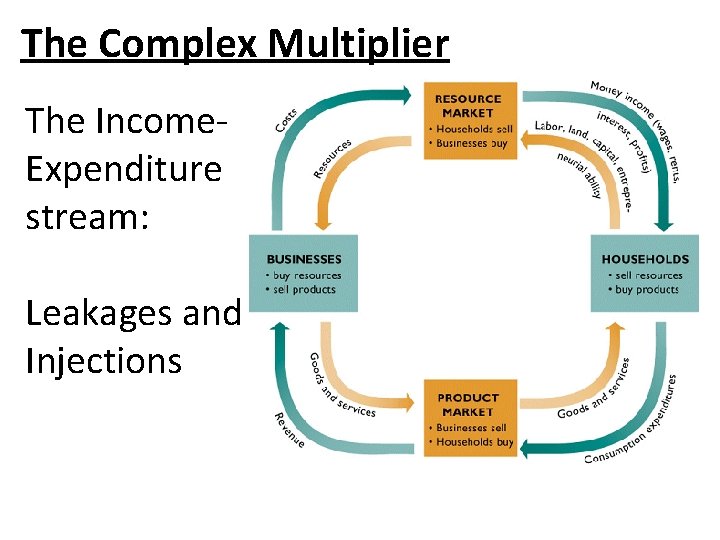
The Complex Multiplier The Income. Expenditure stream: Leakages and Injections
14. We have been ignoring leakages from the Income = Expenditure stream. Leakages will reduce spending Which of the following is NOT a Leakage? 1. 2. 3. 4. Savings (S) Investment (I) Taxes (T) Imports (M) The Complex Multiplier
14. We have been ignoring leakages from the Income = Expenditure stream. Leakages will reduce spending Which of the following is NOT a Leakage? 1. 2. 3. 4. Savings (S) Investment (I) Taxes (T) Imports (M) The Complex Multiplier
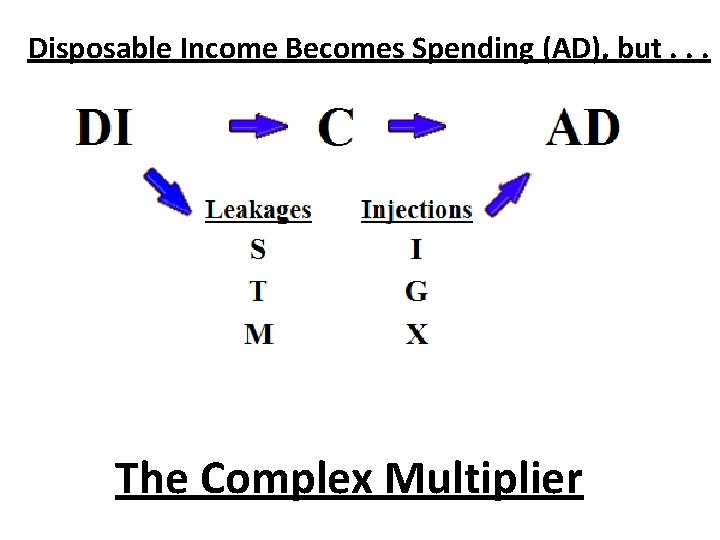
Disposable Income Becomes Spending (AD), but. . . The Complex Multiplier
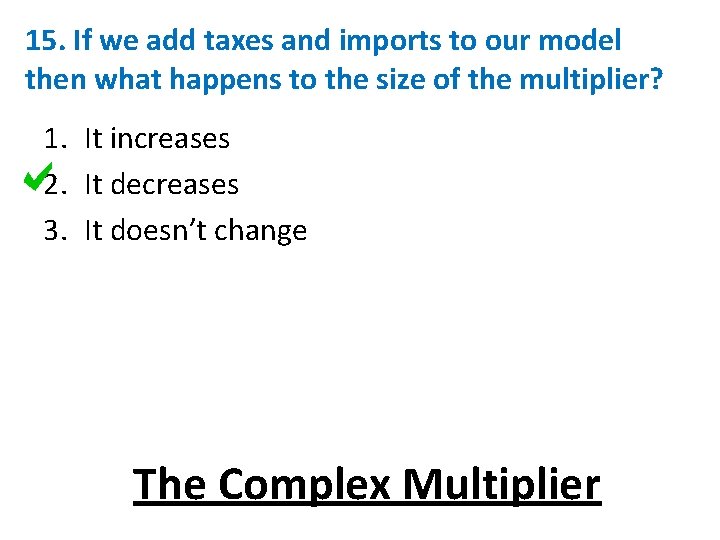
15. If we add taxes and imports to our model then what happens to the size of the multiplier? 1. It increases 2. It decreases 3. It doesn’t change The Complex Multiplier
15. If we add taxes and imports to our model then what happens to the size of the multiplier? 1. It increases 2. It decreases 3. It doesn’t change The Complex Multiplier
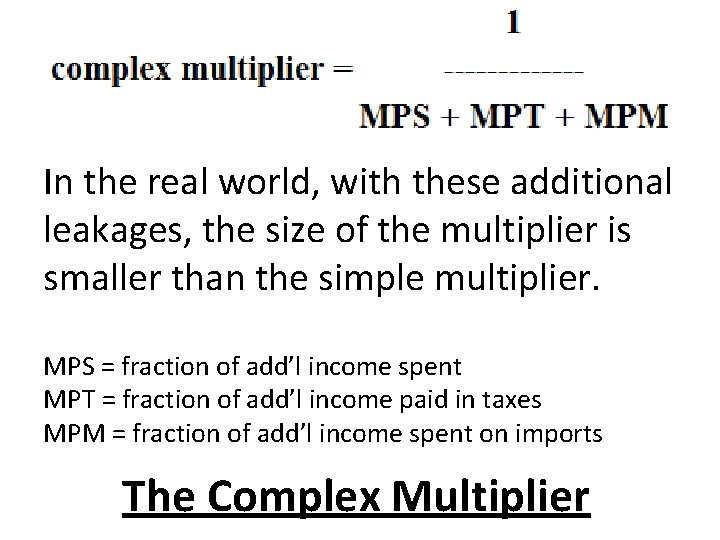
In the real world, with these additional leakages, the size of the multiplier is smaller than the simple multiplier. MPS = fraction of add’l income spent MPT = fraction of add’l income paid in taxes MPM = fraction of add’l income spent on imports The Complex Multiplier
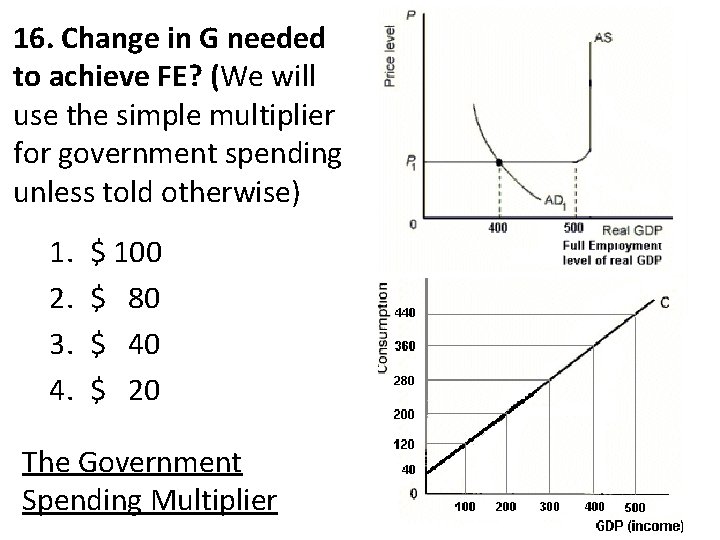
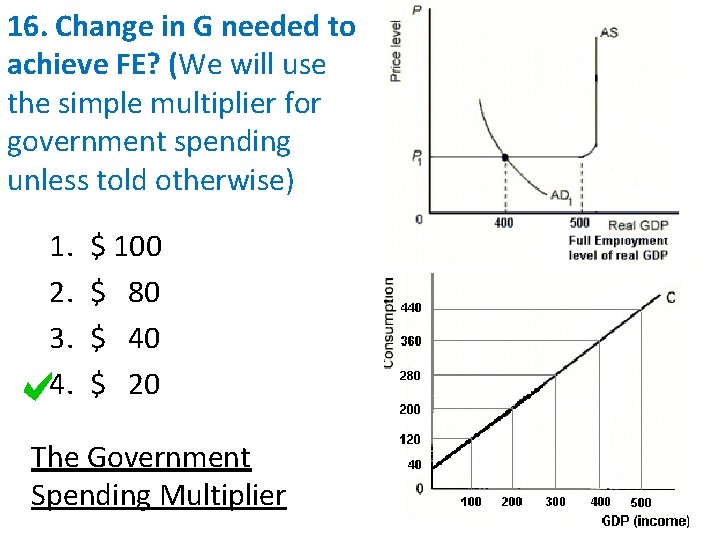
16. Change in G needed to achieve FE? (We will use the simple multiplier for government spending unless told otherwise) 1. 2. 3. 4. $ 100 $ 80 $ 40 $ 20 The Government Spending Multiplier
16. Change in G needed to achieve FE? (We will use the simple multiplier for government spending unless told otherwise) 1. 2. 3. 4. $ 100 $ 80 $ 40 $ 20 The Government Spending Multiplier
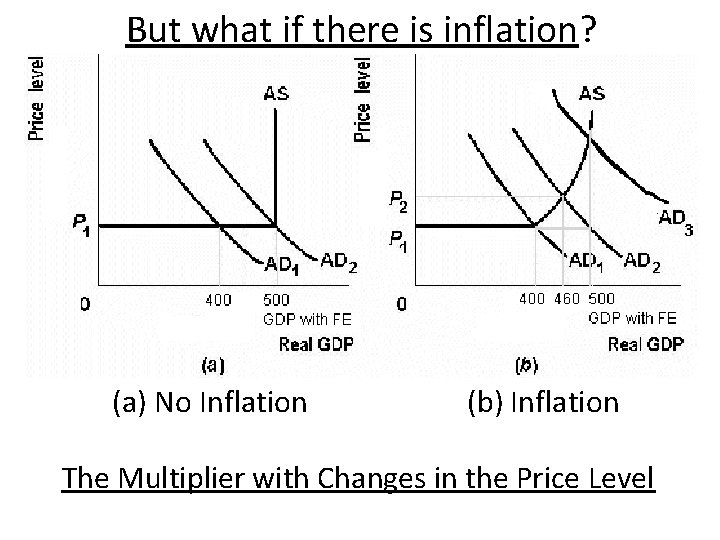
But what if there is inflation? (a) No Inflation (b) Inflation The Multiplier with Changes in the Price Level
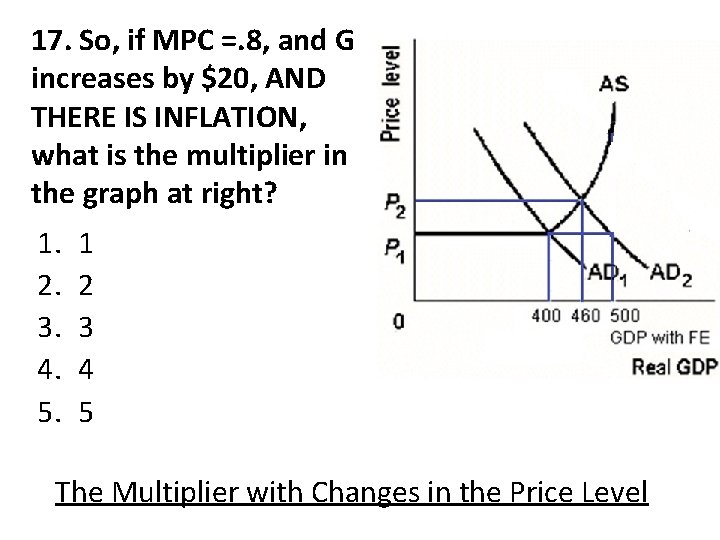
17. So, if MPC =. 8, and G increases by $20, AND THERE IS INFLATION, what is the multiplier in the graph at right? 1. 2. 3. 4. 5. 1 2 3 4 5 The Multiplier with Changes in the Price Level
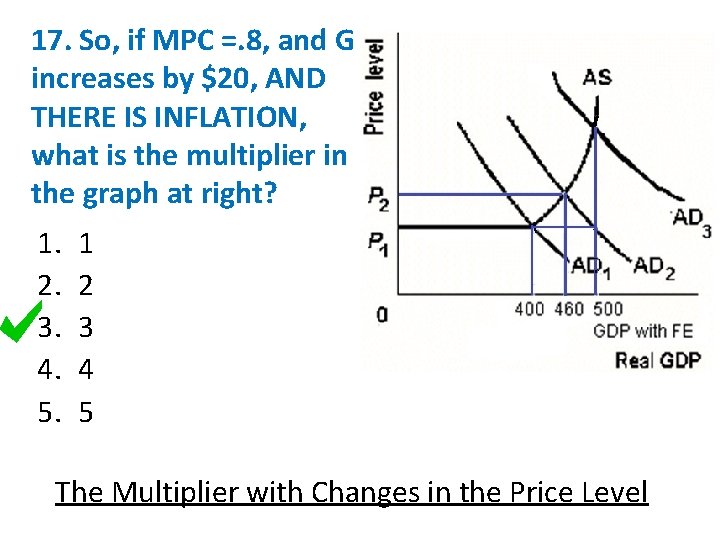
17. So, if MPC =. 8, and G increases by $20, AND THERE IS INFLATION, what is the multiplier in the graph at right? 1. 2. 3. 4. 5. 1 2 3 4 5 The Multiplier with Changes in the Price Level
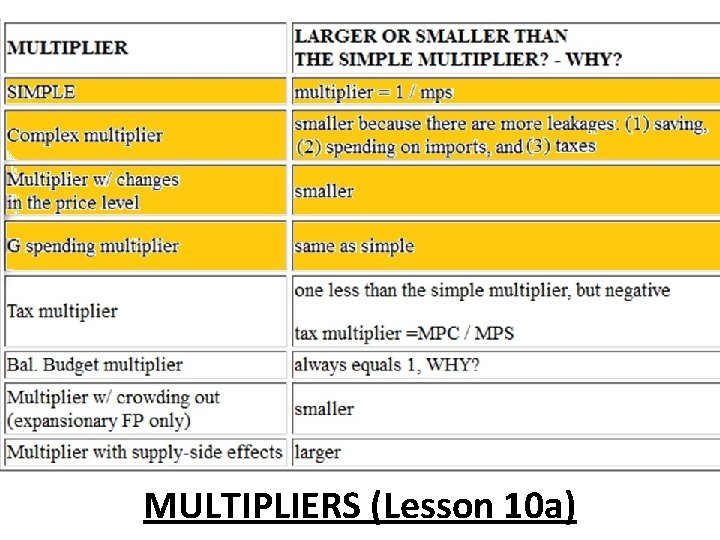
MULTIPLIERS (Lesson 10 a)