
FIS Center of Regulatory Intelligence The Future of
- Slides: 6
FIS Center of Regulatory Intelligence The Future of Military Banking Risk, Information Security & Compliance (RISC) Solutions
Davis Polk Dodd-Frank Progress Report Six-Year Report • July 19, 2016, 271 rulemaking deadlines have passed. • 210 (77. 5%) met with finalized rules and rules proposed that would meet 29 (10. 7%). • Rules have not yet been proposed to meet 32 (11. 8%) passed rulemaking requirements. • Of the 390 total rulemaking requirements, 274 (70. 3%) have been met with finalized rules and rules have been proposed that would meet 36 (9. 2%) more. • Rules not yet been proposed to meet 80 (20. 5%) rulemaking requirements. 2
U. S. Department of the Treasury White Paper “Opportunities and Challenges in Online Marketplace Lending” • Prepared in response to Department of the Treasury’s Request for Information (“RFI”) “Public Input on Expanding Access to Credit through Online Marketplace Lending. ” • Themes 1. Use of Data and Modeling Techniques for Underwriting is an Innovation and a Risk 2. There is Opportunity to Expand Access to Credit 3. New Credit Models and Operations Remain Untested 4. Small Business Borrowers Will Likely Require Enhanced Safeguards 5. Greater Transparency Can Benefit Borrowers and Investors 6. Secondary Market for Loans is Undeveloped 7. Regulatory Clarity Can Benefit the Market 3
Office of the Comptroller of the Currency (OCC) White Paper “Supporting Responsible Innovation in the Federal Banking System: An OCC Perspective” • OCC summarizes its research and discusses the principles guiding the development of its framework for understanding and evaluating innovation. • Guiding Principles for the OCC’s Approach to Responsible Innovation 1. Support responsible innovation. 2. Foster an internal culture receptive to responsible innovation. 3. Leverage agency experience and expertise. 4. Encourage responsible innovation that provides fair access to financial services and fair treatment of consumers. 5. Further safe and sound operations through effective risk management. 6. Encourage banks of all sizes to integrate responsible innovation into their strategic planning. 7. Promote ongoing dialogue through formal outreach. 8. Collaborate with other regulators. 4
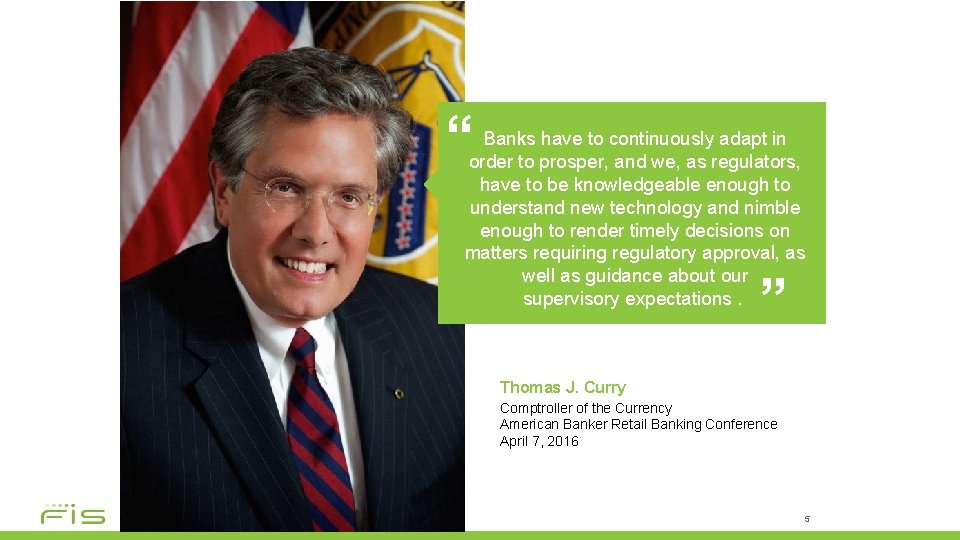
“ Banks have to continuously adapt in order to prosper, and we, as regulators, have to be knowledgeable enough to understand new technology and nimble enough to render timely decisions on matters requiring regulatory approval, as well as guidance about our supervisory expectations. “ Thomas J. Curry Comptroller of the Currency American Banker Retail Banking Conference April 7, 2016 5
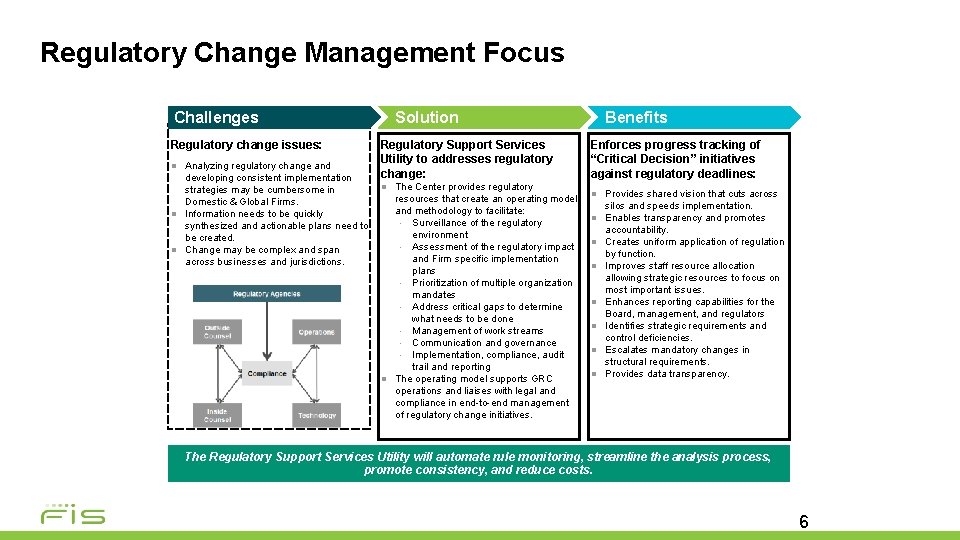
Regulatory Change Management Focus Challenges Regulatory change issues: n n n Analyzing regulatory change and developing consistent implementation strategies may be cumbersome in Domestic & Global Firms. Information needs to be quickly synthesized and actionable plans need to be created. Change may be complex and span across businesses and jurisdictions. Solution Regulatory Support Services Utility to addresses regulatory change: n n The Center provides regulatory resources that create an operating model and methodology to facilitate: • Surveillance of the regulatory environment • Assessment of the regulatory impact and Firm specific implementation plans • Prioritization of multiple organization mandates • Address critical gaps to determine what needs to be done • Management of work streams • Communication and governance • Implementation, compliance, audit trail and reporting The operating model supports GRC operations and liaises with legal and compliance in end-to-end management of regulatory change initiatives. Benefits Enforces progress tracking of “Critical Decision” initiatives against regulatory deadlines: n n n n Provides shared vision that cuts across silos and speeds implementation. Enables transparency and promotes accountability. Creates uniform application of regulation by function. Improves staff resource allocation allowing strategic resources to focus on most important issues. Enhances reporting capabilities for the Board, management, and regulators Identifies strategic requirements and control deficiencies. Escalates mandatory changes in structural requirements. Provides data transparency. The Regulatory Support Services Utility will automate rule monitoring, streamline the analysis process, promote consistency, and reduce costs. 6