
FIRSTLetter Mnemonic Strategy The Learning Strategy Series 2004
- Slides: 17
FIRST-Letter Mnemonic Strategy The Learning Strategy Series 2004 The University of Kansas Center for Research on Learning Lawrence, Kansas
University of Kansas Center for Research on Learning 2004 2
Purpose of the Strategy – To make the student active in processing information in lecture notes and in the textbook – To enable the student to organize information in a simple way (in lists) – To enable the students to memorize listed information – To enable the student to test himself or herself to prepare for a test – To promote a feeling of confidence in students in regard to mastering information and taking tests University of Kansas Center for Research on Learning 2004 3
Two Sets of Steps for the Strategy – Set 1: The FIRST Steps Enable the student to design mnemonic devices to aid memorization of listed information – Set 2: The LISTS Steps Enable the student to find information for lists, to memorize lists, and to self-test University of Kansas Center for Research on Learning 2004 4
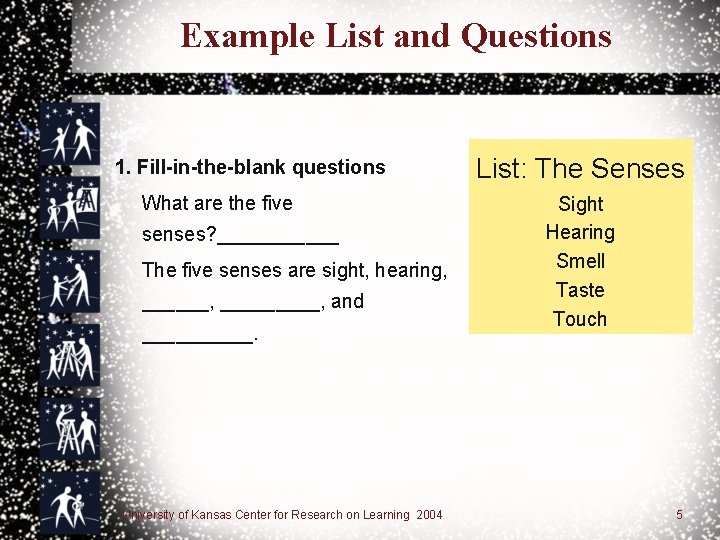
Example List and Questions 1. Fill-in-the-blank questions What are the five senses? ______ The five senses are sight, hearing, _________, and _____. University of Kansas Center for Research on Learning 2004 List: The Senses Sight Hearing Smell Taste Touch 5
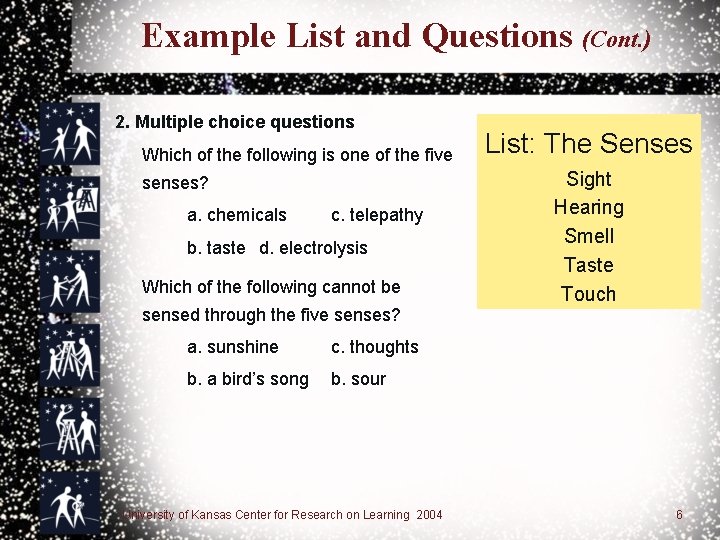
Example List and Questions (Cont. ) 2. Multiple choice questions Which of the following is one of the five senses? a. chemicals c. telepathy b. taste d. electrolysis Which of the following cannot be sensed through the five senses? a. sunshine c. thoughts b. a bird’s song b. sour University of Kansas Center for Research on Learning 2004 List: The Senses Sight Hearing Smell Taste Touch 6
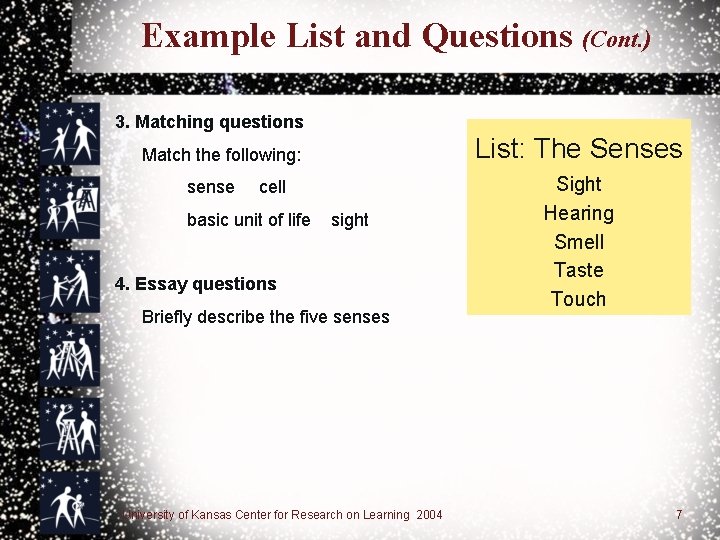
Example List and Questions (Cont. ) 3. Matching questions List: The Senses Match the following: sense cell basic unit of life sight 4. Essay questions Briefly describe the five senses University of Kansas Center for Research on Learning 2004 Sight Hearing Smell Taste Touch 7
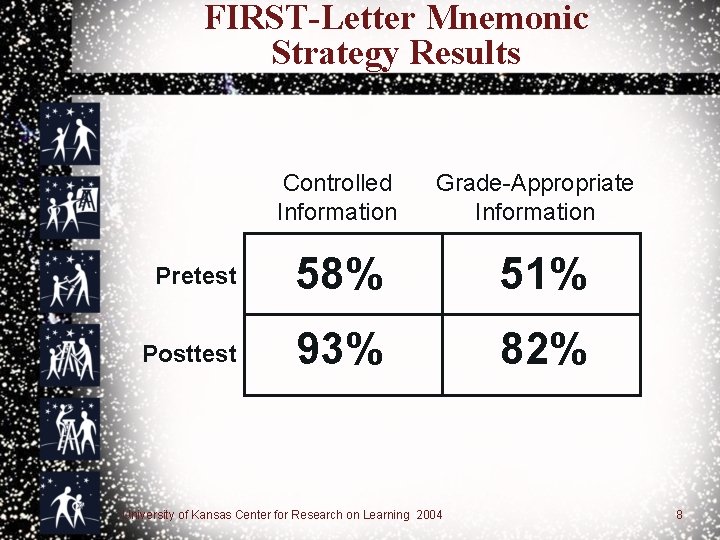
FIRST-Letter Mnemonic Strategy Results Controlled Information Grade-Appropriate Information Pretest 58% 51% Posttest 93% 82% University of Kansas Center for Research on Learning 2004 8
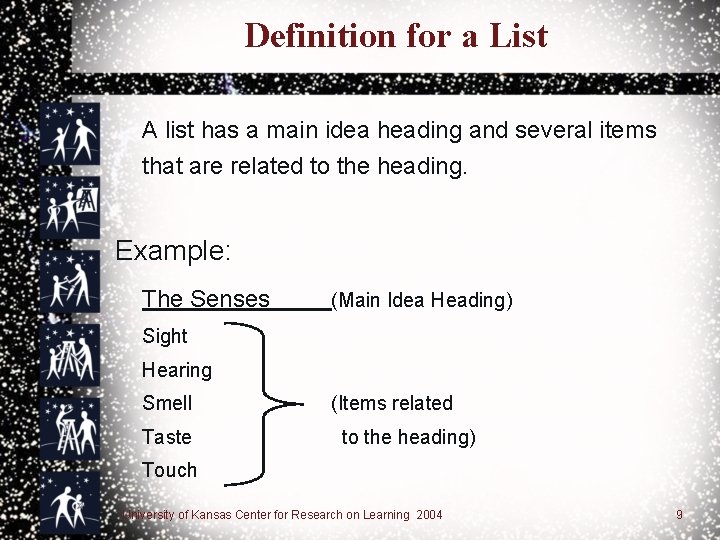
Definition for a List A list has a main idea heading and several items that are related to the heading. Example: The Senses (Main Idea Heading) Sight Hearing Smell Taste (Items related to the heading) Touch University of Kansas Center for Research on Learning 2004 9
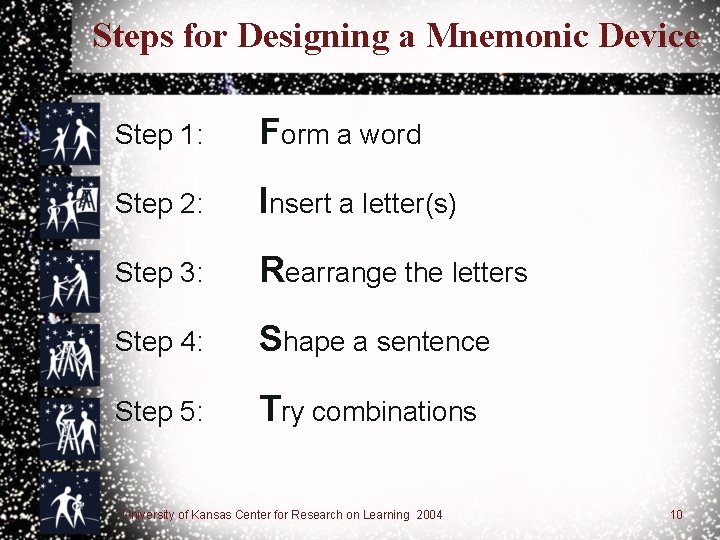
Steps for Designing a Mnemonic Device Step 1: Form a word Step 2: Insert a letter(s) Step 3: Rearrange the letters Step 4: Shape a sentence Step 5: Try combinations University of Kansas Center for Research on Learning 2004 10
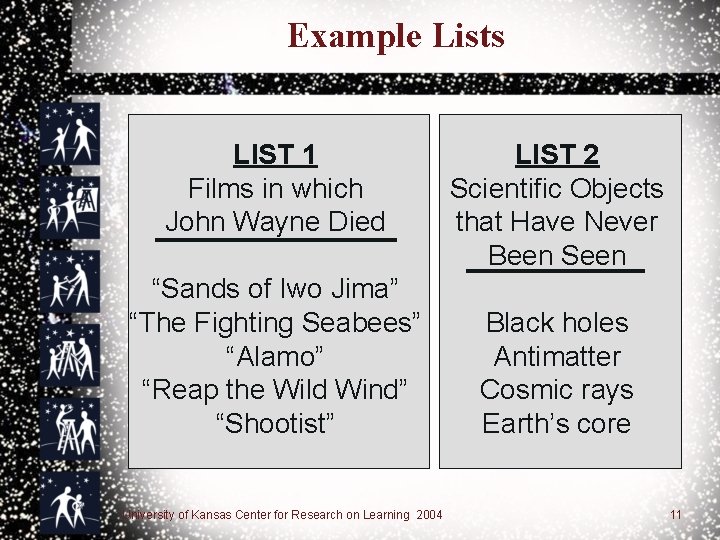
Example Lists LIST 1 Films in which John Wayne Died “Sands of Iwo Jima” “The Fighting Seabees” “Alamo” “Reap the Wild Wind” “Shootist” University of Kansas Center for Research on Learning 2004 LIST 2 Scientific Objects that Have Never Been Seen Black holes Antimatter Cosmic rays Earth’s core 11
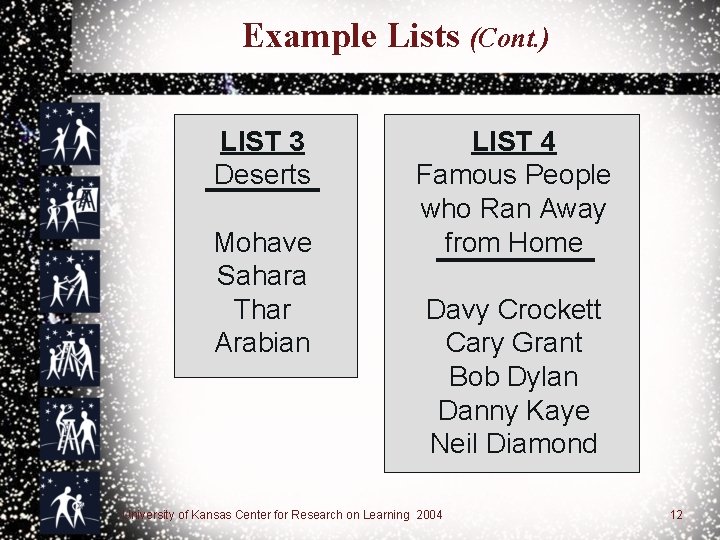
Example Lists (Cont. ) LIST 3 Deserts Mohave Sahara Thar Arabian LIST 4 Famous People who Ran Away from Home Davy Crockett Cary Grant Bob Dylan Danny Kaye Neil Diamond University of Kansas Center for Research on Learning 2004 12
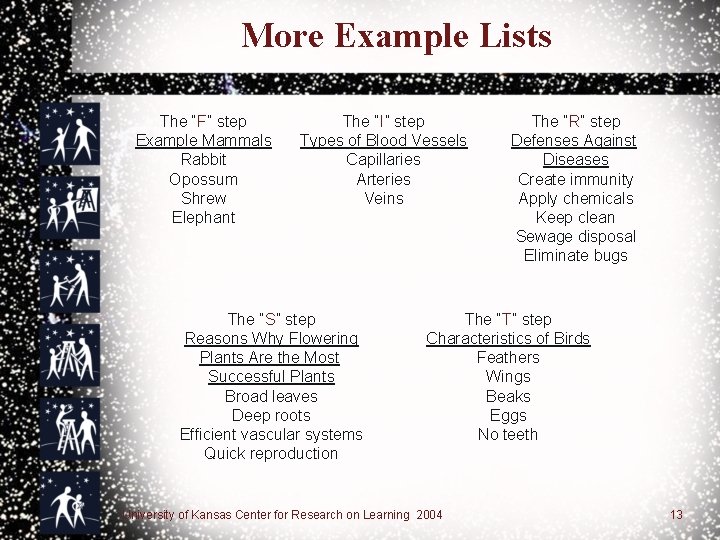
More Example Lists The “F” step Example Mammals Rabbit Opossum Shrew Elephant The “I” step Types of Blood Vessels Capillaries Arteries Veins The “S” step Reasons Why Flowering Plants Are the Most Successful Plants Broad leaves Deep roots Efficient vascular systems Quick reproduction The “R” step Defenses Against Diseases Create immunity Apply chemicals Keep clean Sewage disposal Eliminate bugs The “T” step Characteristics of Birds Feathers Wings Beaks Eggs No teeth University of Kansas Center for Research on Learning 2004 13
Study Card Front of Card Back of Card University of Kansas Center for Research on Learning 2004 14
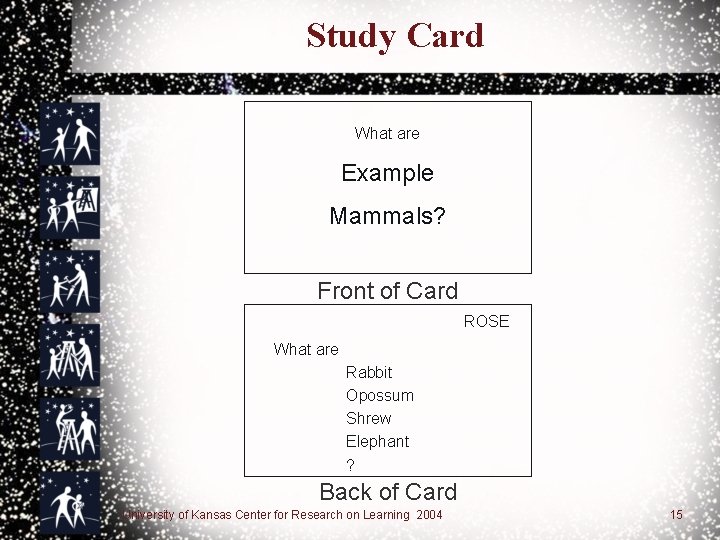
Study Card What are Example Mammals? Front of Card ROSE What are Rabbit Opossum Shrew Elephant ? Back of Card University of Kansas Center for Research on Learning 2004 15
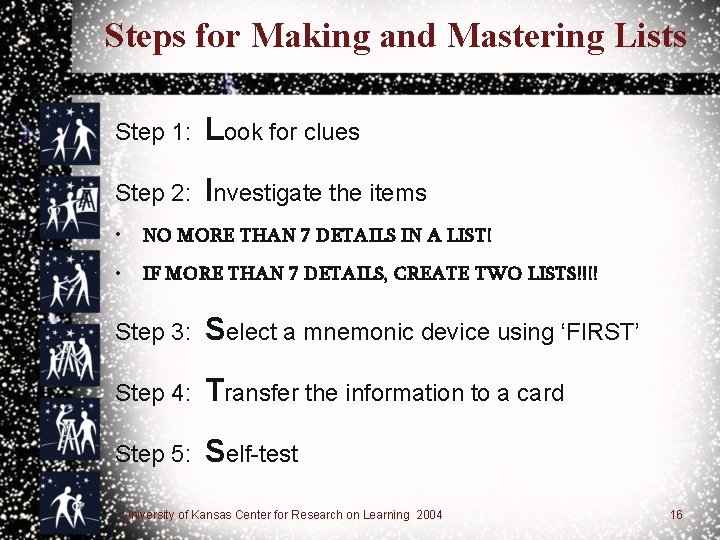
Steps for Making and Mastering Lists Step 1: Look for clues Step 2: Investigate the items • NO MORE THAN 7 DETAILS IN A LIST! • IF MORE THAN 7 DETAILS, CREATE TWO LISTS!!!! Step 3: Select a mnemonic device using ‘FIRST’ Step 4: Transfer the information to a card Step 5: Self-test University of Kansas Center for Research on Learning 2004 16
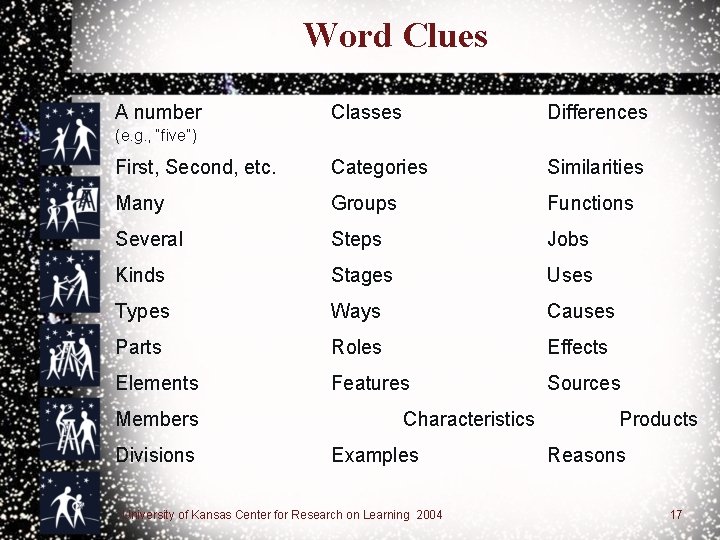
Word Clues A number Classes Differences First, Second, etc. Categories Similarities Many Groups Functions Several Steps Jobs Kinds Stages Uses Types Ways Causes Parts Roles Effects Elements Features Sources (e. g. , “five”) Members Divisions Characteristics Examples University of Kansas Center for Research on Learning 2004 Products Reasons 17